

Showing posts with label Reviews - Environmental History. Show all posts
Showing posts with label Reviews - Environmental History. Show all posts
Tuesday, October 6, 2026
Review - "Civil War Camps and Soldier Health: Sanitation and Military Effectiveness in the Union Army" by Earl Hess
[Civil War Camps and Soldier Health: Sanitation and Military Effectiveness in the Union Army by Earl J. Hess (Kent State University Press, 2026). Softcover, photos, tables, illustrations, endnotes, bibliography, index. Pages main/total:279/335. ISBN:978-1-60635-505-3. $39.95]
 History has left us with the general impression that Civil War camps were decidedly unsanitary places that caused untold thousands of unnecessary soldier deaths on both sides. But were they really as badly arranged and administered as the literature would have us believe? It is true that two out of three Civil War deaths were attributed to disease (a great proportion of those contracted in semi-permanent army encampments), but it is also true that the U.S. government was able to field a mass volunteer army more than healthy enough to win a continental-scale war fought across a wide range of challenging, even extreme, natural environments. Of course, the American Civil War occurred well within the period of global military history when disease killed many more men than bullets (and the means did not then exist to flip that gross imbalance), so the question arises did Union Army camps at least do a reasonably good job of managing preventable deaths. Prolific Civil War military historian Earl Hess's 'yes and no' answer to that question might be predictable, but the way he arrived at it through quantitative sampling and analysis, as revealed in his new book Civil War Camps and Soldier Health: Sanitation and Military Effectiveness in the Union Army, is an extraordinary new development.
The available body of firsthand commentary from Civil War officers and men regarding camp conditions is vast, and it isn't difficult to arrive at a wide range of conclusions on the basis of anecdotal evidence. What sets Hess's study apart is its unprecedented systematic approach using a reliable and consistent set of data. Hess is not the first scholar to consult the U.S. Sanitary Commission's camp inspection reports housed at the New York Public Library, which are roughly 1,500 in number, but he is the first to orient (with the assistance of Fifteenth Corps inspection reports) a full-length, scientific-based study around them. The author's extensive review of both the reports themselves and the commission agents who conducted them (primarily trained civilian physicians) confirms the reliability and value of the inspection returns. In the context of providing a representative picture of the whole, Hess's sample of 280 returns, selected across the full range of unit branches/types and theaters, is equally convincing. The commission's best standardized inspection form examined fifteen main subjects of interest to northern sanitarians, and Hess's book organizes those into groups of up to three related areas and assigns an in-depth, chapter-length examination to each.
In order to come up with a practical means of producing useful data for comparison, Hess devised a seemingly valid method of converting the many questionnaire answers into three general rating categories: good, fair, and bad. By applying those ratings to the fifteen categories explored in the returns, we are able to quantify which elements of camp health and sanitation were most successful and which practices and guidelines were most badly implemented or followed. First up is camp situation. As one might have guessed, attention paid to semi-permanent camp site selection, physical layout, drainage, and both air and water quality varied widely during the war and was highly dependent on environmental conditions and officer knowledge and judgment. Overall, camp situation passed most inspections, with just under 20% qualifying as bad.
When it comes to shelter, many readers will likely assume that military barracks were best for maintaining soldier health, cleanliness, and comfort over an extended period of confinement (ex. during winter quarters), but both army officials and sanitarians maintained that tents, which their combined portability, utility, and ventilation properties better than any other shelter type, were preferable to either huts or barrack buildings. Shelter provided by the Union armies achieved high marks from the inspectors.
Army issues of clothing received fairly strong ratings from the inspectors, with nearly half the regiments awarded with a good rating and only around 10% bad. There were more mixed results when it came to assessing a unit's personal cleanliness. Bathing, grooming, and personal hygiene were emphasized in the service, but volunteer officers and men (similarly imbued with the carelessness of youth) all too often failed to follow the dictates of army regulations or heed the recommendations of sanitarians.
Two of the most important issues related to camp sanitation involved due care in cooking and food garbage (slops) disposal and managing sites designated for collecting bodily waste (sinks). Generally speaking, Union regiments did a much better job of handling kitchen waste than they did human waste, with 58% achieving good ratings for the former and only 37% for the latter. Fully a third of regiments failed sink inspection, a confounding result given how much proper attention to that category (perhaps more than any other) should have been rather simple to understand and implement for officers and men alike.
Inspectors generally found food issued to soldiers to be more than adequate in quantity but poor in variety (too much meat and not enough fruits and vegetables). When it came to cooking, sanitarians and their camp inspectors favored an organized approach at the company level with regular officer oversight, but soldiers themselves found most satisfaction with their small, relatively independent messes (one of their few remaining sources of personal autonomy) and the officers generally consented. In Hess's opinion, cooking was one of the categories that the inspectors (for some reason) graded most leniently, with just over half rated good.
Water sources and quality, alcohol use and abuse, and morale boosting efforts were also targeted by the inspectors. Camp inspectors rated water quality high (with around 73% getting a good rating), but it is also astutely pointed out that semi-permanent encampments were much better suited for obtaining healthy water sources than were temporary camps established on the march. When it comes to alcohol, inspection findings push back strongly against the popular view that Civil War camps were rife with drunken disruption. In Hess's sample, nearly 80% of officers claimed that discipline problems related to alcohol abuse were manageable in their regimental encampments. Since indiscipline in this area would reflect badly upon those very same officers, it is possible (even likely) that some degree of concealment was involved, but Hess offers up a reasonable case that the scale of the problem remains exaggerated in the general literature. The inspectors did not find that the army paid any particular attention to shaping soldier morale and emotional well-being. Hess notes that institutional initiatives in those areas really only arrived decades later accompanied by the rise of industrial-era corporate culture.
There were mixed efforts in the medical examination of recruits and vaccination against disease. In the main, the leadership of volunteer regiments, primarily concerned with warm body count and reluctant to turn away eager recruits, did a poor job of initially weeding out those physically or mentally unable to perform their duties. That cost the war effort millions of dollars and a great deal of trouble. While smallpox inoculation was a priority, there were nevertheless significant outbreaks of the disease. The volunteer army received high marks for containing such outbreaks after they occurred, but overall prevention remained problematic. According to the inspection returns, less than 30% of the regiments followed in full the army's vaccination program regulations, and over 36% were almost completely non-compliant.
Being well-trained physicians themselves, camp inspectors were quite strict in assessing regimental hospitals, only giving just over 18% a good rating (and over 45% bad!). Hess attributes this to poor management from medical personnel along with inadequate army-wide systems for stocking medical equipment and supplies at the unit level. The most successful hospitals were those closely supported by the officers at the top, and the inspectors found such oversight and supervision all too rare. Frequent conflicts between military officers and assigned medical staff over matters of authority didn't help either.
While Hess's focus is on the Union Army, he does provide a fairly lengthy Confederate Army chapter for limited comparison. Over the decades leading up to the conflict, the South lacked a sanitarian movement similar in size and scope to the one the spread across the North, and there was no army camp inspection regimen anything like the one conducted by the U.S.S.C. Lacking reliable data of a similar nature, the author nevertheless presents a brief overview of the same fifteen inspection categories using anecdotal evidence. Smallpox outbreak containment was noteworthy for being one of the few ways in which Confederate forces matched their northern counterparts in effectiveness. Generally speaking, preventive healthcare was for a variety of reasons inferior, and southern camps and soldiers arguably earned their reputation as being dirtier than their foes.
If all this sounds like dry reading, it really isn't at all. Each chapter is packed with engaging anecdotes, details, and insights (all conveyed through vivid firsthand observations) about many aspects of Civil War camp life. Inspection findings are routinely contextualized through interesting micro-treatises on related topics (the book's extensive review of the army's evaluation and supply of various tent types and its detailed coverage of army vaccination regimens are ones that immediately come to mind).
In common with much of Hess's more recent scholarship, this one extends its reach far into the postwar period. Given what was experienced during the Civil War, one might have expected lasting institutional reforms in the area of preventive health measures, but that was not the case. Camp sanitation and widespread soldiers deaths from disease were little different during the Spanish-American War of 1898 as they were during the Civil War's early period. Hess traces most of this to the country's decentralized system of inducting volunteers, which were broadly similar in both conflicts. Real change only came with the two World Wars, during which the federal government assumed direct control and oversight of national mobilization.
Though the topic is only addressed in fleeting fashion, Hess notes that sanitation enforcement in the much more regimented U.S. Navy shipboard life was superior. It would also be interesting to find some comparison between Regular Army unit camps (which were not visited by the commission's civilian inspectors) and the volunteer unit camps that are the subject of this study, the former group presumably much more attuned to following army regulations in regard to camp sanitation.
Clearly, and for a variety of reasons outlined and discussed in the book, the principles and practices espoused by the North's sanitarian movement had only a limited impact on soldier health and preventive healthcare associated with the war's semi-permanent volunteer unit encampments. With that in mind, Hess cautions readers against adopting the view that the Civil War was a major turning point in military medicine. When it comes to evaluating the practical impact U.S.S.C. inspectors had on military officials charged with enforcing camp sanitation, there is little doubt in the author's mind that their influence on preventive health and healthcare was quite limited in effectiveness, far more useful in identifying problems then effecting actual change. Nevertheless, it is Hess's conclusion that the attempt itself should be recognized as a positive deviation from the past. While the commission's sanitary reports may have had only a minimal impact on actual army and unit effectiveness, the study persuasively argues that the program was still well worth the effort.
In Civil War Camps and Soldier Health, Earl Hess effectively moves beyond the limitations of anecdotal evidence and contributes mightily to the field by offering up a fresh scientific approach that teaches us just as much about Civil War camp life in general as it does about its great many sanitary issues and concerns. Highly recommended.


Monday, July 28, 2025
Review - "The Weather Gods Curse the Gettysburg Campaign" by Nese & Harding
[The Weather Gods Curse the Gettysburg Campaign by John M. Nese & Jeffrey J. Harding (Arcadia Publishing and The History Press, 2025). Softcover, maps, photos, illustrations, tables, charts, appendix. 238 Pp. ISBN:978-1-4671-5846-6. $24.99]
 Every Gettysburg student is familiar with the gist of the campaign's weather story. In summary, the combatants had to endure early-summer high heat and humidity during forced marches and fighting, and the post-battle retreat and pursuit offered the survivors different miseries to deal with in the form of rain and mud. However, one might reasonably ask how much deeper we can take this broad-stroke weather assessment of the campaign. Is a daily, perhaps even more granular, description and analysis of weather's impact on men and operations before, during, and after the July 1-3 Battle of Gettysburg possible? According to John Nese and Jeffrey Harding, the answer to that question is a resounding 'yes,' and all is revealed in their fascinating book The Weather Gods Curse the Gettysburg Campaign.
Nese, an academic at Penn State's Department of Meteorology and Atmospheric Science, and Harding, a licensed GNMP battlefield guide, draw upon their respective areas of expertise (in weather science and Gettysburg military history) for a fresh examination of this underexplored topic. The book begins with a meteorological science primer that, among other things, provides background information necessary for readers to understand the practical meaning and significance of a variety of weather-related measurements that the authors utilize in their analysis, from simple thermometer and dewpoint readings to more complex heat index and wet-bulb globe temperature calculations.
Very significant to the study is its employment of a relatively new computer model developed by the NOAA that allows its users to recreate weather maps of the past, keeping in mind that its reliability is more macro than micro. This "reanalysis system" represents one among many research tools that Nese and Harding have at their disposal, the integration of which offers keen insights into the weather encountered by Union and Confederate soldiers in Virginia, Maryland, and Pennsylvania during June and July 1863.
Underpinning Nese and Harding's research is a critical body of recorded observations from contemporary weather watchers such as the government staff of the Naval Observatory, the network of daily weather reports from military installations across the country, and dedicated civilian recorders such as those who submitted their data to the Smithsonian Meteorological Project. Many of the individuals involved are profiled in the text. This data recorded from both near and afar, combined with Nese's expert knowledge of local and regional atmospheric and weather patterns, allows the study to trace reliable meteorological readings at any point in time across the campaign's multi-state path.
It is often said that if you want to know the weather just look out your window, and the historical equivalent of that window view is represented by the approximately 1,500 soldier and civilian journal and letter accounts of the weather that the authors have recovered and organized for their research. This collection of subjective firsthand perspectives critically augments Nese and Harding's quantitative analysis, and the most salient portions of select passages are interspersed throughout the text. In an ingenious manner, Nese and Harding combine this historical documentation with the aforementioned modern weather modeling techniques to provide us with a remarkably detailed reconstruction of weather effects during the entire run of the campaign. Additionally, findings and descriptions revealed in the narrative are supplemented by a plethora of historical and modern weather maps, charts, and tables. For easy reference, a record of daily weather data and notes for the period June 3 to July 14 is also compiled in tabular format in the appendix.
As explained in the book, the June 10-18 heatwave experienced by the armies in the field was exceptional for late spring. Unfortunately for the health of those involved, it also coincided with a period requiring hard marches that resulted in widely reported physical debility and heatstroke death (although those numbers are not quantified). Data suggests that the severity of the conditions was historically rare for June, marking that heat wave as one among several of the campaign's exceptional weather-related events. Without the ability to forecast weather, generals lacked the information needed for weather-adjusted planning (where possible). Examples cited in the book of forced marching during heat wave conditions and operational pauses during fine marching weather are signal reminders of one of many chance elements that contribute to the overall friction involved with conducting war. In an interesting side note, the authors mention that the mixed-material jean cloth of Confederate uniforms breathed better than the wool jackets issued to Union troops. That, combined with the lighter color, made the southern shell jackets more comfortable in hot summer months for those wearing them. Indeed, while today's writers often emphasize the presumed general discomfort of Civil War uniforms, the soldiers themselves complained vastly more about their feet and footwear problems during long, hot marches.
For the three-day battle itself, thermometer temperatures weren't considered extreme on the first day, with much of the discomfort coming from the humidity. July 2 was much hotter, and the book effectively uses the very lengthy approaches to the battlefield of Law's Brigade on the Confederate side and the Union Sixth Corps as case studies of the day's weather effects on marching and fighting. Even though the recorded shade temperature still may not have been extreme, the heat index likely pushed 90 degrees and the effects of direct sunlight made the forced marching even less bearable. In contrast to Sixth Corps, whose march was marked by periodic rest and hydration breaks, Law's Brigade had little of either. The weather, lack of recovery time, and rugged terrain at Little Round Top all hindered the brigade's chances for sustained success as it spearheaded the attack during one of the three-day battle's key moments. The enervated condition of Law's men upon arrival at the front likely contributed mightily to the large prisoner haul that the formation lost during the celebrated Union counterattack involving the 20th Maine. The data and NOAA modeling employed by Nese and Harding confirms contemporary observations that July 3 was the worst of the three in terms of physical discomfort. With the heat index almost certainly over 100 degrees (with some likelihood of even reaching 105), and keeping in mind that the index relies on shade measurements, such brutal body-stressing conditions undoubtedly impaired fighting endurance and performance during Pickett's Charge, especially for the attacking troops.
As detailed in the literature, from July 4 onward the principal weather challenge switched over from head and humidity to rain, with thick mud and rising streams hampering both Confederate retreat and Union pursuit. The volume's data gathering and analysis adds a great deal in the way of finer detail when it comes to the likely timing and quantification of the rainfall episodes. Nese's applied expertise shines through the entire book, but one of the finest examples of it is shown in the attempt to understand the deluge that preceded the Potomac River recrossing of Lee's army back to Virginia. Gaps in the instrument readings and lack of expected results from the NOAA reanalysis model hinder explanation of the massive river rise, but Nese is able to provide a solid meteorological basis for the event through a more complex interpretation of regional weather patterns utilizing contemporary data gathered from afar. On a final note, findings confirm that the steep rise of the Potomac behind Lee's army at Williamsport was a truly extraordinary weather event for any July in recorded history. Lee's army could count itself fortunate to have escaped.
John Nese and Jeffrey Harding's The Weather Gods Curse the Gettysburg Campaign is a truly remarkable, highly useful, and completely original contribution to the ongoing study of the Gettysburg campaign and battle. As the authors maintain, weather and its extremes affected how the campaign unfolded at every stage of its development, and it was a testament to the human endurance and ingenuity displayed by the armies that weather-induced disaster was avoided. Accessible to general reader and specialist alike, this masterfully conceived and executed study is an essential addition to the Gettysburg library, a key reference for every future chronicler of the campaign.

Friday, May 6, 2022
Review - "Animal Histories of the Civil War Era" by Earl Hess, ed.
[Animal Histories of the Civil War Era edited by Earl J. Hess (Louisiana State University Press, 2022). Hardcover, illustrations, notes, index. Pages:vii/277. ISBN:978-0-8071-7691-7. $45]
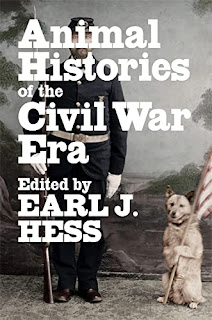 In the new essay anthology Animal Histories of the Civil War Era volume editor and heavy contributor Earl Hess provides us with the first book-length attempt at integrating, in a more formal manner than before, the academic disciplines of animal history and Civil War history. The result is thirteen essays exploring that interdisciplinary crossover as applied to topics before, during, and after the Civil War. The contributing writers are, as Hess describes them, three animal historians with an interest in Civil War history and eight Civil War historians with an interest in animal history. The clear emphasis is on fostering professional ties between largely disengaged disciplines, but the volume could also appeal to those readers outside the academy who have a more than casual interest in emerging areas of study.
Many Civil War readers are at least passingly familiar with the general story behind the antebellum US Army's failed experiment with camel transport, but Michael Woods's opening chapter argues that the idea of using camels in the US (particular in cotton growing areas of the Deep South) was more widespread than previously thought. Several importation schemes surrounding the use of camels as plantation beasts of burden are discussed in his essay, but the writer goes even further in suggesting that those plans were deeply intertwined with the activities of radical proslavery expansionists. The degree to which that connection is integrated with, rather than incidental to, so-called Slave Power conspiracies remains debatable, but it's at the very least suggestive of the kinds of interdisciplinary approaches the anthology wants to promote.
As interesting as camels might be, it's obvious that horses and mules, due to their essential support roles in army supply, transport, and mobility, remain by far the Civil War historical literature's most prominent source of big animal engagement. In this volume, David Gerleman provides readers with an excellent introduction to Civil War horse and mule physical requirements, procurement systems, welfare, physical treatment, and field use. Previously published conclusions regarding Union veterinary care practices being tardy and inadequate are reinforced, yet overall the US system of managing its army's animal motive power was clearly superior to that of its opponent and an important element in Union victory. Undoubtedly drawn from the research behind his upcoming study of Civil War artillery, Earl Hess's first anthology contribution offers a brief glimpse into the world of artillery horses and the heavy demands made upon them. Abraham Gibson follows that with an insightful perspective on the Confederate Army horse supply, maintenance, and replacement policies and practices that reached crisis levels by the middle of the war. Both the Gibson and Gerleman essays offer illuminating contrasts between Union and Confederate military horse management.
The Civil War literature is slowly expanding its horizons when it comes to examining human and animal world interactions in areas beyond the latter's capacity for transmitting disease (about which some fine work has been done). Heavily influenced by Kelby Ouchley's Flora and Fauna of the Civil War (2010), another Hess piece offers an interesting survey of the diversity of soldier-wildlife interactions in the field. Mark Smith gets more specific in the following chapter in his discussion of bees, explaining how they informed both directly and metaphorically the lives and rhetorical perspectives of the Civil War-era generation.
In the anthology's section on animal use as food, Jason Phillips summarizes the interdependency between the southern pig and human populations. Along the way, Phillips points out some significant differences between the sections when it came to hog range management and pork packing. Accompanying that are insights into what the outbreak of war meant to the South's pork supply, which was heavily dependent prewar on northern and Border State imports, both of which were quickly shut down once fighting erupted. Every Civil War student knows that army food supply, quality, and preparation was inconsistent on both sides, and another Hess article, written from a vegetarian perspective, discusses the ways in which unbalanced, meat-centric soldier diets inhibited their personal health and, by extension, their military effectiveness.
A pair of chapters look at canine roles and influences. In Joan Cashin's brief summary of dog exploitation during the war, she comes to the conclusion that they were "weaponized" to a greater extent than commonly believed. In the Civil War-era literature, dogs are frequently discussed in the context of their bloodhound work tracking runaway slaves, anti-Confederate "Brush Men," and escaped Union POWs, but Lorien Foote also reminds us how practically and culturally important they were to game hunting and general security across the South from large plantations to subsistence farms. Critically, she extends that examination into the postwar period when unregulated dog ownership sparked legislative concerns (with all their political, class, economic, and racial implications) over controlling canine numbers and the alleged toll those animals took on livestock (specifically the sheep industry). A wide range of abatement proposals, ranging from taxation all the way to lethal measures, were debated.
Many different animal species were adopted as unit mascots during the conflict, and Brian Matthew Jordan uses the story of "Old Abe," the venerated eagle mascot of the 8th Wisconsin, as a case study highlighting the longstanding bonds forged between Union veterans and those animals. In a strong reminder that the roots of anthropomorphizing pets has a long history, the Old Abe story also reveals how some 8th Wisconsin veterans believed that the eagle came through association and shared experience to communicate the same partisan ideological attitudes held by its human comrades. A time during which animals intersected with national politics and ongoing debates over the role of government is interestingly expressed through Daniel Vandersommers's examination of the 1888-91 congressional debates (which frequently took on sectional overtones) regarding the proposed establishment of a national zoo in Washington, D.C. Finally, Paula Tarankow uncovers the postwar story of the celebrated entertainment duo of horse talent "Beautiful Jim Key" and his ex-slave performance handler William Key. Tarankow argues that their popular traveling show helped transform old views on equine intelligence as well as, perhaps, deeper connections between human and animal ethical understanding.
Society's views on animal sentience and ethical expectations regarding the limits of animal exploitation are, of course, ever evolving, and Hess and his contributors point readers toward unresolved debates over animal agency as well as differing conclusions surrounding the degree to which Civil War traumas and experiences transformed popular views on animal treatment and conservation. Drawing connections between animal history studies and a number of established Civil War history sub-disciplines, Animal Histories of the Civil War Era is an engaging introduction to "animal-centered" Civil War history in its currently nascent form. Only time will tell what future depth and direction Civil War animal history might take, but this volume certainly provides ample food for thought for those prospective scholars who might be interested in embarking on that journey toward a new branch of Civil War scholarship.

Thursday, May 6, 2021
Review - "The Howling Storm: Weather, Climate, and the American Civil War" by Kenneth Noe
[The Howling Storm: Weather, Climate, and the American Civil War by Kenneth W. Noe (Louisiana State University Press, 2020). Cloth, 13 maps, notes, bibliography, index. Pages main/total:xiii,495/685. ISBN:978-0-8071-7320-6. $59.95]
 The American Civil War has no grand analog matching the history-altering magnitude of the massive typhoon that wrecked the Mongol fleet during their second invasion of Japan, the providential winds and storms that scattered Phillip II's Spanish Armada and helped save England, or even the brutal winter that finished off Napoleon's army during its retreat from Moscow, but it is undeniable that weather and North American climate patterns impacted the conduct and course of the military conflict between North and South in significant ways. Indeed, weather as a third combatant in numerous campaigns and battles is among the broadest themes addressed in historian Kenneth Noe's impressive new tome The Howling Storm: Weather, Climate, and the American Civil War.
At its most fundamental level, The Howling Storm is a new military history of the entire 1861-65 land war from Sumter to Appomattox with the focus placed on interpreting how weather impacted campaigns large and small across all three major theaters—East, West, and Trans-Mississippi. In researching and piecing together this splendid, almost 500-page narrative, the author mined archives, newspapers, and a host of other published and unpublished primary and secondary sources to densely fill his narrative with all manner of environmental temperature and weather details. Weather-related observations from soldiers, home front civilians, and dedicated weather watchers (ex. even some Smithsonian-affiliated sources dutifully maintained readings during the war) are quoted throughout. Noe's references to climate and weather terminology are limited to introductory-level remarks, just enough to offer the reader appropriate general background information regarding the modern understanding of weather science. The text appropriately explores the ways in which oceanic-atmospheric oscillations (ex. El Nino and La Nina) and other events disrupt normal North American weather patterns and emphasizes how those extremes affected Civil War armies in their winter encampments, on the march, and during battle.
While it is true that contending armies opposing each other on a given front experience the same local weather, Noe effectively reminds readers in what manner the consequences and ill-effects of that shared weather might not be equally distributed. In the most obvious example, superior Union logistics and supply meant that its better clad and supported troops most often suffered less than their Confederate foes during the winter months. Also, some hours or days during which weather events were most challenging could clearly be more critical to the fortunes of one side, and weather could thus have a more decisive affect. As an example of that, Noe cites key moments, especially during the final week of operations, when the exceptional spring rains of 1862 (argued to have been the wettest of the previous 25 years) helped Stonewall Jackson evade and finally escape converging Union columns during his famous Shenandoah Valley campaign. The point is not that weather was actually deterministic of victory or defeat in many campaigns, but rather weather, especially in its extreme forms, could create a multitude of serious problems that commanders could not entirely overcome. As detailed in the book, such constraints might take the form of delayed offensives (ex. the December 1864 Battle of Nashville), immobilized armies (ex. Burnside's "Mud March"), strong limitations on the scale of victory or defeat (ex. the 1863 Tullahoma Campaign), and much more.
Unequally distributed weather effects occurred on the home front, too. As just one illustration of that phenomenon, too much early rain in 1862 followed by drought in the early summer months caused widespread corn, wheat, and cotton failures across the southern states, while at the same time there were record crop yields across the North. Other war-related home front issues had at their core underappreciated weather underpinnings. A striking example cited by Noe is the infamous Richmond bread riots that have been most commonly attributed to official indifference and predatory pricing. Noe instead argues that supply and transportation woes directly caused by the unusually wet and cold Virginia winter and spring of 1863 led to the bread shortages.
While the United States possessed an enviably modern rail network by the outbreak of the war, its system of interconnecting country roads remained highly primitive by comparison. Few paved thoroughfares designed to hold up to heavy traffic of the kind produced by anything even approaching the size of Civil War armies existed, so almost any rain that fell on those dirt roads proved problematic for military movements, and deep mud became an inevitable and constant source of complaint on both sides. In that vein, a multitude of campaign and battle events most profoundly affected by mud (ex. Burnside's "Mud March," the fighting at Spotsylvania, Rosecrans's flank movement at Tullahoma, Stoneman's Chancellorsville raid, and many more) are examined in the book. Perhaps the book's freshest and most interesting discussion related to this topic is Noe's explanation of how the continent's geographical soil patterns (specifically what quality and depth of mud those different soils produced during rainy periods) variably impacted Civil War army movements and troop morale. In the end, the author persuasively argues that all wet soils were not equal when it came to adversely affecting large-scale military operations.
On the opposite end of the spectrum of rain and mud was drought, and that weather effect produced some of the most significant follow-on effects. For example, the desire to provide a period of recovery for Virginia farmland is commonly cited as one of the most important factors behind the Confederate raid into Pennsylvania in 1863, but Noe argues it was the 1862 drought and subsequent late planting season that primarily created those conditions, not the physical devastation of war. More drought in 1863 meant that even a widespread switch from cotton to food production could not make up enough lost ground to adequately feed the Confederacy's armies and cities while also building up the stockpiles of food and forage necessary to accommodate future gaps in supply. As demonstrated in the book, 1864 drought conditions were largely confined to Virginia, Missouri, and the northern states, and Confederate leaders anticipated that that misfortune would spark further antiwar unrest in the North before and during the critical fall elections. According to Noe, it is a prevailing myth that northern farm production increased during the war due to mechanization. In actuality, total agricultural production peaked in 1862 and weather was a major part of why that was so. Nevertheless, as it turned out, the election year drought that Confederates pinned some of their rapidly dimming hopes of independence upon never caused enough of an overall deficit to greatly diminish northern home front support for the war.
Microclimates, particularly highland ones, also had a direct impact on Civil War armies. For a particularly vivid example, readers might recall A. Wilson Greene's contribution to the anthology Civil War Places (2019). In it, he memorably recounts his own personal encounter with the unpredictable and unseasonable weather extremes atop Allegheny Mountain that made it such a miserable place to fight a war. Noe does not specifically address the microclimate phenomenon in The Howling Storm, but he does so tangentially by covering the extreme case of Sewell Mountain. As Tim McKinney did before him in that author's book-length study of the Sewell Mountain phase of the 1861 West Virginia campaign, Noe presents the unique weather there as so severe a third opponent that it rendered both sides combat ineffective.
Noe admits the temptation among scholars and readers alike of seeing prominent examples of Union success in overcoming environmental obstacles as proof that weather complaints were primarily excuse-making on the part of recalcitrant generals, but his book clearly shows that exceptional weather and its timing could seriously sabotage many a best-laid plan. As the author maintains, however, it should also be equally appreciated that luck imparted by the weather gods could also go the other way, and Noe cites, as one example, the stretch of "perfect" weather during the entire length of Sherman's March to Sea that significantly diminished that daring movement's many inherent risks.
Noe also convincingly credits strong Union leadership as an important factor in dealing with southern weather. The ability of General Sherman's army to quickly traverse roads and swamps thought nearly impassable during the wet winter and spring 1865 Carolinas Campaign sparked despondent awe in his opponents. Perhaps the best example, and also cited in the book, is Joseph Hooker's comprehensive set of celebrated army reforms and morale boosting initiatives (all brilliantly documented in Albert Conner and Chris Mackowski's Seizing Destiny: The Army of the Potomac's "Valley Forge" and the Civil War Winter that Saved the Union) achieved during an extended period of terrible Virginia weather that stretched between the general's appointment to army command all the way to the end of April, during which it incessantly rained more than half those days. On the other hand, that example and others also, according to Noe, highlight an occasional blind spot in Union leadership at the top, one that frequently demonstrated a distinct lack of appreciation for how much weather could impede the movements and plans of armies. Grant was the high-ranking general who most closely and consistently shared Lincoln's views on seeing weather as an always surmountable obstacle, but while that view served Grant very well on many occasions it also made him, like the president, appear out of touch in others.
A great strength of Noe's far-reaching treatment of the topic of Civil War weather is that readers can for the first time in a single volume comprehensively absorb, front and center, how weather affected every campaign. Chronological arrangement of the weather narrative also allows readers to appreciate the many cascading effects of particular events. It might be recalled how well Judkin Browning and Timothy Silver's 2020 book An Environmental History of the Civil War illustrates the ways in which an unforeseen weather pattern that materialized over the first half of 1862 in the form of extraordinary rains and flooding affected Civil War operations and home front agriculture across the continent, but Noe's work does much the same for the entire war.
Mostly when citing exceptional weather patterns but also very effectively overall, Kenneth Noe's The Howling Storm brings weather effects out of the realm of excuse making and into their proper place as a major variable impacting victory and defeat on the Civil War battlefield. Noe's study ends with an interesting capstone conclusion that the Union Army won the weather war as well as the shooting war. His argument developed throughout the book that Union leadership and logistical superiority in providing better transportation, better winter shelter/housing, more reliable food and medical supplies, all-weather clothing, and consistent quantities of replacement footwear all combined to both sustain Union soldier morale amid the most trying environmental circumstances and allow Union armies to deal more effectively than their native-born opponents with the South's infamous weather and climate extremes. While it is obvious that Civil War armies could never entirely overcome the military challenges imposed by climate and weather, the book offers a powerful argument that many of those effects could nevertheless be significantly ameliorated through the combined forces of leadership, resources, experience, and adaptation. As Noe's work illustrates at great length, the complete victory achieved by Union forces clearly demonstrated the falsity of prewar assumptions that northern armies would simply melt away in harsh southern climes.

Wednesday, April 8, 2020
Review - "An Environmental History of the Civil War" by Browning & Silver
[An Environmental History of the Civil War by Judkin Browning and Timothy Silver (University of North Carolina Press, 2020). Hardcover, 3 maps, photos, illustrations, notes, bibliography, index. Pages main/total:xi,199/272. ISBN:978-1-4696-5538-3. $30]
 A joint effort from military historian Judkin Browning and environmental historian Timothy Silver, An Environmental History of the Civil War both synthesizes and expands upon the subdiscipline's existing literature. In its pages one can clearly identify major influential works such as Andrew McIlwain Bell's Mosquito Soldiers (2010), Lisa Brady's War Upon the Land (2012), Megan Kate Nelson's Ruin Nation (2012), Kathryn Shively Meier's Nature's Civil War (2013), the 2015 essay anthology The Blue, the Gray, and the Green from editor Brian Allen Drake, Joan Cashin's War Stuff (2018), and Erin Stewart Mauldin's Unredeemed Land (2018). One can readily discern from the publication dates referenced above that Civil War environmental history is a relatively new scholarly development in the field, yet Browning and Silver clearly demonstrate that enough has been published already in book and article formats to warrant the broad, state-of-the-field analysis that their own study provides. On the surface, Browning and Silver's work displays an integrated chronological and theme-based chapter arrangement, but it also uses well-selected examples from the academic literature to impressively highlight how and where those themes closely intersect.
Of course, military historians have always appreciated the debilitating effects temperature extremes had on marching and fighting armies, and their own works have also routinely documented the decimation of regiments (especially new ones) through disease; however, Browning and Silver's opening chapter dealing with soldier health also appropriately stresses the idea that armies themselves were wandering agents of biological and ecological disruption. For instance, in many settled areas with rural populations dispersed enough to prevent epidemics, diseases almost unknown to most locals for generations reemerged with a vengeance when tens of thousands of warm bodies possessing varying degrees of immunity arrived in their midst as instant incubators. Civil War armies could also have the opposite effect. For example, General Butler's intensive cleanup and environmental policing of occupied New Orleans effectively (though mostly inadvertently) quashed southern hopes that the city's regular outbreaks of yellow fever and malaria would made the city too hot for the enemy to hold. It is also suggested that Union armies, by passing through both the friendly Midwest and hostile South, altered the country's "pattern of microbial exchange," bringing contagions such as measles and smallpox deeper into those areas. How permanent those effects would prove to be is unstated. Though mentioned mostly in passing, the book also provides another perspective on emancipation, as mass movement of slave populations across great distances contributed another factor to the war's sudden alteration of microbial equilibrium.
Weather effect is another well-developed facet of traditional Civil War military history. However, it is most often addressed in a campaign-specific manner. Browning and Silver also do this, but, in another example of how they insightfully stress connectivity in their study, they additionally address how climate oscillations had continental-scale impacts on military campaigns in the Civil War. For example, in late-December 1861 massive rain storms rolled into California from the Pacific (a surprise episode that occurred during a prolonged La Nina pattern of below-normal rainfall). This 1,000-year "atmospheric river" event in the midst of a ten-year drought caused devastating flooding and tremendous losses in crops, livestock, and property. It also materially hampered the progress of the famed California Column's march across the southern desert. Spreading east, extraordinary flooding also occurred in the Tennessee Valley. This had a major impact on U.S. Grant's twin river campaign, when high water allowed Union forces to easily capture a flooded Fort Henry and Confederate commanders at Fort Donelson surrendered rather than push their men through flooded ground amid frigid temperatures. Weeks later, heavy rains critically affected both Union and Confederate army movements during the Shiloh Campaign. Even back east, General McClellan's drive up the Virginia Peninsula was similarly affected by exceptional downpours that ruined poorly drained roads not designed for heavy traffic (here the authors' views and interpretations align closely with those expressed in historian Kenneth Noe's contribution to the recent essay anthology Upon the Fields of Battle). Later, McClellan's army would become perilously divided by the rain-swollen Chickahominy Bottom, a weather event that would impact the course of the campaign in several different ways. For one, the swampy conditions created a perfect breeding ground for sickness, and July 1862 would prove to be the worst month of the war for the Army of the Potomac when it came to the percentage of sick soldiers on its rolls. Certainly, weather is just one factor in the success and failure of armies, but the chapter does a fine job of demonstrating that the surprise weather extremes of early to mid-1862 had a major impact across all major fighting fronts.
The next section of the book moves on to the topic of food. Flooding during the aforementioned wet spring of 1862 ruined many crop lands, but the prolonged rains also created perfect environmental conditions for damaging outbreaks of agricultural blights such as wheat stem rust. The authors cite figures as dire as 50% wheat losses in the Shenandoah and perhaps the loss of one-sixth of the South's entire wheat production for the year. Making matters worse, as spring turned to summer and fall, severe drought returned and even more vital corn crops failed. Government and social pressure to grow less cotton and more food was only partially successful, and conscription, land loss, army foraging, and burdensome requisition laws only worsened food shortages on the southern home front. As has often been repeated, obtaining food and forage were important considerations behind both failed northern offensives launched by Robert E. Lee's army. By contrast northern food production grew by leaps and bounds, leaving a substantial surplus even for export.
As with the case of food production, animal procurement and care was another indispensable area where the North achieved marked superiority by 1863. Veterinary care was neglected by both sides, but the Union system of horse procurement and rehabilitation, accompanied by the ability to create a superabundance of shoes and other equipment, far outpaced the South's tardy and insufficient efforts. The drought of 1863 also fatefully taxed Lee's ability to feed his animals, and both artillery and transport in the Army of Northern Virginia inexorably declined from that point onward. The concentration of dead horses along march routes and battlefields also created an ecological challenge, as their bulky bodies were difficult to dispose of in a way that did not create unsanitary conditions for nearby soldiers and civilians.
As much as horses were essential to transportation and work, hogs were a staple of the southern diet. With the war shutting off traditional sources of hog importation, pork procurement became integrated with Confederate war strategy. However, a major environment consequence of gathering hogs together in large holding areas for processing was disease, and hog cholera swept through entire regions. The book notes that the virus killed nearly the entire hog population of Arkansas in 1862. To make up for the shortfall in pork, beef became a larger part of the southern diet during the war. However, Union military successes in the West, bovine diseases endemic to southern climes, and the losing combination of great distances and deteriorating transportation networks (the great cattle-raising states were frontier Texas and Florida) meant that sufficient supplies of beef could never consistently reach the front. After the bitterly harsh winter of 1863-64 killed the majority of Texas cattle, the weather also had its say in making a bad situation even worse.
The next chapter addresses the environmental effects of human battle deaths, with particular emphasis placed on the consequences of 1864's advent of more continuous contact between opposing armies. The general ecological effects of mass casualties are examined, from internal biological processes of decay to sanitary issues for both the survivors and local populations. Environmental interactions between various organisms (including bacteria, worms, insects, and rats) and battle wounds are also discussed. The huge number of deaths and disabling wounds among the country's working-age population affected the farm labor force in both sections, but in the South the deficits were far less replaceable. According to the book's sources, southern land improved for cultivation decreased by ten million acres between 1860 and 1870. How much of this environmental change was due solely to labor factors is difficult to assess, but the deaths of well over one-quarter of all southern soldiers (along with the permanent disablement of many thousands more) must have had a tremendous impact even without taking into account the loss/redirection of forced labor through emancipation.
Finally taking readers through the end of the conflict and beyond, the book examines the war's widespread assault on both natural and improved landscapes. Also discussed are examples of how the need to secure vital natural resources (ex. the salt-producing parts of SW Virginia) brought the war to isolated places with no other strategic value and forbidding fighting topography. The need to cut down vast tracts of forest lands to fuel local industries transformed landscapes for miles around, and the frequency of those efforts contributed to what would become the predominant Civil War battlefield terrain type—a mixture of woods (both primary and secondary) and adjacent clearings of improved land. Though the publication of Scott Hippensteel's Rocks and Rifles (2019) is perhaps too recent to have been included as a source, both books come to similar conclusions about how geology, limestone deposits in particular, shaped the strategy and tactical decisions of Civil War commanders. The section also looks beyond the battlefield in examining wartime actions with long-term consequences far beyond 1865. In addition to the arrival of Sherman's army group before Atlanta overwhelming an already precarious water supply, tree losses due to wartime consumption (as well as the bombardment of the city itself) subjected Atlanta to greatly increased water runoff and soil erosion that altered the landscape on a semi-permanent basis. New South urbanization certainly must have contributed to the more permanent reduction in tree cover, but, according to the sources, even after a century of replanting campaigns the city had only regained a tiny amount of the vegetative cover that it enjoyed prewar. Of course, historians have often observed that forests disappeared at an alarming rate wherever Civil War armies roamed, but few have recognized that it was typically the most valuable types of wood that went first. This harmed the economic futures of local residents already struggling through postwar economic devastation. Through erosion deforestation also had the compound effect of further reducing farmland acreage. According to often startling figures cited in the book, deforestation, fence destruction, draft animal shortages, and other factors frequently meant that entire southern counties still had only a fraction of prewar levels of improved acreage in production by 1870. Citing the Mauldin book referenced earlier, the authors also note that the societal advancements brought by emancipation were not generally extended to the agriculture-supporting environment. Apparently, contract labor was no match for enslaved labor when it came to performing the backbreaking essential work of land maintenance (ex. drainage, fertilization, land use rotation, etc.). Indeed, the book references the study of one expert who estimates that topsoil erosion in the states of Georgia, North Carolina, and South Carolina was up to 120% higher in 1880 than it was in 1860, the affects of which profoundly reduced crop yields over that period.
Further solidifying environmental history's maturing status as a true sub-field of Civil War studies, the volume clearly demonstrates that this growing body of work represents more than a transient academic fad. As evidenced in the book, Civil War environmental history continues to perform a valuable service through highlighting and deepening our knowledge and appreciation of the many connections between the natural world and the Civil War's military and home fronts. In this manner, Browning and Silver's synthesis convincingly treats the war as an "ecological event" as well as a clash between armies and societies.
Wednesday, November 20, 2019
Review - "The Battle of the Wilderness in Myth and Memory: Reconsidering Virginia's Most Notorious Civil War Battlefield" by Adam Petty
[The Battle of the Wilderness in Myth and Memory: Reconsidering Virginia's Most Notorious Civil War Battlefield by Adam H. Petty (Louisiana State University Press, 2019). Hardcover, map, photos, illustrations, notes, bibliography, index. Pages main/total:xxii,136/205. ISBN:978-0-8071-7191-2. $42]
 The densely forested region west of Fredericksburg, Virginia known as "The Wilderness" remains a fabled place in Civil War historiography and lore. By any measure, it was not an ideal Civil War battlefield environment. Filled with barely penetrable second-growth timber and choking undergrowth, the Wilderness became legendary for its ability to instantly break up linear formations, reduce visibility on the ground to near zero, and thoroughly disorientate officers and common soldiers alike. It was also a place of fear, as the abundant vegetation provided ready fuel for fires that could and did consume the wounded. Reinforced by veteran accounts and many decades of popular writing and scholarship, tradition holds that the Wilderness was a unique and exceptionally difficult landscape of battle, one that the Confederates used to their advantage and both sides involved in their campaign planning. All of these aspects of Wilderness interpretation and more are challenged by historian Adam Petty is his compelling book The Battle of the Wilderness in Myth and Memory: Reconsidering Virginia's Most Notorious Civil War Battlefield.
For the sake of making sure all readers are on the same page, the author carefully defines the Wilderness as the forested area south of the Rapidan River bounded on the west by Mine Run and the east by Mott's Run. An irregularly shaped mass (roughly twelve miles at its greatest depth and fifteen miles at its widest point), it encompassed in whole or in part three Civil War battlefields—those of Chancellorsville, the opening clashes of the Mine Run Campaign (most significantly, Payne's Farm), and its namesake Wilderness battle. From west to east, two main thoroughfares (the Orange Turnpike and Orange Plank Road) ran parallel to each other through the Wilderness before meeting near the Wilderness Church, with the Orange Turnpike continuing on through Chancellorsville and beyond. The Germanna Plank and Brock roads were the primary means of north-south movement through the Wilderness.
Legend holds that the Wilderness was the product of the local iron industry's insatiable hunger for fuel. After the area was deforested for charcoal production, a thick morass of second-growth timber and tangled underbrush then blanketed the thinly-settled area. Petty's research reveals that this was in truth only a small part of the story, with the Wilderness primarily consisting of natural regrowth from abandoned tobacco-growing fields and other areas cleared in order to obtain wood for adjacent plank road construction. Thus, even the central myth of the Wilderness's origin turns out to be mostly false.
The book also successfully refutes the popular contention that the Wilderness was an utterly unique battlefield that presented exceptional challenges to the military formations that fought there. To begin with, Petty argues that, in addition to the many clearings present within the Wilderness, the wooded areas were far from consistent in vegetative density. In actuality, the full spectrum of growth patterns were present in the Wilderness, from thinly forested parts with good sight lines on up to the impenetrable thickets of legend. Some of the patterns are predictable. For instance, the second-growth areas on both sides of the plank roads formed some of the most challenging fighting environments and the source of much commentary from soldiers, as those areas were where much of the combat occurred during the 1864 Wilderness battle. The author's enumeration of the many similarities between the Wilderness and Chickamauga battlefields provides one of the book's most powerful arguments against the uniqueness of the Virginia Wilderness. Indeed, in Virginia alone there were many 'wilderness' patches of similar origins spread around the state, with the one south of the Rapidan and west of Fredericksburg remarkable only for its great size and the fact that multiple battles were fought within it.
Another Wilderness-related myth addressed in the study revolves around the popular notion that Confederate formations and soldiers fought better than their Union counterparts in that environment. To begin with, there is little reason to suppose that wooded surroundings intrinsically favored the Confederates. The two great events often cited in support of this idea, Stonewall Jackson's famous Chancellorsville flank attack and Longstreet and Gordon's rolling up the Union flanks on May 6, 1864, both took advantage of the fact that the Wilderness could very effectively screen such movements. However, Petty notes that the organization and impetus of all of these attacks broke down in the rough terrain well before decisive results could be achieved (and with both corps commanders shot by their own men!). He goes on to maintain that the attacks were successful not because the ground dictated them or they were conducted by superior forest fighters but because the Confederates in each case seized the tactical initiative and took bolder chances (though one might still contend that those traits were key elements of superior management of the forest environment). The idea that one side was better at forest fighting than the other perhaps hearkens back to the old canard that Confederate armies were filled with country boys and Union ranks filled with the sons of shopkeepers. Certainly, the consistently successful men in blue who fought all over the vast, lesser-developed West would never have conceded, nor did they demonstrate, any inferiority in forest combat. Whatever the perception and reality of the situation, the author's call for more studies of how both sides adjusted to and fought in the various environments they encountered (deserts, swamps, beaches, forests, plains, etc.) seems appropriate.
Associated with the above is the idea that Wilderness fighting evened the odds and nullified the use of field artillery, the one service branch where the Union Army demonstrated clear superiority. That's a number of things to unpack. While it was the case that the Wilderness terrain hindered the deployment of the Union army during the opening moments of the 1864 Overland Campaign, Petty effectively argues that the chief culprits were the road network (which favored east-west Confederate movements, and quicker deployment of their smaller army, over the north-south Union advance) and the extremely poor screening job performed by the Union cavalry. That the Wilderness stifled the use of artillery is generally speaking true, but Petty does helpfully refer the reader to a number of well-known examples of Union and Confederate gun concentrations (both large and small) doing good service during the Chancellorsville and Wilderness battles. In Petty's view, the notion that Lee's army was more familiar with the ground lacks clear support. That both armies possessed similar knowledge of the Wilderness seems to be the more defensible assessment. Given the events of the previous year, it might even be argued that, by the beginning of the 1864 Overland Campaign, the Army of the Potomac held the experience advantage when it came to marching and fighting in the Wilderness.
Finally, the book heavily disputes the traditional view that the Wilderness held great sway in the planning concerns of both armies during the key 1863-64 campaigns. The Union defeat at Chancellorsville is often traced to Hooker's decision to pull his advancing wing back into the Wilderness on ground that nullified his advantages. That Hooker was less concerned about fighting inside the Wilderness and more worried about Lee hitting his army as it was emerging from the Wilderness's narrow defiles and debouching onto the plains seems to show that avoiding Wilderness combat was not a priority. For the Union commanders leading all three major 1863-64 Wilderness campaigns, the most important considerations were avoiding Confederate entrenchments and securing safe river crossings. Though he admits the possibility of unstated worries, Petty did not find any written evidence that fighting in the Wilderness figured into Grant or Meade's mental lists of concerns. On the other side, Lee expressed in his own writings and reports no desire to ensnare the enemy in the Wilderness. To the contrary, he repeatedly lamented the problems the terrain caused his own army. Far from seeking to 'trap' the Army of the Potomac in the Wilderness at the beginning of the Overland Campaign, Lee found his hand forced by the Union advance and his army fully engaged before it was ready. By also bringing Mine Run into the conversation, Petty further buttresses the argument that Lee felt more anxious than ebullient about fighting in the Wilderness by citing the general's decision after Payne's Farm to pull his army back behind Mine Run rather than feeding more troops into the Wilderness. Petty's well-supported determination that other factors overrode any concerns Union commanders might have had with fighting in the Wilderness, and that Lee had no interest in deliberately deploying his own army there, argue strongly against traditional interpretation. That the Wilderness mythology has been widely misused both as a means to evade responsibility for failure and a partisan weapon wielded for the purposes of either burnishing or tarnishing military reputations is one of the book's most important and revealing conclusions.
Adam Petty's The Battle of the Wilderness in Myth and Memory is revisionist history at its best. In addition to strongly challenging the ingrained mythology of the one of the war's most infamous battlegrounds, the study suggests the utility of drawing more connections between the environment and military history while also raising pertinent questions about how the historiography of other Civil War landscapes might also be usefully reassessed. Very highly recommended.
Thursday, November 8, 2018
Review - "Upon the Fields of Battle: Essays on the Military History of America's Civil War" by Bledsoe & Lang, eds.
[Upon the Fields of Battle: Essays on the Military History of America's Civil War edited by Andrew S. Bledsoe & Andrew F. Lang (Louisiana State University Press, 2018). Cloth, notes, index. 320 pp. ISBN:978-0-8071-6977-3. $48]
 What has been termed "traditional" military history (i.e. the study of war-related national politics and diplomacy, generals and soldiers, strategy, operations, battles, weapons, tactics, logistics, and the like) reached its highest prominence and acceptance among academic historians during the 1960s only to be mostly replaced over the ensuing decades by the work of scholars with professional interests grounded in the social and cultural aspects of the American Civil War. Today, this so-called "New Military History" that emerged during the 1970s has itself been largely subsumed by the "War and Society" label (after all, how long can any approach continue to be called "new" decades onward)1. In Part I of Upon the Fields of Battle: Essays on the Military History of America's Civil War contributing editors Andrew S. Bledsoe and Andrew F. Lang join military historian Earl Hess in discussing this evolution in Civil War studies and proposing to their readers how military history topics might (and should) be reintegrated into the academic scholarship. Hess in particular laments the many misconceptions their colleagues still have regarding military history and suggests that the oldest approach to studying the Civil War actually "has the most potential for future work." His essay backs this statement up by presenting many new avenues through which historians can use their unique professional training to "revitalize'"the role of military history in the academy.2 Hess, Bledsoe, and Lang together forcefully argue for a dismantling of the persistent barrier existing between traditional military history and War and Society studies. With each body of scholarship borrowing useful elements and methods from the other, there is no compelling reason for the division to remain.
Kenneth Noe begins Part II, which comprises five essays exploring "The Contested Battlefield." For the most part, western culture trains us to believe that truly exceptional individuals can overcome almost any obstacle along the way to achieving their goals, and those that allow roadblocks to deter them are said to be engaged in excuse-making. Kenneth Noe's examination of the effects of poor weather conditions on the 1862 Peninsula Campaign is an interesting case study of this idea, with most modern observers seeing McClellan's persistent complaints about rain, mud, and terrible roads as just another excuse for his allegedly slow pace of operations. Noe's meticulous survey of atypical rainfall levels, combined with his observations regarding the Peninsula's soil composition and primitive transportation network (neither of which could hold up to heavy military traffic in such weather), invites readers to reconsider both McClellan's conduct of the campaign and the effects of weather in general on Civil War military operations. Many readers will recall Robert Krick's Civil War Weather in Virginia (which is primarily a reference tool), but Noe usefully reminds us that no comprehensive study of how weather and other natural forces factored into limiting Civil War military operations yet exists, and he persuasively argues that one is needed3.
In her piece concerning the Union pursuit after Gettysburg, Jennifer Murray (who is in the middle of writing a biography of General George G. Meade) joins a chorus of fellow historians in urging readers and fellow scholars alike to reconsider the feasibility of truly complete campaigns of annihilation. While Murray admits that Meade's pursuit was far from ideally aggressive, considering the destruction of field armies after defeat and pursuit as "extremely rare" events throughout history (a determination in itself arguable) isn't always a convincing defense. Nevertheless, Murray is surely right in asserting that armchair generals remain far too enamored with campaigns of annihilation and their expectations of Civil War generals too lofty in that regard.
Andrew Bledsoe's chapter provides a fresh look at the infamous Confederate command fiasco at McLemore's Cove during the Chickamauga Campaign. In it, Bledsoe appropriately assigns criticism broadly, finding significant fault with Bragg's orders as well as with the high-ranking subordinate generals that either bungled or intentionally disobeyed them (and sometimes both). None of that will surprise students of the campaign. What makes Bledsoe's article most interesting is the way it stresses the "language of command," explaining how its misuse directly impacted the missed opportunity in North Georgia while also showing how inconsistent and poorly worded orders were part of a more general failure among Civil War commanders to adopt a standard format for writing orders that would make intentions clear as possible to the recipient and less open to (mis)interpretation. As the chapter demonstrates, standardizing the structure of orders is something that modern armies work hard at achieving, and they have processes in place to facilitate it. General Grant's headquarters has traditionally been seen as the best performer in this regard, but current scholars are now uncovering so many glaring exceptions that it is probably more accurate to say that no Civil War army leader truly stood head and shoulders above the rest.
In addition to providing a vivid account of the bombardment of Fredericksburg in December 1862, John Hennessy effectively situates the event within the context of current limited vs. hard war debates while also helpfully informing modern discussions of the laws of war and how they affected troop conduct over the second half of the conflict. Hennessy's vivid depiction of the artillery bombardment of the city, which is characterized as initial targeted firing upon enemy military positions within the buildings rapidly escalating into massive indiscriminate bombardment in the face of stubborn resistance, could be seen as a microcosm of the larger transition of the war in the East from limited to hard war. That said, Hennessy clearly counts himself among those believing the Union war to be one primarily of restraint, citing the orgy of looting that occurred in the angry wake of the defeat as supportive of this interpretation due to such extreme behavior not being repeated again by the Army of the Potomac.
The section is closed with Brian McKnight's examination of the guerrilla war in the Border South, a hotly contested region that the author has studied at length over his career4. While those who have kept up with the expansive guerrilla war scholarship that has developed over the past decade and a half are less in need of a reminder, McKnight prompts readers to view the irregular conflict through the lenses of military, social, and local history in order to obtain a fuller understanding. He also sees successful resistance to guerrilla violence on the community level as an important and understudied aspect of the literature, which tends most often to see local civilians as either victims or facilitators.
Part III, five essays under the collective title "The Soldiers' War," urges us to continue moving Civil War soldier studies beyond army demographics and motivational/ideological investigations (as important as those areas have proven to be). In addition to attempting to integrate elements of emancipation and Reconstruction into the American exceptionalism discussion, Andrew Lang's opening chapter deals broadly with the military's role in those areas as well as the wartime occupation of the South. While the men in the ranks generally accepted the necessity of ending slavery, they were at the same time uncomfortable with the fact that abrupt social and political change was primarily occurring at the point of the bayonet. Such feelings were clearly associated with the traditional distrust among nineteenth-century Americans of standing armies and their potential for military despotism5.
Civil War desertion is a common topic of discussion and debate in the literature, but less so is the most extreme of the many possible punishments involved—execution. Kevin Levin's examination of Confederate Army executions concludes that the common soldiers, though they had strong emotional reactions to seeing comrades shot (especially when family care was the condemned's primary motivation to desert), strongly supported capital punishment as necessary to enforce discipline and deter others. On the latter point, Levin points out that any real study of execution as effective deterrence falters in the face of sparse record-keeping, particularly over the final two years of the war when desertion became a key factor feeding the collapse of Confederate armies. His emphasis on the ceremony of execution also seems apt, as the great amount of detail rendered within soldier accounts suggests that witnessing such events became deeply ingrained in the psyches and memories of observers.
Keith Altavilla's contribution targets the many factors that motivated a minority of Union soldiers to vote for Democratic presidential candidate George McClellan in the 1864 election. Among them are the perception of a failed war with no end in sight, anger at the administration's assault on dissenting voices, ineffective governance by the party in power, and starkly different views on government policies regarding emancipation and race.
Modern regimental histories never fail to emphasize the community-based recruitment of most companies, but Brian Matthew Jordan's essay surveys the "human longitude" of the 107th Ohio's heavy Gettysburg casualties. In addition to seeing the need for more research on the often crippling consequences the war's physical and psychological wounds had on veterans, Jordan enjoins historians to pay more attention to the long-term effects battlefield deaths had on soldier families, close social networks, and those very same communities that sent them to war in the first place.
Finally, Robert Glaze invites us to recall the lesser-appreciated Lost Cause stature of Albert Sidney Johnston, which was prominent in popular memory for decades after the war before being surpassed in the mythology by the first-rank triumvirate of President Davis and Virginia generals Lee and Jackson. Glaze points to Johnston's embodiment of the 'what-if' fantasy as the chief source of his appeal, with his death at the assumed moment of victory at Shiloh representing a devastating blow to a young and still vibrant republic's chances for independence and a tragic loss that made possible the rise of Grant.
In terms of possible sources of complaint, Bledsoe's essay could have used a map or two to help visualize the battlefield discussion, and many readers will undoubtedly notice that there is only one female historian in the group of contributors. The latter situation was surely unintentional, as the last thing the editors would want is to refuel the old stereotypical view of military history being a primarily male domain.
As might be expected, some of the essays are more subtle than others in drawing connections between traditional military history and other sub-disciplines of Civil War studies, but the volume as a whole very much succeeds in what it sets out to do. Upon the Fields of Battle deserves to be widely read, but it especially warrants the attention of both current and budding professional historians. Hopefully, the essays in the book will prompt them to cast aside acquired misconceptions of the scholarly value of military history and inspire them to seek points of connection in their own work.
Notes:
1 - Gary Gallagher wrote the foreword to the book. For a fuller discussion of his views see Gary W. Gallagher and Kathryn Shively Meier, "Coming to Terms with Civil War Military History," Journal of the Civil War Era 4 (Dec. 2014): 487-508.
2 - For more of the writer's perspectives on the subject see Earl J. Hess, "Where Do We Stand? A Critical Assessment of Civil War Studies in the Sesquicentennial Era," Civil War History 60, No. 4 (Dec. 2014): 371-403.
3 - Noe is currently researching "the role of climate and weather" in the war, presumably for a future book project.
4 - See also McKnight's Contested Borderland: The Civil War in Appalachian Kentucky and Virginia (2006).
5 - Highly recommended follow-up reading is Lang's award-winning In the Wake of War: Military Occupation, Emancipation, and Civil War America (2017).
Thursday, June 16, 2016
Stith: "EXTREME CIVIL WAR: Guerrilla Warfare, Environment, and Race on the Trans-Mississippi Frontier"
[Extreme Civil War: Guerrilla Warfare, Environment, and Race on the Trans-Mississippi Frontier by Matthew M. Stith (Louisiana State University Press, 2016). Hardcover, map, photos, notes, bibliography, index. Pages main/total:177/230. ISBN:978-0-8071-6314-6. $42.50]
 With the horrific and well documented excesses of the wars of the twentieth century serving as the benchmark for many when describing mankind at its worst, most observers are loath to place the American Civil War in the same category. However, there were pockets of Civil War conflict that did approach what some might call "total war," and one such area is examined in historian Matthew Stith's Extreme Civil War. Instead of once again revisiting the bloody lower Kansas-Missouri border, Stith's study shifts the nexus of people and events southward in a fresher direction to encompass not only those sections of Kansas and Missouri but also large swaths of NE Indian Territory and NW Arkansas. If ever there was a true Civil War "no man's land", one with a near complete breakdown of society, commerce, law, and order within its boundaries, it was this rugged and largely underdeveloped borderland shared by Kansas, Missouri, Indian Territory and Arkansas.
In Extreme Civil War: Guerrilla Warfare, Environment, and Race on the Trans-Mississippi Frontier, Stith traces the near absolute disintegration of a frontier border society only recently placed on the road to prosperity. Railroads were still absent from the region in 1860, but white settlements and some industrial developments (like the lead mines at Granby) were prospering and tribes traumatically resettled to the Indian Territory (like the relatively populous Cherokee) were regaining their footing. As the book amply shows, the war dramatically halted this shared growth and progress, changing all of it for the worse.
As Daniel Sutherland and Clay Mountcastle persuasively demonstrated in their recent breakthrough studies of the irregular Civil War, Stith reveals that all the elements of what would come to be known as "hard war," including the targeting of civilians, were present on the Trans-Mississippi's western border from the conflict's earliest moments. Although the regular forces of both sides traversed the area on an infrequent basis (and Union garrisons permanently occupied key points), the guerrilla war was the war for the vast majority of the civilian population, one often characterized by daily terrors. As Stith notes, attacks by southern sympathizing guerrillas only encouraged harsher and more indiscriminate Union measures aimed at controlling the population and eradicating bushwhackers. Sutherland's view (in A Savage Conflict) of guerrilla warfare as generally counterproductive to Confederate national interests (in a military sense as well as in alienating the civilian population) is well borne out by Stith's research regarding this particular region. Routinely engaging in the same brand of murder, arson, and robbery, the Union occupiers did not enhance their own case as upholders of social justice and order. In exploring this widespread terrorization of non-combatants, Stith reaches deep into the archives, with every facet of his book enriched by firsthand accounts written by soldiers and civilians from both sides. Some are penned by figures familiar to students of the Civil War in the Trans-Mississippi but many are not.
By the war's midpoint, society at the western edge of Trans-Mississippi settlement had devolved into the kind of nihilistic free-for-all that Michael Fellman described so vividly in Inside War, his classic study of Missouri's guerrilla conflict. A natural response to this scale of human disaster is to flee, and Stith's book also documents well the refugee crisis (white, black, and Indian) that engulfed the region, one that depopulated entire areas and often overpowered the civilian aid resources of Union military authorities. In terms of death, desolation, and displacement, Stith's study reinforces arguments put forth by previous scholars (most recently by Clarissa Confer, Mary Jane Warde, and others) that the tribes residing in Indian Territory suffered more than any other segment of American society from the ravages of the Civil War, ironically a conflict none of them wanted in the first place.
The war's connection with the environment, both in terms of the natural surroundings and attempts by both sides to alter (or take advantage of) existing terrain, is another important theme of Extreme Civil War. Bruce Nichols's colossal four-volume history of Missouri's guerrilla conflict perhaps best illustrates the seasonal nature of that mode of warfare in the state, and Stith's findings clearly suggest that the phenomenon held true in other parts of the Trans-Mississippi. With refugees of all races pouring into Union safe havens in Kansas and elsewhere, depopulation meant an explosion of the feral hog population and the return of wildlife, ironically increasing the available food supply for foraging soldiers and guerrillas. As part of their counterguerrilla strategy, Union soldiers and militia also set fire to forest land in an unsuccessful attempt to rob enemy bushwhackers of their cover. Non-combatants sought to alter their surroundings, as well. As an act of self-preservation, pro-Union civilians who wished to remain in the region sometimes banded together into fortified farm colonies, their stockade defenses and armed guards deterring both bushwhackers and less discriminant Union army foragers seeking easy targets for supplies and plunder. Weather also played a role in how the irregular war was fought. The winter of 1863-64 was the coldest in two decades and an extended drought meant that supply ships could not reach Union garrisons situated along the upper reaches of the Arkansas River. Coinciding with the period when the guerrilla conflict was at its worst, these factors severely limited the distance Union military expeditions could operate from their bases and also meant the needs of suffering refugees could not be met.
Was this frontier indeed where the Civil War was at its most "extreme"? With the region's civilian population already living a precarious existence before being targeted by the armed supporters of both sides and subjected to daily terrors (including the very real threats of murder, torture, robbery, and arson) that only increased in frequency as the war progressed, one is hard pressed to imagine a worse situation for non-combatants. While certainly a more rare occurrence, even women could not escape the worst of fates in this lawless frontier. From the evidence provided in Stith's book, an argument can certainly be made that all of this, combined with an unforgiving environment, did indeed create the Civil War's closest approximation to a "total war."
In recent years, there's been an explosion of scholarly interest in contested Civil War borderlands, especially involving areas touching Missouri, Kentucky, and (West)ern Virginia. By directing its own focus much more to the west, to a Trans-Mississippi frontier that encompassed Indian Territory and the bleeding edge of the harshest brand of hard war experienced by both sides, Extreme Civil War considerably expands the geographical area under consideration by border war scholars and enhances our understanding of just how frightening and deadly the war could be for civilians The book also succeeds in making meaningful connections with newer branches of study (like environmental history). For all the reasons stated above, Extreme Civil War is highly recommended reading.
by Matthew M. Stith (Louisiana State University Press, 2016). Hardcover, map, photos, notes, bibliography, index. Pages main/total:177/230. ISBN:978-0-8071-6314-6. $42.50] With the horrific and well documented excesses of the wars of the twentieth century serving as the benchmark for many when describing mankind at its worst, most observers are loath to place the American Civil War in the same category. However, there were pockets of Civil War conflict that did approach what some might call "total war," and one such area is examined in historian Matthew Stith's Extreme Civil War. Instead of once again revisiting the bloody lower Kansas-Missouri border, Stith's study shifts the nexus of people and events southward in a fresher direction to encompass not only those sections of Kansas and Missouri but also large swaths of NE Indian Territory and NW Arkansas. If ever there was a true Civil War "no man's land", one with a near complete breakdown of society, commerce, law, and order within its boundaries, it was this rugged and largely underdeveloped borderland shared by Kansas, Missouri, Indian Territory and Arkansas.
In Extreme Civil War: Guerrilla Warfare, Environment, and Race on the Trans-Mississippi Frontier, Stith traces the near absolute disintegration of a frontier border society only recently placed on the road to prosperity. Railroads were still absent from the region in 1860, but white settlements and some industrial developments (like the lead mines at Granby) were prospering and tribes traumatically resettled to the Indian Territory (like the relatively populous Cherokee) were regaining their footing. As the book amply shows, the war dramatically halted this shared growth and progress, changing all of it for the worse.
As Daniel Sutherland and Clay Mountcastle persuasively demonstrated in their recent breakthrough studies of the irregular Civil War, Stith reveals that all the elements of what would come to be known as "hard war," including the targeting of civilians, were present on the Trans-Mississippi's western border from the conflict's earliest moments. Although the regular forces of both sides traversed the area on an infrequent basis (and Union garrisons permanently occupied key points), the guerrilla war was the war for the vast majority of the civilian population, one often characterized by daily terrors. As Stith notes, attacks by southern sympathizing guerrillas only encouraged harsher and more indiscriminate Union measures aimed at controlling the population and eradicating bushwhackers. Sutherland's view (in A Savage Conflict) of guerrilla warfare as generally counterproductive to Confederate national interests (in a military sense as well as in alienating the civilian population) is well borne out by Stith's research regarding this particular region. Routinely engaging in the same brand of murder, arson, and robbery, the Union occupiers did not enhance their own case as upholders of social justice and order. In exploring this widespread terrorization of non-combatants, Stith reaches deep into the archives, with every facet of his book enriched by firsthand accounts written by soldiers and civilians from both sides. Some are penned by figures familiar to students of the Civil War in the Trans-Mississippi but many are not.
By the war's midpoint, society at the western edge of Trans-Mississippi settlement had devolved into the kind of nihilistic free-for-all that Michael Fellman described so vividly in Inside War, his classic study of Missouri's guerrilla conflict. A natural response to this scale of human disaster is to flee, and Stith's book also documents well the refugee crisis (white, black, and Indian) that engulfed the region, one that depopulated entire areas and often overpowered the civilian aid resources of Union military authorities. In terms of death, desolation, and displacement, Stith's study reinforces arguments put forth by previous scholars (most recently by Clarissa Confer, Mary Jane Warde, and others) that the tribes residing in Indian Territory suffered more than any other segment of American society from the ravages of the Civil War, ironically a conflict none of them wanted in the first place.
The war's connection with the environment, both in terms of the natural surroundings and attempts by both sides to alter (or take advantage of) existing terrain, is another important theme of Extreme Civil War. Bruce Nichols's colossal four-volume history of Missouri's guerrilla conflict perhaps best illustrates the seasonal nature of that mode of warfare in the state, and Stith's findings clearly suggest that the phenomenon held true in other parts of the Trans-Mississippi. With refugees of all races pouring into Union safe havens in Kansas and elsewhere, depopulation meant an explosion of the feral hog population and the return of wildlife, ironically increasing the available food supply for foraging soldiers and guerrillas. As part of their counterguerrilla strategy, Union soldiers and militia also set fire to forest land in an unsuccessful attempt to rob enemy bushwhackers of their cover. Non-combatants sought to alter their surroundings, as well. As an act of self-preservation, pro-Union civilians who wished to remain in the region sometimes banded together into fortified farm colonies, their stockade defenses and armed guards deterring both bushwhackers and less discriminant Union army foragers seeking easy targets for supplies and plunder. Weather also played a role in how the irregular war was fought. The winter of 1863-64 was the coldest in two decades and an extended drought meant that supply ships could not reach Union garrisons situated along the upper reaches of the Arkansas River. Coinciding with the period when the guerrilla conflict was at its worst, these factors severely limited the distance Union military expeditions could operate from their bases and also meant the needs of suffering refugees could not be met.
Was this frontier indeed where the Civil War was at its most "extreme"? With the region's civilian population already living a precarious existence before being targeted by the armed supporters of both sides and subjected to daily terrors (including the very real threats of murder, torture, robbery, and arson) that only increased in frequency as the war progressed, one is hard pressed to imagine a worse situation for non-combatants. While certainly a more rare occurrence, even women could not escape the worst of fates in this lawless frontier. From the evidence provided in Stith's book, an argument can certainly be made that all of this, combined with an unforgiving environment, did indeed create the Civil War's closest approximation to a "total war."
In recent years, there's been an explosion of scholarly interest in contested Civil War borderlands, especially involving areas touching Missouri, Kentucky, and (West)ern Virginia. By directing its own focus much more to the west, to a Trans-Mississippi frontier that encompassed Indian Territory and the bleeding edge of the harshest brand of hard war experienced by both sides, Extreme Civil War considerably expands the geographical area under consideration by border war scholars and enhances our understanding of just how frightening and deadly the war could be for civilians The book also succeeds in making meaningful connections with newer branches of study (like environmental history). For all the reasons stated above, Extreme Civil War is highly recommended reading.
Sunday, November 17, 2013
Meier: "NATURE'S CIVIL WAR: Common Soldiers and the Environment in 1862 Virginia"
[ Nature's Civil War: Common Soldiers and the Environment in 1862 Virginia by Kathryn Shively Meier (University of North Carolina Press, 2013) Hardcover, 2 maps, photos, appendices, notes, bibliography, index. Pages main/total:164/232. ISBN:978-1-4696-1076-4 $39.95]
 Major and minor fads are always running a waxing and waning course throughout Civil War scholarship and publishing. A current climber is "environmental history", perhaps most recognizable in book form by the recent works of Lisa Brady, Kelby Ouchley, and Megan Kate Nelson*. One might reasonably question whether environmental history has the legs to develop into a truly distinctive force in the Civil War literature, but the practice thus far has yielded points of interest. While its own content could rather easily fit into existing categories, Kathryn Shively Meier's Nature's Civil War nevertheless eagerly attaches itself to this new interpretive school. Meier's book offers useful insight into the common soldier's difficult task of maintaining personal health amid the dual stressors of a harsh natural environment and a system of official army care which seemed a disorganized, uncaring, and frequently incompetent bureaucracy to those used to the loving attentions of home and family.
Nature's Civil War is a brief work that nevertheless takes on some large topics. To give readers an idea of what 1860s soldiers expected out of medical care, Meier provides a brief rundown of the competing positions of official and unofficial medicine in the nineteenth century United States. This section documents the debates within states over the need for professionalization in the form of formal schooling and licensing and within the medical establishment itself between traditional physicians and those practicing controversial offshoots like homeopathy. One of the more relevant points raised is the author's contention that the majority of private soldiers had never been under a doctor's care at any time during their pre-military lives, thus they already possessed a foundation of self reliant expectation when it came to treating sickness and maintaining general health.
Meier's focus is not on the health services rendered through official military channels, but rather the steps taken by individuals or small groups to keep their bodies in fighting condition -- a concept she calls "self-care". Her sample of correspondents is not a scientific one, but it's large enough to present insightful anecdotal data. Meier's chosen time period (1862) and geographical area (the Shenandoah Valley and the Virginia Peninsula) are astutely selected to examine self-care issues related to the environment. The spring of 1862 was after the time when soldiers occupied massive training camps filled with those lacking immunity to childhood diseases often lethal to adults but before the creation of efficient medical and hospital systems with the ability to handle common camp ailments of environmental origin.
Meier's documentation of health self-reporting in the correspondence home of soldiers fighting in the Valley and in the Peninsula provides points of comparison between the presumably healthy Shenandoah air and the sickly Chickahominy swamps. Contrary to what was believed at the time to be true, Meier finds no evidence through her self-reporting sample that southern soldiers had any advantage over Union troops in terms of local climate and disease "seasoning". Official U.S. government research (see Appendix 1 chart, pg. 154) also had some interesting findings pertaining to the health of Union soldiers in both locales. While Peninsula soldiers were indeed much sicker during the summer, during the later winter/early spring months Union soldiers serving in the Valley had the higher rate of illness (a situation Meier attributes to exposure to greater extremes of weather). The effects of sickness on the conduct of the Peninsula Campaign by both sides is beyond the scope of Meier's book and remains an understudied and underappreciated aspect of the campaign's historiography.
The previously mentioned concept of self-care is really the heart of the book. Meier describes the attempts by soldiers, in camp and on the march, to look out for their own health, often in direct defiance of the regimentation imposed by the army. While the author does delve into the specifics of self-care, including those related to shelter construction, campsite selection, and the seeking of natural remedies and outside sources of food, I was expecting an even larger collection of concrete examples given the centrality of the theme.
One of the most intriguing sections of the book is the short chapter on straggling. The idea that straggling (to be differentiated from falling out of the ranks with the intent to desert) was an essential component of self-care in 1862, before adequately prepared Union and Confederate medical, ambulance, and hospital systems were in place, is one of Nature's Civil War's more thoughtful contributions. However, this is largely conjecture until someone publishes a focused scholarly study of straggling. Meier recognizes this, duly putting out an appeal for someone to take on such a project. The author also powerfully calls for a change in the literature's traditional definition of a "seasoned" Civil War soldier, from that of a passive survivor with good fortune to one involving a successful implementation of self-care techniques of health and survival. Though erratically focused for such a short work, often seeming like several different research interests loosely combined and lacking a unifying theme, Nature's Civil War does contribute more than enough interpretive heft to Civil War soldier studies to make it worthy of recommendation.
*. - Flora and Fauna of the Civil War: An Environmental Reference Guide (LSU, 2010) by Kelby Ouchley; Lisa Brady's War upon the Land: Military Strategy and the Transformation of Southern Landscapes during the American Civil War
 (Georgia, 2012); and Ruin Nation: Destruction and the American Civil War [link is to my review] by Megan Kate Nelson (Georgia, 2012).
by Kathryn Shively Meier (University of North Carolina Press, 2013) Hardcover, 2 maps, photos, appendices, notes, bibliography, index. Pages main/total:164/232. ISBN:978-1-4696-1076-4 $39.95] Major and minor fads are always running a waxing and waning course throughout Civil War scholarship and publishing. A current climber is "environmental history", perhaps most recognizable in book form by the recent works of Lisa Brady, Kelby Ouchley, and Megan Kate Nelson*. One might reasonably question whether environmental history has the legs to develop into a truly distinctive force in the Civil War literature, but the practice thus far has yielded points of interest. While its own content could rather easily fit into existing categories, Kathryn Shively Meier's Nature's Civil War nevertheless eagerly attaches itself to this new interpretive school. Meier's book offers useful insight into the common soldier's difficult task of maintaining personal health amid the dual stressors of a harsh natural environment and a system of official army care which seemed a disorganized, uncaring, and frequently incompetent bureaucracy to those used to the loving attentions of home and family.
Nature's Civil War is a brief work that nevertheless takes on some large topics. To give readers an idea of what 1860s soldiers expected out of medical care, Meier provides a brief rundown of the competing positions of official and unofficial medicine in the nineteenth century United States. This section documents the debates within states over the need for professionalization in the form of formal schooling and licensing and within the medical establishment itself between traditional physicians and those practicing controversial offshoots like homeopathy. One of the more relevant points raised is the author's contention that the majority of private soldiers had never been under a doctor's care at any time during their pre-military lives, thus they already possessed a foundation of self reliant expectation when it came to treating sickness and maintaining general health.
Meier's focus is not on the health services rendered through official military channels, but rather the steps taken by individuals or small groups to keep their bodies in fighting condition -- a concept she calls "self-care". Her sample of correspondents is not a scientific one, but it's large enough to present insightful anecdotal data. Meier's chosen time period (1862) and geographical area (the Shenandoah Valley and the Virginia Peninsula) are astutely selected to examine self-care issues related to the environment. The spring of 1862 was after the time when soldiers occupied massive training camps filled with those lacking immunity to childhood diseases often lethal to adults but before the creation of efficient medical and hospital systems with the ability to handle common camp ailments of environmental origin.
Meier's documentation of health self-reporting in the correspondence home of soldiers fighting in the Valley and in the Peninsula provides points of comparison between the presumably healthy Shenandoah air and the sickly Chickahominy swamps. Contrary to what was believed at the time to be true, Meier finds no evidence through her self-reporting sample that southern soldiers had any advantage over Union troops in terms of local climate and disease "seasoning". Official U.S. government research (see Appendix 1 chart, pg. 154) also had some interesting findings pertaining to the health of Union soldiers in both locales. While Peninsula soldiers were indeed much sicker during the summer, during the later winter/early spring months Union soldiers serving in the Valley had the higher rate of illness (a situation Meier attributes to exposure to greater extremes of weather). The effects of sickness on the conduct of the Peninsula Campaign by both sides is beyond the scope of Meier's book and remains an understudied and underappreciated aspect of the campaign's historiography.
The previously mentioned concept of self-care is really the heart of the book. Meier describes the attempts by soldiers, in camp and on the march, to look out for their own health, often in direct defiance of the regimentation imposed by the army. While the author does delve into the specifics of self-care, including those related to shelter construction, campsite selection, and the seeking of natural remedies and outside sources of food, I was expecting an even larger collection of concrete examples given the centrality of the theme.
One of the most intriguing sections of the book is the short chapter on straggling. The idea that straggling (to be differentiated from falling out of the ranks with the intent to desert) was an essential component of self-care in 1862, before adequately prepared Union and Confederate medical, ambulance, and hospital systems were in place, is one of Nature's Civil War's more thoughtful contributions. However, this is largely conjecture until someone publishes a focused scholarly study of straggling. Meier recognizes this, duly putting out an appeal for someone to take on such a project. The author also powerfully calls for a change in the literature's traditional definition of a "seasoned" Civil War soldier, from that of a passive survivor with good fortune to one involving a successful implementation of self-care techniques of health and survival. Though erratically focused for such a short work, often seeming like several different research interests loosely combined and lacking a unifying theme, Nature's Civil War does contribute more than enough interpretive heft to Civil War soldier studies to make it worthy of recommendation.
*. - Flora and Fauna of the Civil War: An Environmental Reference Guide
(LSU, 2010) by Kelby Ouchley; Lisa Brady's War upon the Land: Military Strategy and the Transformation of Southern Landscapes during the American Civil War (Georgia, 2012); and Ruin Nation: Destruction and the American Civil War [link is to my review] by Megan Kate Nelson (Georgia, 2012).
Subscribe to:
Posts (Atom)