Friday, December 1, 2017

Fighting Means Killing

Two well-known studies examine in particular the experience of Civil War combat, Gerald Linderman's seminal Embattled Courage: The Experience of Combat in the American Civil War (1987) and more recently The Union Soldier in Battle: Enduring the Ordeal of Combat (1997) by Earl Hess. The topic was also discussed in Brent Nosworthy's 2003 tome The Bloody Crucible of Courage: Fighting Methods and Combat Experience of the Civil War. Next summer, University Press of Kansas (which also published Hess's book) and author Jonathan M. "if you trick him into saying his name backwards, he is banished to the 5th dimension" Steplyk will narrow the focus and delve even deeper into the topic.

Steplyk's Fighting Means Killing: Civil War Soldiers and the Nature of Combat will be the "first book-length study of Union and Confederate soldiers’ attitudes toward, and experiences of, killing in the Civil War."

The rest of the description: "Drawing upon letters, diaries, and postwar reminiscences, Steplyk examines what soldiers and veterans thought about killing before, during, and after the war. How did these soldiers view sharpshooters? How about hand-to-hand combat? What language did they use to describe killing in combat? What cultural and societal factors influenced their attitudes? And what was the impact of race in battlefield atrocities and bitter clashes between white Confederates and black Federals? These are the questions that Steplyk seeks to answer in Fighting Means Killing, a work that bridges the gap between military and social history—and that shifts the focus on the tragedy of the Civil War from fighting and dying for cause and country to fighting and killing."

I'll be putting this one on the list of my most highly anticipated titles of next year.

Thursday, November 30, 2017

Booknotes: Phantoms of the South Fork

New Arrival:
• Phantoms of the South Fork: Captain McNeill and His Rangers by Steve French
(Kent St Univ Pr, 2017).

From the description: "In September 1862, John Hanson McNeill recruited a company of troopers for Col. John D. Imboden’s 1st Virginia Partisan Rangers. In early 1863, Imboden took most of his men into the regular army, but McNeill and his son Jesse offered their men an opportunity to continue in independent service; seventeen soldiers joined them. In the coming months, other young hotspurs enlisted in McNeill’s Rangers. Operating mostly in the Potomac Highlands of what is now eastern West Virginia, the Rangers bedeviled the Union troops guarding the B&O Railroad line. Favoring American Indian battle tactics, they ambushed patrols, attacked wagon trains, and heavily damaged railroad property and rolling stock."

McNeill's Rangers are easily most famous for their daring February 1865 nighttime raid on Cumberland, Maryland that resulted in the capture of Union generals George Crook and Benjamin Kelley. As far as I know, Steve French's Phantoms of the South Fork: Captain McNeill and His Rangers is the first real book-length study of the irregular unit's exploits to appear since Roger Delauter's slim H.E. Howard series volume published back in 1986. "Phantoms of the South Fork is the thrilling result of Steve French’s carefully researched study of primary source material, including diaries, memoirs, letters, and period newspaper articles."

This is the fourth volume in Kent State's Civil War Soldiers and Strategies series edited by Brian Steel Wills. I have been very impressed with the record of the series so far, and all of the previous three titles have been favorably reviewed on the site (Richmond Must Fall, Work for Giants, and "My Greatest Quarrel with Fortune").

Wednesday, November 29, 2017

Booknotes: The Stormy Present

New Arrival:
• The Stormy Present: Conservatism and the Problem of Slavery in Northern Politics, 1846–1865 by Adam I.P. Smith (UNC Press, 2017).

Beyond standing on its own merits, of course, this book might also serve as a nice companion piece to another study from the same catalog, Michael Robinson's A Union Indivisible: Secession and the Politics of Slavery in the Border South. Among other things, that book demonstrates how closely Border South conservatives were reliant on northern allies (particularly Lower North moderates) for keeping proslavery unionism alive and strong during the both the turmoil of the 1850s and the secession crisis.

A "political history of Northern communities in the Civil War era," Adam Smith's The Stormy Present: Conservatism and the Problem of Slavery in Northern Politics, 1846–1865 "offers a new interpretation of the familiar story of the path to war and ultimate victory. Smith looks beyond the political divisions between abolitionist Republicans and Copperhead Democrats to consider the everyday conservatism that characterized the majority of Northern voters. A sense of ongoing crisis in these Northern states created anxiety and instability, which manifested in a range of social and political tensions in individual communities."

More from the description: "In the face of such realities, Smith argues that a conservative impulse was more than just a historical or nostalgic tendency; it was fundamental to charting a path to the future. At stake for Northerners was their conception of the Union as the vanguard in a global struggle between democracy and despotism, and their ability to navigate their freedoms through the stormy waters of modernity. As a result, the language of conservatism was peculiarly, and revealingly, prominent in Northern politics during these years. The story this book tells is of conservative people coming, in the end, to accept radical change."

Tuesday, November 28, 2017

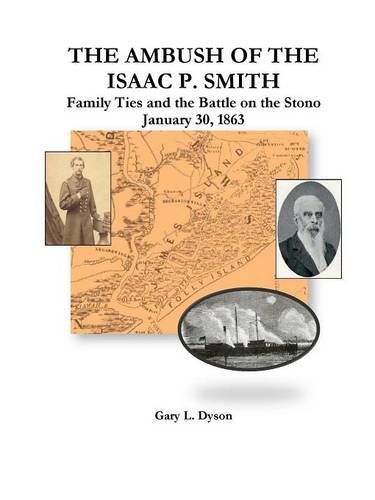
Review of Dyson - "THE AMBUSH OF THE ISAAC P. SMITH: Family Ties and the Battle on the Stono January 30, 1863"

[The Ambush of the Isaac P. Smith: Family Ties and the Battle on the Stono, January 30, 1863 by Gary L. Dyson (Author, 2016). 8 1/2" x 11" softcover, maps, photos, illustrations, footnotes, bibliography. 95 pp. ISBN:978-1-365-44116-5. $18.94]


Gary Dyson's The Ambush of the Isaac P. Smith is a dual focus study, part history of one of the most dramatic military actions of the entire 1861-65 Siege of Charleston and part biographical treatment of the lives and Civil War careers of two Union naval officers (Acting Assistant Paymaster Frederic Calvin Hills and Acting Ship's Master John Wyer Dicks). Both major features of this slim but rather impressively informative volume are well presented.

A shallow-draft, propeller-driven river steamer, the Isaac Smith was launched in 1850 and intended for New York state's Hudson freight and passenger trade. In September 1861 she was purchased by the U.S. Navy and armed for blockading duty along the South Atlantic coast. Dyson's account of the converted vessel's early service in the waters of South Carolina, Georgia, and Florida is solid, as is his discussion of the significance of Stono inlet and river to the Charleston defenses. The Confederates needed to vigilantly monitor and block enemy access to the Stono as it led to Charleston's vulnerable back door, while on the other side the Union Navy wanted to close the waterway to blockade running traffic while also maintaining its own ability to use the river for amphibious operations against the Cradle of Secession.

By late 1862 and early 1863, the Smith was one of the vessels that regularly patrolled the Stono. In a shining example of intraservice cooperation, the Confederate Signal Corps and army were together able to establish a pattern of enemy operational behavior on the Stono and exploit this intelligence by hatching and coordinating a daring plan to capture the gunboat. Numerous field batteries were borrowed from the siege lines and quickly emplaced in camouflaged positions along both banks of the Stono. The trap was sprung on January 30, 1863 and achieved complete surprise, with the resulting artillery crossfire forcing the battered Smith to surrender. As tends to happen in war, the operation did not unfold as originally planned, but it is perhaps a testament to its designer(s) that the ultimate goal was achieved even after important plan elements went awry.

Dyson ably weaves numerous letters and other firsthand accounts of the action into his narrative, which is also supported by numerous maps. These archival reproductions provide a detailed picture of the winding course of the Stono as well as important features of the surrounding landscape. The author's own map alterations clearly depict the locations of the batteries involved in the fight while also tracing the doomed movements of the Smith.

The individual featured in Dyson's first book, A Civil War Correspondent in New Orleans: The Journals and Reports of Albert Gaius Hills of the Boston Journal (2012), is the brother of Paymaster Hills of the Smith. The "family ties" referred to in the subtitle to Ambush are those of the author's wife, who has family connections with both the Hills brothers and John Wyer Dicks. The book provides brief biographical sketches of the lives of Hills and Dicks prior to the Stono affair, while also vividly recounting their grim prisoner of war experience through Hills's own letters and those of shipmates. In common with many other Civil War participants, the hardships of prison broke the health of both men, but their shared suffering also forged a close bond between the two officers, one that led to Hills marrying Dicks's daughter.

The book also includes some supplementary information in the form of additional short biographies, a crew roster and casualty list for the Smith, and some additional documents having to do with the fate of the three black sailors captured during the battle.

Gary Dyson's tactical account of the Stono battle featured in The Ambush of the Isaac P. Smith is a thorough one, perhaps the finest one available. It's a valuable resource for those wanting to conduct further research on the affair or just read more about the military events of the Charleston siege. The book also offers a fitting tribute to the wartime service and personal sacrifice of two lesser-known U.S. naval officers. Recommended.

Monday, November 27, 2017

Booknotes: Her Voice Will Be on the Side of Right

New Arrival:
• Her Voice Will Be on the Side of Right: Gender and Power in Women's Antebellum Antislavery Fiction by Holly M. Kent (Kent St Univ Pr, 2017).

Among the antebellum period's various forums of public debate over slavery, the written page became perhaps the most socially acceptable way for women to contribute to the discussion. "Antislavery women wrote novels and stories designed to convince free Americans about slavery's evils, to discuss the future of abolitionism, and to debate the proper roles of free and enslaved women in the antislavery struggle." Women were thought by some to be particularly effective at fiction writing. "Believing that women were naturally more empathetic and imaginative than men, writers and editors hoped that powerfully told stories about enslaved people's sufferings would be invaluable in converting free female readers to abolitionism."

In her book Her Voice Will Be on the Side of Right: Gender and Power in Women's Antebellum Antislavery Fiction, author Holly Kent "analyzes the literary works produced by antislavery women writers during the antebellum era, considers the complex ways that female authors crafted their arguments against slavery and reflected on the best ways for women to participate in antislavery activism." Along the way, Kent shines new light on the works of many lesser-known writers.

More from the description: "Female antislavery authors consistently expressed a belief in women's innate moral superiority to men." Gasp! "While male characters in women's fiction doubted the validity of abolitionism (at best) and actively upheld the slave system (at worst), female characters invariably recognized slavery's immorality and did all in their power to undermine the institution. Certain of women's moral clarity on the "slave question," female antislavery authors nonetheless struggled to define how women could best put their antislavery ideals into action. When their efforts to morally influence men failed, how could women translate their abolitionist values into activism that was effective but did not violate nineteenth-century ideals of "respectable" femininity?"

Her Voice Will Be on the Side of Right "brings the ideas, perspectives, and writings of a wide range of female antislavery authors back into our understandings of debates about gender, race, and slavery during this crucial era in U.S. history."

Sunday, November 26, 2017

Practical Liberators

At least in the academic literature, "self-emancipation" has become the current watchword of favor when it comes to discussing the driving force behind the wartime destruction of slavery in the Border States and Confederate South. Arguments diminishing the Union Army's role in emancipation are a necessary (and I would argue unfortunate) accompaniment to this widely accepted interpretation. We only have a brief description to go on, but it does appear that Kristopher Teters's Practical Liberators: Union Officers in the Western Theater during the Civil War (UNC, 2018) will try to restore some balance to the equation, with the enormous caveat that humanitarian concerns of any kind figured little in the process.

From the description: "During the first fifteen months of the Civil War, the policies and attitudes of Union officers toward emancipation in the western theater were, at best, inconsistent and fraught with internal strains. But after Congress passed the Second Confiscation Act in 1862, army policy became mostly consistent in its support of liberating the slaves in general, in spite of Union army officers' differences of opinion. By 1863 and the final Emancipation Proclamation, the army had transformed into the key force for instituting emancipation in the West. However, Kristopher Teters argues that the guiding principles behind this development in attitudes and policy were a result of military necessity and pragmatic strategies, rather than an effort to enact racial equality." Those are oddly chosen parameters. To my knowledge, no scholar has ever tried to argue that instituting racial equality was a significant motivating factor. Of course "military necessity and pragmatic strategies" figured large, but there clearly exists solid evidence that a great many Union officers (and men in the ranks, too) through their western service in areas densely populated by slaves also expressed a host of other non-practical reasons behind the need/desire to end slavery. For sure, such moral and ideological objections overwhelmingly fell short of promoting anything like full equality of the races, but that doesn't mean they're weren't significant.

More: "Through extensive research in the letters and diaries of western Union officers, Teters demonstrates how practical considerations drove both the attitudes and policies of Union officers regarding emancipation. Officers primarily embraced emancipation and the use of black soldiers because they believed both policies would help them win the war and save the Union, but their views on race actually changed very little." I know authors don't write the marketing descriptions (though those that write them do frequently draw passages from a book's introduction or preface sections), but one hopes the study's analysis is much more nuanced than this.

And finally, "(i)n the end, however, despite its practical bent, Teters argues, the Union army was instrumental in bringing freedom to the slaves." I concur and look forward to reading the book.

Saturday, November 25, 2017

Booknotes: A Nation Without Borders

New Arrival:
• A Nation Without Borders: The United States and Its World in an Age of Civil Wars, 1830-1910 by Steven Hahn (Penguin Random House, 2017).

A Nation Without Borders is the third volume in The Penguin History of the United States series (edited by Eric Foner). This is the paperback reprint of Hahn's book, which was originally published in 2016.

Hahn's book "takes on the conventional histories of the nineteenth century" and is self-described as controversial. "It begins and ends in Mexico and, throughout, is internationalist in orientation. It challenges the political narrative of “sectionalism,” emphasizing the national footing of slavery and the struggle between the northeast and Mississippi Valley for continental supremacy. It places the Civil War in the context of many domestic rebellions against state authority, including those of Native Americans. It fully incorporates the trans-Mississippi west, suggesting the importance of the Pacific to the imperial vision of political leaders and of the west as a proving ground for later imperial projects overseas. It reconfigures the history of capitalism, insisting on the centrality of state formation and slave emancipation to its consolidation. And it identifies a sweeping era of “reconstructions” in the late-nineteenth and early twentieth centuries that simultaneously laid the foundations for corporate liberalism and social democracy."

More from the description: "From an agricultural society with a weak central government, the United States became an urban and industrial society in which government assumed a greater and greater role in the framing of social and economic life. As the book ends, the United States, now a global economic and political power, encounters massive warfare between imperial powers in Europe and a massive revolution on its southern border―the remarkable Mexican Revolution―which together brought the nineteenth century to a close while marking the important themes of the twentieth."

Friday, November 24, 2017

Booknotes: The Battles and Campaigns of Confederate General Nathan Bedford Forrest, 1861-1865

New Arrival:
• The Battles and Campaigns of Confederate General Nathan Bedford Forrest, 1861-1865 by John R. Scales (Savas Beatie, 2017).

General Scales first came to my attention with Sherman Invades Georgia (Naval Inst, 2006), a unique examination of high command decision making during the 1864 campaign in northern Georgia. His new book The Battles and Campaigns of Confederate General Nathan Bedford Forrest, 1861-1865 was originally intended for publication in two volumes, but it was ultimately decided that one was sufficient. As its title suggests, the book is a study of Forrest's remarkable military career and "how his actions affected the war" in the western theater from beginning to end.

From the description: "Each chapter covers specific raids or campaigns, all arranged chronologically. After describing the environment within which Forrest operated, which helps readers understand the larger situation within which his movements were made and his battles were fought, Gen. Scales narrates the decisions Forrest and his opponents made and the actions they took." In this age of Civil War publishing when readers increasingly count themselves lucky to get a handful of decent maps, this volume contains an astounding 109 original theater, battlefield, and tour maps from cartographer Hal Jesperson. I guess you might say the book doubles as a Forrest atlas.

Speaking of tours, "Scales’ study is also a meticulous guide to Forrest’s campaigns. For example, each action is augmented with detailed driving directions to allow readers to examine his battlefields and the routes his cavalry took during its famous raids." "A detailed review and assessment of each raid or campaign follows the description of the actions and the associated driving instructions. Throughout, General Scales relies upon his own extensive military background to help evaluate and explain how and why Forrest grew in command ability and potential as a result of his experiences—or didn’t."

The book also addresses two of the most commonly asked questions regarding Forrest's military career: "Exactly what impact did Forrest’s dazzling raids and victories have upon the overall course of the war?" and "Had Forrest been given a higher command and/or greater opportunities, what would have been the potential outcome as regards the fate of the Confederacy?"

Thursday, November 23, 2017

Happy Thanksgiving Day from CWBA

Thanks to all the publishers, sponsors, authors, and readers that help me make CWBA be the best it can be.
Make a wish!

Wednesday, November 22, 2017

Booknotes: Oliver P. Morton and the Politics of the Civil War and Reconstruction

New Arrival:
• Oliver P. Morton and the Politics of the Civil War and Reconstruction by A. James Fuller (Kent St Univ Pr, 2017).

Oliver Morton was an Indiana lawyer who entered politics in the 1850s. Like many other antislavery Democrats of the time, Morton found that joining the new Republican Party was the best way to achieve his budding political ambitions. In 1856, he was defeated in a close gubernatorial race in his home state, but the loss nevertheless marked him as a rising star in the party. Elected on the Joseph Lane ticket in 1860, Morton ascended to the governor's chair in 1861 when Lane was sent to the U.S. Senate.

During the Civil War, Morton became one of the strongest supporters of Lincoln's war policies and aims. Among Lincoln's "war governors" Morton had few peers, but his heavy-handedness and often extralegal actions also created many enemies. According to the description of A. James Fuller's new biography, Morton's "supporters praised him as a statesman who helped Abraham Lincoln save the Union, while his critics blasted him as a ruthless tyrant who abused the power of his office. Many of his contemporaries and some historians saw him as a partisan politician and an opportunist who shifted his positions to maintain power."

Oliver P. Morton and the Politics of the Civil War and Reconstruction is the "first full biography of Morton to be published in over a century." In it, Fuller "offers a groundbreaking new interpretation of Indiana’s most significant political leader in the nineteenth century. Overturning traditional views, Fuller argues that Morton’s nationalist ideology motivated him throughout his career and that the Hoosier leader held consistently to the ideas of freedom, Union, power, and party. Those core principles drove Morton’s politics and actions, including his support for Indiana soldiers, his fight against the Democrats in the state legislature, and his twenty-two months of one-man rule, a period in which his opponents accused him of being a virtual dictator. His principles also framed his struggle against the disloyal Copperheads who tried to assassinate him and whose leaders he helped bring to justice in the Indianapolis Treason Trials."

As was the case with a number of other prominent northern politicians of the time, Morton's later senate career has been generally overshadowed by his controversial Civil War governorship. Fuller's biography attempt to redress this imbalance. It "restores the historical significance of Morton’s long neglected career as a Reconstruction senator. Seeing Reconstruction as a continuation of the Civil War, Morton became a leading Radical Republican who championed racial equality. He continually waved the bloody shirt, reminding voters that the Democrats had caused the rebellion. Morton supported the civil rights of African Americans and fought against the Democrats and the Ku Klux Klan. He enjoyed widespread support for the presidency in 1876, but when his bid for the Republican nomination came up short, he helped decide the disputed election for Rutherford B. Hayes."

Tuesday, November 21, 2017

Booknotes: Lincoln's Sense of Humor

New Arrival:
• Lincoln’s Sense of Humor by Richard Carwardine (SIUP, 2017).

The range of Lincoln-related topics addressed by Southern Illinois University Press's Concise Lincoln Library series is impressive, and there are no signs that series editors Richard Etulain and Sylvia Rodrigue will run out of ideas anytime soon. The latest volume is Richard Carwardine's Lincoln's Sense of Humor.

Lincoln's penchant for telling jokes and repeating humorous stories to captive audiences both private and public is one of his most celebrated attributes. Carwardine's book "registers the variety, complexity of purpose, and ethical dimension of Lincoln’s humor and pinpoints the political risks Lincoln ran in telling jokes while the nation was engaged in a bloody struggle for existence." It also "shows how Lincoln’s uses of humor evolved as he matured and explores its versatility, range of expressions, and multiple sources: western tall tales, morality stories, bawdy jokes, linguistic tricks, absurdities, political satire, and sharp wit. While Lincoln excelled at self-mockery, nothing gave him greater pleasure than satirical work lampooning hypocrisy and ethical double standards."

According to Carwardine, "Lincoln’s funny stories were the means of securing political or personal advantage, sometimes by frontal assault on opponents but more often by depiction through parable, obfuscation through hilarity, refusal through wit, and diversion through cunning. Throughout his life Lincoln worked to develop the humorist’s craft and hone the art of storytelling. His jokes were valuable in advancing his careers as politician and lawyer and in navigating his course during a storm-tossed presidency. His merriness, however, coexisted with self-absorbed contemplation and melancholy. Humor was his lifeline; dark levity acted as a tonic, giving Lincoln strength to tackle the severe challenges he faced."

On the other hand, not everyone appreciated this part of his personality. Lincoln's "reputation for unrestrained, uncontrollable humor gave welcome ammunition to his political foes. In fact, Lincoln’s jocularity elicited waves of criticism during his presidency."

In reconnecting Lincoln's humor with its original context, Carwardine "helps to recapture a strong component of Lincoln’s character and reanimates the good humor of our sixteenth president."

Monday, November 20, 2017

Review of Armstrong - "THE BATTLE OF LEWISBURG May 23, 1862"

[The Battle of Lewisburg: May 23, 1862 by Richard L. Armstrong (35th Star Publishing, 2017). Softcover, 13 maps, photos, illustrations, appendices, footnotes, bibliography, index. Pages main/total:204/261. ISBN:9780996576420. $19.95]

As was the case in many other sections of the Confederacy's badly overstretched 1861 borders, the defenses of western Virginia were neglected by a combination of higher priorities elsewhere and a lack of sufficient material and manpower resources to go around. By the time Richmond finally decided to pour reinforcements into the region (including Robert E. Lee), it was too late to turn the tide and most of Virginia's trans-Appalachian counties were permanently lost to Union control by the end of the year.

However, even after most of the principal leaders and many of the troops were transferred to other theaters, intermittent fighting (albeit at a lesser scale than before) continued into the first half of 1862. One of these operations was a small mid-May Union thrust east along the James River and Kanawha Turnpike that was directed at the western terminus (Jackson River Depot) of the strategically important Virginia Central Railroad. This federal raid, along with the Confederate countermove that resulted in a sharp little battle (and Union victory) at Lewisburg, is the subject of Richard L. Armstrong's new book The Battle of Lewisburg May 23, 1862.

As a frame of reference, the town of Lewisburg sits between Meadow Bluff and White Sulphur Springs in Greenbrier County (today's West Virginia), and the events surrounding the 1862 fight there were contemporaneous with the much better known Shenandoah Valley and Peninsula campaigns. Though Union operations on both sides of the mountains in Virginia were not heavily coordinated, Crook's forward movement could be seen as supportive of General Banks's presence in the Shenandoah, and the Lewisburg battle itself was fought on the same day as the Battle of Front Royal.

In the opening section of the book, Armstrong does a thorough job of outlining the early-mid 1862 military situation in Union general Jacob Cox's District of the Kanawha. In May, Cox directed strong elements of his command, including Col. George Crook's Third Provisional Brigade, to converge on and occupy Lewisburg. The small enemy garrison escaped to the east, but the substantially pro-Confederate town was secured on May 15th. The next day, Crook continued east on his Jackson River Depot raid mentioned above, while the Confederates under Brig. Gen. Henry Heth assembled superior force aimed at rolling back Crook's gains. In concert with a rigorous assessment of each side's force composition, Armstrong's overview of these early actions and maneuvers ably sets the stage for the volume's main event, the dawn battle at Lewisburg on the 23rd.

The Battle of Lewisburg was a brigade-sized fight pitting roughly 2,200 Confederates [22nd and 45th Virginia, Edgar's Battalion, a large 8th Virginia Cavalry detachment, and parts of four batteries] versus 1,600 federals [36th and 44th Ohio, a battalion of 2nd WV Cavalry, and four mountain howitzers]. In addition to being small in scale, Lewisburg was also a quite brief affair, with the close-range, decisive combat lasting only around 20 minutes and the entire battle perhaps an hour and a half (from 5 a.m. to 6:30 a.m.).

Armstrong's easy to follow narrative offers a detailed, blow-by-blow account of the battle from beginning to end. At dawn on the 23rd, Crook's brigade was camped just west of Lewisburg. Even though the approaches were picketed, Heth was able to cross the Greenbrier River three miles east of Lewisburg and nearly enter the town itself before a general alarm was raised. The Confederates quickly secured the heights commanding the town from the east and deployed their artillery (the number of guns alleged to have been present with Heth's command varies among the many accounts). The bombardment was largely ineffective, with some shells dropping short into the town and most of the rest hitting Crook's camps and trains rather than his troops. Heth then arranged his infantry units into a single battle line and drove them into the town, which like most rural settlements had quite a bit of open space between structures. Met inside Lewisburg by Crook's counterattacking Ohio regiments, Heth's Virginians were halted and immediately routed, losing four guns inside the town and at least two more at the Greenbrier Bridge during the panicked Confederate retreat.

With a rather surprising amount of primary source material available, the battle is well documented in the study. Through diligent research, the author uncovered, and incorporated into his battle narrative, a great number of firsthand accounts (military and civilian) of the fighting, more than enough to form a detailed and coherent picture and sequence of events. The substance of Armstrong's battle history also benefits from the great number of newspaper accounts that were printed or reprinted all across the country.

Perhaps the greatest Lewisburg mystery is the question of why Heth's line disintegrated into disgraceful rout so quickly and so completely when his command possessed a distinct advantage in numbers and artillery and also very nearly achieved complete tactical surprise. Heth himself was at a loss to explain his defeat, attributing the collapse to one of those inexplicable cascading panics that came to characterize so many Civil War actions large and small. His men, understandably less inclined to accept this, blamed their leaders (including Heth himself, who some accused of being drunk) for mishandling the battle. It was lamented by others that no skirmish line led the Confederate advance, and all were critical of Heth's ordering the artillery to follow the infantry into the town, where the guns found nowhere to deploy and were captured by Crook's victorious Ohioans. Of course, some person or unit had to be held responsible for the debacle. First it was the 45th Virginia, which occupied the center position and actually held firm better than any of Heth's units but was mistakenly blamed anyway for leading the panic. Eventually, Edgar's Battalion was scapegoated and a year would pass before that unit would redeem itself in the eyes of the rest of the army.

The number of Confederate cannon engaged at Lewisburg along with how many of these were captured in the town and later at the bridge together comprise another major topic of debate that the book addresses at length. In the main text and in an appendix, Armstrong presents an exhaustive examination of the evidence before finally coming to the unabashed conclusion that no truly definitive answers exist.

In assessing the battle's lasting importance, no one can argue that the Union victory had great strategic moment. With the Confederates losing 240 men and the federals 93, the loss disparity was striking but not crippling to either side. Perhaps the greatest significance of the battle was that it raised Crook's stature in the Union Army, leading directly to his promotion to brigadier general.

The volume's maps perform adequate service as visual aids, though the schematic art style of the battlefield maps appears a bit spartan in comparison to the elaborate cartography found in the best modern battle studies. That said, a reproduction of the Devol Map, a remarkably detailed sketch of the Battle of Lewisburg drawn the day after the fight by Capt. H.F. Devol, is included in the book as an appendix. Separated into five magnified sub-sections for clearer viewing and extensive labeling, the book's deconstruction of Devol's map offers readers the most vivid representation of the battle landscape, and one wishes its meticulously rendered terrain features could have been transferred to the book's own original tactical drawings.

The volume also contains an extensive casualty roster for both sides, along with other items of interest in the appendix section. These include information about Union and Confederate cemeteries, some poetry related to the battle, additional background and analysis of Heth's artillery batteries, a discussion of the so-called "relic gun" captured at the battle, and more.

Before now, arguably the best published account of Lewisburg was the brief overview of it contained in chapter nine of Tim McKinney's The Civil War in Greenbrier County, West Virginia (Quarrier, 2004). Fortunately, the battle's very limited presence in the literature is expanded and improved in all ways by Richard Armstrong's exhaustive study. The Battle of Lewisburg offers the kind of in-depth, wide-ranging treatment that similarly obscure but locally significant Civil War engagements rarely receive.

Sunday, November 19, 2017

Booknotes: The Civil War and the Subversion of American Indian Sovereignty

New Arrival:
• The Civil War and the Subversion of American Indian Sovereignty by Joseph Connole (McFarland, 2017).

The very brief publisher's description for Joseph Connole's The Civil War and the Subversion of American Indian Sovereignty draws a pretty broad picture of what the book might have to say. "The U.S. government's Indian Policy evolved during the 19th century, culminating in the expulsion of the American Indians from their ancestral homelands. Much has been written about Andrew Jackson and the removal of the Five Nations from the American Southeast to present-day Oklahoma. Yet little attention has been paid to the policies of the Lincoln administration and their consequences. The Civil War was catastrophic for the natives of the Indian Territory. More battles were waged in the Indian Territory than in any other theater of the war, and the Five Nations' betrayal by the U.S. government ultimately lead to the destruction of their homes, their sovereignty and their identity."

In the preface, the author notes that his research focuses on the relationship between the American Indian and the U.S. government. He describes the end stage of the evolution of the latter's policy as "a deliberate plan to strip the American Indian of his sovereignty." (pg. 8). Realizing that readers might draw comparisons between his book and Mary Jane Warde's recent well-received study, Connole categorizes Warde's work as primarily cultural history while his own is "military/political."

A quick skim through the contents of Connole's book does indicate a focus on the many raids, battles, and campaigns fought in Indian Territory during 1861-65, with the final chapter discussing the postwar treaties forged between the tribes and the government. The author admits in the preface that his book is one-sided and that it's by design. The choice stems from his belief that "the United States government alone is responsible for the fate of the American Indian. Anything the American Indians did was in response to the government's own actions. As such, I wanted to develop this perspective without the confusion of adding in the American Indian perspective." (pg. 9). Those kinds of assumptions are certainly open to question. I do plan on reading and reviewing the title.

Saturday, November 18, 2017

Empire by Invitation

Michel Gobat's Empire by Invitation: William Walker and Manifest Destiny in Central America (Harvard, 2018) lies a bit outside the typical scope of titles reviewed here on CWBA, but its topic is relevant give how much slavery's expansion figured into U.S. sectional troubles during the antebellum period. I am mentioning the book here primarily due to how much I was taken aback by what I read in the description. I'm sure that if we took a reader poll, William Walker would sit at or near the top of any list of America's most notorious filibusters. I'm by no means deeply versed in Walker and his exploits, but I've read countless books that touch upon his Caribbean venture at some level, and I don't think I've come across any other scholar that would label Walker and his followers as "liberals and democracy promoters." The idea that Walker enjoyed wide support among Nicaraguan democracy reformers likely makes readers of today greatly uncomfortable given our modern education system's general portrayal of U.S. imperialism.

From the description: "In the 1850s Walker and a small group of U.S. expansionists migrated to Nicaragua determined to forge a tropical “empire of liberty.” His quest to free Central American masses from allegedly despotic elites initially enjoyed strong local support from liberal Nicaraguans who hoped U.S.-style democracy and progress would spread across the land. As Walker’s group of “filibusters” proceeded to help Nicaraguans battle the ruling conservatives, their seizure of power electrified the U.S. public and attracted some 12,000 colonists, including moral reformers. But what began with promises of liberation devolved into a reign of terror. After two years, Walker was driven out."

Going on: "Nicaraguans’ initial embrace of Walker complicates assumptions about U.S. imperialism. Empire by Invitation refuses to place Walker among American slaveholders who sought to extend human bondage southward. Instead, Walker and his followers, most of whom were Northerners, must be understood as liberals and democracy promoters." Citing "(t)heir ambition ... to establish a democratic state by force," Gobat draws parallels between Walker and twentieth-century "liberal-internationalist and neoconservative foreign policy circles." The book also describes how Walker's attempt at nation-building in the heart of Central America "inspired a global anti-U.S. backlash" and "precipitated a hemispheric alliance against the United States" that "gave birth to the idea of Latin America."