Friday, November 30, 2018

Booknotes: Rebel Guerrillas

New Arrival:
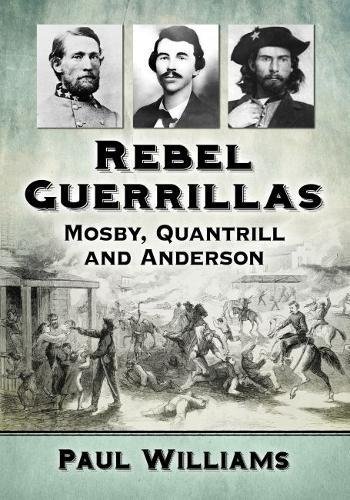
• Rebel Guerrillas: Mosby, Quantrill and Anderson by Paul Williams (McFarland, 2018).

The publisher's description for Rebel Guerrillas: Mosby, Quantrill and Anderson only broadly hints at what interpretive slant(s) might be taken in the book: "From the hills and valleys of the eastern Confederate states to the sun-drenched plains of Missouri and "Bleeding Kansas," a vicious, clandestine war was fought behind the big-battle clashes of the American Civil War. In the east, John Singleton Mosby became renowned for the daring hit-and-run tactics of his rebel horsemen. Here a relatively civilized war was fought; women and children usually left with a roof over their heads. But along the Kansas-Missouri border it was a far more brutal clash; no quarter given. William Clarke Quantrill and William "Bloody Bill" Anderson became notorious for their savagery."

The short prologue is similarly Booknotes-unfriendly in terms of giving me little in the way of a clear layout of the book's overall intentions, though it does offer perhaps some insight into what author Paul Williams plans to do with a trio of already well-documented irregular war figures. With John Singleton Mosby the ideally realized product of what the Confederacy's Partisan Ranger Act of 1862 intended to create, it seems the book will contrast the Virginian's actions with those of notorious Missouri bushwhackers William C. Quantrill and William T. "Bloody Bill" Anderson. It appears the study might also attempt to delineate some essential East vs. West differences in the character of the Civil War's irregular component, though one hopes the author doesn't go too far with drawing radical distinctions given that various savage forms of guerrilla warfare existed across all fronts. With Quantrill and Anderson being the same brand of fighter, it is a bit curious to include both men in what is presumably a three-way comparative study.

Thursday, November 29, 2018

Booknotes: Embattled Freedom

New Arrival:
• Embattled Freedom: Journeys through the Civil War’s Slave Refugee Camps
  by Amy Murrell Taylor (UNC Press, 2018).

Long before the Emancipation Proclamation went into effect, wherever Union armies and navies went in the southern and border states slavery was put on the practical path to extinction. During the war years, an estimated 500,000 enslaved persons took the opportunity that nearby military operations afforded them to flee to Union lines for freedom and protection. Similar to what happened to the medical services when confronted and overwhelmed with the realities of camp sicknesses and the mass casualties of the battlefield, the military authorities tasked with running refugee camps were ill-prepared to house and care for the mass of humanity. Lack of resources, the inherent limitations of mid-nineteenth century medical knowledge, and sometimes neglect often meant that the camps that were set up to shelter ex-slaves became rife with disease and death. But the camps were certainly more than that to all involved, and Amy Murrell Taylor's Embattled Freedom: Journeys through the Civil War’s Slave Refugee Camps examines the full breadth of the refugee camp experience and the meaning those places had to their inhabitants and their aspirations for more permanent freedom.

From the description: "Drawing on an extraordinary survey of slave refugee camps throughout the country, Embattled Freedom reveals as never before the everyday experiences of these refugees from slavery as they made their way through the vast landscape of army-supervised camps that emerged during the war. Amy Murrell Taylor vividly reconstructs the human world of wartime emancipation, taking readers inside military-issued tents and makeshift towns, through commissary warehouses and active combat, and into the realities of individuals and families struggling to survive physically as well as spiritually. Narrating their journeys in and out of the confines of the camps, Taylor shows in often gripping detail how the most basic necessities of life were elemental to a former slave's quest for freedom and full citizenship."

The author integrates a multitude of personal histories into her narrative. "The stories of individuals--storekeepers, a laundress, and a minister among them--anchor this ambitious and wide-ranging history and demonstrate with new clarity how contingent the slaves' pursuit of freedom was on the rhythms and culture of military life. Taylor brings new insight into the enormous risks taken by formerly enslaved people to find freedom in the midst of the nation's most destructive war."

Wednesday, November 28, 2018

Review - "Lincoln's Mercenaries: Economic Motivation Among Union Soldiers During the Civil War" by William Marvel

[Lincoln's Mercenaries: Economic Motivation Among Union Soldiers During the Civil War by William Marvel (Louisiana State University Press, 2018). Hardcover, illustrations, tables, notes, bibliography, index. Pages main/total:xviii,236/347. ISBN:978-0-8071-6952-0. $48]

At this point, the question of why men enlisted in the Union Army has been studied in innumerable books and articles. Among the many motivational factors raised and explored in this large body of scholarship are patriotic fervor, sense of duty, principles of masculine honor, ideology (be it antislavery or just pro-Union), hope for social advancement, religious conviction, or even just sheer boredom and desire for grand adventure. Absent in most of these discussions of early-war volunteerism is the economic incentive, which few soldiers readily admitted to in direct fashion either at the time or in retrospect. However, historian William Marvel believes money to have been a significant inducement at every stage of the conflict, even in its earliest months. In his new book Lincoln's Mercenaries: Economic Motivation Among Union Soldiers During the Civil War Marvel offers the first comprehensive examination of how a lingering downturn in the northern farm and industrial economies (which began during the Panic of 1857 and didn't have an opportunity to recover before being hit anew with the secession crisis's currency, commerce, and trade disruptions) led legions of northern men in 1861-62 to see the volunteer army as the only way to adequately support themselves and their families. In addressing the 1863-65 period, the study confirms some long-held popular and scholarly views on bounty incentives while also proposing fresh perspectives on late-war volunteerism.

Before now, the absence of useful statistical data regarding the financial situations of recruits and their families has severely limited research. Marvel cites the recent availability of median income data from the 1860 census, made possible by the University of Minnesota's Integrated Public Use Microdata Series (IPUMS), as the research tool most indispensable to his study. Previous historians had only anecdotal primary sources and average wealth numbers to rely upon, the latter obviously too skewed by income extremes to be truly valuable. Access to state by state median income figures allowed the author to divide recruits into equally sized study groups. Lest anyone get too carried away with the "rich man's war, poor man's fight" aspects of Marvel's interpretation, the author firmly reminds the reader that recruits with incomes below the median were not necessarily poor (or part of the lowest social class). With that in mind, however, the median income dividing point does for the first time allow meaningful (albeit imperfect) large-scale analysis based on economic class.

On the face of it, it seems quite reasonable for past historians to have viewed the eager response to Lincoln's post-Sumter call for 75,000 militia to put down the rebellion as the war's most fervent expression of northern patriotism. This is certainly part of the story, but Marvel's research also finds that 71% of northern 90-day militia volunteers were men with below-median incomes and attributes this heavy overrepresentation to the dire economic conditions that existed in early 1861 and the vast available pool of unemployed men of military age. This 71% figure is higher than any of the other major recruitment drives examined in the book [the 3-year volunteers of 1861 (the next closest at 70%), 3-year 1862, 9-month militia 1862, 3-year 1863-64 (also 70%), 100-days 1864, and 1-year 1864-65]. While no one reasonably expects to encounter even distribution by income under any circumstances, an observer could be forgiven for anticipating the economic class disparity among the first 90-day volunteers to rank among the lowest of any group, especially if one believes (as Marvel does) that patriotic feeling was more or less evenly distributed during the initial war fever period. This counterintuitive result suggests a disproportionately compelling economic incentive.

Even though the war economy might have been expected to pick up at a time coinciding with the mustering out of the 90-day regiments, Marvel perceptively notes that the extended prewar economic downturn had created surpluses in enough key industries (an important factor in combination with continued currency shortages, trade embargoes, and crop failures) to still make military service attractive on its own. This delay in the wide-scale emergence of competing employment opportunities in the civilian sphere allowed authorities to maintain comparatively low monetary incentives (monthly army pay plus state and local bounties plus monthly family support payments) for the first wave of 3-year volunteer regiments in summer 1861.

As other historians have pointed out, communal generosity in the form of military family stipends dried up relatively quickly in the face of an extended war and promises of support were widely reneged upon. By the time Secretary of War Edwin Stanton unwisely suspended recruitment all across the country in April 1862, the revitalized war economy was already attracting workers in large numbers. Thus when the call for new troops resumed that summer the response was tepid, requiring much larger bounties to convince men already accustomed to reading frightening casualty lists in the newspaper, and who now had more and better employment options than they did in 1861, to volunteer. Confusion over the threat of conscription also had some effect in spurring enlistment. With much higher monetary rewards attached to enlistment for this period, many 1861 volunteers understandably seethed at the lavish (as they saw it) generosity bestowed upon the later volunteers, and their anger was redoubled when they learned it would be taxes on their own property that would help pay for the bounties. As it was in 1861, sizable majorities (typically percentages in the low 60s) of the volunteers that filled the ranks of 1862's three-year regiments came from the poorer side of their state's median income. A notable exception was Iowa, which had very nearly equal representation.

Concurrent with the new three-year regiment recruitment drive of mid-1862 were the 9-month militia regiments, which unlike the former did carry the conscription threat if left unfilled. According to Marvel's research, the militia regiments did not have the same financial inducements but had other obvious benefits of their own. In most states, enlistee rates for those above the median income were decidedly higher in the short-term militia regiments than the three-year formations.

The late-war "bounty men" are those most commonly disparaged then and now, but Marvel finds that even the 1862 volunteers were widely jeered in the army for being latecomers with pockets filled more with money than heads with patriotism. When the first implementation of conscription arrived in March 1863, after liberal draft exemptions and substitute-commutation payments no state exceeded 5% enrollment (and most far less). Even less than that actually entered the ranks in the field. In Marvel's view this is more clear evidence that financial incentives, combined with the draft threat, were required to get any serious number of men into the ranks by the mid-war period.

The recruitment pattern of the 1864 100-day regiments further confirms Marvel's thesis that the higher-than-median income recruits were concentrated in the short-term regiments. Indeed, for some states the roughly two-thirds representation of less-than-median income recruits in their long-term regiments almost exactly matched the representation of higher-than-median recruits in their short-term regiments.

Marvel well recognizes the fact that multiple sources of motivation existed in most individuals and it would be utterly impossible for anyone today to establish a clear-cut hierarchy of motivations with any degree of certitude. Really, most of the men themselves probably could not have honestly done it at the time. It is a common refrain among Civil War researchers that so much primary source material exists that one can anecdotally support a whole range of conclusions associated with almost any issue. That said, Marvel's extensive manuscript research nevertheless powers the creation of an intellectually compelling assembly of individual vignettes supported by personal writings that together lend credence to his thesis. Thickly and evenly spread throughout the chapter-length discussions of the public response to each national appeal for volunteers, the collective thrust of these individual testimonials and vignettes (in combination with the supporting quantitative data presented) suggests a widespread impact of economic incentives. Even though the vast majority of new volunteers understandably avoided any kind of direct admission of money being the primary or sole inducement for joining the army or navy, financial matters and concerns very often dominated their early letters home.

Marvel readily admits that many readers will object to his chosen title of "Lincoln's Mercenaries" as overly burdened with negative connotations, but defends his use of the term "mercenary" as being a selective yet technically appropriate usage of the dictionary definition. Even so, it still seems rather needlessly provocative in the sense that some otherwise reasonable readers might dismiss the book on the title alone or begin reading this important study with a mind less open than it might have been with a different title. Marvel makes clear repeatedly throughout the book that he does not want to create the impression that he's impugning the patriotism of northern soldiers, but this doesn't help.

In persuasively challenging the traditional interpretation of enlistment motives among the 1861-62 recruiting classes as being primarily ideological in nature, Marvel's book is force to be reckoned with in future studies. The author does not seek to elevate money as the top reason that men went into the ranks of the Union Army, only that the strength of economic incentives has been misunderstood and vastly underappreciated by nearly all historians that have studied early Civil War volunteerism. His arguments in this regard are very powerful.

Tuesday, November 27, 2018

Booknotes: The Calculus of Violence

New Arrival:
• The Calculus of Violence: How Americans Fought the Civil War by Aaron Sheehan-Dean (Harvard UP, 2018).

The Calculus of Violence: How Americans Fought the Civil War represents yet another call to scrap the traditional interpretation of the Civil War's violence and destruction as a linear progression from conciliation/limited war to hard/total war. Instead, author Aaron Sheehan-Dean wades into the war's endless cascade of contradictions and recognizes that the worst aspects of the conflict were present from the start but also that restraint was evident at every stage.

The book "demonstrates that this notoriously bloody war could have been much worse. Military forces on both sides sought to contain casualties inflicted on soldiers and civilians. In Congress, in church pews, and in letters home, Americans debated the conditions under which lethal violence was legitimate, and their arguments differentiated carefully among victims―women and men, black and white, enslaved and free. Sometimes, as Sheehan-Dean shows, these well-meaning restraints led to more carnage by implicitly justifying the killing of people who were not protected by the laws of war. As the Civil War raged on, the Union’s confrontations with guerrillas and the Confederacy’s confrontations with black soldiers forced a new reckoning with traditional categories of lawful combatants and raised legal disputes that still hang over military operations around the world today."

"In examining the agonizing debates," both domestic and international, "about the meaning of a just war in the Civil War era, Sheehan-Dean discards conventional abstractions―total, soft, limited―as too tidy to contain what actually happened on the ground."

Monday, November 26, 2018

Booknotes: High Private

New Arrival:
• High Private: The Trans-Mississippi Correspondence of Humorist R. R. Gilbert, 1862–1865 edited by Mary M. Cronin (UT Press, 2018).

Mary Cronin's High Private: The Trans-Mississippi Correspondence of Humorist R. R. Gilbert, 1862–1865 explores the life, military service, and journalistic career of Vermont-raised but passionately Confederate Rensselaer Reed Gilbert (the book's title refers to Gilbert's newspaper nom de plume). According to Cronin, Gilbert "was one of the most prolific newspaper correspondents during the years of the U.S. Civil War. He penned several hundred news and editorial columns, as well as comic sketches, for the Houston Tri-Weekly Telegraph."

Cronin has written about Gilbert before in a journal article and as a contributor to the essay anthology Knights of the Quill, and that earlier scholarship is significantly expanded upon in the first two chapters of High Private. In addition to serving a biographical purpose, those opening sections (which together run over fifty pages) also delve into the comic nature of much of his writing. The book "provides new insight into this form of journalism but also addresses military humor produced while the author was in uniform. When he returned to civilian life, Gilbert wrote chiefly from various military commanders’ headquarters. His work records the social and political experiences of soldiers and civilians living in the Trans-Mississippi region, especially after it was cut off from the rest of the Confederacy following the capture of New Orleans in 1862."

More from the description: "Through parody and satire, Gilbert’s often sharp pen revealed uncomfortable truths, attacked sentimentality and pretension, provided emotional release for those living in the Trans-Mississippi area—particularly Texas, Louisiana, and Arkansas—and served as a critical voice for the region. That Gilbert remains readable today is a testament to his imagination, creativity, and power of observation. In writing about a journalist who covered both military and civilian affairs, Cronin reveals not only a talented writer but also an understudied region in the American Civil War through the keen eyes and pen of a working journalist." Introduced with editorial commentary and arranged in yearly chapters, Gilbert's extensive wartime correspondence is transcribed in full and also annotated.

Cronin’s "extensive look at Gilbert’s life and work introduces readers to the forgotten voice of a Trans-Mississippi comic, correspondent, and Southern advocate" and her work significantly "expands research into the field of Civil War-era humor writing and news reporting."

Friday, November 23, 2018

Booknotes: The War for the Common Soldier

New Arrival:
• The War for the Common Soldier: How Men Thought, Fought, and Survived in Civil War Armies by Peter S. Carmichael (UNC Press, 2018).

While there's no particular shortage of books describing and interpreting the experiences of Civil War soldiers in camp, on the march, and on the battlefield, new ideas and perspectives are always welcome. Central to Peter Carmichael's new book The War for the Common Soldier is the author's broad-themed attempt to answer the age old question of how Civil War soldiers coped with "the brutal and unpredictable existence of army life."

From the description: "Based on close examination of the letters and records left behind by individual soldiers from both the North and the South, Carmichael explores the totality of the Civil War experience--the marching, the fighting, the boredom, the idealism, the exhaustion, the punishments, and the frustrations of being away from families who often faced their own dire circumstances. Carmichael focuses not on what soldiers thought but rather how they thought. In doing so, he reveals how, to the shock of most men, well-established notions of duty or disobedience, morality or immorality, loyalty or disloyalty, and bravery or cowardice were blurred by war." Chapter headings "Comrades, Camp and Community"; "Providence and Cheerfulness"; "Writing Home"; "Courage and Cowardice"; "Desertion and Military Justice"; "Facing the Enemy and Confronting Defeat"; and "The Trophies of Victory and the Relics of Defeat" hint at the wide range of discussion.

More: "Digging deeply into his soldiers' writing, Carmichael resists the idea that there was "a common soldier" but looks into their own words to find common threads in soldiers' experiences and ways of understanding what was happening around them. In the end, he argues that a pragmatic philosophy of soldiering emerged, guiding members of the rank and file as they struggled to live with the contradictory elements of their violent and volatile world."

Wednesday, November 21, 2018

Booknotes: Deep in the Piney Woods

New Arrival:
• Deep in the Piney Woods: Southeastern Alabama from Statehood to the Civil War, 1800–1865 by Tommy C. Brown (Univ of Ala Press, 2018).

Scholarly trends in Civil War home front studies are always in flux and that rarely results in the various sub-regions within states being accorded equal coverage. For Alabama, the recent explosion of Southern Unionist scholarship has diverted much of the attention from the Gulf Coast and black belt to the northern counties. Though many readers will be familiar with Mark Wetherington's superb 2005 study Plain Folk's Fight: The Civil War and Reconstruction in Piney Woods Georgia, Tommy Brown contends in his new book Deep in the Piney Woods: Southeastern Alabama from Statehood to the Civil War, 1800–1865 that the wiregrass region "is one of the most understudied areas in Alabama history." His study "offers a comprehensive and long overdue account of a historically rich region of the state, challenging many commonly held assumptions about the area’s formation and settlement, economy, politics, race relations, and its role in both the secession of the state and the Civil War."

"Historians routinely depict this part of the state as an isolated, economically backward wilderness filled with poor whites who showed little interest in supporting the Confederacy once civil war erupted in 1861." However, like Wetherington did in his own study of five south-central Georgia wiregrass/piney woods counties, Brown "challenges those traditional interpretations, arguing instead that many white Alabamians in this territory participated in the market economy, supported slavery, favored secession, and supported the Confederate war effort for the bulk of the conflict, sending thousands of soldiers to fight in some of the bloodiest campaigns of the war."

More from the description: "This thorough and expansive account of southeastern Alabama’s role in the Civil War also discusses its advocacy for state secession in January 1861; the effects of Confederate conscription on the home front; the economic devastation wrought on the area; and the participation of local military companies in key campaigns in both the eastern and western theaters, including Shiloh, the Peninsula Campaign, the Overland Campaign, Atlanta, and Franklin-Nashville. Brown argues that the lasting effects of the war on the region’s politics, identity, economy, and culture define it in ways that are still evident today."

Tuesday, November 20, 2018

Review - "Fort Snelling and the Civil War" by Stephen Osman

[Fort Snelling and the Civil War by Stephen E. Osman (Ramsey County Historical Society, 2017). Paperback, 7 maps, 100+ photos, illustrations, notes, bibliography, index. Pages main/total:xii,295/335. ISBN:978-0-934294-76-8. $27]

Established in the early 1800s on treaty land acquired from the Dakota, Fort St. Anthony (renamed Fort Snelling in honor of Col. Josiah Snelling of the 5th U.S. Infantry) was completed in 1825 and became a key component of the chain of fortifications that shielded the Old Northwest frontier of the United States. Situated on a high bluff overlooking the confluence of the Minnesota and Mississippi rivers, the massive stone fort served the country off and on for many decades before finally being decommissioned in 1946. The surviving facilities eventually fell into disrepair, but today the site is run as a Minnesota Historical Society education center, the stone fort having been remarkably restored to a state resembling its original appearance. The most significant military post in Minnesota, Fort Snelling would feature prominently in the Civil War years. This wartime history is fully recounted in book-length format for the first time in Stephen Osman's stunning Fort Snelling and the Civil War. Osman, a retired MHS historian who managed Historic Fort Snelling for over thirty years, clearly developed an expert knowledge of and passion for the military post's history during his long tenure there. Fort Snelling and the Civil War appropriately focuses on the two most important responsibilities the post fulfilled during 1861-65—(1) the processing of Minnesota troops for distant service against Confederate armies and (2) the direction of the country's military response to internal threats from the Santee Sioux and other hostile tribal groups in the surrounding region.

Approximately 24,000 volunteers and draftees passed through Fort Snelling on their way to the fighting fronts to confront either Confederates in all three major Civil War theaters or Indian threats that materialized in Minnesota and the Northern Plains. In addition to processing, training, and equipping recruits, the fort was the region's chief administrative and logistical hub. When existing facilities proved inadequate to the scale of operations, the fort rapidly expanded outside its stone walls and tower. During the war years, wooden warehouse, barracks, hospital, armory, prison, and other structures were constructed west of the old stone fort. Each stage of this dramatic physical expansion is documented at great length by Osman and his detailed text descriptions are supported by numerous maps, period photographs, and firsthand accounts.

After the Great Sioux Uprising of 1862 resulted in the indiscriminate murder of hundreds of Minnesota settler families at the hands of Eastern Dakota (a.k.a. Santee Sioux) angry at the federal government's recent neglect of its treaty obligations, panic ensued in the state and Fort Snelling coordinated the military response that both quelled the uprising and expanded the war into the Northern Plains. The actual fighting is not covered in the book, but the fort's central role in directing affairs is thoroughly covered in evenhanded fashion. In line with the views of other historians, Osman credits Minnesota politician turned volunteer colonel (and later general) Henry Hastings Sibley for leading an effective campaign. A significant section of the book also deals with the large enclosed refugee/internment camp that was established near the fort to house surrendered Dakota and other native groups (whether they participated in the uprising or not) before final removal was approved.

Also explored at great length are soldier life at the fort and the mutually beneficial relationship that developed during the war between the military authorities and nearby civilians. Practically every possible context of soldier duty and experience at the fort are discussed in the book, including training, living conditions, entertainment, food, religious life, and health along with darker aspects such as alcohol abuse and violent crime. As was the case in every fort located in populated areas, Minnesota civilians provided valuable support networks (ex. assistance from the state sanitary commission, local aid societies, etc.) while also benefiting themselves from lucrative army supply, construction, and transportation contracts.

Most books that will never realize great acclaim for their authors are labors of love to some degree, but this study really takes it to another level. In addition to his exhaustive research and expansive narrative, Osman packs his book with an incredible number of rarely-seen images. There's seemingly a photograph, map, or visual aid of some kind on every other page. The publisher also deserves a great deal of credit for sparing no expense in presenting all of this material in an arresting package.

Flaws are few. Not related to the material itself, the chief complaint (if one exists) is with the relative unwieldiness of the volume, as such a thick, very heavy paperback published in 9x11-inch landscape format is difficult to handle comfortably during reading. Also, though the author is upfront about the sprawling Dakota War of 1862-65 lying outside the scope of his already dense study, some kind of summary of those events would have been helpful for newer readers in need of more context for the fort's Civil War era activities and expansion.

One never knows, of course, but it's difficult to imagine a future study of Fort Snelling and the Civil War that could replace Osman's book. Anyone with a deep interest in Civil War Minnesota (or Minnesota history in general), the Dakota Wars, and Trans-Mississippi frontier forts will want to own a personal copy of this exceptionally detailed and lovingly crafted pictorial and narrative history of Fort Snelling's Civil War service.

Monday, November 19, 2018

Book News: Leonidas Polk

It doesn't take new Civil War readers long before they are confronted with the stark contrast between the stability and effectiveness of the Confederate high command structure in the East and the self-defeating constant flux and dysfunction embodied in the top leadership in the western theater. In the context of western Confederate generals who occupied high command positions for a long enough period of time to have a singularly harmful impact on the course of the war, Lieutenant General Leonidas Polk is surely second only to Braxton Bragg. While Earl Hess's recent military biography of Bragg had some success in revising the traditional view of that general's martial legacy, no one has attempted a similarly in-depth reappraisal of Polk. However that situation will change early next year with the publication of Huston Horn's Leonidas Polk: Warrior Bishop of the Confederacy (UP of Kansas, Feb 2019).

For those unfamiliar with Polk's pre-Civil War background, the book description offers a nice summary. "Leonidas Polk was a graduate of West Point who resigned his commission to enter the Episcopal priesthood as a young man. At first combining parish ministry with cotton farming in Tennessee, Polk subsequently was elected the first bishop of the Louisiana Diocese, whereupon he bought a sugarcane plantation and worked it with several hundred slaves owned by his wife. Then, in the 1850s he was instrumental in the founding of the University of the South in Sewanee, Tennessee. When secession led to war he pulled his diocese out of the national church and with other Southern bishops established what they styled the Protestant Episcopal Church in the Confederate States of America. Polk then offered his military services to his friend and former West Point classmate Jefferson Davis and became a major general in the Confederate Army."

Immediately elevated to an important department command in the West, Polk would go on to participate in most of the theater's major campaigns and battles as a corps/small-army level commander until his grisly June 1864 death at Pine Mountain, Georgia. While no one today views him as a particularly capable general officer (or at least one fit for the many high-level positions he held during the war), Polk was apparently well-regarded by many of those that served under him, subordinate officers and common soldiers alike. A long-standing critic of Bragg and notable schemer against the controversial army commander, he was also a divisive figure off the battlefield.

It will be interesting to see how Horn will approach Polk's Civil War service and war record. Jacket blurbs are notorious for overstatement, but it is noteworthy that William C. Davis feels that Horn's treatment is "the best Confederate military biography of recent years." I don't know of any previous Civil War work from Horn, but that doesn't mean he won't produce a masterpiece. On a trivia note, I wonder if he's related to Stanley Horn. It is somewhat interesting that he shares a hybrid professional identity with his subject, he being a journalist and Episcopal minister while Polk was a general and Episcopal bishop.

Sunday, November 18, 2018

Booknotes: Brothers in Valor

New Arrival:
• Brothers in Valor: Battlefield Stories of the 89 African Americans Awarded the Medal of Honor by Robert F. Jefferson, Jr. (Lyons Pr, 2018).

"Since the American Civil War, scores of African Americans have served with great distinction. Through thousands of historical accounts, photographs, and documentary evidence," Robert Jefferson's Brothers in Valor "introduces the 89 black soldiers who continued forward when all odds were against them." 

The book "paints a vivid portrait of African-American soldiers who carried the flag of freedom and how they reshaped the very definition of courage under fire during some of the most harrowing moments in United States military history. In turn, their courage and determination left an indelible mark on the American portrait."

Chapters cover the Civil War, Indian Wars, Spanish-American War, WW1, WW2, the Korean Conflict, and Vietnam. From the full list of recipients at the back of the book, twenty-five MOH awards were from the Civil War. Selecting from the list, the opening Civil War chapter focuses on the lives and service of William H. Carney (Fort Wagner, 1863), Christian A. Fleetwood (Chaffin's Farm, 1864), Milton Holland (Chaffin's Farm, 1864), Andrew Jackson Smith (Honey Hill, 1864), and John H. Lawson (Mobile Bay, 1864).

Friday, November 16, 2018

Booknotes: The Lost Indictment of Robert E. Lee

New Arrival:
• The Lost Indictment of Robert E. Lee: The Forgotten Case Against an American Icon
  by John Reeves (Rowman & Littlefield, 2018).

The reputations of major historical figures often follow an undulating course according to the changing cultural zeitgeist and many other factors that tell us just as much about the judges as they do those put in the dock. This is certainly the case with Robert E. Lee. While later generations of Americans would find much to admire in Lee, the years immediately following the end of the Civil War were filled with attacks on the character and moral standing of the Confederacy's leading general. It is this early period in the development of Lee's historical legacy that is the subject of John Reeves's The Lost Indictment of Robert E. Lee.

From the description: "Immediately after the Civil War, ... many northerners believed Lee should be hanged for treason and war crimes. Americans will be surprised to learn that in June of 1865 Robert E. Lee was indicted for treason by a Norfolk, Virginia grand jury. In his instructions to the grand jury, Judge John C. Underwood described treason as “wholesale murder,” and declared that the instigators of the rebellion had “hands dripping with the blood of slaughtered innocents.” In early 1866, Lee decided against visiting friends while in Washington, D.C. for a congressional hearing, because he was conscious of being perceived as a “monster” by citizens of the nation’s capital. Yet somehow, roughly fifty years after his trip to Washington, Lee had been transformed into a venerable American hero, who was highly regarded by southerners and northerners alike."

The book "tells the story of the forgotten legal and moral case that was made against the Confederate general after the Civil War" and "illuminates the incredible turnaround in attitudes towards the defeated general by examining the evolving case against him from 1865 to 1870 and beyond."

Thursday, November 15, 2018

Booknotes: Don Troiani's Civil War Soldiers

New Arrival:
• Don Troiani's Civil War Soldiers by Don Troiani, Earl J. Coates, and Michael J. McAfee   (Stackpole, 2017).

During the 1990s, Civil War artwork peaked in popularity alongside book publishing. Art calendars and advertising could be found all over the place and the original oils went for small fortunes. Even before factoring in matte and framing costs, the numbered prints were outside my poor student means. 

One of the biggest figures in this art scene was Don Troiani, recognized for his battle scenes along with his exhaustively researched and intricately detailed individual officer and soldier portrayals on canvas. A new collection of the latter (27 Confederate. and 22 Union) are featured in Don Troiani's Civil War Soldiers [see the table of contents at the title link above for a complete list].

The range of soldier and officer subjects is impressive—with the three major branches (infantry, cavalry, and artillery) and regulars, volunteers, militia, USCT, specialist and support troops, colorbearers, and more all represented. The large-dimension volume from Stackpole is beautifully presented. The heavy, glossy 8.5" x 11" pages allow full appreciation of all the realistic detail and vivid colors associated with each art reproduction. Every portrait is supported by extensive background and explanatory text contributed by Coates and McAfee as well as captioned photographs (over 300 in number) of the uniforms, accoutrements, and other historical artifacts that Troiani used as painting props.

Wednesday, November 14, 2018

Review - "War Matters: Material Culture in the Civil War Era" by Joan Cashin, ed.

[War Matters: Material Culture in the Civil War Era edited by Joan E. Cashin (University of North Carolina Press, 2018). Softcover, photos, illustrations, notes index. Pages main/total:244/280. ISBN:978-1-4696-4320-5. $29.95]

Within Civil War scholarship, material culture studies continue to be an undervalued academic sub-discipline, a state of affairs that the new essay anthology War Matters: Material Culture in the Civil War Era seeks to address and change. Volume editor Joan Cashin's introductory essay recognizes that there is no universally agreed upon current definition of "material culture" from those that use it most (i.e. anthropologists, archaeologists, folklorists, and the like). The term originated in the anthropology of the early twentieth century and generally refers to "the study of physical objects as evidence of cultural values." Some also believe that particularly valued objects need to be also understood as themselves affecting human behaviors and attitudes. The fairly inclusive definition quoted above serves well enough as the foundation of the broad range of ideas aired in War Matters. While professional Civil War historians as a whole have not fully embraced material culture studies as a significant tool for use in their own work, the following essays represent at least some evidence of growing acceptance and appreciation.

Jason Phillips begins the proceedings by looking at the historical and physical origins of John Brown's famous pikes and their cultural meaning and evolution. After his victory over proslavery militants at Black Jack in Kansas, Brown proudly displayed to supporters and financial backers a captured dagger as emblematic of his cause and evidence of his triumph. Symbolically turning the weapon against its previous owner and the "Slave Power" he represented, Brown commissioned 1,000 pikes with the bladed tips precisely modeled after that of the Black Jack dagger. While the pikes never drew blood in the hands of fellow abolitionist fighters or rebellious slaves, they became meaningful objects on both sides of the cultural divide, with abolitionists keeping them as treasured relics and proslavery activists displaying them as powerful material proof of the North's support for the violent overthrow of slavery and the presumed race war that would ensue. The chapter provides a good example of how the physical nature and symbolic meaning of material objects can evolve in both intended and unintended ways.

Both sides during the Civil War earnestly attempted to appropriate the legacy of the American Revolution in support of their respective causes, and Joan Cashin's chapter discusses the relics from that treasured period of history that were physically threatened by the fighting. Union soldiers wanted to see, touch, and often take sacred objects; Southern Unionists sought to display them as proof of their loyalty; and pro-Confederate citizens tried to protect and preserve them from outright theft and destruction. In citing these examples, Cashin forcefully demonstrates how much Civil War era Americans wanted to possess physical reminders of past glories while also using them as tools of political and cultural expression in their own lives.

By interpreting the entire Antietam National Battlefield as a historical artifact, Lisa Brady and Timothy Silver take perhaps the book's most expansive approach to defining material culture.  Conducting material culture studies through the lens of environmental history, Brady and Silver look beyond relatively small, inanimate objects to large, culturally significant landscapes and their living ecosystems. Their long-term method of examining the complex interplay between the human and natural origins and histories of particular landscapes provides another way of looking at Civil War battlefields.

Everyone has read Civil War anecdotes about printed material in breast pockets stopping bullets and saving lives, but Ronald and Mary Zboray's article offers the first comprehensive examination of the practice, which originated in Cromwellian England. Documenting 108 cases in both Civil War armies, they thoughtfully explore the individual, religious (most were bibles), and cultural significance of using books as personal shields. The printed objects came to be proactively viewed by many as talismans that could ward off harm on the battlefield, and in the case of bibles took on additional elements of divine grace and intervention.

Military material culture studies (particularly those associated with modern conflict archaeology) have made impressive strides in recent decades, but Earl Hess points out that the examination of Civil War weapons as culturally-significant objects has lagged behind. Adopting an international cross-cultural approach, Hess's chapter interprets weapons—in the context of both user and target—from the individual perspective (ex. noting the tendency of many soldiers to see their weapons not as mass-produced things but personally meaningful objects) as well as through societal lenses such as American gun culture and the pervasive 'new is better' attitude toward technology.

Robert Hicks moves the discussion from man-made objects to man-modified natural materials, in this case smallpox vaccine matter extracted from individuals by Confederate Army doctors and prepared for general use in inoculating civilian and military populations. There is a particular focus on failed inoculations and how they prompted a scientific reevaluation of each stage of the vaccination process. This led to improved methods and the compilation of a large body of data and observations useful for future research.

Within black refugee camps managed by white northern relief workers, ex-slaves lived in either tents or existing built structures, and these intimate material spaces are the subject of Sara Jones Weicksel's chapter. In it Weicksel sees refugee dwellings and the artifacts that adorned and furnished them as representations of freedpeople's personal visions of freedom.

Unlike women of the wealthier classes who could afford to leave the home to participate in fundraisers, attend political rallies, and nurse the wounded, Alabama's common folk women found ways to support the Confederate cause and supplement their more meager incomes through home industry, both through hand-made goods and food production. However, Victoria Ott's chapter also shows how hardships and scarcities in those very same material items fueled opposition, often class-based in nature, as the war dragged on.

The final two essays explore the popular passion for relics of the war. Peter Carmichael discusses relic hunting in the context of the conflict's final weeks, when veterans of both armies sought to substantiate their service through keepsakes, while Yael Sternhell recounts Jefferson Davis's twenty-year quest to reclaim his lost or confiscated material belongings. Ironically, those objects held by the federal government were the easiest to get back while those taken by ex-associates the most frustratingly elusive. Davis's loss of control over his own material legacy serves as a notable reminder of how the private artifacts of historically significant figures eventually become public property.

All of the contributors to War Matters successfully argue for the appropriateness and validity of incorporating into the historical scholarship the study of material items of cultural significance. Certainly the book should be read by all Civil War professional historians and graduate students, but many of the essays also exhibit popular appeal sufficient to gain the volume a wider reading audience. Highly recommended.

Tuesday, November 13, 2018

Book News: The Fight for the Old North State

Back in February when I reviewed James White's New Bern and the Civil War (2018) and noted that it offered the first serious book-length treatment of the 1863-64 Confederate offensives in eastern North Carolina, I had no inkling that Hampton Newsome was finishing up a similar project of his own. It's another example of what I call the 'nothing-then-two-books' pattern that comes up in the Civil War military history literature frequently enough to be noticeable.

While White's slim volume took the broader overview approach, Newsome's study will focus on the 1864 offensives. The Fight for the Old North State: The Civil War in North Carolina, January-May 1864 (Kansas, Feb 2019) recounts "a momentous series of events as the Confederates, threatened by a supply crisis and an emerging peace movement, sought to seize Federal bases in eastern North Carolina. This book tells the story of these operations—the late war Confederate resurgence in the Old North State."

A number of Confederate offensive operations conducted over the first half of the year are covered. These would have varying degrees of success. "Using rail lines to rapidly consolidate their forces, the Confederates would attack the main Federal position at New Bern in February, raid the northeastern counties in March, hit the Union garrisons at Plymouth and Washington in late April, and conclude with another attempt at New Bern in early May. The expeditions would involve joint-service operations, as the Confederates looked to support their attacks with powerful, homegrown ironclad gunboats."

Analysis of events also ranges beyond the battlefield. "Newsome does not neglect the broader context, revealing how these military events related to a contested gubernatorial election; the social transformations in the state brought on by the war; the execution of Union prisoners at Kinston; and the activities of North Carolina Unionists." I can't wait to read it. Fortunately, it will be out relatively soon.