Monday, February 28, 2022

Booknotes: Cedar Mountain to Antietam

New Arrival:
• Cedar Mountain to Antietam: A Civil War Campaign History of the Union XII Corps, July – September 1862 by M. Chris Bryan (Savas Beatie, 2022).

Of the Union corps that contributed most to the Union attack on the right flank at Antietam it's probably fair to say the Twelfth Corps was the odd man out in terms of acclaim or recognition (good or bad) of its role in the battle. Hooker's First Corps valiantly fought itself out in a horrific slugging match in the morning phase of the battle and, on the other side of the spectrum, major elements of Sumner's Second Corps suffered infamous disaster in the West Woods. By contrast, the hard fighting of the rank and file of Twelfth Corps has been largely overshadowed (at least when it comes to popular notions of what happened during the battle) by one event—the mortal wounding of its commander, Major General J.K.F. Mansfield, just as the corps went into action. Mansfield's replacement, General Alpheus Williams, did not believe his corps received proper credit from General McClellan and others for what it accomplished at Antietam.

Encompassing the fighting at Antietam and on other fields that busy summer, Chris Bryan's Cedar Mountain to Antietam: A Civil War Campaign History of the Union XII Corps, July – September 1862 seeks to fully restore the combat history of Twelfth Corps. From the description: the "diminutive Union XII corps found significant success on the field at Antietam. Its soldiers swept through the East Woods and the Miller Cornfield—permanently clearing both of Confederates—repelled multiple Southern assaults against the Dunker Church plateau, and eventually secured a foothold in the West Woods. This important piece of high ground had been the Union objective all morning, and its occupation threatened the center and rear of Gen. Robert E. Lee’s embattled Army of Northern Virginia."

Grounded in primary sources, Bryan's very detailed military history narrative, which is supported by 28 maps, follows the corps from its Army of Virginia roots through the end of the Battle of Antietam. More from the description: Cedar Mountain to Antietam "begins with the formation of this often-luckless command as the II Corps in Maj. Gen. John Pope’s Army of Virginia on June 26, 1862. Bryan explains in meticulous detail how the corps endured a bloody and demoralizing loss after coming within a whisker of defeating Maj. Gen. “Stonewall” Jackson at Cedar Mountain on August 9; suffered through the hardships of Pope’s campaign before and after the Battle of Second Manassas; and triumphed after entering Maryland and joining the reorganized Army of the Potomac. The men of this small corps earned a solid reputation in the Army of the Potomac at Antietam that would only grow during the battles of 1863."

The author has revealed that he's currently working on a follow-up volume that will continue the corps history through the rest of its service in the eastern theater. Beyond that, time will tell.

Friday, February 25, 2022

Coming Soon (March '22 Edition)

**NEW RELEASES1** Scheduled for MAR 2022:

• Fortress Nashville: Pioneers, Engineers, Mechanics, Contrabands & U.S. Colored Troops by Mark Zimmerman.
• U.S. Civil War Battle by Battle by Iain MacGregor.
• Olmsted and Yosemite: Civil War, Abolition, and the National Park Idea by Diamant & Carr.
• Ways and Means: Lincoln and His Cabinet and the Financing of the Civil War by Roger Lowenstein.
• Destruction of the Steamboat Sultana: The Worst Maritime Disaster in American History by Gene Salecker.
• Decisions at Perryville: The Twenty-Two Critical Decisions That Defined the Battle by Larry Peterson.
• The Battle of Gettysburg 1863 (1): The First Day by Timothy Orr.
• More Than Just Grit: Civil War Leadership, Logistics and Teamwork in the West, 1862 by Richard Zimmermann.
• Hearts Torn Asunder: Trauma in the Civil War’s Final Campaign in North Carolina by Ernest Dollar.
• Animal Histories of the Civil War Era edited by Earl Hess.
• Grant vs Lee: Favorite Stories and Fresh Perspectives from the Historians at Emerging Civil War edited by Mackowski & Welch.

1 - These monthly release lists are not meant to be exhaustive compilations of non-fiction releases. They do not include non-revised/expanded reprints of previously published books, special editions not distributed to reviewers, and digital-only titles. Works that only tangentially address the war years are also generally excluded. Inevitably, one or more titles on this list will get a rescheduled release (and they do not get repeated later), so revisiting the past few "Coming Soon" posts is the best way to pick up stragglers.

Wednesday, February 23, 2022

Review - "Illusions of Empire: The Civil War and Reconstruction in the U.S.-Mexico Borderlands" by William Kiser

[Illusions of Empire: The Civil War and Reconstruction in the U.S.-Mexico Borderlands by William S. Kiser (University of Pennsylvania Press, 2022). Hardcover, maps, photos, notes, bibliography, index. Pages main/total:165/262. ISBN:978-0-8122-5351-1. $55]
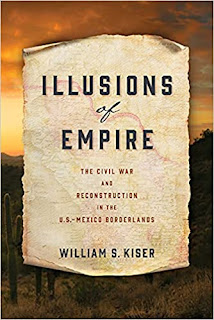
Even though they were small in size and traditionally receive only passing mention in most general Civil War histories, the military campaigns and battles fought in New Mexico Territory and all along the US-Mexico border are remarkably well represented in the more specialist literature. The cross-border cotton exchange's vital economic role in sustaining the Confederate war effort west of the Mississippi has also been well recognized and addressed in numerous books and articles. Most recently, Civil War-era "borderlands" studies and works exploring the international dimensions of the American Civil War have together greatly expanded the range of historical investigation, with the roots of economic interdependency, diplomacy, ethnic conflicts, and sovereignty issues dealt with in a growing list of Southwest-oriented publications. A product of both astute synthesis and original research in U.S. and Mexican sources, William Kiser's Illusions of Empire: The Civil War and Reconstruction in the U.S.-Mexico Borderlands integrates these established and emerging avenues of historical inquiry into a comprehensive work of grand scope made all the more impressive by how much is accomplished in such a slim volume.

With most U.S.-published borderlands studies focused on particular sub-regions (at least when it comes to those most closely tied to the Civil War period), the geographical breadth of Kiser's broad-themed work encompassing the entire U.S.-Mexico border region is highly unusual. To offer just a few notable examples from the Civil War-era scholarship, the works of Kiser himself prior to this one [ex.: see here and here], Andrew Masich, and James Blackshear are centered on the lands surrounding the Upper Rio Grande while those of Miguel Ángel González-Quiroga, Michael Collins, James Irby, Stephen Townsend, Stephen Dupree, and a host of other authors are mostly focused on the Lower Rio Grande region. The Civil War Southwest historian who has published the greatest number and most diverse range of biographies and histories associated with the entire length of the US-Mexico borderlands is Jerry Thompson, and even he has not attempted to gather his career-long engagement with the topic into a single volume treatment. Spanning a vast territory from southern California to Brazos Santiago on the U.S. side of the border and Guaymas to Bagdad on the Mexican side, the scope of Kiser's investigation in Illusions of Empire is probably unique.

Kiser begins the book with a solid discussion of how lingering memories of troubled past relations between the United States and Mexico involving territorial disputes, a major war, Indian raids, and filibustering expeditions haunted Civil War-period diplomatic interactions. With that ingrained mistrust between neighbors always in the background, the narrative moves on to provide readers with a remarkably inclusive political, economic, diplomatic, and military history of the entire borderlands region during the Civil War. Appended to that is a limited but still insightful extension into the Reconstruction period.

Every modern history of the antebellum and Civil War-era southwestern borderlands recognizes their fluid nature (in human movement, violence, economic exchange, diplomacy, governmental control, law enforcement, and more), but Kiser is really the first Civil War scholar to integrate into a single narrative, as he does in Illusions of Empire, the full range of significant transborder actors. Each individual or group actor addressed in Kiser's analysis possessed some degree of real power, but, as the author creatively and persuasively illustrates, each also had "illusions" regarding that power's strength, sovereign aspirations, and extent of influence (by threat and/or persuasion) over other transnational actors. The list of historical actors integrated into Kiser's narrative includes U.S./Confederate military officers, Davis and Lincoln administration diplomats, French emperor Napoleon III, the contending Juarez and puppet Imperial governments and forces in Mexico, northern Mexico's state governors, non-aligned Indian tribes, bandit groups, and regional warlords of shifting loyalty (ex. Juan Cortina). With varying degrees of sovereign expression and support behind their powers, all of these forces vied with each other over control of the borderlands (or, in some cases, survival). Within this complex milieu, conflict was all too often the order of the day, though cooperation in areas of mutual interest (ex. trade) was frequently sought.

Though international diplomacy was the acknowledged domain of central government leaders, in the U.S.-Mexico borderlands the combination of past history, distance, civil conflict, self-interest, competing ideologies, and practicality rendered traditional diplomatic channels a source of frustrating dead end. As Kiser ably and amply demonstrates, however, diplomacy did not die there during the Civil War years but rather assumed a different, more localized and interpersonal form. While the Lincoln administration consistently supported the presidency and government of Benito Juarez, the Confederates, desperate to exchange southern cotton for war materials (especially after the closing of the Mississippi River in July 1863), were prepared to work with any faction in Mexico willing to facilitate cross-border trade that could bypass the Union blockade.

Just like the U.S. had competing philosophies regarding the relations between state and federal governments, Mexico had a long tradition of regionalism versus centralization. In the book, Kiser details how Mexican governors of northern states all along the border assumed the dubious right to conduct international diplomacy with U.S. and Confederate military officers. These governors, successfully and unsuccessfully, employed diplomacy in ways aimed toward reinforcing their own wealth and power while at the same time opposing both domestic and international threats. With tenuous links to the embattled Juarez government, which was on the run during the height of the French Intervention, governors negotiated trade agreements with Confederate military and civilian authorities that lined their own pockets (along with those of key allies), funded the government apparatus, and raised monies needed to recruit and equip state forces necessary to oppose Imperial encroachment. With Mexico's territorial losses from decades earlier still fresh in their minds, the governors were also successful in deterring the aggressive efforts of U.S. officers and diplomats who at various times sought transit rights across the border, wanted approval to use Mexico as a base for cross-border raids by Texas Unionists, and harbored ambitions of future annexation of Mexican lands. Kiser's centering of the roles played by these Mexican governors in the historical narrative of the Civil War borderlands is a major theme and strength of this book.

One area where cross-border cooperation might have been more generally expected was in combating the mutual threat of Apache, Comanche, and Kiowa raiders. These aggressive tribal groups had collectively killed thousands of Mexican citizens during the decade preceding the American Civil War, and they were just as troubling to U.S. civilian and military authorities. However, Union and Confederate hopes for active cooperation from Mexico in that area did not come to fruition, as Mexican officials understandably mistrusted the motives behind any American intervention, fearing the consequences of what might happen if large numbers of U.S. or Confederate forces were allowed to operate on Mexican soil under the pretense of suppressing Indian raids. As Kiser shows, this illusion of expected yet consistently thwarted collaboration joined many others in being a constant headache for border leaders.

Perhaps chief among the many notable contributions to the Civil War historiography that can be found in this book is Kiser's very persuasive presentation of northern Mexico's most powerful governors as worthy of consideration alongside major leaders north of the border when it came to the ability to influence the course of the Civil War in the Trans-Mississippi West. As individuals not vested with the traditional trappings of a diplomatic portfolio, semi-autonomous Mexican governors nevertheless were able to use their local power to profoundly shape international history. With most studies concentrating on the many ways in which contested borderlands facilitated aggressive territorial expansion, this one perceptively demonstrates how those very same frontier properties could also thwart expansionist desires. It's amazing that William Kiser was able to accomplish this marvel of sweeping interpretation of historical forces in little more than 150 pages of principal narrative. If any single volume addressing the Civil War history of the U.S.-Mexico borderlands can be recommended enthusiastically to general readers and scholars alike, Illusions of Empire is worthy of placement at the top of the list of candidates.

Monday, February 21, 2022

Booknotes: Stephen A. Swails

New Arrival:
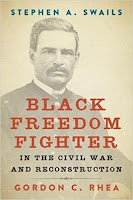
• Stephen A. Swails: Black Freedom Fighter in the Civil War and Reconstruction by Gordon C. Rhea (LSU Press, 2021).

Gordon Rhea's Stephen A. Swails is the newest volume in LSU Press's Southern Biography series, which has been producing titles since the 1930s. That makes me wonder what the longest-running university press book series might be.

Born free in Maryland in 1832 to mixed-race parents, Stephen Atkins Swails was 31 years of age when he made the life-changing decision to enlist in the 54th Massachusetts and was appointed first sergeant in Company F. Swails fought with the regiment in Florida and South Carolina, and he was promoted to second lieutenant in 1864 (though official War Department approval was not received until 1865). According to Rhea, this made Swails "the first African American commissioned as a combat officer in the United States military."

Like many other Union veterans, Swails elected to remain in the South after the war. In South Carolina, Swails "held important positions in the Freedmen’s Bureau, helped draft a progressive state constitution, served in the state senate, and secured legislation benefiting newly liberated Black citizens. Swails remained active in South Carolina politics after Reconstruction until violent Redeemers drove him from the state." After securing government employment in the nation's capital for a time, Swails returned to South Carolina. He passed away in Kingstree, SC in 1900 and was buried in Charleston.

Unusually, the publisher set aside the standard scholarly footnotes and bibliography format in this volume in favor of combining at the rear of the book a list of quotation citations with a collection of source notes/commentary organized by chapter. Perhaps that was conceived as a way to expand the biography's popular reach. What we can be assured of is Rhea's typically deep research. According to the author, little information is available about Swails's early life, but his personal papers contain "a wealth of documents, letters, and the like..." And state and national archives provided Rhea with much in the way of documentation of Swails's time with the Freedmen's Bureau and the South Carolina Senate. Thus, "(u)npublished manuscripts form the core of this book."

Thursday, February 17, 2022

Booknotes: Bluecoats

New Arrival:
• Bluecoats: The Civil War Diary of Cephas B. Hunt by Margaret M. Queen (Author-Foxglove Pr, 2022).

Bluecoats recounts the life story and Civil War experiences of author/editor Margaret Queen's ancestor (Pvt. Cephas Hunt of Company I, 112th Illinois) through the soldier's wartime diary and his memoir. Written between 1915 and 1922, Hunt's autobiography is 140 pages in length, with 40 of them closely pertaining to his Civil War experiences and based on his diary collection, the entries of which were produced on a daily basis between New Year's Day 1863 and the end of June 1865.

Queen does a fine-looking job of integrating both sources into the volume, with memoir excerpts bookending the complete diary transcription with the writer's own account of his life before and after the war. Upon discharge, Hunt reentered civilian life with success, his job-hopping career consisting of service as a US Marshal, state senator, county sheriff, and postmaster among other occupations. The volume does not have a bibliography appended to it and the historical material is not annotated, though Queen credits Hunt's personal copy of his regiment's 1885-published history as the key resource for her chapter introductions.

Hunt's diary entries range in size and depth from a brief line or two talking about the weather and various camp happenings on up to quite intensive personal accounts of events many paragraphs in length. Much like the common description of army life as long stretches of boredom punctuated by moments of excitement and terror, the former outnumber the latter. The 112th was converted to mounted infantry in early 1863, and Hunt's diary discusses his involvement in a host of western theater campaigns and events. Starting with training camp in Illinois and garrison duty in Kentucky, Hunt moves on to describing the role played by his regiment in combating Confederate raids, accompanying Burnside's Knoxville Campaign (during which he was injured and captured before successfully escaping), the Siege of Knoxville, winter patrolling in East Tennessee in 1863-64, the 1864 Atlanta Campaign, the Nashville Campaign, the final campaign in North Carolina, and the return home.

Memoir portions of the volume are supplemented with period and modern photographs, and Queen also includes transcriptions of a pair of newspaper obituaries. From initial impressions, the book looks to be a very useful resource for those seeking firsthand, private soldier accounts of the heartland campaigns referred to above as well as Union mounted operations in the western theater as a whole.

Tuesday, February 15, 2022

Review - "After Vicksburg: The Civil War on Western Waters, 1863-1865" by Myron Smith

[After Vicksburg: The Civil War on Western Waters, 1863-1865 by Myron J. Smith, Jr. (McFarland, 2021). Softcover, maps, photos, illustrations, endnotes, bibliography, index. Pages main/total:viii,252/327. ISBN:978-1-4766-7220-5. $49.95]

In now nine major Civil War books published in rapid succession over a fifteen-year period, Tusculum University emeritus library director and professor Myron Smith has documented in unprecedented fashion the stories of the builders, machines, men, and operations involved in the 1861-65 naval war conducted along the Mississippi River and its major tributaries. While what came to be called the US Navy's Mississippi Squadron is understandably Smith's primary focus, both sides have received ample attention in the series. The latest volume, After Vicksburg: The Civil War on Western Waters, 1863-1865, weaves together threads previously explored in Smith's other books with large amounts of new information.

By the end of the first half of the western naval war, a transition accentuated by the Union army and navy's capture of the Vicksburg and Port Hudson river fortresses and their clearing out of the Yazoo Delta, remaining Confederate resistance in the form of capital ship threats and support facilities capable of producing them had been largely eliminated. That next phase of the river war, which would last until the end of the conflict, would be characterized almost entirely by ship versus shore engagements of all kinds, and those matters are the focal point of this study.

Much of the material covered in the book (especially big topics such as the US naval operation that accompanied the army's push up the Red River in 1864) has been explored before in bits and pieces spread across numerous published monographs, book chapters, and articles, but After Vicksburg is the first noteworthy attempt at compiling and addressing this information in a single volume. In remarkably detailed fashion, Smith explores actions fought all across the Mississippi Squadron's area of operations, a vast area through which the Ohio, Cumberland, Tennessee, Mississippi, Arkansas, White, and Red rivers, along a host of lesser waterways, ran. Without enough remaining armed vessels to directly confront the United States's "Brown Water Navy" during this 1863-65 period, Confederate forces were largely reduced to interdiction efforts conducted by both regular and irregular forces. As Smith recounts at length, that combination did achieve some notable successes in harassing armed vessels, interfering with civilian trade, and capturing or destroying army logistical support shipping. However, as Smith and other writers note, those achievements were isolated and fleeting in nature. Confederate interdiction forces simply did not possess the resources (or high command support) necessary to seize control of any important stretch of river for more than a brief time.

Much has been written about the strengths and weaknesses of the army department and district systems of military administration employed by both sides, but far less attention has been paid to the districts comprising the Mississippi Squadron's interconnected command network. Each was headed by a trusted officer who operated semi-autonomously under a certain set of rules, one of the most important being that ships could not leave one district for another without permission from above. Smith's positive assessment agrees with those who have argued that the system worked as designed, making sure that none of the major western rivers was undefended for significant periods of time. Exceptions were few, but notable. For example, Smith is justifiably critical of the unprecedented concentration of naval forces assembled for the 1864 Red River Campaign, as that action placed the entire district defense system in disarray until those vessels returned to their stations. As a whole, though, effective Union naval district coordination across the West and Trans-Mississippi succeeded admirably in thwarting both interdicting forces and more grandiose enemy plans aimed at moving men and supplies across major rivers.

Far from scaling back their own efforts upon the successful neutralization of the Confederacy's western river fleets, the Union naval presence there was continually expanded from an original six districts to eleven (and new vessel construction continued apace). That process is thoroughly documented in the book. Smith's discussion of the creation of a new flotilla of gunboats above Muscle Shoals on the Tennessee River, a remarkable feat completed quickly and without the benefit of existing shipyard facilities, demonstrates both the strategic prioritization that the US placed in its western navy and the economic, industrial, and transportation might that went into it. In addition to some well-documented events such as the aforementioned Red River Campaign, the destructive Confederate attack on the Union logistical base at Johnsonville, and a few others, Smith's book offers excellent coverage of a great many obscure military actions involving US ships and Confederate ground forces. The claim that After Vicksburg contains more Upper Cumberland and Upper Tennessee river naval affairs information in one place than any other publication is almost certainly correct.

The end of the conflict and the demobilization of the Mississippi Squadron is also addressed in the book. Though one might have hoped for a bit more information about the last remaining major Confederate naval facility at Shreveport (especially given the enduring controversy over exactly what classes of ships and in what numbers were present there), Smith does delve into the capture of the last surviving Confederate ironclad, the Shreveport-based CSS Missouri, which was stationed on the Red River and surrendered to advancing Union forces at the end of the war. In the time-honored tradition of nineteenth and early twentieth-century American wars, western naval demobilization was far reaching and incredibly rapid. Smith recounts the collection of military shipping at designated points where the boats were stripped of armaments and armor before being immediately auctioned off to eager buyers. Though a more in-depth examination of the Mississippi Squadron's end phase is beyond the scope of this book, Smith strongly hints that those big-event auctions, in which hundreds of steamboats were sold at often rock-bottom prices, proved to be a major factor in stimulating postwar commercial revitalization and regional economic recovery.

As is the case with all of Smith's books, the research that went into this volume is impressive in the number and variety of primary and secondary sources utilized. Both the extensive endnotes and the book's nearly thirty-page biography are wonderful resources in themselves. Limited map support is the least appealing hallmark of Smith's naval histories, and we see that deficiency here as well. On the other hand, the book's pages are stuffed with a substantial photographic record of ships and men along with numerous contemporary illustrations.

After Vicksburg is the only truly comprehensive account of the much less heralded, but no less important, second half of the Civil War as it was fought afloat and alongside the West's vast river network. That marks it as one of the most essential of Smith's many in-depth contributions to the conflict's naval literature. Highly recommended.

Monday, February 14, 2022

Booknotes: Gettysburg’s Lost Love Story

New Arrival:
• Gettysburg’s Lost Love Story: The Ill-Fated Romance of General John Reynolds and Kate Hewitt by Jeffrey J. Harding (Arcadia Pub and The Hist Press, 2022).

I originally had something else planned for today but thought this new release Booknotes entry would be more appropriate, this being Valentine's Day and all.

Every regular consumer of Civil War publishing has surely encountered some mention of the tragic romance between John Reynolds and Kate Hewitt at least once in their readings. From the description: "Union general John Reynolds was one of the most beloved and respected military leaders of the Civil War, yet beyond the battlefield, the captivating true story of his secret romance with Catherine "Kate" Mary Hewitt remains etched into his legacy. Clandestinely engaged before John marched off to war, the couple's love remained a secret. Kate made a poignant "last promise," a commitment to enter into a religious life if her beloved were to be killed. Tragically, Reynolds lost his life leading troops into action during the opening phases of the Battle of Gettysburg."

The secret of her engagement with Reynolds revealed in the days following the general's shocking battlefield death, the Catholic-convert Hewitt was warmly received by the Reynolds family and, true to her promise, she entered the Daughters of Charity religious community. It is at that point that historians and writers typically end their discussion of the tragic pair, the balance of Kate's remaining life after leaving the Daughters of Charity considered lost to history. However, in his book Gettysburg’s Lost Love Story: The Ill-Fated Romance of General John Reynolds and Kate Hewitt author Jeffrey Harding reveals that his own research efforts as well as those of genealogist Mary Stanford Pitkin have together uncovered far more of the Reynolds-Hewitt story (both before and after Gettysburg) than has been portrayed in the literature.

For example, though Hewitt was considered a religious "sister" by the Daughters of Charity, she did not become an actual nun. Harding and Pitkin discovered new information about Hewitt's life before she met Reynolds (which includes some unsavory parts of her past that I'd never encountered any suggestion of before) along with fresh details of their meeting and engagement. Showing that Hewitt's story post-1868 was never truly lost but rather just waiting to be rediscovered, the book also conveys previously unknown information about Hewitt's life and marriage after leaving the Daughters of Charity as well as the location of her grave. If you always wanted to know 'the rest of the story,' this looks like the book for you.

Thursday, February 10, 2022

Booknotes: Day by Day Through the Civil War in Georgia

New Arrival:
• Day by Day Through the Civil War in Georgia by Michael K. Shaffer (Mercer UP, 2022).

From the description: "Until now, a daily account (1,630 days) of Georgia's social, political, economic, and military events during the Civil War did not exist. During the 160 years since the conflict's termination, many fine accounts of wartime Georgia have rolled off various presses. Each daily entry derives from a quill scrolling the parchment or a press imprinting type on the day the activity occurred."

Entries generally stick to a single event or topic, presumably judged by author Michael Shaffer to have been the most significant or interesting happening of the day. Nearly every entry includes some length of quoted text from a newspaper article, diary, letter, legislative resolution, government document, political speech, etc. The O.R. is heavily used as well along with a number of other published primary and secondary sources. All of the citations can be found at the bottom of the page in the footnote provided for each day. For reasons unexplained (or at least I didn't uncover more about it during my quick once over), the phases of the moon [quarter, full, new] are also marked on the applicable headings.

More from the description: "Many former reference books were too much North or too much South, but with this effort, Michael K. Shaffer strikes a balance between the combatants while remembering the struggles of enslaved persons, folks on the home front, and merchants and clergy attempting to maintain some sense of normalcy."

The volume contains around fifty pages of illustrations (including maps, paintings, photos, and drawings), all collected together in a gallery placed at the front of the book. Other supplements can be found in the appendix section. There you'll find the full texts of the state secession declaration, Alexander Stephens's "Cornerstone Speech," Georgia's constitution, and more. There's also a substantial index with an abundance of sub-headings for additional cross referencing.

Monday, February 7, 2022

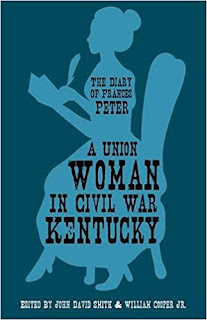
Review - "A Union Woman in Civil War Kentucky: The Diary of Frances Peter" by Smith and Cooper, eds.

[A Union Woman in Civil War Kentucky: The Diary of Frances Peter edited by John David Smith and William Cooper, Jr. (University Press of Kentucky, 2021). Softcover, photos, illustrations, footnotes, index. Pages main/total:xxxiii,203/255. ISBN:978-0-8131-5373-5. $19.95]

Between 1862 and her death in 1864 at the age of twenty-one, Frances Dallam Peter maintained a truly remarkable diary account of a divided wartime city, her hometown of Lexington, Kentucky. Selections from it were first published in 1976 under the title Window on the War. A greatly expanded hardcover edition, now titled A Union Woman in Civil War Kentucky: The Diary of Frances Peter, was published by University Press of Kentucky in 2000. In it editors John David Smith and William Cooper added a scholarly introduction and more than two hundred diary entries not found in the original 1976 publication. Smith and Cooper's lengthy introduction provides a great deal of information regarding Peter's personal and family background. It also usefully contextualizes the Peter diary's place in the evolving historiography of women's Civil War memoirs, journal writings, and letter correspondence.

Absent the revelation in the book's introduction, the reader would never know that Peter suffered from epilepsy, the neurological disorder that would ultimately take her life in August 1864. In her diary, the topic of Peter's health and how it affected her life is never raised. Unlike many other Civil War home front diaries, issues of the domestic home and family take a distant back seat to Peter's firsthand and secondhand perspectives on the outside world. Making her task easier was the fact that the square near her house was a beehive of civilian and military activity throughout the war.

Leaving her home infrequently, Peter had four main sources of city and war news to draw upon: her own observations of happenings in the square below her bedroom window, a network of informed female visitors, northern newspapers, and her father. A great many of Peter's diary entries discuss military events in and around Lexington. Union forces garrisoned Lexington in near continuous fashion, but there were several notable interludes of Confederate occupation. In typical wartime partisan expression, Peter's colorful contrast of Union and Confederate soldiers, in both their behavior and appearance, is far from favorable to the latter. Her highly descriptive account of the Confederate entry into the city during the 1862 Kentucky Campaign led by Generals Bragg and Kirby Smith is probably unsurpassed in its richness of detail. That nearly five-week occupation was by far the longest Confederate military presence in the city, and the Peter diary provides an invaluable window into that unique period.

As was often the case even among Union officers, Peter's partisan-colored observations of enemy combatants often fails to accurately distinguish between enemy regular and irregular warfare. However, her testimony to the frequency of bushwhacking incidents in near proximity to the city reminds readers of how pervasive the guerrilla conflict was in Kentucky and that it was far from exclusively confined to the countryside.

The information war is another notable aspect of Peter's diary commentary. Intercepting civilian and military couriers conveying documents between the home and fighting fronts was one of the most common and demanding tasks that Border State occupation forces had to perform, and Peter's diary puts names and dates to a great many incidents of that kind.

Union soldiers campaigning in the South often observed that the female civilians they encountered in their travels were among the most outspoken supporters of the Confederate cause, such "She-Rebels" being a source of both exasperation and amusement. Peter is a fine representative of the other side of the coin.Though it's unknown how much venom escaped from the pages of her diary and into the ears of the "secesh" she despised so much in her writing, Peter was not shy about documenting in detail her disgust when it came to her perceptions of the character, appearance, hygiene, and courage of Confederate soldiers and their Kentucky home front supporters. The neighboring Morgan family (Confederate general John Hunt Morgan being its most prominent son) became a near obsession for Peter, as she delighted in reporting incidents of arrest or harassment along with news and rumors of fresh Morgan defeats on the battlefield. In stark contrast, she had few negative things to say about northern troops who camped nearby or passed through Lexington (her sole complaint being a particularly obnoxious, in her view, regiment of "abolitionist" Michigan soldiers).

Early on, Peter shared the common outlook of Border State Unionists who viewed saving the Union as the one true goal of the war and who opposed many of the Lincoln administration's domestic war policies. However, by mid-1863 Peter appeared entirely accepting of emancipation and enrollment of free and enslaved black soldiers from her state. Though resistance in many parts of the state would prove otherwise, she also claims that previously outraged Kentuckians as a whole were rapidly getting used to the proposition, with acceptance being framed in herself and others as a practical rather than ideological transformation. During that same period, it came to be her opinion that the activities of Peace Democrats (or even Unionists expressing opposition of any kind to the edicts of the Lincoln administration and congressional mandates) equated to treason. One particular incident of interest was her recording of the local reaction in Lexington to a speech by Col. Frank Wolford proclaiming his staunch resistance to black enrollment and other government policies. Even though Wolford was a Union Army leader of proven valor, Peter welcomed his summary dismissal from the service and wished his punishment to have been much more severe.

As the war entered its second half, Peter detected a sharp increase in felonious acts such as arson and theft in the Lexington area. Other home front writers have noted similar patterns, and the progressive breakdown of law in order in relatively stable areas behind the front lines is probably worthy of further study as an element of Civil War "dark history" yet to be explored much. Local military hospital operation is another subject upon which the Peter diary offers insights. Undoubtedly, nearly all of the hospital information Peter conveys was obtained through conversations with her father, Dr. Robert Peter, who was appointed to run the US military hospitals set up around Lexington.

In addition to the general introduction mentioned above, Smith and Cooper provide footnotes to most diary entries. While some of the sources used in their annotations remind us how much the literature and historiography (especially in the area of Border State scholarship) have improved and expanded just in the last twenty years alone, it's clear a great deal of research went into providing helpful background information associated with persons, places, and events mentioned in the diary.

Though rarity in authorship and location are on their own merits highly noteworthy aspects of Peter's writing, A Union Woman in Civil War Kentucky is arguably one of the best civilian Civil War diaries of any kind. Beneath the vitriol lies a completely frank critique of local society, and the Peter diary embodies a highly informative record of Kentucky heartland military events and politics with added local flavor. Its unique depiction of day to day life in a divided city that was a major Kentucky urban center, garrison, and hospital post gives the diary enduring value as an important resource for current and future research. Hopefully, this reissue will grab the attention of those who missed this lesser-known gem the first time around.

Wednesday, February 2, 2022

Antietam Institute publications

CWBA reader Alex K. kindly passed along some news of a Summer '21 publication that I missed, Brigades of Antietam: The Union and Confederate Brigades at the Battle of Antietam (edited by Bradley Gottfried). You will surely recall Gottfried's The Brigades of Gettysburg, but this one is not the work of one author but rather a collaborative effort of "over 15 Antietam Battlefield Guides, Rangers, and seasoned Antietam volunteers."

From the description: "Using the words of enlisted men and officers, the book weaves a fascinating narrative of the role played by every unit (112 entries) from the time it began its march toward Sharpsburg to the final action at Shepherdstown. Organized by order of battle, each unit is covered in complete and exhaustive detail: where it fought, its commander, what constituted the unit, and how it performed in the campaign." Alex didn't have a copy in hand yet to tell me what he thought of it. If the specifications I've come across (8.5" x 11" hardcover nearly 500 pages in length) are correct, it's quite a doorstopper.

The book was published last summer by the Antietam Institute. I'd never heard of that organization until Alex's email, later learning from its website that it was formed just last year. According to the 'About' page, the Antietam Institute is "a member-based educational and philanthropic 501(c)(3) non-profit organization with a mission to study, collect, publish and teach about the Battle of Antietam and the Maryland Campaign of 1862." Go to their homepage [here] to learn more about their programs and other activities.

Most appropriate to discussion here on this site is the institute's publication work, which at this time includes a journal and, so far, a pair of books. The Antietam Journal: Perspectives on the 1862 Maryland Campaign will be put out twice per year, its articles "featuring the latest scholarly research, interpretation, and stories of the Maryland Campaign." As mentioned above, the Brigades of Antietam book has already been released, and their other book title, currently in the works, is The Artillery Units of Antietam. Planned for a 2022 release, the artillery study is authored by James Rosebrock and designed to be a companion book to the brigade study. It aims to provide "a comprehensive overview of every artillery unit in both armies—including all the divisional artillery batteries and Artillery Reserve of the Army of the Potomac and the divisional artillery battalions and general reserve artillery battalions of the Army of Northern Virginia." Detailed treatment of each unit will include information about "its formation and history, commander, armament, and its role in the Maryland Campaign."

Monday, January 31, 2022

Booknotes: The Carnage was Fearful

New Arrival:
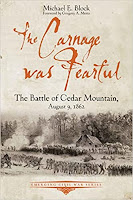
• The Carnage was Fearful: The Battle of Cedar Mountain, August 9, 1862 by Michael Block (Savas Beatie, 2022).

During the early phase of the Battle of Cedar Mountain fought on August 9, 1862, the much-maligned Union political general Nathaniel Banks achieved some surprising success against Stonewall Jackson's advancing corps before being driven from the field. From the description: "Civil War history typically breezes by the battle of Cedar Mountain, moving quickly from the Seven Days’ Battles into the Second Bull Run Campaign, but the stand-alone battle at Cedar Mountain had major implications. It saw the emergence of the Federal cavalry as an effective intelligence collector and screening force. It also provided Confederate Maj. Gen. A.P. Hill’s first opportunity to save the day—and his first opportunity to raise Jackson’s ire. Within the Federal Army, the aftermath of the battle escalated the in-fighting among generals and led to recriminations and finger-pointing over why the battle was even fought."

Drawing from his background "in developing interpretation for the Cedar Mountain battlefield," author Michael Block provides us with a new history of the battle. His book The Carnage was Fearful: The Battle of Cedar Mountain, August 9, 1862 is the latest addition to the Emerging Civil War series. The usual cornucopia of photos, drawings, and maps are present. Including the driving tour overview, there are ten maps in total. The tour presentation is segmented by chapter, tying it more closely to the narrative. There are seven main stops depicted on the tour map, but multiple sites are incorporated into each one.

The appendix collection consists of four items. The first looks at the relationship between Stonewall Jackson and A.P. Hill, the second offers an account of Jackson's crossing of Crooked Run Ford (highlighting quartermaster John Harman's colorful skills at keeping vehicle traffic moving along), the third talks about controversies that arose over the general orders issued by General Pope, and the last discusses Cedar Mountain battlefield preservation.

Robert K. Krick's Stonewall Jackson at Cedar Mountain is still the gold standard when it comes to histories of this battle, but readers that are interested in the topic but aren't up for tackling that tome should definitely give this one a look. Obviously I haven't read this particular installment yet, but the ECW series generally excels at producing these kinds of alternative options.

Friday, January 28, 2022

Booknotes: Invisible Wounds

New Arrival:
• Invisible Wounds: Mental Illness and Civil War Soldiers by Dillon Carroll (LSU Press, 2021).

From the description: Dillon Carroll’s Invisible Wounds "examines the effects of military service, particularly combat, on the psyches and emotional well-being of Civil War soldiers―Black and white, North and South. Soldiers faced harsh military discipline, arduous marches, poor rations, debilitating diseases, and the terror of battle, all of which took a severe psychological toll. While mental collapses sometimes occurred during the war, the emotional damage soldiers incurred more often became apparent in the postwar years, when it manifested itself in disturbing and self-destructive behavior."

Of course, it has always been recognized that the Civil War experience was deeply traumatic on both fighting and home fronts, but, according to Carroll, it wasn't until the 1997 publication of Eric Dean's Shook Over Hell that a scholar seriously addressed in Civil War soldiers what we identify today as post-traumatic stress disorder. Dean's comparison of Vietnam and Civil War veterans argues that members of the latter group indeed experienced much of the same emotional and psychological wounding that the former did. Since then, scholars have examined other medical, social, and cultural aspects of the war's traumas, including amputation, addiction, and suicide.

Carroll self-describes his book as "a hybrid study: part history of medicine, part social history, and part military and institutional history." The first two chapters describe and contrast the military service experiences of white and black Civil War soldiers. The institutional history referenced above is St. Elizabeth's Government Hospital for the Insane, and Carroll uses that place and the experiences of its staff as a way to show how the Union Army attempted to rehabilitate psychologically incapacitated soldiers (around 1,500 entered the hospital during the war itself). With a nod to the 'self-care' concept developed earlier by Kathryn Shively Meier, coping mechanisms of a psychological nature are also explored in the study.

Subsequent chapters examine the postwar lives of Union veterans (white and black) and ex-Confederate soldiers. Also addressed is how poverty, substance abuse, violence, and other challenges affected the families of mentally ill veterans. Finally, returning to St. Elizabeth's, the study looks at how medical professionals diagnosed and treated mental disorders in veterans and discusses how by the 1880s the emerging field of neurology developed a "deepened and more complex view of mental illness" that finally recognized etiologies based more upon science and less upon moral judgments.

In the end, Invisible Wounds provides "a sweeping reevaluation of the mental damage inflicted by the nation’s most tragic conflict."

Wednesday, January 26, 2022

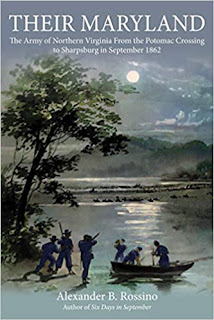
Review - "Their Maryland: The Army of Northern Virginia From the Potomac Crossing to Sharpsburg in September 1862" by Alexander Rossino

[Their Maryland: The Army of Northern Virginia From the Potomac Crossing to Sharpsburg in September 1862 by Alexander B. Rossino (Savas Beatie, 2021). Hardcover, 9 maps, photographs, illustrations, footnotes, appendix section (A-F), bibliography, index. Pages main/total:xiv,262/323. ISBN:978-1-61121-557-1. $32.95]

Pointing out that the existing volume of published Maryland Campaign and Antietam battle literature is second only to that of Gettysburg is stating the obvious, and no one is foolish enough to argue that the subject matter is understudied. However, major avenues of interpretation go in and out of style, evidence (new and old) is routinely being critically reviewed with fresh eyes, and emerging branches of history continue to engage with existing writing in ways little emphasized before or perhaps overlooked altogether. All of those factors and more ensure that coverage of any Civil War military history topic remains ever evolving and never truly settled. Created in that tenor of questioning prior assumptions and crafting alternative interpretations from existing lines of research and reasoning is Alexander Rossino's Their Maryland: The Army of Northern Virginia From the Potomac Crossing to Sharpsburg in September 1862. Based on primary sources, Rossino's chapters offer clearly different views on a number of topics. Each discussion also displays fruitful engagement with the best and most influential secondary works, notable inclusions being Joseph Harsh's multi-volume treatment of the campaign, the classic Carman manuscript (which has been edited twice for publication since 2008, first by Joseph Pierro in a single volume and soon after in a trilogy from Tom Clemens), and the first volume of Scott Harwig's exhaustive new (and still in-progress) account of the Maryland Campaign. Not another narrative-format history, Rossino's book addresses specific issues and themes related to Lee and his army in Maryland mainly through standalone discussions, though there are some connective threads present.

Confederate reasoning behind launching a late-summer offensive into Maryland in 1862 has been well explored at this point, with many interpretations acknowledging the same list of factors but differing on degree of emphasis. Using contemporary and memoir source evidence from Lee's army, Rossino powerfully argues for renewed weight being placed on Lee's hopes and expectations that his army's presence in western Maryland would lead to a pro-secession uprising and a flood of recruits. Significantly, that recentralization of political goals helps render Lee's overwhelmingly criticized decision to stand and fight at Antietam more understandable, and perhaps more rationally defensible. Lee clearly believed the military and political rewards possible from a great victory on northern soil justified hazarding a pitched battle with a major river at his back. Critics benefiting from hindsight can certainly disagree with that, and many do, but what was behind Lee's motivation to fight behind Antietam Creek is undoubtedly more complex than personal ego, meeting honor's demands, or military hubris (though the general's assumption that McClellan's army was too disorganized and demoralized to threaten the southern army with outright annihilation proved dangerously misplaced). In a lot of ways, Lee's hopes and expectations in Maryland contemporaneously mirrored Braxton Bragg's in Kentucky, though each commander reacted to the disappointing results of their respective high-risk Border State campaigns in very different ways. Given how often the specter of foreign recognition is raised as a possible outcome of Lee winning a major victory on northern soil after his army's triumphal summer campaigns in Virginia, it is curious that questions regarding whether diplomatic possibilities influenced Lee's decision-making in Maryland are left out of Rossino's political analysis, which sticks to the domestic sphere.

The next chapter plots when and where all of the major pieces of the Army of the Northern Virginia crossed the Potomac. Carefully noted are the many differences between the author's interpretations and those of prior writers and historians. Of particular moment are the places in the essay's narrative of events where Rossino's fresh examination of the sources respectfully disagrees with Harsh and Hartwig. In similar vein, Rossino also charts the locations of the camping sites of Lee's army around Frederick, which also differ in many specifics from prior accounts. While not profoundly necessary knowledge needed to gain a better understanding of the campaign as a whole, such details are shown in the book to impact at least one enduring mystery—the one revolving around who lost Special Orders No. 191, exactly where the document was left, and what its carrier might have been doing when it happened. Rossino does not pin down any of that with certainty, but his meticulous analysis of the evidence arguably widens the range of possibilities (or, to think about it a different way, narrows some probabilities).

Rossino is largely correct in arguing that today's writers, partially taking their cue from period accounts written by either mocking Unionists or disgruntled Confederates, place too much emphasis on the hostile reaction of western Maryland's population to the presence of Lee's army and their rejection of southern paper currency in exchange for food, clothing, and supplies. Referencing many examples, the author convincingly reorients the reader toward a more accurate representation of a mixed popular urban and rural reaction to hosting Confederate soldiers, and he notes that many merchants accepted Confederate money willingly. What was clear to everyone at the time, however, was that there would be no significant enrollment of Maryland men into the ranks of Lee's depleted army. Obviously, the pro-Union stance of much of the population had a lot to do with that, but the author persuasively cites the transient nature of the army's presence in the state and its outward appearance as two additional major hindrances deserving of more attention. Rossino could easily have pointed to other examples from the war, such as Sterling Price's temporary stay in western Missouri in the fall of 1861 and Bragg's aforementioned experiences in Kentucky, as proof that proslavery Border States under pro-Union state governments would yield few recruits unless Confederate armies exhibited a proven ability to displace federal military occupation long term. On the other matter, the physically worn down and bedraggled appearance of the average Confederate soldier in Lee's army by September 1862 likely chilled the ardor of many a prospective Maryland recruit. Indeed, Rossino cites several Maryland accounts that linked the state of the individual soldier with that of his cause.

One chapter returns to a recent dispute over the famous photographic image of a dense column of Confederate infantry temporarily halted in the streets of Frederick. In it Rossino offers evidence to support the traditionally accepted September 1862 date over its July 1864 challenger. For example, the direction the column is facing ranks among the more compelling pieces of evidence cited in the essay. Interestingly, there is no mention in the essay of anyone having investigated whether the Rosen dry goods and clothing store (its large business sign prominently displayed in the image) has known dates of operation, though it is nearly impossible to imagine that someone has not done that digging already.

Lee very briefly considered a return to Virginia after South Mountain before changing his mind upon hearing of Harpers Ferry's imminent fall. There is some debate over what Lee considered his remaining options to be, but Rossino argues that the evidence strongly supports the conclusion that Lee, from the 15th onward, never seriously explored alternatives beyond concentrating his army for a defensive stand behind Antietam Creek. In response to the question of why Lee (the "King of Spades") then did not entrench his army for the coming onslaught, the author cites the lack of digging tools (supposing that much or most them were sent away with the army supply trains), the rocky soil, and the constant shifting around of formations (along with the late arrival of Jackson) prior to Hooker's opening attack on the morning of the 17th as reasonable answers.

Rossino also reexamines the primary sources to trace Lee's own movements and activities on the 17th. Emphasis is placed on the moments when, after the battle proved to be desperate in nature, Lee personally involved himself in the fighting at the tactical level. As elsewhere in the book, the author carefully notes (in either main text or footnotes) where his interpretations of events and their timing differ from others (for these matters in particular, the writings of Harsh and Carman). The chapter makes a strong case that Antietam should be added to the short list of Civil War battles where Lee dangerously exposed himself at the front in order to stave off disastrous breakthrough. The discussion is also accompanied by an informative series of maps that trace Lee's likely movements throughout the day as well the locations of events described in the text.

As one can readily see from the above, there is no single thread that runs through all of Rossino's chapters; however, it is clear that one of the chief goals of the exercise is to revive the role political objectives held in Lee's mind during the planning stages of the Maryland Campaign and the general's subsequent decision to offer battle at Sharpsburg. The book's in-depth revisitation of this subject will probably leave many readers surprised to learn (if Rossino's characterization of the trend is accurate) the degree to which political considerations have fallen out of favor in recent publications. Rossino also presents a reasonably sound argument for seeing Lee's unwavering decision to make a defensive stand at Antietam not as a foolhardy gesture based on a poor reading of his enemy, but rather as a decision in close alignment with the military and political considerations behind his launching of the campaign in the first place. Casual readers might get bogged down in the drawn-out argumentation involved in some chapters, but those familiar with the campaign's major studies, even if they disagree with some links in the author's chain of analysis, will recognize the formidable nature of Rossino's evidence-based challenges to influential views on a variety of issues related to Lee's army, Lee himself, and the Maryland Campaign as planned and fought.

Sunday, January 23, 2022

Coming Soon (February '22 Edition)

**NEW RELEASES1** Scheduled for FEB 2022:

• Day by Day through the Civil War in Georgia by Michael Shaffer.
• Gettysburg’s Lost Love Story: The Ill-Fated Romance of General John Reynolds and Kate Hewitt by Jeffrey Harding.
• Lincoln and the Fight for Peace by John Avlon.
• Cleveland and the Civil War by W. Dennis Keating.
• Salmon P. Chase: Lincoln's Vital Rival by Walter Stahr.
• A House Built by Slaves: African American Visitors to the Lincoln White House by Jonathan White.
• The Great "What Ifs" of the American Civil War: Historians Tackle the Conflict’s Most Intriguing Possibilities ed. by Chris Mackowski and Brian Matthew Jordan.
• Cedar Mountain to Antietam: A Civil War Campaign History of the Union XII Corps, July–September 1862 by M. Chris Bryan.

Comments: A really slow start for 2022 CW titles, with none received so far beyond the one released early back in December. Looking a little ahead, things should pick up in March. On this short list, the Shaffer book is probably the one that catches my eye the most. I'm usually not into alternate history stuff, but the topics explored in the Mackowski/Jordan-edited book look quite interesting.

1 - These monthly release lists are not meant to be exhaustive compilations of non-fiction releases. They do not include non-revised/expanded reprints of previously published books, special editions not distributed to reviewers, and digital-only titles. Works that only tangentially address the war years are also generally excluded. Inevitably, one or more titles on this list will get a rescheduled release (and they do not get repeated later), so revisiting the past few "Coming Soon" posts is the best way to pick up stragglers.