


Paid Sponsor
Showing posts with label Reviews - Diaries/ Letters/ Memoirs. Show all posts
Showing posts with label Reviews - Diaries/ Letters/ Memoirs. Show all posts
Thursday, December 18, 2025
Review - "Saltgrass Prairie Saga: A German American Family in Texas" by Jim Burnett
[Saltgrass Prairie Saga: A German American Family in Texas by Jim Burnett (Texas A&M University Press, 2025). Hardcover, maps, photos, illustrations, endnotes, appendix section, bibliography, index. Pages main/total:xii,253/320. ISBN:978-1-64843-273-6. $35]
 During the Mexican, independent nation, and early statehood periods of its history, Texas, with its vast amount of economically useful land but having only a small population positioned to develop it, was an inviting place for enterprising American citizens and foreign immigrants alike. An abundant source of the latter were the populous German states of Central Europe, immigrant passage and administration handled by aid ventures such as the Society for the Protection of German Immigrants in Texas (to which a fee was paid by immigrants in exchange for those services). Attracted by the prospect of free land along with access to a modest dwelling and other means of becoming quickly self-sufficient within organized Texas Hill Country colonies populated by fellow Germans, large numbers of individuals and families left behind centuries-old roots for opportunities they could only dream about in their land-restricted ancestral lands. One of those risk-taking families was that of Johan (later anglicized to John) and Johanette Stengler, who, along with seven children from Johanette's current and two previous marriages (surnames Krantz and Hankamer), left their home in the village of Dietz in the fall of 1845, arriving in the port of Galveston only two days after independent Texas was formally annexed by the United States on December 29. The Stengler family's immigrant story, with central focus on the Civil War period, is the subject of Jim Burnett's Saltgrass Prairie Saga: A German American Family in Texas.
Scholarly works tasked with publishing a notable body of historical correspondence generally come in two types. The first and most common variety is to reproduce the letters in full, organize them into chapters, and contextualize them via deeply researched introductory passages, bridging narrative, and footnotes/endnotes. The other method, the less common one and the one employed by Burnett, is to incorporate the most meaningful and informative portions of the letters into a broadly researched narrative, oftentimes supplemented with extensive block quotes of particularly noteworthy firsthand material. Each style has its merits, and Burnett's value-added enhancement of the letters through material gleaned from other primary and secondary sources is seamlessly executed.
Upon landing at Galveston after a long ocean voyage, the Stenglers were immediately confronted with a conundrum of life-changing (even life-threatening) proportions. While the German immigrant aid society that brought them to Texas was generally well-organized, its end-stage resources were taxed by both funding limitations and the Texas interior's primitive infrastructure. There was no immediate means of transportation available for the Stenglers to travel with their possessions all the way to the colony's faraway location, where it was also the case that a deadly epidemic was currently raging. Faced with those challenges, John and Johanette reluctantly made the decision to abandon their free land claim in the colony and instead settle on rental property in the Saltgrass Prairie region of SE Texas. In that part of Liberty County, accessed by lake boat travel, there existed good land for farming and cattle raising along with bountiful wood and fresh water resources. Even though there were few Germans in the area and none of the family members spoke English, the gamble paid off as the Stenglers prospered in farming and ranching, eventually owning their own property and assimilating into the local culture through economic exchange and intermarriage.
With the preponderance of the Civil War-era coverage of German immigrants in Texas centered on the pro-Union Germans of the Texas Hill Country, Burnett's detailed portrait of a single Saltgrass Prairie German immigrant family is noteworthy for contrasts in both allegiance and geography. As presented by Burnett, the Stenglers's words don't reveal much in the way of political engagement and nothing on the great slavery questions of the day, so one might surmise that their support for the Confederacy was grounded in localism and determination to protect their substantial and hard-won property gains from expected Union invasion threats.
Eventually, John Stengler himself, five sons, and a son-in-law served in the Confederate Army or with Texas state troops, all surviving the war and none deserting. Most went into the mounted Company F of Spaight's Battalion, which originated in Liberty County and was primarily involved with mobile coastal defense. Philip Caudill's Moss Bluff Rebel: A Texas Pioneer in the Civil War (2009), which doubles as both Company F captain William Berry Duncan biography and unit history of Spaight's Battalion, is arguably the best single source on the battalion's Civil War activities. Interestingly, neither the Stengler nor the Hankamer name appears in its index, their absence making Burnett's study one of even more signal importance in further documenting the unit's highly peripatetic wartime history.
Walker's Texas Division (the "Greyhounds of the Trans-Mississippi") is often cited as marching the greatest total distance and, less charitably, fighting the least amount of any comparably sized Civil War formation. Burnett describes Company F in similar fashion, likening most of its Civil War service as a chess match of back and forth marching between Galveston and western Louisiana accompanied by relatively little actual fighting. The men of the company were more fortunate than their fellow Texans of Walker's division, however, in rarely venturing more than 100 miles in any direction from their SE Texas homes. The heaviest combat that Company F was engaged in was during the Battle of Bayou Bourbeau, fought during the time when they were temporarily attached to Baylor's Regiment in Louisiana for eight months in 1863 before returning to Texas the following spring. As Burnett describes in the book, most of Company F's more static service time was devoted to dull garrison duties and guarding isolated points of strategic importance (such as bridges) from enemy naval incursions and guerrilla attacks by local Unionists.
With letters both to and from Stengler's Liberty County homestead surviving, Burnett's narrative also includes a great deal of information about the home front experience. Thirteen years her husband John's senior, Johanette struggled running the farm without the working presence of her husband and sons. Like most southern households, hers also had to deal with scarcities of goods and services stemming from the exigencies of war and ever tightening naval blockade. Extended family helped, and Company F's frequent proximity also meant that serving menfolk were able to obtain short leaves of absence from the army for needed farm and ranch work. The Stengler's family network also benefited from the shooting war not directly visiting their doorsteps, though there were constant worries about roaming Confederate deserter bands and Unionist guerrilla encounters.
Burnett's narrative also extends well into the postwar period. While the Stengler-Krantz-Hankamer clan survived the war intact and managed to rebuild and expand their Saltgrass Prairie farming and cattle ranching concerns during Reconstruction, they were visited in 1877 by a devastating smallpox epidemic that killed a great many close and extended family members, including Johanette herself and numerous Wilborns and Hankamers. Nevertheless, the family persevered and its ongoing Texas legacy (which includes Baylor University's Hankamer School of Business) is revealed in the final chapter.
Saltgrass Prairie Saga's numerous contributions to Texas's state and Civil War history are of a conspicuous nature. In addition to providing a fresh angle through which to view the mid-nineteenth century German immigrant experience in Texas, Burnett's study also offers new perspectives on both the Civil War in Southeast Texas and the operations of one of that region's longest-serving and most well-traveled Confederate local defense units. Highly recommended.
During the Mexican, independent nation, and early statehood periods of its history, Texas, with its vast amount of economically useful land but having only a small population positioned to develop it, was an inviting place for enterprising American citizens and foreign immigrants alike. An abundant source of the latter were the populous German states of Central Europe, immigrant passage and administration handled by aid ventures such as the Society for the Protection of German Immigrants in Texas (to which a fee was paid by immigrants in exchange for those services). Attracted by the prospect of free land along with access to a modest dwelling and other means of becoming quickly self-sufficient within organized Texas Hill Country colonies populated by fellow Germans, large numbers of individuals and families left behind centuries-old roots for opportunities they could only dream about in their land-restricted ancestral lands. One of those risk-taking families was that of Johan (later anglicized to John) and Johanette Stengler, who, along with seven children from Johanette's current and two previous marriages (surnames Krantz and Hankamer), left their home in the village of Dietz in the fall of 1845, arriving in the port of Galveston only two days after independent Texas was formally annexed by the United States on December 29. The Stengler family's immigrant story, with central focus on the Civil War period, is the subject of Jim Burnett's Saltgrass Prairie Saga: A German American Family in Texas.
Scholarly works tasked with publishing a notable body of historical correspondence generally come in two types. The first and most common variety is to reproduce the letters in full, organize them into chapters, and contextualize them via deeply researched introductory passages, bridging narrative, and footnotes/endnotes. The other method, the less common one and the one employed by Burnett, is to incorporate the most meaningful and informative portions of the letters into a broadly researched narrative, oftentimes supplemented with extensive block quotes of particularly noteworthy firsthand material. Each style has its merits, and Burnett's value-added enhancement of the letters through material gleaned from other primary and secondary sources is seamlessly executed.
Upon landing at Galveston after a long ocean voyage, the Stenglers were immediately confronted with a conundrum of life-changing (even life-threatening) proportions. While the German immigrant aid society that brought them to Texas was generally well-organized, its end-stage resources were taxed by both funding limitations and the Texas interior's primitive infrastructure. There was no immediate means of transportation available for the Stenglers to travel with their possessions all the way to the colony's faraway location, where it was also the case that a deadly epidemic was currently raging. Faced with those challenges, John and Johanette reluctantly made the decision to abandon their free land claim in the colony and instead settle on rental property in the Saltgrass Prairie region of SE Texas. In that part of Liberty County, accessed by lake boat travel, there existed good land for farming and cattle raising along with bountiful wood and fresh water resources. Even though there were few Germans in the area and none of the family members spoke English, the gamble paid off as the Stenglers prospered in farming and ranching, eventually owning their own property and assimilating into the local culture through economic exchange and intermarriage.
With the preponderance of the Civil War-era coverage of German immigrants in Texas centered on the pro-Union Germans of the Texas Hill Country, Burnett's detailed portrait of a single Saltgrass Prairie German immigrant family is noteworthy for contrasts in both allegiance and geography. As presented by Burnett, the Stenglers's words don't reveal much in the way of political engagement and nothing on the great slavery questions of the day, so one might surmise that their support for the Confederacy was grounded in localism and determination to protect their substantial and hard-won property gains from expected Union invasion threats.
Eventually, John Stengler himself, five sons, and a son-in-law served in the Confederate Army or with Texas state troops, all surviving the war and none deserting. Most went into the mounted Company F of Spaight's Battalion, which originated in Liberty County and was primarily involved with mobile coastal defense. Philip Caudill's Moss Bluff Rebel: A Texas Pioneer in the Civil War (2009), which doubles as both Company F captain William Berry Duncan biography and unit history of Spaight's Battalion, is arguably the best single source on the battalion's Civil War activities. Interestingly, neither the Stengler nor the Hankamer name appears in its index, their absence making Burnett's study one of even more signal importance in further documenting the unit's highly peripatetic wartime history.
Walker's Texas Division (the "Greyhounds of the Trans-Mississippi") is often cited as marching the greatest total distance and, less charitably, fighting the least amount of any comparably sized Civil War formation. Burnett describes Company F in similar fashion, likening most of its Civil War service as a chess match of back and forth marching between Galveston and western Louisiana accompanied by relatively little actual fighting. The men of the company were more fortunate than their fellow Texans of Walker's division, however, in rarely venturing more than 100 miles in any direction from their SE Texas homes. The heaviest combat that Company F was engaged in was during the Battle of Bayou Bourbeau, fought during the time when they were temporarily attached to Baylor's Regiment in Louisiana for eight months in 1863 before returning to Texas the following spring. As Burnett describes in the book, most of Company F's more static service time was devoted to dull garrison duties and guarding isolated points of strategic importance (such as bridges) from enemy naval incursions and guerrilla attacks by local Unionists.
With letters both to and from Stengler's Liberty County homestead surviving, Burnett's narrative also includes a great deal of information about the home front experience. Thirteen years her husband John's senior, Johanette struggled running the farm without the working presence of her husband and sons. Like most southern households, hers also had to deal with scarcities of goods and services stemming from the exigencies of war and ever tightening naval blockade. Extended family helped, and Company F's frequent proximity also meant that serving menfolk were able to obtain short leaves of absence from the army for needed farm and ranch work. The Stengler's family network also benefited from the shooting war not directly visiting their doorsteps, though there were constant worries about roaming Confederate deserter bands and Unionist guerrilla encounters.
Burnett's narrative also extends well into the postwar period. While the Stengler-Krantz-Hankamer clan survived the war intact and managed to rebuild and expand their Saltgrass Prairie farming and cattle ranching concerns during Reconstruction, they were visited in 1877 by a devastating smallpox epidemic that killed a great many close and extended family members, including Johanette herself and numerous Wilborns and Hankamers. Nevertheless, the family persevered and its ongoing Texas legacy (which includes Baylor University's Hankamer School of Business) is revealed in the final chapter.
Saltgrass Prairie Saga's numerous contributions to Texas's state and Civil War history are of a conspicuous nature. In addition to providing a fresh angle through which to view the mid-nineteenth century German immigrant experience in Texas, Burnett's study also offers new perspectives on both the Civil War in Southeast Texas and the operations of one of that region's longest-serving and most well-traveled Confederate local defense units. Highly recommended.


Monday, July 7, 2025
Review - "Fred Grant at Vicksburg: A Boy’s Memoir at His Father’s Side During the American Civil War" by Albert Nofi, ed.
[Fred Grant at Vicksburg: A Boy’s Memoir at His Father’s Side During the American Civil War edited and annotated by Albert A. Nofi (Savas Beatie, 2025). Softcover, 2 maps, photos, illustrations, footnotes, appendix section, bibliography, index. Pages:x,146. ISBN:978-1-61121-741-4. $16.95]
 Perhaps hearkening back to the melancholy he experienced during his Old Army postings on the frontier (those feelings contributing to his decision to resign his commission in 1854), U.S. Grant arranged for the headquarters presence of close family members on numerous occasions during his celebrated Civil War service. Son Frederick Dent Grant was the frequent beneficiary of this chance of a lifetime opportunity for being present at the making of history, and, with the fulsome consent of mother Julia Dent Grant, the boy spent extensive periods of time with his father in the field. Perhaps the most event-filled of those interludes was when young Fred (12 years old at the time) joined the Grant headquarters family for the most active and decisive months of the 1863 Vicksburg Campaign. His most lengthy and detailed remembrance of that adventurous time is reproduced in editor Albert Nofi's Fred Grant at Vicksburg: A Boy’s Memoir at His Father’s Side During the American Civil War.
According to Nofi, more than a dozen versions of Fred Grant's speeches and interviews pertaining to his time in Mississippi can be viewed in print. The most comprehensive version of his wartime remembrance, and the one that forms the basis of this book, is the 18,000-word memoir account serialized by the National Tribune in 1887. In addition to organizing and transcribing that Tribune account in full, Nofi annotates the material. His footnotes identify or clarify persons, places, and events mentioned in Fred's memoir while dutifully pointing out errors in the account as well as noteworthy differences with, or omissions from, other versions. A selection of important people and places mentioned in the text are addressed at greater length in a pair of appendices as well.
It's easy to see why Fred Grant was a prize get for the Gilded Age speaking circuit. Beyond the obvious appeal of being the son of the Union Army's greatest war hero, Fred, a West Point graduate himself (Class of 1871) who eventually reached the rank of major general, was well informed on military matters in his own right. His Tribune account is a mixture of serious observation balanced by more lighthearted remembrances of boyish antics and adventures near the enemy (sometimes too close for comfort). Though obviously pro-Union in sentiment, the memoir treats friend (even comrades with whom his father sharply conflicted, such as John C. McClernand) and foe alike with an even keel.
Fred's Vicksburg account was developed well after the war ended and apparently without the fact-checking benefit of any additional source material or personal notes. As Nofi mentions, that led to a lot of mistakes in identifying persons, places, and especially dates. Events were also occasionally conflated or mistaken altogether. So what value is there to be had? The memoir definitely provides Civil War readers with a unique perspective in terms of its author being the son of the commanding general, a position that afforded him ready access and opportunity for observing and interacting with the army's high command in the middle of a critically important campaign. The boyish adventures that young Grant engaged in on multiple occasions might also interest many readers. Some anecdotes are uniquely Fred's. For instance, his account of General Grant and Admiral David Porter personally involving themselves with a shipboard test firing of a coffee mill gun, the unfortunate result of which was a fairly severe (by Fred's estimate) accidental injury to the general's hand that took some time to heal. According to Nofi, that incident, though very specific and vividly described by Fred, is mentioned nowhere in Grant's own writings nor could the editor find the incident described in any other books about Grant.
By his own account (which spans the period, with some interruption, from the end of March 1863 to just after the fall of Vicksburg), Fred seemed to have had the ability to freely attach himself to any of Grant's subordinate generals, and he apparently shared company with all the army's corps and division commanders at one time or another, witnessing most in action. He claims to have been adopted as a special "pet" by some of the Grant's officers (ex. James McPherson) and befriended an orderly that joined him on many escapades.
Fred's high command access allowed him to gain the measure of Grant's lieutenants, at least in retrospect, and he freely shares his perceptions of them in the memoir. His impressions of the personalities and abilities of important generals such as Sherman, McClernand, and McPherson closely align with the most common descriptions of those qualities passed down through history all the way to today. Of the division commanders in the Army of the Tennessee, John Logan inspired exceptional curiosity and admiration from Fred. It's interesting that he repeatedly refers to the general as "Fighting Jack," with no mention of the "Black Jack" nickname that today's students are much more familiar with in their own reading.
The absence of extensive discussion related to the Vicksburg operation's siege phase is explained by the fact that the writer was sent away during that time to recover from a festering flesh wound received earlier in the campaign. Given that camp diseases and stray bullets had no regard for rank or youth (ask Sherman about the deadly risks involved in exposing one's own child to that), it is somewhat startling to learn just how enthusiastic Julia was about continually sending Fred to be with her husband at the front, even after the boy was shot and also caught a life-threatening case of dysentery. She even amusingly justifies Grant having Fred around on campaign as being akin to Philip of Macedon mentoring a young Alexander.
This is a fine memoir of the Vicksburg Campaign written from a wholly distinctive perspective, made even more valuable through the prodigious enhancements and supplements provided by the editor.
Perhaps hearkening back to the melancholy he experienced during his Old Army postings on the frontier (those feelings contributing to his decision to resign his commission in 1854), U.S. Grant arranged for the headquarters presence of close family members on numerous occasions during his celebrated Civil War service. Son Frederick Dent Grant was the frequent beneficiary of this chance of a lifetime opportunity for being present at the making of history, and, with the fulsome consent of mother Julia Dent Grant, the boy spent extensive periods of time with his father in the field. Perhaps the most event-filled of those interludes was when young Fred (12 years old at the time) joined the Grant headquarters family for the most active and decisive months of the 1863 Vicksburg Campaign. His most lengthy and detailed remembrance of that adventurous time is reproduced in editor Albert Nofi's Fred Grant at Vicksburg: A Boy’s Memoir at His Father’s Side During the American Civil War.
According to Nofi, more than a dozen versions of Fred Grant's speeches and interviews pertaining to his time in Mississippi can be viewed in print. The most comprehensive version of his wartime remembrance, and the one that forms the basis of this book, is the 18,000-word memoir account serialized by the National Tribune in 1887. In addition to organizing and transcribing that Tribune account in full, Nofi annotates the material. His footnotes identify or clarify persons, places, and events mentioned in Fred's memoir while dutifully pointing out errors in the account as well as noteworthy differences with, or omissions from, other versions. A selection of important people and places mentioned in the text are addressed at greater length in a pair of appendices as well.
It's easy to see why Fred Grant was a prize get for the Gilded Age speaking circuit. Beyond the obvious appeal of being the son of the Union Army's greatest war hero, Fred, a West Point graduate himself (Class of 1871) who eventually reached the rank of major general, was well informed on military matters in his own right. His Tribune account is a mixture of serious observation balanced by more lighthearted remembrances of boyish antics and adventures near the enemy (sometimes too close for comfort). Though obviously pro-Union in sentiment, the memoir treats friend (even comrades with whom his father sharply conflicted, such as John C. McClernand) and foe alike with an even keel.
Fred's Vicksburg account was developed well after the war ended and apparently without the fact-checking benefit of any additional source material or personal notes. As Nofi mentions, that led to a lot of mistakes in identifying persons, places, and especially dates. Events were also occasionally conflated or mistaken altogether. So what value is there to be had? The memoir definitely provides Civil War readers with a unique perspective in terms of its author being the son of the commanding general, a position that afforded him ready access and opportunity for observing and interacting with the army's high command in the middle of a critically important campaign. The boyish adventures that young Grant engaged in on multiple occasions might also interest many readers. Some anecdotes are uniquely Fred's. For instance, his account of General Grant and Admiral David Porter personally involving themselves with a shipboard test firing of a coffee mill gun, the unfortunate result of which was a fairly severe (by Fred's estimate) accidental injury to the general's hand that took some time to heal. According to Nofi, that incident, though very specific and vividly described by Fred, is mentioned nowhere in Grant's own writings nor could the editor find the incident described in any other books about Grant.
By his own account (which spans the period, with some interruption, from the end of March 1863 to just after the fall of Vicksburg), Fred seemed to have had the ability to freely attach himself to any of Grant's subordinate generals, and he apparently shared company with all the army's corps and division commanders at one time or another, witnessing most in action. He claims to have been adopted as a special "pet" by some of the Grant's officers (ex. James McPherson) and befriended an orderly that joined him on many escapades.
Fred's high command access allowed him to gain the measure of Grant's lieutenants, at least in retrospect, and he freely shares his perceptions of them in the memoir. His impressions of the personalities and abilities of important generals such as Sherman, McClernand, and McPherson closely align with the most common descriptions of those qualities passed down through history all the way to today. Of the division commanders in the Army of the Tennessee, John Logan inspired exceptional curiosity and admiration from Fred. It's interesting that he repeatedly refers to the general as "Fighting Jack," with no mention of the "Black Jack" nickname that today's students are much more familiar with in their own reading.
The absence of extensive discussion related to the Vicksburg operation's siege phase is explained by the fact that the writer was sent away during that time to recover from a festering flesh wound received earlier in the campaign. Given that camp diseases and stray bullets had no regard for rank or youth (ask Sherman about the deadly risks involved in exposing one's own child to that), it is somewhat startling to learn just how enthusiastic Julia was about continually sending Fred to be with her husband at the front, even after the boy was shot and also caught a life-threatening case of dysentery. She even amusingly justifies Grant having Fred around on campaign as being akin to Philip of Macedon mentoring a young Alexander.
This is a fine memoir of the Vicksburg Campaign written from a wholly distinctive perspective, made even more valuable through the prodigious enhancements and supplements provided by the editor.

Thursday, May 8, 2025
Review - "From Dakota to Dixie: George Buswell's Civil War" by White & Connelly, eds.
[From Dakota to Dixie: George Buswell's Civil War edited by Jonathan W. White & Reagan Connelly (University of Virginia Press, 2025). Softcover, 3 maps, illustrations, footnotes, index. Pages main/total:xxxii,245/285. ISBN:978-0-8139-5278-9. $35]
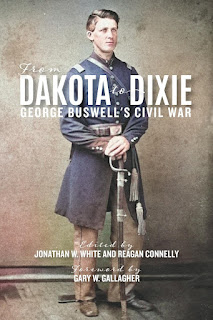 Edited volumes of Civil War soldier journals and letters continue to be published with regularity. One constant among them is the fact that the vast majority of these firsthand accounts were written by officers and enlisted men who spent the bulk of their service with the principal field armies that fought in the primary theaters of war. That's not necessarily a negative thing, and, after all, sheer numbers would dictate it, but it does make the better writings from soldiers with very different Civil War experiences all the more distinctive, insightful, and valuable. That is certainly the case with From Dakota to Dixie: George Buswell's Civil War, a far from ordinary diary edited by Jonathan White and Reagan Connelly.
In August 1862, twenty-one year old Winona County, Minnesota resident George Buswell put down his carpentry tools in response to the Lincoln administration's July call for 300,000 more volunteers and signed up as a private soldier in the newly formed Seventh Minnesota Volunteer Infantry. One need not conjecture as to why Buswell enlisted as he spells it out very clearly that he felt it his sacred duty to do his part in crushing the rebellion and restoring the "glorious old union," its flag representing "the best country that ever existed" (pp. 6-7).
Buswell's war diary begins on August 13, 1862, the date of his enlistment, and continues on a daily basis until the end of 1864. As was the case with most Union volunteers from his part of the country, young Buswell held heady aspirations of fighting great battles on the other side of the Mississippi River. However, fate had an entirely different course in mind for him, and he fully appreciated that matters closer to home needed to be dealt with first. Early diary entries describe his unit's sweep through the area of his home state most devastated by the late-summer settler massacres and subsequent Santee Sioux attacks on nearby settlements and military outposts. Buswell's diary contains a detailed firsthand account of the Battle of Wood Lake, and he also witnessed the mass execution at Mankato on December 26. Between then and the following May, Buswell mostly guarded prisoners. During his free time, he made a close study of Silas Casey's Infantry Tactics, which the editors credit as helping set him up to be a strong officer candidate later on in the war. In the spring of 1863, Buswell set out with the Sibley Expedition and spent the summer on the northern plains marching and fighting in the widening Dakota War. He provides a strong eyewitness account of the Battle of Big Mound in July, as well as the battles of Dead Buffalo Lake and Stony Lake that followed days later, with some revealing commentary on the foe's style of fighting.
Upon conclusion of the 1862-63 Dakota War, Buswell and the 7th switched theaters and opponents. Between then and the end of 1863, he spent time in Chicago, St. Louis, and Nashville. For a time, his detachment was sent on a sweep through southern Illinois to weed out bushwhackers and alleged Copperhead militants, capturing (by his count) some sixty men and a few deserters. Returning to St. Louis by late December, Buswell was determined to try his hand at obtaining an officer commission in one of the new black regiments forming in the area. He studied hard outside his office work duties and by his own account did very well during the examinations. His diligence was rewarded in the spring with a promotion to second lieutenant, though he wouldn't receive his official commission and company assignment with the 68th USCT until later.
On an interesting side note, Buswell, observing from afar, became a very early admirer of U.S. Grant, frequently commenting confidently and favorably on that general's upward career projection. It's an interesting contrast to the widespread attitude, as revealed in Jonathan Engel's recent study of the junior officers of Grant's Army of the Tennessee, among those who actually served under Grant and who maintained serious reservations about their commander until the final triumph at Vicksburg erased all doubts. Eventually, Buswell did get to see his idol in person, and one diary entry offers a pretty thorough description of Grant's personal appearance in January 1864 during that general's visit to St. Louis.
Central motivations behind seeking an officer position in a USCT regiment varied widely. On one end of the spectrum was the idealistic crusader and on the other the opportunistic seeker of personal advancement. One supposes that the great majority were guided by impulses that lay somewhere in between those two poles. Certainly, becoming a company officer in a USCT regiment offered ambitious and experienced enlisted soldiers substantial advancement up the promotional ladder, the type of leap in rank, pay, and prestige they were unlikely to obtain through staying in their white regiments. Buswell himself jumped from private to second lieutenant, and was told by those impressed by his examination results that only his age kept him from first lieutenant. His earliest remarks from this period indicate more of the practical careerist motivation, but Buswell quickly found that his new assignment profoundly altered his preconceptions about slavery and its degrading influences on human and social development. His descriptions of his men do reflect common prejudices, but he believed from the beginning that those placed under his charge would develop into good soldiers.
In June 1864, Buswell's regiment was assigned guard and picket duty in occupied Memphis. Some of the more enlightening diary passages from that time describe the extensive smuggling that passed between the lines and how Union troops stationed on the outskirts of the city (like his own) attempted to interdict that lucrative illicit trade in goods and medicines. The only major military operation that Buswell experienced that year was the Tupelo Campaign, the operation recounted at some length in his diary. Buswell was absent in the field when Confederate cavalry raider Nathan Bedford Forrest slipped behind Union lines and launched his Memphis Raid that reached the city on August 21.
The balance of 1864 was filled with routine garrison duty back in Memphis and its primary defense installation, Fort Pickering. Referencing that year's momentous presidential election, Buswell describes the reasoning behind his political transformation from Douglas Democrat to Republican supporter, placing himself fully behind Lincoln's re-election. Though he maintained respect for McClellan the soldier, he decried the influence of the peace faction during the election cycle and lost all faith in the Democratic Party.
In addition to footnotes more fully identifying persons and places mentioned in Buswell's writings as well as expanding upon referenced events and their background, editors White and Connelly contribute a fine general introduction along with chapter introductions that both review and contextualize what follows. With Buswell's diaries leaving readers hanging by inexplicably ending on December 31, 1864, the volume epilogue also briefly follows the thirteen-month remainder of Buswell's military service with the 68th. Also recounted are some details their research uncovered in regard to Buswell's postwar life, his involvement in Republican politics, and his tragic drowning death at age 80 during a steamship sinking off the Pacific coast.
If you are looking to read a Civil War diary far different from those commonly published by popular and academic presses, yet no less engaging and informative than those, this is the one for you. Between his August 1862 enlistment and his final mustering out in February 1866, George Buswell never fought with any of the war's main armies, his only sizable Civil War battle being Tupelo and only major campaign the one directed against Mobile in 1865. From Dakota warriors on the distant northern plains to guerrillas and anti-Republican militants in Illinois to St. Louis prisoners and Memphis smugglers to Forrest's cavalry in West Tennessee and northern Mississippi, the variety of wartime opponents and sheer breadth of fronts faced by Buswell during his long 1862-66 army service are highly remarkable, perhaps even unique, among Civil War diarists. Expertly framed and edited by Jonathan White and Reagan Connelly, the Buswell diary contained in From Dakota to Dixie is an extraordinary reading experience. Highly recommended.
Edited volumes of Civil War soldier journals and letters continue to be published with regularity. One constant among them is the fact that the vast majority of these firsthand accounts were written by officers and enlisted men who spent the bulk of their service with the principal field armies that fought in the primary theaters of war. That's not necessarily a negative thing, and, after all, sheer numbers would dictate it, but it does make the better writings from soldiers with very different Civil War experiences all the more distinctive, insightful, and valuable. That is certainly the case with From Dakota to Dixie: George Buswell's Civil War, a far from ordinary diary edited by Jonathan White and Reagan Connelly.
In August 1862, twenty-one year old Winona County, Minnesota resident George Buswell put down his carpentry tools in response to the Lincoln administration's July call for 300,000 more volunteers and signed up as a private soldier in the newly formed Seventh Minnesota Volunteer Infantry. One need not conjecture as to why Buswell enlisted as he spells it out very clearly that he felt it his sacred duty to do his part in crushing the rebellion and restoring the "glorious old union," its flag representing "the best country that ever existed" (pp. 6-7).
Buswell's war diary begins on August 13, 1862, the date of his enlistment, and continues on a daily basis until the end of 1864. As was the case with most Union volunteers from his part of the country, young Buswell held heady aspirations of fighting great battles on the other side of the Mississippi River. However, fate had an entirely different course in mind for him, and he fully appreciated that matters closer to home needed to be dealt with first. Early diary entries describe his unit's sweep through the area of his home state most devastated by the late-summer settler massacres and subsequent Santee Sioux attacks on nearby settlements and military outposts. Buswell's diary contains a detailed firsthand account of the Battle of Wood Lake, and he also witnessed the mass execution at Mankato on December 26. Between then and the following May, Buswell mostly guarded prisoners. During his free time, he made a close study of Silas Casey's Infantry Tactics, which the editors credit as helping set him up to be a strong officer candidate later on in the war. In the spring of 1863, Buswell set out with the Sibley Expedition and spent the summer on the northern plains marching and fighting in the widening Dakota War. He provides a strong eyewitness account of the Battle of Big Mound in July, as well as the battles of Dead Buffalo Lake and Stony Lake that followed days later, with some revealing commentary on the foe's style of fighting.
Upon conclusion of the 1862-63 Dakota War, Buswell and the 7th switched theaters and opponents. Between then and the end of 1863, he spent time in Chicago, St. Louis, and Nashville. For a time, his detachment was sent on a sweep through southern Illinois to weed out bushwhackers and alleged Copperhead militants, capturing (by his count) some sixty men and a few deserters. Returning to St. Louis by late December, Buswell was determined to try his hand at obtaining an officer commission in one of the new black regiments forming in the area. He studied hard outside his office work duties and by his own account did very well during the examinations. His diligence was rewarded in the spring with a promotion to second lieutenant, though he wouldn't receive his official commission and company assignment with the 68th USCT until later.
On an interesting side note, Buswell, observing from afar, became a very early admirer of U.S. Grant, frequently commenting confidently and favorably on that general's upward career projection. It's an interesting contrast to the widespread attitude, as revealed in Jonathan Engel's recent study of the junior officers of Grant's Army of the Tennessee, among those who actually served under Grant and who maintained serious reservations about their commander until the final triumph at Vicksburg erased all doubts. Eventually, Buswell did get to see his idol in person, and one diary entry offers a pretty thorough description of Grant's personal appearance in January 1864 during that general's visit to St. Louis.
Central motivations behind seeking an officer position in a USCT regiment varied widely. On one end of the spectrum was the idealistic crusader and on the other the opportunistic seeker of personal advancement. One supposes that the great majority were guided by impulses that lay somewhere in between those two poles. Certainly, becoming a company officer in a USCT regiment offered ambitious and experienced enlisted soldiers substantial advancement up the promotional ladder, the type of leap in rank, pay, and prestige they were unlikely to obtain through staying in their white regiments. Buswell himself jumped from private to second lieutenant, and was told by those impressed by his examination results that only his age kept him from first lieutenant. His earliest remarks from this period indicate more of the practical careerist motivation, but Buswell quickly found that his new assignment profoundly altered his preconceptions about slavery and its degrading influences on human and social development. His descriptions of his men do reflect common prejudices, but he believed from the beginning that those placed under his charge would develop into good soldiers.
In June 1864, Buswell's regiment was assigned guard and picket duty in occupied Memphis. Some of the more enlightening diary passages from that time describe the extensive smuggling that passed between the lines and how Union troops stationed on the outskirts of the city (like his own) attempted to interdict that lucrative illicit trade in goods and medicines. The only major military operation that Buswell experienced that year was the Tupelo Campaign, the operation recounted at some length in his diary. Buswell was absent in the field when Confederate cavalry raider Nathan Bedford Forrest slipped behind Union lines and launched his Memphis Raid that reached the city on August 21.
The balance of 1864 was filled with routine garrison duty back in Memphis and its primary defense installation, Fort Pickering. Referencing that year's momentous presidential election, Buswell describes the reasoning behind his political transformation from Douglas Democrat to Republican supporter, placing himself fully behind Lincoln's re-election. Though he maintained respect for McClellan the soldier, he decried the influence of the peace faction during the election cycle and lost all faith in the Democratic Party.
In addition to footnotes more fully identifying persons and places mentioned in Buswell's writings as well as expanding upon referenced events and their background, editors White and Connelly contribute a fine general introduction along with chapter introductions that both review and contextualize what follows. With Buswell's diaries leaving readers hanging by inexplicably ending on December 31, 1864, the volume epilogue also briefly follows the thirteen-month remainder of Buswell's military service with the 68th. Also recounted are some details their research uncovered in regard to Buswell's postwar life, his involvement in Republican politics, and his tragic drowning death at age 80 during a steamship sinking off the Pacific coast.
If you are looking to read a Civil War diary far different from those commonly published by popular and academic presses, yet no less engaging and informative than those, this is the one for you. Between his August 1862 enlistment and his final mustering out in February 1866, George Buswell never fought with any of the war's main armies, his only sizable Civil War battle being Tupelo and only major campaign the one directed against Mobile in 1865. From Dakota warriors on the distant northern plains to guerrillas and anti-Republican militants in Illinois to St. Louis prisoners and Memphis smugglers to Forrest's cavalry in West Tennessee and northern Mississippi, the variety of wartime opponents and sheer breadth of fronts faced by Buswell during his long 1862-66 army service are highly remarkable, perhaps even unique, among Civil War diarists. Expertly framed and edited by Jonathan White and Reagan Connelly, the Buswell diary contained in From Dakota to Dixie is an extraordinary reading experience. Highly recommended.

Thursday, August 15, 2024
Review - "New Fields of Adventure: The Writings of Lyman G. Bennett, Civil War Soldier and Topographical Engineer, 1861–1865" by M. Jane Johansson, editor
[New Fields of Adventure: The Writings of Lyman G. Bennett, Civil War Soldier and Topographical Engineer, 1861–1865 edited by M. Jane Johansson (University of Tennessee Press, 2024). Softcover, maps, photos, illustrations, endnotes, bibliography, index. Pages main/total:xxiv,298/399. ISBN:978-1-62190-861-6. $39.95]
 Big picture investigation of Civil War military engineering has drawn increased attention from scholars over the past quarter century. Given the viewpoint expressed in his book Engineering Victory: How Technology Won the Civil War (2016), Thomas Army is arguably the most vigorous proponent of the idea that the vast disparity between North and South in the areas of formal engineering education, practitioner pools, technology, and resources was a primary (and even perhaps the key) factor in Union victory. While Army's case is compelling on a number of levels, it is also clear through studies such as Larry Daniel's Engineering in the Confederate Heartland (2022) and Saxon Bisbee's Engines of Rebellion: Confederate Ironclads and Steam Engineering in the American Civil War (2018) that impressive feats of military engineering effort and skill were not entirely beyond the limited capabilities of the South. Examples of relatively recent works focusing on military engineering's role during specific campaigns are Earl Hess's excellent series of books published between 2005 and 2018 that cover field fortifications in the eastern theater and the western theater's Atlanta Campaign. Justin Solonick's Engineering Victory: The Union Siege of Vicksburg (2015) is equally insightful. Histories of specialized engineering units have also emerged during this time, two examples being Mark Hoffman's "My Brave Mechanics": The First Michigan Engineers and Their Civil War (2007) and Patterson's Independent Company of Engineers and Mechanics 1861-1865 (2020) by Charles Bogart.
Scholarly editing and publication of the writings of Union engineers is another major feature of this expanding body of literature. Correspondence from one of the war's most celebrated military engineers can be studied through Paul Taylor's My Dear Nelly: The Selected Civil War Letters of General Orlando M. Poe to His Wife Eleanor (2020). Also in 2020, University of Tennessee Press published A Volunteer in the Regulars: The Civil War Journal and Memoir of Gilbert Thompson, US Engineer Battalion (edited by Mark Smith) through their Voices of the Civil War series. Another Voices title of similar vein is the subject of this review, M. Jane Johansson's New Fields of Adventure: The Writings of Lyman G. Bennett, Civil War Soldier and Topographical Engineer, 1861–1865. Johansson's volume possesses the added distinction of being the rare military engineering volume centered on the Trans-Mississippi theater, not only Missouri, Arkansas, and Kansas but the Great Plains and Mountain West as well.
Married at the end of 1859 and a father by the outbreak of the Civil War, Connecticut-born Illinoisan Lyman Gibson Bennett derived the bulk of his personal income from surveying, an in-demand skill that would place him in good stead during the coming conflict. He enlisted in the Thirty-Sixth Illinois, and by the fall of 1861 found himself in Rolla, Missouri, a town located at the terminus of the Southwestern Branch of the Pacific Railroad. Rolla's location made it one of the state's most strategically important posts, and Bennett's surveying skills were immediately put to use in the construction of Fort Lyman and in mapping the surrounding countryside. Johansson very aptly describes Bennett's writing style as being similar to a "travelogue." Indeed, Bennett's engaging prose combined with his lengthy and highly detailed descriptions of physical distances between points of interest, the weather, the natural landscape (and its most prominent geographical features), habitations, and developmental improvements are a prime feature of all of his writings and serve as a veritable goldmine of historical information for today's readers and scholars. Perhaps only the late John Bradbury, the foremost expert on Civil War Rolla, could have told us for certain, but it seems likely that Bennett's extensive diary of this period is the most notable single source behind our knowledge of the critical early-war period in and around that center of transportation and military occupation. Significantly, unlike so many other Civil War diary, letter, and journal writers, Bennett was also very willing to 'talk shop,' detailing for readers the instruments he used and processes he followed for accurately estimating distances, laying out fortifications, and platting out the countryside for military use.
Soon, Bennett's engineering skills brought him to the attention of higher ups, and after a brief hospital stay in St. Louis he returned to active service, rejoining his regiment as it crossed into northwest Arkansas with General Samuel Curtis's Army of the Southwest. In addition to describing the increasing levels of devastating observed during his march to the front, during which he was also detailed to lead a side expedition, Bennett also offers very extensive eyewitness accounts of the battles of Bentonville and Pea Ridge. In hailing Bennett's account of his experiences during the Battle of Pea Ridge, Johansson is certainly not exaggerating the depth and significance of it as one of the most enlightening ones written by a soldier serving in the ranks. His regiment, the Thirty-Sixth Illinois, was a key contributor to Union success in the highly consequential Oberson's Field sector on March 7, 1862. There, its skirmishers essentially decapitated the Confederate high command in that area of the sprawling battlefield by killing in close succession generals Ben McCulloch and second in command James McIntosh. An admirer of General Franz Sigel, Bennett also vividly describes his regiment's participation in the March 8 counterattack that routed the Confederate army and produced, by many accounts, Sigel's best day as a Civil War general. After the battle Bennett formally joined Curtis's staff and performed topographical engineering duties during the army's long march across northern Arkansas.
Returning to St. Louis to finalize his maps, Bennett became bored with department headquarters desk work and received a commission to raise troops in northwest Arkansas. His two-part memoir "Recruiting in Dixie," written in the 1870s, vividly recounts his dangerous entry and recruitment adventures in that guerrilla-infested part of the state, where anti-Confederate "Mounted Feds" enlisted and fought in large numbers. While tall tales of enemy atrocities abound, readers nevertheless gain a clear sense of the societal breakdown that occurred in a mountainous region where lethal violence was common on and off the battlefield and household neutrality impossible to maintain. Bennett eventually was promoted to major of the Fourth Arkansas Cavalry (US), and his writings offer useful firsthand perspectives on operations in the area. Hand in hand with those accounts are rather sharp opinions of the region's backwardness (at least in comparison to his own views of elevated civilization). Citing what he felt to have been "unjust prejudice against northern officers" (pg. 232), Bennett resigned his commission near the end of 1864.
In 1865, Bennett returned to the war, this time as a civilian contract engineer. As his diaries reveal, Bennett surveyed battlefields from the recently concluded Price Expedition as well as government lands in eastern Kansas. Those intimately familiar with the atlas to the O.R. will immediately recognize the former. In a remarkable journey spanning, by Johansson's estimate, two thousand miles, Bennett then followed the overland trail across Nebraska and into Colorado (with a detour to observe the territory's gold fields). He also was sent on a mission to survey fortifications at Fort Laramie in Wyoming, Dakota Territory. Though those journeys were full of danger from Indian raids, extreme weather, and frontier privation, Bennett's typical curiosity and colorful travelogue style of writing remained intact. Finding no need to return to the Bennett material already well covered by another scholar [see David Wagner's Powder River Odyssey: Nelson Cole's Western Campaign of 1865 - The Journals of Lyman G. Bennett and Other Eyewitness Accounts (2009)], Johansson's examination ends in April 1865.
Johansson's professionalism in compiling, arranging, and editing the Bennett writings is exemplary. She puts her own considerable primary and secondary source research to good use in the volume's illuminating chapter introductions, the epilogue, and endnotes. The notes provide consistent source and background information on persons, places, and events described in Bennett's writing while also offering corrections to Bennett's factual mistakes. Johansson also makes sure to include as many of Bennett's surviving maps and drawings as possible, noting that copyright precluded reproduction of the artwork Bennett produced for his "Personal Reminiscences," one part of which was the aforementioned "Recruiting in Dixie."
Bennett's Civil War writings and Jane Johansson's expert editing of them for scholarly publication should draw interest from a broad range of readers, among them those concerned with the major military campaigns of the Trans-Mississippi West, the role of military engineering in both the conduct and historical documentation of those campaigns, and the hardships and military contributions of the Unionist minority in Arkansas. This fresh Voices of the Civil War series title is very highly recommended.
Big picture investigation of Civil War military engineering has drawn increased attention from scholars over the past quarter century. Given the viewpoint expressed in his book Engineering Victory: How Technology Won the Civil War (2016), Thomas Army is arguably the most vigorous proponent of the idea that the vast disparity between North and South in the areas of formal engineering education, practitioner pools, technology, and resources was a primary (and even perhaps the key) factor in Union victory. While Army's case is compelling on a number of levels, it is also clear through studies such as Larry Daniel's Engineering in the Confederate Heartland (2022) and Saxon Bisbee's Engines of Rebellion: Confederate Ironclads and Steam Engineering in the American Civil War (2018) that impressive feats of military engineering effort and skill were not entirely beyond the limited capabilities of the South. Examples of relatively recent works focusing on military engineering's role during specific campaigns are Earl Hess's excellent series of books published between 2005 and 2018 that cover field fortifications in the eastern theater and the western theater's Atlanta Campaign. Justin Solonick's Engineering Victory: The Union Siege of Vicksburg (2015) is equally insightful. Histories of specialized engineering units have also emerged during this time, two examples being Mark Hoffman's "My Brave Mechanics": The First Michigan Engineers and Their Civil War (2007) and Patterson's Independent Company of Engineers and Mechanics 1861-1865 (2020) by Charles Bogart.
Scholarly editing and publication of the writings of Union engineers is another major feature of this expanding body of literature. Correspondence from one of the war's most celebrated military engineers can be studied through Paul Taylor's My Dear Nelly: The Selected Civil War Letters of General Orlando M. Poe to His Wife Eleanor (2020). Also in 2020, University of Tennessee Press published A Volunteer in the Regulars: The Civil War Journal and Memoir of Gilbert Thompson, US Engineer Battalion (edited by Mark Smith) through their Voices of the Civil War series. Another Voices title of similar vein is the subject of this review, M. Jane Johansson's New Fields of Adventure: The Writings of Lyman G. Bennett, Civil War Soldier and Topographical Engineer, 1861–1865. Johansson's volume possesses the added distinction of being the rare military engineering volume centered on the Trans-Mississippi theater, not only Missouri, Arkansas, and Kansas but the Great Plains and Mountain West as well.
Married at the end of 1859 and a father by the outbreak of the Civil War, Connecticut-born Illinoisan Lyman Gibson Bennett derived the bulk of his personal income from surveying, an in-demand skill that would place him in good stead during the coming conflict. He enlisted in the Thirty-Sixth Illinois, and by the fall of 1861 found himself in Rolla, Missouri, a town located at the terminus of the Southwestern Branch of the Pacific Railroad. Rolla's location made it one of the state's most strategically important posts, and Bennett's surveying skills were immediately put to use in the construction of Fort Lyman and in mapping the surrounding countryside. Johansson very aptly describes Bennett's writing style as being similar to a "travelogue." Indeed, Bennett's engaging prose combined with his lengthy and highly detailed descriptions of physical distances between points of interest, the weather, the natural landscape (and its most prominent geographical features), habitations, and developmental improvements are a prime feature of all of his writings and serve as a veritable goldmine of historical information for today's readers and scholars. Perhaps only the late John Bradbury, the foremost expert on Civil War Rolla, could have told us for certain, but it seems likely that Bennett's extensive diary of this period is the most notable single source behind our knowledge of the critical early-war period in and around that center of transportation and military occupation. Significantly, unlike so many other Civil War diary, letter, and journal writers, Bennett was also very willing to 'talk shop,' detailing for readers the instruments he used and processes he followed for accurately estimating distances, laying out fortifications, and platting out the countryside for military use.
Soon, Bennett's engineering skills brought him to the attention of higher ups, and after a brief hospital stay in St. Louis he returned to active service, rejoining his regiment as it crossed into northwest Arkansas with General Samuel Curtis's Army of the Southwest. In addition to describing the increasing levels of devastating observed during his march to the front, during which he was also detailed to lead a side expedition, Bennett also offers very extensive eyewitness accounts of the battles of Bentonville and Pea Ridge. In hailing Bennett's account of his experiences during the Battle of Pea Ridge, Johansson is certainly not exaggerating the depth and significance of it as one of the most enlightening ones written by a soldier serving in the ranks. His regiment, the Thirty-Sixth Illinois, was a key contributor to Union success in the highly consequential Oberson's Field sector on March 7, 1862. There, its skirmishers essentially decapitated the Confederate high command in that area of the sprawling battlefield by killing in close succession generals Ben McCulloch and second in command James McIntosh. An admirer of General Franz Sigel, Bennett also vividly describes his regiment's participation in the March 8 counterattack that routed the Confederate army and produced, by many accounts, Sigel's best day as a Civil War general. After the battle Bennett formally joined Curtis's staff and performed topographical engineering duties during the army's long march across northern Arkansas.
Returning to St. Louis to finalize his maps, Bennett became bored with department headquarters desk work and received a commission to raise troops in northwest Arkansas. His two-part memoir "Recruiting in Dixie," written in the 1870s, vividly recounts his dangerous entry and recruitment adventures in that guerrilla-infested part of the state, where anti-Confederate "Mounted Feds" enlisted and fought in large numbers. While tall tales of enemy atrocities abound, readers nevertheless gain a clear sense of the societal breakdown that occurred in a mountainous region where lethal violence was common on and off the battlefield and household neutrality impossible to maintain. Bennett eventually was promoted to major of the Fourth Arkansas Cavalry (US), and his writings offer useful firsthand perspectives on operations in the area. Hand in hand with those accounts are rather sharp opinions of the region's backwardness (at least in comparison to his own views of elevated civilization). Citing what he felt to have been "unjust prejudice against northern officers" (pg. 232), Bennett resigned his commission near the end of 1864.
In 1865, Bennett returned to the war, this time as a civilian contract engineer. As his diaries reveal, Bennett surveyed battlefields from the recently concluded Price Expedition as well as government lands in eastern Kansas. Those intimately familiar with the atlas to the O.R. will immediately recognize the former. In a remarkable journey spanning, by Johansson's estimate, two thousand miles, Bennett then followed the overland trail across Nebraska and into Colorado (with a detour to observe the territory's gold fields). He also was sent on a mission to survey fortifications at Fort Laramie in Wyoming, Dakota Territory. Though those journeys were full of danger from Indian raids, extreme weather, and frontier privation, Bennett's typical curiosity and colorful travelogue style of writing remained intact. Finding no need to return to the Bennett material already well covered by another scholar [see David Wagner's Powder River Odyssey: Nelson Cole's Western Campaign of 1865 - The Journals of Lyman G. Bennett and Other Eyewitness Accounts (2009)], Johansson's examination ends in April 1865.
Johansson's professionalism in compiling, arranging, and editing the Bennett writings is exemplary. She puts her own considerable primary and secondary source research to good use in the volume's illuminating chapter introductions, the epilogue, and endnotes. The notes provide consistent source and background information on persons, places, and events described in Bennett's writing while also offering corrections to Bennett's factual mistakes. Johansson also makes sure to include as many of Bennett's surviving maps and drawings as possible, noting that copyright precluded reproduction of the artwork Bennett produced for his "Personal Reminiscences," one part of which was the aforementioned "Recruiting in Dixie."
Bennett's Civil War writings and Jane Johansson's expert editing of them for scholarly publication should draw interest from a broad range of readers, among them those concerned with the major military campaigns of the Trans-Mississippi West, the role of military engineering in both the conduct and historical documentation of those campaigns, and the hardships and military contributions of the Unionist minority in Arkansas. This fresh Voices of the Civil War series title is very highly recommended.

Thursday, February 22, 2024
Review - "The Folly and the Madness: The Civil War Letters of Captain Orlando S. Palmer, Fifteenth Arkansas Infantry" edited by Thomas Cutrer
[The Folly and the Madness: The Civil War Letters of Captain Orlando S. Palmer, Fifteenth Arkansas Infantry edited by Thomas W. Cutrer (University of Tennessee Press, 2023). Softcover, 4 maps, photos, illustrations, notes, bibliography, index. Pages main/total:154/230. ISBN:978-1-62190-841-8. $39]
 The Folly and the Madness: The Civil War Letters of Captain Orlando S. Palmer, Fifteenth Arkansas Infantry is a recent installment from University of Tennessee Press's venerable Voices of the Civil War series. In the main, the volume consists of secession period and wartime letters from lawyer and Civil War officer Orlando Palmer (1833-1864) to his younger sister Artimisia Palmer. The experience of being orphaned relatively early in life (Orlando was eleven when his father died, and the pair's mother passed away six years later) seems to have fostered a very tight emotional bond between the two. Orlando's letters to Missie (as his sister was called) are consistently encouraging and deeply solicitous of her welfare.
As explained in editor Thomas Cutrer's introduction, the Palmers were raised in northern Alabama near the border with Tennessee. When Orlando moved away, first to briefly attend Cumberland School of Law in Tennessee and then to start his professional career in Des Arc, Arkansas, Artimisia lived with their grandparents in Florence, Alabama. In addition to filling in background information and context for the letters that follow, Cutrer also introduces readers to the Palmer's extended family network, which is helpful as he uses the letters of first cousin Oliver Kennedy to fill in some of the considerable time and content gaps in the Palmer correspondence. Though Orlando displays some sympathies with Fire-eater politics and joined a local militia company for presumably more than just social reasons, he did not look forward to nor did he anticipate war between the sections, which he deemed "folly" and "madness." After tidying up his law practice affairs, he enlisted in what would become the Fifteenth Arkansas Volunteer Infantry. No doubt influenced by his education, background, and rising reputation in the legal field, administrative postings took Palmer out of the ranks and into brigade headquarters. Indeed, he was employed by a succession of generals, his roles including secretary to William J. Hardee and brigade adjutant to Sterling A.M. Wood and successor Mark Lowrey.
Though ground-level military perspectives are obviously narrow with very limited knowledge of larger affairs, the opinions of intelligent lower-ranking officers regarding superior officers in the same army are always interesting to read. While Palmer does not describe his adjutant duties to his sister in any detail, his headquarters positions presumably afforded him some personal access to the higher echelons of western theater generals. Palmer's very negative first impression of Hardee's haughty treatment of him as the general's personal secretary was quickly replaced by esteem. Beyond the Arkansas connection, it should come as no surprise that Patrick Cleburne is described in glowing terms. Though one wishes he had explained his views in more depth, Palmer positively gushes about Simon Bolivar Buckner, proclaiming him to be the officer that he prefers over all others. Presumably that opinion grew out of personal interactions or observations made during the prolonged early-war occupation of Bowling Green, Kentucky. Palmer also viewed Army of Tennessee commander Braxton Bragg as a competent leader and expressed no wish to join that general's list of abusers and detractors that grew as the war progressed. Even after the disaster at Chattanooga, not a single negative word about Bragg's leadership can be found in Palmer's letters, only confidence in the future. This reinforces the research conclusions of recent biographer Earl Hess and others before him who have strongly challenged the traditional notion in the literature that Bragg was deeply unpopular. Somewhat curiously, beyond general comments expressing how agreeable their working and personal relationships were, Palmer writes relatively little about Brig. Gen. S.A.M. Wood, the man whom he directly served in the capacity of brigade adjutant before Wood resigned between Chickamauga and Chattanooga (and was replaced by newly promoted general Mark Lowrey, who kept Palmer on in the same post).
As mentioned before, there are significant gaps in Palmer's correspondence, and Cutrer gamely tries to fill them with letters from family members, most prominently a first cousin named Oliver Kennedy. One particularly lengthy gap (which filled much of 1862) was between Bowling Green and the aftermath of the 1862 Kentucky Campaign. Palmer's serious leg wound suffered at Shiloh was undoubtedly a major factor in making letter writing less of a priority, but it is unfortunate to have no letters from such a critical, event-filled period. In fact, Palmer's body of correspondence consistently leaves large gaps around major movements and battles, which is understandable on his part but frustrating for future readers. For example, it is unfortunate that Palmer, who correctly anticipated that Union Army of the Cumberland commander William S. Rosecrans would attempt to outflank Tullahoma's built-up defenses, did not write about the actual campaign of maneuver once it started nor did he describe for his sister the pitched battle at Chickamauga that followed it. Though it's possible such letters once existed, it is October 1863 before known correspondence from Palmer picks up again. He does offer some brief observations regarding the fighting experiences of his own brigade and division at Tunnel Hill and Ringgold, but once again demurs when it comes to offering more detailed information. Anticipating his sister's interest in the battle fought and lost along Missionary Ridge, Palmer offers the common refrain ["I am not prepared to give you a general description of the battle, not being sufficiently informed to do so with any satisfaction" (pg. 129)]. A few letters follow from the period of the 1864 Atlanta Campaign, most notably a short description of the June 27 fight at Kennesaw Mountain. Palmer's letter writing campaign ended on June 29, with no surviving correspondence existing between that day and his death in action five months later during the November 30, 1864 assault at Franklin.
Due to what would quickly become a permanent detachment from his regiment to brigade headquarters, the Palmer letters as a whole will not greatly satisfy readers hoping to find an extensive personal record of wartime service with the 15th Arkansas. The letters contain a great deal of the typical content found in Civil War correspondence, including descriptions of personal health, inquiries about the well-being of extended family members, news from home, and gossip. A unique facet of Orlando Palmer's letters are his continual attempts at assuaging his sister's melancholy, the mindful tenderness and frequency of which leads the editor to surmise that Missie suffered from what we might diagnose today as clinical depression (though we can never know that for certain). Courtship rituals and behavioral mores regarding relations between men and women are also common subjects of discussion, prodigious commentary and advice apparently coming from both sides of the letter exchange. Palmer also repeatedly enjoins his sister to expand her horizons of independence.
In terms of editorial duties, Cutrer contributes the aforementioned chapter-length introduction and helps bridge the more extended time gaps with helpful contextual narrative. Additional context can be found in the volume's frequently lengthy explanatory endnotes. In this particular collection of soldier letters, cultural and societal insights outnumber military ones, but it's a solid entry in a series that always manages to sustain its reputation for masterful curation of Civil War primary source materials.
The Folly and the Madness: The Civil War Letters of Captain Orlando S. Palmer, Fifteenth Arkansas Infantry is a recent installment from University of Tennessee Press's venerable Voices of the Civil War series. In the main, the volume consists of secession period and wartime letters from lawyer and Civil War officer Orlando Palmer (1833-1864) to his younger sister Artimisia Palmer. The experience of being orphaned relatively early in life (Orlando was eleven when his father died, and the pair's mother passed away six years later) seems to have fostered a very tight emotional bond between the two. Orlando's letters to Missie (as his sister was called) are consistently encouraging and deeply solicitous of her welfare.
As explained in editor Thomas Cutrer's introduction, the Palmers were raised in northern Alabama near the border with Tennessee. When Orlando moved away, first to briefly attend Cumberland School of Law in Tennessee and then to start his professional career in Des Arc, Arkansas, Artimisia lived with their grandparents in Florence, Alabama. In addition to filling in background information and context for the letters that follow, Cutrer also introduces readers to the Palmer's extended family network, which is helpful as he uses the letters of first cousin Oliver Kennedy to fill in some of the considerable time and content gaps in the Palmer correspondence. Though Orlando displays some sympathies with Fire-eater politics and joined a local militia company for presumably more than just social reasons, he did not look forward to nor did he anticipate war between the sections, which he deemed "folly" and "madness." After tidying up his law practice affairs, he enlisted in what would become the Fifteenth Arkansas Volunteer Infantry. No doubt influenced by his education, background, and rising reputation in the legal field, administrative postings took Palmer out of the ranks and into brigade headquarters. Indeed, he was employed by a succession of generals, his roles including secretary to William J. Hardee and brigade adjutant to Sterling A.M. Wood and successor Mark Lowrey.
Though ground-level military perspectives are obviously narrow with very limited knowledge of larger affairs, the opinions of intelligent lower-ranking officers regarding superior officers in the same army are always interesting to read. While Palmer does not describe his adjutant duties to his sister in any detail, his headquarters positions presumably afforded him some personal access to the higher echelons of western theater generals. Palmer's very negative first impression of Hardee's haughty treatment of him as the general's personal secretary was quickly replaced by esteem. Beyond the Arkansas connection, it should come as no surprise that Patrick Cleburne is described in glowing terms. Though one wishes he had explained his views in more depth, Palmer positively gushes about Simon Bolivar Buckner, proclaiming him to be the officer that he prefers over all others. Presumably that opinion grew out of personal interactions or observations made during the prolonged early-war occupation of Bowling Green, Kentucky. Palmer also viewed Army of Tennessee commander Braxton Bragg as a competent leader and expressed no wish to join that general's list of abusers and detractors that grew as the war progressed. Even after the disaster at Chattanooga, not a single negative word about Bragg's leadership can be found in Palmer's letters, only confidence in the future. This reinforces the research conclusions of recent biographer Earl Hess and others before him who have strongly challenged the traditional notion in the literature that Bragg was deeply unpopular. Somewhat curiously, beyond general comments expressing how agreeable their working and personal relationships were, Palmer writes relatively little about Brig. Gen. S.A.M. Wood, the man whom he directly served in the capacity of brigade adjutant before Wood resigned between Chickamauga and Chattanooga (and was replaced by newly promoted general Mark Lowrey, who kept Palmer on in the same post).
As mentioned before, there are significant gaps in Palmer's correspondence, and Cutrer gamely tries to fill them with letters from family members, most prominently a first cousin named Oliver Kennedy. One particularly lengthy gap (which filled much of 1862) was between Bowling Green and the aftermath of the 1862 Kentucky Campaign. Palmer's serious leg wound suffered at Shiloh was undoubtedly a major factor in making letter writing less of a priority, but it is unfortunate to have no letters from such a critical, event-filled period. In fact, Palmer's body of correspondence consistently leaves large gaps around major movements and battles, which is understandable on his part but frustrating for future readers. For example, it is unfortunate that Palmer, who correctly anticipated that Union Army of the Cumberland commander William S. Rosecrans would attempt to outflank Tullahoma's built-up defenses, did not write about the actual campaign of maneuver once it started nor did he describe for his sister the pitched battle at Chickamauga that followed it. Though it's possible such letters once existed, it is October 1863 before known correspondence from Palmer picks up again. He does offer some brief observations regarding the fighting experiences of his own brigade and division at Tunnel Hill and Ringgold, but once again demurs when it comes to offering more detailed information. Anticipating his sister's interest in the battle fought and lost along Missionary Ridge, Palmer offers the common refrain ["I am not prepared to give you a general description of the battle, not being sufficiently informed to do so with any satisfaction" (pg. 129)]. A few letters follow from the period of the 1864 Atlanta Campaign, most notably a short description of the June 27 fight at Kennesaw Mountain. Palmer's letter writing campaign ended on June 29, with no surviving correspondence existing between that day and his death in action five months later during the November 30, 1864 assault at Franklin.
Due to what would quickly become a permanent detachment from his regiment to brigade headquarters, the Palmer letters as a whole will not greatly satisfy readers hoping to find an extensive personal record of wartime service with the 15th Arkansas. The letters contain a great deal of the typical content found in Civil War correspondence, including descriptions of personal health, inquiries about the well-being of extended family members, news from home, and gossip. A unique facet of Orlando Palmer's letters are his continual attempts at assuaging his sister's melancholy, the mindful tenderness and frequency of which leads the editor to surmise that Missie suffered from what we might diagnose today as clinical depression (though we can never know that for certain). Courtship rituals and behavioral mores regarding relations between men and women are also common subjects of discussion, prodigious commentary and advice apparently coming from both sides of the letter exchange. Palmer also repeatedly enjoins his sister to expand her horizons of independence.
In terms of editorial duties, Cutrer contributes the aforementioned chapter-length introduction and helps bridge the more extended time gaps with helpful contextual narrative. Additional context can be found in the volume's frequently lengthy explanatory endnotes. In this particular collection of soldier letters, cultural and societal insights outnumber military ones, but it's a solid entry in a series that always manages to sustain its reputation for masterful curation of Civil War primary source materials.

Friday, June 23, 2023
Review - " I Am Fighting for the Union: The Civil War Letters of Naval Officer Henry Willis Wells " edited by Robert Browning
[I Am Fighting for the Union: The Civil War Letters of Naval Officer Henry Willis Wells edited by Robert M. Browning, Jr. (University of Alabama Press, 2023). Paperback, maps, photos, illustrations, notes, bibliography, index. Pages main/total:xxxiii,304/368. ISBN:978-0-8173-6105-1. $34.95]
 When eminent Union Navy historian (and retired chief historian of the U.S. Coast Guard) Robert Browning was researching his monumental studies of the North Atlantic, South Atlantic, and West Gulf Blockading Squadrons, he uncovered (or rediscovered) a true gem in the service correspondence of Henry Willis Wells. Born in Cambridge, Massachusetts, Wells was twenty years of age when he was appointed Master's Mate on the USS Cambridge in August 1861. Assigned at various times to the Cambridge, Ceres, Montgomery, Gem of the Seas, Rosalie, and finally Annie, the young junior officer found himself at a number of important naval stations between Norfolk, Virginia and the southwest coast of Florida. In performance of his duties, Wells gained a broad perspective of the U.S. Navy's blockade enforcement between the summer of 1861 and his untimely demise at the end of 1864.
Henry left behind for posterity over 200 letters to his family, the depth of which offer today's Civil War navy researchers a treasure trove of information. Their value is enhanced through Browning's endnotes, which identify individuals, vessels, places, and events mentioned in the letters. The frequency of Wells's letter writing and the depth of his observations leave behind an invaluable record of the day to day life of a junior officer on blockade duty during the Civil War. When discussing both major and minor events, Wells often expounds at great length. For example, he wrote a very long and detailed account of his observations of the famous Hampton Roads engagement of 1862. In that letter, Wells also describes his own ship's actions in suppressing enemy shore batteries and escorting a disabled vessel to safety. Much of Well's service was spent in the rivers and sounds of tidewater North Carolina, and he also penned a detailed account of the fighting there at Washington in 1863. In that engagement, Wells commanded a naval shore battery that helped repel the Confederate attack, and for that success he earned well-deserved plaudits. Numerous incidents of blockade enforcement are detailed in the Wells letters. In writing about failures to catch incoming or outgoing runners, Wells was frequently critical of a perceived lack of drive at the captain level. Henry also participated in a number of shore landings, and during one of those actions he was captured while trying to save a launch caught in the surf. Fortunately for him, the period of incarceration within the walls of the infamous Libby Prison was relatively brief.
Occupying a middle position within a Civil War navy ship's hierarchy of rank from captain on down to landsman, Wells interacted on a daily basis with senior officers and ordinary seamen alike. Writing from that perspective reveals many insights into shipboard life, crew relations, and, as often occurred, internal tensions. As referenced above, Wells was frequently critical of the officers above him and was not afraid to air his grievances aloud. In addition to questioning the competence and aggressiveness of more than one captain, Wells on multiple occasions expresses anger and dismay at his seemingly blocked path to promotion. At one point, his captain refused to write a letter of recommendation due to Henry's age, even though men younger than Wells, and with far less seafaring experience (before or during the war), were promoted around him. Like many frustrated officers in the blockading service, Wells pined to test his mettle in ship versus ship action aboard a modern man-of-war. But that was not to be.
When eminent Union Navy historian (and retired chief historian of the U.S. Coast Guard) Robert Browning was researching his monumental studies of the North Atlantic, South Atlantic, and West Gulf Blockading Squadrons, he uncovered (or rediscovered) a true gem in the service correspondence of Henry Willis Wells. Born in Cambridge, Massachusetts, Wells was twenty years of age when he was appointed Master's Mate on the USS Cambridge in August 1861. Assigned at various times to the Cambridge, Ceres, Montgomery, Gem of the Seas, Rosalie, and finally Annie, the young junior officer found himself at a number of important naval stations between Norfolk, Virginia and the southwest coast of Florida. In performance of his duties, Wells gained a broad perspective of the U.S. Navy's blockade enforcement between the summer of 1861 and his untimely demise at the end of 1864.
Henry left behind for posterity over 200 letters to his family, the depth of which offer today's Civil War navy researchers a treasure trove of information. Their value is enhanced through Browning's endnotes, which identify individuals, vessels, places, and events mentioned in the letters. The frequency of Wells's letter writing and the depth of his observations leave behind an invaluable record of the day to day life of a junior officer on blockade duty during the Civil War. When discussing both major and minor events, Wells often expounds at great length. For example, he wrote a very long and detailed account of his observations of the famous Hampton Roads engagement of 1862. In that letter, Wells also describes his own ship's actions in suppressing enemy shore batteries and escorting a disabled vessel to safety. Much of Well's service was spent in the rivers and sounds of tidewater North Carolina, and he also penned a detailed account of the fighting there at Washington in 1863. In that engagement, Wells commanded a naval shore battery that helped repel the Confederate attack, and for that success he earned well-deserved plaudits. Numerous incidents of blockade enforcement are detailed in the Wells letters. In writing about failures to catch incoming or outgoing runners, Wells was frequently critical of a perceived lack of drive at the captain level. Henry also participated in a number of shore landings, and during one of those actions he was captured while trying to save a launch caught in the surf. Fortunately for him, the period of incarceration within the walls of the infamous Libby Prison was relatively brief.
Occupying a middle position within a Civil War navy ship's hierarchy of rank from captain on down to landsman, Wells interacted on a daily basis with senior officers and ordinary seamen alike. Writing from that perspective reveals many insights into shipboard life, crew relations, and, as often occurred, internal tensions. As referenced above, Wells was frequently critical of the officers above him and was not afraid to air his grievances aloud. In addition to questioning the competence and aggressiveness of more than one captain, Wells on multiple occasions expresses anger and dismay at his seemingly blocked path to promotion. At one point, his captain refused to write a letter of recommendation due to Henry's age, even though men younger than Wells, and with far less seafaring experience (before or during the war), were promoted around him. Like many frustrated officers in the blockading service, Wells pined to test his mettle in ship versus ship action aboard a modern man-of-war. But that was not to be.
On the Cambridge, Henry's complaints about fellow officers and his constant war with messmates over food matters indicate he might have been a difficult person to get along with when disagreements arose. One officer he did unabashedly admire was Lt. William Gwin, who, as students of the Brown Water Navy well know, subsequently made a name for himself commanding gunboats on the western waters before meeting his end in action there. Wells practically worshiped his memory. In his mind, none of the other officers which which he served during the war measured up to Gwin's example. As mentioned in his letters, Wells was strongly antislavery in sentiment and ideology. Nevertheless, he was dismayed to learn that someone on the home front accused him of being a Copperhead. While Wells was skeptical of black citizenship and equality, he felt nothing but contempt for Peace Democrats and was angered that his loyalty was being questioned back home. On an interesting related note, Wells expresses thanks that the crew with which he served at the time of the presidential election of 1864 was not able to vote in it, as polling of his shipmates indicated that McClellan would have been the clear winner over Lincoln. Eventually, Wells's exemplary service would earn him promotion to Acting Ensign and his own ship commands in late 1864, first with the Rosalie and then the Annie (both rather modest tenders). While at sea commanding the latter, Wells and the entire crew were lost, assumed killed during what investigators concluded to be a magazine explosion of unknown origin. With the tragic event leaving no witnesses nor wreckage to be examined today with modern forensics, the full story of the Annie's demise remains a mystery that will never be definitively solved. Though Henry Wells was never able to live the life he might have imagined for himself, his letters leave behind a richly informative legacy of Civil War naval service that historian Robert Browning has significantly rescued from obscurity. In terms of sheer numbers, the body of published Union naval correspondence remains disproportionately small in comparison to that of those who wrote about their army service, but the Wells letter collection at least qualitatively narrows that unfortunate gap. Worthy of the highest recommendation, I Am Fighting for the Union is a letter collection possessing value rarely equaled in the entire Civil War naval library.

On the Cambridge, Henry's complaints about fellow officers and his constant war with messmates over food matters indicate he might have been a difficult person to get along with when disagreements arose. One officer he did unabashedly admire was Lt. William Gwin, who, as students of the Brown Water Navy well know, subsequently made a name for himself commanding gunboats on the western waters before meeting his end in action there. Wells practically worshiped his memory. In his mind, none of the other officers which which he served during the war measured up to Gwin's example. As mentioned in his letters, Wells was strongly antislavery in sentiment and ideology. Nevertheless, he was dismayed to learn that someone on the home front accused him of being a Copperhead. While Wells was skeptical of black citizenship and equality, he felt nothing but contempt for Peace Democrats and was angered that his loyalty was being questioned back home. On an interesting related note, Wells expresses thanks that the crew with which he served at the time of the presidential election of 1864 was not able to vote in it, as polling of his shipmates indicated that McClellan would have been the clear winner over Lincoln. Eventually, Wells's exemplary service would earn him promotion to Acting Ensign and his own ship commands in late 1864, first with the Rosalie and then the Annie (both rather modest tenders). While at sea commanding the latter, Wells and the entire crew were lost, assumed killed during what investigators concluded to be a magazine explosion of unknown origin. With the tragic event leaving no witnesses nor wreckage to be examined today with modern forensics, the full story of the Annie's demise remains a mystery that will never be definitively solved. Though Henry Wells was never able to live the life he might have imagined for himself, his letters leave behind a richly informative legacy of Civil War naval service that historian Robert Browning has significantly rescued from obscurity. In terms of sheer numbers, the body of published Union naval correspondence remains disproportionately small in comparison to that of those who wrote about their army service, but the Wells letter collection at least qualitatively narrows that unfortunate gap. Worthy of the highest recommendation, I Am Fighting for the Union is a letter collection possessing value rarely equaled in the entire Civil War naval library.
Monday, February 7, 2022
Review - "A Union Woman in Civil War Kentucky: The Diary of Frances Peter" by Smith and Cooper, eds.
[A Union Woman in Civil War Kentucky: The Diary of Frances Peter edited by John David Smith and William Cooper, Jr. (University Press of Kentucky, 2021). Softcover, photos, illustrations, footnotes, index. Pages main/total:xxxiii,203/255. ISBN:978-0-8131-5373-5. $19.95]
 Between 1862 and her death in 1864 at the age of twenty-one, Frances Dallam Peter maintained a truly remarkable diary account of a divided wartime city, her hometown of Lexington, Kentucky. Selections from it were first published in 1976 under the title Window on the War. A greatly expanded hardcover edition, now titled A Union Woman in Civil War Kentucky: The Diary of Frances Peter, was published by University Press of Kentucky in 2000. In it editors John David Smith and William Cooper added a scholarly introduction and more than two hundred diary entries not found in the original 1976 publication. Smith and Cooper's lengthy introduction provides a great deal of information regarding Peter's personal and family background. It also usefully contextualizes the Peter diary's place in the evolving historiography of women's Civil War memoirs, journal writings, and letter correspondence.
Absent the revelation in the book's introduction, the reader would never know that Peter suffered from epilepsy, the neurological disorder that would ultimately take her life in August 1864. In her diary, the topic of Peter's health and how it affected her life is never raised. Unlike many other Civil War home front diaries, issues of the domestic home and family take a distant back seat to Peter's firsthand and secondhand perspectives on the outside world. Making her task easier was the fact that the square near her house was a beehive of civilian and military activity throughout the war.
Leaving her home infrequently, Peter had four main sources of city and war news to draw upon: her own observations of happenings in the square below her bedroom window, a network of informed female visitors, northern newspapers, and her father. A great many of Peter's diary entries discuss military events in and around Lexington. Union forces garrisoned Lexington in near continuous fashion, but there were several notable interludes of Confederate occupation. In typical wartime partisan expression, Peter's colorful contrast of Union and Confederate soldiers, in both their behavior and appearance, is far from favorable to the latter. Her highly descriptive account of the Confederate entry into the city during the 1862 Kentucky Campaign led by Generals Bragg and Kirby Smith is probably unsurpassed in its richness of detail. That nearly five-week occupation was by far the longest Confederate military presence in the city, and the Peter diary provides an invaluable window into that unique period.
As was often the case even among Union officers, Peter's partisan-colored observations of enemy combatants often fails to accurately distinguish between enemy regular and irregular warfare. However, her testimony to the frequency of bushwhacking incidents in near proximity to the city reminds readers of how pervasive the guerrilla conflict was in Kentucky and that it was far from exclusively confined to the countryside.
The information war is another notable aspect of Peter's diary commentary. Intercepting civilian and military couriers conveying documents between the home and fighting fronts was one of the most common and demanding tasks that Border State occupation forces had to perform, and Peter's diary puts names and dates to a great many incidents of that kind.
Union soldiers campaigning in the South often observed that the female civilians they encountered in their travels were among the most outspoken supporters of the Confederate cause, such "She-Rebels" being a source of both exasperation and amusement. Peter is a fine representative of the other side of the coin.Though it's unknown how much venom escaped from the pages of her diary and into the ears of the "secesh" she despised so much in her writing, Peter was not shy about documenting in detail her disgust when it came to her perceptions of the character, appearance, hygiene, and courage of Confederate soldiers and their Kentucky home front supporters. The neighboring Morgan family (Confederate general John Hunt Morgan being its most prominent son) became a near obsession for Peter, as she delighted in reporting incidents of arrest or harassment along with news and rumors of fresh Morgan defeats on the battlefield. In stark contrast, she had few negative things to say about northern troops who camped nearby or passed through Lexington (her sole complaint being a particularly obnoxious, in her view, regiment of "abolitionist" Michigan soldiers).
Early on, Peter shared the common outlook of Border State Unionists who viewed saving the Union as the one true goal of the war and who opposed many of the Lincoln administration's domestic war policies. However, by mid-1863 Peter appeared entirely accepting of emancipation and enrollment of free and enslaved black soldiers from her state. Though resistance in many parts of the state would prove otherwise, she also claims that previously outraged Kentuckians as a whole were rapidly getting used to the proposition, with acceptance being framed in herself and others as a practical rather than ideological transformation. During that same period, it came to be her opinion that the activities of Peace Democrats (or even Unionists expressing opposition of any kind to the edicts of the Lincoln administration and congressional mandates) equated to treason. One particular incident of interest was her recording of the local reaction in Lexington to a speech by Col. Frank Wolford proclaiming his staunch resistance to black enrollment and other government policies. Even though Wolford was a Union Army leader of proven valor, Peter welcomed his summary dismissal from the service and wished his punishment to have been much more severe.
As the war entered its second half, Peter detected a sharp increase in felonious acts such as arson and theft in the Lexington area. Other home front writers have noted similar patterns, and the progressive breakdown of law in order in relatively stable areas behind the front lines is probably worthy of further study as an element of Civil War "dark history" yet to be explored much. Local military hospital operation is another subject upon which the Peter diary offers insights. Undoubtedly, nearly all of the hospital information Peter conveys was obtained through conversations with her father, Dr. Robert Peter, who was appointed to run the US military hospitals set up around Lexington.
In addition to the general introduction mentioned above, Smith and Cooper provide footnotes to most diary entries. While some of the sources used in their annotations remind us how much the literature and historiography (especially in the area of Border State scholarship) have improved and expanded just in the last twenty years alone, it's clear a great deal of research went into providing helpful background information associated with persons, places, and events mentioned in the diary.
Though rarity in authorship and location are on their own merits highly noteworthy aspects of Peter's writing, A Union Woman in Civil War Kentucky is arguably one of the best civilian Civil War diaries of any kind. Beneath the vitriol lies a completely frank critique of local society, and the Peter diary embodies a highly informative record of Kentucky heartland military events and politics with added local flavor. Its unique depiction of day to day life in a divided city that was a major Kentucky urban center, garrison, and hospital post gives the diary enduring value as an important resource for current and future research. Hopefully, this reissue will grab the attention of those who missed this lesser-known gem the first time around.
Between 1862 and her death in 1864 at the age of twenty-one, Frances Dallam Peter maintained a truly remarkable diary account of a divided wartime city, her hometown of Lexington, Kentucky. Selections from it were first published in 1976 under the title Window on the War. A greatly expanded hardcover edition, now titled A Union Woman in Civil War Kentucky: The Diary of Frances Peter, was published by University Press of Kentucky in 2000. In it editors John David Smith and William Cooper added a scholarly introduction and more than two hundred diary entries not found in the original 1976 publication. Smith and Cooper's lengthy introduction provides a great deal of information regarding Peter's personal and family background. It also usefully contextualizes the Peter diary's place in the evolving historiography of women's Civil War memoirs, journal writings, and letter correspondence.
Absent the revelation in the book's introduction, the reader would never know that Peter suffered from epilepsy, the neurological disorder that would ultimately take her life in August 1864. In her diary, the topic of Peter's health and how it affected her life is never raised. Unlike many other Civil War home front diaries, issues of the domestic home and family take a distant back seat to Peter's firsthand and secondhand perspectives on the outside world. Making her task easier was the fact that the square near her house was a beehive of civilian and military activity throughout the war.
Leaving her home infrequently, Peter had four main sources of city and war news to draw upon: her own observations of happenings in the square below her bedroom window, a network of informed female visitors, northern newspapers, and her father. A great many of Peter's diary entries discuss military events in and around Lexington. Union forces garrisoned Lexington in near continuous fashion, but there were several notable interludes of Confederate occupation. In typical wartime partisan expression, Peter's colorful contrast of Union and Confederate soldiers, in both their behavior and appearance, is far from favorable to the latter. Her highly descriptive account of the Confederate entry into the city during the 1862 Kentucky Campaign led by Generals Bragg and Kirby Smith is probably unsurpassed in its richness of detail. That nearly five-week occupation was by far the longest Confederate military presence in the city, and the Peter diary provides an invaluable window into that unique period.
As was often the case even among Union officers, Peter's partisan-colored observations of enemy combatants often fails to accurately distinguish between enemy regular and irregular warfare. However, her testimony to the frequency of bushwhacking incidents in near proximity to the city reminds readers of how pervasive the guerrilla conflict was in Kentucky and that it was far from exclusively confined to the countryside.
The information war is another notable aspect of Peter's diary commentary. Intercepting civilian and military couriers conveying documents between the home and fighting fronts was one of the most common and demanding tasks that Border State occupation forces had to perform, and Peter's diary puts names and dates to a great many incidents of that kind.
Union soldiers campaigning in the South often observed that the female civilians they encountered in their travels were among the most outspoken supporters of the Confederate cause, such "She-Rebels" being a source of both exasperation and amusement. Peter is a fine representative of the other side of the coin.Though it's unknown how much venom escaped from the pages of her diary and into the ears of the "secesh" she despised so much in her writing, Peter was not shy about documenting in detail her disgust when it came to her perceptions of the character, appearance, hygiene, and courage of Confederate soldiers and their Kentucky home front supporters. The neighboring Morgan family (Confederate general John Hunt Morgan being its most prominent son) became a near obsession for Peter, as she delighted in reporting incidents of arrest or harassment along with news and rumors of fresh Morgan defeats on the battlefield. In stark contrast, she had few negative things to say about northern troops who camped nearby or passed through Lexington (her sole complaint being a particularly obnoxious, in her view, regiment of "abolitionist" Michigan soldiers).
Early on, Peter shared the common outlook of Border State Unionists who viewed saving the Union as the one true goal of the war and who opposed many of the Lincoln administration's domestic war policies. However, by mid-1863 Peter appeared entirely accepting of emancipation and enrollment of free and enslaved black soldiers from her state. Though resistance in many parts of the state would prove otherwise, she also claims that previously outraged Kentuckians as a whole were rapidly getting used to the proposition, with acceptance being framed in herself and others as a practical rather than ideological transformation. During that same period, it came to be her opinion that the activities of Peace Democrats (or even Unionists expressing opposition of any kind to the edicts of the Lincoln administration and congressional mandates) equated to treason. One particular incident of interest was her recording of the local reaction in Lexington to a speech by Col. Frank Wolford proclaiming his staunch resistance to black enrollment and other government policies. Even though Wolford was a Union Army leader of proven valor, Peter welcomed his summary dismissal from the service and wished his punishment to have been much more severe.
As the war entered its second half, Peter detected a sharp increase in felonious acts such as arson and theft in the Lexington area. Other home front writers have noted similar patterns, and the progressive breakdown of law in order in relatively stable areas behind the front lines is probably worthy of further study as an element of Civil War "dark history" yet to be explored much. Local military hospital operation is another subject upon which the Peter diary offers insights. Undoubtedly, nearly all of the hospital information Peter conveys was obtained through conversations with her father, Dr. Robert Peter, who was appointed to run the US military hospitals set up around Lexington.
In addition to the general introduction mentioned above, Smith and Cooper provide footnotes to most diary entries. While some of the sources used in their annotations remind us how much the literature and historiography (especially in the area of Border State scholarship) have improved and expanded just in the last twenty years alone, it's clear a great deal of research went into providing helpful background information associated with persons, places, and events mentioned in the diary.
Though rarity in authorship and location are on their own merits highly noteworthy aspects of Peter's writing, A Union Woman in Civil War Kentucky is arguably one of the best civilian Civil War diaries of any kind. Beneath the vitriol lies a completely frank critique of local society, and the Peter diary embodies a highly informative record of Kentucky heartland military events and politics with added local flavor. Its unique depiction of day to day life in a divided city that was a major Kentucky urban center, garrison, and hospital post gives the diary enduring value as an important resource for current and future research. Hopefully, this reissue will grab the attention of those who missed this lesser-known gem the first time around.
Tuesday, July 6, 2021
Review - "The Civil War Memoir of a Boy from Baltimore: The Remembrance of George C. Maguire, Written in 1893" by Holly Powers, ed.
[The Civil War Memoir of a Boy from Baltimore: The Remembrance of George C. Maguire, Written in 1893 edited by Holly I. Powers (University of Tennessee Press, 2021). Hardcover, photos, drawings, notes, bibliography, index. Pages:xxvi,133. ISBN:978-1-62190-335-2. $45]
 A great multitude of underage soldiers served in the fighting ranks of Civil War armies of both sides (some estimates maintain that one-fifth of all Union soldiers were under the prescribed age of eighteen at enlistment). Impressed by the promise of grand adventure or any of a number of additional motivating factors, other boys too young to shoulder a rifle accompanied regiments as drummer boys or unit "mascots" looked after by the older officers and men. Mascots that demonstrated maturity beyond their years could even be assigned a certain degree of real responsibility in either official or unofficial roles. This was the case with Baltimore's George C. Maguire. Though his own deeds attained far less fame than those of some other Union child soldiers such as John Clem (a.k.a. "Johnny Shiloh"), Orion P. Howe, or Manny Root, young Maguire nevertheless contributed to the war in ways no less worthy of recognition. With the publication of The Civil War Memoir of a Boy from Baltimore: The Remembrance of George C. Maguire, Written in 1893, the newest volume in University of Tennessee Press's Voices of the Civil War series, a great many Civil War readers can now be fully exposed to Maguire's wartime activities through the efforts of editor Holly Powers.
In his memoir Maguire claimed to be "around 12" years of age when Fort Sumter was fired upon, but Powers's examination of census records indicates that he would have been closer to 14. The memoir's earliest wartime remembrances include observations of the violent 1861 rioting in Maguire's native Baltimore, made perhaps most interesting to today's readers for the writer's unconventional determination that the infamous assaults on passing Union soldiers were primarily motivated by false assumptions about the war and over two-thirds of the perpetrators would eventually see the error of their ways and enthusiastically join the Union Army. How Maguire arrived at such a number is unknown, but perhaps, as he came from a solidly pro-Union family, he wanted to present his fellow Baltimoreans in a more favorable (i.e. more loyal) light.
Maguire was allowed/invited to join his brother-in-law Lt. Salome Marsh (whom he lived with before the war) and two brothers in the Fifth Maryland, a volunteer infantry regiment that received its training at nearby Camp LaFayette and first field assignment at Fort Monroe in Virginia. The regiment did not participate in any of the Peninsula and Seven Days battles, and Maguire relates mostly boyish adventures on the Hampton Roads stretch of the Virginia Peninsula. However, during the 1862 Maryland Campaign Maguire would in more earnest begin his transformation from army tourist to active participant. He came under fire at Antietam (the Fifth was involved in the Second Corps attack on the Bloody Lane) and assisted the regimental surgeon in caring for the wounded. Traumatized by the experience, he returned home to Baltimore and reentered school. However, Maguire quickly became bored with the routine of home and school life, and rejoined the regiment at the end of 1862.
At the time of Maguire's return the Fifth was part of the Harpers Ferry garrison, and Lt. Marsh was provost marshal. Marsh employed the educated Maguire as an office clerk with document-issuing powers, and Maguire's memoir offers an eventful picture of Potomac River smuggling operations and the inner workings of the pass system for civilians traveling both directions through Harpers Ferry. This job would be his final one at the front. In June 1863, Maguire left the regiment altogether and returned home. There would be one final attempt to rejoin the war, though. Tempted by the considerable allure of the high fees being paid to late-war substitutes, Maguire tried to engage a broker in the city but was rejected.
In 1865, Maguire obtained employment at Maryland's new Thomas Hicks United States General Hospital. Impressed by his wartime experience (slim as it was) and his education, staff assigned Maguire a posting as Ward Master, and he was even given Medical Cadet status by the supervising physician as a way to allow Maguire to assume expanded duties related to direct patient care. Though this part of the memoir is relatively brief, it contains a number of empathetic patient stories as well as useful information regarding the layout and operation of the hospital. A number of Maguire's sketches are reproduced in the book, and the ones related to the hospital are the most revealing.
The memoir itself is a quick read, running sixty pages in the book. As part of her editorial duties, Powers contributes a scholarly introduction, a chapter-length conclusion, and extensive endnotes to the volume. Quite expansive discussions of persons, objects, places, and events are contained in her notes, and the editor frequently found in her research documented confirmation of Maguire's experiences and observations. Over the past few decades, the Civil War scholarship has examined in far more depth than ever before the many ways in which children engaged with the Civil War and were affected by it (most readers will be at least familiar with James Marten's work, but there are many others), and The Civil War Memoir of a Boy from Baltimore is another strong resource and contribution to that subfield.
A great multitude of underage soldiers served in the fighting ranks of Civil War armies of both sides (some estimates maintain that one-fifth of all Union soldiers were under the prescribed age of eighteen at enlistment). Impressed by the promise of grand adventure or any of a number of additional motivating factors, other boys too young to shoulder a rifle accompanied regiments as drummer boys or unit "mascots" looked after by the older officers and men. Mascots that demonstrated maturity beyond their years could even be assigned a certain degree of real responsibility in either official or unofficial roles. This was the case with Baltimore's George C. Maguire. Though his own deeds attained far less fame than those of some other Union child soldiers such as John Clem (a.k.a. "Johnny Shiloh"), Orion P. Howe, or Manny Root, young Maguire nevertheless contributed to the war in ways no less worthy of recognition. With the publication of The Civil War Memoir of a Boy from Baltimore: The Remembrance of George C. Maguire, Written in 1893, the newest volume in University of Tennessee Press's Voices of the Civil War series, a great many Civil War readers can now be fully exposed to Maguire's wartime activities through the efforts of editor Holly Powers.
In his memoir Maguire claimed to be "around 12" years of age when Fort Sumter was fired upon, but Powers's examination of census records indicates that he would have been closer to 14. The memoir's earliest wartime remembrances include observations of the violent 1861 rioting in Maguire's native Baltimore, made perhaps most interesting to today's readers for the writer's unconventional determination that the infamous assaults on passing Union soldiers were primarily motivated by false assumptions about the war and over two-thirds of the perpetrators would eventually see the error of their ways and enthusiastically join the Union Army. How Maguire arrived at such a number is unknown, but perhaps, as he came from a solidly pro-Union family, he wanted to present his fellow Baltimoreans in a more favorable (i.e. more loyal) light.
Maguire was allowed/invited to join his brother-in-law Lt. Salome Marsh (whom he lived with before the war) and two brothers in the Fifth Maryland, a volunteer infantry regiment that received its training at nearby Camp LaFayette and first field assignment at Fort Monroe in Virginia. The regiment did not participate in any of the Peninsula and Seven Days battles, and Maguire relates mostly boyish adventures on the Hampton Roads stretch of the Virginia Peninsula. However, during the 1862 Maryland Campaign Maguire would in more earnest begin his transformation from army tourist to active participant. He came under fire at Antietam (the Fifth was involved in the Second Corps attack on the Bloody Lane) and assisted the regimental surgeon in caring for the wounded. Traumatized by the experience, he returned home to Baltimore and reentered school. However, Maguire quickly became bored with the routine of home and school life, and rejoined the regiment at the end of 1862.
At the time of Maguire's return the Fifth was part of the Harpers Ferry garrison, and Lt. Marsh was provost marshal. Marsh employed the educated Maguire as an office clerk with document-issuing powers, and Maguire's memoir offers an eventful picture of Potomac River smuggling operations and the inner workings of the pass system for civilians traveling both directions through Harpers Ferry. This job would be his final one at the front. In June 1863, Maguire left the regiment altogether and returned home. There would be one final attempt to rejoin the war, though. Tempted by the considerable allure of the high fees being paid to late-war substitutes, Maguire tried to engage a broker in the city but was rejected.
In 1865, Maguire obtained employment at Maryland's new Thomas Hicks United States General Hospital. Impressed by his wartime experience (slim as it was) and his education, staff assigned Maguire a posting as Ward Master, and he was even given Medical Cadet status by the supervising physician as a way to allow Maguire to assume expanded duties related to direct patient care. Though this part of the memoir is relatively brief, it contains a number of empathetic patient stories as well as useful information regarding the layout and operation of the hospital. A number of Maguire's sketches are reproduced in the book, and the ones related to the hospital are the most revealing.
The memoir itself is a quick read, running sixty pages in the book. As part of her editorial duties, Powers contributes a scholarly introduction, a chapter-length conclusion, and extensive endnotes to the volume. Quite expansive discussions of persons, objects, places, and events are contained in her notes, and the editor frequently found in her research documented confirmation of Maguire's experiences and observations. Over the past few decades, the Civil War scholarship has examined in far more depth than ever before the many ways in which children engaged with the Civil War and were affected by it (most readers will be at least familiar with James Marten's work, but there are many others), and The Civil War Memoir of a Boy from Baltimore is another strong resource and contribution to that subfield.

Wednesday, June 16, 2021
Review - "Life in the Mississippi Marine Brigade: The Civil War Diary of George Painter" by Beverly Kerr, ed.
[Life in the Mississippi Marine Brigade: The Civil War Diary of George Painter edited by Beverly Wencek Kerr (Author, 2020). Softcover, diary images, bibliography. Pages:xi,240. ISBN:979-8-559686-03-5. $14.95]
 Consisting of an infantry battalion, a cavalry battalion, and an artillery battery (all transported by the Ellet ram fleet), the regiment-sized Mississippi Marine Brigade assumed a number of notable combat and support roles up and down its namesake river. Organized during the winter of 1862-63 and independent of both army and navy hierarchies over most of its existence, the MMB proved useful as an all-arms, amphibious strike force before its unfortunate penchant for looting and indiscriminate destruction led to it being disbanded in August 1864. Not much has been published about the Mississippi Marine Brigade in book-length format during or subsequent to the near century that passed between former MMB captains Isaac Newell and Warren Crandall's History of the Ram Fleet and the Mississippi Marine Brigade in the War for the Union on the Mississippi and Its Tributaries: The Story of the Ellets and Their Men (1907) and Chester Hearns's Ellet's Brigade: The Strangest Outfit of All (2000). Published letters and diaries are similarly scarce. Norman E. Clarke edited the correspondence of one of the formation's most prominent officers and published the book in 1961 under the title Warfare Along the Mississippi: The Letters of Lieutenant Colonel George E. Currie, but there is little else*. That dearth of available works makes Beverly Kerr's Life in the Mississippi Marine Brigade: The Civil War Diary of George Painter all the more valuable to the western theater literature.
At first glance it might seem that service in the Mississippi Marine Brigade would be attractive, but filling the ranks proved highly difficult. Eventually, recruiting officers had to resort to visiting hospital wards to sign up medical transfers and discharges, their pitch being that service in the unit would be less than arduous. One of those recruits was Private George Painter, who suffered multiple typhoid complications and remained sickly throughout his enlistment. He joined the MMB in January 1863 and immediately started a daily diary that ran unbroken, despite frequent health relapses, from January 4 through December 31. Though his weakened constitution often relegated him to guard duty while his comrades were experiencing more dangerous adventures, Painter did observe firsthand more than enough events to make his diary appeal to readers outside research specialists. At the very least, Painter's dedication as a diarist makes his writing an invaluable record of the unit's whereabouts and actions on a daily basis over an entire year.
Painter's diary exposes the full range of MMB activities, which included extensive foraging, destruction of rivercraft (to deny their use to the enemy), chasing guerrillas, breaking up river blockades, transporting army units, and occasional rear-area garrisoning. In March, two ships from the MMB fleet were tasked with passing the Vicksburg batteries, and one was sunk. The following month, the brigade escorted Abel Streight's raiders over the first leg of their journey before returning to the Vicksburg front. There, during May through July, the MMB garrisoned Snyder's Bluff for a time and did more scouting and foraging along both banks of the Mississippi. However, complaints about the sharp increase in their incendiary proclivities soon led General Grant to employ them as troop transports through much of August, as much to keep them out of trouble as to be useful. The men of the brigade could not have been completely unaware of their growing negative reputation within the military, but Painter does not comment upon the matter. Perhaps that speaks to the insularity within independently operating units such as this one.
The MMB was primarily tasked with counterguerrilla operations through the end of September, when their boats were taken away for detached service and the men relegated to shore duty. This was only temporary, though, and by November they were back afloat and operating against both irregular and conventional foes. Those events are documented in Painter's diary before his entries finally cease in late December. Unfortunately for us, Painter did not pick up his pen to describe the MMB's controversial role in the 1864 Red River Campaign or his unit's subsequent actions ashore in Arkansas against Confederate attempts to blockade the Mississippi. Painter's views on the brigade's sullied reputation and ultimate disbandment are also lost to history. Sadly, Painter himself did not live far beyond the MMB's demise, succumbing in September 1864 to his old typhoid nemesis while a patient in a Vicksburg military hospital.
Editor Beverly Kerr expresses some concern that the diary might not be exciting enough for many readers, but, though most entries are only a few sentences in length, there is enough meat on the bone to attract those interested in the wartime actions of the MMB as well as Mississippi Valley military operations more generally. Though the volume is not formally annotated and possesses only a slim bibliography, Kerr's connecting narrative does provide between diary entries some persons, places, and events background information of the kind normally found in footnotes. Diary presentation is a bit unusual in that each entry appears twice. Unedited diary text is shown in italics and immediately below that, in a box, is the same text edited for modern spelling, punctuation, and grammar. Painter writes more than well enough (especially in comparison to many other Civil War letter writers and diarists) to have not made this feature necessary, but it doesn't detract from anything. The book does not include any maps, illustrations, or historical photographs, the only images being photographs of original diary pages used as chapter separators. Though the absence of those supplements is felt, the diary itself stands on its own merits as a quite useful firsthand account of the activities of the controversial Mississippi Marine Brigade during much of its relatively brief existence. The book also serves as a compassionate memorial to Pvt. Painter's long-suffering but uncomplaining Civil War service, which likely would have remained, like so many others, completely unknown and unremembered by all but a few without this publication.
Consisting of an infantry battalion, a cavalry battalion, and an artillery battery (all transported by the Ellet ram fleet), the regiment-sized Mississippi Marine Brigade assumed a number of notable combat and support roles up and down its namesake river. Organized during the winter of 1862-63 and independent of both army and navy hierarchies over most of its existence, the MMB proved useful as an all-arms, amphibious strike force before its unfortunate penchant for looting and indiscriminate destruction led to it being disbanded in August 1864. Not much has been published about the Mississippi Marine Brigade in book-length format during or subsequent to the near century that passed between former MMB captains Isaac Newell and Warren Crandall's History of the Ram Fleet and the Mississippi Marine Brigade in the War for the Union on the Mississippi and Its Tributaries: The Story of the Ellets and Their Men (1907) and Chester Hearns's Ellet's Brigade: The Strangest Outfit of All (2000). Published letters and diaries are similarly scarce. Norman E. Clarke edited the correspondence of one of the formation's most prominent officers and published the book in 1961 under the title Warfare Along the Mississippi: The Letters of Lieutenant Colonel George E. Currie, but there is little else*. That dearth of available works makes Beverly Kerr's Life in the Mississippi Marine Brigade: The Civil War Diary of George Painter all the more valuable to the western theater literature.
At first glance it might seem that service in the Mississippi Marine Brigade would be attractive, but filling the ranks proved highly difficult. Eventually, recruiting officers had to resort to visiting hospital wards to sign up medical transfers and discharges, their pitch being that service in the unit would be less than arduous. One of those recruits was Private George Painter, who suffered multiple typhoid complications and remained sickly throughout his enlistment. He joined the MMB in January 1863 and immediately started a daily diary that ran unbroken, despite frequent health relapses, from January 4 through December 31. Though his weakened constitution often relegated him to guard duty while his comrades were experiencing more dangerous adventures, Painter did observe firsthand more than enough events to make his diary appeal to readers outside research specialists. At the very least, Painter's dedication as a diarist makes his writing an invaluable record of the unit's whereabouts and actions on a daily basis over an entire year.
Painter's diary exposes the full range of MMB activities, which included extensive foraging, destruction of rivercraft (to deny their use to the enemy), chasing guerrillas, breaking up river blockades, transporting army units, and occasional rear-area garrisoning. In March, two ships from the MMB fleet were tasked with passing the Vicksburg batteries, and one was sunk. The following month, the brigade escorted Abel Streight's raiders over the first leg of their journey before returning to the Vicksburg front. There, during May through July, the MMB garrisoned Snyder's Bluff for a time and did more scouting and foraging along both banks of the Mississippi. However, complaints about the sharp increase in their incendiary proclivities soon led General Grant to employ them as troop transports through much of August, as much to keep them out of trouble as to be useful. The men of the brigade could not have been completely unaware of their growing negative reputation within the military, but Painter does not comment upon the matter. Perhaps that speaks to the insularity within independently operating units such as this one.
The MMB was primarily tasked with counterguerrilla operations through the end of September, when their boats were taken away for detached service and the men relegated to shore duty. This was only temporary, though, and by November they were back afloat and operating against both irregular and conventional foes. Those events are documented in Painter's diary before his entries finally cease in late December. Unfortunately for us, Painter did not pick up his pen to describe the MMB's controversial role in the 1864 Red River Campaign or his unit's subsequent actions ashore in Arkansas against Confederate attempts to blockade the Mississippi. Painter's views on the brigade's sullied reputation and ultimate disbandment are also lost to history. Sadly, Painter himself did not live far beyond the MMB's demise, succumbing in September 1864 to his old typhoid nemesis while a patient in a Vicksburg military hospital.
Editor Beverly Kerr expresses some concern that the diary might not be exciting enough for many readers, but, though most entries are only a few sentences in length, there is enough meat on the bone to attract those interested in the wartime actions of the MMB as well as Mississippi Valley military operations more generally. Though the volume is not formally annotated and possesses only a slim bibliography, Kerr's connecting narrative does provide between diary entries some persons, places, and events background information of the kind normally found in footnotes. Diary presentation is a bit unusual in that each entry appears twice. Unedited diary text is shown in italics and immediately below that, in a box, is the same text edited for modern spelling, punctuation, and grammar. Painter writes more than well enough (especially in comparison to many other Civil War letter writers and diarists) to have not made this feature necessary, but it doesn't detract from anything. The book does not include any maps, illustrations, or historical photographs, the only images being photographs of original diary pages used as chapter separators. Though the absence of those supplements is felt, the diary itself stands on its own merits as a quite useful firsthand account of the activities of the controversial Mississippi Marine Brigade during much of its relatively brief existence. The book also serves as a compassionate memorial to Pvt. Painter's long-suffering but uncomplaining Civil War service, which likely would have remained, like so many others, completely unknown and unremembered by all but a few without this publication.
* - I am not familiar with 1994's Brown Paper Rams and Horse Marines: The History of the United States Ram Fleet and the Mississippi Marine Brigade in the American Civil War, self-published by Stephen R. Howard. The Diary of Josiah Henry Goodwin: Fife Major for the Fife and Drum Band of the Mississippi Marine Brigade, Covering the Period January 1, 1863 Through June 1, 1864 was apparently transcribed and bound in a single copy for library use.

* - I am not familiar with 1994's Brown Paper Rams and Horse Marines: The History of the United States Ram Fleet and the Mississippi Marine Brigade in the American Civil War, self-published by Stephen R. Howard. The Diary of Josiah Henry Goodwin: Fife Major for the Fife and Drum Band of the Mississippi Marine Brigade, Covering the Period January 1, 1863 Through June 1, 1864 was apparently transcribed and bound in a single copy for library use.
Wednesday, May 27, 2020
Review - "Not Till Then Can the World Know: Replacement Companies of the Fourteenth Iowa Infantry in the Trans-Mississippi" by L. Spencer Busch, ed.
[Not Till Then Can the World Know: Replacement Companies of the Fourteenth Iowa Infantry in the Trans-Mississippi by L. Spencer Busch & Valentine L. Spawr (Laurel Busch-Author, 2020). Softcover, 2 maps, photos, footnotes, roster appendix, bibliography, index. Pages:xiv,326. ISBN978-1-7347086-1-5. $9.99]
 The 14th Iowa Volunteer Infantry regiment distinguished itself in a great number of campaigns and battles on both sides of the Mississippi River from Fort Donelson in 1862 through Pilot Knob in 1864. Though memoir, diary, and letter materials associated with the 14th have appeared in print over years (including regimental chaplain F.F. Kiner's 1863 classic One Year's Soldiering and the much more recent 2008 volume Soldier Life—Many Must Fall), it appears that no modern, full-length regimental history has been published. The 14th Iowa entered service in 1861, and three companies (A-C) were detached that October for frontier duty at Fort Randall in Dakota Territory. The loss of the battalion became permanent in September 1862, necessitating the need to recruit three new companies to take their place. It is their Civil War story that is the primary focus of L. Spencer Busch's Not Till Then Can the World Know: Replacement Companies of the Fourteenth Iowa Infantry in the Trans-Mississippi.
The first part of the book consists of the 1863 diary of Busch's ancestor, 28-year-old Corporal (later Sergeant) Valentine Spawr of replacement company C. Written between June 18 and September 15, the diary documents the early period of Spawr's war service spent at Kentucky's Fort Halleck, which was located atop a Mississippi River bluff a short distance north of Columbus. Though the sparsely footnoted diary only covers a relatively brief interlude of rear area garrison duty, much of which was spent by the writer sick and in the camp hospital, there are definitely points of interest for Civil War readers. Spawr's literacy level was far from polished, but he was highly observant of his surroundings. His examination of the remnants of the heavy chain system that Confederate forces previously used to block river traffic at Columbus is interesting, as are his detailed descriptions of several prominent events he witnessed (including the execution of three contraband camp recruits who murdered a local family and the passing wreckage of the paddle-steamer Ruth). Overshadowed in Civil War maritime disaster lore by the even more horrific Sultana episode of 1865, the Ruth burned and sank on with heavy loss of life during the night of August 4-5, 1863. Spawr also documents his interactions with Chaplain Kiner, the prominent 14th Iowa author mentioned above. His noting how frequently the fort was placed on high alert, as well as how often troops became casualties when patrolling the surrounding area, effectively reminds readers how dangerous even secure rear area posts like Fort Halleck could be. Spawr's camp diary may not be the most terribly exciting one for more general Civil War readers, but it offers original, or at least rare, coverage [is there another Camp Halleck diary addressing this mid-war period as extensively as this one does?] representing another informative thread in the vast tapestry of published Civil War firsthand accounts.
The second part of the book picks up where the Spawr diary left off, with Busch's narrative following the 14th Iowa through a number of significant 1864 campaigns. As part of Col. William T. Shaw's brigade (Shaw was also the 14th's first commander) of A.J. Smith's Sixteenth Corps, the replacement companies experienced their first real field service during the February 1864 Meridian Campaign in Mississippi and participated in their first battle a short time later during the storming and capture of Fort DuRussy in Louisiana. The replacement companies and the rest of the 14th featured prominently at the Battle of Pleasant Hill, where Shaw's Brigade occupied a vulnerable bulge in the Union center and suffered heavy casualties. They also helped anchor the Union left at Yellow Bayou near the end of the Red River Campaign. On the whole, Busch's unit history narrative strikes a good balance between being attentive to the experiences of the replacement companies while also keeping the bigger picture in focus. Primary accounts associated with other regiments in the brigade are used effectively to fill gaps in 14th Iowa source coverage.
The regiment was next back in action in North Mississippi, where the Iowans were present at Smith's successful defense of Tupelo and suffered substantial casualties at Old Town Creek during the pursuit phase of the operation. Later that year, after Confederate forces under General Sterling Price advanced from Arkansas into Missouri, the 14th also provided key veteran support to the defenders of Fort Davidson at Pilot Knob. There, Union forces repulsed all of Price's attacks before slipping away. The daring escape from surrounded Fort Davidson and retreat to safety represented the end of the 14th's combat service. Desperate to retain veterans, the War Department initially attempted to renege on its earlier promise to muster out the replacement companies at the same time as the 1861 three-year enlistees but ultimately relented, and the short-timers were released from service along with the original seven companies in November 1864.
Busch also addresses at some length the circumstances behind the ordering of Col. Shaw's dismissal from the army for official misconduct in criticizing both superiors and fellow officers. Shaw's complaints stemmed from his general dissatisfaction with the conduct of the Red River Campaign and his particular anger over what he perceived as lack of support on both flanks of his brigade at Pleasant Hill. Like many other citizen-officers, Shaw unwisely flouted army regulations by airing his grievances in public. Fortunately for Shaw, his otherwise excellent command record saved him from having the dismissal acted upon.
Complaints with the book center mostly around flaws and irregularities in formatting and presentation, the types of issues common to self-publishing. More and better maps would have been helpful. The editor/author's decision to deal almost exclusively with primary sources is admirable to a point but does exclude the possibility of engaging with an extensive secondary literature that frequently offers excellent coverage of many of the events described and analyzed in the text. The bibliography lists only a small number of digitized primary sources, but it is obviously incomplete as just a quick perusal through the footnotes reveals many sources (the most obvious ones being newspapers) not listed there. The very modestly priced book contains many valuable strengths as is, but it might be worth Busch's time to enhance the volume's lasting worth by publishing a future edition that fleshes out the bibliography and standardizes the footnotes.
In addition to the edited Spawr diary and narrative history of the 14th's extensive 1864 combat record in Mississippi, Louisiana, and Missouri, the book also contains a detailed roster of the three replacement companies compiled from Roster and Record of Iowa Soldiers in the War of the Rebellion. Each of these elements hold considerable value for readers and researchers. Focusing on the 14th Iowa's extensive contributions to Union victory in both the western and Trans-Mississippi theaters during key moments of the second half of the Civil War, Not Till Then Can the World Know will hopefully also help inspire the creation of the complete regimental history the unit richly deserves.
 The 14th Iowa Volunteer Infantry regiment distinguished itself in a great number of campaigns and battles on both sides of the Mississippi River from Fort Donelson in 1862 through Pilot Knob in 1864. Though memoir, diary, and letter materials associated with the 14th have appeared in print over years (including regimental chaplain F.F. Kiner's 1863 classic One Year's Soldiering and the much more recent 2008 volume Soldier Life—Many Must Fall), it appears that no modern, full-length regimental history has been published. The 14th Iowa entered service in 1861, and three companies (A-C) were detached that October for frontier duty at Fort Randall in Dakota Territory. The loss of the battalion became permanent in September 1862, necessitating the need to recruit three new companies to take their place. It is their Civil War story that is the primary focus of L. Spencer Busch's Not Till Then Can the World Know: Replacement Companies of the Fourteenth Iowa Infantry in the Trans-Mississippi.
The first part of the book consists of the 1863 diary of Busch's ancestor, 28-year-old Corporal (later Sergeant) Valentine Spawr of replacement company C. Written between June 18 and September 15, the diary documents the early period of Spawr's war service spent at Kentucky's Fort Halleck, which was located atop a Mississippi River bluff a short distance north of Columbus. Though the sparsely footnoted diary only covers a relatively brief interlude of rear area garrison duty, much of which was spent by the writer sick and in the camp hospital, there are definitely points of interest for Civil War readers. Spawr's literacy level was far from polished, but he was highly observant of his surroundings. His examination of the remnants of the heavy chain system that Confederate forces previously used to block river traffic at Columbus is interesting, as are his detailed descriptions of several prominent events he witnessed (including the execution of three contraband camp recruits who murdered a local family and the passing wreckage of the paddle-steamer Ruth). Overshadowed in Civil War maritime disaster lore by the even more horrific Sultana episode of 1865, the Ruth burned and sank on with heavy loss of life during the night of August 4-5, 1863. Spawr also documents his interactions with Chaplain Kiner, the prominent 14th Iowa author mentioned above. His noting how frequently the fort was placed on high alert, as well as how often troops became casualties when patrolling the surrounding area, effectively reminds readers how dangerous even secure rear area posts like Fort Halleck could be. Spawr's camp diary may not be the most terribly exciting one for more general Civil War readers, but it offers original, or at least rare, coverage [is there another Camp Halleck diary addressing this mid-war period as extensively as this one does?] representing another informative thread in the vast tapestry of published Civil War firsthand accounts.
The second part of the book picks up where the Spawr diary left off, with Busch's narrative following the 14th Iowa through a number of significant 1864 campaigns. As part of Col. William T. Shaw's brigade (Shaw was also the 14th's first commander) of A.J. Smith's Sixteenth Corps, the replacement companies experienced their first real field service during the February 1864 Meridian Campaign in Mississippi and participated in their first battle a short time later during the storming and capture of Fort DuRussy in Louisiana. The replacement companies and the rest of the 14th featured prominently at the Battle of Pleasant Hill, where Shaw's Brigade occupied a vulnerable bulge in the Union center and suffered heavy casualties. They also helped anchor the Union left at Yellow Bayou near the end of the Red River Campaign. On the whole, Busch's unit history narrative strikes a good balance between being attentive to the experiences of the replacement companies while also keeping the bigger picture in focus. Primary accounts associated with other regiments in the brigade are used effectively to fill gaps in 14th Iowa source coverage.
The regiment was next back in action in North Mississippi, where the Iowans were present at Smith's successful defense of Tupelo and suffered substantial casualties at Old Town Creek during the pursuit phase of the operation. Later that year, after Confederate forces under General Sterling Price advanced from Arkansas into Missouri, the 14th also provided key veteran support to the defenders of Fort Davidson at Pilot Knob. There, Union forces repulsed all of Price's attacks before slipping away. The daring escape from surrounded Fort Davidson and retreat to safety represented the end of the 14th's combat service. Desperate to retain veterans, the War Department initially attempted to renege on its earlier promise to muster out the replacement companies at the same time as the 1861 three-year enlistees but ultimately relented, and the short-timers were released from service along with the original seven companies in November 1864.
Busch also addresses at some length the circumstances behind the ordering of Col. Shaw's dismissal from the army for official misconduct in criticizing both superiors and fellow officers. Shaw's complaints stemmed from his general dissatisfaction with the conduct of the Red River Campaign and his particular anger over what he perceived as lack of support on both flanks of his brigade at Pleasant Hill. Like many other citizen-officers, Shaw unwisely flouted army regulations by airing his grievances in public. Fortunately for Shaw, his otherwise excellent command record saved him from having the dismissal acted upon.
Complaints with the book center mostly around flaws and irregularities in formatting and presentation, the types of issues common to self-publishing. More and better maps would have been helpful. The editor/author's decision to deal almost exclusively with primary sources is admirable to a point but does exclude the possibility of engaging with an extensive secondary literature that frequently offers excellent coverage of many of the events described and analyzed in the text. The bibliography lists only a small number of digitized primary sources, but it is obviously incomplete as just a quick perusal through the footnotes reveals many sources (the most obvious ones being newspapers) not listed there. The very modestly priced book contains many valuable strengths as is, but it might be worth Busch's time to enhance the volume's lasting worth by publishing a future edition that fleshes out the bibliography and standardizes the footnotes.
In addition to the edited Spawr diary and narrative history of the 14th's extensive 1864 combat record in Mississippi, Louisiana, and Missouri, the book also contains a detailed roster of the three replacement companies compiled from Roster and Record of Iowa Soldiers in the War of the Rebellion. Each of these elements hold considerable value for readers and researchers. Focusing on the 14th Iowa's extensive contributions to Union victory in both the western and Trans-Mississippi theaters during key moments of the second half of the Civil War, Not Till Then Can the World Know will hopefully also help inspire the creation of the complete regimental history the unit richly deserves.
Thursday, April 16, 2020
Review - "The Spirits of Bad Men Made Perfect: The Life and Diary of Confederate Artillerist William Ellis Jones" by Constance Jones, ed.
[The Spirits of Bad Men Made Perfect: The Life and Diary of Confederate Artillerist William Ellis Jones ed. by Constance Hall Jones (Southern Illinois University Press, 2020) Softcover, 9 maps, photos, illustrations, appendix, notes, bibliography, index. Pp. 263. ISBN:978-0-8093-3761-3. $26.50]
 The Richmond-born son of a well-to-do Welsh immigrant merchant, William Ellis Jones (1838-1910) enlisted as an artillery private in the Crenshaw (Virginia) Battery in March 1862. He served with the Army of Northern Virginia's long arm until a Spotsylvania wound led to his 1864 medical discharge. Jones spent the rest of the war years employed as a Quartermaster Department clerk in the capital. After the war, Jones returned to his prior occupation in the printing and publishing business. The firm he worked with and eventually purchased was highly successful and a major publisher of Confederate history in partnership with the Southern Historical Society Papers and other organizations (including the Virginia Historical Society). In The Spirits of Bad Men Made Perfect one will find not only an annotated version of Jones's diary but also a rather extensive biographical treatment of its author.
Though spanning less than ten months of early-war campaigning, Jones's wartime diary (March 14, 1862 through December 31, 1862) is noteworthy on several counts. Published diaries of Confederate artillery privates are uncommon enough on their own, but Jones's diary is even more remarkable for its exceptionally observant account of the most fluid year of fighting in the eastern theater. Jones also writes well, fulsomely, and regularly. Replete with literary allusions, environmental notations, and detailed commentary on camping, marching, and fighting, the diary is a rather extraordinary day-by-day record of an artillerist's ground-level viewpoint of the Peninsula, Second Manassas, Maryland, and Fredericksburg campaigns. Most descriptive is the diary's Seven Days coverage, but it should also be mentioned on the other end of the spectrum that the detail contained in Jones's daily musings decreased steadily from the Maryland Campaign onward. Unfortunately for us, the diary simply ends at the conclusion of the calendar year, with no evidence that Jones picked up the pen again for the duration.
The considerable research editor Constance Hall Jones applied to her diary notes and commentary adds much in the way of supporting background information and useful context. On the other hand, in repeatedly questioning the diarist's wartime commitment (positioned in the book as contrasting significantly with his later "Lost Cause" advocacy) she arguably makes too much of Jones's March 1862 enlistment date, his clashes with battery officers (particularly Capt. Crenshaw), the abrupt termination of his diary, and his acceptance of a disability discharge. What the editor sees as collective evidence of lukewarm ardor others might see as rather unexceptional circumstances. On the last point, nothing solid is presented to raise suspicion that Jones's disability certificate was irregularly obtained.
A research effort similar to that devoted to annotating the diary was also spent on creating a wonderfully evocative portrait of Jones's antebellum Richmond upbringing and social circle. His family's extensive prewar business and trade interests in the city are explored at some length, as are its wartime enterprises. Picking up again after the diary ends, the editor's biographical narrative briefly describes the rest of Jones's Civil War career, that section concluding with a vivid account of the ruinous economic consequences of the wanton destruction that engulfed the capital during its April 1865 evacuation. Finally, notable insights into the nineteenth-century Richmond publishing scene are interspersed throughout the book, with particular emphasis placed on Jones's prominent role in promoting Confederate history and remembrance in print.
In expanding her study's purview beyond a brief Civil War diary to encompass its writer's personal, family, and professional connections with Richmond commerce, culture, and society over many decades, Constance Hall Jones has created a work of significant historiographical value on multiple levels. The Spirits of Bad Men Made Perfect is highly recommended.
 The Richmond-born son of a well-to-do Welsh immigrant merchant, William Ellis Jones (1838-1910) enlisted as an artillery private in the Crenshaw (Virginia) Battery in March 1862. He served with the Army of Northern Virginia's long arm until a Spotsylvania wound led to his 1864 medical discharge. Jones spent the rest of the war years employed as a Quartermaster Department clerk in the capital. After the war, Jones returned to his prior occupation in the printing and publishing business. The firm he worked with and eventually purchased was highly successful and a major publisher of Confederate history in partnership with the Southern Historical Society Papers and other organizations (including the Virginia Historical Society). In The Spirits of Bad Men Made Perfect one will find not only an annotated version of Jones's diary but also a rather extensive biographical treatment of its author.
Though spanning less than ten months of early-war campaigning, Jones's wartime diary (March 14, 1862 through December 31, 1862) is noteworthy on several counts. Published diaries of Confederate artillery privates are uncommon enough on their own, but Jones's diary is even more remarkable for its exceptionally observant account of the most fluid year of fighting in the eastern theater. Jones also writes well, fulsomely, and regularly. Replete with literary allusions, environmental notations, and detailed commentary on camping, marching, and fighting, the diary is a rather extraordinary day-by-day record of an artillerist's ground-level viewpoint of the Peninsula, Second Manassas, Maryland, and Fredericksburg campaigns. Most descriptive is the diary's Seven Days coverage, but it should also be mentioned on the other end of the spectrum that the detail contained in Jones's daily musings decreased steadily from the Maryland Campaign onward. Unfortunately for us, the diary simply ends at the conclusion of the calendar year, with no evidence that Jones picked up the pen again for the duration.
The considerable research editor Constance Hall Jones applied to her diary notes and commentary adds much in the way of supporting background information and useful context. On the other hand, in repeatedly questioning the diarist's wartime commitment (positioned in the book as contrasting significantly with his later "Lost Cause" advocacy) she arguably makes too much of Jones's March 1862 enlistment date, his clashes with battery officers (particularly Capt. Crenshaw), the abrupt termination of his diary, and his acceptance of a disability discharge. What the editor sees as collective evidence of lukewarm ardor others might see as rather unexceptional circumstances. On the last point, nothing solid is presented to raise suspicion that Jones's disability certificate was irregularly obtained.
A research effort similar to that devoted to annotating the diary was also spent on creating a wonderfully evocative portrait of Jones's antebellum Richmond upbringing and social circle. His family's extensive prewar business and trade interests in the city are explored at some length, as are its wartime enterprises. Picking up again after the diary ends, the editor's biographical narrative briefly describes the rest of Jones's Civil War career, that section concluding with a vivid account of the ruinous economic consequences of the wanton destruction that engulfed the capital during its April 1865 evacuation. Finally, notable insights into the nineteenth-century Richmond publishing scene are interspersed throughout the book, with particular emphasis placed on Jones's prominent role in promoting Confederate history and remembrance in print.
In expanding her study's purview beyond a brief Civil War diary to encompass its writer's personal, family, and professional connections with Richmond commerce, culture, and society over many decades, Constance Hall Jones has created a work of significant historiographical value on multiple levels. The Spirits of Bad Men Made Perfect is highly recommended.
Thursday, January 16, 2020
Review - "William Gregg's Civil War: The Battle to Shape the History of Guerrilla Warfare" by Joseph Beilein, ed.
[William Gregg's Civil War: The Battle to Shape the History of Guerrilla Warfare edited by Joseph M. Beilein, Jr. (University of Georgia Press, 2019). Softcover, 3 maps, photos, footnotes, addenda, bibliography, index. Pages:xi,133. ISBN:978-0-8203-5577-1. $26.95]
 Unlike their Revolutionary War forebears, Civil War guerrilla leaders as a whole have not been the recipients of enduring popular adulation. While some individuals such as Virginia partisan ranger officer John S. Mosby did achieve lasting acclaim, it's the Missouri bushwhackers and their much more desperate mode of fighting that have come to be most closely associated with Civil War guerrilla warfare. Fair or not, the actions of the most infamous practitioners, among them William Clarke Quantrill and William "Bloody Bill" Anderson, blackened the reputation of the Civil War's irregular warfare movement as a whole. Indeed, at the time it well suited the purposes of Union authorities struggling to pacify the southern home front to ascribe outlaw status as widely as possible. The fact that many of these brush men turned to criminal careers after the war also failed to burnish the modern image of the Civil War guerrilla. Early books had an important impact as well. In the context of the Missouri conflict, William E. Connelley's Quantrill and the Border Wars (1910) provided readers with a powerful counterpoint to contemporary hagiographical treatments, in particular John Newman Edwards's celebratory Noted Guerrillas, or the Warfare of the Border (1879). It is Connelley's relationship with Quantrill associate William H. Gregg that is at the center of Joseph Beilein's William Gregg's Civil War: The Battle to Shape the History of Guerrilla Warfare.
Wanting to set the record straight regarding what he viewed as the truth behind Quantrill's life and the actions of his command during the Civil War, Kansas resident and avocational historian William Connelley needed a prominent guerrilla participant source to add authority and authenticity to his study. To that end, Connelley engaged in a cynically-inspired friendship with an aging William Gregg, who was one of Quantrill's principal lieutenants and arguably his right arm during the first half of the war. In exchange for promising to help Gregg get his own memoir published, Connelley pumped the ex-guerrilla for information to include in Quantrill and the Border Wars. He succeeded in his scheme, but the relationship inevitably soured after Connelley blocked the publication of Gregg's memoir (likely because, according to Beilein, it contradicted key parts of Quantrill and the Border Wars that the author claimed to have been based on Gregg's writing). The entire truth behind Connelley's motivations will never be known, but Beilein offers a reasonable suggestion that ideological imperative (Connelley was intensely partisan in defense of the twin causes of Union and abolition) led Connelley to bypass any kind of scruples he may have had in betraying Gregg's friendship and trust.
In addition to detailing the complexities of the Connelley-Gregg relationship, Beilein's introduction also informatively surveys the early guerrilla historiography. With Noted Guerrillas and Quantrill and the Border Wars offering two very different sides of the same coin (and both written by untrained historians), Richard Brownlee's Gray Ghosts of the Confederacy (which also used Gregg's unpublished manuscript as a primary source) finally arrived in 1958 to provide the first scholarly history. It would surpass Connelley's book as the standard treatment of the topic. This was followed in 1962 by Albert Castel's William Clarke Quantrill: His Life and Times. While praising the overall quality of Castel's research, Beilein appropriately condemns as impossible Castel's self-proclaimed objective approach and criticizes his fellow historian for basing entire chapters on some of the most distorted sections of Connelley's deeply-slanted book. As pathbreaking as Michael Fellman's Inside War was in 1990 (and continues to be influential today), it is Beilein's view that the study falls into a similar trap of being too broadly dismissive of Missouri guerrilla sources. Fortunately, the current body of scholarship, to which Beilein himself is an important contributor, is offering a deeper and far more nuanced picture of the guerrilla war (and of guerrillas themselves and their supporters) than the nihilistic landscape of Fellman's imagination.
Also published (probably for the first time in its entirety) in the book is the author's transcription of Gregg's handwritten manuscript, which is currently held in the collection of the State Historical Society of Missouri. In addition to editing and annotating Gregg's memoir (self-titled "A Dab of History Without Embellishment"), Beilein includes copies of the Connelley-Gregg correspondence along with some additional Gregg documents not integrated into the main manuscript. These materials are also annotated. As a final remark on the volume's editing, while the Gregg memoir and other documents provided in the book are only lightly footnoted it should be mentioned that much additional scholarly commentary of the kind normally relegated to note sections can instead be found within the author's extensive introduction.
The Gregg memoir itself is fairly brief, only running 32 octavo-sized pages in the book, but it summarizes the major activities of Quantrill and his men pretty thoroughly. In it, Gregg also provides a brief account of what he knew of Quantrill's oft-disputed origins and motivations, but not his own. Beilein reasonably conjectures that Gregg's slaveholding family background, the unique situation of western Missouri, and the lure of independent military service near one's own home were all factors that contributed heavily to Gregg's decision to go to the brush rather than join the Confederate Army. The manuscript does offer an insider perspective on some persistent questions regarding Quantrill's outfit. Gregg's own explanation of the reasons behind the launching of the infamous Lawrence Raid, which center on guerrilla rage over the prison deaths of female relatives and accumulated feelings of revenge produced by years of Jayhawker incursions into western Missouri, will not surprise any reader familiar with the topic. He does assign a major factor behind the ultimate breakup of Quantrill's command to Quantrill's decision to forego a final assault on the Baxter Springs fort. This order was designed to spare guerrilla blood, but it deeply angered some of his more reckless sub-chieftains (Dave Pool and Bill Anderson in particular). Even though Gregg left Quantrill and joined Jo Shelby's cavalry before the guerrilla war in western Missouri took an even more grim turn in 1864, his manuscript does offer descriptions (albeit graphically muted ones) of the many acts of lethal violence he and his fellow bushwhackers committed before that time.
An important new editing and interpretation of a valuable primary source, William Gregg's Civil War is a decidedly useful contribution to the burgeoning historiography of the guerrilla conflict in Missouri and elsewhere. Highly recommended.

Wanting to set the record straight regarding what he viewed as the truth behind Quantrill's life and the actions of his command during the Civil War, Kansas resident and avocational historian William Connelley needed a prominent guerrilla participant source to add authority and authenticity to his study. To that end, Connelley engaged in a cynically-inspired friendship with an aging William Gregg, who was one of Quantrill's principal lieutenants and arguably his right arm during the first half of the war. In exchange for promising to help Gregg get his own memoir published, Connelley pumped the ex-guerrilla for information to include in Quantrill and the Border Wars. He succeeded in his scheme, but the relationship inevitably soured after Connelley blocked the publication of Gregg's memoir (likely because, according to Beilein, it contradicted key parts of Quantrill and the Border Wars that the author claimed to have been based on Gregg's writing). The entire truth behind Connelley's motivations will never be known, but Beilein offers a reasonable suggestion that ideological imperative (Connelley was intensely partisan in defense of the twin causes of Union and abolition) led Connelley to bypass any kind of scruples he may have had in betraying Gregg's friendship and trust.
In addition to detailing the complexities of the Connelley-Gregg relationship, Beilein's introduction also informatively surveys the early guerrilla historiography. With Noted Guerrillas and Quantrill and the Border Wars offering two very different sides of the same coin (and both written by untrained historians), Richard Brownlee's Gray Ghosts of the Confederacy (which also used Gregg's unpublished manuscript as a primary source) finally arrived in 1958 to provide the first scholarly history. It would surpass Connelley's book as the standard treatment of the topic. This was followed in 1962 by Albert Castel's William Clarke Quantrill: His Life and Times. While praising the overall quality of Castel's research, Beilein appropriately condemns as impossible Castel's self-proclaimed objective approach and criticizes his fellow historian for basing entire chapters on some of the most distorted sections of Connelley's deeply-slanted book. As pathbreaking as Michael Fellman's Inside War was in 1990 (and continues to be influential today), it is Beilein's view that the study falls into a similar trap of being too broadly dismissive of Missouri guerrilla sources. Fortunately, the current body of scholarship, to which Beilein himself is an important contributor, is offering a deeper and far more nuanced picture of the guerrilla war (and of guerrillas themselves and their supporters) than the nihilistic landscape of Fellman's imagination.
Also published (probably for the first time in its entirety) in the book is the author's transcription of Gregg's handwritten manuscript, which is currently held in the collection of the State Historical Society of Missouri. In addition to editing and annotating Gregg's memoir (self-titled "A Dab of History Without Embellishment"), Beilein includes copies of the Connelley-Gregg correspondence along with some additional Gregg documents not integrated into the main manuscript. These materials are also annotated. As a final remark on the volume's editing, while the Gregg memoir and other documents provided in the book are only lightly footnoted it should be mentioned that much additional scholarly commentary of the kind normally relegated to note sections can instead be found within the author's extensive introduction.
The Gregg memoir itself is fairly brief, only running 32 octavo-sized pages in the book, but it summarizes the major activities of Quantrill and his men pretty thoroughly. In it, Gregg also provides a brief account of what he knew of Quantrill's oft-disputed origins and motivations, but not his own. Beilein reasonably conjectures that Gregg's slaveholding family background, the unique situation of western Missouri, and the lure of independent military service near one's own home were all factors that contributed heavily to Gregg's decision to go to the brush rather than join the Confederate Army. The manuscript does offer an insider perspective on some persistent questions regarding Quantrill's outfit. Gregg's own explanation of the reasons behind the launching of the infamous Lawrence Raid, which center on guerrilla rage over the prison deaths of female relatives and accumulated feelings of revenge produced by years of Jayhawker incursions into western Missouri, will not surprise any reader familiar with the topic. He does assign a major factor behind the ultimate breakup of Quantrill's command to Quantrill's decision to forego a final assault on the Baxter Springs fort. This order was designed to spare guerrilla blood, but it deeply angered some of his more reckless sub-chieftains (Dave Pool and Bill Anderson in particular). Even though Gregg left Quantrill and joined Jo Shelby's cavalry before the guerrilla war in western Missouri took an even more grim turn in 1864, his manuscript does offer descriptions (albeit graphically muted ones) of the many acts of lethal violence he and his fellow bushwhackers committed before that time.
An important new editing and interpretation of a valuable primary source, William Gregg's Civil War is a decidedly useful contribution to the burgeoning historiography of the guerrilla conflict in Missouri and elsewhere. Highly recommended.
Tuesday, November 5, 2019
Review - "Confederate "Tales of the War" in the Trans-Mississippi, Part Five: 1864-1865" by Banasik & Banasik, eds.
[Confederate "Tales of the War" in the Trans-Mississippi, Part Five: 1864-1865 edited by Michael E. Banasik & Brenda F. Banasik (Camp Pope Publishing, 2019). Paperback, 11 maps, photos, notes, appendices, bibliography, index. 528 pp. ISBN:978-1-929919-89-5. $29.95]
 Confederate "Tales of the War" in the Trans-Mississippi, Part Five: 1864-1865 is the latest addition to Camp Pope Publishing's profoundly useful and important Unwritten Chapters of the Civil War West of the River series. Part Five of Volume VII also marks the conclusion of Michael and Brenda Banasik's editing of the Confederate collection of "Tales of the War" reminiscences first published in the St. Louis Missouri Republican between 1885 and 1887. It is no promotional exaggeration to say that the still-growing Unwritten Chapters series "probably constitutes the greatest single collection of primary material ever assembled on the Trans-Mississippi to date."
The first chapter of Part Five deals with the aftermath of the 1864 Camden Expedition in Arkansas, which ended with Union defeat and retreat but was costly in Confederate casualties during its final stage. Other articles in the section deal with late-war fighting along the Mississippi and White rivers. Most prominent of the events discussed by the "Tales of the War" writers are the Battle of Ditch Bayou and Jo Shelby's celebrated capture of the gunboat U.S.S. Queen City.
The next chapter continues to explore events related to the war's finishing strokes in the Trans-Mississippi, but its unique highlight is the trio of accounts dealing with the August 1865 murders in Mexico of Missouri Confederate general Mosby Monroe Parsons and his traveling companions. Their deaths remain shrouded in mystery, and the three historical articles along with the deeply researched editorial commentary in the footnotes offer readers multiple views and perspectives that together remind us that we will likely never know the complete truth about the bloody affair and its perpetrators.
While the 1864 Red River Campaign was a major focus of Part Four, Sterling Price's 1864 Missouri Expedition is the major military operation at the heart of Part Five. Based on his meticulous campaign diary, 10th Missouri cavalryman Henry Luttrell's third chapter article offers readers one of the most extensive eyewitness accounts available of the operation from beginning to end. A significant resource, Luttrell's memoir addresses aspects of nearly all major battles fought during the campaign, from Pilot Knob through Second Newtonia.
Last but not least, the book's fourth chapter deals with irregular operations, and its deep coverage of lesser-known actors associated with the guerrilla conflict greatly enhances its appeal and value to readers. While the figure of Sidney Drake Jackman is well recognized by most students of the war in Missouri (two articles, a biography of Jackman and Jackman's own account of his 1863 recruiting operations, are included), the other individuals featured in the chapter—Charles Harrison, James W. Cooper, and August Doley—are obscure or completely unknown to most. On a Confederate mission to Colorado, the purpose of which remains a subject of debate, Harrison and nearly his entire traveling party were killed by pro-Union Osages in Kansas. Cooper was a guerrilla who operated mostly in NW Arkansas, and his article describes his experiences over the second half of the war. Doley was a Confederate recruiter who was captured behind enemy lines and, like many of his compatriots (regularly commissioned or not) performing similar duty, executed.
A great deal of well-deserved skepticism is directed toward memoir-type materials, but "Tales" writers frequently employed research along with their own wartime documents to create articles with useful amounts of detail, specificity of dates, etc. Also, contributors to the series were mostly low-ranking officers and men without lofty public reputations to promote or protect (or prominent enemies to try to discredit).
As is the case with all volumes in the series, the book's many editorial features are invaluable supplements to the historical articles. Because article introductions and bridging narrative are not components of the book's format, those types of traditional editorial text are instead placed in the notes. It is often the case that the footnote section fills nearly the entire page with heavily-referenced historical context along with extensive descriptions of persons, places, and events mentioned in the associated article. The editors' wide-ranging research in primary and secondary sources includes a vast array of books, articles, government documents, newspapers, and manuscript materials of all kinds. The footnotes and appendix section alone are worth more than the book's purchase price.
Much of the volume's 200-page appendix section is focused on the 1864 Missouri Expedition. Inside are additional documents and editorial commentary; a collection of short biographies; an extensively annotated September 1864 Army of Missouri order of battle; orders of battle for Pilot Knob, Glasgow, and Westport; a reassessment of Confederate casualties at Mine Creek; and a quantitative summary of the results of the Missouri Expedition (more specifically, data and numbers regarding federal prisoners captured, arms and artillery lost and captured, Confederate prisoners lost, Confederate recruits gained, value and type of property destroyed or captured, and damage levels to the state's railroad network). Numbers and losses of all kinds are heavily documented and analysis of them results in many conclusions that challenge established interpretations. As just one example, the editors arrived at a range of initial effective troop numbers in Price's army that are as much as 50% higher than the traditionally accepted range of 10-12,000. Their manpower analysis, combined with their recruitment versus loss estimates over the course of the campaign, generally supports Walter Busch's revisionist determination (the product of a decade of records research by Fort Davidson park staff) that Price had over 20,000 fighting men at Westport.
The publication of Confederate "Tales of the War" in the Trans-Mississippi, Part Five marks the completion of just one major phase of the massive effort on the part of Michael and Brenda Banasik to bring the St. Louis Missouri Republican articles the wider attention that they deserve. The editorial pair are now on to Union "Tales of the War," and in the coming years those will be just as highly anticipated.
 Confederate "Tales of the War" in the Trans-Mississippi, Part Five: 1864-1865 is the latest addition to Camp Pope Publishing's profoundly useful and important Unwritten Chapters of the Civil War West of the River series. Part Five of Volume VII also marks the conclusion of Michael and Brenda Banasik's editing of the Confederate collection of "Tales of the War" reminiscences first published in the St. Louis Missouri Republican between 1885 and 1887. It is no promotional exaggeration to say that the still-growing Unwritten Chapters series "probably constitutes the greatest single collection of primary material ever assembled on the Trans-Mississippi to date."
The first chapter of Part Five deals with the aftermath of the 1864 Camden Expedition in Arkansas, which ended with Union defeat and retreat but was costly in Confederate casualties during its final stage. Other articles in the section deal with late-war fighting along the Mississippi and White rivers. Most prominent of the events discussed by the "Tales of the War" writers are the Battle of Ditch Bayou and Jo Shelby's celebrated capture of the gunboat U.S.S. Queen City.
The next chapter continues to explore events related to the war's finishing strokes in the Trans-Mississippi, but its unique highlight is the trio of accounts dealing with the August 1865 murders in Mexico of Missouri Confederate general Mosby Monroe Parsons and his traveling companions. Their deaths remain shrouded in mystery, and the three historical articles along with the deeply researched editorial commentary in the footnotes offer readers multiple views and perspectives that together remind us that we will likely never know the complete truth about the bloody affair and its perpetrators.
While the 1864 Red River Campaign was a major focus of Part Four, Sterling Price's 1864 Missouri Expedition is the major military operation at the heart of Part Five. Based on his meticulous campaign diary, 10th Missouri cavalryman Henry Luttrell's third chapter article offers readers one of the most extensive eyewitness accounts available of the operation from beginning to end. A significant resource, Luttrell's memoir addresses aspects of nearly all major battles fought during the campaign, from Pilot Knob through Second Newtonia.
Last but not least, the book's fourth chapter deals with irregular operations, and its deep coverage of lesser-known actors associated with the guerrilla conflict greatly enhances its appeal and value to readers. While the figure of Sidney Drake Jackman is well recognized by most students of the war in Missouri (two articles, a biography of Jackman and Jackman's own account of his 1863 recruiting operations, are included), the other individuals featured in the chapter—Charles Harrison, James W. Cooper, and August Doley—are obscure or completely unknown to most. On a Confederate mission to Colorado, the purpose of which remains a subject of debate, Harrison and nearly his entire traveling party were killed by pro-Union Osages in Kansas. Cooper was a guerrilla who operated mostly in NW Arkansas, and his article describes his experiences over the second half of the war. Doley was a Confederate recruiter who was captured behind enemy lines and, like many of his compatriots (regularly commissioned or not) performing similar duty, executed.
A great deal of well-deserved skepticism is directed toward memoir-type materials, but "Tales" writers frequently employed research along with their own wartime documents to create articles with useful amounts of detail, specificity of dates, etc. Also, contributors to the series were mostly low-ranking officers and men without lofty public reputations to promote or protect (or prominent enemies to try to discredit).
As is the case with all volumes in the series, the book's many editorial features are invaluable supplements to the historical articles. Because article introductions and bridging narrative are not components of the book's format, those types of traditional editorial text are instead placed in the notes. It is often the case that the footnote section fills nearly the entire page with heavily-referenced historical context along with extensive descriptions of persons, places, and events mentioned in the associated article. The editors' wide-ranging research in primary and secondary sources includes a vast array of books, articles, government documents, newspapers, and manuscript materials of all kinds. The footnotes and appendix section alone are worth more than the book's purchase price.
Much of the volume's 200-page appendix section is focused on the 1864 Missouri Expedition. Inside are additional documents and editorial commentary; a collection of short biographies; an extensively annotated September 1864 Army of Missouri order of battle; orders of battle for Pilot Knob, Glasgow, and Westport; a reassessment of Confederate casualties at Mine Creek; and a quantitative summary of the results of the Missouri Expedition (more specifically, data and numbers regarding federal prisoners captured, arms and artillery lost and captured, Confederate prisoners lost, Confederate recruits gained, value and type of property destroyed or captured, and damage levels to the state's railroad network). Numbers and losses of all kinds are heavily documented and analysis of them results in many conclusions that challenge established interpretations. As just one example, the editors arrived at a range of initial effective troop numbers in Price's army that are as much as 50% higher than the traditionally accepted range of 10-12,000. Their manpower analysis, combined with their recruitment versus loss estimates over the course of the campaign, generally supports Walter Busch's revisionist determination (the product of a decade of records research by Fort Davidson park staff) that Price had over 20,000 fighting men at Westport.
The publication of Confederate "Tales of the War" in the Trans-Mississippi, Part Five marks the completion of just one major phase of the massive effort on the part of Michael and Brenda Banasik to bring the St. Louis Missouri Republican articles the wider attention that they deserve. The editorial pair are now on to Union "Tales of the War," and in the coming years those will be just as highly anticipated.
Subscribe to:
Posts (Atom)