

Showing posts with label Reviews - Civil War Economy. Show all posts
Showing posts with label Reviews - Civil War Economy. Show all posts
Wednesday, May 13, 2026
Review - "William Watson and the Rob Roy: The Adventures of a Civil War Blockade Runner" by Walter Wilson
[William Watson and the Rob Roy: The Adventures of a Civil War Blockade Runner by Walter E. Wilson (McFarland, 2026). Softcover, maps, tables, photos, illustrations, appendix section, endnotes, bibliography, index. Pages main/total:vi,157/250. ISBN:978-1-4766-9903-5. $39.95]
 A British citizen but long-term resident of Louisiana, Scotland's William Bryant Watson joined many other foreign nationals in being caught up in the whirlwind of America's Civil War. Volunteering with the Third Louisiana infantry regiment, Sergeant Watson fought at Wilson's Creek and Pea Ridge, and in October of 1862 he was wounded at Second Corinth. Returning home to recover, Watson eventually decided to switch gears and engage in the potentially lucrative pursuit of blockade running out of Texas. His vessel, the schooner Rob Roy, became perhaps the best remembered of that class to ply the trade, mostly due to Watson's event-filled 1892 memoir The Adventures Of A Blockade Runner; Or, Trade In Time Of War. A critical reexamination of that published account, Walter Wilson's William Watson and the Rob Roy: The Adventures of a Civil War Blockade Runner assigns itself the difficult task of correcting mistakes, filling in gaps and omissions, and addressing the various half-truths and embellishments that together seriously challenge the truthfulness of Watson's story. In the end, Wilson's research finds that much of Watson's memoir is backed by historical sources.
As Wilson confirms, Watson's blockade-running adventure had a rocky start. At first the Rob Roy was confiscated by Confederate authorities for government use. This caused a minor international incident due to Watson's foreign citizenship. After that matter was resolved and the Rob Roy was finally loaded with cotton bales to run the blockade, the schooner sank in its berth from gross negligence in cargo stowage. Eventually, the schooner was raised and completed its first voyage without incident. It speaks to the sheer vastness of the Gulf Coast and the difficulties involved with maintaining a tight blockade of even a limited number of ports, that a slow sailing vessel such as the Rob Roy was able to achieve a measure of success. This is especially notable given its relatively late start (near the end of 1863) in the high risk-high reward business of illicit trade, well after the U.S. Navy's blockade enforcement was in full swing. Watson increased his chances of avoiding capture by taking an indirect route to Havana, first stopping at Tampico, Mexico and then hugging the coast all the way to the Yucatan Peninsula's eastern extent before sailing directly to Cuba (the journey from the Tampico waypoint to Havana taking perhaps just over two weeks). For his second voyage to Havana, he changed the route to avoid predictability.
As Watson explains, feelings of considerable relief upon safely reaching a blockade-running harbor with a full cargo did not last long. Wilson confirms that such places were rife with unscrupulous speculators and corrupt brokers. In reading about Watson's two stopovers in Havana, one gets a sense of both the scale of profits involved as well as the complex behind-the-scenes activities attendant to finding crews, acquiring and financing return cargoes, and (related to the last point) negotiating new ownership shares. The number of shady characters swarming each arriving ship was legion, and it took considerable knowledge and interpersonal skills to determine who was worthy of trust. Politicking was also involved, with brokers, captains, and shipowners ingratiating themselves with local military commanders in ways that smoothed the permit process as well as hampered competitors or (in the case of Watson) those with whom they had business quarrels. Watson's encounters with other schooner owners, expanded upon by Wilson's research, also strongly suggests that the use of small, sail-powered vessels played a significant part in the international blockade running trade in the Gulf throughout the war.
In addition to shedding considerable light on a largely unsung and underappreciated aspect of Civil War blockade running, Watson's memoir also provides useful information about the tactics he employed to escape detection and capture. The most modern of contemporary steamships employed in blockade running relied on sleek hulls, long and low profiles, and sheer speed, but Watson developed effective strategies of his own that were tailored to both the strengths and limitations of schooners. In their case, it was best to move cautiously and methodically. Watson avoided unfurling sails during daylight hours, and moved at night as much as possible. When a blockader was sighted on the horizon during the day, it was best not to run. Instead, small boats were immediately launched to turn the schooner bow-on to the approaching steamer, making the runner's small profile difficult to discern among the waves. When approaching the destination, the shallow draft of the schooner was a strength, allowing it safe passage through channels that the much larger blockading steamships could not closely cover.
Among his wide-ranging efforts, Wilson performs yeoman work in attempting to uncover the full names of the litany of figures in Watson's account who were identified only by a single initial (ex. Mr. L). In the most difficult cases, Wilson provides readers with a number of possible candidates while offering his own opinion as to the most likely one. Wilson's research uncovers in-depth information on a great many of the historically obscure characters that figure large and small in Watson's story. The author's work also follows other individuals involved in captaining schooners, the most colorful of these being Capt. Dave McClusky. In addition to exploring the social and business networks and relationships that shaped Watson's experiences, those parts of the book collectively expand our understanding of the wider trade. One of the most important aspects of Wilson's analysis is his close reexamination of Watson's shaky, and occasionally non-existent, grasp of the where and when. Utilizing a variety of sources, Wilson imposes upon Watson's memoir an authoritative timeline of dates and events backed by solid evidence that serve to either confirm, question, or completely debunk Watson's claims. Much of the author's research in Gulf blockade runners, their cargoes, and the timing of their voyages is helpfully compiled in tabular format for current and future use.
Some of the volume's strongest historical detective work goes into investigating Watson's series of alleged voyages involving the Rob Roy, Phoenix/Pelican, and Jeanette that have no existing records or outside corroborating sources. The author calls these parts of Watson's story his "phantom voyages." As thoroughly documented and discussed among three chapters, there is no direct or even indirect evidence that Watson, as he claimed, completed a second return run into Galveston with Rob Roy, later sold his share in the schooner, and continued blockade running with steamships. By Wilson's best determination from the available sources, none of the steamship claims are supported by actual evidence. Instead of divesting himself of his ownership share in Rob Roy, the truth seems to be that Watson made a final voyage aboard it in early 1865, during which the schooner was forced onto a beach in Florida and burned to prevent its capture. After the war, Watson returned to his native land and, by all appearances, led a life of successful business pursuits.
In addition to constituting a significant addition to the Civil War blockade literature (in particular, the lesser-examined Texas, Mexico, and Cuba trading triangle in the Gulf), Walter Wilson's William Watson and the Rob Roy demonstrably affirms that Watson's celebrated yet controversial memoir does indeed possess considerable value as a historical document, if used with an abundance of caution. Indispensable to that necessity is pairing Watson's book with Wilson's impressive new critical evaluation.
A British citizen but long-term resident of Louisiana, Scotland's William Bryant Watson joined many other foreign nationals in being caught up in the whirlwind of America's Civil War. Volunteering with the Third Louisiana infantry regiment, Sergeant Watson fought at Wilson's Creek and Pea Ridge, and in October of 1862 he was wounded at Second Corinth. Returning home to recover, Watson eventually decided to switch gears and engage in the potentially lucrative pursuit of blockade running out of Texas. His vessel, the schooner Rob Roy, became perhaps the best remembered of that class to ply the trade, mostly due to Watson's event-filled 1892 memoir The Adventures Of A Blockade Runner; Or, Trade In Time Of War. A critical reexamination of that published account, Walter Wilson's William Watson and the Rob Roy: The Adventures of a Civil War Blockade Runner assigns itself the difficult task of correcting mistakes, filling in gaps and omissions, and addressing the various half-truths and embellishments that together seriously challenge the truthfulness of Watson's story. In the end, Wilson's research finds that much of Watson's memoir is backed by historical sources.
As Wilson confirms, Watson's blockade-running adventure had a rocky start. At first the Rob Roy was confiscated by Confederate authorities for government use. This caused a minor international incident due to Watson's foreign citizenship. After that matter was resolved and the Rob Roy was finally loaded with cotton bales to run the blockade, the schooner sank in its berth from gross negligence in cargo stowage. Eventually, the schooner was raised and completed its first voyage without incident. It speaks to the sheer vastness of the Gulf Coast and the difficulties involved with maintaining a tight blockade of even a limited number of ports, that a slow sailing vessel such as the Rob Roy was able to achieve a measure of success. This is especially notable given its relatively late start (near the end of 1863) in the high risk-high reward business of illicit trade, well after the U.S. Navy's blockade enforcement was in full swing. Watson increased his chances of avoiding capture by taking an indirect route to Havana, first stopping at Tampico, Mexico and then hugging the coast all the way to the Yucatan Peninsula's eastern extent before sailing directly to Cuba (the journey from the Tampico waypoint to Havana taking perhaps just over two weeks). For his second voyage to Havana, he changed the route to avoid predictability.
As Watson explains, feelings of considerable relief upon safely reaching a blockade-running harbor with a full cargo did not last long. Wilson confirms that such places were rife with unscrupulous speculators and corrupt brokers. In reading about Watson's two stopovers in Havana, one gets a sense of both the scale of profits involved as well as the complex behind-the-scenes activities attendant to finding crews, acquiring and financing return cargoes, and (related to the last point) negotiating new ownership shares. The number of shady characters swarming each arriving ship was legion, and it took considerable knowledge and interpersonal skills to determine who was worthy of trust. Politicking was also involved, with brokers, captains, and shipowners ingratiating themselves with local military commanders in ways that smoothed the permit process as well as hampered competitors or (in the case of Watson) those with whom they had business quarrels. Watson's encounters with other schooner owners, expanded upon by Wilson's research, also strongly suggests that the use of small, sail-powered vessels played a significant part in the international blockade running trade in the Gulf throughout the war.
In addition to shedding considerable light on a largely unsung and underappreciated aspect of Civil War blockade running, Watson's memoir also provides useful information about the tactics he employed to escape detection and capture. The most modern of contemporary steamships employed in blockade running relied on sleek hulls, long and low profiles, and sheer speed, but Watson developed effective strategies of his own that were tailored to both the strengths and limitations of schooners. In their case, it was best to move cautiously and methodically. Watson avoided unfurling sails during daylight hours, and moved at night as much as possible. When a blockader was sighted on the horizon during the day, it was best not to run. Instead, small boats were immediately launched to turn the schooner bow-on to the approaching steamer, making the runner's small profile difficult to discern among the waves. When approaching the destination, the shallow draft of the schooner was a strength, allowing it safe passage through channels that the much larger blockading steamships could not closely cover.
Among his wide-ranging efforts, Wilson performs yeoman work in attempting to uncover the full names of the litany of figures in Watson's account who were identified only by a single initial (ex. Mr. L). In the most difficult cases, Wilson provides readers with a number of possible candidates while offering his own opinion as to the most likely one. Wilson's research uncovers in-depth information on a great many of the historically obscure characters that figure large and small in Watson's story. The author's work also follows other individuals involved in captaining schooners, the most colorful of these being Capt. Dave McClusky. In addition to exploring the social and business networks and relationships that shaped Watson's experiences, those parts of the book collectively expand our understanding of the wider trade. One of the most important aspects of Wilson's analysis is his close reexamination of Watson's shaky, and occasionally non-existent, grasp of the where and when. Utilizing a variety of sources, Wilson imposes upon Watson's memoir an authoritative timeline of dates and events backed by solid evidence that serve to either confirm, question, or completely debunk Watson's claims. Much of the author's research in Gulf blockade runners, their cargoes, and the timing of their voyages is helpfully compiled in tabular format for current and future use.
Some of the volume's strongest historical detective work goes into investigating Watson's series of alleged voyages involving the Rob Roy, Phoenix/Pelican, and Jeanette that have no existing records or outside corroborating sources. The author calls these parts of Watson's story his "phantom voyages." As thoroughly documented and discussed among three chapters, there is no direct or even indirect evidence that Watson, as he claimed, completed a second return run into Galveston with Rob Roy, later sold his share in the schooner, and continued blockade running with steamships. By Wilson's best determination from the available sources, none of the steamship claims are supported by actual evidence. Instead of divesting himself of his ownership share in Rob Roy, the truth seems to be that Watson made a final voyage aboard it in early 1865, during which the schooner was forced onto a beach in Florida and burned to prevent its capture. After the war, Watson returned to his native land and, by all appearances, led a life of successful business pursuits.
In addition to constituting a significant addition to the Civil War blockade literature (in particular, the lesser-examined Texas, Mexico, and Cuba trading triangle in the Gulf), Walter Wilson's William Watson and the Rob Roy demonstrably affirms that Watson's celebrated yet controversial memoir does indeed possess considerable value as a historical document, if used with an abundance of caution. Indispensable to that necessity is pairing Watson's book with Wilson's impressive new critical evaluation.


Tuesday, April 15, 2025
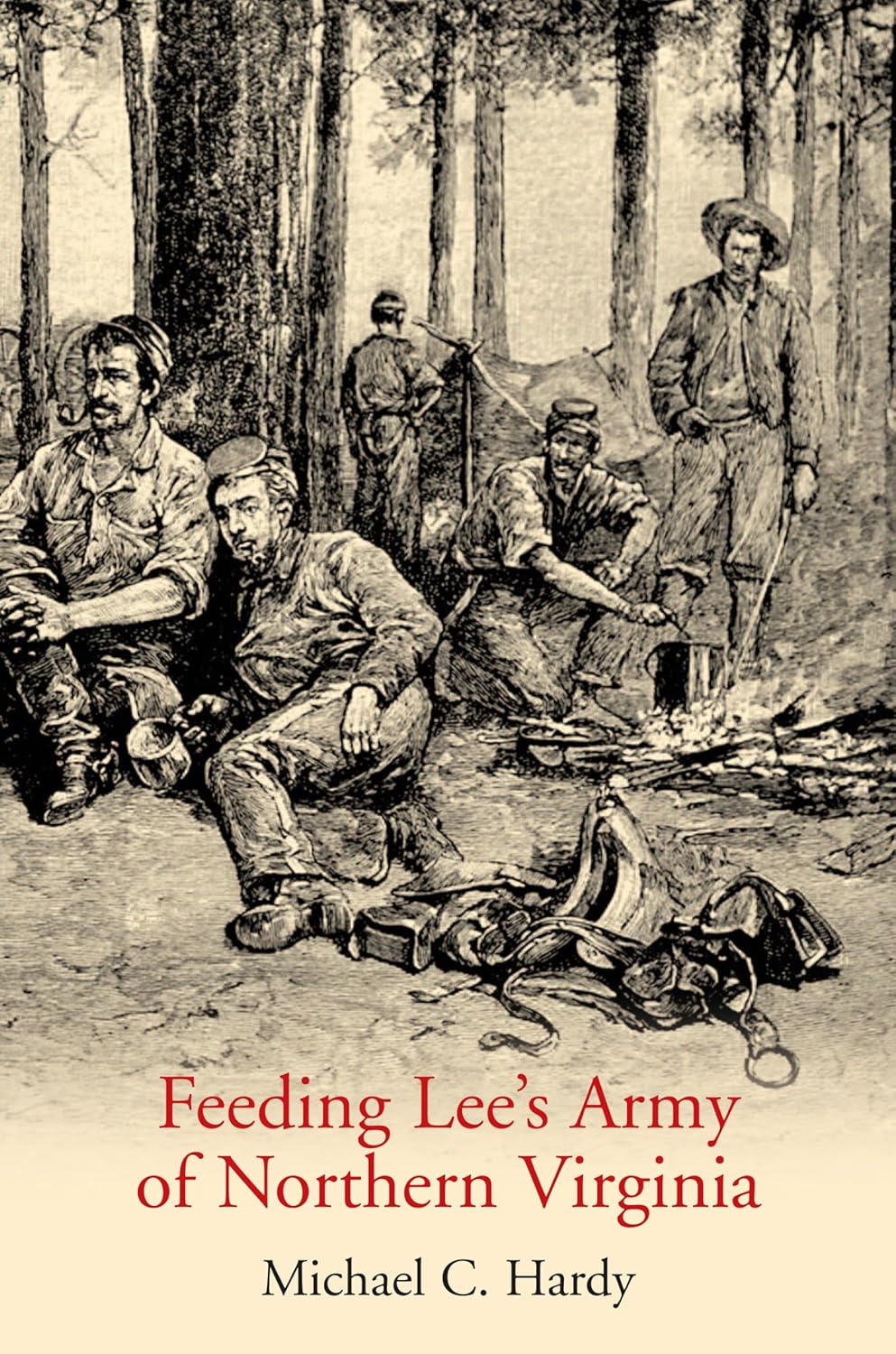
Review - "Feeding Lee’s Army of Northern Virginia" by Michael Hardy
[Feeding Lee’s Army of Northern Virginia by Michael C. Hardy (Savas Beatie, 2025). Hardcover, map, photos, illustrations, footnotes, appendix section, bibliography, index. Pages main/total:xii,129/175. ISBN:978-1-61121-731-5. $27.95]
 A clear takeaway message from reading Michael Hardy's Feeding Lee’s Army of Northern Virginia is that describing how well, or how badly, Lee's army was fed during the war lacks easy generalization. Perhaps the best way to describe that army's food situation throughout the war might be feast and famine along a generally declining curve. Depending on a variety of circumstances, even when the army was static and its logistical tail secure, the availability of supplies (either through domestic sources or through the blockade) proved highly variable. This made stockpiling foodstuffs for the lean times very difficult to accumulate in enough tonnage to sustain consistent soldier rations, especially during the winter months.
The most senior government official directly involved in keeping the Army of Northern Virginia fed was Commissary-General Lucius B. Northrop, an administrative figure not presented favorably in the literature. Hardy himself does not lean heavily toward either end of the spectrum when it comes to weighing Colonel Northrop energy and competence level (or President Jefferson Davis's questionable decision to sustain his beleaguered friend at the post for nearly the entire war). Instead, when discussing Northrop, the author focuses mostly on recounting the Commissary-General's frequent disputes with Lee over food supplies and ration orders. You don't often read of Lee fighting with the administration's War Department (even to the point of disobeying official directives) as much as and for as long as he does against Northrop's ration cutting. Hardy does note that Northrop's February 1865 successor (Brigadier General Isaac St. John) made an immediate positive impact on supply, even at a time when the Confederacy as a whole was in dire straits, but his appointment came far too late in the war (just two months before Appomattox) to make comprehensive comparative analysis possible. Highlighting the efforts of lower-level commissary officers is a useful appendix that names a number of officers who served in the army as commissaries of subsistence and summarizes their duties. The standard view that the South produced at least adequate amounts of food for its armies for most of the war but a large percentage of it could not get to the army due to insufficient transportation (especially over the South's overworked and under-maintained rail system) and storage capacity is supported by Hardy's evidence assessments.
As Hardy explains, a number of alternate ways of procuring food, including through private purchases and activities such as foraging and fishing, were available to supplement meager official rations. Connecting soldiers at the front with family and local communities were boxes from home. A vital source of necessities and delicacies alike, these care packages boosted morale and helped soldiers feel appreciated by those for whom they were fighting. However, as sources indicate, sending those boxes was often very expensive and receiving them intact was far from assured, as even from the very beginning of the war shipment of non-essential goods was unreliable and freight thievery common. As one can imagine, neither situation improved as the war progressed and general privation hit all segments of Confederate society. As Hardy notes, official government impressment and tax-in-kind measures also limited the ability of families and aid society donators back home to set aside extra food to send to local soldiers fighting at the front.
In addition to those associated with the long periods of encampment between campaigns, the measures and challenges involved in feeding Lee's army while on the march and on the firing line are also addressed in the book. An added bonus of sorts for Lee's men was the opportunity active campaigning offered to feast upon foodstuffs left behind by or taken from their more lavishly supplied foes. The process involved with either seizing or purchasing food from enemy civilians, most relevant to the 1862 Maryland and 1863 Pennsylvania campaigns, is also accorded due attention.
For the most part, officers had it better than the rank and file when it came to food, and how the army's high command, including Lee himself, fared is also considered in the book. Just like a soldier marches on his stomach, food played a major part in keeping an over-stressed general officer's mind clear and focused, and Hardy notes at least two instances in which severe bowel complaints impaired Lee's performance in battle. Freeing generals and their staffs from the day to day concerns surrounding the procurement of food and its preparation were camp cooking servants. That position was frequently occupied by slaves, but paid individuals (black and white) also served as cooks. According to Hardy, their numbers and overall proportions in the ANV can only be guessed at, but it's clear there were never enough and the most skilled ones were priceless additions to officer messes.
Every Civil War reader knows that coffee was especially prized by soldiers of both sides, and this book offers an interesting revelation related to that treasured commodity. The literature often claims that supplies of real coffee, for soldiers and civilians alike, largely disappeared as the war progressed, replaced by variations of 'ersatz' coffee alternatives (all disappointing to some degree or another). Thus many readers will be surprised to find how many references there are in Hardy's book to ANV units being issued regular rations of real coffee, undoubtedly sourced through Wilmington and its direct rail connections with ANV warehouses and commissaries, well into the late-war period.
The main reasons but forth by Civil War scholars to explain Confederate collapse and defeat are numerous and commonly known to Civil War readers, and Hardy suggests that inadequate food supply ranked at or near the top. Due to a variety of factors, food supply levels in the southern armies clearly trended downward (regardless of temporary times of plenty), and it is not unreasonable to claim that deficiencies in the quantity and quality of foodstuffs occurred so regularly across the Confederacy as to seriously, perhaps even fatally, impair the morale and efficiency of its armies. Additionally, winter food shortages were arguably the chief driving factor behind the flood of desertions that plagued Confederate armies, including the ANV, during that most challenging time of year.
This slim volume was obviously not intended to be exhaustive in nature, but it would have been interesting to read Hardy's thoughts on some additional matters. Food-related problems in Lee's army, which is considered to have been the Confederacy's best supplied in comparison to the others, are often deemed structural in nature, and one might wish to have read Hardy's views in regard to where, if anywhere, he thought clear improvements controllable at the army administrative level were possible. More in-depth analysis of the depot system supplying the Virginia front, and its prospects for improvement, would also have been appreciated. Nevertheless, there is powerful substance to be found this fine study, which incorporates a large and diverse collection of pointed and informative food-related commentaries and perspectives left behind by the officers and men who served in the Confederacy's premier field army. Michael Hardy's Feeding Lee’s Army of Northern Virginia is both an elegantly written narrative overview of the topic as well as an insightful observance of the grave consequences involved with failing to maintain the vital link between food and sustaining soldier health and morale.
A clear takeaway message from reading Michael Hardy's Feeding Lee’s Army of Northern Virginia is that describing how well, or how badly, Lee's army was fed during the war lacks easy generalization. Perhaps the best way to describe that army's food situation throughout the war might be feast and famine along a generally declining curve. Depending on a variety of circumstances, even when the army was static and its logistical tail secure, the availability of supplies (either through domestic sources or through the blockade) proved highly variable. This made stockpiling foodstuffs for the lean times very difficult to accumulate in enough tonnage to sustain consistent soldier rations, especially during the winter months.
The most senior government official directly involved in keeping the Army of Northern Virginia fed was Commissary-General Lucius B. Northrop, an administrative figure not presented favorably in the literature. Hardy himself does not lean heavily toward either end of the spectrum when it comes to weighing Colonel Northrop energy and competence level (or President Jefferson Davis's questionable decision to sustain his beleaguered friend at the post for nearly the entire war). Instead, when discussing Northrop, the author focuses mostly on recounting the Commissary-General's frequent disputes with Lee over food supplies and ration orders. You don't often read of Lee fighting with the administration's War Department (even to the point of disobeying official directives) as much as and for as long as he does against Northrop's ration cutting. Hardy does note that Northrop's February 1865 successor (Brigadier General Isaac St. John) made an immediate positive impact on supply, even at a time when the Confederacy as a whole was in dire straits, but his appointment came far too late in the war (just two months before Appomattox) to make comprehensive comparative analysis possible. Highlighting the efforts of lower-level commissary officers is a useful appendix that names a number of officers who served in the army as commissaries of subsistence and summarizes their duties. The standard view that the South produced at least adequate amounts of food for its armies for most of the war but a large percentage of it could not get to the army due to insufficient transportation (especially over the South's overworked and under-maintained rail system) and storage capacity is supported by Hardy's evidence assessments.
As Hardy explains, a number of alternate ways of procuring food, including through private purchases and activities such as foraging and fishing, were available to supplement meager official rations. Connecting soldiers at the front with family and local communities were boxes from home. A vital source of necessities and delicacies alike, these care packages boosted morale and helped soldiers feel appreciated by those for whom they were fighting. However, as sources indicate, sending those boxes was often very expensive and receiving them intact was far from assured, as even from the very beginning of the war shipment of non-essential goods was unreliable and freight thievery common. As one can imagine, neither situation improved as the war progressed and general privation hit all segments of Confederate society. As Hardy notes, official government impressment and tax-in-kind measures also limited the ability of families and aid society donators back home to set aside extra food to send to local soldiers fighting at the front.
In addition to those associated with the long periods of encampment between campaigns, the measures and challenges involved in feeding Lee's army while on the march and on the firing line are also addressed in the book. An added bonus of sorts for Lee's men was the opportunity active campaigning offered to feast upon foodstuffs left behind by or taken from their more lavishly supplied foes. The process involved with either seizing or purchasing food from enemy civilians, most relevant to the 1862 Maryland and 1863 Pennsylvania campaigns, is also accorded due attention.
For the most part, officers had it better than the rank and file when it came to food, and how the army's high command, including Lee himself, fared is also considered in the book. Just like a soldier marches on his stomach, food played a major part in keeping an over-stressed general officer's mind clear and focused, and Hardy notes at least two instances in which severe bowel complaints impaired Lee's performance in battle. Freeing generals and their staffs from the day to day concerns surrounding the procurement of food and its preparation were camp cooking servants. That position was frequently occupied by slaves, but paid individuals (black and white) also served as cooks. According to Hardy, their numbers and overall proportions in the ANV can only be guessed at, but it's clear there were never enough and the most skilled ones were priceless additions to officer messes.
Every Civil War reader knows that coffee was especially prized by soldiers of both sides, and this book offers an interesting revelation related to that treasured commodity. The literature often claims that supplies of real coffee, for soldiers and civilians alike, largely disappeared as the war progressed, replaced by variations of 'ersatz' coffee alternatives (all disappointing to some degree or another). Thus many readers will be surprised to find how many references there are in Hardy's book to ANV units being issued regular rations of real coffee, undoubtedly sourced through Wilmington and its direct rail connections with ANV warehouses and commissaries, well into the late-war period.
The main reasons but forth by Civil War scholars to explain Confederate collapse and defeat are numerous and commonly known to Civil War readers, and Hardy suggests that inadequate food supply ranked at or near the top. Due to a variety of factors, food supply levels in the southern armies clearly trended downward (regardless of temporary times of plenty), and it is not unreasonable to claim that deficiencies in the quantity and quality of foodstuffs occurred so regularly across the Confederacy as to seriously, perhaps even fatally, impair the morale and efficiency of its armies. Additionally, winter food shortages were arguably the chief driving factor behind the flood of desertions that plagued Confederate armies, including the ANV, during that most challenging time of year.
This slim volume was obviously not intended to be exhaustive in nature, but it would have been interesting to read Hardy's thoughts on some additional matters. Food-related problems in Lee's army, which is considered to have been the Confederacy's best supplied in comparison to the others, are often deemed structural in nature, and one might wish to have read Hardy's views in regard to where, if anywhere, he thought clear improvements controllable at the army administrative level were possible. More in-depth analysis of the depot system supplying the Virginia front, and its prospects for improvement, would also have been appreciated. Nevertheless, there is powerful substance to be found this fine study, which incorporates a large and diverse collection of pointed and informative food-related commentaries and perspectives left behind by the officers and men who served in the Confederacy's premier field army. Michael Hardy's Feeding Lee’s Army of Northern Virginia is both an elegantly written narrative overview of the topic as well as an insightful observance of the grave consequences involved with failing to maintain the vital link between food and sustaining soldier health and morale.
Wednesday, March 26, 2025
Review - "The Confederate Resurgence of 1864" by William Marvel
[The Confederate Resurgence of 1864 by William Marvel (Louisiana State University Press, 2024). Hardcover, 10 maps, notes, bibliography, index. Pages main/total:xiii,231/336. ISBN:978-0-8071-8243-7. $49.95]
 During the harsh winter of 1863-64, Confederate national morale found itself standing at yet another crossroads moment between confidence and despair. For southern armies and the home front they defended, 1863 was a tough year to say the least. In the West, the costly Confederate victory at Chickamauga in September 1863 briefly revived spirits dampened by the drawn-out catastrophe of Vicksburg, but all of that shaky optimism was dashed by the end of the year following defeat at Knoxville and the utter rout of the main body of the Army of Tennessee at Chattanooga. Across the Mississippi River, federal amphibious forces ranged up and down the Texas coast with impunity, and in Arkansas a bloody repulse at Helena was followed by Union occupation of the length of the Arkansas River Valley, including the state capital at Little Rock. In the East, national elation following the unlikely triumph at Chancellorsville (though that joy was tempered by the loss of Stonewall Jackson and heavy casualties incurred overall) was followed that summer by terrible defeat and more irreplaceable losses in Pennsylvania at Gettysburg. Even though the heavily depleted Army of Northern Virginia retained its confidence in commander Robert E. Lee and stymied Gettysburg's victors for the remainder of the year, some deemed that army's 1863 losses, particularly in officers, so crippling as to seriously impair its prospects for the coming year. Bad news also extended to the North Carolina front, which was reinforced early in the year at some strategic risk. There, the manner in which the failed attack on New Bern was bungled raised serious questions over whether anything could be accomplished toward regaining cities and territory lost in the region the previous year. Amidst all that doom and gloom, everyone in the Confederacy knew that there would be no let up in pressure by the enemy. So what steeled the Confederacy's badly shaken supporters for the even greater challenges and sacrifices that 1864 would undoubtedly bring? Seeking the answer to that question, or at least a significant part of it, is the most probing theme of William Marvel's new book The Confederate Resurgence of 1864.
It is Marvel's view, strongly developed throughout this study, that the string of Confederate military victories on land and water over a roughly ten-week period from February 20 to April 30 provided such a significant boost to both the home and fighting fronts that it sustained them through the horrendous casualties and steady loss of national territory produced by the fierce fighting between the main armies in Georgia and Virginia. Perhaps more controversially, Marvel even goes so far as to say that the widespread injection of fresh optimism into flagging spirits provided by that late-winter and early-spring "resurgence" was instrumental in sustaining Confederate resistance into the following year.
Marvel sets the stage by recounting the depths to which army confidence in eventual victory had sunk by the onset of the winter of 1863-64, which was exceptionally cold in places. That increasing despair led to a widespread surge in desertion, even in areas far from the main action. Many of those who abandoned southern ranks, both individually and in groups, took advantage of President Lincoln's shrewdly conceived amnesty proposal. Of course, the Confederacy had experienced ups and downs in national prospects and morale before, but things seemed different as 1864 arrived. Hopelessness started to pervade Confederate society, currency values approached complete worthlessness, total economic collapse seemed impending, and supplies of clothing and shoes for the army were increasingly inadequate (with little to no prospect for improvement). General Sherman's February 1864 Meridian Expedition, which started at Vicksburg and drove inland into the Mississippi heartland with near impunity, only furthered the perception that Confederate defenses were now a hollow shell. The Confederate resurgence arrived just in the nick of time.
Fine overviews of the sequence of military events large and small that form the basis of Marvel's argument and analysis, with map support, are offered. Covered are the Union expedition in Florida that suffered defeat at the Battle of Olustee, the cavalry clashes between Nathan Bedford Forrest and Sooy Smith in North Mississippi, the confrontation at Rocky Face Ridge/Mill Creek Gap in North Georgia, the abortive Butler/Wistar raid on Richmond in early February (stopped at Bottom's Bridge) and accompanying diversionary operation from the Army of the Potomac, the infamous Kilpatrick/Dahlgren Raid on Richmond, the Red River Campaign and Camden Expedition, Forrest's raids on widely separated points across western Tennessee and Kentucky (especially at Union City, Paducah, and Fort Pillow), and the Confederate recapture of Plymouth, North Carolina. These Confederate successes are discussed in both isolation and in cumulative effect. Certainly other factors were involved in sustaining hope within Confederate ranks through the rest of 1864, not least of which were having Lee in the East and replacing Bragg with Johnston in the West (the latter overwhelmingly perceived as a major upgrade), but Marvel, through surveying a wide range of contemporary primary sources, builds a strong case that the string of victories listed above produced a noticeably powerful boost to Confederate national morale and determination.
Even events that were damaging on the face of it could be widely seen as having a silver lining. In Charleston harbor, the sinking of the USS Housatonic, even though it also resulted in the loss of the attacking submersible CSS Hunley, nevertheless increased hopes that further blows could be struck against the ever tightening blockade of the southern coastline. While the relatively weak response to Sherman's incursion into the heart of Mississippi and the level of destruction wrought there was disheartening to Confederate supporters, Marvel notes that the public morale effect was largely mitigated by Forrest's manhandling of Sooy Smith's cavalry wing. Not recognizing that Sherman had already turned back by the time Forrest confronted Smith and harried him into retreat, it was inaccurately assumed by a great many within the Confederate military leadership and among the general populace that stopping Smith had compelled Sherman to give up plans for further advances toward either Selma or Mobile. Likewise, to the north, the successful Confederate defensive action at Dalton was widely perceived as repulsing a major enemy advance rather than the mostly diversionary action it really was.
According to Marvel, the period under consideration in his book also had a major political component in that it represented an interval that delivered key blows to Lincoln's presidential reconstruction plans. The administration's political initiative was an utter failure in Florida and, with Steele stripping much of his occupation forces from the Arkansas River Valley in support of his Camden Expedition, the pro-Union political position in Arkansas started to deteriorate. Abject defeat in the Red River Valley also meant that reconstruction could not be carried from New Orleans into the heart of Louisiana.
As Marvel outlines, the early-1864 Confederate resurgence also contributed to a corresponding stumble in Union self-assurance. Since modern observers lack scientific opinion data for the Civil War period, fluctuations in the value of paper currency relative to gold prices are commonly used to gauge northern confidence in the war effort and economy at a given time, and Marvel points to several events during the book's ten-week interlude that corresponded with spikes in gold demand/prices and greenback depreciation.
Drawing support from a variety of primary source materials, the quality of Marvel's main argument is vigorously developed and presented to the reader in his own inimitable writing style and tone. What's most open for debate is just how much of the strength of Confederate resistance revealed throughout the rest of 1864 can be directly attributed to that early-year window of successive battlefield victories. The least convincing part of the argument is the attempt to draw an analogy between the Confederate national mood at the beginnings of years 1864 and 1865. Marvel's suggestion that the first six months of the latter witnessed a widespread and rapid collapse because it lacked anything like the previous year's boosting victories has some merit, but one can't help but feel that much more of a gulf in military and home front starting conditions existed between the respective winters of 1863-64 and 1864-65 than Marvel concedes. Regardless, one is still able to fully appreciate the thought-provoking power behind Marvel's central thesis without necessarily agreeing with all of his conclusions associated with it.
As he readily admits in his introduction, Marvel is not the first scholar to raise the matter of this dramatic early spring revival of Confederate fortunes, but he certainly is the first author to both descriptively recount the period in comprehensive fashion and analyze the full impact of its significance. The Confederate Resurgence of 1864 offers fresh thinking and a powerful new way to assess the events of that pivotal Civil War year and beyond.
During the harsh winter of 1863-64, Confederate national morale found itself standing at yet another crossroads moment between confidence and despair. For southern armies and the home front they defended, 1863 was a tough year to say the least. In the West, the costly Confederate victory at Chickamauga in September 1863 briefly revived spirits dampened by the drawn-out catastrophe of Vicksburg, but all of that shaky optimism was dashed by the end of the year following defeat at Knoxville and the utter rout of the main body of the Army of Tennessee at Chattanooga. Across the Mississippi River, federal amphibious forces ranged up and down the Texas coast with impunity, and in Arkansas a bloody repulse at Helena was followed by Union occupation of the length of the Arkansas River Valley, including the state capital at Little Rock. In the East, national elation following the unlikely triumph at Chancellorsville (though that joy was tempered by the loss of Stonewall Jackson and heavy casualties incurred overall) was followed that summer by terrible defeat and more irreplaceable losses in Pennsylvania at Gettysburg. Even though the heavily depleted Army of Northern Virginia retained its confidence in commander Robert E. Lee and stymied Gettysburg's victors for the remainder of the year, some deemed that army's 1863 losses, particularly in officers, so crippling as to seriously impair its prospects for the coming year. Bad news also extended to the North Carolina front, which was reinforced early in the year at some strategic risk. There, the manner in which the failed attack on New Bern was bungled raised serious questions over whether anything could be accomplished toward regaining cities and territory lost in the region the previous year. Amidst all that doom and gloom, everyone in the Confederacy knew that there would be no let up in pressure by the enemy. So what steeled the Confederacy's badly shaken supporters for the even greater challenges and sacrifices that 1864 would undoubtedly bring? Seeking the answer to that question, or at least a significant part of it, is the most probing theme of William Marvel's new book The Confederate Resurgence of 1864.
It is Marvel's view, strongly developed throughout this study, that the string of Confederate military victories on land and water over a roughly ten-week period from February 20 to April 30 provided such a significant boost to both the home and fighting fronts that it sustained them through the horrendous casualties and steady loss of national territory produced by the fierce fighting between the main armies in Georgia and Virginia. Perhaps more controversially, Marvel even goes so far as to say that the widespread injection of fresh optimism into flagging spirits provided by that late-winter and early-spring "resurgence" was instrumental in sustaining Confederate resistance into the following year.
Marvel sets the stage by recounting the depths to which army confidence in eventual victory had sunk by the onset of the winter of 1863-64, which was exceptionally cold in places. That increasing despair led to a widespread surge in desertion, even in areas far from the main action. Many of those who abandoned southern ranks, both individually and in groups, took advantage of President Lincoln's shrewdly conceived amnesty proposal. Of course, the Confederacy had experienced ups and downs in national prospects and morale before, but things seemed different as 1864 arrived. Hopelessness started to pervade Confederate society, currency values approached complete worthlessness, total economic collapse seemed impending, and supplies of clothing and shoes for the army were increasingly inadequate (with little to no prospect for improvement). General Sherman's February 1864 Meridian Expedition, which started at Vicksburg and drove inland into the Mississippi heartland with near impunity, only furthered the perception that Confederate defenses were now a hollow shell. The Confederate resurgence arrived just in the nick of time.
Fine overviews of the sequence of military events large and small that form the basis of Marvel's argument and analysis, with map support, are offered. Covered are the Union expedition in Florida that suffered defeat at the Battle of Olustee, the cavalry clashes between Nathan Bedford Forrest and Sooy Smith in North Mississippi, the confrontation at Rocky Face Ridge/Mill Creek Gap in North Georgia, the abortive Butler/Wistar raid on Richmond in early February (stopped at Bottom's Bridge) and accompanying diversionary operation from the Army of the Potomac, the infamous Kilpatrick/Dahlgren Raid on Richmond, the Red River Campaign and Camden Expedition, Forrest's raids on widely separated points across western Tennessee and Kentucky (especially at Union City, Paducah, and Fort Pillow), and the Confederate recapture of Plymouth, North Carolina. These Confederate successes are discussed in both isolation and in cumulative effect. Certainly other factors were involved in sustaining hope within Confederate ranks through the rest of 1864, not least of which were having Lee in the East and replacing Bragg with Johnston in the West (the latter overwhelmingly perceived as a major upgrade), but Marvel, through surveying a wide range of contemporary primary sources, builds a strong case that the string of victories listed above produced a noticeably powerful boost to Confederate national morale and determination.
Even events that were damaging on the face of it could be widely seen as having a silver lining. In Charleston harbor, the sinking of the USS Housatonic, even though it also resulted in the loss of the attacking submersible CSS Hunley, nevertheless increased hopes that further blows could be struck against the ever tightening blockade of the southern coastline. While the relatively weak response to Sherman's incursion into the heart of Mississippi and the level of destruction wrought there was disheartening to Confederate supporters, Marvel notes that the public morale effect was largely mitigated by Forrest's manhandling of Sooy Smith's cavalry wing. Not recognizing that Sherman had already turned back by the time Forrest confronted Smith and harried him into retreat, it was inaccurately assumed by a great many within the Confederate military leadership and among the general populace that stopping Smith had compelled Sherman to give up plans for further advances toward either Selma or Mobile. Likewise, to the north, the successful Confederate defensive action at Dalton was widely perceived as repulsing a major enemy advance rather than the mostly diversionary action it really was.
According to Marvel, the period under consideration in his book also had a major political component in that it represented an interval that delivered key blows to Lincoln's presidential reconstruction plans. The administration's political initiative was an utter failure in Florida and, with Steele stripping much of his occupation forces from the Arkansas River Valley in support of his Camden Expedition, the pro-Union political position in Arkansas started to deteriorate. Abject defeat in the Red River Valley also meant that reconstruction could not be carried from New Orleans into the heart of Louisiana.
As Marvel outlines, the early-1864 Confederate resurgence also contributed to a corresponding stumble in Union self-assurance. Since modern observers lack scientific opinion data for the Civil War period, fluctuations in the value of paper currency relative to gold prices are commonly used to gauge northern confidence in the war effort and economy at a given time, and Marvel points to several events during the book's ten-week interlude that corresponded with spikes in gold demand/prices and greenback depreciation.
Drawing support from a variety of primary source materials, the quality of Marvel's main argument is vigorously developed and presented to the reader in his own inimitable writing style and tone. What's most open for debate is just how much of the strength of Confederate resistance revealed throughout the rest of 1864 can be directly attributed to that early-year window of successive battlefield victories. The least convincing part of the argument is the attempt to draw an analogy between the Confederate national mood at the beginnings of years 1864 and 1865. Marvel's suggestion that the first six months of the latter witnessed a widespread and rapid collapse because it lacked anything like the previous year's boosting victories has some merit, but one can't help but feel that much more of a gulf in military and home front starting conditions existed between the respective winters of 1863-64 and 1864-65 than Marvel concedes. Regardless, one is still able to fully appreciate the thought-provoking power behind Marvel's central thesis without necessarily agreeing with all of his conclusions associated with it.
As he readily admits in his introduction, Marvel is not the first scholar to raise the matter of this dramatic early spring revival of Confederate fortunes, but he certainly is the first author to both descriptively recount the period in comprehensive fashion and analyze the full impact of its significance. The Confederate Resurgence of 1864 offers fresh thinking and a powerful new way to assess the events of that pivotal Civil War year and beyond.

Friday, June 7, 2024
Review - "The Old War Horse: The USS Benton on Western Waters, 1853-1865" by Myron Smith
[The Old War Horse: The USS Benton on Western Waters, 1853-1865 by Myron J. Smith, Jr. (McFarland, 2024). Softcover, maps, photos, illustrations, notes, bibliography, index. Pages main/total:viii,190/264. ISBN:978-1-4766-8689-9. $49.95]
 Students of Civil War naval matters associated with the West's most strategically significant inland waterways owe a great deal to Myron Smith and his prodigious body of work. The author of ten volumes published beginning in 2007 that include ship histories, vessel class histories, officer and builder biographies, operational studies, and reference guides, Smith has been remarkably prolific. Though there is considerable overlap among those wide-ranging publications, it's undeniable that the amount and quality of information conveyed inside them about the men, ships, and actions of the Union Brown Water Navy and (to a lesser extent) their western Confederate counterparts are far more than anyone has the right to expect from a single person. The value of the narrative history work is also very considerably enhanced by Smith's willingness to scour libraries and archives for relevant photographs, design drawings, period maps, and popular illustrations, all kinds of which are liberally distributed throughout the pages of his books. With the release of his eleventh title from McFarland Publishing, The Old War Horse: The USS Benton on Western Waters, 1853-1865, Smith is still going strong.
Combining new research with a deep understanding of the existing scholarship (while also building upon his own previous work), Smith's new book effectively allows the Benton's story to freshly shine amid coverage of well-trodden ground. At times the flag vessel of the Mississippi Squadron and operating under a series of commanders, the Benton's role in a number of major waterborne actions—including engagements against Island No. 10, Fort Pillow, Memphis, and Vicksburg's Yazoo and Mississippi river defenses—is recounted in great detail and in stirring fashion. Smith is the author of a standalone CSS Arkansas ship study, and this volume offers further perspective of that flawed ironclad's famous run through and past the Union river fleet. The Benton's role in combating the theater's intractable contraband trade is also discussed, along with the notoriety the ironclad earned by being among the western squadron's premier exploiters of the Navy's cotton prize system. Supplementing the relatively few photos we have of the Benton are a great number of period drawings and illustrations of the vessel in action. Day to day life aboard the Benton is not a major focus of the narrative, though aspects of it such as the effects of leadership changes and the role widespread tropical sickness played in crew health and composition are duly noted.
But the Civil War years comprise only part of Smith's research and writing efforts. While details of the squadron-level naval actions associated with the Benton are familiar to this book's intended reading audience, the ironclad vessel's own origin story, conversion process, and early history are much more likely not. Comparable in depth and insight to the aforementioned Civil War sections (and just as heavily illustrated) are those that explore the Benton's earlier career as the catamaran marine salvage vessel Submarine No. 7. In devoting so much space to the innovative vessel's prewar activities, Smith gifts readers a fascinating view into both the omnipresent dangers inherent to the West's early to mid-nineteenth century riverboat trade and the lucrative business that was built around salvaging lost vessels and their cargoes. Brilliant engineer and inventor James B. Eads, who became one of the Mississippi River Valley's wealthiest salvage company operators, is at the center of an expansive narrative that provides numerous insights into the West's river economy during the antebellum period. Though many of the cutting-edge mechanical features and systems (such as a diving bell and steam-powered winches and cranes) that went into Submarine No. 7 were removed during the warship conversion process, Smith's descriptions of them and how their workings made Eads a rich man in the steamboat salvage business comprise a fascinating side story.
Smith's in-depth discussions of Eads's struggles coordinating the vast material requirements, labor, and financing (all on a time-compressed schedule) that went into the construction of both his purpose-built City Class ironclads and the Benton conversion offer an informative window into the nuts and bolts of the U.S. government's military contracting and procurement processes, which were full of interpersonal, professional, and political-level pitfalls and challenges. Bidding and conflict of interest issues, such as those associated with Eads's success in getting the government to buy his own vessel for the conversion, are addressed as are the independent inspection and valuation procedures devised to help combat the types of fraudulent and/or unethical practices that plagued the army and navy procurement systems.
Following Smith's absorbing point by point explanation of the conversion process itself (with its meaningful insights into key design features) is an objective assessment of the strengths and weaknesses of the resulting warship. As Smith reveals, the great size and punching power of the Benton proved to be both asset and limitation. Benton and the City Class ironclads shared unfortunate traits of dangerous vulnerability to plunging fire, plodding maneuverability, and suboptimal motive power, but the Benton, at nearly twice the displacement, was especially deficient in the latter two qualities. Initial tests revealed the Benton to be little better than a floating battery. In its first propulsion configuration, the Benton's insufficient power plant could not make headway against the Mississippi's current, and though it was never replaced it was reconfigured to at least offer passable upriver efficiency. A City Class ironclad could not match the Benton in total armament array, but there were places that those smaller vessels could go with a modicum of safety that the massive Benton could not.
Myron Smith's The Old War Horse is a marvelous history of the USS Benton from birth to dismantlement. For those interested in the practices and technologies involved, the book's lively and informative discussion of the steamboat salvage business is interesting enough to stand on its own. Nevertheless, it is the Civil War coverage that will draw the largest audience. In addition to providing a comprehensive account of the ironclad's warship's western river service, the book offers noteworthy contributions to our knowledge and understanding of a host of people, policies, and events associated on a wider basis with the birth and early history of the Union's Brown Water Navy.
Students of Civil War naval matters associated with the West's most strategically significant inland waterways owe a great deal to Myron Smith and his prodigious body of work. The author of ten volumes published beginning in 2007 that include ship histories, vessel class histories, officer and builder biographies, operational studies, and reference guides, Smith has been remarkably prolific. Though there is considerable overlap among those wide-ranging publications, it's undeniable that the amount and quality of information conveyed inside them about the men, ships, and actions of the Union Brown Water Navy and (to a lesser extent) their western Confederate counterparts are far more than anyone has the right to expect from a single person. The value of the narrative history work is also very considerably enhanced by Smith's willingness to scour libraries and archives for relevant photographs, design drawings, period maps, and popular illustrations, all kinds of which are liberally distributed throughout the pages of his books. With the release of his eleventh title from McFarland Publishing, The Old War Horse: The USS Benton on Western Waters, 1853-1865, Smith is still going strong.
Combining new research with a deep understanding of the existing scholarship (while also building upon his own previous work), Smith's new book effectively allows the Benton's story to freshly shine amid coverage of well-trodden ground. At times the flag vessel of the Mississippi Squadron and operating under a series of commanders, the Benton's role in a number of major waterborne actions—including engagements against Island No. 10, Fort Pillow, Memphis, and Vicksburg's Yazoo and Mississippi river defenses—is recounted in great detail and in stirring fashion. Smith is the author of a standalone CSS Arkansas ship study, and this volume offers further perspective of that flawed ironclad's famous run through and past the Union river fleet. The Benton's role in combating the theater's intractable contraband trade is also discussed, along with the notoriety the ironclad earned by being among the western squadron's premier exploiters of the Navy's cotton prize system. Supplementing the relatively few photos we have of the Benton are a great number of period drawings and illustrations of the vessel in action. Day to day life aboard the Benton is not a major focus of the narrative, though aspects of it such as the effects of leadership changes and the role widespread tropical sickness played in crew health and composition are duly noted.
But the Civil War years comprise only part of Smith's research and writing efforts. While details of the squadron-level naval actions associated with the Benton are familiar to this book's intended reading audience, the ironclad vessel's own origin story, conversion process, and early history are much more likely not. Comparable in depth and insight to the aforementioned Civil War sections (and just as heavily illustrated) are those that explore the Benton's earlier career as the catamaran marine salvage vessel Submarine No. 7. In devoting so much space to the innovative vessel's prewar activities, Smith gifts readers a fascinating view into both the omnipresent dangers inherent to the West's early to mid-nineteenth century riverboat trade and the lucrative business that was built around salvaging lost vessels and their cargoes. Brilliant engineer and inventor James B. Eads, who became one of the Mississippi River Valley's wealthiest salvage company operators, is at the center of an expansive narrative that provides numerous insights into the West's river economy during the antebellum period. Though many of the cutting-edge mechanical features and systems (such as a diving bell and steam-powered winches and cranes) that went into Submarine No. 7 were removed during the warship conversion process, Smith's descriptions of them and how their workings made Eads a rich man in the steamboat salvage business comprise a fascinating side story.
Smith's in-depth discussions of Eads's struggles coordinating the vast material requirements, labor, and financing (all on a time-compressed schedule) that went into the construction of both his purpose-built City Class ironclads and the Benton conversion offer an informative window into the nuts and bolts of the U.S. government's military contracting and procurement processes, which were full of interpersonal, professional, and political-level pitfalls and challenges. Bidding and conflict of interest issues, such as those associated with Eads's success in getting the government to buy his own vessel for the conversion, are addressed as are the independent inspection and valuation procedures devised to help combat the types of fraudulent and/or unethical practices that plagued the army and navy procurement systems.
Following Smith's absorbing point by point explanation of the conversion process itself (with its meaningful insights into key design features) is an objective assessment of the strengths and weaknesses of the resulting warship. As Smith reveals, the great size and punching power of the Benton proved to be both asset and limitation. Benton and the City Class ironclads shared unfortunate traits of dangerous vulnerability to plunging fire, plodding maneuverability, and suboptimal motive power, but the Benton, at nearly twice the displacement, was especially deficient in the latter two qualities. Initial tests revealed the Benton to be little better than a floating battery. In its first propulsion configuration, the Benton's insufficient power plant could not make headway against the Mississippi's current, and though it was never replaced it was reconfigured to at least offer passable upriver efficiency. A City Class ironclad could not match the Benton in total armament array, but there were places that those smaller vessels could go with a modicum of safety that the massive Benton could not.
Myron Smith's The Old War Horse is a marvelous history of the USS Benton from birth to dismantlement. For those interested in the practices and technologies involved, the book's lively and informative discussion of the steamboat salvage business is interesting enough to stand on its own. Nevertheless, it is the Civil War coverage that will draw the largest audience. In addition to providing a comprehensive account of the ironclad's warship's western river service, the book offers noteworthy contributions to our knowledge and understanding of a host of people, policies, and events associated on a wider basis with the birth and early history of the Union's Brown Water Navy.

Friday, May 24, 2024
Review - "Treasure and Empire in the Civil War: The Panama Route, the West and the Campaigns to Control America's Mineral Wealth" by Neil Chatelain
[Treasure and Empire in the Civil War: The Panama Route, the West and the Campaigns to Control America's Mineral Wealth by Neil P. Chatelain (McFarland, 2024). Softcover, maps, photos, illustrations, notes, bibliography, index. Pages main/total:vii,221/283. ISBN:978-1-4766-9381-1. $49.95]
 The Far West's antebellum and Civil War period economic, military, political, and social history and development have received more frequent and in-depth investigation in recent years, with much of the focus on California (which achieved statehood in 1850). Hand in hand with every discussion of California's loyalty to the Union—and recognition of its essential military manpower contributions across the sparsely defended Pacific Northwest, Mountain West, and Desert Southwest regions—is some level of appreciation of California gold's role in financing the Civil War. However, the important in-between parts of that process, namely specifics regarding exactly what was involved in getting that newly extracted gold safely from California all the way to New York, have lacked cohesive study. Happily, that is no longer the case, with the California-New York gold route at the front and center of naval historian Neil Chatelain's new book Treasure and Empire in the Civil War: The Panama Route, the West and the Campaigns to Control America's Mineral Wealth. As the title indicates, the passage's fascinating history, though significant enough to merit standalone study, is also closely integrated into a wider discussion of Civil War-era economic resource competition in the West.
Upon successful conclusion of the War with Mexico, the United States clearly assumed the dominant role in the American West, and with that rapidly growing preeminence came prime positioning for highly lucrative exploitation of the western continent's vast mineral deposits. Among the principal challenges were the vast distances involved and uncertain communications between the western mines and the nation's government and financial centers. Setting up a safe and reliable means of getting California gold to New York was paramount, and Chatelain sets the stage with a detailed account of the establishment of what came to be known as the Panama Route. As finalized, the route stretched from San Francisco to Panama City (with a stop in Mazatlan, Mexico along the way) on the vessels of William Aspinwall's Pacific Mail Steamship Company. From there, a relatively brief Panama Railroad journey crossed the narrow isthmus to the Atlantic port of Colon. Finally, ships of Cornelius Vanderbilt's monopolistic Atlantic and Pacific Steamship Company carried passengers and cargo between Colon and the port of New York. By the time of the outbreak of civil war, movement along the Panama Route was already a well-oiled machine.
In addition to tracing the historical development of the treasure route, Chatelain outlines its place in the wider expansionist context of the time. Concurrent with extracting wealth from its Mexican War conquests and forging political and economic ties with Isthmus authorities, the United States was extending its feelers into the Pacific with an eye toward possessing guano islands and future coaling stations. Early in the Civil War, taking its cue from long-held proslavery ambitions that extended into the southern hemisphere, the new Confederate government quickly attempted to stake its own territorial claims in the American Southwest, with the ultimate goal of opening pathways to both the Pacific Ocean and the gold fields of Colorado. Of course, in the way of some Union and Confederate plans were Mexican sovereignty and the interests of the native occupants of much of the western land mass.
As Chatelain outlines in the book, Confederate authorities were keen on intercepting U.S. treasure ships, which could carry up to $1.5M in gold during a single voyage. The Confederate Navy Department's three-headed plan encompassed the use of commerce raiders, privateers, and small clandestine groups who would book passage on enemy vessels and attempt to seize them from within. Prominent examples of each of those activities (none of which met expectations) are explored at length in the book, as are the coordinated Union responses to them. A potentially dangerous bottleneck in the Colon to New York route was the narrow "Windward Passage" between Cuba and the island of Haiti/Santo Domingo. In December 1862, the commerce raider CSS Alabama captured the Vanderbilt steamer Ariel. It wasn't a treasure ship, but the act, combined with the brief cruise of the privateer Retribution, helped prompt the U.S. Navy to finally adopt a formal convoy system. For all their multi-faceted efforts, the Confederates never captured a gold-laden prize ship. Chatelain does recount their largest bullion seizure, the CSS Florida's capture of some $500,000 in silver bars aboard the Benjamin F. Hoxie, but it proved to be a lost bonanza as both ship and cargo were owned by neutral Britain. On the Pacific side of the gold route, Confederate agents and sympathizers hoped to expand their privateering efforts in California. The most noteworthy episode, the failure of the Asbury Harpending-led mission to outfit the privateer J.M. Chapman for service in the Pacific, is detailed in the book (as is the piracy trial of its leaders and men). As Chatelain relates, fears of further attempts along those lines prompted both an expansion of the navy's Pacific Squadron (which included assembly of an ironclad warship) and a bolstering of Pacific Coast land defenses. Additionally, the failure of the plot by a small group of Confederates led by Thomas Hogg to seize control of the Salvador spurred U.S. authorities to apply even tighter strictures to its Pacific passport system in order to prevent further incidents.
Overall, the above events demonstrated the remarkable effectiveness of U.S. detective and diplomatic/naval intelligence networks in thwarting potentially dangerous Confederate plots and activities. The overseas capabilities and extent of those civilian, diplomatic, and military information and enforcement systems have been revealed again and again in the Civil War literature, and Chatelain's research represents a significant new contribution. The fact that no gold ship was lost to Confederate action during the length of the conflict might suggest a particularly effective convoy system (and perhaps also an indication that true threats were not as dangerous as they might have seemed at the time), but Chatelain points to several factors (including lack of strategic prioritization, assignment of unreliable ships to the West Indies Squadron, and inconsistent rotation) that seriously hindered the establishment, strength, and maintenance of consistent convoys. Even with those problems and shortcomings, though, the convoy system is nevertheless still hailed as having been a "cost-effective" measure that helped ensure that Panama Route ships safely completed their voyages. More widely, Chatelain persuasively suggests that just the mere presence of the convoys and their support facilities enhanced U.S.-Caribbean relations, helped enforce the Monroe Doctrine during a troubling period of international conflict, and raised the stature and visibility of the United States as a premier hemispheric power.
Significantly, Chatelain also points to the indispensable partnership formed between private business and federal government when it came to the custody, transport, and safety of the gold moved along the Panama Route. For a notion of scale, Chatelain notes that between April 1861 and June 1865 nearly $171M (almost $6B in today's dollars) in bullion was transported on the Pacific leg between San Francisco and Panama City by the Pacific Mail Steamship Company. It's largely beyond the themes and scope of this particular study, but it would be interesting to extend that public-private partnership story into a branching exploration of how the West Coast's mineral bonanza was integrated into the national wartime economy after it reached the financial centers of the East. In contrast, as the book makes clear, none of the Confederate efforts explained in the book were able to obtain the coveted riches that might have helped address their own more dire economic challenges.
Neil Chatelain's Treasure and Empire in the Civil War offers a deep and fresh examination of one of the more neglected aspects of the naval war fought between the United States and the Confederacy while also extending its considerable reach into related issues of concurrent wartime continental expansion, economic resource competition, and transnational politics. That expansive perspective should make the volume attractive to a wide range of reader interests.
The Far West's antebellum and Civil War period economic, military, political, and social history and development have received more frequent and in-depth investigation in recent years, with much of the focus on California (which achieved statehood in 1850). Hand in hand with every discussion of California's loyalty to the Union—and recognition of its essential military manpower contributions across the sparsely defended Pacific Northwest, Mountain West, and Desert Southwest regions—is some level of appreciation of California gold's role in financing the Civil War. However, the important in-between parts of that process, namely specifics regarding exactly what was involved in getting that newly extracted gold safely from California all the way to New York, have lacked cohesive study. Happily, that is no longer the case, with the California-New York gold route at the front and center of naval historian Neil Chatelain's new book Treasure and Empire in the Civil War: The Panama Route, the West and the Campaigns to Control America's Mineral Wealth. As the title indicates, the passage's fascinating history, though significant enough to merit standalone study, is also closely integrated into a wider discussion of Civil War-era economic resource competition in the West.
Upon successful conclusion of the War with Mexico, the United States clearly assumed the dominant role in the American West, and with that rapidly growing preeminence came prime positioning for highly lucrative exploitation of the western continent's vast mineral deposits. Among the principal challenges were the vast distances involved and uncertain communications between the western mines and the nation's government and financial centers. Setting up a safe and reliable means of getting California gold to New York was paramount, and Chatelain sets the stage with a detailed account of the establishment of what came to be known as the Panama Route. As finalized, the route stretched from San Francisco to Panama City (with a stop in Mazatlan, Mexico along the way) on the vessels of William Aspinwall's Pacific Mail Steamship Company. From there, a relatively brief Panama Railroad journey crossed the narrow isthmus to the Atlantic port of Colon. Finally, ships of Cornelius Vanderbilt's monopolistic Atlantic and Pacific Steamship Company carried passengers and cargo between Colon and the port of New York. By the time of the outbreak of civil war, movement along the Panama Route was already a well-oiled machine.
In addition to tracing the historical development of the treasure route, Chatelain outlines its place in the wider expansionist context of the time. Concurrent with extracting wealth from its Mexican War conquests and forging political and economic ties with Isthmus authorities, the United States was extending its feelers into the Pacific with an eye toward possessing guano islands and future coaling stations. Early in the Civil War, taking its cue from long-held proslavery ambitions that extended into the southern hemisphere, the new Confederate government quickly attempted to stake its own territorial claims in the American Southwest, with the ultimate goal of opening pathways to both the Pacific Ocean and the gold fields of Colorado. Of course, in the way of some Union and Confederate plans were Mexican sovereignty and the interests of the native occupants of much of the western land mass.
As Chatelain outlines in the book, Confederate authorities were keen on intercepting U.S. treasure ships, which could carry up to $1.5M in gold during a single voyage. The Confederate Navy Department's three-headed plan encompassed the use of commerce raiders, privateers, and small clandestine groups who would book passage on enemy vessels and attempt to seize them from within. Prominent examples of each of those activities (none of which met expectations) are explored at length in the book, as are the coordinated Union responses to them. A potentially dangerous bottleneck in the Colon to New York route was the narrow "Windward Passage" between Cuba and the island of Haiti/Santo Domingo. In December 1862, the commerce raider CSS Alabama captured the Vanderbilt steamer Ariel. It wasn't a treasure ship, but the act, combined with the brief cruise of the privateer Retribution, helped prompt the U.S. Navy to finally adopt a formal convoy system. For all their multi-faceted efforts, the Confederates never captured a gold-laden prize ship. Chatelain does recount their largest bullion seizure, the CSS Florida's capture of some $500,000 in silver bars aboard the Benjamin F. Hoxie, but it proved to be a lost bonanza as both ship and cargo were owned by neutral Britain. On the Pacific side of the gold route, Confederate agents and sympathizers hoped to expand their privateering efforts in California. The most noteworthy episode, the failure of the Asbury Harpending-led mission to outfit the privateer J.M. Chapman for service in the Pacific, is detailed in the book (as is the piracy trial of its leaders and men). As Chatelain relates, fears of further attempts along those lines prompted both an expansion of the navy's Pacific Squadron (which included assembly of an ironclad warship) and a bolstering of Pacific Coast land defenses. Additionally, the failure of the plot by a small group of Confederates led by Thomas Hogg to seize control of the Salvador spurred U.S. authorities to apply even tighter strictures to its Pacific passport system in order to prevent further incidents.
Overall, the above events demonstrated the remarkable effectiveness of U.S. detective and diplomatic/naval intelligence networks in thwarting potentially dangerous Confederate plots and activities. The overseas capabilities and extent of those civilian, diplomatic, and military information and enforcement systems have been revealed again and again in the Civil War literature, and Chatelain's research represents a significant new contribution. The fact that no gold ship was lost to Confederate action during the length of the conflict might suggest a particularly effective convoy system (and perhaps also an indication that true threats were not as dangerous as they might have seemed at the time), but Chatelain points to several factors (including lack of strategic prioritization, assignment of unreliable ships to the West Indies Squadron, and inconsistent rotation) that seriously hindered the establishment, strength, and maintenance of consistent convoys. Even with those problems and shortcomings, though, the convoy system is nevertheless still hailed as having been a "cost-effective" measure that helped ensure that Panama Route ships safely completed their voyages. More widely, Chatelain persuasively suggests that just the mere presence of the convoys and their support facilities enhanced U.S.-Caribbean relations, helped enforce the Monroe Doctrine during a troubling period of international conflict, and raised the stature and visibility of the United States as a premier hemispheric power.
Significantly, Chatelain also points to the indispensable partnership formed between private business and federal government when it came to the custody, transport, and safety of the gold moved along the Panama Route. For a notion of scale, Chatelain notes that between April 1861 and June 1865 nearly $171M (almost $6B in today's dollars) in bullion was transported on the Pacific leg between San Francisco and Panama City by the Pacific Mail Steamship Company. It's largely beyond the themes and scope of this particular study, but it would be interesting to extend that public-private partnership story into a branching exploration of how the West Coast's mineral bonanza was integrated into the national wartime economy after it reached the financial centers of the East. In contrast, as the book makes clear, none of the Confederate efforts explained in the book were able to obtain the coveted riches that might have helped address their own more dire economic challenges.
Neil Chatelain's Treasure and Empire in the Civil War offers a deep and fresh examination of one of the more neglected aspects of the naval war fought between the United States and the Confederacy while also extending its considerable reach into related issues of concurrent wartime continental expansion, economic resource competition, and transnational politics. That expansive perspective should make the volume attractive to a wide range of reader interests.

Thursday, April 11, 2024
Review - "Our People Are Warlike: Civil War Pittsburgh and Home-Front Mobilization" by Allen Christopher York
[Our People Are Warlike: Civil War Pittsburgh and Home-Front Mobilization by Allen Christopher York (University of Tennessee Press, 2023). Hardcover, map, photos, illustrations, tables, notes, bibliography, index. Pages main/total:xii,162/211. ISBN:978-1-62190-825-8. $50]
 Our People Are Warlike: Civil War Pittsburgh and Home-Front Mobilization begins with an informative overview of the nineteenth-century growth and development of Pittsburgh, Pennsylvania into a major industrial and population center. By 1860, its nearly 50,000 inhabitants (37% of which were foreign-born) ranked it in the top twenty of U.S. cities. If the entire metro area were to be included, that population rises to nearly 80,000. Located in the southwestern corner of Pennsylvania, where the confluence of the Allegheny and Monongahela rivers forms the head of the great Ohio River, Pittsburgh was ideally situated at the crossroads of east and west and additionally held commercial ties to the South. Rather than recount the Civil War-era story of the city in typical chronological fashion, author Allen Christopher York instead thematically organizes and presents Pittsburgh's myriad of political, military, industrial, and social contributions to Union victory as a series of interlocking mobilizations.
Though his city study does not meticulously trace the evolution of the political history of Pittsburgh in terms of party affiliation, York claims that during the November 1860 general election "no major city gave a greater majority to Lincoln than Pittsburgh" (pg. 29). While a more thorough explanation of the reasons behind that would have made for interesting reading, the author seems to argue that widespread antislavery activism, including opposition to fugitive slave laws, in the city during the late-antebellum period made it a fertile ground for Republican dominance and later a broad acceptance of emancipation. After the firing on Fort Sumter there was an outpouring of support in Pittsburgh for Lincoln's call to arms, and York's examination of the Democratic response in the city suggests that opposition to war was comparatively muted. Prewar southern ties were enthusiastically severed during this atmosphere of war fever, although one suspects that the prospects of replacing that lost manufacturing business with the new business of war made that change more readily palatable. York does not provide a detailed rundown of wartime election results in the text, but he does suggest that, unlike other northern urban centers that experienced Democratic resurgence in 1862-63, Pittsburgh remained a steady Republican stronghold.
Manpower mobilization was another key part of Pittsburgh's response to Lincoln's call for volunteers. As was the case in many parts of the North, the early wave of volunteers from Pittsburgh and surrounding Allegheny County well exceeded assigned quotas, and local leaders struggled to determine what to do with the excess numbers. Forward thinkers feared that the rejected volunteers might not make themselves available again when the government inevitably asked for future levies, and York details local initiatives aimed toward pressing state and federal authorities to establish a permanent military camp in the city to house the excess volunteers. The author also recounts the municipal law and order problems that ensued when those volunteers, confined indefinitely and forced to witness the parading about of far better uniformed and equipped home guards, became unruly. Surprisingly, York does not enter into formal discussion of the formation of the Pennsylvania Reserves and which units in that division had the strongest Pittsburgh imprint.
Pittsburgh would later become famous as the Steel City, but before that it was a major producer of iron and iron products, that heavy industry itself supported by coal imports from the surrounding region. The Fort Pitt foundry will already be familiar to many Civil War readers, and York discusses its significance to the Union war effort through the facility's production of heavy cannon. Perhaps lesser recognized by readers is the importance of Pittsburgh's shipyards, which converted or constructed numerous gunboats for the war on the western waterways. While the Ellet ram fleet and its Mississippi Marine Brigade successor became famous for their Mississippi River Valley exploits, mastermind Charles Ellet himself was based in Pittsburgh and most of the converted vessels were fitted out and crewed there.
Another aspect of Pittsburgh's mobilization was the city's all-hands-on-deck response to the threat of the first major federal draft in 1863. This coincided with the recent Emancipation Proclamation and increased concerns over the government suppression of free speech and civil rights on the home front. As was the case in most northern industrial centers, Pittsburgh's laboring classes feared the wage and job competition that would take place if emancipation flooded their city with a new source of cheap labor. While other cities (New York being the most egregious example) experienced significant popular unrest in response to conscription and the shifting goals of the Union war effort, the reaction in Pittsburgh was different. Instead of riots, York finds the primary public concern to have been one of outside perception. Up to that point Pittsburgh had always met its quotas, but city leaders worried that mid-war slackening in volunteerism would foster an outside impression that Pittsburgh was not among the most patriotic of the nation's first cities. What was behind the stagnation in volunteerism is not fully explained, though one strongly suspects that the city's robust job market had much to do with it. Regardless of the whys involved, York shows that draft fears mobilized a broad-based civic response that raised the money necessary to fund enlistment bounties generous enough for Pittsburgh to quickly fill its quotas and prevent embarrassment.
Another major mobilization was what York terms "benevolent" mobilization. All evidence points to the Pittsburgh branch of the U.S. Sanitary Commission being very generously sustained, but the aid organization and its supporters also keenly felt the conflict between helping their own local boys and having their many contributions delivered facelessly across the entire Union war effort. Even closer to home, was the Pittsburgh Subsistence Committee, which provided meals, lodging, and medical services to soldiers passing through the city. As York reveals, this was a high-profile civilian mobilization given Pittsburgh's status as a heavily trafficked waypoint used by men moving back and forth from the front and between theaters. By 1863, the Pittsburgh branch of the U.S. Christian Commission had, in addition to its spiritual mission, largely assumed responsibility for medical supplies. In Pittsburgh, there was also significant overlap in both leadership and participation in these three aid organizations. In June 1864 Pittsburgh hosted its own sanitary fair, which was successful by all accounts. Incredibly, in terms of cash and material totals raised during the war, Pittsburgh's Sanitary Commission was responsible for an estimated quarter of all USSC donations.
The communal response to tragedy was yet another form of home front mobilization detailed in the book. From the battlefield dead to the civilian worker victims of the infamous Allegheny Arsenal explosion, Pittsburghers mobilized themselves to provide proper funerals (including respectful public processions) and take care of survivors, especially orphans, in need. York draws insightful parallels between how Pittsburgh citizens and press editors alike chose to recognize and memorialize the arsenal victims and the battlefield dead, those expressions inextricably linking fighting front sacrifices to home front sacrifices. Additionally, the predominant attitude expressed in both cases was one of appreciation of the victims' patriotic selflessness rather than blame-seeking indignation at the losses.
Allen York's theme-based Our People Are Warlike stands well on its own, but its exploration of Civil War Pittsburgh's home and fighting front connections also very usefully complements other recent works such as Arthur Fox's Pittsburgh During the American Civil War 1860-1865 (2002, 2009-R) [review] and Our Honored Dead: Allegheny County, Pennsylvania in the American Civil War (2008) [review]. In York's view, Pittsburgh escaped the riots and labor unrest that plagued other northern cities through its strong record of sustained wartime economic growth and its small base of potentially violent opposition to the war. York ends his thoughtful study by issuing a call for fellow scholars to investigate the mobilizations of other great northern Civil War-era cities in order to determine if similar patterns existed (or if, as the author strongly suggests, Pittsburgh was in many ways truly exceptional).
Our People Are Warlike: Civil War Pittsburgh and Home-Front Mobilization begins with an informative overview of the nineteenth-century growth and development of Pittsburgh, Pennsylvania into a major industrial and population center. By 1860, its nearly 50,000 inhabitants (37% of which were foreign-born) ranked it in the top twenty of U.S. cities. If the entire metro area were to be included, that population rises to nearly 80,000. Located in the southwestern corner of Pennsylvania, where the confluence of the Allegheny and Monongahela rivers forms the head of the great Ohio River, Pittsburgh was ideally situated at the crossroads of east and west and additionally held commercial ties to the South. Rather than recount the Civil War-era story of the city in typical chronological fashion, author Allen Christopher York instead thematically organizes and presents Pittsburgh's myriad of political, military, industrial, and social contributions to Union victory as a series of interlocking mobilizations.
Though his city study does not meticulously trace the evolution of the political history of Pittsburgh in terms of party affiliation, York claims that during the November 1860 general election "no major city gave a greater majority to Lincoln than Pittsburgh" (pg. 29). While a more thorough explanation of the reasons behind that would have made for interesting reading, the author seems to argue that widespread antislavery activism, including opposition to fugitive slave laws, in the city during the late-antebellum period made it a fertile ground for Republican dominance and later a broad acceptance of emancipation. After the firing on Fort Sumter there was an outpouring of support in Pittsburgh for Lincoln's call to arms, and York's examination of the Democratic response in the city suggests that opposition to war was comparatively muted. Prewar southern ties were enthusiastically severed during this atmosphere of war fever, although one suspects that the prospects of replacing that lost manufacturing business with the new business of war made that change more readily palatable. York does not provide a detailed rundown of wartime election results in the text, but he does suggest that, unlike other northern urban centers that experienced Democratic resurgence in 1862-63, Pittsburgh remained a steady Republican stronghold.
Manpower mobilization was another key part of Pittsburgh's response to Lincoln's call for volunteers. As was the case in many parts of the North, the early wave of volunteers from Pittsburgh and surrounding Allegheny County well exceeded assigned quotas, and local leaders struggled to determine what to do with the excess numbers. Forward thinkers feared that the rejected volunteers might not make themselves available again when the government inevitably asked for future levies, and York details local initiatives aimed toward pressing state and federal authorities to establish a permanent military camp in the city to house the excess volunteers. The author also recounts the municipal law and order problems that ensued when those volunteers, confined indefinitely and forced to witness the parading about of far better uniformed and equipped home guards, became unruly. Surprisingly, York does not enter into formal discussion of the formation of the Pennsylvania Reserves and which units in that division had the strongest Pittsburgh imprint.
Pittsburgh would later become famous as the Steel City, but before that it was a major producer of iron and iron products, that heavy industry itself supported by coal imports from the surrounding region. The Fort Pitt foundry will already be familiar to many Civil War readers, and York discusses its significance to the Union war effort through the facility's production of heavy cannon. Perhaps lesser recognized by readers is the importance of Pittsburgh's shipyards, which converted or constructed numerous gunboats for the war on the western waterways. While the Ellet ram fleet and its Mississippi Marine Brigade successor became famous for their Mississippi River Valley exploits, mastermind Charles Ellet himself was based in Pittsburgh and most of the converted vessels were fitted out and crewed there.
Another aspect of Pittsburgh's mobilization was the city's all-hands-on-deck response to the threat of the first major federal draft in 1863. This coincided with the recent Emancipation Proclamation and increased concerns over the government suppression of free speech and civil rights on the home front. As was the case in most northern industrial centers, Pittsburgh's laboring classes feared the wage and job competition that would take place if emancipation flooded their city with a new source of cheap labor. While other cities (New York being the most egregious example) experienced significant popular unrest in response to conscription and the shifting goals of the Union war effort, the reaction in Pittsburgh was different. Instead of riots, York finds the primary public concern to have been one of outside perception. Up to that point Pittsburgh had always met its quotas, but city leaders worried that mid-war slackening in volunteerism would foster an outside impression that Pittsburgh was not among the most patriotic of the nation's first cities. What was behind the stagnation in volunteerism is not fully explained, though one strongly suspects that the city's robust job market had much to do with it. Regardless of the whys involved, York shows that draft fears mobilized a broad-based civic response that raised the money necessary to fund enlistment bounties generous enough for Pittsburgh to quickly fill its quotas and prevent embarrassment.
Another major mobilization was what York terms "benevolent" mobilization. All evidence points to the Pittsburgh branch of the U.S. Sanitary Commission being very generously sustained, but the aid organization and its supporters also keenly felt the conflict between helping their own local boys and having their many contributions delivered facelessly across the entire Union war effort. Even closer to home, was the Pittsburgh Subsistence Committee, which provided meals, lodging, and medical services to soldiers passing through the city. As York reveals, this was a high-profile civilian mobilization given Pittsburgh's status as a heavily trafficked waypoint used by men moving back and forth from the front and between theaters. By 1863, the Pittsburgh branch of the U.S. Christian Commission had, in addition to its spiritual mission, largely assumed responsibility for medical supplies. In Pittsburgh, there was also significant overlap in both leadership and participation in these three aid organizations. In June 1864 Pittsburgh hosted its own sanitary fair, which was successful by all accounts. Incredibly, in terms of cash and material totals raised during the war, Pittsburgh's Sanitary Commission was responsible for an estimated quarter of all USSC donations.
The communal response to tragedy was yet another form of home front mobilization detailed in the book. From the battlefield dead to the civilian worker victims of the infamous Allegheny Arsenal explosion, Pittsburghers mobilized themselves to provide proper funerals (including respectful public processions) and take care of survivors, especially orphans, in need. York draws insightful parallels between how Pittsburgh citizens and press editors alike chose to recognize and memorialize the arsenal victims and the battlefield dead, those expressions inextricably linking fighting front sacrifices to home front sacrifices. Additionally, the predominant attitude expressed in both cases was one of appreciation of the victims' patriotic selflessness rather than blame-seeking indignation at the losses.
Allen York's theme-based Our People Are Warlike stands well on its own, but its exploration of Civil War Pittsburgh's home and fighting front connections also very usefully complements other recent works such as Arthur Fox's Pittsburgh During the American Civil War 1860-1865 (2002, 2009-R) [review] and Our Honored Dead: Allegheny County, Pennsylvania in the American Civil War (2008) [review]. In York's view, Pittsburgh escaped the riots and labor unrest that plagued other northern cities through its strong record of sustained wartime economic growth and its small base of potentially violent opposition to the war. York ends his thoughtful study by issuing a call for fellow scholars to investigate the mobilizations of other great northern Civil War-era cities in order to determine if similar patterns existed (or if, as the author strongly suggests, Pittsburgh was in many ways truly exceptional).

Thursday, September 1, 2022
Review - "The Mobile & Ohio Railroad in the Civil War: The Struggle for Control of the Nation's Longest Railway" by Dan Lee
[The Mobile & Ohio Railroad in the Civil War: The Struggle for Control of the Nation's Longest Railway by Dan Lee (McFarland, 2022). Softcover, map, photos, notes, bibliography, index. Pages main/total:viii,206/244. ISBN:978-1-4766-8972-2. $39.95]
 Originating on Alabama's Gulf Coast, the Mobile & Ohio Railroad initially followed a northwesterly course into Mississippi, where it then skirted that state's eastern border for much of its length before plunging through the heart of West Tennessee. From there, the M&O tracks entered Kentucky's Jackson Purchase, finally terminating on the Mississippi River at Columbus. Familiar to all Civil War students, that long stretch of western geography hosted some of the conflict's most bitterly contested ground. Those campaigns and raids intimately tied to the M&O along with the many challenges the railroad faced on a daily basis in order to remain afloat in that environment are the focus of Dan Lee's The Mobile & Ohio Railroad in the Civil War: The Struggle for Control of the Nation's Longest Railway.
Lee's chronological narrative recounts, at varying degrees of detail, the series of Civil War operations in which the railroad played a key role as either logistical lifeline or target of destruction. In 1861, the M&O supported Confederate forces during their controversial movement into western Kentucky and their establishment of an extensive fortified position at Columbus. Throughout 1862, during the Shiloh Campaign, Siege of Corinth, and fall battles fought at Iuka and Corinth, the contest for control of the M&O would intensify. By the end of the year, Union forces would be firmly in control of the railroad's northern half. In contrast to the previous year, the situation would stabilize in 1863, with action against the railroad mostly confined to raids behind Union lines. Though the damage inflicted by those raids was swiftly repaired, numerous towns in West Tennessee and North Mississippi were victimized by wanton destruction. The Meridian Expedition led by General Sherman in early 1864 brought more extensive damage to the M&O, this time farther south. Later that summer, two more Union expeditions led by generals Samuel Sturgis and A.J. Smith (the former leading to disaster at Brice's Crossroads and the latter inflicting heavy casualties on southern mounted forces at Tupelo) spread further destruction but kept Nathan Bedford Forrest and his feared raiders fixed in North Mississippi and unable to target Union supply lines feeding General Sherman's army group in Georgia. Late in 1864, the crippled M&O was tasked with supplying Confederate general John Bell Hood's desperate advance into Middle Tennessee. The line was targeted later that winter by another Grierson's Raid (the lesser-known of the two), which was aimed at both cutting off Hood's retreat and applying the coup de grace to the rickety M&O's remaining capacity for supporting Confederate forces in the region. During the war's final spring, the M&O was used to reinforce and supply beleaguered Mobile, and it transported the garrison into the interior after the port city was evacuated. The Citronelle surrender, one of the war's most significant, occurred on the M&O. While these large sections of the narrative sometimes lose focus on the railroad itself in favor of detailing military operations (even at tactical level), they nevertheless prove useful in demonstrating to readers the critical role the M&O played in Mississippi River Valley supply and strategy.
Lee's narrative also frequently reminds readers of the range of dire threats the war imposed on the viability of southern railroads. At the start of the war, the modern M&O was fully capable of supporting military traffic and civilian commerce. However, it did was not long before nearby armies immediately threw a series of challenges in its path, and, by the end of the Civil War, the railroad was only a shadow of its former self. The physical destruction inflicted by both sides to stations, tracks, bridges, culverts, etc. was both extensive and repeated. Regular line and equipment maintenance proved impossible, with currency inflation and supply shortages making replacement parts for equipment and railroad repair materials either prohibitively expensive or unobtainable at any price. This rendered the M&O, which prided itself prewar for having suffered no deaths along its length, prone to deadly accidents.
Lee's history of the M&O also illustrates how often railroads were at the center of the war's struggle to balance the competing needs of the fighting and home fronts. Army quartermasters frequently interfered, sometimes illegally, with civilian use of the line to feed urban populations. In the case of the M&O, this became a particular problem for Mobile's hungry citizens, who had to petition Richmond authorities for relief. Army-mandated intermingling of M&O locomotives and cars with other lines also led to missing, neglected, abused, or destroyed equipment that could not be replaced during the war.
In describing the M&O as the "nation's longest railway," the author is specifically referring to the M&O being the longest line controlled by a single corporate entity. That unity of effort undoubtedly helped the railroad survive its wartime trials, but the author additionally credits continuity in leadership (in particular company president Milton Brown and superintendent L.J. Fleming) for keeping the railroad in near-continuous operation and in the red (though Lee sagely admits that paper profits and other forms of creative accounting were involved). Given the railroad's ability to recover its function throughout the war (for example, the massive destruction from the Meridian Raid was repaired sufficiently in less than 50 days), it would have been interesting to read more detail as to how that was achieved in the face of the challenges listed above. Likewise, more information about those who performed those minor miracles on the ground (ex. the railroad's work crews and hired or impressed slave labor) would have been welcome. Perhaps significant source material on those matters does not exist. With the government eventually comprising nearly all of its business (and either not paying its bills or forcing the railroad to accept increasingly worthless Confederate bonds in exchange), how the railroad managed to repair itself and remain in operation throughout the war remains an impressive feat.
Though lighter on matters of railroad management, defense, repair work, and operations detail than some readers might have wanted, Dan Lee's The Mobile & Ohio Railroad in the Civil War very clearly demonstrates the great degree by which this vital logistical artery shaped how and where major western theater military campaigns were conducted over the entire length of the war.
Originating on Alabama's Gulf Coast, the Mobile & Ohio Railroad initially followed a northwesterly course into Mississippi, where it then skirted that state's eastern border for much of its length before plunging through the heart of West Tennessee. From there, the M&O tracks entered Kentucky's Jackson Purchase, finally terminating on the Mississippi River at Columbus. Familiar to all Civil War students, that long stretch of western geography hosted some of the conflict's most bitterly contested ground. Those campaigns and raids intimately tied to the M&O along with the many challenges the railroad faced on a daily basis in order to remain afloat in that environment are the focus of Dan Lee's The Mobile & Ohio Railroad in the Civil War: The Struggle for Control of the Nation's Longest Railway.
Lee's chronological narrative recounts, at varying degrees of detail, the series of Civil War operations in which the railroad played a key role as either logistical lifeline or target of destruction. In 1861, the M&O supported Confederate forces during their controversial movement into western Kentucky and their establishment of an extensive fortified position at Columbus. Throughout 1862, during the Shiloh Campaign, Siege of Corinth, and fall battles fought at Iuka and Corinth, the contest for control of the M&O would intensify. By the end of the year, Union forces would be firmly in control of the railroad's northern half. In contrast to the previous year, the situation would stabilize in 1863, with action against the railroad mostly confined to raids behind Union lines. Though the damage inflicted by those raids was swiftly repaired, numerous towns in West Tennessee and North Mississippi were victimized by wanton destruction. The Meridian Expedition led by General Sherman in early 1864 brought more extensive damage to the M&O, this time farther south. Later that summer, two more Union expeditions led by generals Samuel Sturgis and A.J. Smith (the former leading to disaster at Brice's Crossroads and the latter inflicting heavy casualties on southern mounted forces at Tupelo) spread further destruction but kept Nathan Bedford Forrest and his feared raiders fixed in North Mississippi and unable to target Union supply lines feeding General Sherman's army group in Georgia. Late in 1864, the crippled M&O was tasked with supplying Confederate general John Bell Hood's desperate advance into Middle Tennessee. The line was targeted later that winter by another Grierson's Raid (the lesser-known of the two), which was aimed at both cutting off Hood's retreat and applying the coup de grace to the rickety M&O's remaining capacity for supporting Confederate forces in the region. During the war's final spring, the M&O was used to reinforce and supply beleaguered Mobile, and it transported the garrison into the interior after the port city was evacuated. The Citronelle surrender, one of the war's most significant, occurred on the M&O. While these large sections of the narrative sometimes lose focus on the railroad itself in favor of detailing military operations (even at tactical level), they nevertheless prove useful in demonstrating to readers the critical role the M&O played in Mississippi River Valley supply and strategy.
Lee's narrative also frequently reminds readers of the range of dire threats the war imposed on the viability of southern railroads. At the start of the war, the modern M&O was fully capable of supporting military traffic and civilian commerce. However, it did was not long before nearby armies immediately threw a series of challenges in its path, and, by the end of the Civil War, the railroad was only a shadow of its former self. The physical destruction inflicted by both sides to stations, tracks, bridges, culverts, etc. was both extensive and repeated. Regular line and equipment maintenance proved impossible, with currency inflation and supply shortages making replacement parts for equipment and railroad repair materials either prohibitively expensive or unobtainable at any price. This rendered the M&O, which prided itself prewar for having suffered no deaths along its length, prone to deadly accidents.
Lee's history of the M&O also illustrates how often railroads were at the center of the war's struggle to balance the competing needs of the fighting and home fronts. Army quartermasters frequently interfered, sometimes illegally, with civilian use of the line to feed urban populations. In the case of the M&O, this became a particular problem for Mobile's hungry citizens, who had to petition Richmond authorities for relief. Army-mandated intermingling of M&O locomotives and cars with other lines also led to missing, neglected, abused, or destroyed equipment that could not be replaced during the war.
In describing the M&O as the "nation's longest railway," the author is specifically referring to the M&O being the longest line controlled by a single corporate entity. That unity of effort undoubtedly helped the railroad survive its wartime trials, but the author additionally credits continuity in leadership (in particular company president Milton Brown and superintendent L.J. Fleming) for keeping the railroad in near-continuous operation and in the red (though Lee sagely admits that paper profits and other forms of creative accounting were involved). Given the railroad's ability to recover its function throughout the war (for example, the massive destruction from the Meridian Raid was repaired sufficiently in less than 50 days), it would have been interesting to read more detail as to how that was achieved in the face of the challenges listed above. Likewise, more information about those who performed those minor miracles on the ground (ex. the railroad's work crews and hired or impressed slave labor) would have been welcome. Perhaps significant source material on those matters does not exist. With the government eventually comprising nearly all of its business (and either not paying its bills or forcing the railroad to accept increasingly worthless Confederate bonds in exchange), how the railroad managed to repair itself and remain in operation throughout the war remains an impressive feat.
Though lighter on matters of railroad management, defense, repair work, and operations detail than some readers might have wanted, Dan Lee's The Mobile & Ohio Railroad in the Civil War very clearly demonstrates the great degree by which this vital logistical artery shaped how and where major western theater military campaigns were conducted over the entire length of the war.

Wednesday, December 15, 2021
Review - "Confederates and Comancheros: Skullduggery and Double-Dealing in the Texas–New Mexico Borderlands" by Blackshear & Ely
[Confederates and Comancheros: Skullduggery and Double-Dealing in the Texas–New Mexico Borderlands by James Bailey Blackshear and Glen Sample Ely (University of Oklahoma Press, 2021). Hardcover, maps, photos, appendix, notes, bibliography, index. Pages main/total:x,175/286. ISBN:978-0-8061-7560-7. $32.95]
 Ever since the Comanche people moved into the Texas-New Mexico borderlands between the Pecos and Rio Grande rivers during the early 1700s, trade relationships were formed between the region's Hispano settlers and the powerful, empire-building tribe. By the 1840s, an important economic-exchange network had evolved between New Mexican merchants and Pueblo Indians on one side and Southern Plains indigenous groups (the aforementioned Comanche, but also Kiowa and Apache) that came to be known as the "Comanchero" trade. That early to mid-nineteenth century period, which witnessed a changed in territorial control from Mexico to the United States at the conclusion of the 1846-48 war fought between those nations, also saw an influx in European (most prominently German) immigrants and Anglo-American entrepreneurs who prospered as merchants and army supply contractors. Those partners forged indispensable ties with Comanchero middle men who could effectively transport and negotiate the exchange of manufactured goods highly prized by the Comanche with Texas livestock stolen by Comanche raiders. The Comanchero trade of the 1860s and 1870s, with the American Civil War context as its centerpiece, is the subject of James Blackshear and Glen Ely's important new study Confederates and Comancheros: Skullduggery and Double-Dealing in the Texas–New Mexico Borderlands.
Confederates and Comancheros makes two fresh and notable contributions to the historiography of the nineteenth-century American West. First, its chronicling of the final two decades of the Comanchero trade in the Texas-New Mexico borderlands offers an important reappraisal of who was involved in the trade, its significance to the region's culture and economy, and what factors contributed to its demise. Second, Blackshear and Ely's study is the first book to document in detail Civil War activities and events in the Trans-Pecos during the 1862-65 period. The literature of the 1861-62 Confederate invasion of New Mexico and Arizona is very well developed at this point, a notable circumstance in itself given how little coverage is accorded to much larger Trans-Mississippi campaigns and battles situated much closer to the theater's military and political centers of gravity. However, those studies typically end with the less than triumphal return to Texas of General Henry H. Sibley's defeated and bedraggled army, offering only cursory reminder of sustained tensions in the region between Union and Confederate authorities. With New Mexico reasonably secure, Union planners turned their military attentions away from Confederate enemies and toward pacification of hostile tribes, and the disappointed Confederates in Texas were diverted by more pressing problems to the south and east. This volume fills that gap.
Ever since the Comanche people moved into the Texas-New Mexico borderlands between the Pecos and Rio Grande rivers during the early 1700s, trade relationships were formed between the region's Hispano settlers and the powerful, empire-building tribe. By the 1840s, an important economic-exchange network had evolved between New Mexican merchants and Pueblo Indians on one side and Southern Plains indigenous groups (the aforementioned Comanche, but also Kiowa and Apache) that came to be known as the "Comanchero" trade. That early to mid-nineteenth century period, which witnessed a changed in territorial control from Mexico to the United States at the conclusion of the 1846-48 war fought between those nations, also saw an influx in European (most prominently German) immigrants and Anglo-American entrepreneurs who prospered as merchants and army supply contractors. Those partners forged indispensable ties with Comanchero middle men who could effectively transport and negotiate the exchange of manufactured goods highly prized by the Comanche with Texas livestock stolen by Comanche raiders. The Comanchero trade of the 1860s and 1870s, with the American Civil War context as its centerpiece, is the subject of James Blackshear and Glen Ely's important new study Confederates and Comancheros: Skullduggery and Double-Dealing in the Texas–New Mexico Borderlands.
Confederates and Comancheros makes two fresh and notable contributions to the historiography of the nineteenth-century American West. First, its chronicling of the final two decades of the Comanchero trade in the Texas-New Mexico borderlands offers an important reappraisal of who was involved in the trade, its significance to the region's culture and economy, and what factors contributed to its demise. Second, Blackshear and Ely's study is the first book to document in detail Civil War activities and events in the Trans-Pecos during the 1862-65 period. The literature of the 1861-62 Confederate invasion of New Mexico and Arizona is very well developed at this point, a notable circumstance in itself given how little coverage is accorded to much larger Trans-Mississippi campaigns and battles situated much closer to the theater's military and political centers of gravity. However, those studies typically end with the less than triumphal return to Texas of General Henry H. Sibley's defeated and bedraggled army, offering only cursory reminder of sustained tensions in the region between Union and Confederate authorities. With New Mexico reasonably secure, Union planners turned their military attentions away from Confederate enemies and toward pacification of hostile tribes, and the disappointed Confederates in Texas were diverted by more pressing problems to the south and east. This volume fills that gap.
Blackshear and Ely offer readers really the first full examination of the spying, scouting, and raiding that persisted in the trans-Pecos between 1862 and 1865. In deftly weaving the international dimensions of those overt and covert activities into their narrative, the authors make a notable contribution to the Civil War-era borderlands literature that has become highly fashionable of late. They draw attention to an important regional figure, Confederate irregular scout Henry Skillman, who remains unknown to nearly all Civil War students but was the scourge of Union authorities. Skillman's aptitude for the work lived up to his name as he crisscrossed the region gathering intelligence, raiding enemy lines of supply and communication, and facilitating many beneficial cross-border connections. As the authors document, his death in an 1864 ambush was a loss that proved irreplaceable to Confederate military authorities in Texas and contributed mightily to tightened Union control over the region during the late-war period. The authors further illustrate how the grander plans of both sides, the Confederate dreams of returning to New Mexico with another army and Union ideas of using troops in southern New Mexico to cooperate with invading forces from the coast, never materialized due to logistical and manpower constraints. The text is supplemented by a handful of excellent, detailed maps of the region's geography. All are essential to understanding key locations, trade routes, and military movements obscure to most readers. Comancheros were primarily New Mexican traders descended from Spanish settlers, but Pueblo Indians and other ethnicities were also involved in the widely interconnected network of legal and illegal exchange. These groups became vital go-betweens in the region's lucrative barter system in stolen Texas cattle that Comanche and Kiowa perpetrators traded with Comancheros for highly desirable trade goods obtained from New Mexican merchants. German immigrants and Anglo-Americans (often former army officers) eager to profit from their knowledge of the region and their government connections also became intimately involved. After the end of the war between the US and Mexico, the trade system operated on an officially licensed basis with significant financial bond requirements, but there was a great deal of corruption in the profitable business, and illegal trade in guns, powder, and whiskey was rampart. US government and military authorities tried to clamp down on the illegal activity but often had to tread lightly as Comancheros proved to be essential negotiators in bartering for the return of white women and children kidnapped by the Indians during their livestock raids. Using depredation files, court records, and other sources, the authors piece together a detailed picture of the trade, along with many of its players both major and minor, as it existed in the trans-Pecos. In an appendix, the authors also compile for future reference a large, alphabetically organized roster of known Comancheros, their employees, and bond holders. After the end of the Civil War, cattle ranching and trailing (the Goodnight-Loving trail that followed the Pecos into New Mexico before continuing on to Colorado and Cheyenne, Wyoming being the nearest) exploded in scale, and old animosities between Texans and New Mexicans boiled over, with conflict (including deadly vigilante raids) ensuing between angry ranchers and those in New Mexico who participated in the trade in stolen Texas cattle. New Mexico Territory was not the only source of pain to Texas ranchers, and the book also documents the Comanche-Comanchero trade in stolen horses and cattle on the Upper Arkansas that occurred during the late-1850s, especially activities around Bent's New Fort. During the Civil War, demand for beef skyrocketed under the dual demands of Union military occupation and the need to feed thousands of new mouths on the Bosque Redondo reservation. This was a windfall for army contractors, Comancheros, and Comanche raiders. The authors also note that, by the mid-war period, NW Texas ranchers, their livestock subject to impressment and payment in worthless Confederate paper money, themselves secretly traded with Union authorities. Before and during the Civil War, the Comanchero trade was tolerated largely because the military posts and government agencies across northeastern New Mexico needed beef in great quantities and Comancheros were a major part of the 'few questions asked' subcontracting process. After the Civil War, with the arrival of the railroad and the booming business in feeding the teeming population of the East with Texas beef, a more concerted effort was finally made to defeat the powerful Comanche and Kiowa, whose raids still routinely stole thousands of head from the growing cattle trails. Doing so also meant that the Comanchero trade that previously supplied the army with fresh beef had to be dealt a severe and permanent blow. As the book demonstrates, the Comanchero trade was largely extinguished by the mid-1870s, and the US Army was the primary force behind its demise. The authors note Texas vigilante threats and violence (and later their heavy migration into the region), a hostile press, and elements of elite New Mexican opposition as other major contributing factors. However, sources of prosperity and violence associated with the trade did not disappear with its end but rather changed in form, and the book insightfully draws many direct connections between the economic forces and players involved in the Comanchero trade with the cattle wars that followed, including the infamous Lincoln County War. While most presumably redirected their economic activities into more acceptable contemporary pursuits, what happened to the former Comancheros themselves is not delved into deeply. The authors do note that they were prized by allies and former enemies alike for their intimate knowledge of the region's geography, and some were even hired out by cattle ranchers on that basis. In discussing those Union men who traveled into Texas itself to gather herds (mostly through purchase but supplemented through jayhawking), the book complements earlier studies in addressing the impact of California Column veterans on economic activities in the Southwest. Most of these large purchases were from John Chisum, who also acted as broker for other large ranchers. According to the authors, and contrary to many historical accounts, the record is clear that James Patterson and his associates forged the great trans-Pecos cattle trail a year before Goodnight and Loving. The book additionally documents the massive scale of Texas livestock losses from Indian raiders (who were often accompanied by Comancheros) during the early 1870s, and those losses would only diminish with the end of the Red River War in 1875 and establishment of Comanche, Kiowa, and Mescalero Apache reservations. Though raiders left the reservations on a regular basis that decade, losses from their activities weren't as serious as before and their extinguishment roughly coincided with the end of the Comanchero trade. Deeply researched and expansive in scope, Confederates and Comancheros adds fresh and vital understanding to the history of the rise and fall of a legendary Trans-Mississippi trade network involving all segments of New Mexican and Southern Plains societies. The volume also admirably fills a major time and subject matter gap in the literature's coverage of the American Civil War fought in the Border Southwest. Highly recommended.

Blackshear and Ely offer readers really the first full examination of the spying, scouting, and raiding that persisted in the trans-Pecos between 1862 and 1865. In deftly weaving the international dimensions of those overt and covert activities into their narrative, the authors make a notable contribution to the Civil War-era borderlands literature that has become highly fashionable of late. They draw attention to an important regional figure, Confederate irregular scout Henry Skillman, who remains unknown to nearly all Civil War students but was the scourge of Union authorities. Skillman's aptitude for the work lived up to his name as he crisscrossed the region gathering intelligence, raiding enemy lines of supply and communication, and facilitating many beneficial cross-border connections. As the authors document, his death in an 1864 ambush was a loss that proved irreplaceable to Confederate military authorities in Texas and contributed mightily to tightened Union control over the region during the late-war period. The authors further illustrate how the grander plans of both sides, the Confederate dreams of returning to New Mexico with another army and Union ideas of using troops in southern New Mexico to cooperate with invading forces from the coast, never materialized due to logistical and manpower constraints. The text is supplemented by a handful of excellent, detailed maps of the region's geography. All are essential to understanding key locations, trade routes, and military movements obscure to most readers. Comancheros were primarily New Mexican traders descended from Spanish settlers, but Pueblo Indians and other ethnicities were also involved in the widely interconnected network of legal and illegal exchange. These groups became vital go-betweens in the region's lucrative barter system in stolen Texas cattle that Comanche and Kiowa perpetrators traded with Comancheros for highly desirable trade goods obtained from New Mexican merchants. German immigrants and Anglo-Americans (often former army officers) eager to profit from their knowledge of the region and their government connections also became intimately involved. After the end of the war between the US and Mexico, the trade system operated on an officially licensed basis with significant financial bond requirements, but there was a great deal of corruption in the profitable business, and illegal trade in guns, powder, and whiskey was rampart. US government and military authorities tried to clamp down on the illegal activity but often had to tread lightly as Comancheros proved to be essential negotiators in bartering for the return of white women and children kidnapped by the Indians during their livestock raids. Using depredation files, court records, and other sources, the authors piece together a detailed picture of the trade, along with many of its players both major and minor, as it existed in the trans-Pecos. In an appendix, the authors also compile for future reference a large, alphabetically organized roster of known Comancheros, their employees, and bond holders. After the end of the Civil War, cattle ranching and trailing (the Goodnight-Loving trail that followed the Pecos into New Mexico before continuing on to Colorado and Cheyenne, Wyoming being the nearest) exploded in scale, and old animosities between Texans and New Mexicans boiled over, with conflict (including deadly vigilante raids) ensuing between angry ranchers and those in New Mexico who participated in the trade in stolen Texas cattle. New Mexico Territory was not the only source of pain to Texas ranchers, and the book also documents the Comanche-Comanchero trade in stolen horses and cattle on the Upper Arkansas that occurred during the late-1850s, especially activities around Bent's New Fort. During the Civil War, demand for beef skyrocketed under the dual demands of Union military occupation and the need to feed thousands of new mouths on the Bosque Redondo reservation. This was a windfall for army contractors, Comancheros, and Comanche raiders. The authors also note that, by the mid-war period, NW Texas ranchers, their livestock subject to impressment and payment in worthless Confederate paper money, themselves secretly traded with Union authorities. Before and during the Civil War, the Comanchero trade was tolerated largely because the military posts and government agencies across northeastern New Mexico needed beef in great quantities and Comancheros were a major part of the 'few questions asked' subcontracting process. After the Civil War, with the arrival of the railroad and the booming business in feeding the teeming population of the East with Texas beef, a more concerted effort was finally made to defeat the powerful Comanche and Kiowa, whose raids still routinely stole thousands of head from the growing cattle trails. Doing so also meant that the Comanchero trade that previously supplied the army with fresh beef had to be dealt a severe and permanent blow. As the book demonstrates, the Comanchero trade was largely extinguished by the mid-1870s, and the US Army was the primary force behind its demise. The authors note Texas vigilante threats and violence (and later their heavy migration into the region), a hostile press, and elements of elite New Mexican opposition as other major contributing factors. However, sources of prosperity and violence associated with the trade did not disappear with its end but rather changed in form, and the book insightfully draws many direct connections between the economic forces and players involved in the Comanchero trade with the cattle wars that followed, including the infamous Lincoln County War. While most presumably redirected their economic activities into more acceptable contemporary pursuits, what happened to the former Comancheros themselves is not delved into deeply. The authors do note that they were prized by allies and former enemies alike for their intimate knowledge of the region's geography, and some were even hired out by cattle ranchers on that basis. In discussing those Union men who traveled into Texas itself to gather herds (mostly through purchase but supplemented through jayhawking), the book complements earlier studies in addressing the impact of California Column veterans on economic activities in the Southwest. Most of these large purchases were from John Chisum, who also acted as broker for other large ranchers. According to the authors, and contrary to many historical accounts, the record is clear that James Patterson and his associates forged the great trans-Pecos cattle trail a year before Goodnight and Loving. The book additionally documents the massive scale of Texas livestock losses from Indian raiders (who were often accompanied by Comancheros) during the early 1870s, and those losses would only diminish with the end of the Red River War in 1875 and establishment of Comanche, Kiowa, and Mescalero Apache reservations. Though raiders left the reservations on a regular basis that decade, losses from their activities weren't as serious as before and their extinguishment roughly coincided with the end of the Comanchero trade. Deeply researched and expansive in scope, Confederates and Comancheros adds fresh and vital understanding to the history of the rise and fall of a legendary Trans-Mississippi trade network involving all segments of New Mexican and Southern Plains societies. The volume also admirably fills a major time and subject matter gap in the literature's coverage of the American Civil War fought in the Border Southwest. Highly recommended.
Thursday, December 9, 2021
Review - "Southern Strategies: Why the Confederacy Failed" by Christian Keller, ed.
[Southern Strategies: Why the Confederacy Failed edited by Christian B. Keller (University Press of Kansas, 2021). Hardcover, maps, photos, chapter notes, index. Pp. 275. ISBN:978-0-7006-3218-3. $34.95]
 It is tempting to take conflict analysis paradigms developed by and for today's national security professionals and test their strength and validity against historical belligerents and the wars they fought long ago. Employing timeless elements, the DIME model of strategy analysis seems to be a particularly appropriate candidate for such an exercise, and the way it is used in Southern Strategies: Why the Confederacy Failed exposes in fresh ways a number of well-recognized shortcomings in Confederate strategic thinking and execution.
Over the more than 150 years that have passed since the end of the Civil War, historians have proposed a great multitude of factors that help explain Confederate defeat. Many of them go in and out of fashion and no two scholars will ever rank their relative significance in the same order. However, everyone will agree that key flaws and mistakes in Confederate civilian and military leadership and strategy contributed mightily to the downfall of the rebellion. Essays in Southern Strategies explore how those faults impacted the four instruments of national power represented in the DIME model, the "synchronicity" of which is necessary to maintain that power in wartime and achieve strategic goals. The Diplomatic, Informational (on both fighting and home fronts), Military power, and Economic instruments of a nation's strategic DIME must all work hand in hand to achieve defined ends (in the case of the Confederacy, independence and international recognition). Though each is focused on a single instrument, all six essays in the book stress that synchronicity and many showcase, directly or indirectly, the Confederacy's doom-inducing inability to counteract failures in one DIME facet with achievement in the others. Importantly, each contributor also fully recognizes that it is just as important for a warring power to understand the opponent's DIME (and seek ways to undermine it) than it is to try to successfully manage its own.
Volume editor Christian Keller's opening essay reminds readers straight away of the impact of contingency on the Confederate strategic DIME. As readers of Keller's award-winning 2019 book The Great Partnership: Robert E. Lee, Stonewall Jackson, and the Fate of the Confederacy know, the author strongly believes that the successful Lee-Jackson command team (part of the 'M' in DIME) represented the Confederacy's best chance to achieve military success in the eastern theater, and Jackson's death was a heavy blow to southern hopes for independence and diplomatic recognition. Much of the argumentation and conclusions presented in that earlier book are summarized again here, but there is also a renewed look at a counterfactual situation in which Jackson, fresh off his Spring 1862 Shenandoah Valley exploits, has his invasion plan for Maryland and Pennsylvania approved. In reasoning that a successful movement north would have had significant diplomatic impact abroad, boosted domestic morale, and, if it successfully damaged the Pennsylvania coal industry as intended, injurious effects on the Union economy, the chapter also incorporates other DIME elements into the discussion. Keller is fully aware that the pressure on Richmond exerted by the Army of the Potomac advancing up the Peninsula likely required Jackson's presence there and giving Jackson all of the reinforcements he wanted impractical, but the author also reasonably argues that a narrow window of opportunity did exist for a bold, though more modest-sized, counterstroke. On the other hand, if one subscribes to the common view that Jackson's Valley campaign had reduced the general to a state of physical and mental exhaustion by the beginning of the Seven Days, it can be questioned whether Old Jack was up to conducting a long raid fraught with danger. Indeed, in theorizing how such a movement by Jackson during the latter half of 1862 might have turned out, Keller readily acknowledges the situation to be one where "counterfactual clouds become so dense that to speculate further begs incredulity" (pg. 40). Still, it can be a useful mental exercise to imagine how such an operation could have effected both Confederate and Union DIME instruments.
Eric Johnson's chapter provides both a wonderful summary of post-Industrial Revolution methods available for war financing and an insightful comparison between successful Union fiscal strategy and disastrously unsuccessful Confederate fiscal policy. In contrast to the Lincoln administration, which possessed an existing national revenue-raising bureaucracy and adopted a suitable combination of new taxes, bonds, and paper money issuance to finance the war, the Davis government was unable to overcome traditional sectional opposition to national tax levying, and its newly organized Treasury Department was not up to the task of putting the war effort on sound enough financial footing before being overtaken by rampant inflation. The 1864 balance of 5% war financing revenue from taxation, 30% from bonds, and 60% through paper money printing contrasted sharply and unfavorably with Union funding estimates of 60% bonds and short-term loans, 21% taxes, and just 13% paper money. Apart from the singular success of the Erlanger loan, Confederate defeats, hyperinflation, and diminishing confidence in the viability of the rebel movement made bonds an unappealing investment in relative short order, and the overreliance on paper money printing furthered the economic death spiral. Though naturally focused on the 'E' instrument, the chapter effectively incorporates additional context in the form of Union and Confederate diplomatic efforts (the former much more effective than the latter), Union intelligence operations abroad, and naval blockade effects on the Confederate DIME.
Special Orders 191 often dominates discussion of how intelligence contributed to Confederate defeat in the 1862 Maryland Campaign, but Kevin McCall's detailed examination of the 'I' in the Confederate DIME at a critical moment in the history of the war draws attention toward challenges to Confederate strategic, operational, and tactical intelligence that stemmed from the abrupt shifting of the theater of war from friendly Virginia to mostly hostile Maryland. Using modern military intelligence terminology, McCall interestingly and convincingly outlines how rapid change in the army's operational space upended every aspect of Lee's established Virginia-based intelligence gathering system (including human, communications, and open source collection). The writer also holds previously reliable Jeb Stuart directly responsible for much of Lee's blindness. According to McCall, after successfully establishing a screen, Stuart failed to go further and obtain operational and tactical-level information regarding enemy strength, locations, and key terrain to evaluate and report to his commander. Naturally, it is understood that operating in enemy territory is more difficult than operating in friendly territory, but the chapter clearly demonstrates that multi-level intelligence failures as well as unavoidable short-term barriers contributed heavily to the squandering of a strategic opportunity (the possible dimensions of which are certainly up for debate). As accomplished by the other contributors, McCall also successfully integrates other instruments of the Confederate and Union DIME (primarily diplomatic and military components) into his 'I'-focused examination. He also includes an appendix that provides a new perspective on the Lost Order controversy from a counterintelligence perspective that envisions the possibility, though purely speculative, that the loss of the document was not accidental.
Erik Anderson boldly sees the role of diplomatic failure in the overall misalignment of the Confederacy's strategic DIME as "the most critical issue" that held the breakaway republic back from achieving its goal of independence. Unlike most diplomacy discussions found in the Civil War literature, Anderson's centers on what the paradigm shift in post-Napoleonic Wars Great Powers statecraft and diplomacy meant to Confederate officials seeking European recognition. After reading Anderson's explanation of how international relations goals and priorities among European powers had profoundly altered the diplomatic landscape by the mid-nineteenth century, one arrives at a fuller realization of the true scope of the impediments that Confederate diplomats needed to overcome. The strategic partners that the Confederate government sought (mainly France and Britain) catered to their own best interests not by weakening rivals through far away foreign entanglements but rather by striving to maintain hold on their own domestic power, by blunting nationalistic movements on the continent that threatened peace for themselves and their neighbors, and through preserving the continental balance of power. Though France did insert itself into Mexican affairs, Britain especially had little stomach for military adventures in North America that could threaten its ability to uphold the empire's central concerns in domestic and "near abroad" spheres. That said, much of the essay focuses on matters that the Confederate government had more ability to control. Anderson does agree with those that maintain that the Confederacy still did have a narrow window of opportunity in 1861-62 to take advantage of its still robust military strength (accentuated by victories in the East not yet diminished by disasters in the West) and coordinate that with a strong diplomatic push. That never happened because, as Anderson keenly observes, the Confederate government moved too slowly, made very poor choices in diplomat selection, and never articulated a message that could help mitigate foreign opposition to slavery. In not understanding geopolitics and where European interests primarily lay (and thus devising influence-seeking diplomatic initiatives that could take those into account), Confederate leaders did not manage to integrate diplomacy with the other elements of DIME, such missteps including underfunded propaganda efforts in the informational sphere and an economically and diplomatically disastrous (though unofficial) cotton embargo.
Of course, strategy is pointless if it is never applied, and in the military instrument that action is performed operationally and tactically. Chris Compton's reassessment of Robert E. Lee's pursuit of strategic goals in the summer of 1863 presents the Army of Northern Virginia's commander as well informed regarding the Confederacy's overall strategic position and restates the many arguments both for an against reinforcing the West versus going on the offensive in the East. Using the modern FAS-R (feasibility, acceptability, suitability, and risk) paradigm for testing strategy, the essay author has determined that Davis administration approval of a northern offensive had defensible underpinnings and Lee's conduct of the operation was mostly sound. In Compton's view, both Lee and Davis displayed conscientious understanding of the risks to the strategic DIME that such bold action imposed. Compton persuasively argues that Lee managed the operation reasonably well during planning, preparation, and in the early stages of execution before his summer strategy decisively unraveled at the climactic phase of operational and tactical execution (through a combination of subordinate actions, Lee's own mistakes, and the determined efforts of the enemy). In the competing schools of thought regarding the extent of Lee's strategic myopia, risk-taking, and overreliance on the offensive, Compton's essay is a solid ally to the more traditional positions espoused by Gary Gallagher, D.S. Freeman, and others, and a pretty formidable challenger to the most strident parts of the harshly critical revisionist literature that has become widely accepted.
While the bulk of the book addresses affairs east of the Appalachians, the final chapter offers a trenchant critique of Confederate strategy west of the Mississippi River. Centering once again on the military power instrument, essay author Michael Forsyth highlights the key ways in which the Davis administration failed to closely integrate Trans-Mississippi affairs into the Confederate DIME, perhaps most notably by appointing a string of district and departmental commanders lacking compatible strategic vision (though, to be fair, one could argue that Davis's pool of qualified candidates was very shallow). In judging strategic affairs within the department, Forsyth keenly observes that the Trans-Mississippi commanders, isolated as they were, tended to the view the defense of the department as a strategic end of its own rather than an integral part of national strategy, and this flawed command thinking was only abetted by the Confederate president and his successive secretaries of war. According to Forsyth, the depth of that myopia was demonstrated most clearly by the lack of cooperation during critical moments of the Vicksburg Campaign, but the post-Vicksburg establishment of a vast, essentially self-ruling department under General Edmund Kirby Smith that essentially pursued its own strategic DIME proved almost as harmful. Smith's department was clearly limited in what it could do to assist the West but, according to Forsyth, it nevertheless failed to grasp national-level strategic opportunities when they did arise (ex. during the 1864 Red River Campaign and Camden Expedition) in favor of meeting more localized defensive goals. In Forsyth's view, the trans-Appalachian departmental system as created by the Davis administration (with the Mississippi Valley serving as both critical invasion corridor and administrative boundary) and the consistently poor leadership appointments to it left the vast region west of the Mississippi critically disconnected from the Confederate DIME.
Authored by seasoned individuals possessing decades of military/national security service and/or extensive experience in professional military education as student and teacher, the essays in Southern Strategies demonstrate the usefulness of the modern DIME model in fruitfully discussing and reappraising the flaws and missteps in Confederate civilian and military strategic leadership. Though they begin with the generally accepted assumption that the fledgling Confederacy possessed enough DIME strength at the beginning of the war to achieve its goals, the essayists nevertheless recognize that the challenges were immense and margins for error decidedly slim. Collectively, volume contributors effectively illustrate how policymaking, planning, and execution breakdowns in one instrument of power placed compensatory burdens on the others that Confederate strategic leaders were consistently unable to mitigate or overcome, even though the war effort overall still proved surprisingly resilient. Of course, it was the contrasting and successful wielding of the United States's DIME power that ultimately crushed the Confederacy (and wouldn't that make for a fitting companion volume), but that is still only part of the equation. All of the essays in Southern Strategies are highly recommended for their freshly formulated insights into arguments new and old regarding the Confederate leadership's role in its own defeat.
It is tempting to take conflict analysis paradigms developed by and for today's national security professionals and test their strength and validity against historical belligerents and the wars they fought long ago. Employing timeless elements, the DIME model of strategy analysis seems to be a particularly appropriate candidate for such an exercise, and the way it is used in Southern Strategies: Why the Confederacy Failed exposes in fresh ways a number of well-recognized shortcomings in Confederate strategic thinking and execution.
Over the more than 150 years that have passed since the end of the Civil War, historians have proposed a great multitude of factors that help explain Confederate defeat. Many of them go in and out of fashion and no two scholars will ever rank their relative significance in the same order. However, everyone will agree that key flaws and mistakes in Confederate civilian and military leadership and strategy contributed mightily to the downfall of the rebellion. Essays in Southern Strategies explore how those faults impacted the four instruments of national power represented in the DIME model, the "synchronicity" of which is necessary to maintain that power in wartime and achieve strategic goals. The Diplomatic, Informational (on both fighting and home fronts), Military power, and Economic instruments of a nation's strategic DIME must all work hand in hand to achieve defined ends (in the case of the Confederacy, independence and international recognition). Though each is focused on a single instrument, all six essays in the book stress that synchronicity and many showcase, directly or indirectly, the Confederacy's doom-inducing inability to counteract failures in one DIME facet with achievement in the others. Importantly, each contributor also fully recognizes that it is just as important for a warring power to understand the opponent's DIME (and seek ways to undermine it) than it is to try to successfully manage its own.
Volume editor Christian Keller's opening essay reminds readers straight away of the impact of contingency on the Confederate strategic DIME. As readers of Keller's award-winning 2019 book The Great Partnership: Robert E. Lee, Stonewall Jackson, and the Fate of the Confederacy know, the author strongly believes that the successful Lee-Jackson command team (part of the 'M' in DIME) represented the Confederacy's best chance to achieve military success in the eastern theater, and Jackson's death was a heavy blow to southern hopes for independence and diplomatic recognition. Much of the argumentation and conclusions presented in that earlier book are summarized again here, but there is also a renewed look at a counterfactual situation in which Jackson, fresh off his Spring 1862 Shenandoah Valley exploits, has his invasion plan for Maryland and Pennsylvania approved. In reasoning that a successful movement north would have had significant diplomatic impact abroad, boosted domestic morale, and, if it successfully damaged the Pennsylvania coal industry as intended, injurious effects on the Union economy, the chapter also incorporates other DIME elements into the discussion. Keller is fully aware that the pressure on Richmond exerted by the Army of the Potomac advancing up the Peninsula likely required Jackson's presence there and giving Jackson all of the reinforcements he wanted impractical, but the author also reasonably argues that a narrow window of opportunity did exist for a bold, though more modest-sized, counterstroke. On the other hand, if one subscribes to the common view that Jackson's Valley campaign had reduced the general to a state of physical and mental exhaustion by the beginning of the Seven Days, it can be questioned whether Old Jack was up to conducting a long raid fraught with danger. Indeed, in theorizing how such a movement by Jackson during the latter half of 1862 might have turned out, Keller readily acknowledges the situation to be one where "counterfactual clouds become so dense that to speculate further begs incredulity" (pg. 40). Still, it can be a useful mental exercise to imagine how such an operation could have effected both Confederate and Union DIME instruments.
Eric Johnson's chapter provides both a wonderful summary of post-Industrial Revolution methods available for war financing and an insightful comparison between successful Union fiscal strategy and disastrously unsuccessful Confederate fiscal policy. In contrast to the Lincoln administration, which possessed an existing national revenue-raising bureaucracy and adopted a suitable combination of new taxes, bonds, and paper money issuance to finance the war, the Davis government was unable to overcome traditional sectional opposition to national tax levying, and its newly organized Treasury Department was not up to the task of putting the war effort on sound enough financial footing before being overtaken by rampant inflation. The 1864 balance of 5% war financing revenue from taxation, 30% from bonds, and 60% through paper money printing contrasted sharply and unfavorably with Union funding estimates of 60% bonds and short-term loans, 21% taxes, and just 13% paper money. Apart from the singular success of the Erlanger loan, Confederate defeats, hyperinflation, and diminishing confidence in the viability of the rebel movement made bonds an unappealing investment in relative short order, and the overreliance on paper money printing furthered the economic death spiral. Though naturally focused on the 'E' instrument, the chapter effectively incorporates additional context in the form of Union and Confederate diplomatic efforts (the former much more effective than the latter), Union intelligence operations abroad, and naval blockade effects on the Confederate DIME.
Special Orders 191 often dominates discussion of how intelligence contributed to Confederate defeat in the 1862 Maryland Campaign, but Kevin McCall's detailed examination of the 'I' in the Confederate DIME at a critical moment in the history of the war draws attention toward challenges to Confederate strategic, operational, and tactical intelligence that stemmed from the abrupt shifting of the theater of war from friendly Virginia to mostly hostile Maryland. Using modern military intelligence terminology, McCall interestingly and convincingly outlines how rapid change in the army's operational space upended every aspect of Lee's established Virginia-based intelligence gathering system (including human, communications, and open source collection). The writer also holds previously reliable Jeb Stuart directly responsible for much of Lee's blindness. According to McCall, after successfully establishing a screen, Stuart failed to go further and obtain operational and tactical-level information regarding enemy strength, locations, and key terrain to evaluate and report to his commander. Naturally, it is understood that operating in enemy territory is more difficult than operating in friendly territory, but the chapter clearly demonstrates that multi-level intelligence failures as well as unavoidable short-term barriers contributed heavily to the squandering of a strategic opportunity (the possible dimensions of which are certainly up for debate). As accomplished by the other contributors, McCall also successfully integrates other instruments of the Confederate and Union DIME (primarily diplomatic and military components) into his 'I'-focused examination. He also includes an appendix that provides a new perspective on the Lost Order controversy from a counterintelligence perspective that envisions the possibility, though purely speculative, that the loss of the document was not accidental.
Erik Anderson boldly sees the role of diplomatic failure in the overall misalignment of the Confederacy's strategic DIME as "the most critical issue" that held the breakaway republic back from achieving its goal of independence. Unlike most diplomacy discussions found in the Civil War literature, Anderson's centers on what the paradigm shift in post-Napoleonic Wars Great Powers statecraft and diplomacy meant to Confederate officials seeking European recognition. After reading Anderson's explanation of how international relations goals and priorities among European powers had profoundly altered the diplomatic landscape by the mid-nineteenth century, one arrives at a fuller realization of the true scope of the impediments that Confederate diplomats needed to overcome. The strategic partners that the Confederate government sought (mainly France and Britain) catered to their own best interests not by weakening rivals through far away foreign entanglements but rather by striving to maintain hold on their own domestic power, by blunting nationalistic movements on the continent that threatened peace for themselves and their neighbors, and through preserving the continental balance of power. Though France did insert itself into Mexican affairs, Britain especially had little stomach for military adventures in North America that could threaten its ability to uphold the empire's central concerns in domestic and "near abroad" spheres. That said, much of the essay focuses on matters that the Confederate government had more ability to control. Anderson does agree with those that maintain that the Confederacy still did have a narrow window of opportunity in 1861-62 to take advantage of its still robust military strength (accentuated by victories in the East not yet diminished by disasters in the West) and coordinate that with a strong diplomatic push. That never happened because, as Anderson keenly observes, the Confederate government moved too slowly, made very poor choices in diplomat selection, and never articulated a message that could help mitigate foreign opposition to slavery. In not understanding geopolitics and where European interests primarily lay (and thus devising influence-seeking diplomatic initiatives that could take those into account), Confederate leaders did not manage to integrate diplomacy with the other elements of DIME, such missteps including underfunded propaganda efforts in the informational sphere and an economically and diplomatically disastrous (though unofficial) cotton embargo.
Of course, strategy is pointless if it is never applied, and in the military instrument that action is performed operationally and tactically. Chris Compton's reassessment of Robert E. Lee's pursuit of strategic goals in the summer of 1863 presents the Army of Northern Virginia's commander as well informed regarding the Confederacy's overall strategic position and restates the many arguments both for an against reinforcing the West versus going on the offensive in the East. Using the modern FAS-R (feasibility, acceptability, suitability, and risk) paradigm for testing strategy, the essay author has determined that Davis administration approval of a northern offensive had defensible underpinnings and Lee's conduct of the operation was mostly sound. In Compton's view, both Lee and Davis displayed conscientious understanding of the risks to the strategic DIME that such bold action imposed. Compton persuasively argues that Lee managed the operation reasonably well during planning, preparation, and in the early stages of execution before his summer strategy decisively unraveled at the climactic phase of operational and tactical execution (through a combination of subordinate actions, Lee's own mistakes, and the determined efforts of the enemy). In the competing schools of thought regarding the extent of Lee's strategic myopia, risk-taking, and overreliance on the offensive, Compton's essay is a solid ally to the more traditional positions espoused by Gary Gallagher, D.S. Freeman, and others, and a pretty formidable challenger to the most strident parts of the harshly critical revisionist literature that has become widely accepted.
While the bulk of the book addresses affairs east of the Appalachians, the final chapter offers a trenchant critique of Confederate strategy west of the Mississippi River. Centering once again on the military power instrument, essay author Michael Forsyth highlights the key ways in which the Davis administration failed to closely integrate Trans-Mississippi affairs into the Confederate DIME, perhaps most notably by appointing a string of district and departmental commanders lacking compatible strategic vision (though, to be fair, one could argue that Davis's pool of qualified candidates was very shallow). In judging strategic affairs within the department, Forsyth keenly observes that the Trans-Mississippi commanders, isolated as they were, tended to the view the defense of the department as a strategic end of its own rather than an integral part of national strategy, and this flawed command thinking was only abetted by the Confederate president and his successive secretaries of war. According to Forsyth, the depth of that myopia was demonstrated most clearly by the lack of cooperation during critical moments of the Vicksburg Campaign, but the post-Vicksburg establishment of a vast, essentially self-ruling department under General Edmund Kirby Smith that essentially pursued its own strategic DIME proved almost as harmful. Smith's department was clearly limited in what it could do to assist the West but, according to Forsyth, it nevertheless failed to grasp national-level strategic opportunities when they did arise (ex. during the 1864 Red River Campaign and Camden Expedition) in favor of meeting more localized defensive goals. In Forsyth's view, the trans-Appalachian departmental system as created by the Davis administration (with the Mississippi Valley serving as both critical invasion corridor and administrative boundary) and the consistently poor leadership appointments to it left the vast region west of the Mississippi critically disconnected from the Confederate DIME.
Authored by seasoned individuals possessing decades of military/national security service and/or extensive experience in professional military education as student and teacher, the essays in Southern Strategies demonstrate the usefulness of the modern DIME model in fruitfully discussing and reappraising the flaws and missteps in Confederate civilian and military strategic leadership. Though they begin with the generally accepted assumption that the fledgling Confederacy possessed enough DIME strength at the beginning of the war to achieve its goals, the essayists nevertheless recognize that the challenges were immense and margins for error decidedly slim. Collectively, volume contributors effectively illustrate how policymaking, planning, and execution breakdowns in one instrument of power placed compensatory burdens on the others that Confederate strategic leaders were consistently unable to mitigate or overcome, even though the war effort overall still proved surprisingly resilient. Of course, it was the contrasting and successful wielding of the United States's DIME power that ultimately crushed the Confederacy (and wouldn't that make for a fitting companion volume), but that is still only part of the equation. All of the essays in Southern Strategies are highly recommended for their freshly formulated insights into arguments new and old regarding the Confederate leadership's role in its own defeat.

Wednesday, November 10, 2021
Review - "The Union Blockade in the American Civil War: A Reassessment" by Bonner & McCord
[The Union Blockade in the American Civil War: A Reassessment by Michael Brem Bonner & Peter McCord (University of Tennessee Press, 2021). Hardcover, tables, appendix section, notes, list of works cited, index. Pages main/total:viii,170/225. ISBN:978-1-62190-670-4. $45]
 The literature of the 1861-65 Union blockade of the southern coastline is rich and continues to expand. As just one example of its ever-evolving nature, scholarly examination of the international dimensions of the American Civil War is in high fashion at the moment, and the trend has produced numerous new works on blockade-related diplomacy as well as more in-depth looks at Britain's participation in all aspects of blockade running. The blockade remains a fairly contentious topic, with well-regarded historians lined up on both sides of the debate regarding the its effectiveness and whether it was a decisive factor in Union victory and Confederate defeat. Reexamining those questions, particularly the former, is Michael Bonner and Peter McCord's fascinating new study The Union Blockade in the American Civil War: A Reassessment.
Using the existing published literature as the foundation for their research, Bonner and McCord craft a synthesis history of the blockade and blockade running that is concise yet remarkably thorough for a narrative less than 200 pages in length. Through examining policy and practices as well as the outcomes of particular inciting events (ex. the prewar Vixen and wartime Petrel and Labuan affairs), the authors do a fine job of explaining how all three parties—the belligerent United States and Confederate governments and neutral Great Britain—attempted to manipulate any and all gray areas of international law regarding blockades and neutral shipping rights (as then recently defined in the Declaration of Paris) to their own benefit while at the same time assiduously seeking to avoid creating harmful precedent for present and future conflicts. In striving to escape war with the US while still keeping access to southern cotton (the latter by respecting the blockade but looking the other way when it came to officially endorsing blockade running), the professionalism of the British Empire's diplomatic corps is credited most by Bonner and McCord for avoiding more serious conflict and in best upholding established maritime law. Also discussed are Union blockade strategy and tactics (including how geographical challenges were confronted) along with the evolving naval ship numbers and composition of blockading squadrons. On the Confederate side of the equation, blockade running tactics, new ship designs, cargoes, and technologies are addressed, as are relevant failures in diplomacy and economic policy (ex. King Cotton diplomacy and the early-war embargo). Another chapter offers insights into how Confederate high-seas commerce raiders affected the blockade.
In terms of freshest material, the book shines brightest in its latter third, where all of the arguments regarding blockade effectiveness are reexamined. More than most, Bonner and McCord convey a broad appreciation of the psychological effects of the blockade. The authors argue that the blockade imposed a progressively demoralizing impression of impending doom on the Confederate home front as well as an unavoidably high-profile and dispiriting window into superior Union military might. They base this on a selection of well-known Confederate diaries (with the assumption that letters would offer the same sentiments), but it would be interesting to also consider geography and class as additional factors (the latter from groups less accustomed to imported luxuries). On the Union side, the blockade declaration provided a needed morale boost in the North when news on the war front was less encouraging in 1861.
One of the chief problems in assessing blockade effectiveness, and a large reason why it remains a topic of eternal scholarly debate, lies in the difficulty in establishing a common definition and its parameters. In each discussion, Bonner and McCord weigh competing scholarly arguments and then offer their own assessment. As a corollary to the psychological impact of the blockade, the 'deterrent effect' argument for the blockade's effectiveness is one that does not greatly impress the authors of this study. While acknowledging in passing that the blockade led to an almost immediate cessation of ordinary international and intersectional bulk-shipping trade as well as suppression of sail-powered intercoastal trade, Bonner and McCord find no evidence that blockade had a deterrent effect on those seeking the opportunity to challenge it. However, limiting the research sample to the high risk/high reward players doesn't strike one as a representative enough data pool from which to draw general conclusions regarding the overall deterrence effect. Though conceding the fact that deciding not to engage in an enterprise will always be far less documented than actually doing so, the authors nevertheless cite a year on year increase in the number of steamships that ran the blockade 1861-64 before coming to the conclusion that the "blockade-as-a-deterrent" model will always remain "speculative" (pg. 139). While informative in its way, this section's analysis is arguably the book's least convincing.
In the context of the accepted view that Confederate home industry was inadequate to sustain a modern war machine, the axiom that Confederate armies never lost a battle due to lack of arms and ammunition is commonly cited as a reason to suggest the blockade was ineffective. The authors agree with that general assertion, though one might argue that it is too simplistic and due for a modern reassessment of its own.
On the other hand, proponents of an effective blockade claim that the Union's Navy's efforts in that regard rank highest among those factors that resulted in the wrecking of the southern economy, many sectors of which were import-dependent before the war. The authors of this study certainly agree that the blockade had a contributory effect in creating consumer and industrial goods scarcities that exacerbated pricing inflation, but, like some others, they see domestic actions (chief among them disastrous Confederate fiscal and monetary policies) and other limitations as more significant.
Where the authors of this study make their own greatest contribution to the blockade discussion is in their statistical analysis of effectiveness through quantitative investigation of blockade running attempts, successes, and captures. Employing two authoritative data sets compiled by historians Marcus Price and Stephen Wise, Bonner and McCord gauge blockade interdiction effectiveness over time through twelve three-month "phases" from October 1861 through October 1864 (with the periods before and after deemed outliers). The results are striking in that they directly contradict decades of commonly accepted assumptions that the blockade's efficiency increased over time. This book's analysis demonstrates that blockade efficiency steadily decreased (as a function of number of steamers captured or destroyed divided by total blockade running attempts) from a July 1862 peak of nearly 68% to a wartime nadir of less than 13% for late-1864's phase twelve. Why the blockade was at its least efficient when it was at its peak in terms of numbers and types of ships employed and experience levels of admirals, captains, and crews (and those after most major ports or outlets were captured) is not a topic of extensive conjecture in the book, with the authors simply citing the technological advances in blockade runner design and technology possibly outweighing those other factors. In viewing the blockade as a campaign in its own right, the war's longest and most continuous, the authors also perceptively note the stark contrast in attrition between Confederate army and Confederate blockade-running resources. While the Confederate Army was being progressively ground down from 1862-64, the blockade running part of the war effort was always able to both replace its prodigious losses and augment its fleet with significant year on year increases in blockade-runner total tonnage, with an 1864 peak. Lest one overstate their conclusions, it should also be noted that the authors make clear that their novel observation "does not negate the blockade's overall effectiveness" (pg. 162) or its status as a major contributor to Union victory.
As the authors maintain, all of the above demonstrates how difficult it is to arrive at general statements without some contradiction regarding the effectiveness of the Union blockade of southern ports during the Civil War. That the blockade could be both an important contributor to Union victory (and thus presumed to be effective) but also startlingly ineffective when it came to catching steam-powered blockade runners exemplifies one of the central themes of the book, the argument that gauging effectiveness often depends on how general or specific the question under consideration. The examples cited above along with others unmentioned here lead one to arrive at a more nuanced appreciation of the blockade as both effective and ineffective. Because this debate will always be open to multiple lines of interpretation, it will undoubtedly remain a subject of sustained scholarly publishing, and this new offering from Michael Bonner and Peter McCord is a notable addition that effectively synthesizes, questions, and augments our current understanding.
The literature of the 1861-65 Union blockade of the southern coastline is rich and continues to expand. As just one example of its ever-evolving nature, scholarly examination of the international dimensions of the American Civil War is in high fashion at the moment, and the trend has produced numerous new works on blockade-related diplomacy as well as more in-depth looks at Britain's participation in all aspects of blockade running. The blockade remains a fairly contentious topic, with well-regarded historians lined up on both sides of the debate regarding the its effectiveness and whether it was a decisive factor in Union victory and Confederate defeat. Reexamining those questions, particularly the former, is Michael Bonner and Peter McCord's fascinating new study The Union Blockade in the American Civil War: A Reassessment.
Using the existing published literature as the foundation for their research, Bonner and McCord craft a synthesis history of the blockade and blockade running that is concise yet remarkably thorough for a narrative less than 200 pages in length. Through examining policy and practices as well as the outcomes of particular inciting events (ex. the prewar Vixen and wartime Petrel and Labuan affairs), the authors do a fine job of explaining how all three parties—the belligerent United States and Confederate governments and neutral Great Britain—attempted to manipulate any and all gray areas of international law regarding blockades and neutral shipping rights (as then recently defined in the Declaration of Paris) to their own benefit while at the same time assiduously seeking to avoid creating harmful precedent for present and future conflicts. In striving to escape war with the US while still keeping access to southern cotton (the latter by respecting the blockade but looking the other way when it came to officially endorsing blockade running), the professionalism of the British Empire's diplomatic corps is credited most by Bonner and McCord for avoiding more serious conflict and in best upholding established maritime law. Also discussed are Union blockade strategy and tactics (including how geographical challenges were confronted) along with the evolving naval ship numbers and composition of blockading squadrons. On the Confederate side of the equation, blockade running tactics, new ship designs, cargoes, and technologies are addressed, as are relevant failures in diplomacy and economic policy (ex. King Cotton diplomacy and the early-war embargo). Another chapter offers insights into how Confederate high-seas commerce raiders affected the blockade.
In terms of freshest material, the book shines brightest in its latter third, where all of the arguments regarding blockade effectiveness are reexamined. More than most, Bonner and McCord convey a broad appreciation of the psychological effects of the blockade. The authors argue that the blockade imposed a progressively demoralizing impression of impending doom on the Confederate home front as well as an unavoidably high-profile and dispiriting window into superior Union military might. They base this on a selection of well-known Confederate diaries (with the assumption that letters would offer the same sentiments), but it would be interesting to also consider geography and class as additional factors (the latter from groups less accustomed to imported luxuries). On the Union side, the blockade declaration provided a needed morale boost in the North when news on the war front was less encouraging in 1861.
One of the chief problems in assessing blockade effectiveness, and a large reason why it remains a topic of eternal scholarly debate, lies in the difficulty in establishing a common definition and its parameters. In each discussion, Bonner and McCord weigh competing scholarly arguments and then offer their own assessment. As a corollary to the psychological impact of the blockade, the 'deterrent effect' argument for the blockade's effectiveness is one that does not greatly impress the authors of this study. While acknowledging in passing that the blockade led to an almost immediate cessation of ordinary international and intersectional bulk-shipping trade as well as suppression of sail-powered intercoastal trade, Bonner and McCord find no evidence that blockade had a deterrent effect on those seeking the opportunity to challenge it. However, limiting the research sample to the high risk/high reward players doesn't strike one as a representative enough data pool from which to draw general conclusions regarding the overall deterrence effect. Though conceding the fact that deciding not to engage in an enterprise will always be far less documented than actually doing so, the authors nevertheless cite a year on year increase in the number of steamships that ran the blockade 1861-64 before coming to the conclusion that the "blockade-as-a-deterrent" model will always remain "speculative" (pg. 139). While informative in its way, this section's analysis is arguably the book's least convincing.
In the context of the accepted view that Confederate home industry was inadequate to sustain a modern war machine, the axiom that Confederate armies never lost a battle due to lack of arms and ammunition is commonly cited as a reason to suggest the blockade was ineffective. The authors agree with that general assertion, though one might argue that it is too simplistic and due for a modern reassessment of its own.
On the other hand, proponents of an effective blockade claim that the Union's Navy's efforts in that regard rank highest among those factors that resulted in the wrecking of the southern economy, many sectors of which were import-dependent before the war. The authors of this study certainly agree that the blockade had a contributory effect in creating consumer and industrial goods scarcities that exacerbated pricing inflation, but, like some others, they see domestic actions (chief among them disastrous Confederate fiscal and monetary policies) and other limitations as more significant.
Where the authors of this study make their own greatest contribution to the blockade discussion is in their statistical analysis of effectiveness through quantitative investigation of blockade running attempts, successes, and captures. Employing two authoritative data sets compiled by historians Marcus Price and Stephen Wise, Bonner and McCord gauge blockade interdiction effectiveness over time through twelve three-month "phases" from October 1861 through October 1864 (with the periods before and after deemed outliers). The results are striking in that they directly contradict decades of commonly accepted assumptions that the blockade's efficiency increased over time. This book's analysis demonstrates that blockade efficiency steadily decreased (as a function of number of steamers captured or destroyed divided by total blockade running attempts) from a July 1862 peak of nearly 68% to a wartime nadir of less than 13% for late-1864's phase twelve. Why the blockade was at its least efficient when it was at its peak in terms of numbers and types of ships employed and experience levels of admirals, captains, and crews (and those after most major ports or outlets were captured) is not a topic of extensive conjecture in the book, with the authors simply citing the technological advances in blockade runner design and technology possibly outweighing those other factors. In viewing the blockade as a campaign in its own right, the war's longest and most continuous, the authors also perceptively note the stark contrast in attrition between Confederate army and Confederate blockade-running resources. While the Confederate Army was being progressively ground down from 1862-64, the blockade running part of the war effort was always able to both replace its prodigious losses and augment its fleet with significant year on year increases in blockade-runner total tonnage, with an 1864 peak. Lest one overstate their conclusions, it should also be noted that the authors make clear that their novel observation "does not negate the blockade's overall effectiveness" (pg. 162) or its status as a major contributor to Union victory.
As the authors maintain, all of the above demonstrates how difficult it is to arrive at general statements without some contradiction regarding the effectiveness of the Union blockade of southern ports during the Civil War. That the blockade could be both an important contributor to Union victory (and thus presumed to be effective) but also startlingly ineffective when it came to catching steam-powered blockade runners exemplifies one of the central themes of the book, the argument that gauging effectiveness often depends on how general or specific the question under consideration. The examples cited above along with others unmentioned here lead one to arrive at a more nuanced appreciation of the blockade as both effective and ineffective. Because this debate will always be open to multiple lines of interpretation, it will undoubtedly remain a subject of sustained scholarly publishing, and this new offering from Michael Bonner and Peter McCord is a notable addition that effectively synthesizes, questions, and augments our current understanding.

Subscribe to:
Posts (Atom)