


Paid Sponsor
Showing posts with label Snapshots from the Collection. Show all posts
Showing posts with label Snapshots from the Collection. Show all posts
Tuesday, October 21, 2025
Snapshots from the Collection: "The Siege of Suffolk: The Forgotten Campaign April 11-May 4, 1863"
Steven A. Cormier's The Siege of Suffolk: The Forgotten Campaign April 11-May 4, 1863 was first published in 1989 by H.E. Howard in a numbered edition that was part of The Virginia Civil War Battles and Leaders series. I missed the boat on that one, but I was able to secure a Second Edition some time ago. It sat on my bookshelf for many years, always passed over by new releases. However, during this most recent lull, I was determined to finally get around to reading it, and I'm very glad I did as it is one of the very best volumes in a series widely known for being uneven in depth and quality.
 Though it had a major impact on the 1863 Chancellorsville Campaign, Lieutenant General James Longstreet's Southside Virginia operation directed toward Major General John Peck's substantial Union garrison of Suffolk has received no detailed treatment outside Cormier's decades-old study. That isn't terribly surprising, given that casualties were low on both sides and there was no culminating battle to spark wider interest in the campaign.
Cormier outlines the four "missions" behind sending Longstreet and a large detachment from his corps (two divisions) south of the James River and into the Union-occupied eastern counties. The protection of Richmond was easily enough secured by their mere presence in the area and seizing enemy garrisons in the region (including the one at Suffolk) was a non-essential, although hoped for, goal given the problems (and probable heavy losses) involved in attempting to storm heavily fortified positions backed by naval support. As the author astutely observes, the dilemma came when two of the missions were incompatible with each other. Longstreet was enjoined by his army commander, General Robert E. Lee, to keep his divisions close to the Richmond-Petersburg railheads in case Union general Joseph Hooker's massive Army of the Potomac unexpectedly stirred. At the same time, Confederate War Secretary James Seddon ordered Longstreet to press deep into the coastal counties to gather supplies and relieve the Army of Northern Virginia's subsistence concerns, which were pressing due to the previous year's poor harvest. Longstreet could not fulfill both missions at the same, and it nearly resulted in disaster as Hooker struck while Longstreet, still engaged in securing food and fodder in the eastern counties, could not reach Lee's army in time for Chancellorsville.
Backed by a diverse collection of source materials (including manuscript research), Cormier explores the campaign's strategic origins and meticulously traces its conduct at both operational and micro-tactical levels. Though, as mentioned above, no major battles occurred, there were regular artillery duels, sharp fighting along the skirmish line, and guerrilla warfare to contend with as the Confederates sought to bottle up the Union garrison, freeing the countryside for extensive food and fodder collection. Longstreet also explored opportunities to seize the town, all of which Peck and his naval support effectively thwarted. Incorporating extensive quotes from reports, letters, and diaries, the text also conveys a rich portrait of the personal experiences of rank and file soldiers and civilians alike in their own words.
Cormier praises Peck's successful efforts in fortifying and defending Suffolk, which were rewarded by consistent support from above (including heavy reinforcement). Higher level dysfunction in army-navy cooperation is duly criticized, but the officers closest to the scene were able to produce some notable achievements. The Union naval war on the Nansemond River during this period, which consisted of numerous ship versus shore engagements and amphibious landings, is explored at great depth and is one of the volume's most original and noteworthy aspects. The author seems of two minds when it comes to assessing Longstreet's aggressiveness, on the one hand being critical of his failure to force a crossing of the upper Nansemond and on the other clearly recognizing the risks involved in forcing the issue by leaping into the Union rear. It is clear that Longstreet, closely engaged as he was before Suffolk, could never have reached Lee's army in time for the Chancellorsville battle without much more prior notice than was given. Accusations of tardiness during the withdrawal are effectively refuted by noting the necessity of covering the command's heavily laden subsistence trains. In attempting to gauge just how much food and fodder the Confederates were able to extract from the region during the operation, the late-war destruction of Subsistence Department records is lamented. However, estimates from other sources reveal a haul that did much to meet the needs of Lee's army as it prepared for its next campaign.
The only large complaint I have with the book is the state of its cartography, which is frankly dreadful. There are just a few bare-bones, hand-drawn area maps included, none of which show the movements and positions of either side, the Suffolk defenses, or the upper Nansemond front that yielded so much action. It is a testament to Cormier's organization and writing skills that the narrative is still comprehensible and highly readable. This map coverage deficiency, which definitely holds the book back from greatness, makes the volume a strong candidate for a fresh update from Savas Beatie, who has published a number of revised and expanded editions of H.E. Howard series titles with new and improved maps. I have my doubts that they would be interested, given the aforementioned issues that make the operation so obscure to begin with, but we can still hope!
Though it had a major impact on the 1863 Chancellorsville Campaign, Lieutenant General James Longstreet's Southside Virginia operation directed toward Major General John Peck's substantial Union garrison of Suffolk has received no detailed treatment outside Cormier's decades-old study. That isn't terribly surprising, given that casualties were low on both sides and there was no culminating battle to spark wider interest in the campaign.
Cormier outlines the four "missions" behind sending Longstreet and a large detachment from his corps (two divisions) south of the James River and into the Union-occupied eastern counties. The protection of Richmond was easily enough secured by their mere presence in the area and seizing enemy garrisons in the region (including the one at Suffolk) was a non-essential, although hoped for, goal given the problems (and probable heavy losses) involved in attempting to storm heavily fortified positions backed by naval support. As the author astutely observes, the dilemma came when two of the missions were incompatible with each other. Longstreet was enjoined by his army commander, General Robert E. Lee, to keep his divisions close to the Richmond-Petersburg railheads in case Union general Joseph Hooker's massive Army of the Potomac unexpectedly stirred. At the same time, Confederate War Secretary James Seddon ordered Longstreet to press deep into the coastal counties to gather supplies and relieve the Army of Northern Virginia's subsistence concerns, which were pressing due to the previous year's poor harvest. Longstreet could not fulfill both missions at the same, and it nearly resulted in disaster as Hooker struck while Longstreet, still engaged in securing food and fodder in the eastern counties, could not reach Lee's army in time for Chancellorsville.
Backed by a diverse collection of source materials (including manuscript research), Cormier explores the campaign's strategic origins and meticulously traces its conduct at both operational and micro-tactical levels. Though, as mentioned above, no major battles occurred, there were regular artillery duels, sharp fighting along the skirmish line, and guerrilla warfare to contend with as the Confederates sought to bottle up the Union garrison, freeing the countryside for extensive food and fodder collection. Longstreet also explored opportunities to seize the town, all of which Peck and his naval support effectively thwarted. Incorporating extensive quotes from reports, letters, and diaries, the text also conveys a rich portrait of the personal experiences of rank and file soldiers and civilians alike in their own words.
Cormier praises Peck's successful efforts in fortifying and defending Suffolk, which were rewarded by consistent support from above (including heavy reinforcement). Higher level dysfunction in army-navy cooperation is duly criticized, but the officers closest to the scene were able to produce some notable achievements. The Union naval war on the Nansemond River during this period, which consisted of numerous ship versus shore engagements and amphibious landings, is explored at great depth and is one of the volume's most original and noteworthy aspects. The author seems of two minds when it comes to assessing Longstreet's aggressiveness, on the one hand being critical of his failure to force a crossing of the upper Nansemond and on the other clearly recognizing the risks involved in forcing the issue by leaping into the Union rear. It is clear that Longstreet, closely engaged as he was before Suffolk, could never have reached Lee's army in time for the Chancellorsville battle without much more prior notice than was given. Accusations of tardiness during the withdrawal are effectively refuted by noting the necessity of covering the command's heavily laden subsistence trains. In attempting to gauge just how much food and fodder the Confederates were able to extract from the region during the operation, the late-war destruction of Subsistence Department records is lamented. However, estimates from other sources reveal a haul that did much to meet the needs of Lee's army as it prepared for its next campaign.
The only large complaint I have with the book is the state of its cartography, which is frankly dreadful. There are just a few bare-bones, hand-drawn area maps included, none of which show the movements and positions of either side, the Suffolk defenses, or the upper Nansemond front that yielded so much action. It is a testament to Cormier's organization and writing skills that the narrative is still comprehensible and highly readable. This map coverage deficiency, which definitely holds the book back from greatness, makes the volume a strong candidate for a fresh update from Savas Beatie, who has published a number of revised and expanded editions of H.E. Howard series titles with new and improved maps. I have my doubts that they would be interested, given the aforementioned issues that make the operation so obscure to begin with, but we can still hope!


Monday, October 28, 2024
Snapshot from the Collection: "A Man And His Boat: The Civil War Career And Correspondence of Lieutenant Jonathan H. Carter, CSN"

Much of what is known about the Shreveport, Louisiana-built and based Confederate ironclad CSS Missouri comes from the official wartime correspondence of the man principally involved in managing its construction (and who later, through default, became its captain), Lt. Jonathan H. Carter. The volume's lengthy preface consists of an edited version of Jeter's 1987 Louisiana History journal article that explores the life and career of Carter, who was an 1846 Annapolis graduate. As one readily recognizes while reading the rest of the book, the research that went into that article relied very heavily upon Carter's (1863-67) correspondence, the edited collection of which follows the Preface and is reproduced in full. Numerous documents in this compilation, perhaps most of them, are simple two-line administrative notes and personnel requests/orders. The names and dates are valuable to researchers, but on the whole probably of limited interest to general readers. There are many other letters, though, that exemplify the range of challenges faced by every Confederate ironclad construction project, among them shortages of skilled labor, raw and manufactured materials, and modern armaments. Additionally, army-navy disputes hampered (even blocked) timely efforts to build, arm, and man the vessel. Carter's frustration is palpable. He repeatedly points toward lack of cooperation with, and false promises from, the army, which seems to have greatly doubted the ironclad's value. Thus, it was no surprise that the vessel was designed for more but was fitted out with only three cannon (one of those being an antiquated 32-pounder), leaked badly from its green timber construction and insufficient caulking, was slower than promised, and had a glaring vulnerability in that the top of its single paddle wheel (center rear) was completely unprotected at the top. Building and maintaining crew strength proved to be a consistent thorn in Carter's side. Judging from the frequency with which the topic was raised in Carter's letters, when the army did release small groups of enlisted men for transfer to the Missouri's crew complement, many if not most seemed to have promptly deserted. There are no detailed drawings of the Missouri provided, just two photos of a detailed scale model. The ironclad was described at the time as being vaguely similar in appearance to the CSS Tennessee, but to me it looks more like the child of a union between that vessel and a Pook turtle. That much of the center wheel was exposed is a really striking feature of the model. There's a contemporary watercolor painting that shows the wheel as having been, if not armor-protected, at the very least fully covered, but a close inspection of the vessel by a Union officer in June 1865 confirms that over 8 feet of the wheel was entirely unprotected. Going by Carter's correspondence, it doesn't appear that the ironclad fired a shot in anger. Through still struggling with crew shortages, the Missouri was, at least in Carter's judgment, fully operational by the time of the 1864 Red River Campaign. However, low water kept it out of action. As we know, those same river conditions hampered Carter's Union naval opponents, too, though it was General Banks's defeat at Mansfield and subsequent retreat that conclusively removed the Union threat to the Missouri's Shreveport base. With no real opportunities to make a difference on either the Red or Mississippi Rivers, the Missouri was basically put into use as a floating battery until its surrender in June 1865, the last Confederate ironclad to lower its flag. In the end, the story of the Missouri provides little in the way of strong challenges to those critics who have argued that the Confederate ironclad fleet was an expensive resource drain that failed to produce enough noteworthy achievements to come even close to matching its exorbitant cost to the Confederate war economy. Carter had wider responsibilities that those directly attached to the Missouri (for example, he was involved in off and on discussions, debates, and plans in regard to the prospects of building torpedo boats, and even an ironclad, in Texas), and his correspondence has additional value there. Jeter's extensive footnotes, especially those identifying and discussing lesser-known persons mentioned in the letters, are also helpful to other historians. A Man And His Boat has much to recommend it. It explores obscure subject matter such as Confederate naval activities in the Trans-Mississippi, and its central topic, the CSS Missouri, is one of the least known vessels in the Confederate ironclad fleet.
Monday, August 24, 2015
Snapshots from the Collection: "On Valor's Side: Tom Green and the Battles for Early Texas"

It's a rather brief treatment of Green's life and military career, running only 190 pages (including chapter notes, illustrations, and bibliography) in a small 5.25 x 8 trade size paperback. In addition to Green's military service during the Texas Revolution, the Mexican-American War, and the Civil War, Sayers covers Green's upbringing, his marriage and home situation (which included generous mass adoption of orphaned children from his wife's family), and his various work pursuits and political appointments. Fighting with Sam Houston's army in Texas and later with Zachary Taylor's command in Mexico, the latter described in some detail in the book, made Green a hero in his adopted state.
The book's account of Green's Civil War service is broadly inclusive, if a bit imbalanced and inconsistent in depth. While Sayers incorporated some Texas based manuscript resources into his narrative, the Civil War content is largely based on published sources. Much of the emphasis is placed on the disastrous New Mexico Campaign, leaving a relatively limited amount of page space for Green's equally significant 1863-64 operations along the Texas coast and in Louisiana. A few paragraphs are devoted to Green's most serious defeat (at Fort Butler in June 1863), but perhaps the general's greatest victory in a mostly independent role, the battle fought at Kock's/Koch's/Cox's Plantation only weeks after Ft. Butler, is surprisingly mentioned only in passing.
Sayers doesn't totally shy away from some of the more controversial aspects of Green's Civil War career, specifically his alleged heavy drinking. Several sources mention the general's affinity for alcohol, but signs seem to point toward its general limitation to off-duty hours. On the other hand, it's debatable what role, if any, alcohol played in the foolhardy attack at Blair's Landing in 1864 that led to Green's death. Several accounts of his grisly demise exist, but the book doesn't task itself with weighing the available evidence and offering its own interpretation of the event.
Much has been written about Green's Confederate career in the sixteen years following the publication of Sayers's biography, and there really isn't anything Civil War-related in On Valor's Side that hasn't been covered since and with greater focus and depth. At this point in time, it's the other parts of the book, those comprising information about the public and private aspects of Green's domestic life and civilian occupations, that have the most value to today's Civil War students.
Sunday, August 9, 2015
Snapshots from the Collection: "Sabers on the Rio Grande"

The impression that the book is primarily a Civil War study proved to be a greatly mistaken one. The formal title presented in the introduction, Sabers on the Rio Grande. Laredo: A Military History, 1755-1865, better informs readers of content coverage but it generally doesn't appear that way in citations (or at least that's how I recall it). The volume is a set of revised historical articles that Thompson submitted to the Laredo Times newspaper between September 1973 and August 1974. Together, the pieces comprise a military history of Laredo, Texas from the colonial period through the end of the Civil War. It begins with Spanish Conquistadors and colonizers and covers a broad array of armed conflicts involving at one time or another Spaniards, Mexicans, Indians, Texians, and the U.S. military.
Actual Civil War content is very limited (less than 10% of the book), with Thompson only briefly profiling Confederate officer Santos Benavides, the "battle" of Laredo, and the Rio Grande Expedition. The material isn't sourced but bibliography and bibliographical essay both indicate scholarly research was applied to the project. Even so, for today's reader the Civil War subject matter presented in Sabers on the Rio Grande is better covered elsewhere in the literature by the later writings of Thompson and others.
The book itself is a handsome 10.25x10.25 in. square cloth hardcover [note to publishers: white or off-white cloth might look great just off the presses but doesn't hold up to the shelf and finger grime of the decades!] released in a numbered edition, 500 in total. There are no maps but a full color art print is pasted in between each chapter. It's an interesting collectible Texas military history title but high price paired with paucity of Civil War content certainly impacts its desirability to specialists.
Wednesday, October 22, 2014
Snapshots from the Collection: "Polignac's Texas Brigade"
I scrapped plans to write about Alwyn Barr's classic Polignac's Texas Brigade (Texas Gulf Coast Historical Association, 1964) after Jane's post from last month, but after reading it again I decided good things are worth repeating.
The book is a marvel of compact scholarly narrative. In only 57 pages, you get an entire unit history, from the July 1862 brigading of the 22nd, 31st, and 34th Texas Cavalry regiments (others would be added to this core later on) to disbandment in 1865. Barr's account follows the brigade to Indian Territory, Arkansas, Louisiana, and back to Texas, the dismounted cavalrymen wearing out their footwear marching all over the place and fighting numerous battles and skirmishes along Bayou Teche and the Red, Ouchita, Atchafalaya, and Mississippi rivers. The Texans' biggest moments came at Bayou Bourbeau in 1863 and at Mansfield and Yellow Bayou during the 1864 Red River Campaign.
Acknowledging problems with morale, desertion, and leadership, Barr does not sugarcoat the picture. He attributes high desertion rates to several factors, among them poor logistical support, demoralization from being dismounted (a common refrain with Trans-Mississippi cavalry units), and the brigade's lukewarm Confederate recruitment base of North Texas. Unmentioned is another consideration, that of the servicemen's families' proximity to those parts of Texas frequently subjected to raiding by roving bands of Kiowa and Comanche, as well as the uncertain relationship with the tribes across the border in Indian Territory.
Barr, a Civil War Texas expert who has authored numerous seminal journal articles, here is able to craft a complete history that is brief but feels more substantial than many modern Civil War unit histories many times its own modest length. In addition to the author's skill at condensing narrative, the depth of research is surely another element in the perception. In many instances, there are more primary sources cited in the footnotes than sentences on the page.
Monographs of similar scope were published in the 60s and 70s by outfits like the Texas Gulf Coast Historical Association, Texas Western Press, Hill College Press, and others, but it's a testament to the enduring value of Polignac's Texas Brigade that it remains in print after 50 years. The 1998 edition from Texas A&M University Press adds a very informative historiographical update (written by Barr) listing and assessing related studies published between 1964 and that date. It is this version that is still widely available and high recommended reading for all students of the Civil War in the Trans-Mississippi.
(Texas Gulf Coast Historical Association, 1964) after Jane's post from last month, but after reading it again I decided good things are worth repeating.  |
| nice hat, Camille |
Acknowledging problems with morale, desertion, and leadership, Barr does not sugarcoat the picture. He attributes high desertion rates to several factors, among them poor logistical support, demoralization from being dismounted (a common refrain with Trans-Mississippi cavalry units), and the brigade's lukewarm Confederate recruitment base of North Texas. Unmentioned is another consideration, that of the servicemen's families' proximity to those parts of Texas frequently subjected to raiding by roving bands of Kiowa and Comanche, as well as the uncertain relationship with the tribes across the border in Indian Territory.
Barr, a Civil War Texas expert who has authored numerous seminal journal articles, here is able to craft a complete history that is brief but feels more substantial than many modern Civil War unit histories many times its own modest length. In addition to the author's skill at condensing narrative, the depth of research is surely another element in the perception. In many instances, there are more primary sources cited in the footnotes than sentences on the page.
Monographs of similar scope were published in the 60s and 70s by outfits like the Texas Gulf Coast Historical Association, Texas Western Press, Hill College Press, and others, but it's a testament to the enduring value of Polignac's Texas Brigade that it remains in print after 50 years. The 1998 edition from Texas A&M University Press adds a very informative historiographical update (written by Barr) listing and assessing related studies published between 1964 and that date. It is this version that is still widely available and high recommended reading for all students of the Civil War in the Trans-Mississippi.
Wednesday, September 3, 2014
Snapshots from the Collection: "Horse Sweat and Powder Smoke: The First Texas Cavalry in the Civil War"
Being busy in school at the time, Stanley McGowen's Horse Sweat and Powder Smoke: The First Texas Cavalry in the Civil War (TAMU, 1999) slipped by me when it first appeared. A decent number of modern Texas cavalry unit studies have been published before and since [many of the earlier ones quite pricey], but this one is my favorite to date. Even 15 years later, it's not too late to get a brand new, shrinkwrapped copy, either, as the book remains in print and widely available.
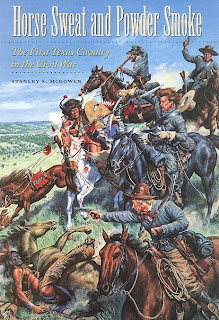 Modern regimental studies of units raised in the Trans-Mississippi and remaining there during their entire service are rare and the First, in its several forms, has the added bonus of having a fascinatingly disparate range of duties. From February 1861, the job of the First Texas Mounted Rifles (a 12-month regiment) was primarily to patrol the Texas frontier and protect settlers from frequent Comanche and Kiowa attacks. When this initial enlistment period expired in spring 1862, four companies formed the nucleus of a cavalry battalion that guarded the coast but also dealt with internal troubles stirred up by pro-Union German immigrants. Officers and men from the old First fought in the Neuces battle but apparently did not directly participate in the prisoner murders that tainted the aftermath. In May 1863, the regiment was reconstituted as the First Texas Cavalry. The Texans spent much of the remaining period of the war on the move safeguarding the essential cross border cotton trade, defending the state from a number of Union amphibious operations (their duty stations ranging up and down the entire coastline between Fort Brown and the Texas-Louisiana border), and campaigning in Louisiana with Confederate forces opposing the Union army's 1863 Texas Overland Expedition and 1864 Red River Campaign.
The study does not include a roster and the demographic analysis of the men that served in the ranks is fairly minimal by today's standards. The large number of German-Americans in the regiment will interest many readers more familiar with stories surrounding the pro-Union element among German-Texan citizenry. McGowen provides detailed mini-biographies of their officers (including that of the talented professional soldier that would eventually lead the regiment, Augustus Buchel) but unfortunately wasn't able to uncover much common soldier source material documenting the source of their Confederate loyalties and what they thought about their unionist neighbors
McGowen does devote a great deal of space in the book to the difficulties of frontier military service in the Confederacy, including how the Texans dealt with scarcities in food, supplies, weapons, horses, equipment, and medical services in camp and on campaign. Horse Sweat and Powder Smoke really is a noteworthy original when it comes to Trans-Mississippi regimental histories. From Indian fighting to border security to suppressing armed internal dissent to defending coastal and overland routes from Union invasion, the variety of roles performed by the men of the First Texas Cavalry almost perfectly encapsulates the entire range of Civil War Texas military experiences.

The study does not include a roster and the demographic analysis of the men that served in the ranks is fairly minimal by today's standards. The large number of German-Americans in the regiment will interest many readers more familiar with stories surrounding the pro-Union element among German-Texan citizenry. McGowen provides detailed mini-biographies of their officers (including that of the talented professional soldier that would eventually lead the regiment, Augustus Buchel) but unfortunately wasn't able to uncover much common soldier source material documenting the source of their Confederate loyalties and what they thought about their unionist neighbors
McGowen does devote a great deal of space in the book to the difficulties of frontier military service in the Confederacy, including how the Texans dealt with scarcities in food, supplies, weapons, horses, equipment, and medical services in camp and on campaign. Horse Sweat and Powder Smoke really is a noteworthy original when it comes to Trans-Mississippi regimental histories. From Indian fighting to border security to suppressing armed internal dissent to defending coastal and overland routes from Union invasion, the variety of roles performed by the men of the First Texas Cavalry almost perfectly encapsulates the entire range of Civil War Texas military experiences.
Wednesday, January 29, 2014
Snapshots from the Collection: "Acadian General: Alfred Mouton and the Civil War"
 I spend so much time reading and reviewing new releases that I rarely have time to revisit books from the home library purchased years ago but never read. Earlier this month, I finally unwrapped William Arceneaux's Acadian General: Alfred Mouton and the Civil War (Center for Louisiana Studies, 1981 2nd revised & expanded ed.). I picked it up at a special sale from the publisher, in reckless disregard of my favorite Louisiana Civil War consultant's sage advice to not bother with it. It turns out I probably should have listened. It's not that it's a terrible book, just dated past being particularly useful.
A member of a distinguished and politically prominent Louisiana family (his father was a governor), Jean-Jacques Alexandre Alfred Mouton was one of those West Point graduates that immediately resigned to seek greener pastures but returned to military service with the outbreak of the Civil War. Elected colonel of the 18th Louisiana, Mouton was wounded at Shiloh. Returning to West Louisiana with increasing levels of rank and responsibility, he fought in many battles and skirmishes in the Lafourche district, Bayou Teche region, and Red River (where he was killed at Mansfield).
Acadian General describes at some length the travails of the Acadian people of North American and how they established themselves in Louisiana after their expulsion from British Canada. While the family history and section describing Mouton's antebellum life and career is helpful, the book doesn't really enhance our understanding of the military events chronicled inside, but, to be fair, when the first edition was published in 1972 (I believe) the material would have seemed far fresher than today. Still, as the reader, it's a very limiting experience to read an officer's military biography with no private commentary or campaign perspective from the man himself. The 2nd edition does add a roster of the 18th (just a list of names), a copy of Mouton's academic marks at West Point, some poetry, and a bibliographical essay.
Monday, April 8, 2013
Snapshots from the Collection: "About Brigadier General Nathaniel Lyon, U.S. Army Volunteers and Wilson's Creek"
Before I came across About Brigadier General Nathaniel Lyon, U.S. Army Volunteers and Wilson's Creek by Hardy A. Kemp (Author, 1978) in a recent visit to my favorite local bookstore, I thought I was familiar with all the modern book length treatments of the campaign. No publisher or even a publishing date is mentioned in its pages, so the assumption is that it is self-published with the given date corresponding to the one attached to an author appreciation piece inside written by a Missouri state senator. Initially, as Hardy does not mention Bearss's work, I thought the manuscript was written much earlier, but the notes do cite works from the early to mid 1970s. Online used book outlets and bibliographical listings confirm the 1978 date so that's good enough for me, I guess.
As the title suggests, the book is a combination Lyon biography and examination of the general's role in the 1861 Missouri Campaign. The study does not go as far as Lyon biographer Christopher Phillips went in attempting to drill inside their subject's psyche, but Kemp does offer a portrait of Lyon's volatile personality using contemporary sources (salient among these the writings of Thomas Snead, James Peckham, and Drs. Ashbel Woodward and William Hammond). The picture of Lyon that emerges is the fairly typical one of an officer with rigid beliefs in the areas of slavery, military duty, and federal supremacy, while at the same time unabashedly insubordinate and entirely intolerant of dissenting views.
Kemp also studies the ways that Lyon's West Point education and his experiences in the Mexican War and antebellum Far West Indian conflicts informed his Civil War generalship. The most helpful professional development section deals with practical lessons learned from the Mexican War, although the author's criticism of Lyon's artillery deployments at Wilson's Creek as not indicative of best practices learned from that conflict is strikingly unpersuasive. It's a small part of the book overall, but the discussion of Lyon's tactical and command failings at Wilson's Creek is where I found the study's freshest material and most trenchant analysis. Kemp favors comparison via excerpts from some translation of Jomini, but the principles cited are common sense observations of military history and practice more than anything else.
The choice of constructing the book as a hybrid of sequential thematic analysis with narrative makes it a structural mess, and better books exist in the arenas of Lyon biography and Wilson's Creek battle history, but there are more than enough thoughtful bits and pieces spread throughout Kemp's study to recommend it to those with a special interest in both subjects (if a copy can be found!).
As the title suggests, the book is a combination Lyon biography and examination of the general's role in the 1861 Missouri Campaign. The study does not go as far as Lyon biographer Christopher Phillips went in attempting to drill inside their subject's psyche, but Kemp does offer a portrait of Lyon's volatile personality using contemporary sources (salient among these the writings of Thomas Snead, James Peckham, and Drs. Ashbel Woodward and William Hammond). The picture of Lyon that emerges is the fairly typical one of an officer with rigid beliefs in the areas of slavery, military duty, and federal supremacy, while at the same time unabashedly insubordinate and entirely intolerant of dissenting views.
Kemp also studies the ways that Lyon's West Point education and his experiences in the Mexican War and antebellum Far West Indian conflicts informed his Civil War generalship. The most helpful professional development section deals with practical lessons learned from the Mexican War, although the author's criticism of Lyon's artillery deployments at Wilson's Creek as not indicative of best practices learned from that conflict is strikingly unpersuasive. It's a small part of the book overall, but the discussion of Lyon's tactical and command failings at Wilson's Creek is where I found the study's freshest material and most trenchant analysis. Kemp favors comparison via excerpts from some translation of Jomini, but the principles cited are common sense observations of military history and practice more than anything else.
The choice of constructing the book as a hybrid of sequential thematic analysis with narrative makes it a structural mess, and better books exist in the arenas of Lyon biography and Wilson's Creek battle history, but there are more than enough thoughtful bits and pieces spread throughout Kemp's study to recommend it to those with a special interest in both subjects (if a copy can be found!).
Thursday, August 9, 2012
Snapshots from the Collection: "Westward the Texans"
 Trans-Mississippians love to complain about what's ignored in the literature, but, given its small size, there's actually a rather large body of published material for the 1861-62 Confederate invasion of Arizona and New Mexico. Few have contributed as much to the field as historian Jerry Thompson. Westward the Texans: The Civil War Journal of Private William Randolph Howell
 (Texas Western Press, 1990) comprises yet another very worthwhile offering from this prolific Civil War author and editor.
Thompson begins the book with a set of annotated bibliographical essays for the campaign (one each for diaries, letters, memoirs, official records, and newspapers), weighing the content and relative value of each. These are a great beginning resource for those looking to delve into primary sources.
A soldier in the 4th Texas Mounted Volunteers, Howell began his journal in April 1861 and ended it in July 1862. Different from other existing diaries and letters, which are frequently fragmentary, Howell covers the entire Sibley campaign, often on a daily basis. Entries are typically only a few sentences, but early passages and those covering the fighting can be several paragraphs in length. The retreat chronicle is quite valuable, and remarkable given how arduous and worrisome the experience must have been and how sick Howell was near the end [As an aside, the book includes the best map that I've ever seen depicting the path of the retreat in the mountains west of Fort Craig].
As with most Thompson books, the background material contained in the notes is expansive, with mounds of detail associated with persons, places, and events mentioned in Howell's journal. The bibliography is richer than those found in most original works of the period, another common characteristic of Thompson's editorial career. With the diary and rich supplemental material, there's much in Westward the Texans to recommend to students of both the New Mexico Campaign and Texas Confederates in general.
Though out of print, used copies are available at reasonable prices.
Monday, May 21, 2012
Snapshots from the Collection: "The Big Guns of Fayette"

From 1861-64, the unit drew garrison duty the length of the Texas coast as places like Liberty, Virginia Point, Galveston Island, Sandy Point, and Fort Mannahassett (Sabine Pass). The only real combat experienced by the men was at Calcasieu Pass (LA) in 1864, where the guns came under heavy fire (disabling two) but were nevertheless instrumental in forcing a pair of powerful Union gunboats (Granite City and Wave, mounting 14 cannon) to surrender. At only 69 pages, Boethel's narrative, based on a variety of primary and secondary source materials (but primarily on official documents), is brief, but it is strong on organizational and roster data. The chapter on Calcasieu Pass is judiciously written and suitably detailed, although a battle map would have been helpful. A trio of drawings indicate geographical points significant to the unit's service history as well as the locales where it was organized and trained. The roster at the back of the book contains a good number of sizable mini-biographies.
The Big Guns of Fayette has aged rather well and is worth picking up [unfortunately, used copies offered on the secondary market currently run in the $200 range so ILL is a better bet]. In addition to providing useful coverage of military affairs on relatively obscure coastal fronts in the Trans-Mississippi, the book's portrait of an unusual Confederate unit should also arouse the interest of social historians interested in the multi-ethnic makeup of Civil War armies.
Tuesday, July 19, 2011
Snapshots from the Collection: "From Desert to Bayou"

 .
Thompson contributed an introduction and detailed notes, but perhaps From Desert to Bayou 's greatest value lies in its dozens of color reproductions of Merrick's sketches and paintings. In addition to many detailed drawings of the regional architecture, Merrick sketched maps, landscapes, camps, forts, and battle scenes. A series of portraits of Mescalero Apaches encountered by Merrick are among the more unusual images. The native New Yorker but pre-war San Antonio resident also fought in Louisiana with the 3rd Texas Cavalry (Co. E). There he continued his amateur artwork, completing several camp and battle scenes from the shores of the Mississippi and in the LaFourche District. From Desert to Bayou is a very worthwhile personal and visual record of the Civil War in the Trans-Mississippi.
.
Thompson contributed an introduction and detailed notes, but perhaps From Desert to Bayou 's greatest value lies in its dozens of color reproductions of Merrick's sketches and paintings. In addition to many detailed drawings of the regional architecture, Merrick sketched maps, landscapes, camps, forts, and battle scenes. A series of portraits of Mescalero Apaches encountered by Merrick are among the more unusual images. The native New Yorker but pre-war San Antonio resident also fought in Louisiana with the 3rd Texas Cavalry (Co. E). There he continued his amateur artwork, completing several camp and battle scenes from the shores of the Mississippi and in the LaFourche District. From Desert to Bayou is a very worthwhile personal and visual record of the Civil War in the Trans-Mississippi.
Monday, July 11, 2011
Snapshots from the Collection: "Sibley's New Mexico Campaign"

In 2000, Sibley's New Mexico Campaign
 was reissued by the University of New Mexico Press (with a foreword by Jerry D. Thompson). The new edition contains a number of minor corrections discovered by Hall after the original publication (and noted by Hall in Thompson's personal copy). The five maps that accompanied the first edition are absent, replaced by a single theater image. While the more recent campaign overview authored by Donald Frazier is excellent and several of the battles have received their own book length studies from capable talents like Don Alberts, it remains a worthwhile endeavor to go back and review the work of the man that started it all, Martin Hardwick Hall.
Friday, January 7, 2011
Snapshots from the Collection: "One Blanket and Ten Days Rations: 1st Infantry New Mexico Volunteers in Arizona 1864-1866"
 Students of the 1862 Confederate New Mexico and Arizona campaign will recall the role of the 1st New Mexico, but the men whose Civil War service is recounted in Charles and Jacqueline Meketa's One Blanket and Ten Days Rations: 1st Infantry New Mexico Volunteers in Arizona 1864-1866
 (Southwest Parks and Monuments Association, 1980) belonged to a different unit. In 1863, the governor of New Mexico reactivated the 1st NMVI as a three year regiment and recruited its officers and men from scratch (the original unit was disbanded).
One Blanket and Ten Days Rations is a scholarly treatment of the military service of companies A and I. In addition to capsule organizational and campaign histories of these companies, rosters, demographic data, and lists of dead, desertions, disabilities, and equipment are provided by the authors. The men of Company A were nearly all Hispanic and I only slightly less so. Both companies organized and trained at Fort Union before being sent to southern Arizona to participate in General Carleton's 1864 Apache campaign. The pair did not serve together, with A going to Fort Bowie at Apache Pass and I joining California volunteers for the unsuccessful Pinal Mountains Expedition (July - August). None of Carleton's lofty operational goals were met and the New Mexicans spent the balance of their service in garrison, patrol, and escort duties. This book is a fine documented history of arduous volunteer infantry service on a forgotten front.
Monday, December 13, 2010
Snapshots from the Collection: "Lone Star Regiments in Gray"

 (Eakin Press, 2002). The hardcover has been out of print for a few years now, but last time I looked it remained available in paperback
 format.
Texas supplied a whopping 53 cavalry regiments to the Confederate army, along with 24 infantry regiments, an artillery regiment, 4 artillery battalions, and 35 batteries. Divided into chapters by geographical region of service, all of these units are discussed by Wooster. He also elected to group many of them by brigade, instead of by the more common sequential presentation, a logical choice given that so many Texas regiments were afforded the unusual privilege of being able to serve together in the same brigade for the entire war.
The capsule regimental histories are footnoted and provide basic organizational, leadership, and combat service information. Photos of prominent officers are present, as well as maps. While many of the regimental entries are quite lengthy, the book's artillery section is brief, with many batteries receiving only a single short paragraph. As so many Texas infantry and cavalry (mounted and dismounted) units, and nearly all the artillery, spent their entire Civil War careers in the Trans-Mississippi theater, the book is also a useful record of obscure formations. Wooster ends the book with an excellent bibliographical essay and index.
Tuesday, November 16, 2010
Snapshots from the Collection: "Desert Tiger: Captain Paddy Graydon and the Civil War in the Far Southwest"
 If he's recognized at all by Civil War readers, James "Paddy" Graydon is known for his flawed scheme to attack a Confederate camp in New Mexico by forwarding mules laden with lit fused howitzer shells. Regardless of which version of the story is to be believed, it was a fiasco, fatal only to the poor mules. But there is more to Capt. Graydon's Civil War service, a subject ably recounted by Jerry Thompson in his study Desert Tiger: Captain Paddy Graydon and the Civil War in the Far Southwest
 (Texas Western Press, 1992).
Born in Ireland, Graydon immigrated to America at age 21, enlisting almost immediately in the 1st Dragoons in 1853. The dragoons ranged across the New Mexico Territory and the Gadsden Purchase, gaining its officers and men valuable experience fighting Indians, particularly the Apache. Discharged in 1858, Graydon stayed in the area and became a prosperous businessman, and a bit of a frontier enforcer. When Civil War broke out, he formed an "Independent Spy Company", recruited from a cross section of New Mexican society. Attached to E.R.S. Canby's army at Fort Craig, Graydon's company vigorously gathered intelligence about the approaching Confederates under Henry H. Sibley. While appreciating the Irishman's success in maintaining discipline, Thompson notes that the information obtained by Graydon was sometimes seriously inaccurate. Even so, he was well regarded by many in the Union army. After Sibley's retreat back to Texas, Graydon remained in New Mexico, scouting the mountains and trails surrounding Fort Stanton. There, an alleged ambush and massacre of Apaches at Gallinas Springs indirectly led to Graydon's demise, as he was mortally wounded in a dispute over the event with ex-army surgeon John Whitlock at Fort Stanton in November 1862.
At only 63 pages of text, Thompson's monograph is a brief, albeit well researched and even handed treatment of James Graydon's army service, both before and during the Civil War. While it is fully annotated and several useful maps supplement the narrative, the book suffers from the lack of a bibliography and index. Nevertheless, in addition to its biographical features, Desert Tiger provides important insights into lesser known events of the Civil War in the desert southwest.
Monday, October 18, 2010
Snapshots from the Collection: "Croxton's Raid"
 Of the handful of Wilson's Raid studies, none are truly satisfying, with James Pickett Jones's almost 30 year old Yankee Blitzkrieg: Wilson's Raid through Alabama and Georgia
 still the best. Rex Miller's Croxton's Raid
 isn't a great book either, but it details a significant but lesser known aspect of the operation, the ancillary raid conducted by a detached force commanded by Brigadier General John T. Croxton.
Published in paperback by The Old Army Press in 1979, Miller's study traces the independent movements and destructive activities of Croxton's brigade, which separated from Wilson's main body of three divisions early on in the raid at Elyton, Alabama on March 30, 1865 and headed to Tuscaloosa, fighting briefly at Trion before crossing the Black Warrior River and approaching the city from the north. There, Croxton burned the university [to the joy of Auburn fans everywhere] and destroyed other public properties and military targets. Next, the raiders headed southwest, seeking to cross the Tombigbee but turning back upon finding the river unfordable and hearing that Wilson was already in possession of Selma. Returning to Tuscaloosa, Croxton then adopted a winding eastward course across the state, crossing the Coosa River and passing through Talladega before finally crossing the border and rejoining Wilson at Macon, Georgia on May 1. Along the way, detachments were sent out to destroy iron works and other industrial sites, and several very small skirmishes were fought.
About half the book (94 pages) covers the raid in narrative form, the rest comprising unit histories as well as officer lists and biographies. The volume is well illustrated and numerous maps allow the reader to easily follow the path of the raiders. The text is properly documented, and, while the bibliography is a bit thin by today's standards, a good range of sources (published and unpublished) were used. Students of Wilson's Raid will find the volume well worth a look.
Tuesday, October 20, 2009
Snapshots from the Collection: "All Quiet on the Yamhill"
 When the Civil War led the federal government to recall the regular army units patrolling the frontier, California volunteers picked up much of the slack up and down the Pacific coast and into the mountain west. Corporal Royal A. Bensell (Company D, 4th California Volunteer Infantry) was one of these men. His daily journal, beginning in March 1862 and ending in October 1864, relates his often frustrating experiences in the Cascade Mountains of Oregon. His company garrisoned Fort Yamhill, a post situated along the banks of the Yamhill River approximately 25 miles west of Salem, as well as Fort Hoskins and the blockhouse at Siletz. All of these facilities were established in the mid-1850s to police the local Indian tribes, and during the Civil War came under the administrative umbrella of the District of Oregon.
 In 1959, University of Oregon Press published Bensell's diary, ably edited by then graduate student Gunter Barth, under the title All Quiet on the Yamhill: The Civil War in Oregon
 (cover art upper left). In 2001, UO Press came out with a paperback reprint (cover at right) but the first edition remains fairly plentiful on the secondary market. Barth contributed a Preface, extensive footnotes, a large detailed pullout map of the region, and four useful appendices [I-a summary of the local Indian population, II-a biographical sketch for Bensell, III-a short history of four Cascade forts, and IV-a Company D roster], and an index. Barth really did fine work with his explanatory notes, which were often comprised of detailed background information into persons, places, and events. The pull out map very helpfully locates the many place names mentioned in the journal, and also carefully traces the paths of Cpl. Bensell's trips up and down the coast.
Ostensibly there to contain any flare up of Indian or Copperhead troubles, Bensell's company instead experienced no battles and near endless boredom. The writer penned his journal with a view to posterity, and his unromanticized and unexaggerated account of his service is indeed a valuable day-to-day record of events in a typical Far West frontier fort during the Civil War. The quality editorship of Barth's (the equal of anything produced today by the current standards of scholarship) and the journal itself combine for a unique work well worthy of consideration as a Civil War classic.
Saturday, August 16, 2008
Snapshots from the Collection: "The Iowa Northern Border Brigade"
The Iowa Northern Border Brigade (INBB) was a state militia unit formed in the immediate aftermath of the 1862 Dakota uprising in Minnesota [a subject of several previous posts - here, here, and here about various books covering it]. Far from a true brigade-sized organization, the INBB was composed of a handful of understrength companies that patrolled the NW Iowa frontier. The men also built and garrisoned a chain of fortifications that began near Sioux City and stretched in a roughly northeastern pattern all the way to the Iowa-Minnesota border. The government sponsored monograph The Iowa Northern Border Brigade by Marshall McKusick (Office of the State Archaeologist, 1976) is part unit history, part archaeological report. While data and analysis are not at the depth found in the best of today's unit studies, this three decades old book does address issues of personnel makeup, logistics, armament, and operations to a mostly satisfying degree. While the text itself is marred by poor editing, the flaws of presentation are redeemed by the amount of information presented about this near unknown Civil War mounted organization. McKusick's lengthy, minutely detailed descriptions of the forts lining the INBB's patrol area, along with the large number of photographs and maps, engineering drawings, and illustrations of these posts, increase the value of his study for the collector and esoteric obsessed Civil War reader. I liked it, others may not!
by Marshall McKusick (Office of the State Archaeologist, 1976) is part unit history, part archaeological report. While data and analysis are not at the depth found in the best of today's unit studies, this three decades old book does address issues of personnel makeup, logistics, armament, and operations to a mostly satisfying degree. While the text itself is marred by poor editing, the flaws of presentation are redeemed by the amount of information presented about this near unknown Civil War mounted organization. McKusick's lengthy, minutely detailed descriptions of the forts lining the INBB's patrol area, along with the large number of photographs and maps, engineering drawings, and illustrations of these posts, increase the value of his study for the collector and esoteric obsessed Civil War reader. I liked it, others may not!
Subscribe to:
Posts (Atom)