

Showing posts with label Book Snapshots. Show all posts
Showing posts with label Book Snapshots. Show all posts
Monday, April 1, 2024
Book Snapshot: "Armies in Gray: The Organizational History of the Confederate States Army in the Civil War"
I first posted about US Army Command and General Staff College professor Dan Fullerton's Armies in Gray: The Organizational History of the Confederate States Army in the Civil War way back in 2016. Still in print today, it was published in 2017 and, aside from a couple of reviews, seems to have promptly disappeared from larger notice. I don't recall seeing it in any bibliography yet. My own attempt at getting a review copy was unsuccessful, but patience paid off a year and a half later when I found a warehouse deal on it for a fraction of the $200 list price (and it wasn't even damaged).
 A massive tome at 1,350 pages, Fullerton's Armies in Gray is essentially an attempt to recreate for Civil War students and researchers the organizational evolution of the entire Confederate Army at quarterly time stamps. With yearly intervals missing too much in the way of momentous organizational change and monthly intervals far too static and unwieldy, quarterly snapshots in time seem to hit the sweet spot. The order of battle resources that form the backbone of the book's own series of OBs are the usual suspects (chief among those the Official Records, Crute, and Sifakis) along with supplemental first-person accounts and unit histories. Sifakis's books have a bit of a hit and miss reputation, and presumably the author did as much cross-checking as was reasonably possible given the scale of the project.
Order of battle presentation employs the standard descending-org arrangement, beginning with military departments at the top and progressing all the way down the organizational tree to component regiments/battalions/batteries at the bottom. Numbers data is most consistent at the department, district, sub-district, army, corps, and division levels. Strength estimates for brigades is spotty and generally absent below that, although many small garrison post strengths are provided. Number of guns and tube types for batteries are also not part of the process. Independent local and state forces are excluded by design, but orders of battle for non-Confederate militia organizations that directly cooperated with Confederate forces in the field (ex. the Missouri State Guard) are attached. A volume index was likely omitted due to space concerns.
Each quarterly order of battle is extensively annotated at multiple formation levels. For those, hefty explanatory endnotes, a single one of which can run a thousand words or more, discuss that quarter's organizational changes and area(s) of operations (often with numbers and dates sprinkled within). Source information and reliability is also part of the endnote discussion.
This is definitely one of the jewels of my home reference library. I might be reading too much into it, but there seemed to be at least some suggestion of the possibility of producing a Union Army companion volume. Given that Armies in Gray took ten years to research, though, I can only imagine how much time (and how many volumes!) would be involved with repeating the same process for an Armies in Blue.
A massive tome at 1,350 pages, Fullerton's Armies in Gray is essentially an attempt to recreate for Civil War students and researchers the organizational evolution of the entire Confederate Army at quarterly time stamps. With yearly intervals missing too much in the way of momentous organizational change and monthly intervals far too static and unwieldy, quarterly snapshots in time seem to hit the sweet spot. The order of battle resources that form the backbone of the book's own series of OBs are the usual suspects (chief among those the Official Records, Crute, and Sifakis) along with supplemental first-person accounts and unit histories. Sifakis's books have a bit of a hit and miss reputation, and presumably the author did as much cross-checking as was reasonably possible given the scale of the project.
Order of battle presentation employs the standard descending-org arrangement, beginning with military departments at the top and progressing all the way down the organizational tree to component regiments/battalions/batteries at the bottom. Numbers data is most consistent at the department, district, sub-district, army, corps, and division levels. Strength estimates for brigades is spotty and generally absent below that, although many small garrison post strengths are provided. Number of guns and tube types for batteries are also not part of the process. Independent local and state forces are excluded by design, but orders of battle for non-Confederate militia organizations that directly cooperated with Confederate forces in the field (ex. the Missouri State Guard) are attached. A volume index was likely omitted due to space concerns.
Each quarterly order of battle is extensively annotated at multiple formation levels. For those, hefty explanatory endnotes, a single one of which can run a thousand words or more, discuss that quarter's organizational changes and area(s) of operations (often with numbers and dates sprinkled within). Source information and reliability is also part of the endnote discussion.
This is definitely one of the jewels of my home reference library. I might be reading too much into it, but there seemed to be at least some suggestion of the possibility of producing a Union Army companion volume. Given that Armies in Gray took ten years to research, though, I can only imagine how much time (and how many volumes!) would be involved with repeating the same process for an Armies in Blue.


Thursday, July 20, 2023
Snapshot Review - Forging a New South: The Life of General John T. Wilder
Having lived a long and remarkable life on and off the battlefield, along the way justly earning a historical reputation as one of the Civil War's more talented citizen-generals, Indiana's John Thomas Wilder is richly deserving of a up to date and full biographical treatment of the kind presented in the pages of Maury Nicely's Forging a New South: The Life of General John T. Wilder (University of Tennessee Press, 2023). This "Snapshot" review feature will solely address those parts of the book that detail Wilder's Civil War career, leaving his lengthy and eventful postwar life as a New South industrialist and politician for others to comment upon elsewhere in the review sphere.
 During the years leading up to the outbreak of the Civil War, the New York-born Wilder achieved business and financial success in Indiana. Patenting an efficient horizontal waterwheel to power industry, Wilder's technologically innovative mind was also on display in his adopted western state. Though praised for his vision and drive, his highly individualistic and impulsive nature concerned those suddenly left behind to manage his business partnerships. As Nicely keenly observes, these character traits carried over into Wilder's military career.
Quickly deciding to personally join the war effort, Wilder raised and led a company of the 17th Indiana VI into western Virginia in 1861. He quickly climbed the officer ranks, becoming the regiment's colonel by the time of the summer 1862 campaign and siege of Corinth. During the ensuing Kentucky Campaign of that year, Wilder commanded the brigade-sized Munfordville garrison. On September 17, after engaging in the highly irregular practice of consulting with and seeking advice from the enemy about where his duty lay, Wilder surrendered the post to General Braxton Bragg's army. However, he escaped strong censure on the merits of the daunting odds he faced and the fact that he had successfully defended Munfordville a short time earlier against a headlong Confederate assault, inflicting heavy casualties on the enemy. Missing the theater's big battles at Shiloh, Perryville, and Stones River, Wilder's frustrations grew as an infantry commander forced to contend with mobile Confederate cavalry raiders. The maddening inability to come to grips with elusive enemy forces such as those led by John Hunt Morgan helped inspire Wilder to transform his command into what would eventually be celebrated as the "Lightning Brigade."
Troubled by his situation, Wilder's inventive, problem-solving mind went to work in Kentucky and Middle Tennessee, the end result being the conversion of his infantry brigade into mounted infantry armed with repeating rifles. With the goal of creating a brigade with the swiftness of cavalry and fighting power of infantry (an enticing combination that some of his more skeptical superiors did not believe possible), Wilder trained his men in open order dismounted fighting tactics and tirelessly lobbied to arm them with the latest repeaters (eventually getting the vaunted Spencers). Such weapons would compensate both for dispersal on the firing line and diminished strength due to horseholders. In describing the process, the author, as others have also done in the literature, appropriately credits Army of the Cumberland commander William S. Rosecrans for being Wilder's partner in innovation and necessary ranking sponsor. Along the way, however, Wilder's singlemindedness not only ruffled the feathers of superiors but put the countryside surrounding his camps into an uproar through the brigade's repeated scouring of Middle Tennessee farms and homes for horseflesh, riding equipment, trophies, and supplies. Except for the weapons (of course), Wilder's goal of making the enemy pay for his command's upgrade and upkeep was largely successful.
The Civil War portion of Nicely's cradle-to-grave biographical narrative fills roughly half of the nearly 550-page volume. Two Wilder biographies have been published in 2023, this one and Steven Cox's John T. Wilder: Union General, Southern Industrialist (Mercer UP). The depth of Nicely's research far outstrips Cox's, and the breadth and detail of his narrative is also on another level. Utilizing a truly vast number and diversity of primary and secondary sources, Nicely's text covers with broad satisfaction the very significant role played by Wilder and his brigade during the 1863 Tullahoma and Chickamauga campaigns. Though critical observations are dutifully included, Nicely's highly laudatory interpretations of Wilder's actions are strongly supported by modern published accounts of mounted operations in both campaigns, including the best and most recent ones authored by David Powell and Eric Wittenberg. Interestingly, the Tullahoma study co-written by Powell and Wittenberg is not included in the bibliography. Perhaps its recent publication post-dated the author's completion of those sections of the book. Map quality is very good, though a few more would have helped (especially for the Chickamauga coverage).
As Nicely reveals, chronic health problems seriously curtailed Wilder's field service during 1863 and 1864, leaving most of his brigade's post-Chickamauga activities only briefly summarized in the text due to its commander's frequent absences. While sickness cut Wilder's front-line service short, both before and after his 1864 resignation he still was able to significantly contribute to the war effort as a recruiting agent for Indiana governor Oliver Morton. Indeed, it remains curious that Wilder, a field-grade officer having an enviable record of battlefield distinction and top-level supporters (both Morton and General George Thomas urged his promotion), did not receive his general's star until August of 1864. By then, Wilder was effectively out of the war. The possibility is raised that the Lincoln administration, wary of Morton's presidential aspirations, slow-tracked the governor's appointment requests, but the author seems more accepting of the simpler explanation that a lack of suitable vacancies delayed Senate approval. Perhaps it was a bit of both.
As mentioned earlier, the second half of the book covers Wilder's ironworks and railroad manufacturing activities in post-Civil War East Tennessee as well as his political aspirations, which included an unsuccessful congressional run but successful election as mayor of Chattanooga. The volume also includes a large gallery of photographs, many presumably little-seen before now.
Judging from this substantial foray into the book's content, all evidence points toward Maury Nicely's Wilder biography being the clear frontrunner of the two candidates and well worthy of recommendation.
During the years leading up to the outbreak of the Civil War, the New York-born Wilder achieved business and financial success in Indiana. Patenting an efficient horizontal waterwheel to power industry, Wilder's technologically innovative mind was also on display in his adopted western state. Though praised for his vision and drive, his highly individualistic and impulsive nature concerned those suddenly left behind to manage his business partnerships. As Nicely keenly observes, these character traits carried over into Wilder's military career.
Quickly deciding to personally join the war effort, Wilder raised and led a company of the 17th Indiana VI into western Virginia in 1861. He quickly climbed the officer ranks, becoming the regiment's colonel by the time of the summer 1862 campaign and siege of Corinth. During the ensuing Kentucky Campaign of that year, Wilder commanded the brigade-sized Munfordville garrison. On September 17, after engaging in the highly irregular practice of consulting with and seeking advice from the enemy about where his duty lay, Wilder surrendered the post to General Braxton Bragg's army. However, he escaped strong censure on the merits of the daunting odds he faced and the fact that he had successfully defended Munfordville a short time earlier against a headlong Confederate assault, inflicting heavy casualties on the enemy. Missing the theater's big battles at Shiloh, Perryville, and Stones River, Wilder's frustrations grew as an infantry commander forced to contend with mobile Confederate cavalry raiders. The maddening inability to come to grips with elusive enemy forces such as those led by John Hunt Morgan helped inspire Wilder to transform his command into what would eventually be celebrated as the "Lightning Brigade."
Troubled by his situation, Wilder's inventive, problem-solving mind went to work in Kentucky and Middle Tennessee, the end result being the conversion of his infantry brigade into mounted infantry armed with repeating rifles. With the goal of creating a brigade with the swiftness of cavalry and fighting power of infantry (an enticing combination that some of his more skeptical superiors did not believe possible), Wilder trained his men in open order dismounted fighting tactics and tirelessly lobbied to arm them with the latest repeaters (eventually getting the vaunted Spencers). Such weapons would compensate both for dispersal on the firing line and diminished strength due to horseholders. In describing the process, the author, as others have also done in the literature, appropriately credits Army of the Cumberland commander William S. Rosecrans for being Wilder's partner in innovation and necessary ranking sponsor. Along the way, however, Wilder's singlemindedness not only ruffled the feathers of superiors but put the countryside surrounding his camps into an uproar through the brigade's repeated scouring of Middle Tennessee farms and homes for horseflesh, riding equipment, trophies, and supplies. Except for the weapons (of course), Wilder's goal of making the enemy pay for his command's upgrade and upkeep was largely successful.
The Civil War portion of Nicely's cradle-to-grave biographical narrative fills roughly half of the nearly 550-page volume. Two Wilder biographies have been published in 2023, this one and Steven Cox's John T. Wilder: Union General, Southern Industrialist (Mercer UP). The depth of Nicely's research far outstrips Cox's, and the breadth and detail of his narrative is also on another level. Utilizing a truly vast number and diversity of primary and secondary sources, Nicely's text covers with broad satisfaction the very significant role played by Wilder and his brigade during the 1863 Tullahoma and Chickamauga campaigns. Though critical observations are dutifully included, Nicely's highly laudatory interpretations of Wilder's actions are strongly supported by modern published accounts of mounted operations in both campaigns, including the best and most recent ones authored by David Powell and Eric Wittenberg. Interestingly, the Tullahoma study co-written by Powell and Wittenberg is not included in the bibliography. Perhaps its recent publication post-dated the author's completion of those sections of the book. Map quality is very good, though a few more would have helped (especially for the Chickamauga coverage).
As Nicely reveals, chronic health problems seriously curtailed Wilder's field service during 1863 and 1864, leaving most of his brigade's post-Chickamauga activities only briefly summarized in the text due to its commander's frequent absences. While sickness cut Wilder's front-line service short, both before and after his 1864 resignation he still was able to significantly contribute to the war effort as a recruiting agent for Indiana governor Oliver Morton. Indeed, it remains curious that Wilder, a field-grade officer having an enviable record of battlefield distinction and top-level supporters (both Morton and General George Thomas urged his promotion), did not receive his general's star until August of 1864. By then, Wilder was effectively out of the war. The possibility is raised that the Lincoln administration, wary of Morton's presidential aspirations, slow-tracked the governor's appointment requests, but the author seems more accepting of the simpler explanation that a lack of suitable vacancies delayed Senate approval. Perhaps it was a bit of both.
As mentioned earlier, the second half of the book covers Wilder's ironworks and railroad manufacturing activities in post-Civil War East Tennessee as well as his political aspirations, which included an unsuccessful congressional run but successful election as mayor of Chattanooga. The volume also includes a large gallery of photographs, many presumably little-seen before now.
Judging from this substantial foray into the book's content, all evidence points toward Maury Nicely's Wilder biography being the clear frontrunner of the two candidates and well worthy of recommendation.
 During the years leading up to the outbreak of the Civil War, the New York-born Wilder achieved business and financial success in Indiana. Patenting an efficient horizontal waterwheel to power industry, Wilder's technologically innovative mind was also on display in his adopted western state. Though praised for his vision and drive, his highly individualistic and impulsive nature concerned those suddenly left behind to manage his business partnerships. As Nicely keenly observes, these character traits carried over into Wilder's military career.
Thursday, February 2, 2023
Booknotes: Lee Invades the North
New Arrival:
• Lee Invades the North: A Comparison of the Antietam and Gettysburg Campaigns by Bradley M. Gottfried (Author, 2022). I'm obviously not familiar with every title among the legions of 1862 Maryland Campaign and 1863 Gettysburg Campaign studies, but I don't recall any existing work offering an in-depth, point by point discussion of the differences and similarities between the two. Bradley Gottfried, a Licensed Town Guide for Gettysburg, Certified Battlefield Guide for Antietam, and author of numerous publications addressing both campaigns, has not encountered such a book either, and that proved to be the motivating force behind the creation of his 2022 book Lee Invades the North: A Comparison of the Antietam and Gettysburg Campaigns.
Gottfried envisions nearly every aspect of both campaigns, from beginning to end, as open to fruitful comparison. His description offers an overview of topical breadth as follows: "The military and political environment at the beginning of each campaign," "why Lee undertook the invasions," "the armies and their leaders," "the condition of the armies," "military intelligence," "getting to the battlefield," "battles along the way," "battlefield terrain," "initial encounters," "the three phases of battle in each campaign," "the armies and their commanders-in-chiefs," "post-campaign events," and "final thoughts."
The above and more comprise chapter-length subsections in the book, and those are subdivided even further into as many as a half dozen additional topics of discussion. Each chapter's text exploration is supplemented, in tabular format, by a useful recapitulation of that subject's most notable similarities and differences. Both primary and secondary research were involved in this volume's creation, with notes and bibliography revealing a wide range of manuscript, newspaper, government document, book, and article resources. Gottfried also includes 35 maps drawn from his published atlas studies of both campaigns.
It's obvious from all this that Gottfried has deeply pondered the subject from top to bottom. If you're the kind of reader who has already spent years devouring everything Antietam and Gettysburg and are wondering if this might be the book for you, the author notes in the foreword that the material is directed toward both newbies and nitpickers alike. "This book is written for all readers. Anyone who is not familiar with the campaigns might wish to read the entire volume; those with greater knowledge will benefit by concentrating on the comparison sections."
I'm obviously not familiar with every title among the legions of 1862 Maryland Campaign and 1863 Gettysburg Campaign studies, but I don't recall any existing work offering an in-depth, point by point discussion of the differences and similarities between the two. Bradley Gottfried, a Licensed Town Guide for Gettysburg, Certified Battlefield Guide for Antietam, and author of numerous publications addressing both campaigns, has not encountered such a book either, and that proved to be the motivating force behind the creation of his 2022 book Lee Invades the North: A Comparison of the Antietam and Gettysburg Campaigns.
Gottfried envisions nearly every aspect of both campaigns, from beginning to end, as open to fruitful comparison. His description offers an overview of topical breadth as follows: "The military and political environment at the beginning of each campaign," "why Lee undertook the invasions," "the armies and their leaders," "the condition of the armies," "military intelligence," "getting to the battlefield," "battles along the way," "battlefield terrain," "initial encounters," "the three phases of battle in each campaign," "the armies and their commanders-in-chiefs," "post-campaign events," and "final thoughts."
The above and more comprise chapter-length subsections in the book, and those are subdivided even further into as many as a half dozen additional topics of discussion. Each chapter's text exploration is supplemented, in tabular format, by a useful recapitulation of that subject's most notable similarities and differences. Both primary and secondary research were involved in this volume's creation, with notes and bibliography revealing a wide range of manuscript, newspaper, government document, book, and article resources. Gottfried also includes 35 maps drawn from his published atlas studies of both campaigns.
It's obvious from all this that Gottfried has deeply pondered the subject from top to bottom. If you're the kind of reader who has already spent years devouring everything Antietam and Gettysburg and are wondering if this might be the book for you, the author notes in the foreword that the material is directed toward both newbies and nitpickers alike. "This book is written for all readers. Anyone who is not familiar with the campaigns might wish to read the entire volume; those with greater knowledge will benefit by concentrating on the comparison sections."
• Lee Invades the North: A Comparison of the Antietam and Gettysburg Campaigns by Bradley M. Gottfried (Author, 2022).

Tuesday, January 31, 2023
Booknotes: The Antietam Paintings by James Hope
New Arrival:
• The Antietam Paintings by James Hope by Bradley M. Gottfried & Linda I. Gottfried (Author, 2022).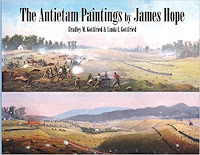 Except for the too-perfect alignment of battle lines in some of them, I've always liked the Hope series of paintings depicting scenes from the Battle of Antietam. According to the introduction to Bradley and Linda Gottfried's The Antietam Paintings by James Hope, Hope's work was directly informed by the artist's prewar painting background (during which he developed a passion for landscapes), his personal experience of the battle (he was a captain in the Second Vermont), and his topographical engineer duties during the war.
From the description: "The Battle of Antietam held a special place for Hope, and during the late 1880's into the 1890's, he created five large panoramic paintings of various aspects of the battle. Four of the five still exist today and are regularly displayed at the Antietam National Battlefield; the fifth was badly damaged in a flood, but a smaller version still exists."
In addition to learning more about Hope himself, I am looking forward to perusing the volume's breakdown of key features displayed in his painting series. More from the description: The 48-page booklet "describes Hope's life and then reviews each of the five panoramic paintings in detail, beginning with a representation of the entire painting and then by dividing the painting into three sections and illustrating the major features of each in subsequent pages. A full-color panel is on the right side of each page and a description of the events/scenes, is on the left."
Except for the too-perfect alignment of battle lines in some of them, I've always liked the Hope series of paintings depicting scenes from the Battle of Antietam. According to the introduction to Bradley and Linda Gottfried's The Antietam Paintings by James Hope, Hope's work was directly informed by the artist's prewar painting background (during which he developed a passion for landscapes), his personal experience of the battle (he was a captain in the Second Vermont), and his topographical engineer duties during the war.
From the description: "The Battle of Antietam held a special place for Hope, and during the late 1880's into the 1890's, he created five large panoramic paintings of various aspects of the battle. Four of the five still exist today and are regularly displayed at the Antietam National Battlefield; the fifth was badly damaged in a flood, but a smaller version still exists."
In addition to learning more about Hope himself, I am looking forward to perusing the volume's breakdown of key features displayed in his painting series. More from the description: The 48-page booklet "describes Hope's life and then reviews each of the five panoramic paintings in detail, beginning with a representation of the entire painting and then by dividing the painting into three sections and illustrating the major features of each in subsequent pages. A full-color panel is on the right side of each page and a description of the events/scenes, is on the left."
• The Antietam Paintings by James Hope by Bradley M. Gottfried & Linda I. Gottfried (Author, 2022).

Tuesday, September 6, 2022
Book Snapshot: Old Glory at the Crossroads 1861-1865

Thursday, June 30, 2022
Book Snapshot: "The Twenty-Eighth Regiment Iowa Volunteer Infantry: A Brief History"

Sunday, March 6, 2022
Book Snapshot: Brigades of Antietam
Monday, November 22, 2021
Book Snapshot: "The Summer of ’63: Vicksburg and Tullahoma"

Thursday, April 29, 2021
Book Snapshot: "Echoes From Gettysburg: Georgia's Memories and Images"
Echoes From Gettysburg: Georgia's Memories and Images (Fox Run Publishing, 2021) is the second volume of Keith Jones's Echoes of Gettysburg series of books collecting published reminiscences of the battle by state. The first, Echoes From Gettysburg: South Carolina's Memories and Images, was published back in 2016. The Georgia volume also serves as a revised and expanded update to an earlier book from the author, Georgia Remembers Gettysburg: A Collection of First-Hand Accounts Written by Georgia Soldiers, which was released in 2013 by Ten Roads Publishing.
 As one of the Confederacy's most populous states, Georgia's contribution in officers and men to the Army of Northern Virginia at Gettysburg was substantial, and Georgia units and formations figured prominently in many well-known events that occurred during the campaign and battle. From the description: "The first infantry actions of the Gettysburg Campaign involved Georgia troops. Brigadier General John B. Gordon's brigade crossed the Potomac River on June 22, 1863, and was the first Confederate infantry to march into the town of Gettysburg on June 26. They also flew their flag over a one-time seat of the Continental Congress in York, Pennsylvania and engaged in early action during an attempt to capture the bridge over the Susquehanna River at Wrightsville, Pennsylvania. Most discussion about Gettysburg focuses on the third day, obscuring the first two days in which Robert E. Lee' s troops were far more successful, in fact on the first day, they dominated. Thirteen thousand Georgia troops played a significant role in the three-day battle."
Georgia's role in the Gettysburg campaign is recounted in an annotated introductory essay of around thirty pages in length, with the narrative supported by a set of eight splendid Philip Laino maps. Spread throughout the volume are dozens of images (often full-page sized) of Georgia officers and men. The appendix is an order of battle for Georgia ANV units at Gettysburg, and the volume concludes with a bibliography and a unit, name, and place index.
Georgia "memories" of the battle fill just over 230 pages in the book and are almost entirely sourced from articles that appeared in thirteen (mostly Georgia) newspapers and Confederate Veteran magazine, a few published during the war years but mostly between the 1880s and early 1900s. Unpublished soldier letters or journal entries are not part of the collection.
The material is organized into standalone chapters by unit, with the first covering the Georgia artillery. Published reminiscences from those serving in the many Georgia infantry brigades (Anderson's, Benning's, Doles', Gordon's, Semmes', Wofford's, Wright's, and Thomas') that fought at Gettysburg follow that in succession. There is also a chapter for the Georgia cavalry. The final section consists of reunion accounts.
As one of the Confederacy's most populous states, Georgia's contribution in officers and men to the Army of Northern Virginia at Gettysburg was substantial, and Georgia units and formations figured prominently in many well-known events that occurred during the campaign and battle. From the description: "The first infantry actions of the Gettysburg Campaign involved Georgia troops. Brigadier General John B. Gordon's brigade crossed the Potomac River on June 22, 1863, and was the first Confederate infantry to march into the town of Gettysburg on June 26. They also flew their flag over a one-time seat of the Continental Congress in York, Pennsylvania and engaged in early action during an attempt to capture the bridge over the Susquehanna River at Wrightsville, Pennsylvania. Most discussion about Gettysburg focuses on the third day, obscuring the first two days in which Robert E. Lee' s troops were far more successful, in fact on the first day, they dominated. Thirteen thousand Georgia troops played a significant role in the three-day battle."
Georgia's role in the Gettysburg campaign is recounted in an annotated introductory essay of around thirty pages in length, with the narrative supported by a set of eight splendid Philip Laino maps. Spread throughout the volume are dozens of images (often full-page sized) of Georgia officers and men. The appendix is an order of battle for Georgia ANV units at Gettysburg, and the volume concludes with a bibliography and a unit, name, and place index.
Georgia "memories" of the battle fill just over 230 pages in the book and are almost entirely sourced from articles that appeared in thirteen (mostly Georgia) newspapers and Confederate Veteran magazine, a few published during the war years but mostly between the 1880s and early 1900s. Unpublished soldier letters or journal entries are not part of the collection.
The material is organized into standalone chapters by unit, with the first covering the Georgia artillery. Published reminiscences from those serving in the many Georgia infantry brigades (Anderson's, Benning's, Doles', Gordon's, Semmes', Wofford's, Wright's, and Thomas') that fought at Gettysburg follow that in succession. There is also a chapter for the Georgia cavalry. The final section consists of reunion accounts.

Monday, April 19, 2021
Book Snapshot: "Decisions at Antietam: The Fourteen Critical Decisions That Defined the Battle"
With the release of Decisions at Antietam: The Fourteen Critical Decisions That Defined the Battle, the prolific Command Decisions in America’s Civil War series created by retired army officer Matt Spruill and published by University of Tennessee Press has now reached ten volumes*. It also marks the introduction of a promising new contributor in Michael S. Lang.
 Regular Decisions followers can skip this introductory paragraph, but some definition of terms and explanation of series format and structure are in order for new readers. As the title implies, analysis centers on the concept of the "critical decision." The series defines this as a decision "of such magnitude that it shapes not only the events immediately following, but also the campaign or battle thereafter." The number of critical decisions varies by volume, but each is evaluated using the same sequential five-stage process—"Situation", "Options", "Decision", "Results/Impact", and "Alternate Decision/Scenario". The first and typically the lengthiest section, Situation describes the state of affairs at a crossroads moment before, during, or after the campaign/battle. It provides readers with the background information necessary to recognize and evaluate the command decision Options (usually two or three in number) that immediately follow. The historical Decision is then outlined briefly before the Results/Impact section recounts what happened and how those events shaped the rest of the battle and perhaps beyond. The Situation and Results/Impact sections quite often reference other decisions in a meaningful way, further reminding readers of their interconnectivity and the cascading consequences of critical decisions made earlier. The Alternate Decision/Scenario section delves into alternative history conjecture based, obviously, on Options not selected (often the most tantalizing one readers favor with the benefit of hindsight). In using this framework rather than traditional narrative forms, it is felt that readers, even those well steeped in the topic at hand, will gain an enriched sense of "why events happened as they did." Rather than repeat an evaluation of how that's achieved (in the main part of the book as well as in the appendix's integrated battlefield guide), I would refer readers to the site reviews (here and here) of two volumes I feel were exceptionally effective in doing so.
Critical decisions can be "strategic, operational, tactical, organizational, personnel related, or logistical." Unlike other authors, Lang does not explicitly categorized his list of decisions. Beginning his analysis on the very eve of the Antietam fight, he also doesn't examine important pre-campaign (ex. Lincoln's decision to appoint McClellan to lead the newly organized army tasked with intercepting Lee's invasion) or any pre-battle decisions related to the fighting at the mountain passes or at Harpers Ferry. Apparently all of that will be addressed in a companion volume. As they are, the fourteen critical Antietam decisions are grouped into three chapters. The first consists of two September 15-16 operational decisions, the second ten tactical-level decisions made on September 17, and the final two are operational choices made on September 18. The set will be sampled here by looking at one from each chapter.
After defeat at the passes, a suddenly vulnerable Lee had a critical decision to make with three options: retreat across the Potomac, offer battle at Antietam (the historical choice), or move north toward Hagerstown to continue the campaign. Employing references to up to date scholarship, Lang does well in reciting the relevant considerations involved in each decision. General readers usually see the situation along Antietam creek as only a dual stay or fight proposition, but the author's inclusion of the third choice is supported by strong evidence that Lee was still seriously considering possible movements to regain the initiative after his previous plans were badly deranged by his opponent. Less convincing is Lang's suggestion in the Alternative Decision/Scenario section that a decision to retreat did not necessarily signal an end to the campaign. It seems to difficult to imagine the possibility that Lee's army, worn down and needing time to recoup from the Maryland Campaign's heavy straggling, would have attempted to force another Potomac crossing mere days later and now directly opposed on the north bank by McClellan's rested and fully concentrated army.
With the very recent publication of William Marvel's sympathetic Fitz John Porter biography it might be interesting to revisit next that general's role in the battle late on the 17th and see how Lang's decision analysis sees the matter. Citing a conservative estimate of 4,000 uncommitted Fifth Corps troops available to attack the Confederate center in the afternoon, Lang judiciously weighs factors for and against McClellan's two options regarding the deployment of Porter's troops. These were: (1) use the remaining army reserve (Porter's uncommitted Fifth Corps elements) to attack, or (2) continue to hold the reserve back to secure the Union center, its artillery (the 20-lb Parrotts on the east side of the creek had apparently exhausted all or most of their ammunition), and army trains. Lang makes a good point that an attack by Porter's troops, depending on how it was timed, didn't need to pierce Lee's center to have the possibility of achieving major results. In his view, just securing the Cemetery Hill high ground east of Sharpsburg as an enfilading artillery platform might have helped secure victory on the 17th.
Our last example, taken from the pair of post-battle decisions, involves McClellan's critical decision to not renew the attack on the 18th despite having received more than enough reinforcements to make up for the previous day's losses (Lang does not suggest the possibility of a third option involving maneuver). In keeping with the series tradition of not labeling decision options as necessarily good or bad but rather what factors went into their consideration, Lang offers a lucid, dispassionate assessment of what conditions and perceptions influenced McClellan's almost universally damned decision-making on that day. In his Alternate Decision/Scenario assessment, Lang is much more guarded than most in judging the results of a September 18 renewal of the battle. That scenario is typically presented by others as guaranteed destruction of Lee's army's. The author rejects going that far but is nevertheless confident that Lee would have been forced to retreat sometime during the day (which would have been highly dangerous by any measure) or following night. Emphasizing the connectivity aspect of critical decisions, Lang also remarks that McClellan's cautious decision did not signal an end to the campaign but only a shifting of the final (the book's fourteenth) critical decision onto the shoulders of Lee, who then had to decide whether to stand his ground for yet another day, attack, or retreat.
In terms of visual aids, fifteen maps support the main decision analysis, and modern battlefield photographs are interspersed throughout the volume. As is the case with the other series installments, a detailed battlefield touring guide closely tied to the critical decision analysis is present in the appendix section along with a set of army orders of battle. Distinct from other series volumes is Lang's inclusion of comparative strength and casualty tables based on a selection of contemporary and modern sources that differ in their research conclusions.
This assessment of Decisions at Antietam is admittedly limited, yet the quality of its sampled parts leads me to believe in the likelihood that Lang's contribution will be ranked among the stronger installments in the series.
Regular Decisions followers can skip this introductory paragraph, but some definition of terms and explanation of series format and structure are in order for new readers. As the title implies, analysis centers on the concept of the "critical decision." The series defines this as a decision "of such magnitude that it shapes not only the events immediately following, but also the campaign or battle thereafter." The number of critical decisions varies by volume, but each is evaluated using the same sequential five-stage process—"Situation", "Options", "Decision", "Results/Impact", and "Alternate Decision/Scenario". The first and typically the lengthiest section, Situation describes the state of affairs at a crossroads moment before, during, or after the campaign/battle. It provides readers with the background information necessary to recognize and evaluate the command decision Options (usually two or three in number) that immediately follow. The historical Decision is then outlined briefly before the Results/Impact section recounts what happened and how those events shaped the rest of the battle and perhaps beyond. The Situation and Results/Impact sections quite often reference other decisions in a meaningful way, further reminding readers of their interconnectivity and the cascading consequences of critical decisions made earlier. The Alternate Decision/Scenario section delves into alternative history conjecture based, obviously, on Options not selected (often the most tantalizing one readers favor with the benefit of hindsight). In using this framework rather than traditional narrative forms, it is felt that readers, even those well steeped in the topic at hand, will gain an enriched sense of "why events happened as they did." Rather than repeat an evaluation of how that's achieved (in the main part of the book as well as in the appendix's integrated battlefield guide), I would refer readers to the site reviews (here and here) of two volumes I feel were exceptionally effective in doing so.
Critical decisions can be "strategic, operational, tactical, organizational, personnel related, or logistical." Unlike other authors, Lang does not explicitly categorized his list of decisions. Beginning his analysis on the very eve of the Antietam fight, he also doesn't examine important pre-campaign (ex. Lincoln's decision to appoint McClellan to lead the newly organized army tasked with intercepting Lee's invasion) or any pre-battle decisions related to the fighting at the mountain passes or at Harpers Ferry. Apparently all of that will be addressed in a companion volume. As they are, the fourteen critical Antietam decisions are grouped into three chapters. The first consists of two September 15-16 operational decisions, the second ten tactical-level decisions made on September 17, and the final two are operational choices made on September 18. The set will be sampled here by looking at one from each chapter.
After defeat at the passes, a suddenly vulnerable Lee had a critical decision to make with three options: retreat across the Potomac, offer battle at Antietam (the historical choice), or move north toward Hagerstown to continue the campaign. Employing references to up to date scholarship, Lang does well in reciting the relevant considerations involved in each decision. General readers usually see the situation along Antietam creek as only a dual stay or fight proposition, but the author's inclusion of the third choice is supported by strong evidence that Lee was still seriously considering possible movements to regain the initiative after his previous plans were badly deranged by his opponent. Less convincing is Lang's suggestion in the Alternative Decision/Scenario section that a decision to retreat did not necessarily signal an end to the campaign. It seems to difficult to imagine the possibility that Lee's army, worn down and needing time to recoup from the Maryland Campaign's heavy straggling, would have attempted to force another Potomac crossing mere days later and now directly opposed on the north bank by McClellan's rested and fully concentrated army.
With the very recent publication of William Marvel's sympathetic Fitz John Porter biography it might be interesting to revisit next that general's role in the battle late on the 17th and see how Lang's decision analysis sees the matter. Citing a conservative estimate of 4,000 uncommitted Fifth Corps troops available to attack the Confederate center in the afternoon, Lang judiciously weighs factors for and against McClellan's two options regarding the deployment of Porter's troops. These were: (1) use the remaining army reserve (Porter's uncommitted Fifth Corps elements) to attack, or (2) continue to hold the reserve back to secure the Union center, its artillery (the 20-lb Parrotts on the east side of the creek had apparently exhausted all or most of their ammunition), and army trains. Lang makes a good point that an attack by Porter's troops, depending on how it was timed, didn't need to pierce Lee's center to have the possibility of achieving major results. In his view, just securing the Cemetery Hill high ground east of Sharpsburg as an enfilading artillery platform might have helped secure victory on the 17th.
Our last example, taken from the pair of post-battle decisions, involves McClellan's critical decision to not renew the attack on the 18th despite having received more than enough reinforcements to make up for the previous day's losses (Lang does not suggest the possibility of a third option involving maneuver). In keeping with the series tradition of not labeling decision options as necessarily good or bad but rather what factors went into their consideration, Lang offers a lucid, dispassionate assessment of what conditions and perceptions influenced McClellan's almost universally damned decision-making on that day. In his Alternate Decision/Scenario assessment, Lang is much more guarded than most in judging the results of a September 18 renewal of the battle. That scenario is typically presented by others as guaranteed destruction of Lee's army's. The author rejects going that far but is nevertheless confident that Lee would have been forced to retreat sometime during the day (which would have been highly dangerous by any measure) or following night. Emphasizing the connectivity aspect of critical decisions, Lang also remarks that McClellan's cautious decision did not signal an end to the campaign but only a shifting of the final (the book's fourteenth) critical decision onto the shoulders of Lee, who then had to decide whether to stand his ground for yet another day, attack, or retreat.
In terms of visual aids, fifteen maps support the main decision analysis, and modern battlefield photographs are interspersed throughout the volume. As is the case with the other series installments, a detailed battlefield touring guide closely tied to the critical decision analysis is present in the appendix section along with a set of army orders of battle. Distinct from other series volumes is Lang's inclusion of comparative strength and casualty tables based on a selection of contemporary and modern sources that differ in their research conclusions.
This assessment of Decisions at Antietam is admittedly limited, yet the quality of its sampled parts leads me to believe in the likelihood that Lang's contribution will be ranked among the stronger installments in the series.
* - The publisher's description is in slight error in stating that this is the ninth volume in the series. With prior releases of Stones River, Second Manassas, Chickamauga, Chattanooga, Atlanta, the 1862 Kentucky Campaign, Gettysburg, Wilderness & Spotsylvania, and Tullahoma volumes, this is indeed the tenth installment in the series with another one covering the Seven Days scheduled for release later this year.

* - The publisher's description is in slight error in stating that this is the ninth volume in the series. With prior releases of Stones River, Second Manassas, Chickamauga, Chattanooga, Atlanta, the 1862 Kentucky Campaign, Gettysburg, Wilderness & Spotsylvania, and Tullahoma volumes, this is indeed the tenth installment in the series with another one covering the Seven Days scheduled for release later this year.
Thursday, January 28, 2021
Book Snapshot: "Courage Above All Things: General John Ellis Wool and the U.S. Military, 1812–1863"
A project started decades ago by historian Harwood Hinton and edited/completed after his passing by colleague Jerry Thompson, Courage Above All Things: General John Ellis Wool and the U.S. Military, 1812–1863 (University of Oklahoma Press, 2020) provides us with the first fully comprehensive military biography of one of the most prominent U.S. Army figures of the Early Republic and Antebellum periods. At nearly 400 pages of detailed narrative, Harwood/Thompson's biography examines at great length the general's more than half a century of service that included the War of 1812, the 1846-48 War with Mexico, numerous conflicts with native peoples of the West, and the American Civil War. It is the final 100 pages or so of the book addressing Wool's role in his last major war that will be discussed here. The volume's Civil War period coverage begins on Chapter Thirteen just after Wool's transfer from California to New York to head the U.S. Army's Department of the East. During the feverish days immediately following the Confederate bombardment of Fort Sumter, Wool seems to have put to rest most questions about his advanced age (he was 77 when the war broke out) and presumed decline in necessary energy and mental acuity when he aggressively secured arsenals and depots, directed troop movements, organized arms and munitions shipments to numerous states, shipped tons of supplies to the nation's capital, and even chartered and outfitted ad hoc warships to escort transports and blockade Virginia waters. Less commendable was the awarding by Wool's department of lucrative army contracts to the general's nephew, John Griswold (a Democrat who later switched parties and supported the Radical Republican agenda in Congress).
With his department placed on solid footing and the nation's capital secured, Wool lobbied for active service at the front and was assigned a new department based at Fort Monroe on the tip of the Virginia Peninsula. He replaced the previous commander, Benjamin Butler, after the politician-general's embarrassing setback at the Battle of Big Bethel. At his new front-line command, Wool labored hard to improve the fort complex's land defenses, sustain Butler's contraband labor and support programs, regulate travel and mail between the lines, and work through the difficult process of prisoner exchange. Made independent of the Army of the Potomac at his own insistence, Wool agreed to cooperate with General George McClellan's drive up the Peninsula but would bristle when doing so had any whiff of his being directly subordinated to the junior officer. Oddly, among his many private complaints about McClellan's generalship were charges of organizational and logistical incompetence, the two skills even McClellan's harshest critics uniformly concede to have been great professional strengths. On the naval side, Wool's relationship with Flag Officer Louis Goldsborough did not go smoothly, and each held a dim view of the other. The energetic Wool did have strong ideas about how the Virginia campaign should have been waged, and he repeatedly advocated for a Southside operations against Richmond via Norfolk and Petersburg. However, it would take Lincoln's arrival on the scene in May 1862 (the president finally forcing Goldsborough to provide direct naval support to Wool) before a movement on Norfolk could finally be launched. Interestingly, the Hinton/Thompson account of the post-landing confusion that held up the army's initial advance along the roads leading into Norfolk credits Wool for unsnarling things while Steve Norder's version of events recently published in Lincoln Takes Command: The Campaign to Seize Norfolk and the Destruction of the CSS Virginia (2020) instead portrays Wool as contributing to it.
While the book's treatment of Wool (at least in the Civil War sections) is highly laudatory, it does not overlook the general's faults. If one uses this book's characterization of the general's Fort Monroe tenure as a template for imagining how he might have fared in leading a larger command in the field, it could be argued that Wool's extreme punctiliousness over issues of rank, his penchant for lecturing fellow officers, and his inability to work smoothly with the navy might easily have limited his effectiveness, even if his superannuated yet robust constitution held up to the increased strain.
In expressing Wool's most unadulterated views on people, politics, and events, the authors make good use of the general's wartime correspondence with his wife, Sarah. While Wool was very vocal in his public support of the administration and the Union war effort, privately the general seethed in his letters to his wife over Lincoln being the wrong man for the job. He also voiced very grave reservations about how the war was being conducted by Lincoln's War Department and the army's leading generals (much of his ire being directed toward McClellan). Wool's feelings about Lincoln did not change much over time, but they also did stop him from publicly campaigning for the president's second term during his semi-retirement (actions Wool surely considered dutiful, though also doubtlessly colored by his intense disdain for McClellan and especially the peace wing of the Democratic Party).
Wool was criticized for his heavy-handed military occupation of Norfolk (even to the extent of his being accused of starving the population in an attempt to cow them into more complete submission), and he was transferred to Baltimore in June 1862 to lead the Middle Department (at that time a geographically large area of responsibility encompassing Pennsylvania, Maryland, New Jersey, Delaware, and Virginia's Eastern Shore). According to the book, his switching places with General Dix was not viewed by the normally prickly Wool as official censure, and he apparently cheerfully submitted to the change. In employing a decidedly more moderate stance toward dissent in Maryland (what produced that change in approach is not explained but may perhaps have been as simple as Maryland still being in the Union while Virginia was enemy territory), Wool angered Maryland's radical Unionists and that was apparently his undoing there. If one subscribes to the notion that an administrating general has probably achieved the right balance when no faction among the populace is entirely satisfied, then Wool did his job well before political pressures from the strongest group (the unconditional Unionists) forced his return to New York City in January 1863 to once again lead the Department of the East.
According to Hinton and Thompson, Wool applied his usual energy to visiting all of the states under his juridiction and establishing cooperative ties with governors and other important politicians. He also labored hard to suppress the highly profitable illicit trade that passed through New York. Wool attempted with varying degrees of success to resist pressure from the War Department to strip the forts and garrisons under his command of troops and artillery batteries. Neveretheless, by the time of the New York City draft riots of July 1863, Wool felt he had too few troops to spare to help the city's police forces. It seems that Wool felt the forts defending the city undermanned and vulnerable, as unrealistic as it might sound now, to Confederate raiders penetrating the harbor and wreaking havoc at the docks. Wool could also be criticized for not streamlining chain of command in response to swiftly moving events. Even so, though Wool initially allowed army and militia commanders to bicker over authority, the authors argue that the level of impasse was overblown and resolved quickly. The book's suggestion that there was little more Wool could have done until reinforced (which he was, and the rioting quashed) seems reasonable, although it could be maintained that Wool's reluctance to involve federal forces in crushing domestic rioting was an interpretation of duty not shared by many other Union generals during the war.
The overall response to the riots was criticized in many quarters, and Wool was relieved from his post on July 18 in what would be his final play at departmental musical chairs with General Dix. Far from relaxing his labors after returning home to Troy, Wool, as mentioned above, continued to tirelessly promote the war effort in the region and publicly voiced his support for Lincoln's reelection. In the years immediately following the war, he was subjected to many lawsuits stemming from his actions in Baltimore (mainly regarding false arrest and imprisonment), all of which were eventually dropped. Wool supported moderate Reconstruction, including the application of a more gradual approach to according full citizenship rights and social status to freedmen. He died at his Troy home in November 1869 at the age of 85, a still respected figure. Courage Above All Things is heartily recommended to anyone interested in Wool's activities during the early-war period in the East and the New York City draft riots of 1863. The informative depth found in those sections also certainly creates a favorable impression of what a reader interested in the entirety of Wool's military career can gain from reading the rest of the book.
The volume's Civil War period coverage begins on Chapter Thirteen just after Wool's transfer from California to New York to head the U.S. Army's Department of the East. During the feverish days immediately following the Confederate bombardment of Fort Sumter, Wool seems to have put to rest most questions about his advanced age (he was 77 when the war broke out) and presumed decline in necessary energy and mental acuity when he aggressively secured arsenals and depots, directed troop movements, organized arms and munitions shipments to numerous states, shipped tons of supplies to the nation's capital, and even chartered and outfitted ad hoc warships to escort transports and blockade Virginia waters. Less commendable was the awarding by Wool's department of lucrative army contracts to the general's nephew, John Griswold (a Democrat who later switched parties and supported the Radical Republican agenda in Congress).
With his department placed on solid footing and the nation's capital secured, Wool lobbied for active service at the front and was assigned a new department based at Fort Monroe on the tip of the Virginia Peninsula. He replaced the previous commander, Benjamin Butler, after the politician-general's embarrassing setback at the Battle of Big Bethel. At his new front-line command, Wool labored hard to improve the fort complex's land defenses, sustain Butler's contraband labor and support programs, regulate travel and mail between the lines, and work through the difficult process of prisoner exchange. Made independent of the Army of the Potomac at his own insistence, Wool agreed to cooperate with General George McClellan's drive up the Peninsula but would bristle when doing so had any whiff of his being directly subordinated to the junior officer. Oddly, among his many private complaints about McClellan's generalship were charges of organizational and logistical incompetence, the two skills even McClellan's harshest critics uniformly concede to have been great professional strengths. On the naval side, Wool's relationship with Flag Officer Louis Goldsborough did not go smoothly, and each held a dim view of the other. The energetic Wool did have strong ideas about how the Virginia campaign should have been waged, and he repeatedly advocated for a Southside operations against Richmond via Norfolk and Petersburg. However, it would take Lincoln's arrival on the scene in May 1862 (the president finally forcing Goldsborough to provide direct naval support to Wool) before a movement on Norfolk could finally be launched. Interestingly, the Hinton/Thompson account of the post-landing confusion that held up the army's initial advance along the roads leading into Norfolk credits Wool for unsnarling things while Steve Norder's version of events recently published in Lincoln Takes Command: The Campaign to Seize Norfolk and the Destruction of the CSS Virginia (2020) instead portrays Wool as contributing to it.
While the book's treatment of Wool (at least in the Civil War sections) is highly laudatory, it does not overlook the general's faults. If one uses this book's characterization of the general's Fort Monroe tenure as a template for imagining how he might have fared in leading a larger command in the field, it could be argued that Wool's extreme punctiliousness over issues of rank, his penchant for lecturing fellow officers, and his inability to work smoothly with the navy might easily have limited his effectiveness, even if his superannuated yet robust constitution held up to the increased strain.
In expressing Wool's most unadulterated views on people, politics, and events, the authors make good use of the general's wartime correspondence with his wife, Sarah. While Wool was very vocal in his public support of the administration and the Union war effort, privately the general seethed in his letters to his wife over Lincoln being the wrong man for the job. He also voiced very grave reservations about how the war was being conducted by Lincoln's War Department and the army's leading generals (much of his ire being directed toward McClellan). Wool's feelings about Lincoln did not change much over time, but they also did stop him from publicly campaigning for the president's second term during his semi-retirement (actions Wool surely considered dutiful, though also doubtlessly colored by his intense disdain for McClellan and especially the peace wing of the Democratic Party).
Wool was criticized for his heavy-handed military occupation of Norfolk (even to the extent of his being accused of starving the population in an attempt to cow them into more complete submission), and he was transferred to Baltimore in June 1862 to lead the Middle Department (at that time a geographically large area of responsibility encompassing Pennsylvania, Maryland, New Jersey, Delaware, and Virginia's Eastern Shore). According to the book, his switching places with General Dix was not viewed by the normally prickly Wool as official censure, and he apparently cheerfully submitted to the change. In employing a decidedly more moderate stance toward dissent in Maryland (what produced that change in approach is not explained but may perhaps have been as simple as Maryland still being in the Union while Virginia was enemy territory), Wool angered Maryland's radical Unionists and that was apparently his undoing there. If one subscribes to the notion that an administrating general has probably achieved the right balance when no faction among the populace is entirely satisfied, then Wool did his job well before political pressures from the strongest group (the unconditional Unionists) forced his return to New York City in January 1863 to once again lead the Department of the East.
According to Hinton and Thompson, Wool applied his usual energy to visiting all of the states under his juridiction and establishing cooperative ties with governors and other important politicians. He also labored hard to suppress the highly profitable illicit trade that passed through New York. Wool attempted with varying degrees of success to resist pressure from the War Department to strip the forts and garrisons under his command of troops and artillery batteries. Neveretheless, by the time of the New York City draft riots of July 1863, Wool felt he had too few troops to spare to help the city's police forces. It seems that Wool felt the forts defending the city undermanned and vulnerable, as unrealistic as it might sound now, to Confederate raiders penetrating the harbor and wreaking havoc at the docks. Wool could also be criticized for not streamlining chain of command in response to swiftly moving events. Even so, though Wool initially allowed army and militia commanders to bicker over authority, the authors argue that the level of impasse was overblown and resolved quickly. The book's suggestion that there was little more Wool could have done until reinforced (which he was, and the rioting quashed) seems reasonable, although it could be maintained that Wool's reluctance to involve federal forces in crushing domestic rioting was an interpretation of duty not shared by many other Union generals during the war.
The overall response to the riots was criticized in many quarters, and Wool was relieved from his post on July 18 in what would be his final play at departmental musical chairs with General Dix. Far from relaxing his labors after returning home to Troy, Wool, as mentioned above, continued to tirelessly promote the war effort in the region and publicly voiced his support for Lincoln's reelection. In the years immediately following the war, he was subjected to many lawsuits stemming from his actions in Baltimore (mainly regarding false arrest and imprisonment), all of which were eventually dropped. Wool supported moderate Reconstruction, including the application of a more gradual approach to according full citizenship rights and social status to freedmen. He died at his Troy home in November 1869 at the age of 85, a still respected figure. Courage Above All Things is heartily recommended to anyone interested in Wool's activities during the early-war period in the East and the New York City draft riots of 1863. The informative depth found in those sections also certainly creates a favorable impression of what a reader interested in the entirety of Wool's military career can gain from reading the rest of the book.

Monday, December 2, 2019
Book Snapshot: Rhode Island's Civil War Dead
 With seemingly inexhaustible research and writing interests in the Rhode Island Civil War experience, Robert Grandchamp is rapidly becoming a leading authority on the subject. His eight related books include several unit studies, an edited letter collection, an annotated bibliography of Rhode Island sources, and an introductory history of the state's contributions to the war effort. The newest addition to this body of work is Rhode Island's Civil War Dead: A Complete Roster (McFarland, 2019).
During his twenty years of researching Civil War Rhode Island topics, Grandchamp strongly suspected the most commonly cited figures for Rhode Island military deaths (William Fox's 1,321, Harold Barker's unsourced 1,685, and the state monument committee's 1,727) were all much too low. Using the official state roster as a base, the author consulted service and pension records in the National Archives and visited "every town hall, cemetery, and archive" in the state (regardless of how small of a state Rhode Island is, that's quite the dedicated effort). Those local, ground-level efforts in town records and gravestone inscriptions, supplemented by regimental histories, diaries, and letters, uncovered "scores" of additional fatalities that occurred either during the war or were directly related to war service. The figure finally arrived at is 2,217 soldiers and sailors (out of 23,236 men who served), accompanied by humble acknowledgement that the true number of deaths will never been known for certain.
Directly following the introductory chapter and brief methodology discussion is the complete roster of the dead. Organized by unit [generals and staff, one Detached Militia regiment, seven volunteer infantry regiments, three heavy artillery regiments, three cavalry regiments (plus one independent squadron), nine artillery batteries, hospital guards, regular army and navy, and finally those that served in the volunteer forces of other states] and arranged alphabetically, roster information includes name, rank, company, residence, circumstances and date of death, and interment site. Where applicable, grave numbers are also added.
An appendix table helpfully lists total fatality numbers (in battle and by other causes) for each regiment. In addition to a name index, chapter notes and an annotated bibliography can be found at the rear of the book. For certain, this is a valuable reference tool for anyone researching Rhode Island Civil War genealogy and history.
Monday, September 10, 2018
Book Snapshot: Battlefield Atlas of Price's Missouri Expedition of 1864
 Charles D. Collins, Jr. is a history professor at the U.S. Army's Combat Studies Institute and the author of a pair of military atlases covering the Cheyenne and Sioux wars. His new map and text study, Battlefield Atlas of Price's Missouri Expedition of 1864 (2018), addresses one of the very largest, but at the same time least studied, Civil War campaigns fought in the Trans-Mississippi theater. Only very recently has the first truly full-length military history of this operation been published, Kyle Sinisi's excellent The Last Hurrah: Sterling Price's Missouri Expedition of 1864 (2015).
Consisting of 77 maps in total, the Missouri Expedition atlas is divided into seven parts, with the first two sections background related, for both early Missouri history and for those military events that occurred in the state during the first half of the war. Parts III-VII together discuss and map the entire 1864 campaign beginning to end, from initial planning stages through the ultimate return of Price's shattered remnants to Arkansas.
In terms of general layout, the author adopts the common military atlas format of presenting a full-page map on the left faced by explanatory text on the right. Pages are 8.5" x 11" in size so the large maps make it easy to view the wealth of features that so many of them offer. The cartography comes in all three military map scales—strategic, operational, and tactical. Most attractive are the last, a good example of which can be seen on the cover art image above. For a great many of these, impressive terrain and small-unit details are present, and the modern landscape is faintly traced as an additional layer underneath the historical one (a helpful touch for those wanting to visit the sites today). It should be mentioned that the new 2018 print edition's cartography is all in black and white. Those wishing to see the maps in color will need to pick up a copy of the earlier 2017 version, which is nearly double the list price. As far as I know, that is the only difference between the two editions beyond the cover art, which is frankly terrible in the case of the 2017 color edition. For those that don't mind looking at atlases on a computer screen, a digital version has been made available free of charge since 2016.
The author research that goes into atlas studies can be typically characterized as a synthesis of select published sources, and that is the case here, as well. Notes and bibliography indicate reliance on the O.R. plus a small list of published books and a few journal, magazine, and newspaper articles. Sinisi's study is not referenced, but that's understandable given the closeness of original publishing dates.
Many events, most particularly from Westport onward, receive appropriately exhaustive coverage, but some earlier battles, even significant ones, get comparatively slight treatment. For example, the bloody Pilot Knob battle only gets two maps that aren't particularly detailed and the book's text description of the fight at Glasgow is only a couple sentences in length even though readily available sources exist, particular the work of James Denny, that could have fleshed out the skirmish/battle more. Also, many of the map-facing text pages contain a great deal of empty white space that could have been put to use. In general, I would have preferred more interpreted text rather than the primary source 'vignettes' placed at the bottom of every right-hand page, but the latter have a larger purpose Collins deems important [From the author: "These vignettes provide an overview of the events shown on the map and discussed in the narrative from the perspective of persons who participated in the events. In most cases there are two vignettes with the first from a person loyal to the Union and the second from a person who supported the southern cause. A few narratives have two or more vignettes from only the Union side. This was done to emphasize disagreements and struggles among senior leaders to establish a common course of action."]
Maps and text seem globally reliable, though the latter could have used some much more thorough proofreading. Without offering specifics, one campaign authority claims to have found map "errors" for the October 23 fighting, but it's unclear if these were careless mistakes on the part of Collins or just differences in interpretation. Of course, everything should be viewed with a critical eye, and I don't see any reason for anyone interested in the campaign to be deterred from picking up a copy. With so many events mapped in unprecedented detail (or for the first time ever) in its pages, Battlefield Atlas of Price's Missouri Expedition of 1864 is an exciting new resource.
Monday, July 30, 2018
The Essential Guide to the Battle of Coffeeville, Mississippi
During his 1862-63 series of operations aimed at capturing Vicksburg, the December 5, 1862 Battle of Coffeeville marked the farthest southern reach of U.S. Grant's initial overland advance into the heart of the Magnolia State along the axis of the Mississippi Central Railroad. It was a small affair pitting the Union army's cavalry vanguard under Colonel Theophilus Dickey against a larger mixed force of Confederate infantry and cavalry from General Mansfield Lovell's command under the tactical direction of General Lloyd Tilghman. Their troops well placed in ambush positions just north of Coffeeville, the Confederates surprised the onrushing federal cavalry and drove them back over a mile and half before nightfall finally ended the fighting.
 My only point of reference for Coffeeville is the section (Chapter V "Race for the Yalobusha") contained in the first volume of Ed Bearss's classic Vicksburg Campaign trilogy, and Don Sides's The Essential Guide to the Battle of Coffeeville, Mississippi: December 5, 1862
 (Author, 2015) is the first book length treatment of the engagement. There seems to be broadstroke agreement between the two accounts, with the much more detailed and expansive narrative in Sides's book coming in at over 150 pages and incorporating more diverse source material (particularly letter, diary, and newspaper accounts). I don't recall seeing a map of the battle in any prior publication, and Sides does include some adapted satellite images that point out historical landmarks, unit positions, and battle movements over the modern topography.
Bearss more convincingly sees the battle as a bloody nose to the Union cavalry more incidental than consequential to Grant's post-battle operational pause, but Sides interprets Coffeeville as a "staggering" victory that decisively ended Grant's forward advance. According to the author, it was Coffeeville that transferred the initiative from the federals to the Confederates, the battle directly making possible the cavalry raids (particularly the famous Holly Springs Raid) that would disrupt Union supply lines enough to convince Grant to abandon the campaign in North Mississippi altogether. This chain of events triggered by Coffeeville ultimately delayed Vicksburg's fall for many months. Sides even goes further to argue that the Coffeeville victory was an integral component of the true "High Tide of the Confederacy" that took place in December 1862 when Grant was turned back in North Mississippi, Sherman was defeated at Chickasaw Bayou, and Burnside was badly beaten at Fredericksburg. While some of the connections referenced above seem dubious and conclusions overwrought, the battle narrative itself is worthwhile reading for Vicksburg aficionados.
I only skimmed lightly over the book's multitude of supplementary extras, which together comprise Parts II through V and fill around half the volume. Among them is a collection of short chapters describing the author's process of putting the book together over a period of many years. Sides also reproduces the Union and Confederate reports from the O.R., adding his own commentary in brackets. Union and Confederate officer biographies are included, as are lengthy weapons, FAQ, and local legend discussions. The land on which the fighting occurred remains private property, but most of the scenes of action can be viewed from public roads so Sides also put together a driving tour for the book. It appears that the author is very familiar with the ground.
In addition to its questionable analysis and conclusions, the volume exhibits many of the drawbacks common to self-publishing, from less than ideal page formatting to irregular source citation (particularly in the bibliography listings) and lack of an index. Sides is also too frequently overzealous in inserting unnecessary clarifying notes in the narrative's many quoted passages. The Coffeeville battle narrative contained in Part I will probably be the section having the greatest reader appeal. The aborted overland phase of Grant's Vicksburg Campaign has received the least comprehensive coverage by far, and if you're interested in the operations in North Mississippi during this period the book is worth picking up, flaws and all.

 (Author, 2015) is the first book length treatment of the engagement. There seems to be broadstroke agreement between the two accounts, with the much more detailed and expansive narrative in Sides's book coming in at over 150 pages and incorporating more diverse source material (particularly letter, diary, and newspaper accounts). I don't recall seeing a map of the battle in any prior publication, and Sides does include some adapted satellite images that point out historical landmarks, unit positions, and battle movements over the modern topography.
Bearss more convincingly sees the battle as a bloody nose to the Union cavalry more incidental than consequential to Grant's post-battle operational pause, but Sides interprets Coffeeville as a "staggering" victory that decisively ended Grant's forward advance. According to the author, it was Coffeeville that transferred the initiative from the federals to the Confederates, the battle directly making possible the cavalry raids (particularly the famous Holly Springs Raid) that would disrupt Union supply lines enough to convince Grant to abandon the campaign in North Mississippi altogether. This chain of events triggered by Coffeeville ultimately delayed Vicksburg's fall for many months. Sides even goes further to argue that the Coffeeville victory was an integral component of the true "High Tide of the Confederacy" that took place in December 1862 when Grant was turned back in North Mississippi, Sherman was defeated at Chickasaw Bayou, and Burnside was badly beaten at Fredericksburg. While some of the connections referenced above seem dubious and conclusions overwrought, the battle narrative itself is worthwhile reading for Vicksburg aficionados.
I only skimmed lightly over the book's multitude of supplementary extras, which together comprise Parts II through V and fill around half the volume. Among them is a collection of short chapters describing the author's process of putting the book together over a period of many years. Sides also reproduces the Union and Confederate reports from the O.R., adding his own commentary in brackets. Union and Confederate officer biographies are included, as are lengthy weapons, FAQ, and local legend discussions. The land on which the fighting occurred remains private property, but most of the scenes of action can be viewed from public roads so Sides also put together a driving tour for the book. It appears that the author is very familiar with the ground.
In addition to its questionable analysis and conclusions, the volume exhibits many of the drawbacks common to self-publishing, from less than ideal page formatting to irregular source citation (particularly in the bibliography listings) and lack of an index. Sides is also too frequently overzealous in inserting unnecessary clarifying notes in the narrative's many quoted passages. The Coffeeville battle narrative contained in Part I will probably be the section having the greatest reader appeal. The aborted overland phase of Grant's Vicksburg Campaign has received the least comprehensive coverage by far, and if you're interested in the operations in North Mississippi during this period the book is worth picking up, flaws and all.
Monday, October 24, 2016
"HOFFMAN'S ARMY: The 31st Virginia Infantry, CSA 1861-1865"
 With well-equipped Union forces in overwhelming numbers lurking just across the state border and a disaffected local population to contend with, the Confederacy was greeted with a tall (and likely insurmountable) order when it came to defending trans-Allegheny Virginia. Arms and supplies were scarce and the region's budding oil industry further siphoned off potential recruits. Making the grim military situation even worse, Confederate and state authorities deemed the area one of low priority when it came to defending Virginia's potential avenues of Union invasion.
From this troubled military and political milieu emerged the 31st Virginia, a Confederate infantry regiment comprised of volunteers from nine western Virginia counties. David Wooddell's Hoffman's Army: The 31st Virginia Infantry, CSA 1861-1865
 (Author, 2016) is a new regimental study that examines at length the organization and Civil War service history of the unit.
I've only read the first four chapters (thus categorizing this as a "Book Snapshot," and not a full review). In them, Wooddell ably recreates for the reader the military and political situation in western Virginia, while also carefully documenting the raising of Confederate companies in the region and their incorporation into what would become the 31st regiment. From the Confederate perspective, it is one of the better treatments of the early war months in western Virginia. Regional military operations (ex. at Philippi, Corrick's Ford, Laurel Hill, Greenbrier River, Allegheny Mountain, and other places) are recounted to a satisfactory level of detail, while also dutifully highlighting the actions of the officers (among them field grade officers William L. Jackson and the John S. Hoffman of the title) and men of the 31st. As with most better books of this type, mini-biographies of the regimental officers are plentiful.
The notes indicate a strong emphasis on primary source research. The author mined manuscript collections at the National Archives and a few other repositories in Virginia and West Virginia, and he does a fine job of integrating the material (from both officers and enlisted soldiers) into the text. Wooddell also created a large set of original maps for the book, and, though a bit small, they are of better-than-average usefulness.
Skimming through the rest of the book, one finds similarly intensive treatments of the regiment's role in a series of eastern theater campaigns and battles fought between 1862 and 1865. These include Jackson's Valley Campaign, the Peninsula Campaign, Second Bull Run, the Maryland Campaign, Fredericksburg, the return to West Virginia during the 1863 Imboden Raid, Gettysburg, the Overland Campaign, and finally Petersburg and Appomattox. My sampling of the book's content is admittedly limited, but general concerns regarding problems typically found with self-published regimental histories were satisfactorily addressed in the process. Save an absent roster, all signs point toward Hoffman's Army being a vastly superior upgrade to the existing Virginia Regimental History series volume.
Thursday, May 26, 2016
"Hiking to History: A Guide to Off-Road New Mexico Historic Sites"
 I heartily concur with author Robert Julyan that touring historical sites in a car can't hold a candle to actually walking the ground. Hiking to History: A Guide to Off-Road New Mexico Historic Sites
 (University of New Mexico Press, 2016) visits 23 places within the state's borders. According to the author, the sites are generally inaccessible by car anyway, but all are foot traffic friendly and open to the public. I added the volume to my review checklist hoping that there would be Civil War content and there is one hike (for the March 1862 Battle of Glorieta Pass) directly associated with the conflict.
The book is not a traditional guide in terms of having detailed directions, a carefully mapped out tour route, numbered stops, etc. Instead, it is more of a nature hike-o-logue [I made up that word]. Designed for both active and armchair readers, each chapter contains site background history and much of the text is informal first-person narrative describing the author's experience of walking the ground. The afterword invites readers to actively participate in the preservation of the state's historical heritage, and the final section recommends published resources.
For each chapter, general directions on how to reach the site are offered as are photographs and select GPS coordinates. There are two maps (a state-level overview and a battlefield drawing). At the end of some chapters, sidebars direct readers toward alternative sites to visit as well as suggested reading.
Julyan selected an interesting assortment of sites for the book, his choices representing all eras of New Mexico's past from pre-history up to modern times. Among them are a plane crash location, a bombing range, a Civil War battle, the site of the famous Tunstall Murder of "Billy the Kid" lore, Dog Canyon (used by local tribes as a refuge for generations), Jaramillo Creek (an important area of geological science investigation), a sacred religious site (El Cerro de Tome), a fossil dig, and much more.
CWBA reviews of UNMP titles:
* A Civil War History of the New Mexico Volunteers and Militia
* From Western Deserts to Carolina Swamps: A Civil War Soldier's Journals and Letters Home
* New Mexico Territory During the Civil War: Wallen and Evans Inspection Reports, 1862-1863
* Sibley's New Mexico Campaign (reprint)
Tuesday, June 23, 2015
"The War Worth Fighting: Abraham Lincoln's Presidency and Civil War America"
 President Lincoln's lofty reputation seems to have survived the Civil War Sesquicentennial without any serious bruising from professional historians and, indeed, few faults emerge in the nine scholarly essays collected in The War Worth Fighting: Abraham Lincoln's Presidency and Civil War America
 edited by Stephen D. Engle (University Press of Florida, 2015). The volume begins with Orville Vernon Burton's earnestly admiring essay extolling Lincoln's progressive virtues and their guiding influence on a rapidly evolving American republic. Matthew Gallman then delves into Lincoln's wartime correspondence with ordinary citizens (as opposed to military and political leaders) to see if he can tease out exactly what the president expected of them in a time of civil war. Mark Grimsley critically examines the president's series of impulsive interventions into the conduct of military operations in Virginia during early 1862, finding them "well-intentioned but misguided." Jennifer Weber again looks at Copperheads, emphasizing the threat the movement posed to Lincoln's presidency and the war effort at large while offering a secondary nod toward their minority status within the Democratic party and their almost unfathomable political ineptitude. Mark Neely attempts to expose the writ of habeas corpus as a largely mythical construct when it came to its actual use in the defense of civil liberties, his small sample selection finding it most often invoked during child custody proceedings and underage army enlistment cases rather than in protecting individuals from arbitrary arrest and imprisonment. Emancipation in the District of Columbia is the subject of Kate Masur's chapter, with proximity to the seat of national power and cooperation between a large activist free black population and Republican politicians a fruitful combination. Richard Carwardine looks at the "visible hand" of leadership in terms of Lincoln's strategic goal setting and policy development as well as his management and communication abilities, with added emphasis on Lincoln as a source of international inspiration. Howard Jones sees Lincoln as a natural diplomat who effectively used the bellicose Secretary Seward to run interference for his own aggressive foreign policy outlook, one that managed to keep the great powers from intervening in the American civil conflict. Finally, Brooks Simpson traces the evolution of wartime military Reconstruction in those areas of Confederate territory occupied by Union forces, a process that also offers hints at imagining what postwar Reconstruction might have been like had Lincoln lived.
Tuesday, May 12, 2015
"A History of Civil War Military Activities at Velasco & Quintana, Brazoria County, & Virginia Point, Galveston County, Texas"
The secondary source material for military operations along the Texas coastline isn't as well developed as other Civil War fronts but some older articles and newer books by Stephen Dupree and Stephen Townsend broadly cover the subject. A few battles, like Galveston and Sabine Pass (see Ed Cotham's wonderful books), are very well covered. Some areas require more digging.
A pair of not easy to find book length historical and archaeological reports published by Austin consulting firm Prewitt and Associates offer unique details about Confederate defensive preparations and Union blockading activities at sites located between Galveston and the upper end of Matagorda Bay. Sargent Beach Project (1994: Reports of Investigations, Number 98) by Martha Doty Freeman and Elton R. Prewitt discusses the history behind Confederate fortifications built to defend the mouth of Caney Creek, just beyond the north end of Matagorda Bay, as well as the findings of the archaeological investigation.
Also by Freeman and the Prewitt team is A History of Civil War Military Activities at Velasco & Quintana, Brazoria County, & Virginia Point, Galveston County, Texas (1995: Reports of Investigations, Number 103). In the book, Freeman discusses the economic importance of the rail connection between Houston and Galveston as well as the inland transportation and trade routes (especially the Galveston & Brazos Navigation Co. Canal) between Galveston Bay and the Brazos River, the inland passages increasing in profile with the tightening of the federal blockade of Galveston. Fortification efforts in this region, a large mid-coast span untouched by Union soldier boots but frequently exposed to naval bombardment, are meticulously described, focusing on the earthwork systems defending the mouth of the Brazos River and at Virginia Point (the spot where the Galveston, Houston & Henderson Railroad leaves the mainland and passes over West Bay to Galveston Island).
The history of the massive Confederate fort construction effort, which was effectively managed by gifted foreign-born engineers Julius Kellersberg and Valery Sulakowski with local slave gangs providing the labor, is presented at a level of detail found no where else. The Union navy frequently tested these defenses and their own vessel ordnance reports are reproduced in tabular format in the book. Research is heavily based on archival resources and government documents and the value of the historical text is greatly enhanced by an extensive collection of maps, tables, and drawings prepared by Prewitt staff. Many engineer drawings from the National Archives are also reproduced. The entire project was prepared under contract with the U.S. Corps of Engineers so an appendix also maps the historical sites to current locations, addressing ownership concerns. Anyone researching the Civil War on the Texas coast would do well to consult these fascinating Prewitt monographs (of which there are 3 in total*).
* - the two mentioned above plus an earlier study of Galveston Island's Fort San Jacinto, the last unseen by me. The Freeman pair that I have read are filled with information not available anywhere else at anything approaching comparable depth (including McKinney's revised Confederates on the Caney: An Illustrated Account of the Civil War on the Texas Gulf Coast from 1997).
[Special thank you to Sandy at Prewitt for sending me copies of the Freeman reports for my personal library, ending a years long quest]
A pair of not easy to find book length historical and archaeological reports published by Austin consulting firm Prewitt and Associates offer unique details about Confederate defensive preparations and Union blockading activities at sites located between Galveston and the upper end of Matagorda Bay. Sargent Beach Project (1994: Reports of Investigations, Number 98) by Martha Doty Freeman and Elton R. Prewitt discusses the history behind Confederate fortifications built to defend the mouth of Caney Creek, just beyond the north end of Matagorda Bay, as well as the findings of the archaeological investigation.
Also by Freeman and the Prewitt team is A History of Civil War Military Activities at Velasco & Quintana, Brazoria County, & Virginia Point, Galveston County, Texas (1995: Reports of Investigations, Number 103). In the book, Freeman discusses the economic importance of the rail connection between Houston and Galveston as well as the inland transportation and trade routes (especially the Galveston & Brazos Navigation Co. Canal) between Galveston Bay and the Brazos River, the inland passages increasing in profile with the tightening of the federal blockade of Galveston. Fortification efforts in this region, a large mid-coast span untouched by Union soldier boots but frequently exposed to naval bombardment, are meticulously described, focusing on the earthwork systems defending the mouth of the Brazos River and at Virginia Point (the spot where the Galveston, Houston & Henderson Railroad leaves the mainland and passes over West Bay to Galveston Island).
The history of the massive Confederate fort construction effort, which was effectively managed by gifted foreign-born engineers Julius Kellersberg and Valery Sulakowski with local slave gangs providing the labor, is presented at a level of detail found no where else. The Union navy frequently tested these defenses and their own vessel ordnance reports are reproduced in tabular format in the book. Research is heavily based on archival resources and government documents and the value of the historical text is greatly enhanced by an extensive collection of maps, tables, and drawings prepared by Prewitt staff. Many engineer drawings from the National Archives are also reproduced. The entire project was prepared under contract with the U.S. Corps of Engineers so an appendix also maps the historical sites to current locations, addressing ownership concerns. Anyone researching the Civil War on the Texas coast would do well to consult these fascinating Prewitt monographs (of which there are 3 in total*).
* - the two mentioned above plus an earlier study of Galveston Island's Fort San Jacinto, the last unseen by me. The Freeman pair that I have read are filled with information not available anywhere else at anything approaching comparable depth (including McKinney's revised Confederates on the Caney: An Illustrated Account of the Civil War on the Texas Gulf Coast from 1997).
[Special thank you to Sandy at Prewitt for sending me copies of the Freeman reports for my personal library, ending a years long quest]
Monday, November 3, 2014
"Civil War Chicago: Eyewitness to History"
 Ohio University Press's Civil War in the Great Interior series does fine work in presenting readers with all-embracing selections of published and unpublished Civil War documents on a state by state basis, the whole accompanied by expert editing. From the same publisher and similar in presentation style, Civil War Chicago: Eyewitness to History
 edited by Theodore J. Karamanski and Eileen M. McMahon (Ohio University Press, 2014) narrows the documentary subject focus even further. The editors, both professors at nearby universities and published authors of Chicago history, are well placed to know where to find interesting materials (obscure or otherwise) as well as interpret them.
The volume is packed with newspaper articles, letters, diaries, memoirs, speeches, government papers and more related to every conceivable home front and military topic directly related to Civil War Chicago. Among the many themes addressed are the 1860 election, early war enlistment fever, Chicagoans and the battlefield, Chicago as Confederate prisoner of war camp, opposition politics in the city, labor and management in Chicago industry, class and ethnic tensions, and, finally, events surrounding the end of the war. There's even a select history and photographic tour of Chicago's Civil War memorials and other sites. In addition to curating the documents, Karamanski and McMahon also contributed book and chapter introductory essays that are substantive enough in their own right to together comprise a quite comprehensive short form Civil War city history.
This is a really impressive documentary immersion project. With no shortage of Midwestern candidates, perhaps Civil War Chicago can be the first title in a new city series.
Tuesday, August 27, 2013
"Civil War General and Indian Fighter James M. Williams: Leader of the 1st Kansas Colored Volunteer Infantry and the 8th U.S. Cavalry"

Lull's biographical sketch of Williams is reasonably good and he does bring welcome attention to a number of small yet significant Trans-Mississippi military events [e.g. Island Mound, Cabin Creek, Honey Springs, and Poison Spring] fought within Missouri, Kansas, Arkansas, and Indian Territory. However, I found the book's tone, content, and interpretative elements problematic in a number of ways. The author's constant 'rah-rah regiment' cheerleading when describing the exploits of the 1st Kansas quickly becomes grating for those of us who prefer our history presented in a more dispassionate manner. Lull also employs some questionable secondary sources and frequently cites secondary sources for direct quotes rather than the original documents. The amount of new information pertaining to these battles, as well as the 1st Kansas's role in them, seems negligible. Additionally, the interpretations of earlier scholars are too often simply repeated in the text, without much in the way of Lull's own reevaluation of the evidence. Finally, little is revealed about Williams himself in his own words, though it's entirely possible sources are lacking in this regard.
The most obvious problem with the book, however, is the raw state of the manuscript, more akin to an early galley than a finished product fit to be published by a university press. The writing is unpolished and typographical errors abound. There's even a place in the book where an entire extended passage is repeated word for word, the two blocks of text located only pages apart. UNT Press has published some strong Civil War related titles in the past (see below), but they really dropped the ball on the editing for this one. I cannot recommend this book in its current form.
Other titles from UNT Press:
* Antebellum Jefferson, Texas: Everyday Life in an East Texas Town
* Andersonvilles of the North: The Myths and Realities of Northern Treatment of Civil War Confederate Prisoners
* The Seventh Star of the Confederacy: Texas During the Civil War
* Texas Civil War Artifacts: A Photographic Guide to the Physical Culture of Texas Civil War Soldiers
* Spartan Band: Burnett’s 13th Texas Cavalry in the Civil War
Subscribe to:
Posts (Atom)