


Paid Sponsor
Showing posts with label Reviews - Indian Conflicts. Show all posts
Showing posts with label Reviews - Indian Conflicts. Show all posts
Friday, August 14, 2026
Review - "Henry Eustace McCulloch: Texas Ranger, Legislator, Civil War General" by David Paul Smith
[Henry Eustace McCulloch: Texas Ranger, Legislator, Civil War General by David Paul Smith (Louisiana State University Press, 2026). Hardcover, 6 maps, photos, appendix section, endnotes, bibliography, index. Pages main/total:xiv,216/297. ISBN:978-0-8071-8599-5. $49.95]
 Brothers Henry E. McCulloch and Benjamin McCulloch inhabited closely connected frontier lives. Though both were born and raised in Tennessee, their most enduring association with place was with the Republic and later state of Texas. The pair made a living as land surveyors and were notable Indian fighters, legislators, lawmen, famed Texas Rangers, and Mexican War veterans. Enthusiastic Confederates, Ben and Henry served as brigadier generals in the Trans-Mississippi theater. Ben achieved greater heights, commanding the small army that was victorious at Wilson's Creek in August 1861 and leading the Confederate contingent of Earl Van Dorn's combined army the following March at Pea Ridge (where he was killed in action very early on in the battle), but Henry served much longer, mostly in district-level administrative posts. Far exceeding his brother in the realm of historical memory, the elder McCulloch received full biographical treatment in 1993 with the publication of Thomas Cutrer's well-received book Ben McCulloch and the Frontier Military Tradition. It is only now, through David Paul Smith's excellent Henry Eustace McCulloch: Texas Ranger, Legislator, Civil War General, that Henry's life has been accorded the same level of comprehensive scholarly attention.
Perhaps due to source limitations, Henry's childhood and early life are summarized over only a handful of pages, and McCulloch is already well into his Texas period in the volume's opening chapter. Henry missed the pivotal Battle of San Jacinto but joined a Ranger company in 1838 to oppose Waco and Comanche raids. As Rangers, the McCulloch brothers distinguished themselves during the Great Comanche Raid of 1840, and Henry was wounded at the Battle of Plum Creek. Henry also opposed a major Mexican incursion into Texas in 1842. During the 1846-48 war with Mexico, Henry's volunteer Ranger service was with the U.S. Army. His unwanted diversion to Indian frontier patrol duty instead of riding into Mexico meant that he missed the glory and notoriety that other Texas Rangers achieved during the war's decisive campaigning. In Smith's view, this was the primary reason behind Henry not achieving the lasting fame that was attached to other Texas Rangers such as brother Ben.
During the 1850s, Henry McCulloch also swerved toward politics, serving in the legislature where he strongly advocated for state spending on frontier defense. The federal government was ostensibly responsible for protecting Texas settlements from Indian attacks, but the assignment of mostly infantry to the frontier produced an ineffective static defense that only improved when the new 2nd U.S. Cavalry regiment arrived. McCulloch also briefly flirted with the Know-Nothing Party before abandoning it in 1856 in favor of supporting James Buchanan in that year's presidential election.
A keen supporter of the new Confederacy, McCulloch played a major part in securing the surrender of U.S. troops and supplies in Texas during the 1860-61 secession crisis. He later was elected colonel of the twelve-month First Regiment, Texas Mounted Riflemen, which was tasked with protecting the sparsely populated western counties while other Texas troops headed to those parts of the state, the coastline and eastern border, where it was presumed they might encounter invading Union land and naval forces. One of the reasons why Smith is particularly well suited to be Henry McCulloch's biographer is that he literally wrote the book (1992's Frontier Defense in the Civil War: Texas' Rangers and Rebels) on the complicated military and political facets of Texas frontier defense during the 1861-65 period. Given logistical constraints, the vastness of the western frontier border, and the mobility and stealth of the raiders, it was impossible to stop all Indian incursions into Texas, but McCulloch, drawing upon past experience, developed a reasonably effective system of defense that achieved notable successes.
Upon conclusion of his regiment's term of enlistment, McCulloch was assigned a district command in NE Texas. The Confederate defeat at Pea Ridge sparked a major reorientation of Texas forces in the region. That flood of Texas regiments going to the aid of Arkansas and points beyond passed through McCulloch's district, where he diligently applied his headquarters and staff toward organizing and supplying the ragged arrivals for active service in the field. McCulloch himself briefly led a division before being superseded by John G. Walker. As a brigade commander in Walker's Texas Division, McCulloch directed the June 7, 1863 Battle of Milliken's Bend. Hamstrung by poor decision-making from those up the chain of command, McCulloch and his men nevertheless fought well against a determined foe, inflicting heavy casualties upon the Union defenders of the post (who were saved by the timely arrival of Union naval support). It would be the only major action against Union forces that Henry would lead in person during the entire war, a circumstance that undoubtedly contributed much to his remaining a relatively obscure Civil War general.
McCulloch would serve out the rest of the war occupying major administrative positions in his home state. His Northern Sub-District was the size of South Carolina, and in leading it he was tasked with strict enforcement of conscription law and suppression of armed bands of "brush men." This great abundance of army deserters, anti-Confederate draft dodgers, and general criminal types infesting the district outnumbered McCulloch's own forces (some unreliable themselves) by some margin. Determined to be fair-minded toward his fellow Texans, McCulloch tried both conciliatory measures and harsh approaches (though, in the latter case, Smith credits him for earnest attempts at stamping out the excesses perpetrated by subordinates such as James Bourland), but the task of reining in all of the anti-government violence in the region was an impossible one. In addition to that, McCulloch had to manage his district's significant supply, manufacturing, and munitions depots while at the same time dividing his attention among Indian raids from the west and the possibility of Union invasion from the north (via Indian Territory) and east (through occupied parts of Arkansas). Smith's overall assessment of McCulloch as a district commander from 1863-65 is one of an energetic and diligent military administrator who did the best he could under extreme hardships and circumstances.
As explained in the book's final chapter covering McCulloch's post-Civil War life, Henry worked to quickly restore his family's financial and social footing, building up extensive ranch properties and holding state postings such as superintendent of Texas's Institution for the Deaf and Dumb and employment with the State Land Board. He also returned to politics. In addition to being involved in the general brouhaha surrounding the Coke-Davis gubernatorial contest that ended Radical Republican leadership in the state, McCulloch became a leading figure in the new People's Party before declining health forced his retirement from public service.
David Paul Smith's fine biography firmly and persuasively reestablishes Henry E. McCulloch as a major figure in the nineteenth-century political and military history of Texas. Along with its groundbreaking biographical features, Smith's study contributes mightily to our knowledge and understanding of Texas's western frontier border defense before and during the Civil War. The book's detailed account of McCulloch's leadership of Confederate Texas district commands from the war's middle period onward also significantly illuminates the many challenges involved with sustaining the war effort along key parts of the state's northern frontier while also attempting to manage the growing dissent that erupted across the region. Highly recommended.
Brothers Henry E. McCulloch and Benjamin McCulloch inhabited closely connected frontier lives. Though both were born and raised in Tennessee, their most enduring association with place was with the Republic and later state of Texas. The pair made a living as land surveyors and were notable Indian fighters, legislators, lawmen, famed Texas Rangers, and Mexican War veterans. Enthusiastic Confederates, Ben and Henry served as brigadier generals in the Trans-Mississippi theater. Ben achieved greater heights, commanding the small army that was victorious at Wilson's Creek in August 1861 and leading the Confederate contingent of Earl Van Dorn's combined army the following March at Pea Ridge (where he was killed in action very early on in the battle), but Henry served much longer, mostly in district-level administrative posts. Far exceeding his brother in the realm of historical memory, the elder McCulloch received full biographical treatment in 1993 with the publication of Thomas Cutrer's well-received book Ben McCulloch and the Frontier Military Tradition. It is only now, through David Paul Smith's excellent Henry Eustace McCulloch: Texas Ranger, Legislator, Civil War General, that Henry's life has been accorded the same level of comprehensive scholarly attention.
Perhaps due to source limitations, Henry's childhood and early life are summarized over only a handful of pages, and McCulloch is already well into his Texas period in the volume's opening chapter. Henry missed the pivotal Battle of San Jacinto but joined a Ranger company in 1838 to oppose Waco and Comanche raids. As Rangers, the McCulloch brothers distinguished themselves during the Great Comanche Raid of 1840, and Henry was wounded at the Battle of Plum Creek. Henry also opposed a major Mexican incursion into Texas in 1842. During the 1846-48 war with Mexico, Henry's volunteer Ranger service was with the U.S. Army. His unwanted diversion to Indian frontier patrol duty instead of riding into Mexico meant that he missed the glory and notoriety that other Texas Rangers achieved during the war's decisive campaigning. In Smith's view, this was the primary reason behind Henry not achieving the lasting fame that was attached to other Texas Rangers such as brother Ben.
During the 1850s, Henry McCulloch also swerved toward politics, serving in the legislature where he strongly advocated for state spending on frontier defense. The federal government was ostensibly responsible for protecting Texas settlements from Indian attacks, but the assignment of mostly infantry to the frontier produced an ineffective static defense that only improved when the new 2nd U.S. Cavalry regiment arrived. McCulloch also briefly flirted with the Know-Nothing Party before abandoning it in 1856 in favor of supporting James Buchanan in that year's presidential election.
A keen supporter of the new Confederacy, McCulloch played a major part in securing the surrender of U.S. troops and supplies in Texas during the 1860-61 secession crisis. He later was elected colonel of the twelve-month First Regiment, Texas Mounted Riflemen, which was tasked with protecting the sparsely populated western counties while other Texas troops headed to those parts of the state, the coastline and eastern border, where it was presumed they might encounter invading Union land and naval forces. One of the reasons why Smith is particularly well suited to be Henry McCulloch's biographer is that he literally wrote the book (1992's Frontier Defense in the Civil War: Texas' Rangers and Rebels) on the complicated military and political facets of Texas frontier defense during the 1861-65 period. Given logistical constraints, the vastness of the western frontier border, and the mobility and stealth of the raiders, it was impossible to stop all Indian incursions into Texas, but McCulloch, drawing upon past experience, developed a reasonably effective system of defense that achieved notable successes.
Upon conclusion of his regiment's term of enlistment, McCulloch was assigned a district command in NE Texas. The Confederate defeat at Pea Ridge sparked a major reorientation of Texas forces in the region. That flood of Texas regiments going to the aid of Arkansas and points beyond passed through McCulloch's district, where he diligently applied his headquarters and staff toward organizing and supplying the ragged arrivals for active service in the field. McCulloch himself briefly led a division before being superseded by John G. Walker. As a brigade commander in Walker's Texas Division, McCulloch directed the June 7, 1863 Battle of Milliken's Bend. Hamstrung by poor decision-making from those up the chain of command, McCulloch and his men nevertheless fought well against a determined foe, inflicting heavy casualties upon the Union defenders of the post (who were saved by the timely arrival of Union naval support). It would be the only major action against Union forces that Henry would lead in person during the entire war, a circumstance that undoubtedly contributed much to his remaining a relatively obscure Civil War general.
McCulloch would serve out the rest of the war occupying major administrative positions in his home state. His Northern Sub-District was the size of South Carolina, and in leading it he was tasked with strict enforcement of conscription law and suppression of armed bands of "brush men." This great abundance of army deserters, anti-Confederate draft dodgers, and general criminal types infesting the district outnumbered McCulloch's own forces (some unreliable themselves) by some margin. Determined to be fair-minded toward his fellow Texans, McCulloch tried both conciliatory measures and harsh approaches (though, in the latter case, Smith credits him for earnest attempts at stamping out the excesses perpetrated by subordinates such as James Bourland), but the task of reining in all of the anti-government violence in the region was an impossible one. In addition to that, McCulloch had to manage his district's significant supply, manufacturing, and munitions depots while at the same time dividing his attention among Indian raids from the west and the possibility of Union invasion from the north (via Indian Territory) and east (through occupied parts of Arkansas). Smith's overall assessment of McCulloch as a district commander from 1863-65 is one of an energetic and diligent military administrator who did the best he could under extreme hardships and circumstances.
As explained in the book's final chapter covering McCulloch's post-Civil War life, Henry worked to quickly restore his family's financial and social footing, building up extensive ranch properties and holding state postings such as superintendent of Texas's Institution for the Deaf and Dumb and employment with the State Land Board. He also returned to politics. In addition to being involved in the general brouhaha surrounding the Coke-Davis gubernatorial contest that ended Radical Republican leadership in the state, McCulloch became a leading figure in the new People's Party before declining health forced his retirement from public service.
David Paul Smith's fine biography firmly and persuasively reestablishes Henry E. McCulloch as a major figure in the nineteenth-century political and military history of Texas. Along with its groundbreaking biographical features, Smith's study contributes mightily to our knowledge and understanding of Texas's western frontier border defense before and during the Civil War. The book's detailed account of McCulloch's leadership of Confederate Texas district commands from the war's middle period onward also significantly illuminates the many challenges involved with sustaining the war effort along key parts of the state's northern frontier while also attempting to manage the growing dissent that erupted across the region. Highly recommended.


Thursday, March 5, 2026
Review - "They Fought Like Veterans: The Military History of the Civil War in the Indian Territory" by Michael Manning
[They Fought Like Veterans: The Military History of the Civil War in the Indian Territory by Michael J. Manning (Prairie Star Music & Pub, 2025). Hardcover, maps, photos, chapter notes, bibliography, index. Pages main/total:564/586. ISBN:979-8-9997957-1-7. $49.95]
 When addressing a reading audience interested in the lesser-known parts of the Civil War fought west of the Mississippi River, it is worthwhile to never lose an opportunity to sing the praises of Mary Jane Warde's award-winning When the Wolf Came: The Civil War and the Indian Territory (2013) and recommend it as the best single-volume treatment of its subject. Nevertheless, with her book's broad approach directing roughly equal focus and attention toward the conflict's political, social, and military aspects, Warde's campaign and battle coverage necessarily lacks the depth of detail that a more specialized study can offer. Providing just that is Michael Manning's They Fought Like Veterans: The Military History of the Civil War in the Indian Territory, which documents the area's collection of 1861-65 skirmishes, battles, and campaigns in a comprehensive fashion not found anywhere else in the literature. Readers might recall Manning's earlier exploration of this topic in two issues of Blue & Gray Magazine published in 2011 and 2015, the limitations of the periodical format in terms of available examination space being obvious. While some of that previously published material makes its way into this work, the new approach to the subject found in They Fought Like Veterans exhibits a marked overall increase in depth and breadth. Indeed, the volume's double-column narrative, numerous accompanying maps, and front/back matter together fill nearly six hundred 8.5"x11" pages.
While military events tower above all other topics of discussion in the book, there is ample social and political background history explaining the forces that drove the many internecine tribal conflicts that emerged in Indian Territory during the secession period and Civil War years. It has been well established in the literature that the bitterest internal divisions within the Five Civilized Tribes (Cherokee, Creek/Muscogee, Choctaw, Chickasaw, and Seminole) of Indian Territory were rooted decades earlier in unresolved animosities that developed between pro-treaty and anti-treaty factions (i.e. those who adamantly opposed removal during the 1820s and 1830s and those who reluctantly adopted the path of pragmatic acceptance). Especially among the Cherokees and Creeks, those differences directly impacted the ways in which the various tribes responded to southern secession. Heavily lobbied by Confederate representatives wielding big promises of support, each tribe had to decided for itself whether to maintain treaty ties with the U.S. (which created widespread mistrust by evacuating all of its military posts in the territory) or forge new ones with the nascent Confederacy. All of that background is explored at some length in the book's first three chapters. At the opposite end of the volume, a final chapter summarizes the Reconstruction-era struggles experienced by all the tribes, regardless of wartime loyalties, who had to both rebuild after the war's mass destruction and negotiate new treaties with the restored United States.
In terms of presentation style, the text melds author narrative with extensive block quotes from O.R. reports and a host of other government documents and firsthand accounts. In addition to referencing those government sources, chapter notes and bibliography cite Oklahoma and Kansas manuscript collections, published primary sources of various types, newspaper articles, and the secondary literature. Often full-page in size, military maps number in the many dozens and feature tactical and operational-scale movements and unit positions superimposed upon modern topographical maps. The breadth of map coverage is atlas level in scope. This is a big deal due to map numbers and quality being persistent weaknesses across the Civil War in Indian Territory literature. In many cases, the maps created by Manning are notable improvements upon the best examples found in other publications or are the first of their kind. The most sparsely detailed ones are likely the consequence of inescapable source limitations. Photographs are similarly plentiful in number and feature both archival images and the author's own battlefield photography. On the less positive front, the finished manuscript does exhibit a number of drawbacks common to self-publishing, among them frequent name misspellings and inconsistent rank designations.
In addition to covering many smaller-scale skirmishes and raids, the book offers detailed accounts of all of the major military campaigns fought inside the borders of Indian Territory, among them the battles associated with Opothleyahola's flight to Kansas, the Union Army's First and Second Indian Expeditions, the Battle of Old Fort Wayne, First and Second Cabin Creek, the Battle of Honey Springs, and the 1864 Phillips Expedition and its Battle of Middle Boggy. With Indian Territory situated as a strategic buffer between Union Kansas and Confederate Texas as well as being in close proximity to the Missouri-Kansas border war and the fighting in NW Arkansas, Indians units and other forces stationed in the territory were heavily involved in major and minor campaigns conducted along the periphery. With emphasis on Indian unit participation, Manning also covers those campaigns—which include Pea Ridge, Cane Hill/Prairie Grove, the 1863 Union capture of Fort Smith, and the 1864 Camden Expedition—at appropriate depth.
Manning's comparison of Union and Confederate Indian regiments raised for service in the territory flatters the former far more than the latter. The three (First through Third) Indian Home Guard regiments raised for federal service were better armed, equipped, and clothed than their Confederate Indian counterparts, whose own military upkeep was routinely low priority, but factors behind their success went deeper than just material support. Confederate Indian units operating inside Indian Territory were frequently bolstered by Texas (and sometimes Arkansas) cavalry, but Manning's campaign accounts clearly show that the Indian Home Guard regiments consistently exhibited stronger unit cohesion, were better integrated in the order of battle, and enjoyed far stronger artillery support. On the Confederate side, too many Indian officers and men came and went as they pleased, leaving their forces chronically scattered and understrength when the critical moment of doing battle arose. Of course, some of that could be blamed on poor top leadership (ex. from generals Albert Pike and Douglas Cooper), but it does seem to be the case that the Union Indian regiments more successfully adapted their own martial cultures to what would have been to them alien structures of military organization and discipline.
In keeping with the July 17, 1863 Battle of Honey Springs being widely recognized as the most significant battle fought in Indian Territory during the war, the campaign and its aftermath are accorded extensive coverage. In describing the battle and explaining Confederate defeat, Manning addresses some of the same issues and concerns raised in William Lees's recently published archaeological study. Both authors note the imbalanced concentration of fighting in the center, but, while Lees suggests that Confederate commander Douglas Cooper's leadership deficiencies were primarily responsible for the Indian units on either flank not getting into the action in any meaningful way, Manning sees the problem as being with the poor fighting and leadership qualities of the Indian units themselves (much of the blame for that being due to unfulfilled promises and neglect from the Confederate government). Like Lees, Manning credits clear superiority in Union firepower and the possibility of poorly manufactured/weather ruined powder on the Confederate side as being major contributors to Union victory and Confederate defeat. Manning's analysis follows the established narrative of marking Honey Springs as a significant turning point in Confederate prospects for success in Indian Territory, but he also sees it as coinciding with downsized Union aims. After the demoralizing defeat, Confederate forces inside the territory assumed a largely defensive posture punctuated by occasional mounted raids against Union supply lines. On the other side, the Federals abandoned grandiose plans of using victories in Indian Territory as a springboard for launching offensives into North Texas. Instead, after the occupation of Fort Smith, Arkansas in September 1863 secured the eastern flank of Union occupation forces in Indian Territory, resettlement of tribal refugees to their formerly abandoned homes and maintaining supply and communications with key military posts such as Fort Gibson were prioritized.
Manning is not the only writer to characterize the guerrilla war in Indian Territory as being perhaps the most destructive produced during the war, rivaling the worse excesses in Missouri. The brunt of that mass-scale horse theft, crop losses, livestock rustling, and homestead destruction was concentrated in the northeastern corner of the territory, in the Cherokee and Creek domains. What isn't clearly documented is which bushwhacker-style guerrilla chieftains and bands operated in Indian Territory. Manning blames some of the chaos on Cherokee leader Stand Watie's raiding, but Watie and his men were not guerrillas. Perhaps the source material is too sparse to support such a project, but a truly full study of the guerrilla war in Indian Territory and its impact is sorely needed. What does seem clear is that the relative safety of the Choctaw and Chickasaw home fronts strongly contributed to those tribes maintaining consistent, and largely unified, popular support for the Confederate war effort up until the conflict's waning moments.
Throughout the book, Manning compares the quality of high command leadership demonstrated by both sides, mostly finding the administrative, planning, and fighting capacities of Union generals, particularly James G. Blunt and Samuel R. Curtis, far superior to the string of Confederate commanders that led combined white and Indian forces. The author maintains that Union commanders were generally better able to concentrate their forces at decisive moments, that contention supported by numerous examples of Confederate forces (even when possessing superior overall numbers in the territory) being caught scattered when forced to give battle. Manning is among those who hold General Blunt in high regard for his aggressiveness and military leadership. Unlike historian William Shea, a deep admirer and biographer of Curtis but who has also closely studied Blunt's career, Manning believes Blunt was destined for greater responsibilities (perhaps even departmental command) before his career was derailed (unfairly, in Manning's opinion) by the Baxter Springs debacle of October 1863. Manning's characterization of John Schofield as a petty schemer and intraservice squabbler will be familiar to most Trans-Mississippi Civil War readers but perhaps less so to those primarily acquainted with Schofield's later 1864-65 army command performances in Georgia and Tennessee.
Easily the most comprehensive military history and map study of the Civil War in Indian Territory, Michael Manning's They Fought Like Veterans successfully bridges a longstanding gap in the literature. Recommended.
When addressing a reading audience interested in the lesser-known parts of the Civil War fought west of the Mississippi River, it is worthwhile to never lose an opportunity to sing the praises of Mary Jane Warde's award-winning When the Wolf Came: The Civil War and the Indian Territory (2013) and recommend it as the best single-volume treatment of its subject. Nevertheless, with her book's broad approach directing roughly equal focus and attention toward the conflict's political, social, and military aspects, Warde's campaign and battle coverage necessarily lacks the depth of detail that a more specialized study can offer. Providing just that is Michael Manning's They Fought Like Veterans: The Military History of the Civil War in the Indian Territory, which documents the area's collection of 1861-65 skirmishes, battles, and campaigns in a comprehensive fashion not found anywhere else in the literature. Readers might recall Manning's earlier exploration of this topic in two issues of Blue & Gray Magazine published in 2011 and 2015, the limitations of the periodical format in terms of available examination space being obvious. While some of that previously published material makes its way into this work, the new approach to the subject found in They Fought Like Veterans exhibits a marked overall increase in depth and breadth. Indeed, the volume's double-column narrative, numerous accompanying maps, and front/back matter together fill nearly six hundred 8.5"x11" pages.
While military events tower above all other topics of discussion in the book, there is ample social and political background history explaining the forces that drove the many internecine tribal conflicts that emerged in Indian Territory during the secession period and Civil War years. It has been well established in the literature that the bitterest internal divisions within the Five Civilized Tribes (Cherokee, Creek/Muscogee, Choctaw, Chickasaw, and Seminole) of Indian Territory were rooted decades earlier in unresolved animosities that developed between pro-treaty and anti-treaty factions (i.e. those who adamantly opposed removal during the 1820s and 1830s and those who reluctantly adopted the path of pragmatic acceptance). Especially among the Cherokees and Creeks, those differences directly impacted the ways in which the various tribes responded to southern secession. Heavily lobbied by Confederate representatives wielding big promises of support, each tribe had to decided for itself whether to maintain treaty ties with the U.S. (which created widespread mistrust by evacuating all of its military posts in the territory) or forge new ones with the nascent Confederacy. All of that background is explored at some length in the book's first three chapters. At the opposite end of the volume, a final chapter summarizes the Reconstruction-era struggles experienced by all the tribes, regardless of wartime loyalties, who had to both rebuild after the war's mass destruction and negotiate new treaties with the restored United States.
In terms of presentation style, the text melds author narrative with extensive block quotes from O.R. reports and a host of other government documents and firsthand accounts. In addition to referencing those government sources, chapter notes and bibliography cite Oklahoma and Kansas manuscript collections, published primary sources of various types, newspaper articles, and the secondary literature. Often full-page in size, military maps number in the many dozens and feature tactical and operational-scale movements and unit positions superimposed upon modern topographical maps. The breadth of map coverage is atlas level in scope. This is a big deal due to map numbers and quality being persistent weaknesses across the Civil War in Indian Territory literature. In many cases, the maps created by Manning are notable improvements upon the best examples found in other publications or are the first of their kind. The most sparsely detailed ones are likely the consequence of inescapable source limitations. Photographs are similarly plentiful in number and feature both archival images and the author's own battlefield photography. On the less positive front, the finished manuscript does exhibit a number of drawbacks common to self-publishing, among them frequent name misspellings and inconsistent rank designations.
In addition to covering many smaller-scale skirmishes and raids, the book offers detailed accounts of all of the major military campaigns fought inside the borders of Indian Territory, among them the battles associated with Opothleyahola's flight to Kansas, the Union Army's First and Second Indian Expeditions, the Battle of Old Fort Wayne, First and Second Cabin Creek, the Battle of Honey Springs, and the 1864 Phillips Expedition and its Battle of Middle Boggy. With Indian Territory situated as a strategic buffer between Union Kansas and Confederate Texas as well as being in close proximity to the Missouri-Kansas border war and the fighting in NW Arkansas, Indians units and other forces stationed in the territory were heavily involved in major and minor campaigns conducted along the periphery. With emphasis on Indian unit participation, Manning also covers those campaigns—which include Pea Ridge, Cane Hill/Prairie Grove, the 1863 Union capture of Fort Smith, and the 1864 Camden Expedition—at appropriate depth.
Manning's comparison of Union and Confederate Indian regiments raised for service in the territory flatters the former far more than the latter. The three (First through Third) Indian Home Guard regiments raised for federal service were better armed, equipped, and clothed than their Confederate Indian counterparts, whose own military upkeep was routinely low priority, but factors behind their success went deeper than just material support. Confederate Indian units operating inside Indian Territory were frequently bolstered by Texas (and sometimes Arkansas) cavalry, but Manning's campaign accounts clearly show that the Indian Home Guard regiments consistently exhibited stronger unit cohesion, were better integrated in the order of battle, and enjoyed far stronger artillery support. On the Confederate side, too many Indian officers and men came and went as they pleased, leaving their forces chronically scattered and understrength when the critical moment of doing battle arose. Of course, some of that could be blamed on poor top leadership (ex. from generals Albert Pike and Douglas Cooper), but it does seem to be the case that the Union Indian regiments more successfully adapted their own martial cultures to what would have been to them alien structures of military organization and discipline.
In keeping with the July 17, 1863 Battle of Honey Springs being widely recognized as the most significant battle fought in Indian Territory during the war, the campaign and its aftermath are accorded extensive coverage. In describing the battle and explaining Confederate defeat, Manning addresses some of the same issues and concerns raised in William Lees's recently published archaeological study. Both authors note the imbalanced concentration of fighting in the center, but, while Lees suggests that Confederate commander Douglas Cooper's leadership deficiencies were primarily responsible for the Indian units on either flank not getting into the action in any meaningful way, Manning sees the problem as being with the poor fighting and leadership qualities of the Indian units themselves (much of the blame for that being due to unfulfilled promises and neglect from the Confederate government). Like Lees, Manning credits clear superiority in Union firepower and the possibility of poorly manufactured/weather ruined powder on the Confederate side as being major contributors to Union victory and Confederate defeat. Manning's analysis follows the established narrative of marking Honey Springs as a significant turning point in Confederate prospects for success in Indian Territory, but he also sees it as coinciding with downsized Union aims. After the demoralizing defeat, Confederate forces inside the territory assumed a largely defensive posture punctuated by occasional mounted raids against Union supply lines. On the other side, the Federals abandoned grandiose plans of using victories in Indian Territory as a springboard for launching offensives into North Texas. Instead, after the occupation of Fort Smith, Arkansas in September 1863 secured the eastern flank of Union occupation forces in Indian Territory, resettlement of tribal refugees to their formerly abandoned homes and maintaining supply and communications with key military posts such as Fort Gibson were prioritized.
Manning is not the only writer to characterize the guerrilla war in Indian Territory as being perhaps the most destructive produced during the war, rivaling the worse excesses in Missouri. The brunt of that mass-scale horse theft, crop losses, livestock rustling, and homestead destruction was concentrated in the northeastern corner of the territory, in the Cherokee and Creek domains. What isn't clearly documented is which bushwhacker-style guerrilla chieftains and bands operated in Indian Territory. Manning blames some of the chaos on Cherokee leader Stand Watie's raiding, but Watie and his men were not guerrillas. Perhaps the source material is too sparse to support such a project, but a truly full study of the guerrilla war in Indian Territory and its impact is sorely needed. What does seem clear is that the relative safety of the Choctaw and Chickasaw home fronts strongly contributed to those tribes maintaining consistent, and largely unified, popular support for the Confederate war effort up until the conflict's waning moments.
Throughout the book, Manning compares the quality of high command leadership demonstrated by both sides, mostly finding the administrative, planning, and fighting capacities of Union generals, particularly James G. Blunt and Samuel R. Curtis, far superior to the string of Confederate commanders that led combined white and Indian forces. The author maintains that Union commanders were generally better able to concentrate their forces at decisive moments, that contention supported by numerous examples of Confederate forces (even when possessing superior overall numbers in the territory) being caught scattered when forced to give battle. Manning is among those who hold General Blunt in high regard for his aggressiveness and military leadership. Unlike historian William Shea, a deep admirer and biographer of Curtis but who has also closely studied Blunt's career, Manning believes Blunt was destined for greater responsibilities (perhaps even departmental command) before his career was derailed (unfairly, in Manning's opinion) by the Baxter Springs debacle of October 1863. Manning's characterization of John Schofield as a petty schemer and intraservice squabbler will be familiar to most Trans-Mississippi Civil War readers but perhaps less so to those primarily acquainted with Schofield's later 1864-65 army command performances in Georgia and Tennessee.
Easily the most comprehensive military history and map study of the Civil War in Indian Territory, Michael Manning's They Fought Like Veterans successfully bridges a longstanding gap in the literature. Recommended.

Monday, August 28, 2023
Review - "Revisiting The Battle of Red Fork: A Two-Part Review and Analysis of the History and Controversy of the First Civil War Battle Fought in Indian Territory in What is Now Oklahoma" by Dale Chlouber
[Revisiting The Battle of Red Fork: A Two-Part Review and Analysis of the History and Controversy of the First Civil War Battle Fought in Indian Territory in What is Now Oklahoma by Dale Chlouber (New Forums Press, 2023). Softcover, maps, photos, notes, appendix section. Pages:vi,164. ISBN:978-1-58107-378-2. $26.95]
 In a rare diplomatic victory over its Union foe, the Confederate government in 1861 successfully negotiated alliance treaties with the major tribal nations residing within Indian Territory. However, even after principal chief John Ross finally succumbed to the pressure and aligned the powerful Cherokee with Richmond, there were many among the Creeks and other groups who believed their best interests still lay in honoring the old agreements with the U.S. government. Numbering in the thousands, they rallied around the highly respected Muscogee Creek former chief Opothleyahola. On the other side, the now Confederate Indians and their new Texas and Arkansas allies were determined to deny the possibility of armed opposition blossoming under their noses. That rising threat of open warfare caused Opothleyahola and his followers to flee north, a winter trek that some have called the "Trail of Blood on Ice." Pursuit led to a running series of engagements, the most significant of which were the "battles" of Round Mountain (November 19, 1861), Chusto Talasah (December 9), and Chustenahlah (December 26). The last was a rout of Opothleyahola's remaining warriors, but the harried Indian loyalists ultimately reached asylum in Kansas. There they huddled in refugee camps under less than ideal conditions, their sufferings endured amid the hope and promise of eventual return to their former homes under the protection of U.S. forces.
Perhaps the most notable historiographical controversy of the entire campaign revolves around the disputed location of the Battle of Round Mountain (less commonly known as the Battle of Red Fork or Round Mountains). Strong oral history and local tradition built up around the Twin Mounds site west of Yale, Oklahoma, but the controversy really started with the public dissemination of the findings of avocational historian John Melton and the 1949 Chronicles of Oklahoma article authored by professional historian Angie Debo. Their arguments in support of the Twin Mounds site convinced many, and the issue seemed resolved. However, Debo's scholarship was soon challenged by Chronicles of Oklahoma editor Muriel Wright, who initially seemed satisfied by Debo's analysis before rejecting it wholesale in favor of promoting a location (or locations) near the confluence of the Cimarron and Arkansas Rivers, the so-called "Keystone Site" or sites. That was followed by decades of back and forth arguments and competing claims among historians, interested individuals, historical societies, and local communities. The conflict, which frequently reached unseemly depths, resulted in competing monuments and enduring questions. This contentious and nearly three quarters of a century-long debate is the subject of Dale Chlouber's Revisiting The Battle of Red Fork: A Two-Part Review and Analysis of the History and Controversy of the First Civil War Battle Fought in Indian Territory in What is Now Oklahoma.
Chlouber's book is divided into two parts of roughly equal length: (1) "Background on the Controversy of the Battle of Red Fork" and (2) "Revisiting the Battle of Red Fork." "Background" re-explores the source of the controversy in depth, one of its most useful reference features being its creation of an extensive and well-documented timeline of events spanning 1949-1996. After professional historians lost interest in the debate, sometimes due to the career problems involved with it, amateurs stepped forward, and Chlouber also critiques the merits of the battle location advanced by Robert DeMoss (called, appropriately enough, the "DeMoss Site"). In strong fashion, the author explains why he is unconvinced by DeMoss's arguments and unsupported conspiracy charges, finding instead that the best features of DeMoss's analysis not only do not reject the Twin Mounds/Yale site but buttress it.
In point by point fashion, the "Revisiting" section reevaluates the merits of the best sets of evidence put forth by proponents of both main locations: the collective Keystone area site(s) and the Twin Mounds/Yale site. Chlouber judiciously weighs the strengths and weaknesses of each piece of evidence, and persuasively concludes that the preponderance of best sources (including maps, participant accounts written closest to the time of actual events, and oral history) strongly supports the Twin Mounds/Yale location over any other suggested site. In determining this, Chlouber is not a lone wolf. By his estimation, knowledgeable persons today support the Twin Mounds/Yale site with near unanimity.
In text and photos (including the results of his own amateur relic hunting), Chlouber also advances the notion that available artifact discoveries tend to support Twin Mounds as being the true battle site. What's really needed, as Chlouber admits, is a more systematic survey of the location candidates using the most current technology and professional practices of battlefield archaeology. Douglas Scott and others have used such tools to great effect on other Civil War battlegrounds. Chlouber reminds us, however, that man-made Keystone Lake has placed some potential survey sites underwater.
In terms of suggestions for improvement, typos were pretty heavy, especially in the first section. Inclusion of an updated, article-length narrative summary of the battle itself would have helped many readers more fully comprehend the events themselves along with their historiographical dimensions. The volume seems to assume that most, if not all, prospective readers possess at least a rudimentary prior understanding of the battle, but the topic along with its sources and critical geography will undoubtedly be alien to a number of interested readers (as they mostly were to this one!). Additionally, key sources excerpted in the main text are limited enough in number to be fully reproduced in the appendix section. For a future edition, the book's overall organizational structure might also be gainfully reconsidered. There is some needless repetition between sections, and, at least from this reader's perspective, there's a great deal of information presented in the second part of the book that provides useful context for sounder comprehension of key matters explored in the first. In some ways, I wish I had read the second part first. Those concerns might have been resolved through employment of a more integrative approach.
In highlighting the negative consequences of institutionalized personal animosity, incomplete and selective research, misuse of sources and context, flawed assumptions, and community rivalry, Chlouber's Round Mountain examination draws sober lessons from the controversy that can be more broadly applied to the practice of history. In what seems appropriate, the author broadly faults Wright's leadership of the publication arm of the state historical society, The Chronicles of Oklahoma, as doing a disservice to history. By "neutralizing and subduing critiques," (pg. 71) Wright's editorship promoted deeply flawed history and engendered a fear of reprisal (i.e. through refusal to publish other professional articles in The Chronicles) that suppressed healthy scholarly dissent.
Out of an abundance of caution, one might still deem the matter of the Round Mountain battle location to be lacking an unassailable resolution. Nevertheless, this volume thoroughly and effectively compiles and analyzes the available evidence in ways that significantly reinforce those assessments favoring the Twin Mounds site. In doing so, author Dale Chlouber strongly rebuffs the claims of those who still argue that good evidence, or not enough of it, in support of one site over the others does not exist. Revisiting the Battle of Red Fork is a very useful tool for guiding readers through a long, complicated, and lesson-filled historiographical dispute.
In a rare diplomatic victory over its Union foe, the Confederate government in 1861 successfully negotiated alliance treaties with the major tribal nations residing within Indian Territory. However, even after principal chief John Ross finally succumbed to the pressure and aligned the powerful Cherokee with Richmond, there were many among the Creeks and other groups who believed their best interests still lay in honoring the old agreements with the U.S. government. Numbering in the thousands, they rallied around the highly respected Muscogee Creek former chief Opothleyahola. On the other side, the now Confederate Indians and their new Texas and Arkansas allies were determined to deny the possibility of armed opposition blossoming under their noses. That rising threat of open warfare caused Opothleyahola and his followers to flee north, a winter trek that some have called the "Trail of Blood on Ice." Pursuit led to a running series of engagements, the most significant of which were the "battles" of Round Mountain (November 19, 1861), Chusto Talasah (December 9), and Chustenahlah (December 26). The last was a rout of Opothleyahola's remaining warriors, but the harried Indian loyalists ultimately reached asylum in Kansas. There they huddled in refugee camps under less than ideal conditions, their sufferings endured amid the hope and promise of eventual return to their former homes under the protection of U.S. forces.
Perhaps the most notable historiographical controversy of the entire campaign revolves around the disputed location of the Battle of Round Mountain (less commonly known as the Battle of Red Fork or Round Mountains). Strong oral history and local tradition built up around the Twin Mounds site west of Yale, Oklahoma, but the controversy really started with the public dissemination of the findings of avocational historian John Melton and the 1949 Chronicles of Oklahoma article authored by professional historian Angie Debo. Their arguments in support of the Twin Mounds site convinced many, and the issue seemed resolved. However, Debo's scholarship was soon challenged by Chronicles of Oklahoma editor Muriel Wright, who initially seemed satisfied by Debo's analysis before rejecting it wholesale in favor of promoting a location (or locations) near the confluence of the Cimarron and Arkansas Rivers, the so-called "Keystone Site" or sites. That was followed by decades of back and forth arguments and competing claims among historians, interested individuals, historical societies, and local communities. The conflict, which frequently reached unseemly depths, resulted in competing monuments and enduring questions. This contentious and nearly three quarters of a century-long debate is the subject of Dale Chlouber's Revisiting The Battle of Red Fork: A Two-Part Review and Analysis of the History and Controversy of the First Civil War Battle Fought in Indian Territory in What is Now Oklahoma.
Chlouber's book is divided into two parts of roughly equal length: (1) "Background on the Controversy of the Battle of Red Fork" and (2) "Revisiting the Battle of Red Fork." "Background" re-explores the source of the controversy in depth, one of its most useful reference features being its creation of an extensive and well-documented timeline of events spanning 1949-1996. After professional historians lost interest in the debate, sometimes due to the career problems involved with it, amateurs stepped forward, and Chlouber also critiques the merits of the battle location advanced by Robert DeMoss (called, appropriately enough, the "DeMoss Site"). In strong fashion, the author explains why he is unconvinced by DeMoss's arguments and unsupported conspiracy charges, finding instead that the best features of DeMoss's analysis not only do not reject the Twin Mounds/Yale site but buttress it.
In point by point fashion, the "Revisiting" section reevaluates the merits of the best sets of evidence put forth by proponents of both main locations: the collective Keystone area site(s) and the Twin Mounds/Yale site. Chlouber judiciously weighs the strengths and weaknesses of each piece of evidence, and persuasively concludes that the preponderance of best sources (including maps, participant accounts written closest to the time of actual events, and oral history) strongly supports the Twin Mounds/Yale location over any other suggested site. In determining this, Chlouber is not a lone wolf. By his estimation, knowledgeable persons today support the Twin Mounds/Yale site with near unanimity.
In text and photos (including the results of his own amateur relic hunting), Chlouber also advances the notion that available artifact discoveries tend to support Twin Mounds as being the true battle site. What's really needed, as Chlouber admits, is a more systematic survey of the location candidates using the most current technology and professional practices of battlefield archaeology. Douglas Scott and others have used such tools to great effect on other Civil War battlegrounds. Chlouber reminds us, however, that man-made Keystone Lake has placed some potential survey sites underwater.
In terms of suggestions for improvement, typos were pretty heavy, especially in the first section. Inclusion of an updated, article-length narrative summary of the battle itself would have helped many readers more fully comprehend the events themselves along with their historiographical dimensions. The volume seems to assume that most, if not all, prospective readers possess at least a rudimentary prior understanding of the battle, but the topic along with its sources and critical geography will undoubtedly be alien to a number of interested readers (as they mostly were to this one!). Additionally, key sources excerpted in the main text are limited enough in number to be fully reproduced in the appendix section. For a future edition, the book's overall organizational structure might also be gainfully reconsidered. There is some needless repetition between sections, and, at least from this reader's perspective, there's a great deal of information presented in the second part of the book that provides useful context for sounder comprehension of key matters explored in the first. In some ways, I wish I had read the second part first. Those concerns might have been resolved through employment of a more integrative approach.
In highlighting the negative consequences of institutionalized personal animosity, incomplete and selective research, misuse of sources and context, flawed assumptions, and community rivalry, Chlouber's Round Mountain examination draws sober lessons from the controversy that can be more broadly applied to the practice of history. In what seems appropriate, the author broadly faults Wright's leadership of the publication arm of the state historical society, The Chronicles of Oklahoma, as doing a disservice to history. By "neutralizing and subduing critiques," (pg. 71) Wright's editorship promoted deeply flawed history and engendered a fear of reprisal (i.e. through refusal to publish other professional articles in The Chronicles) that suppressed healthy scholarly dissent.
Out of an abundance of caution, one might still deem the matter of the Round Mountain battle location to be lacking an unassailable resolution. Nevertheless, this volume thoroughly and effectively compiles and analyzes the available evidence in ways that significantly reinforce those assessments favoring the Twin Mounds site. In doing so, author Dale Chlouber strongly rebuffs the claims of those who still argue that good evidence, or not enough of it, in support of one site over the others does not exist. Revisiting the Battle of Red Fork is a very useful tool for guiding readers through a long, complicated, and lesson-filled historiographical dispute.

Thursday, June 15, 2023
Review - " Agents of Empire: The First Oregon Cavalry and the Opening of the Interior Pacific Northwest during the Civil War " by James Robbins Jewell
[Agents of Empire: The First Oregon Cavalry and the Opening of the Interior Pacific Northwest during the Civil War by James Robbins Jewell (University of Nebraska Press, 2023). Hardcover, 7 maps, photos, figures, notes, bibliography, index. Pages main/total:xxvi,272/352. ISBN:978-1-4962-3303-5. $45]
 For a very long time, the standard published account of the Civil War years in Oregon from a military participant's perspective has been Gunter Barth's All Quiet on the Yamhill: The Civil War in Oregon (1959), the edited diary of Corporal Royal A. Bensell of Co. H, 4th California Volunteer Infantry. Unfortunately, Bensell's experiences of garrison duty in the Willamette Valley from 1862 through 1864, during which no engagements were fought and bored frustration abounded, served to reinforce the false popular notion that little to nothing actually happened in the state during the Civil War (or perhaps even that Oregon produced no regiments of its own). Those seeking the rest of the story had to find it in bits and parts through unpublished academic monographs or within relatively obscure journal articles. Even Scott McArthur's 2012 book The Enemy Never Came: The Civil War in the Pacific Northwest did not venture much outside the Willamette Valley, where the vast majority of Oregon's settler population was concentrated but conflict was rare.
Historian James Robbins Jewell changed all that in 2018 with the publication of his groundbreaking book On Duty in the Pacific Northwest during the Civil War: Correspondence and Reminiscences of the First Oregon Cavalry Regiment (UT Press). In it, Jewell clearly demonstrated that the narrow personal perspectives of Bensell and others represented a very limited picture of a much larger wartime experience that encompassed long marches, extended campaigns, and sharp little skirmishes with native opponents. Happily, Jewell has now followed up that earlier effort with a full-length regimental history titled Agents of Empire: The First Oregon Cavalry and the Opening of the Interior Pacific Northwest during the Civil War.
With the outbreak of Civil War sparking the Regular Army's departure from Oregon, it was recognized by all that a state-raised mounted force (at least a regiment) was needed to fill the void and perform important tasks. Those troopers would be tasked with securing posts first established during the Indian troubles of the 1850s, suppressing any pro-Confederate plots that might emerge, and protecting citizens and emigrant trains from attacks by Northern Paiute, Bannock, and Shoshone tribes in the east and the Modocs and Klamath Indians to the south. However, raising that kind of force was easier said than done.
For a very long time, the standard published account of the Civil War years in Oregon from a military participant's perspective has been Gunter Barth's All Quiet on the Yamhill: The Civil War in Oregon (1959), the edited diary of Corporal Royal A. Bensell of Co. H, 4th California Volunteer Infantry. Unfortunately, Bensell's experiences of garrison duty in the Willamette Valley from 1862 through 1864, during which no engagements were fought and bored frustration abounded, served to reinforce the false popular notion that little to nothing actually happened in the state during the Civil War (or perhaps even that Oregon produced no regiments of its own). Those seeking the rest of the story had to find it in bits and parts through unpublished academic monographs or within relatively obscure journal articles. Even Scott McArthur's 2012 book The Enemy Never Came: The Civil War in the Pacific Northwest did not venture much outside the Willamette Valley, where the vast majority of Oregon's settler population was concentrated but conflict was rare.
Historian James Robbins Jewell changed all that in 2018 with the publication of his groundbreaking book On Duty in the Pacific Northwest during the Civil War: Correspondence and Reminiscences of the First Oregon Cavalry Regiment (UT Press). In it, Jewell clearly demonstrated that the narrow personal perspectives of Bensell and others represented a very limited picture of a much larger wartime experience that encompassed long marches, extended campaigns, and sharp little skirmishes with native opponents. Happily, Jewell has now followed up that earlier effort with a full-length regimental history titled Agents of Empire: The First Oregon Cavalry and the Opening of the Interior Pacific Northwest during the Civil War.
With the outbreak of Civil War sparking the Regular Army's departure from Oregon, it was recognized by all that a state-raised mounted force (at least a regiment) was needed to fill the void and perform important tasks. Those troopers would be tasked with securing posts first established during the Indian troubles of the 1850s, suppressing any pro-Confederate plots that might emerge, and protecting citizens and emigrant trains from attacks by Northern Paiute, Bannock, and Shoshone tribes in the east and the Modocs and Klamath Indians to the south. However, raising that kind of force was easier said than done.
With an 1860 census figure below the 60,000 stipulated for statehood, Oregon, which joined the Union as the 33rd state in 1859, was sparsely populated for its size and as isolated as one could get from the seat of war, a challenging combination that Jewell cites as very problematic for recruiting. By contrast, with both native and Confederate threats closer and judged more real by its own leaders and residents, the Mountain West's Colorado Territory successfully raised multiple regiments in 1861-62 from a much smaller population. When it came to actually volunteering, Oregonians were apparently much tougher to convince, but reluctance to serve didn't stop their communities from demanding military protection. As Jewell recounts, recruiting was slow from the start and did not much improve over time, the result being that the First Oregon Cavalry never came close to reaching a full complement of companies and men (though roughly 900 individuals in total served with the unit over the course of the conflict). The backgrounds and lives of many of these men before, during, and after the war, particularly the field grade and company officers, are explored in the text, though some readers will be disappointed that there is no roster appendix of the kind frequently attached to unit histories of this depth. During the secession crisis and early stages of the war, Union supporters across the West were concerned with the presence and alleged strength, often vastly overstated, of pro-Confederate secret societies such as the Knights of the Golden Circle. It was widely believed that such groups might take advantage of the military vacuum created by the Regular Army's absence to disrupt or even overthrow loyal state and territorial governments. As the war progressed, "Copperhead" influences were added to the list of individuals and groups believed to be dangerous to Union authority. As mentioned before, the First Oregon Cavalry was tasked with suppressing such activities, though Jewell's research did not uncover the presence of any significant threats along those lines. Opposition that did prove to be real was from the native tribes of the area, particularly the Paiute, Bannock, and Shoshone bands that came to be collectively called "Snake" Indians by their settler foes. The wily Chief Paulina was regarded as particularly troublesome to those entering lands claimed by his band of Paiutes. Several chapters recount in great detail the sequence of yearly 1862-64 summer campaigns conducted by the regiment east of the Cascades and along today's California, Nevada, and Idaho borders with Oregon. During those movements, especially when ground needed to be held for an extended period of time, the troopers of the First Oregon Cavalry received close support from the Washington Territory's own volunteer infantry regiment and later the First Oregon Infantry. Highlighting differences between how those military actions unfolded and how more typical Civil War mounted operations were performed, the unique character of the campaigns, which lasted for many hot and dry months and often crossed hundreds of miles of extremely rugged terrain, is very well expressed in the text. Hampered by home front pressures to hold entire companies back for community defense, advancing columns were small (mostly one or two companies with some additional allied Indian scouts and auxiliaries). Pack encumbrances often limited speed, and the Oregon troopers were only rarely able to bring strength to bear against sizable concentrations of warriors (the largest fight was the McCall engagement of May 18, 1864, an indecisive two-company affair). While the Oregon cavalry, in failing to crush the Snakes, did not achieve all they set out to do during the Civil War years, they did succeed to providing a measure of protection to emigrants and miners. They also managed, albeit only temporarily, to bring Paulina to the negotiating table. As the author suggests, the most that can be said is that the First Oregon played a major part in setting the stage for the ensuing Snake War of 1864-68, a very violent but mostly little-known conflict most extensively recounted in Gregory Michno's 2007 book The Deadliest Indian War in the West. As Jewell maintains, perhaps the regiment's strongest record of success lay in its key contributions to the economic development of the state as well as that of surrounding areas. The literature exploring this larger western theme is strong, especially that tracing how California Column veterans enhanced the development of the Desert Southwest and accelerated the region's ties to the rest of the westward expanding country. As Jewell reveals, Oregon cavalry troopers, through shielding emigrants, mapping previously unexplored lands, protecting road surveying crews, and marking resources (such as water and minerals) for current use and future exploitation, had much the same impact. A very strong case is made that those achievements, on both state and national levels, represent the unit's most lasting legacy. The memory of the men and military service of the First Oregon Cavalry languished over the decades following the war. Jewell posits persuasively that a major reason behind that suppression was that the regiment's veterans, proud though they may have been, were reluctant to publicize their own experiences after finding themselves in the midst of battle-hardened Civil War veterans who emigrated to the Far West in droves. Even an editor of the state's most prominent newspaper, the Oregonian, mocked the regiment and its veterans for contributing nothing to the war effort. Transcending such ignorance and correcting its influences, Jewell's pair of works succeed in ensuring that the historical legacy of the First Oregon Cavalry is both understood and appreciated. Though Jewell does not fully engage with current popular debates over what degree, if any, military operations in the Great Plains, Mountain West, and Far West should be regarded as part of the same conflict fought by Union and Confederate armies far to the east, On Duty in the Pacific Northwest during the Civil War and now Agents of Empire: The First Oregon Cavalry and the Opening of the Interior Pacific Northwest during the Civil War both enhance growing recognition of the American Civil War as continent-wide in breadth and scale. In that way, Jewell's scholarship also critically argues that fighting men who died in Oregon were just as much 'Civil War soldiers' as those celebrated for their battlefield heroics as members of the Union armies of the Tennessee, Cumberland, and Potomac. Civil War military history readers should always resolve to venture outside traditional comfort zones every once in a while, and they can certainly do that through the education lessons offered inside James Jewell's highly original and praiseworthy scholarship.

With an 1860 census figure below the 60,000 stipulated for statehood, Oregon, which joined the Union as the 33rd state in 1859, was sparsely populated for its size and as isolated as one could get from the seat of war, a challenging combination that Jewell cites as very problematic for recruiting. By contrast, with both native and Confederate threats closer and judged more real by its own leaders and residents, the Mountain West's Colorado Territory successfully raised multiple regiments in 1861-62 from a much smaller population. When it came to actually volunteering, Oregonians were apparently much tougher to convince, but reluctance to serve didn't stop their communities from demanding military protection. As Jewell recounts, recruiting was slow from the start and did not much improve over time, the result being that the First Oregon Cavalry never came close to reaching a full complement of companies and men (though roughly 900 individuals in total served with the unit over the course of the conflict). The backgrounds and lives of many of these men before, during, and after the war, particularly the field grade and company officers, are explored in the text, though some readers will be disappointed that there is no roster appendix of the kind frequently attached to unit histories of this depth. During the secession crisis and early stages of the war, Union supporters across the West were concerned with the presence and alleged strength, often vastly overstated, of pro-Confederate secret societies such as the Knights of the Golden Circle. It was widely believed that such groups might take advantage of the military vacuum created by the Regular Army's absence to disrupt or even overthrow loyal state and territorial governments. As the war progressed, "Copperhead" influences were added to the list of individuals and groups believed to be dangerous to Union authority. As mentioned before, the First Oregon Cavalry was tasked with suppressing such activities, though Jewell's research did not uncover the presence of any significant threats along those lines. Opposition that did prove to be real was from the native tribes of the area, particularly the Paiute, Bannock, and Shoshone bands that came to be collectively called "Snake" Indians by their settler foes. The wily Chief Paulina was regarded as particularly troublesome to those entering lands claimed by his band of Paiutes. Several chapters recount in great detail the sequence of yearly 1862-64 summer campaigns conducted by the regiment east of the Cascades and along today's California, Nevada, and Idaho borders with Oregon. During those movements, especially when ground needed to be held for an extended period of time, the troopers of the First Oregon Cavalry received close support from the Washington Territory's own volunteer infantry regiment and later the First Oregon Infantry. Highlighting differences between how those military actions unfolded and how more typical Civil War mounted operations were performed, the unique character of the campaigns, which lasted for many hot and dry months and often crossed hundreds of miles of extremely rugged terrain, is very well expressed in the text. Hampered by home front pressures to hold entire companies back for community defense, advancing columns were small (mostly one or two companies with some additional allied Indian scouts and auxiliaries). Pack encumbrances often limited speed, and the Oregon troopers were only rarely able to bring strength to bear against sizable concentrations of warriors (the largest fight was the McCall engagement of May 18, 1864, an indecisive two-company affair). While the Oregon cavalry, in failing to crush the Snakes, did not achieve all they set out to do during the Civil War years, they did succeed to providing a measure of protection to emigrants and miners. They also managed, albeit only temporarily, to bring Paulina to the negotiating table. As the author suggests, the most that can be said is that the First Oregon played a major part in setting the stage for the ensuing Snake War of 1864-68, a very violent but mostly little-known conflict most extensively recounted in Gregory Michno's 2007 book The Deadliest Indian War in the West. As Jewell maintains, perhaps the regiment's strongest record of success lay in its key contributions to the economic development of the state as well as that of surrounding areas. The literature exploring this larger western theme is strong, especially that tracing how California Column veterans enhanced the development of the Desert Southwest and accelerated the region's ties to the rest of the westward expanding country. As Jewell reveals, Oregon cavalry troopers, through shielding emigrants, mapping previously unexplored lands, protecting road surveying crews, and marking resources (such as water and minerals) for current use and future exploitation, had much the same impact. A very strong case is made that those achievements, on both state and national levels, represent the unit's most lasting legacy. The memory of the men and military service of the First Oregon Cavalry languished over the decades following the war. Jewell posits persuasively that a major reason behind that suppression was that the regiment's veterans, proud though they may have been, were reluctant to publicize their own experiences after finding themselves in the midst of battle-hardened Civil War veterans who emigrated to the Far West in droves. Even an editor of the state's most prominent newspaper, the Oregonian, mocked the regiment and its veterans for contributing nothing to the war effort. Transcending such ignorance and correcting its influences, Jewell's pair of works succeed in ensuring that the historical legacy of the First Oregon Cavalry is both understood and appreciated. Though Jewell does not fully engage with current popular debates over what degree, if any, military operations in the Great Plains, Mountain West, and Far West should be regarded as part of the same conflict fought by Union and Confederate armies far to the east, On Duty in the Pacific Northwest during the Civil War and now Agents of Empire: The First Oregon Cavalry and the Opening of the Interior Pacific Northwest during the Civil War both enhance growing recognition of the American Civil War as continent-wide in breadth and scale. In that way, Jewell's scholarship also critically argues that fighting men who died in Oregon were just as much 'Civil War soldiers' as those celebrated for their battlefield heroics as members of the Union armies of the Tennessee, Cumberland, and Potomac. Civil War military history readers should always resolve to venture outside traditional comfort zones every once in a while, and they can certainly do that through the education lessons offered inside James Jewell's highly original and praiseworthy scholarship.
Wednesday, February 23, 2022
Review - "Illusions of Empire: The Civil War and Reconstruction in the U.S.-Mexico Borderlands" by William Kiser
[Illusions of Empire: The Civil War and Reconstruction in the U.S.-Mexico Borderlands by William S. Kiser (University of Pennsylvania Press, 2022). Hardcover, maps, photos, notes, bibliography, index. Pages main/total:165/262. ISBN:978-0-8122-5351-1. $55]
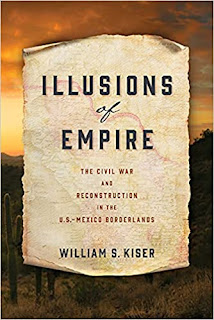 Even though they were small in size and traditionally receive only passing mention in most general Civil War histories, the military campaigns and battles fought in New Mexico Territory and all along the US-Mexico border are remarkably well represented in the more specialist literature. The cross-border cotton exchange's vital economic role in sustaining the Confederate war effort west of the Mississippi has also been well recognized and addressed in numerous books and articles. Most recently, Civil War-era "borderlands" studies and works exploring the international dimensions of the American Civil War have together greatly expanded the range of historical investigation, with the roots of economic interdependency, diplomacy, ethnic conflicts, and sovereignty issues dealt with in a growing list of Southwest-oriented publications. A product of both astute synthesis and original research in U.S. and Mexican sources, William Kiser's Illusions of Empire: The Civil War and Reconstruction in the U.S.-Mexico Borderlands integrates these established and emerging avenues of historical inquiry into a comprehensive work of grand scope made all the more impressive by how much is accomplished in such a slim volume.
With most U.S.-published borderlands studies focused on particular sub-regions (at least when it comes to those most closely tied to the Civil War period), the geographical breadth of Kiser's broad-themed work encompassing the entire U.S.-Mexico border region is highly unusual. To offer just a few notable examples from the Civil War-era scholarship, the works of Kiser himself prior to this one [ex.: see here and here], Andrew Masich, and James Blackshear are centered on the lands surrounding the Upper Rio Grande while those of Miguel Ángel González-Quiroga, Michael Collins, James Irby, Stephen Townsend, Stephen Dupree, and a host of other authors are mostly focused on the Lower Rio Grande region. The Civil War Southwest historian who has published the greatest number and most diverse range of biographies and histories associated with the entire length of the US-Mexico borderlands is Jerry Thompson, and even he has not attempted to gather his career-long engagement with the topic into a single volume treatment. Spanning a vast territory from southern California to Brazos Santiago on the U.S. side of the border and Guaymas to Bagdad on the Mexican side, the scope of Kiser's investigation in Illusions of Empire is probably unique.
Kiser begins the book with a solid discussion of how lingering memories of troubled past relations between the United States and Mexico involving territorial disputes, a major war, Indian raids, and filibustering expeditions haunted Civil War-period diplomatic interactions. With that ingrained mistrust between neighbors always in the background, the narrative moves on to provide readers with a remarkably inclusive political, economic, diplomatic, and military history of the entire borderlands region during the Civil War. Appended to that is a limited but still insightful extension into the Reconstruction period.
Every modern history of the antebellum and Civil War-era southwestern borderlands recognizes their fluid nature (in human movement, violence, economic exchange, diplomacy, governmental control, law enforcement, and more), but Kiser is really the first Civil War scholar to integrate into a single narrative, as he does in Illusions of Empire, the full range of significant transborder actors. Each individual or group actor addressed in Kiser's analysis possessed some degree of real power, but, as the author creatively and persuasively illustrates, each also had "illusions" regarding that power's strength, sovereign aspirations, and extent of influence (by threat and/or persuasion) over other transnational actors. The list of historical actors integrated into Kiser's narrative includes U.S./Confederate military officers, Davis and Lincoln administration diplomats, French emperor Napoleon III, the contending Juarez and puppet Imperial governments and forces in Mexico, northern Mexico's state governors, non-aligned Indian tribes, bandit groups, and regional warlords of shifting loyalty (ex. Juan Cortina). With varying degrees of sovereign expression and support behind their powers, all of these forces vied with each other over control of the borderlands (or, in some cases, survival). Within this complex milieu, conflict was all too often the order of the day, though cooperation in areas of mutual interest (ex. trade) was frequently sought.
Though international diplomacy was the acknowledged domain of central government leaders, in the U.S.-Mexico borderlands the combination of past history, distance, civil conflict, self-interest, competing ideologies, and practicality rendered traditional diplomatic channels a source of frustrating dead end. As Kiser ably and amply demonstrates, however, diplomacy did not die there during the Civil War years but rather assumed a different, more localized and interpersonal form. While the Lincoln administration consistently supported the presidency and government of Benito Juarez, the Confederates, desperate to exchange southern cotton for war materials (especially after the closing of the Mississippi River in July 1863), were prepared to work with any faction in Mexico willing to facilitate cross-border trade that could bypass the Union blockade.
Just like the U.S. had competing philosophies regarding the relations between state and federal governments, Mexico had a long tradition of regionalism versus centralization. In the book, Kiser details how Mexican governors of northern states all along the border assumed the dubious right to conduct international diplomacy with U.S. and Confederate military officers. These governors, successfully and unsuccessfully, employed diplomacy
in ways aimed toward reinforcing their own wealth and power while at the
same time opposing both domestic and international threats. With tenuous links to the embattled Juarez government, which was on the run during the height of the French Intervention, governors negotiated trade agreements with Confederate military and civilian authorities that lined their own pockets (along with those of key allies), funded the government apparatus, and raised monies needed to recruit and equip state forces necessary to oppose Imperial encroachment. With Mexico's territorial losses from decades earlier still fresh in their minds, the governors were also successful in deterring the aggressive efforts of U.S. officers and diplomats who at various times sought transit rights across the border, wanted approval to use Mexico as a base for cross-border raids by Texas Unionists, and harbored ambitions of future annexation of Mexican lands. Kiser's centering of the roles played by these Mexican governors in the historical narrative of the Civil War borderlands is a major theme and strength of this book.
Even though they were small in size and traditionally receive only passing mention in most general Civil War histories, the military campaigns and battles fought in New Mexico Territory and all along the US-Mexico border are remarkably well represented in the more specialist literature. The cross-border cotton exchange's vital economic role in sustaining the Confederate war effort west of the Mississippi has also been well recognized and addressed in numerous books and articles. Most recently, Civil War-era "borderlands" studies and works exploring the international dimensions of the American Civil War have together greatly expanded the range of historical investigation, with the roots of economic interdependency, diplomacy, ethnic conflicts, and sovereignty issues dealt with in a growing list of Southwest-oriented publications. A product of both astute synthesis and original research in U.S. and Mexican sources, William Kiser's Illusions of Empire: The Civil War and Reconstruction in the U.S.-Mexico Borderlands integrates these established and emerging avenues of historical inquiry into a comprehensive work of grand scope made all the more impressive by how much is accomplished in such a slim volume.
With most U.S.-published borderlands studies focused on particular sub-regions (at least when it comes to those most closely tied to the Civil War period), the geographical breadth of Kiser's broad-themed work encompassing the entire U.S.-Mexico border region is highly unusual. To offer just a few notable examples from the Civil War-era scholarship, the works of Kiser himself prior to this one [ex.: see here and here], Andrew Masich, and James Blackshear are centered on the lands surrounding the Upper Rio Grande while those of Miguel Ángel González-Quiroga, Michael Collins, James Irby, Stephen Townsend, Stephen Dupree, and a host of other authors are mostly focused on the Lower Rio Grande region. The Civil War Southwest historian who has published the greatest number and most diverse range of biographies and histories associated with the entire length of the US-Mexico borderlands is Jerry Thompson, and even he has not attempted to gather his career-long engagement with the topic into a single volume treatment. Spanning a vast territory from southern California to Brazos Santiago on the U.S. side of the border and Guaymas to Bagdad on the Mexican side, the scope of Kiser's investigation in Illusions of Empire is probably unique.
Kiser begins the book with a solid discussion of how lingering memories of troubled past relations between the United States and Mexico involving territorial disputes, a major war, Indian raids, and filibustering expeditions haunted Civil War-period diplomatic interactions. With that ingrained mistrust between neighbors always in the background, the narrative moves on to provide readers with a remarkably inclusive political, economic, diplomatic, and military history of the entire borderlands region during the Civil War. Appended to that is a limited but still insightful extension into the Reconstruction period.
Every modern history of the antebellum and Civil War-era southwestern borderlands recognizes their fluid nature (in human movement, violence, economic exchange, diplomacy, governmental control, law enforcement, and more), but Kiser is really the first Civil War scholar to integrate into a single narrative, as he does in Illusions of Empire, the full range of significant transborder actors. Each individual or group actor addressed in Kiser's analysis possessed some degree of real power, but, as the author creatively and persuasively illustrates, each also had "illusions" regarding that power's strength, sovereign aspirations, and extent of influence (by threat and/or persuasion) over other transnational actors. The list of historical actors integrated into Kiser's narrative includes U.S./Confederate military officers, Davis and Lincoln administration diplomats, French emperor Napoleon III, the contending Juarez and puppet Imperial governments and forces in Mexico, northern Mexico's state governors, non-aligned Indian tribes, bandit groups, and regional warlords of shifting loyalty (ex. Juan Cortina). With varying degrees of sovereign expression and support behind their powers, all of these forces vied with each other over control of the borderlands (or, in some cases, survival). Within this complex milieu, conflict was all too often the order of the day, though cooperation in areas of mutual interest (ex. trade) was frequently sought.
Though international diplomacy was the acknowledged domain of central government leaders, in the U.S.-Mexico borderlands the combination of past history, distance, civil conflict, self-interest, competing ideologies, and practicality rendered traditional diplomatic channels a source of frustrating dead end. As Kiser ably and amply demonstrates, however, diplomacy did not die there during the Civil War years but rather assumed a different, more localized and interpersonal form. While the Lincoln administration consistently supported the presidency and government of Benito Juarez, the Confederates, desperate to exchange southern cotton for war materials (especially after the closing of the Mississippi River in July 1863), were prepared to work with any faction in Mexico willing to facilitate cross-border trade that could bypass the Union blockade.
Just like the U.S. had competing philosophies regarding the relations between state and federal governments, Mexico had a long tradition of regionalism versus centralization. In the book, Kiser details how Mexican governors of northern states all along the border assumed the dubious right to conduct international diplomacy with U.S. and Confederate military officers. These governors, successfully and unsuccessfully, employed diplomacy
in ways aimed toward reinforcing their own wealth and power while at the
same time opposing both domestic and international threats. With tenuous links to the embattled Juarez government, which was on the run during the height of the French Intervention, governors negotiated trade agreements with Confederate military and civilian authorities that lined their own pockets (along with those of key allies), funded the government apparatus, and raised monies needed to recruit and equip state forces necessary to oppose Imperial encroachment. With Mexico's territorial losses from decades earlier still fresh in their minds, the governors were also successful in deterring the aggressive efforts of U.S. officers and diplomats who at various times sought transit rights across the border, wanted approval to use Mexico as a base for cross-border raids by Texas Unionists, and harbored ambitions of future annexation of Mexican lands. Kiser's centering of the roles played by these Mexican governors in the historical narrative of the Civil War borderlands is a major theme and strength of this book.
One area where cross-border cooperation might have been more generally expected was in combating the mutual threat of Apache, Comanche, and Kiowa raiders. These aggressive tribal groups had collectively killed thousands of Mexican citizens during the decade preceding the American Civil War, and they were just as troubling to U.S. civilian and military authorities. However, Union and Confederate hopes for active cooperation from Mexico in that area did not come to fruition, as Mexican officials understandably mistrusted the motives behind any American intervention, fearing the consequences of what might happen if large numbers of U.S. or Confederate forces were allowed to operate on Mexican soil under the pretense of suppressing Indian raids. As Kiser shows, this illusion of expected yet consistently thwarted collaboration joined many others in being a constant headache for border leaders.
Perhaps chief among the many notable contributions to the Civil War historiography that can be found in this book is Kiser's very persuasive presentation of northern Mexico's most powerful governors as worthy of consideration alongside major leaders north of the border when it came to the ability to influence the course of the Civil War in the Trans-Mississippi West. As individuals not vested with the traditional trappings of a diplomatic portfolio, semi-autonomous Mexican governors nevertheless were able to use their local power to profoundly shape international history. With most studies concentrating on the many ways in which contested borderlands facilitated aggressive territorial expansion, this one perceptively demonstrates how those very same frontier properties could also thwart expansionist desires. It's amazing that William Kiser was able to accomplish this marvel of sweeping interpretation of historical forces in little more than 150 pages of principal narrative. If any single volume addressing the Civil War history of the U.S.-Mexico borderlands can be recommended enthusiastically to general readers and scholars alike, Illusions of Empire is worthy of placement at the top of the list of candidates.
One area where cross-border cooperation might have been more generally expected was in combating the mutual threat of Apache, Comanche, and Kiowa raiders. These aggressive tribal groups had collectively killed thousands of Mexican citizens during the decade preceding the American Civil War, and they were just as troubling to U.S. civilian and military authorities. However, Union and Confederate hopes for active cooperation from Mexico in that area did not come to fruition, as Mexican officials understandably mistrusted the motives behind any American intervention, fearing the consequences of what might happen if large numbers of U.S. or Confederate forces were allowed to operate on Mexican soil under the pretense of suppressing Indian raids. As Kiser shows, this illusion of expected yet consistently thwarted collaboration joined many others in being a constant headache for border leaders.
Perhaps chief among the many notable contributions to the Civil War historiography that can be found in this book is Kiser's very persuasive presentation of northern Mexico's most powerful governors as worthy of consideration alongside major leaders north of the border when it came to the ability to influence the course of the Civil War in the Trans-Mississippi West. As individuals not vested with the traditional trappings of a diplomatic portfolio, semi-autonomous Mexican governors nevertheless were able to use their local power to profoundly shape international history. With most studies concentrating on the many ways in which contested borderlands facilitated aggressive territorial expansion, this one perceptively demonstrates how those very same frontier properties could also thwart expansionist desires. It's amazing that William Kiser was able to accomplish this marvel of sweeping interpretation of historical forces in little more than 150 pages of principal narrative. If any single volume addressing the Civil War history of the U.S.-Mexico borderlands can be recommended enthusiastically to general readers and scholars alike, Illusions of Empire is worthy of placement at the top of the list of candidates.
Wednesday, January 19, 2022
Review - "Choctaw Confederates: The American Civil War in Indian Country" by Fay Yarbrough
[Choctaw Confederates: The American Civil War in Indian Country by Fay A. Yarbrough (University of North Carolina Press, 2021). Hardcover, 10 maps, illustrations, notes, bibliography, index. Pages main/total:207/280. ISBN:978-1-4696-6511-5. $32.95]
 In a flurry of diplomatic maneuvering during July and August 1861, the Confederate government successfully signed alliance treaties with nearly all of the most populous nations of Indian Territory, chief among them the Muscogee (Creeks), Choctaws, Chickasaws, and Seminoles. It was a stunning turn of events. Only three decades had passed since the Indian Removal Act of 1830 initiated a mass migration across the Mississippi1, yet those same peoples were willing to risk their prosperous renewal in order to ally themselves with a rebellious new nation founded by the very same Deep South states (in the case of the Choctaw, Mississippi and Alabama) that were instrumental to the process of traumatic displacement. After the recalcitrant Cherokee of the dominant Ross faction and a host of other Indian Territory and Southern Plains peoples and bands finally agreed to alliances of their own later in the year, all of the so-called "Five Civilized Tribes" had become Confederate allies, though the Muscogee and Cherokee in particular remained violently split. In the century that has passed since the publication of Annie Abel's pioneering work on slaveholding Indian participation in the American Civil War, the motivating factors behind those alliances have been explored in numerous books and articles, but Fay Yarbrough's Choctaw Confederates: The American Civil War in Indian Country represents the first book-length study of what was behind that tribal government's earnest participation in the war.
Yarbrough dutifully restates the most commonly cited reasons behind Choctaw willingness to ally themselves with the Confederacy, among them the federal government's sudden abandonment of forts in the region, financial insecurity, Choctaw society's gradual transformation into one bearing significant cultural affinity with the Deep South, and concerns both present and future for the preservation of slavery. Choctaw leaders held justified fears that the federal government's war priorities would cause it to default on the financial parts of its treaty obligations, and the war itself would directly threaten tribal investments held in trust (the greater balance of which was invested in southern states). Over the several generations preceding the American Civil War, the Choctaw's traditional matrilineal social organization and clan culture became heavily altered both legally and socially, gradually taking on many characteristics shared by their white southern neighbors. Associated with that cultural process were gender role reversals. With fewer prospects for war and less dependence on wild game hunting by the early 1800s, Choctaw males took up many of the agriculturally related duties that Choctaw women had typically performed. All of these changes drew the nation closer to the American, and, in more specific ways, Southern agrarian culture and economy. Choctaw laws and government institutions enshrined in their post-Removal constitution also mirrored the American political system in many ways (especially that of the Deep South). Of course, a major element of the aforementioned affinity with southern culture was slavery. The Choctaw had enslaved blacks since the early eighteenth century, and by 1860 slaves represented up to 14% of the Choctaw population in Indian Territory. In the book, Yarbrough discusses similarities and differences between the slave systems of the Choctaw and white South, and she finds clear evidence that the Choctaw defense of slavery (rhetorically, socially, legally, etc.) corresponded in many ways to that of the Deep South.
The author makes her greatest contributions to our understanding Choctaw Confederate motivations by paving new ground in two additional areas, those involving issues of Choctaw sovereignty and masculinity. According to Yarbrough, Choctaw leaders gambled that secessionist and Confederate ideology grounded in localism and States Rights might better preserve their own tenuous sovereignty. Those leaders certainly had good reason to be wary. The presence and strength of militant abolitionism right across the border in Kansas was widely seen as a clear menace, and the Kansas governor himself expressed a desire to expedite the elimination of Indian title to lands in the territory with a view toward creating another free state. Secessionist promoters from Texas and Arkansas also eagerly reminded the Choctaw of William Seward's comments during the 1860 election season that Indian Territory lands should be seized by the government and opened to white settlement. Militant abolitionist threats and those made by the incoming president's right-hand man must have disturbed many Choctaws who were wavering. Generous financial promises along with favorable military and political concessions further made joining the Confederacy a risk Choctaw leaders were willing take. Some have suggested that the Choctaw reluctantly succumbed to outside pressure, but it is clear from Yarbrough's research in Choctaw rhetoric, legislation, and volunteerism that their pro-Confederate enthusiasm was very real and very ardent.
Yarbrough also convincingly argues that reclaiming a lost, or much faded, source of manhood in the form of traditional warrior culture (and all that stemmed from it, including important naming rituals) was a major part in motivating Choctaw men to fight alongside the Confederate Army. Obviously, as one might argue that that end could also have been served by fighting on the other side, this factor went hand in hand with the others outlined above. White settlement of traditional Choctaw lands severely restricted opportunities for Choctaw men to (literally) make a name for themselves through intertribal warfare and successful long-range hunting expeditions, and they were forced to redirect masculine expression through other more peaceful and domestic outlets. The Choctaw were able to preserve some of their martial traditions through the paramilitary organization of light horsemen (an interesting judicial and social policing force that is well documented in the book), though membership in that group was very small. Thus, many Choctaw men leapt at the opportunity to join the first Choctaw and Chickasaw regiment2.
With the notable exception of W. Craig Gaines's groundbreaking history of John Drew's Confederate Cherokee regiment3, the popular and scholarly publication of unit histories continues to overlook the many battalions and regiments sourced from Indian Territory nations that fought for either side. Though Yarbrough's book cannot be thought of as a proper unit history of the First Regiment, Choctaw and Chickasaw Mounted Rifles (which was organized in the summer of 1861 and led by former Indian agent Col. Douglas Cooper and mixed-blood Choctaw Lt. Col. Tandy Walker), it does provide notable insights. The author's extensive examination of enlistment and service records heavily reinforce the conclusion that Choctaw support for the war was not coerced. With letters and diary sources sparse, the service records and attached notes provide the best available insight into the wheres and whens of Choctaw enlistment. They also help explain absences. Some demographic insights (ex. the average Choctaw recruit was slightly older than the average white Confederate volunteer) can gleaned from those records as well. Even before the treaty with the Confederacy was confirmed, nearly 800 men had volunteered for the regiment, and many hundreds more were added to the rolls during the first half of the conflict. Yarbrough's very brief summary of the regiment's active service over a wide geographical area of operations that included parts of Indian Territory, Missouri, and Arkansas along with her noting of a precipitous drop in enlistment during the second half of the conflict both reinforce the common view expressed in the literature that the July 17, 1863 Battle of Honey Springs, a disastrous Confederate defeat, marked a turning point in home and fighting front morale and support for the war among the allied nations of Indian Territory. Others have suggested that the sharp increase in desertion preceding Honey Springs in May-June 1863 (which was rare before then) was also indicative of growing disaffection among the Choctaw, but Yarbrough offers up a possible, and reasonable, alternative explanation that seasonal crop demands might have had as much or more to do with the exodus from the ranks during that particular time. Regardless, it is made clear in this study that the soldiers of the First Choctaw and Chickasaw were as steadfast as most white Southern volunteers in their adherence to the Confederate cause and willingness to fight for it..
An extension of Yarbough's excellent contribution to the essay anthology Civil War Wests4, the book's final section explores disputes over the Emancipation Proclamation's application to Indian Territory and Choctaw resistance during the Reconstruction period and beyond toward granting full citizenship rights to the nation's freedpeople. That latter process dragged on for twenty years after the end of the Civil War and has restrictions for descendants that to this day spark controversy and legal challenge.
Fay Yarbrough's Choctaw Confederates is an award-worthy feat of research and writing. Its wide-ranging treatment of the Choctaw offers much needed expansion to a literature of Civil War-era Indian Territory that remains disproportionately focused on the Cherokee. Similarly, in the scholarship's discussion of pro-Confederate Indians the Watie faction of Cherokee garners the lion's share of popular and scholarly awareness, and Yarbrough successfully redirects attention toward the native people that proved as a nation to be the most thoroughly Confederate. The book very effectively draws social, cultural, and ideological parallels between the Choctaw state and southern states that seceded from the US, arriving at the undeniable conclusion that the Choctaws were as deserving of the "Confederate" label as, for example, the average Mississippi volunteer. The volume also serves as a major contribution to the study of the black enslavement views and practices of Indian Territory nations. Finally, one can hope that Yarbrough's more broadbrush treatment of military events might spark some future scholar to write a full history of Choctaw military participation in the Civil War as well as the first comprehensive treatment of the First Choctaw and Chickasaw regiment's wartime service. Both would be welcome additions to a Civil War military literature that fully embraces coverage of previously understudied participants but still continues to sideline the profound experiences of Indian Territory nations that fought in the war in notable fashion from the conflict's very beginning.
In a flurry of diplomatic maneuvering during July and August 1861, the Confederate government successfully signed alliance treaties with nearly all of the most populous nations of Indian Territory, chief among them the Muscogee (Creeks), Choctaws, Chickasaws, and Seminoles. It was a stunning turn of events. Only three decades had passed since the Indian Removal Act of 1830 initiated a mass migration across the Mississippi1, yet those same peoples were willing to risk their prosperous renewal in order to ally themselves with a rebellious new nation founded by the very same Deep South states (in the case of the Choctaw, Mississippi and Alabama) that were instrumental to the process of traumatic displacement. After the recalcitrant Cherokee of the dominant Ross faction and a host of other Indian Territory and Southern Plains peoples and bands finally agreed to alliances of their own later in the year, all of the so-called "Five Civilized Tribes" had become Confederate allies, though the Muscogee and Cherokee in particular remained violently split. In the century that has passed since the publication of Annie Abel's pioneering work on slaveholding Indian participation in the American Civil War, the motivating factors behind those alliances have been explored in numerous books and articles, but Fay Yarbrough's Choctaw Confederates: The American Civil War in Indian Country represents the first book-length study of what was behind that tribal government's earnest participation in the war.
Yarbrough dutifully restates the most commonly cited reasons behind Choctaw willingness to ally themselves with the Confederacy, among them the federal government's sudden abandonment of forts in the region, financial insecurity, Choctaw society's gradual transformation into one bearing significant cultural affinity with the Deep South, and concerns both present and future for the preservation of slavery. Choctaw leaders held justified fears that the federal government's war priorities would cause it to default on the financial parts of its treaty obligations, and the war itself would directly threaten tribal investments held in trust (the greater balance of which was invested in southern states). Over the several generations preceding the American Civil War, the Choctaw's traditional matrilineal social organization and clan culture became heavily altered both legally and socially, gradually taking on many characteristics shared by their white southern neighbors. Associated with that cultural process were gender role reversals. With fewer prospects for war and less dependence on wild game hunting by the early 1800s, Choctaw males took up many of the agriculturally related duties that Choctaw women had typically performed. All of these changes drew the nation closer to the American, and, in more specific ways, Southern agrarian culture and economy. Choctaw laws and government institutions enshrined in their post-Removal constitution also mirrored the American political system in many ways (especially that of the Deep South). Of course, a major element of the aforementioned affinity with southern culture was slavery. The Choctaw had enslaved blacks since the early eighteenth century, and by 1860 slaves represented up to 14% of the Choctaw population in Indian Territory. In the book, Yarbrough discusses similarities and differences between the slave systems of the Choctaw and white South, and she finds clear evidence that the Choctaw defense of slavery (rhetorically, socially, legally, etc.) corresponded in many ways to that of the Deep South.
The author makes her greatest contributions to our understanding Choctaw Confederate motivations by paving new ground in two additional areas, those involving issues of Choctaw sovereignty and masculinity. According to Yarbrough, Choctaw leaders gambled that secessionist and Confederate ideology grounded in localism and States Rights might better preserve their own tenuous sovereignty. Those leaders certainly had good reason to be wary. The presence and strength of militant abolitionism right across the border in Kansas was widely seen as a clear menace, and the Kansas governor himself expressed a desire to expedite the elimination of Indian title to lands in the territory with a view toward creating another free state. Secessionist promoters from Texas and Arkansas also eagerly reminded the Choctaw of William Seward's comments during the 1860 election season that Indian Territory lands should be seized by the government and opened to white settlement. Militant abolitionist threats and those made by the incoming president's right-hand man must have disturbed many Choctaws who were wavering. Generous financial promises along with favorable military and political concessions further made joining the Confederacy a risk Choctaw leaders were willing take. Some have suggested that the Choctaw reluctantly succumbed to outside pressure, but it is clear from Yarbrough's research in Choctaw rhetoric, legislation, and volunteerism that their pro-Confederate enthusiasm was very real and very ardent.
Yarbrough also convincingly argues that reclaiming a lost, or much faded, source of manhood in the form of traditional warrior culture (and all that stemmed from it, including important naming rituals) was a major part in motivating Choctaw men to fight alongside the Confederate Army. Obviously, as one might argue that that end could also have been served by fighting on the other side, this factor went hand in hand with the others outlined above. White settlement of traditional Choctaw lands severely restricted opportunities for Choctaw men to (literally) make a name for themselves through intertribal warfare and successful long-range hunting expeditions, and they were forced to redirect masculine expression through other more peaceful and domestic outlets. The Choctaw were able to preserve some of their martial traditions through the paramilitary organization of light horsemen (an interesting judicial and social policing force that is well documented in the book), though membership in that group was very small. Thus, many Choctaw men leapt at the opportunity to join the first Choctaw and Chickasaw regiment2.
With the notable exception of W. Craig Gaines's groundbreaking history of John Drew's Confederate Cherokee regiment3, the popular and scholarly publication of unit histories continues to overlook the many battalions and regiments sourced from Indian Territory nations that fought for either side. Though Yarbrough's book cannot be thought of as a proper unit history of the First Regiment, Choctaw and Chickasaw Mounted Rifles (which was organized in the summer of 1861 and led by former Indian agent Col. Douglas Cooper and mixed-blood Choctaw Lt. Col. Tandy Walker), it does provide notable insights. The author's extensive examination of enlistment and service records heavily reinforce the conclusion that Choctaw support for the war was not coerced. With letters and diary sources sparse, the service records and attached notes provide the best available insight into the wheres and whens of Choctaw enlistment. They also help explain absences. Some demographic insights (ex. the average Choctaw recruit was slightly older than the average white Confederate volunteer) can gleaned from those records as well. Even before the treaty with the Confederacy was confirmed, nearly 800 men had volunteered for the regiment, and many hundreds more were added to the rolls during the first half of the conflict. Yarbrough's very brief summary of the regiment's active service over a wide geographical area of operations that included parts of Indian Territory, Missouri, and Arkansas along with her noting of a precipitous drop in enlistment during the second half of the conflict both reinforce the common view expressed in the literature that the July 17, 1863 Battle of Honey Springs, a disastrous Confederate defeat, marked a turning point in home and fighting front morale and support for the war among the allied nations of Indian Territory. Others have suggested that the sharp increase in desertion preceding Honey Springs in May-June 1863 (which was rare before then) was also indicative of growing disaffection among the Choctaw, but Yarbrough offers up a possible, and reasonable, alternative explanation that seasonal crop demands might have had as much or more to do with the exodus from the ranks during that particular time. Regardless, it is made clear in this study that the soldiers of the First Choctaw and Chickasaw were as steadfast as most white Southern volunteers in their adherence to the Confederate cause and willingness to fight for it..
An extension of Yarbough's excellent contribution to the essay anthology Civil War Wests4, the book's final section explores disputes over the Emancipation Proclamation's application to Indian Territory and Choctaw resistance during the Reconstruction period and beyond toward granting full citizenship rights to the nation's freedpeople. That latter process dragged on for twenty years after the end of the Civil War and has restrictions for descendants that to this day spark controversy and legal challenge.
Fay Yarbrough's Choctaw Confederates is an award-worthy feat of research and writing. Its wide-ranging treatment of the Choctaw offers much needed expansion to a literature of Civil War-era Indian Territory that remains disproportionately focused on the Cherokee. Similarly, in the scholarship's discussion of pro-Confederate Indians the Watie faction of Cherokee garners the lion's share of popular and scholarly awareness, and Yarbrough successfully redirects attention toward the native people that proved as a nation to be the most thoroughly Confederate. The book very effectively draws social, cultural, and ideological parallels between the Choctaw state and southern states that seceded from the US, arriving at the undeniable conclusion that the Choctaws were as deserving of the "Confederate" label as, for example, the average Mississippi volunteer. The volume also serves as a major contribution to the study of the black enslavement views and practices of Indian Territory nations. Finally, one can hope that Yarbrough's more broadbrush treatment of military events might spark some future scholar to write a full history of Choctaw military participation in the Civil War as well as the first comprehensive treatment of the First Choctaw and Chickasaw regiment's wartime service. Both would be welcome additions to a Civil War military literature that fully embraces coverage of previously understudied participants but still continues to sideline the profound experiences of Indian Territory nations that fought in the war in notable fashion from the conflict's very beginning.
Notes:
1 - An often overlooked aspect of the removal treaties such as the one signed by the Choctaw is that individuals were given the option to stay, giving up their tribal sovereignty in exchange for US citizenship and land from the state. In the case of the Choctaw, almost a third of the population elected to remain in Mississippi when the rest of the nation relocated to Indian Territory in the early 1830s. Though outside the boundaries of Yarbrough's research, it would be interesting to read about the experiences of the remaining "Mississippi Band" of Choctaws during the lead-in to the Civil War and learn more about what they did during the conflict.
2 - The Chickasaw are related to the Choctaw by language and culture (and lived among and adjacent to them in Indian Territory), but they successfully resisted outside pressure to become a part of the Choctaw nation and remained independent. Their story, and their relationship as fighting comrades in the First Choctaw and Chickasaw regiment, is touched upon briefly but is generally beyond the purview of Yarbrough's narrative.
3 - Follow the link to read a review of W. Craig Gaines's The Confederate Cherokees: John Drew's Regiment of Mounted Rifles, Updated Edition (LSU Press, 2017). First published in 1989, this landmark study was reissued in paperback nearly three decades later, unchanged but with a new preface.
4 - See Yarbrough's essay "Dis Land Which Jines Dat of Ole Master's': The Meaning of Citizenship for the Choctaw Freedpeople," in Civil War Wests: Testing the Limits of the United States, ed. by Adam Arenson & Andrew Graybill , 224-41 (Oakland, University of California Press, 2015).
Notes:
1 - An often overlooked aspect of the removal treaties such as the one signed by the Choctaw is that individuals were given the option to stay, giving up their tribal sovereignty in exchange for US citizenship and land from the state. In the case of the Choctaw, almost a third of the population elected to remain in Mississippi when the rest of the nation relocated to Indian Territory in the early 1830s. Though outside the boundaries of Yarbrough's research, it would be interesting to read about the experiences of the remaining "Mississippi Band" of Choctaws during the lead-in to the Civil War and learn more about what they did during the conflict.
2 - The Chickasaw are related to the Choctaw by language and culture (and lived among and adjacent to them in Indian Territory), but they successfully resisted outside pressure to become a part of the Choctaw nation and remained independent. Their story, and their relationship as fighting comrades in the First Choctaw and Chickasaw regiment, is touched upon briefly but is generally beyond the purview of Yarbrough's narrative.
3 - Follow the link to read a review of W. Craig Gaines's The Confederate Cherokees: John Drew's Regiment of Mounted Rifles, Updated Edition (LSU Press, 2017). First published in 1989, this landmark study was reissued in paperback nearly three decades later, unchanged but with a new preface.
4 - See Yarbrough's essay "Dis Land Which Jines Dat of Ole Master's': The Meaning of Citizenship for the Choctaw Freedpeople," in Civil War Wests: Testing the Limits of the United States, ed. by Adam Arenson & Andrew Graybill , 224-41 (Oakland, University of California Press, 2015).
Wednesday, December 15, 2021
Review - "Confederates and Comancheros: Skullduggery and Double-Dealing in the Texas–New Mexico Borderlands" by Blackshear & Ely
[Confederates and Comancheros: Skullduggery and Double-Dealing in the Texas–New Mexico Borderlands by James Bailey Blackshear and Glen Sample Ely (University of Oklahoma Press, 2021). Hardcover, maps, photos, appendix, notes, bibliography, index. Pages main/total:x,175/286. ISBN:978-0-8061-7560-7. $32.95]
 Ever since the Comanche people moved into the Texas-New Mexico borderlands between the Pecos and Rio Grande rivers during the early 1700s, trade relationships were formed between the region's Hispano settlers and the powerful, empire-building tribe. By the 1840s, an important economic-exchange network had evolved between New Mexican merchants and Pueblo Indians on one side and Southern Plains indigenous groups (the aforementioned Comanche, but also Kiowa and Apache) that came to be known as the "Comanchero" trade. That early to mid-nineteenth century period, which witnessed a changed in territorial control from Mexico to the United States at the conclusion of the 1846-48 war fought between those nations, also saw an influx in European (most prominently German) immigrants and Anglo-American entrepreneurs who prospered as merchants and army supply contractors. Those partners forged indispensable ties with Comanchero middle men who could effectively transport and negotiate the exchange of manufactured goods highly prized by the Comanche with Texas livestock stolen by Comanche raiders. The Comanchero trade of the 1860s and 1870s, with the American Civil War context as its centerpiece, is the subject of James Blackshear and Glen Ely's important new study Confederates and Comancheros: Skullduggery and Double-Dealing in the Texas–New Mexico Borderlands.
Confederates and Comancheros makes two fresh and notable contributions to the historiography of the nineteenth-century American West. First, its chronicling of the final two decades of the Comanchero trade in the Texas-New Mexico borderlands offers an important reappraisal of who was involved in the trade, its significance to the region's culture and economy, and what factors contributed to its demise. Second, Blackshear and Ely's study is the first book to document in detail Civil War activities and events in the Trans-Pecos during the 1862-65 period. The literature of the 1861-62 Confederate invasion of New Mexico and Arizona is very well developed at this point, a notable circumstance in itself given how little coverage is accorded to much larger Trans-Mississippi campaigns and battles situated much closer to the theater's military and political centers of gravity. However, those studies typically end with the less than triumphal return to Texas of General Henry H. Sibley's defeated and bedraggled army, offering only cursory reminder of sustained tensions in the region between Union and Confederate authorities. With New Mexico reasonably secure, Union planners turned their military attentions away from Confederate enemies and toward pacification of hostile tribes, and the disappointed Confederates in Texas were diverted by more pressing problems to the south and east. This volume fills that gap.
Ever since the Comanche people moved into the Texas-New Mexico borderlands between the Pecos and Rio Grande rivers during the early 1700s, trade relationships were formed between the region's Hispano settlers and the powerful, empire-building tribe. By the 1840s, an important economic-exchange network had evolved between New Mexican merchants and Pueblo Indians on one side and Southern Plains indigenous groups (the aforementioned Comanche, but also Kiowa and Apache) that came to be known as the "Comanchero" trade. That early to mid-nineteenth century period, which witnessed a changed in territorial control from Mexico to the United States at the conclusion of the 1846-48 war fought between those nations, also saw an influx in European (most prominently German) immigrants and Anglo-American entrepreneurs who prospered as merchants and army supply contractors. Those partners forged indispensable ties with Comanchero middle men who could effectively transport and negotiate the exchange of manufactured goods highly prized by the Comanche with Texas livestock stolen by Comanche raiders. The Comanchero trade of the 1860s and 1870s, with the American Civil War context as its centerpiece, is the subject of James Blackshear and Glen Ely's important new study Confederates and Comancheros: Skullduggery and Double-Dealing in the Texas–New Mexico Borderlands.
Confederates and Comancheros makes two fresh and notable contributions to the historiography of the nineteenth-century American West. First, its chronicling of the final two decades of the Comanchero trade in the Texas-New Mexico borderlands offers an important reappraisal of who was involved in the trade, its significance to the region's culture and economy, and what factors contributed to its demise. Second, Blackshear and Ely's study is the first book to document in detail Civil War activities and events in the Trans-Pecos during the 1862-65 period. The literature of the 1861-62 Confederate invasion of New Mexico and Arizona is very well developed at this point, a notable circumstance in itself given how little coverage is accorded to much larger Trans-Mississippi campaigns and battles situated much closer to the theater's military and political centers of gravity. However, those studies typically end with the less than triumphal return to Texas of General Henry H. Sibley's defeated and bedraggled army, offering only cursory reminder of sustained tensions in the region between Union and Confederate authorities. With New Mexico reasonably secure, Union planners turned their military attentions away from Confederate enemies and toward pacification of hostile tribes, and the disappointed Confederates in Texas were diverted by more pressing problems to the south and east. This volume fills that gap.
Blackshear and Ely offer readers really the first full examination of the spying, scouting, and raiding that persisted in the trans-Pecos between 1862 and 1865. In deftly weaving the international dimensions of those overt and covert activities into their narrative, the authors make a notable contribution to the Civil War-era borderlands literature that has become highly fashionable of late. They draw attention to an important regional figure, Confederate irregular scout Henry Skillman, who remains unknown to nearly all Civil War students but was the scourge of Union authorities. Skillman's aptitude for the work lived up to his name as he crisscrossed the region gathering intelligence, raiding enemy lines of supply and communication, and facilitating many beneficial cross-border connections. As the authors document, his death in an 1864 ambush was a loss that proved irreplaceable to Confederate military authorities in Texas and contributed mightily to tightened Union control over the region during the late-war period. The authors further illustrate how the grander plans of both sides, the Confederate dreams of returning to New Mexico with another army and Union ideas of using troops in southern New Mexico to cooperate with invading forces from the coast, never materialized due to logistical and manpower constraints. The text is supplemented by a handful of excellent, detailed maps of the region's geography. All are essential to understanding key locations, trade routes, and military movements obscure to most readers. Comancheros were primarily New Mexican traders descended from Spanish settlers, but Pueblo Indians and other ethnicities were also involved in the widely interconnected network of legal and illegal exchange. These groups became vital go-betweens in the region's lucrative barter system in stolen Texas cattle that Comanche and Kiowa perpetrators traded with Comancheros for highly desirable trade goods obtained from New Mexican merchants. German immigrants and Anglo-Americans (often former army officers) eager to profit from their knowledge of the region and their government connections also became intimately involved. After the end of the war between the US and Mexico, the trade system operated on an officially licensed basis with significant financial bond requirements, but there was a great deal of corruption in the profitable business, and illegal trade in guns, powder, and whiskey was rampart. US government and military authorities tried to clamp down on the illegal activity but often had to tread lightly as Comancheros proved to be essential negotiators in bartering for the return of white women and children kidnapped by the Indians during their livestock raids. Using depredation files, court records, and other sources, the authors piece together a detailed picture of the trade, along with many of its players both major and minor, as it existed in the trans-Pecos. In an appendix, the authors also compile for future reference a large, alphabetically organized roster of known Comancheros, their employees, and bond holders. After the end of the Civil War, cattle ranching and trailing (the Goodnight-Loving trail that followed the Pecos into New Mexico before continuing on to Colorado and Cheyenne, Wyoming being the nearest) exploded in scale, and old animosities between Texans and New Mexicans boiled over, with conflict (including deadly vigilante raids) ensuing between angry ranchers and those in New Mexico who participated in the trade in stolen Texas cattle. New Mexico Territory was not the only source of pain to Texas ranchers, and the book also documents the Comanche-Comanchero trade in stolen horses and cattle on the Upper Arkansas that occurred during the late-1850s, especially activities around Bent's New Fort. During the Civil War, demand for beef skyrocketed under the dual demands of Union military occupation and the need to feed thousands of new mouths on the Bosque Redondo reservation. This was a windfall for army contractors, Comancheros, and Comanche raiders. The authors also note that, by the mid-war period, NW Texas ranchers, their livestock subject to impressment and payment in worthless Confederate paper money, themselves secretly traded with Union authorities. Before and during the Civil War, the Comanchero trade was tolerated largely because the military posts and government agencies across northeastern New Mexico needed beef in great quantities and Comancheros were a major part of the 'few questions asked' subcontracting process. After the Civil War, with the arrival of the railroad and the booming business in feeding the teeming population of the East with Texas beef, a more concerted effort was finally made to defeat the powerful Comanche and Kiowa, whose raids still routinely stole thousands of head from the growing cattle trails. Doing so also meant that the Comanchero trade that previously supplied the army with fresh beef had to be dealt a severe and permanent blow. As the book demonstrates, the Comanchero trade was largely extinguished by the mid-1870s, and the US Army was the primary force behind its demise. The authors note Texas vigilante threats and violence (and later their heavy migration into the region), a hostile press, and elements of elite New Mexican opposition as other major contributing factors. However, sources of prosperity and violence associated with the trade did not disappear with its end but rather changed in form, and the book insightfully draws many direct connections between the economic forces and players involved in the Comanchero trade with the cattle wars that followed, including the infamous Lincoln County War. While most presumably redirected their economic activities into more acceptable contemporary pursuits, what happened to the former Comancheros themselves is not delved into deeply. The authors do note that they were prized by allies and former enemies alike for their intimate knowledge of the region's geography, and some were even hired out by cattle ranchers on that basis. In discussing those Union men who traveled into Texas itself to gather herds (mostly through purchase but supplemented through jayhawking), the book complements earlier studies in addressing the impact of California Column veterans on economic activities in the Southwest. Most of these large purchases were from John Chisum, who also acted as broker for other large ranchers. According to the authors, and contrary to many historical accounts, the record is clear that James Patterson and his associates forged the great trans-Pecos cattle trail a year before Goodnight and Loving. The book additionally documents the massive scale of Texas livestock losses from Indian raiders (who were often accompanied by Comancheros) during the early 1870s, and those losses would only diminish with the end of the Red River War in 1875 and establishment of Comanche, Kiowa, and Mescalero Apache reservations. Though raiders left the reservations on a regular basis that decade, losses from their activities weren't as serious as before and their extinguishment roughly coincided with the end of the Comanchero trade. Deeply researched and expansive in scope, Confederates and Comancheros adds fresh and vital understanding to the history of the rise and fall of a legendary Trans-Mississippi trade network involving all segments of New Mexican and Southern Plains societies. The volume also admirably fills a major time and subject matter gap in the literature's coverage of the American Civil War fought in the Border Southwest. Highly recommended.

Blackshear and Ely offer readers really the first full examination of the spying, scouting, and raiding that persisted in the trans-Pecos between 1862 and 1865. In deftly weaving the international dimensions of those overt and covert activities into their narrative, the authors make a notable contribution to the Civil War-era borderlands literature that has become highly fashionable of late. They draw attention to an important regional figure, Confederate irregular scout Henry Skillman, who remains unknown to nearly all Civil War students but was the scourge of Union authorities. Skillman's aptitude for the work lived up to his name as he crisscrossed the region gathering intelligence, raiding enemy lines of supply and communication, and facilitating many beneficial cross-border connections. As the authors document, his death in an 1864 ambush was a loss that proved irreplaceable to Confederate military authorities in Texas and contributed mightily to tightened Union control over the region during the late-war period. The authors further illustrate how the grander plans of both sides, the Confederate dreams of returning to New Mexico with another army and Union ideas of using troops in southern New Mexico to cooperate with invading forces from the coast, never materialized due to logistical and manpower constraints. The text is supplemented by a handful of excellent, detailed maps of the region's geography. All are essential to understanding key locations, trade routes, and military movements obscure to most readers. Comancheros were primarily New Mexican traders descended from Spanish settlers, but Pueblo Indians and other ethnicities were also involved in the widely interconnected network of legal and illegal exchange. These groups became vital go-betweens in the region's lucrative barter system in stolen Texas cattle that Comanche and Kiowa perpetrators traded with Comancheros for highly desirable trade goods obtained from New Mexican merchants. German immigrants and Anglo-Americans (often former army officers) eager to profit from their knowledge of the region and their government connections also became intimately involved. After the end of the war between the US and Mexico, the trade system operated on an officially licensed basis with significant financial bond requirements, but there was a great deal of corruption in the profitable business, and illegal trade in guns, powder, and whiskey was rampart. US government and military authorities tried to clamp down on the illegal activity but often had to tread lightly as Comancheros proved to be essential negotiators in bartering for the return of white women and children kidnapped by the Indians during their livestock raids. Using depredation files, court records, and other sources, the authors piece together a detailed picture of the trade, along with many of its players both major and minor, as it existed in the trans-Pecos. In an appendix, the authors also compile for future reference a large, alphabetically organized roster of known Comancheros, their employees, and bond holders. After the end of the Civil War, cattle ranching and trailing (the Goodnight-Loving trail that followed the Pecos into New Mexico before continuing on to Colorado and Cheyenne, Wyoming being the nearest) exploded in scale, and old animosities between Texans and New Mexicans boiled over, with conflict (including deadly vigilante raids) ensuing between angry ranchers and those in New Mexico who participated in the trade in stolen Texas cattle. New Mexico Territory was not the only source of pain to Texas ranchers, and the book also documents the Comanche-Comanchero trade in stolen horses and cattle on the Upper Arkansas that occurred during the late-1850s, especially activities around Bent's New Fort. During the Civil War, demand for beef skyrocketed under the dual demands of Union military occupation and the need to feed thousands of new mouths on the Bosque Redondo reservation. This was a windfall for army contractors, Comancheros, and Comanche raiders. The authors also note that, by the mid-war period, NW Texas ranchers, their livestock subject to impressment and payment in worthless Confederate paper money, themselves secretly traded with Union authorities. Before and during the Civil War, the Comanchero trade was tolerated largely because the military posts and government agencies across northeastern New Mexico needed beef in great quantities and Comancheros were a major part of the 'few questions asked' subcontracting process. After the Civil War, with the arrival of the railroad and the booming business in feeding the teeming population of the East with Texas beef, a more concerted effort was finally made to defeat the powerful Comanche and Kiowa, whose raids still routinely stole thousands of head from the growing cattle trails. Doing so also meant that the Comanchero trade that previously supplied the army with fresh beef had to be dealt a severe and permanent blow. As the book demonstrates, the Comanchero trade was largely extinguished by the mid-1870s, and the US Army was the primary force behind its demise. The authors note Texas vigilante threats and violence (and later their heavy migration into the region), a hostile press, and elements of elite New Mexican opposition as other major contributing factors. However, sources of prosperity and violence associated with the trade did not disappear with its end but rather changed in form, and the book insightfully draws many direct connections between the economic forces and players involved in the Comanchero trade with the cattle wars that followed, including the infamous Lincoln County War. While most presumably redirected their economic activities into more acceptable contemporary pursuits, what happened to the former Comancheros themselves is not delved into deeply. The authors do note that they were prized by allies and former enemies alike for their intimate knowledge of the region's geography, and some were even hired out by cattle ranchers on that basis. In discussing those Union men who traveled into Texas itself to gather herds (mostly through purchase but supplemented through jayhawking), the book complements earlier studies in addressing the impact of California Column veterans on economic activities in the Southwest. Most of these large purchases were from John Chisum, who also acted as broker for other large ranchers. According to the authors, and contrary to many historical accounts, the record is clear that James Patterson and his associates forged the great trans-Pecos cattle trail a year before Goodnight and Loving. The book additionally documents the massive scale of Texas livestock losses from Indian raiders (who were often accompanied by Comancheros) during the early 1870s, and those losses would only diminish with the end of the Red River War in 1875 and establishment of Comanche, Kiowa, and Mescalero Apache reservations. Though raiders left the reservations on a regular basis that decade, losses from their activities weren't as serious as before and their extinguishment roughly coincided with the end of the Comanchero trade. Deeply researched and expansive in scope, Confederates and Comancheros adds fresh and vital understanding to the history of the rise and fall of a legendary Trans-Mississippi trade network involving all segments of New Mexican and Southern Plains societies. The volume also admirably fills a major time and subject matter gap in the literature's coverage of the American Civil War fought in the Border Southwest. Highly recommended.
Thursday, October 28, 2021
Review - "Lincoln and Native Americans" by Michael Green
[Lincoln and Native Americans by Michael S. Green (Southern Illinois University Press, 2021). Hardcover, photos, illustrations, endnotes, bibliography, index. Pages main/total:ix,108/170. ISBN:978-0-8093-3825-2. $24.95]
 Having well over two-dozen existing volumes and still growing with multiple titles published most years, SIU Press's Concise Lincoln Library is continually building upon its goal of giving readers "the opportunity to quickly achieve basic knowledge of a Lincoln-related topic." Written by a host of scholars, series entries bring "fresh perspectives to well-known topics, investigate previously overlooked subjects, and explore in greater depth topics that have not yet received book-length treatment." The newest release, Michael Green's Lincoln and Native Americans, is yet another strong installment that meets one or more of those series characteristics.
Lincoln's relations with North American indigenous groups are far from completely neglected in the historical literature, but at the same time the topic has received very little book-length coverage. As Green reminds us, David Nichols's Lincoln and the Indians: Civil War Policy and Politics has become a classic, but it is well over forty years old at this point and does not examine the pre-1860 decades of Lincoln's life at any depth. Green's study does venture into that earlier period, opening with a brief but fascination summary of the history of Lincoln's personal and family associations. Though his own paternal grandfather was murdered by a raiding party while planting corn in a field (with his own father very narrowly escaping a similar fate on that day), Lincoln himself, unlike many other frontier-raised citizens and politicians, never became an Indian "hater." In Green's view, while Lincoln's service as a militia captain in the Black Hawk War did more than a little to shape the future president's own course in public life (through friendships gained, an education in leadership, and beneficial enhancement of his own political network and reputation), it had a more uncertain impact on his attitudes regarding the region's indigenous population. Whatever Lincoln's views on reforming Indian affairs might have been early on in his political career, they clearly remained low priority during his contentious rise to the presidency. While the Republican Party successfully campaigned in 1860 against the corruption of previous Democratic administrations, Lincoln fully involved himself in territorial and Bureau of Indian Affairs patronage appointments that only perpetuated the old spoils system that benefited its operators far more than those under its charge. Green agrees with Nichols in characterizing Lincoln as being mostly detached from Indian affairs; however, Green does credit Lincoln for consistently passing on opportunities both before and during his presidency to cheaply score political points through public employment of anti-Indian rhetoric.
After the outbreak of Civil War, Lincoln was immediately confronted with what to do in Indian Territory, where US forces deployed there in 1861 were weak, logistically isolated, and threatened by rapidly growing Confederate military forces operating out of Texas and Arkansas. Green makes an interesting point in noting that events there provide us with a rare example of the Davis government politically and strategically outmaneuvering the Lincoln administration in a major way. While Lincoln basically abandoned the territory without consulting the treaty partners there, the Confederates swiftly moved in and established both a military department for defending the territory and alliance treaties with most large tribal groups. Lincoln has been criticized with some justification for creating the vacuum that the Davis government exploited to the full, but those same critics often fail to see how difficult, and perhaps impossible, it would have been to maintain any sort of effective US military presence there in 1861. As was the case elsewhere in dealing with Trans-Mississippi Indian relations, Lincoln was reactive rather than proactive in the territory. While a series of military expeditions did eventually restore most pro-Union tribes to their Indian Territory homes, this was only after extensive devastation in human lives lost, livestock killed or stolen, and property destroyed. Some have even argued that no other population suffered more from the directs effects of the war than the residents of Indian Territory.
In his very brief yet fine summary of topically relevant wartime events in the Pacific Northwest, California, Utah, Colorado, the Desert Southwest, and Minnesota, Green notes that Lincoln's personal involvement in military and political affairs in most of those places was minimal. However, the author does reasonably maintain that the president bears leadership responsibility for the litany of mistreatment and abuse conducted by or facilitated through his patronage appointments. Lincoln was forced to take a more direct role in Minnesota during the aftermath of the massacre of hundreds of settlers by the Dakota and the widening of the conflict into a Northern Plains war. He had his staff review the results of the deeply flawed legal process that resulted in over 300 capital sentences and commuted all but 39 (later reduced to 38). Though it is not the purpose of the book to provide any major new insights into the subject matter (the topic has been explored in numerous books and articles), Green does briefly ponder the possibility, though he finds no written evidence to support it, that Lincoln's dealings with the Dakota uprising and its aftermath had an impact on the framing of the Lieber Code issued four months after the Mankato hangings.
In discussing the few face to face meetings Lincoln had with tribal leaders, the author finds none of the hostility but much of the cultural dismissiveness characteristic of most citizens of the period. Somewhat oddly, even when assured of Chief John Ross's loyalty by respected citizens and military officers alike who either knew him personally or had extensive contact with him, Lincoln remained very skeptical and was decidedly cold toward the Cherokee statesman. Finding Lincoln intensely focused on emancipation and freedmen concerns but politically unengaged when it came to concurrent Indian reforms, Green maintains that Lincoln was disappointingly consistent in not including native groups alongside white and black Americans in his otherwise expansive vision of post-Civil War western settlement and shared economic prosperity.
Green clearly acknowledges that all of this creates a problem for the legions of Lincoln admirers. In his conclusion, Green concisely articulates the challenge, noting that "while Lincoln advanced considerably in his thinking about African Americans, Native Americans were another matter. He approved a mass execution, said nothing about massacres, had no conversations with Indigenous people that rivaled the respect he demonstrated for African Americans, stalled Indian reformers, and thought it necessary to explain the planet to a delegation of chiefs. He put economic growth ahead of those who had lived in the West for generations, and he denied their heritage by supporting taking their land and concentrating them (in reservations). He encouraged a free labor ideology for white Americans and sought to extend it to African Americans, but he saw no place in it for Native Americans" (pg. 106-107). Whether Lincoln's promise to devote his full attention to Indian reform once the Civil War was concluded would ever have come to pass remains one of the great unknowns. There are those that demand that Lincoln, in viewing everything else as secondary to winning the war and prioritizing his white and emerging black political constituencies, face unqualified condemnation for doing so little to improve Indian lives and their treatment at the hands of the government during the Civil War. On the other end of the spectrum, those that insist that we treat Lincoln only as a man of his time, and one lacking personal animus toward Indians and more sympathetic than most when it came to their plight, can be too blind to what might have been achieved with even a modestly greater expenditure of national treasure and political capital. Clearly doubts about what Lincoln might have been willing or able to do remain, but those with a hopeful nature, as well as being charitably inclined toward a president who demonstrated a fairly profound capacity for change and who was assassinated in the middle of his presidency when the Civil War still raging, might assign to Lincoln not failing marks but rather a grade of 'incomplete.'
Having well over two-dozen existing volumes and still growing with multiple titles published most years, SIU Press's Concise Lincoln Library is continually building upon its goal of giving readers "the opportunity to quickly achieve basic knowledge of a Lincoln-related topic." Written by a host of scholars, series entries bring "fresh perspectives to well-known topics, investigate previously overlooked subjects, and explore in greater depth topics that have not yet received book-length treatment." The newest release, Michael Green's Lincoln and Native Americans, is yet another strong installment that meets one or more of those series characteristics.
Lincoln's relations with North American indigenous groups are far from completely neglected in the historical literature, but at the same time the topic has received very little book-length coverage. As Green reminds us, David Nichols's Lincoln and the Indians: Civil War Policy and Politics has become a classic, but it is well over forty years old at this point and does not examine the pre-1860 decades of Lincoln's life at any depth. Green's study does venture into that earlier period, opening with a brief but fascination summary of the history of Lincoln's personal and family associations. Though his own paternal grandfather was murdered by a raiding party while planting corn in a field (with his own father very narrowly escaping a similar fate on that day), Lincoln himself, unlike many other frontier-raised citizens and politicians, never became an Indian "hater." In Green's view, while Lincoln's service as a militia captain in the Black Hawk War did more than a little to shape the future president's own course in public life (through friendships gained, an education in leadership, and beneficial enhancement of his own political network and reputation), it had a more uncertain impact on his attitudes regarding the region's indigenous population. Whatever Lincoln's views on reforming Indian affairs might have been early on in his political career, they clearly remained low priority during his contentious rise to the presidency. While the Republican Party successfully campaigned in 1860 against the corruption of previous Democratic administrations, Lincoln fully involved himself in territorial and Bureau of Indian Affairs patronage appointments that only perpetuated the old spoils system that benefited its operators far more than those under its charge. Green agrees with Nichols in characterizing Lincoln as being mostly detached from Indian affairs; however, Green does credit Lincoln for consistently passing on opportunities both before and during his presidency to cheaply score political points through public employment of anti-Indian rhetoric.
After the outbreak of Civil War, Lincoln was immediately confronted with what to do in Indian Territory, where US forces deployed there in 1861 were weak, logistically isolated, and threatened by rapidly growing Confederate military forces operating out of Texas and Arkansas. Green makes an interesting point in noting that events there provide us with a rare example of the Davis government politically and strategically outmaneuvering the Lincoln administration in a major way. While Lincoln basically abandoned the territory without consulting the treaty partners there, the Confederates swiftly moved in and established both a military department for defending the territory and alliance treaties with most large tribal groups. Lincoln has been criticized with some justification for creating the vacuum that the Davis government exploited to the full, but those same critics often fail to see how difficult, and perhaps impossible, it would have been to maintain any sort of effective US military presence there in 1861. As was the case elsewhere in dealing with Trans-Mississippi Indian relations, Lincoln was reactive rather than proactive in the territory. While a series of military expeditions did eventually restore most pro-Union tribes to their Indian Territory homes, this was only after extensive devastation in human lives lost, livestock killed or stolen, and property destroyed. Some have even argued that no other population suffered more from the directs effects of the war than the residents of Indian Territory.
In his very brief yet fine summary of topically relevant wartime events in the Pacific Northwest, California, Utah, Colorado, the Desert Southwest, and Minnesota, Green notes that Lincoln's personal involvement in military and political affairs in most of those places was minimal. However, the author does reasonably maintain that the president bears leadership responsibility for the litany of mistreatment and abuse conducted by or facilitated through his patronage appointments. Lincoln was forced to take a more direct role in Minnesota during the aftermath of the massacre of hundreds of settlers by the Dakota and the widening of the conflict into a Northern Plains war. He had his staff review the results of the deeply flawed legal process that resulted in over 300 capital sentences and commuted all but 39 (later reduced to 38). Though it is not the purpose of the book to provide any major new insights into the subject matter (the topic has been explored in numerous books and articles), Green does briefly ponder the possibility, though he finds no written evidence to support it, that Lincoln's dealings with the Dakota uprising and its aftermath had an impact on the framing of the Lieber Code issued four months after the Mankato hangings.
In discussing the few face to face meetings Lincoln had with tribal leaders, the author finds none of the hostility but much of the cultural dismissiveness characteristic of most citizens of the period. Somewhat oddly, even when assured of Chief John Ross's loyalty by respected citizens and military officers alike who either knew him personally or had extensive contact with him, Lincoln remained very skeptical and was decidedly cold toward the Cherokee statesman. Finding Lincoln intensely focused on emancipation and freedmen concerns but politically unengaged when it came to concurrent Indian reforms, Green maintains that Lincoln was disappointingly consistent in not including native groups alongside white and black Americans in his otherwise expansive vision of post-Civil War western settlement and shared economic prosperity.
Green clearly acknowledges that all of this creates a problem for the legions of Lincoln admirers. In his conclusion, Green concisely articulates the challenge, noting that "while Lincoln advanced considerably in his thinking about African Americans, Native Americans were another matter. He approved a mass execution, said nothing about massacres, had no conversations with Indigenous people that rivaled the respect he demonstrated for African Americans, stalled Indian reformers, and thought it necessary to explain the planet to a delegation of chiefs. He put economic growth ahead of those who had lived in the West for generations, and he denied their heritage by supporting taking their land and concentrating them (in reservations). He encouraged a free labor ideology for white Americans and sought to extend it to African Americans, but he saw no place in it for Native Americans" (pg. 106-107). Whether Lincoln's promise to devote his full attention to Indian reform once the Civil War was concluded would ever have come to pass remains one of the great unknowns. There are those that demand that Lincoln, in viewing everything else as secondary to winning the war and prioritizing his white and emerging black political constituencies, face unqualified condemnation for doing so little to improve Indian lives and their treatment at the hands of the government during the Civil War. On the other end of the spectrum, those that insist that we treat Lincoln only as a man of his time, and one lacking personal animus toward Indians and more sympathetic than most when it came to their plight, can be too blind to what might have been achieved with even a modestly greater expenditure of national treasure and political capital. Clearly doubts about what Lincoln might have been willing or able to do remain, but those with a hopeful nature, as well as being charitably inclined toward a president who demonstrated a fairly profound capacity for change and who was assassinated in the middle of his presidency when the Civil War still raging, might assign to Lincoln not failing marks but rather a grade of 'incomplete.'

Monday, March 8, 2021
Review - "Violence in the Hill Country: The Texas Frontier in the Civil War Era" by Nicholas Roland
[Violence in the Hill Country: The Texas Frontier in the Civil War Era by Nicholas Keefauver Roland (University of Texas Press, 2021). Hardcover, maps, photos, notes, index. Pages main/total:200/288. ISBN:978-1-4773-2175-1. $45]
 Wilderness frontier borderlands have attracted opportunity-hungry individuals and agents of collective/national expansion since time immemorial, but occupying those often contested spaces also typically came with a host of human and environmental dangers. Living an isolated existence far from the protections and regulating forces of "civilization," newcomers often maintained personal security, communal welfare, or even existence itself through violent intervention. In cases where cultures alien to each other were competing for the same land and resources, the turn to violence was often at its most extreme. Many of those qualities could be found in the Texas Hill Country before, during, and after the American Civil War, when Anglo American and German immigrant settlers to the area clashed with themselves and with a common enemy in the form of highly mobile native groups (primarily Comanche, Kiowa, and Lipan Apache) whose raids commonly took settler lives and property. Analysis of both regularly occurring and unique "patterns of violence" that swept through the region over that period is the main focus of Nicholas Roland's fascinating new study Violence in the Hill Country: The Texas Frontier in the Civil War Era.
The Texas "Hill Country" can be seen as a rather nebulous geographical term, so, at least for the purposes of Roland's study, the "Hill Country" is defined as a twelve-county area formed by the "eroded eastern and southern margins of the Edwards Plateau, which rises to the west and north of the Blackland Prairie and Rio Grande Plains, respectively" (pg. 12). It is basically a large, rugged expanse of south-central Texas with natural features and white settlement patterns distinct from both the frontier northwest counties and those that formed the state's Red River border with Indian Territory.
Though the nature and scale of the Hill Country's internal and external conflicts varied over the 1845-81 period studied in the book, one of its mainstays, according to Roland's research, was the honor code violence brought to the area by its Anglo American settlers, most of whom possessed upland South origins. Much of the study dwells upon this. In the context of the high level of uncertainty that the frontier broadly brought to settler life, this code allowed citizens to use vigilante force (even lethal means) to protect their bodies, property, and livelihood as well as enforce societal norms, laws, and ideas of order until "civilized" government was established. The author claims that Germans did not have an honor culture tradition, and thus that particular brand of violent expression was not prevalent in their own immigrant communities. German-speaking states in Europe certainly did have some elements of honor culture violence (one can refer to the nineteenth-century dueling tradition that trickled down society somewhat from the German and Austrian upper classes), but if Roland is only specifically referring to commonplace lethality then his point is well taken. Also addressed is the raiding culture common to Southern Plains native groups that frequently resulted in settler killings of an indiscriminate nature.
1850s politics in the German immigrant-heavy Hill Country counties and support there for the federal government and U.S. Army there were complicated by numerous factors: including nativism, economic relationships, and party loyalties, but the frequency of Indian raids on isolated homes and settlements was a unifying force among those with otherwise divided views. The broader literature often overgeneralizes the 1860 German American vote as staunchly abolitionist and Republican in the North and Border South, but it was different in frontier Texas. Democratic Party ties in the Hill Country counties (though there were some exceptions) remained strong among its broadly antislavery immigrant voters, a bond that the author primarily attributes to party loyalty with some secondary impulses related to fitting in better with local society.
Unlike other parts of the lower South, however, the Hill Country's Breckinridge votes (Douglas was not on the ballot in Texas), particularly among the Germans, did not necessarily translate into support for secession. Countering some views to the contrary in the literature, Roland offers several convincing arguments that Indian raids had little effect on frontier voting patterns in the northwest, Red River north, and Hill Country counties during the build up to secession. Instead, the evidence the author presents convincingly shows that settler origins and state of relations between citizens and the federal government at election time (the latter heavily influenced by prominent newspaper editors and other local leaders) had the most significant impact. Charles Grear, the acknowledged expert on why Texans fought during the Civil War, found that family and social networks between Texans and the cis-Mississippi southern states they left behind strongly motivated them to both support Texas secession and be willing to fight and die on faraway fronts1. Complementing Grear, Roland establishes that the heavily pro-secession northwest frontier counties had a proportionally higher number of settlers from the Deep South to go along with their poor relations with the federal government during the late antebellum period. In contrast, Hill Country citizens were far more skeptical of the fruits of secession. As the book documents at length, many were heavily involved in supplying area forts with food, fuel, and forage and had good relations with both the federal government and the army. Additionally, the Hill Country's native-born American population was largely from the Upper South, where conditional unionism thrived.
Though recent studies have reminded us of the diversity of German immigrant culture and politics, the fact remains that most German Texans possessed the same antislavery impulses and liberal nationalism outlook that motivated the more closely studied Border South and western (especially St. Louis) Germans to support the Union. As was the case across the political spectrum, individuals who were important opinion leaders swayed the popular vote. Roland also found this to be the case of the Hill Country, where a small group of Forty-Eighters (perhaps only a hundred) assumed many leadership positions and influenced German voters at a scale far beyond their meager numbers. Of course, small but active pro-secession minorities among both German and Anglo American populations existed in the Hill County, too, and the many reasons why they differed from their neighbors are also enumerated and convincingly explained in the text.
When secession finally did become reality, hoped for improvements in western Texas border security under the new Confederate regime did not at all materialize after the departure of the U.S. Army. This caused no little consternation among Unionists and secessionists alike. Additionally, in the Hill Country secession and Civil War dissolved the strongest source of unity that existed among all social and political factions [that of having a common enemy (i.e. Indian raiders)]. This led to interpersonal and collective violence being redirected inward at internal ethnic and political foes. Indian raids and settler killings did not fall away, but they no longer distracted citizens from internal divisions. Rather quickly, secessionist violence against Hill Country Unionists assumed similar characteristics to that of Union suppression of pro-Confederate guerrillas and civilians in the Border South. The Hill Country became riven with internal borderland strife while as the same time the external threats from the prewar frontier borderland continued unabated. Confederate Army supply contracts and the organization of a Frontier Regiment2 specifically organized to address border security allayed some of the opposition's concerns, but the state's militia act of December 1861 and national conscription in April 1862 only amplified fears that the open frontier would be left undefended.
As was the case during the war's early months in East Tennessee prior to the coordinated bridge burning campaign there that sparked a harsh crackdown, Confederate martial law in the Hill Country was broadly conciliatory. However, the situation changed by summer 1862 when more organized and militant draft resistance (a Union Loyal League was formed) and other forms of subversion (ex. killing informants and forming armed groups to cooperate with expected Union invasion) led to violent suppression. Though the bloody Nueces River battle and continued killing, arrest, and imprisonment of Unionists into the fall effectively suppressed organized resistance in the Hill Country by the end of 1862, draft opposition, an uptick in Indian raids, Frontier Regiment ineffectiveness (through both failed tactics and logistical shortfalls), drought, choked-off trade, and sharp inflation all fed a growing disaffection with a flailing government and all of the power instability that came with that. All of those factors plus a dramatic increase in deserters and draft evaders infesting the Hill Country widely intensified interpersonal violence among Union and Confederate supporters. These were in addition to regular deaths from Indian raids. The Confederate government was not entirely unresponsive to the turmoil, and President Davis ordered martial law to be rescinded (he determined that local commanders were exceeding their authority) and opposition subsided somewhat after conscription was suspended across the Texas frontier from the end of 1863 onward. When it came to violence committed by the Hill County's secessionist minority, Roland interprets much of its source to the ways southern honor culture addressed the frontier and power uncertainies reference earlier.
The year 1863 brought another outside contributor to Hill Country violence in the form of uniformed Union troops. Though they did not strike inland, Union Army forays up the Rio Grande Valley in 1863 nevertheless inspired an uptick in armed irregular activities by Texas Unionists based in the Hill Country and across the border in Mexico. These men, variously labeled by their enemies as jayhawkers, bushwhackers, and renegades, attacked secessionist lives and property in the Hill Country and, as described in the book, also came into violent contact with the Frontier Regiment and assorted state militia organizations. Additionally, Union Army recruiters infiltrated the Hill Country, and there was the ever present criminal element to contend with as well. In response, localized pro-Confederate vigilantism met this threat with deadly force of their own. Oddly enough, Roland finds evidence of cooperation between Unionists and state authorities by early 1864, there being a mutual desire to stem the increasingly chaotic flow of disorder and violence. Much of the credit appears to be due to Governor Pendleton Murrah, who investigated claims from all sides and installed a new commander, militia general John McAdoo, who seemed to have possessed a rare gift for calming the passions of extremists on both sides and bringing relative peace to the Hill Country. Murrah himself even fought with national authorities to allow Hill Country citizens regardless of affiliation to be exempted from Confederate export restrictions as they had no other markets available to sustain themselves in their economically strangled region. If not entirely unique, this state-level initiative of reaching out to the enemy was at the very least uncommon in the conflict's many other bitterly contested 'inner wars,' and the author's suggestion that it was largely accomplished with a pragmatic view toward the future (stock in the Confederate government's continued existence being at low ebb in the 1864 Trans-Mississippi) and the readdressing of the common Indian threat to the frontier counties is persuasive.
While animosities, lawsuits, and some instances of extralegal murder continued after the war, the book shows that Reconstruction violence in the Texas Hill Country was relatively scarce in comparison to other parts of the state. In Roland's view several key factors were at play. Even though continued postwar violence is duly documented in the text, it is the author's opinion that the German population's lack of all-encompassing cultural trauma (at least compared to the world-shattering losses and social/political changes experienced by Anglo Texans) eased reconciliation and thwarted widespread revenge seeking. It also helped that many of the most notorious vigilante offenders left the area soon after the Confederate collapse. Given that much Reconstruction violence was directed toward freedmen, the tiny size of the region's black population also did not inspire much (comparatively speaking) in the way of racial violence. Also, the poverty of postwar Texas and its weak justice system meant that there were few attempts at prosecuting individuals for their wartime deeds, the result being that the kinds of festering resentments that such efforts could have created failed to materialize. As mentioned before, instead of fighting each other Hill County citizens banded together to oppose a dramatic postwar increase in Indian raiding and organized criminal activities such as livestock rustling and cross-border banditry. The former was the result of a number of military, political, and environmental factors (all of which are documented in the book), and the latter arose from the abundant openings for lucrative criminal enterprise that weak, underfunded legal institutions and the emerging cattle industry created.
The appendix section of the book usefully compiles some valuable reference data in the form of Hill Country death rosters. These are sub-divided into categories related to lethal Civil War violence, Indian raiding deaths during the Civil War years, and postwar Indian raiding deaths. On the negative side of things, a pair of publishing decisions provide sources of complaint. While the endnotes appropriately display the author's research depth and range, the study unfortunately lacks a bibliography. Also, while a number of general-purpose maps showing the state's county borders are borrowed from other sources, an original map of the volume's twelve-county region of study, one detailing the major locations and events covered in the text, is absent. Such a tool would have been immensely helpful, especially for those readers unfamiliar with Hill Country geography.
Employing a sophisticated and creative research and analysis of Texas Hill Country patterns of interpersonal, ethnic, political, and economic violence during the key transitional period of the mid to late nineteenth-century, Nicholas Roland skillfully weaves into his narrative a host of local, state, and national contexts the overall assessment of which forms a welcome, even vital, contribution to the literature of westward expansion. A multitude of scholarly and popular reading audiences, including American Civil War, Indian Wars, Southwest borderlands, and German American immigrant history students, are abundantly well served through the contents of this book. Violence in the Hill Country is highly recommended.
Wilderness frontier borderlands have attracted opportunity-hungry individuals and agents of collective/national expansion since time immemorial, but occupying those often contested spaces also typically came with a host of human and environmental dangers. Living an isolated existence far from the protections and regulating forces of "civilization," newcomers often maintained personal security, communal welfare, or even existence itself through violent intervention. In cases where cultures alien to each other were competing for the same land and resources, the turn to violence was often at its most extreme. Many of those qualities could be found in the Texas Hill Country before, during, and after the American Civil War, when Anglo American and German immigrant settlers to the area clashed with themselves and with a common enemy in the form of highly mobile native groups (primarily Comanche, Kiowa, and Lipan Apache) whose raids commonly took settler lives and property. Analysis of both regularly occurring and unique "patterns of violence" that swept through the region over that period is the main focus of Nicholas Roland's fascinating new study Violence in the Hill Country: The Texas Frontier in the Civil War Era.
The Texas "Hill Country" can be seen as a rather nebulous geographical term, so, at least for the purposes of Roland's study, the "Hill Country" is defined as a twelve-county area formed by the "eroded eastern and southern margins of the Edwards Plateau, which rises to the west and north of the Blackland Prairie and Rio Grande Plains, respectively" (pg. 12). It is basically a large, rugged expanse of south-central Texas with natural features and white settlement patterns distinct from both the frontier northwest counties and those that formed the state's Red River border with Indian Territory.
Though the nature and scale of the Hill Country's internal and external conflicts varied over the 1845-81 period studied in the book, one of its mainstays, according to Roland's research, was the honor code violence brought to the area by its Anglo American settlers, most of whom possessed upland South origins. Much of the study dwells upon this. In the context of the high level of uncertainty that the frontier broadly brought to settler life, this code allowed citizens to use vigilante force (even lethal means) to protect their bodies, property, and livelihood as well as enforce societal norms, laws, and ideas of order until "civilized" government was established. The author claims that Germans did not have an honor culture tradition, and thus that particular brand of violent expression was not prevalent in their own immigrant communities. German-speaking states in Europe certainly did have some elements of honor culture violence (one can refer to the nineteenth-century dueling tradition that trickled down society somewhat from the German and Austrian upper classes), but if Roland is only specifically referring to commonplace lethality then his point is well taken. Also addressed is the raiding culture common to Southern Plains native groups that frequently resulted in settler killings of an indiscriminate nature.
1850s politics in the German immigrant-heavy Hill Country counties and support there for the federal government and U.S. Army there were complicated by numerous factors: including nativism, economic relationships, and party loyalties, but the frequency of Indian raids on isolated homes and settlements was a unifying force among those with otherwise divided views. The broader literature often overgeneralizes the 1860 German American vote as staunchly abolitionist and Republican in the North and Border South, but it was different in frontier Texas. Democratic Party ties in the Hill Country counties (though there were some exceptions) remained strong among its broadly antislavery immigrant voters, a bond that the author primarily attributes to party loyalty with some secondary impulses related to fitting in better with local society.
Unlike other parts of the lower South, however, the Hill Country's Breckinridge votes (Douglas was not on the ballot in Texas), particularly among the Germans, did not necessarily translate into support for secession. Countering some views to the contrary in the literature, Roland offers several convincing arguments that Indian raids had little effect on frontier voting patterns in the northwest, Red River north, and Hill Country counties during the build up to secession. Instead, the evidence the author presents convincingly shows that settler origins and state of relations between citizens and the federal government at election time (the latter heavily influenced by prominent newspaper editors and other local leaders) had the most significant impact. Charles Grear, the acknowledged expert on why Texans fought during the Civil War, found that family and social networks between Texans and the cis-Mississippi southern states they left behind strongly motivated them to both support Texas secession and be willing to fight and die on faraway fronts1. Complementing Grear, Roland establishes that the heavily pro-secession northwest frontier counties had a proportionally higher number of settlers from the Deep South to go along with their poor relations with the federal government during the late antebellum period. In contrast, Hill Country citizens were far more skeptical of the fruits of secession. As the book documents at length, many were heavily involved in supplying area forts with food, fuel, and forage and had good relations with both the federal government and the army. Additionally, the Hill Country's native-born American population was largely from the Upper South, where conditional unionism thrived.
Though recent studies have reminded us of the diversity of German immigrant culture and politics, the fact remains that most German Texans possessed the same antislavery impulses and liberal nationalism outlook that motivated the more closely studied Border South and western (especially St. Louis) Germans to support the Union. As was the case across the political spectrum, individuals who were important opinion leaders swayed the popular vote. Roland also found this to be the case of the Hill Country, where a small group of Forty-Eighters (perhaps only a hundred) assumed many leadership positions and influenced German voters at a scale far beyond their meager numbers. Of course, small but active pro-secession minorities among both German and Anglo American populations existed in the Hill County, too, and the many reasons why they differed from their neighbors are also enumerated and convincingly explained in the text.
When secession finally did become reality, hoped for improvements in western Texas border security under the new Confederate regime did not at all materialize after the departure of the U.S. Army. This caused no little consternation among Unionists and secessionists alike. Additionally, in the Hill Country secession and Civil War dissolved the strongest source of unity that existed among all social and political factions [that of having a common enemy (i.e. Indian raiders)]. This led to interpersonal and collective violence being redirected inward at internal ethnic and political foes. Indian raids and settler killings did not fall away, but they no longer distracted citizens from internal divisions. Rather quickly, secessionist violence against Hill Country Unionists assumed similar characteristics to that of Union suppression of pro-Confederate guerrillas and civilians in the Border South. The Hill Country became riven with internal borderland strife while as the same time the external threats from the prewar frontier borderland continued unabated. Confederate Army supply contracts and the organization of a Frontier Regiment2 specifically organized to address border security allayed some of the opposition's concerns, but the state's militia act of December 1861 and national conscription in April 1862 only amplified fears that the open frontier would be left undefended.
As was the case during the war's early months in East Tennessee prior to the coordinated bridge burning campaign there that sparked a harsh crackdown, Confederate martial law in the Hill Country was broadly conciliatory. However, the situation changed by summer 1862 when more organized and militant draft resistance (a Union Loyal League was formed) and other forms of subversion (ex. killing informants and forming armed groups to cooperate with expected Union invasion) led to violent suppression. Though the bloody Nueces River battle and continued killing, arrest, and imprisonment of Unionists into the fall effectively suppressed organized resistance in the Hill Country by the end of 1862, draft opposition, an uptick in Indian raids, Frontier Regiment ineffectiveness (through both failed tactics and logistical shortfalls), drought, choked-off trade, and sharp inflation all fed a growing disaffection with a flailing government and all of the power instability that came with that. All of those factors plus a dramatic increase in deserters and draft evaders infesting the Hill Country widely intensified interpersonal violence among Union and Confederate supporters. These were in addition to regular deaths from Indian raids. The Confederate government was not entirely unresponsive to the turmoil, and President Davis ordered martial law to be rescinded (he determined that local commanders were exceeding their authority) and opposition subsided somewhat after conscription was suspended across the Texas frontier from the end of 1863 onward. When it came to violence committed by the Hill County's secessionist minority, Roland interprets much of its source to the ways southern honor culture addressed the frontier and power uncertainies reference earlier.
The year 1863 brought another outside contributor to Hill Country violence in the form of uniformed Union troops. Though they did not strike inland, Union Army forays up the Rio Grande Valley in 1863 nevertheless inspired an uptick in armed irregular activities by Texas Unionists based in the Hill Country and across the border in Mexico. These men, variously labeled by their enemies as jayhawkers, bushwhackers, and renegades, attacked secessionist lives and property in the Hill Country and, as described in the book, also came into violent contact with the Frontier Regiment and assorted state militia organizations. Additionally, Union Army recruiters infiltrated the Hill Country, and there was the ever present criminal element to contend with as well. In response, localized pro-Confederate vigilantism met this threat with deadly force of their own. Oddly enough, Roland finds evidence of cooperation between Unionists and state authorities by early 1864, there being a mutual desire to stem the increasingly chaotic flow of disorder and violence. Much of the credit appears to be due to Governor Pendleton Murrah, who investigated claims from all sides and installed a new commander, militia general John McAdoo, who seemed to have possessed a rare gift for calming the passions of extremists on both sides and bringing relative peace to the Hill Country. Murrah himself even fought with national authorities to allow Hill Country citizens regardless of affiliation to be exempted from Confederate export restrictions as they had no other markets available to sustain themselves in their economically strangled region. If not entirely unique, this state-level initiative of reaching out to the enemy was at the very least uncommon in the conflict's many other bitterly contested 'inner wars,' and the author's suggestion that it was largely accomplished with a pragmatic view toward the future (stock in the Confederate government's continued existence being at low ebb in the 1864 Trans-Mississippi) and the readdressing of the common Indian threat to the frontier counties is persuasive.
While animosities, lawsuits, and some instances of extralegal murder continued after the war, the book shows that Reconstruction violence in the Texas Hill Country was relatively scarce in comparison to other parts of the state. In Roland's view several key factors were at play. Even though continued postwar violence is duly documented in the text, it is the author's opinion that the German population's lack of all-encompassing cultural trauma (at least compared to the world-shattering losses and social/political changes experienced by Anglo Texans) eased reconciliation and thwarted widespread revenge seeking. It also helped that many of the most notorious vigilante offenders left the area soon after the Confederate collapse. Given that much Reconstruction violence was directed toward freedmen, the tiny size of the region's black population also did not inspire much (comparatively speaking) in the way of racial violence. Also, the poverty of postwar Texas and its weak justice system meant that there were few attempts at prosecuting individuals for their wartime deeds, the result being that the kinds of festering resentments that such efforts could have created failed to materialize. As mentioned before, instead of fighting each other Hill County citizens banded together to oppose a dramatic postwar increase in Indian raiding and organized criminal activities such as livestock rustling and cross-border banditry. The former was the result of a number of military, political, and environmental factors (all of which are documented in the book), and the latter arose from the abundant openings for lucrative criminal enterprise that weak, underfunded legal institutions and the emerging cattle industry created.
The appendix section of the book usefully compiles some valuable reference data in the form of Hill Country death rosters. These are sub-divided into categories related to lethal Civil War violence, Indian raiding deaths during the Civil War years, and postwar Indian raiding deaths. On the negative side of things, a pair of publishing decisions provide sources of complaint. While the endnotes appropriately display the author's research depth and range, the study unfortunately lacks a bibliography. Also, while a number of general-purpose maps showing the state's county borders are borrowed from other sources, an original map of the volume's twelve-county region of study, one detailing the major locations and events covered in the text, is absent. Such a tool would have been immensely helpful, especially for those readers unfamiliar with Hill Country geography.
Employing a sophisticated and creative research and analysis of Texas Hill Country patterns of interpersonal, ethnic, political, and economic violence during the key transitional period of the mid to late nineteenth-century, Nicholas Roland skillfully weaves into his narrative a host of local, state, and national contexts the overall assessment of which forms a welcome, even vital, contribution to the literature of westward expansion. A multitude of scholarly and popular reading audiences, including American Civil War, Indian Wars, Southwest borderlands, and German American immigrant history students, are abundantly well served through the contents of this book. Violence in the Hill Country is highly recommended.
Notes:
1 - See Grear's Why Texans Fought in the Civil War (TAMU Press, 2010). No one knows more about the topic than the author.
2 - For a highly useful and still unsurpassed history of the Frontier Regiment as well as Civil War Texas frontier defense as a whole, see David Paul Smith's Frontier Defense during the Civil War (TAMU Press, 1992). Roland's many references in Violence in the Hill Country to the multi-faceted and varyingly effective role of Texas militia leaders and units in frontier defense and internal security makes one wish for the publication of a Civil War history of the organization. Unfortunately, comprehensive study of most Confederate state-sponsored armies continues to be neglected.

Notes:
1 - See Grear's Why Texans Fought in the Civil War (TAMU Press, 2010). No one knows more about the topic than the author.
2 - For a highly useful and still unsurpassed history of the Frontier Regiment as well as Civil War Texas frontier defense as a whole, see David Paul Smith's Frontier Defense during the Civil War (TAMU Press, 1992). Roland's many references in Violence in the Hill Country to the multi-faceted and varyingly effective role of Texas militia leaders and units in frontier defense and internal security makes one wish for the publication of a Civil War history of the organization. Unfortunately, comprehensive study of most Confederate state-sponsored armies continues to be neglected.
Subscribe to:
Posts (Atom)