Paid Sponsor

Thursday, February 23, 2023

Booknotes: Delivered Under Fire

New Arrival:
Delivered Under Fire: Absalom Markland and Freedom's Mail by Candice Shy Hooper (Potomac Bks, 2023).

Candice Shy Hooper's Delivered Under Fire is the first biography of Kentucky-born Absalom Hanks Markland (any relation to Lincoln's mother?), who was appointed special agent of the United States Post Office in 1861 and gained a reputation as an exceptionally able administrator of the military mail system in departments under U.S. Grant's oversight.

From the description: "During the Civil War his movements from battlefield to battlefield were followed in the North and in the South nearly as closely as those of generals, though he was not in the military. After the war, his swift response to Ku Klux Klan violence sparked passage of a landmark civil rights law, though he was not a politician. When he died in 1888 newspapers reported his death from coast to coast, yet he’s unknown today."

He's obscure enough to not even have a Wikipedia biography. According to his Find A Grave bio, Markland was a teacher, business entrepreneur, government clerk, and lawyer before the Civil War. He was also involved in newspaper press and railroad interests. As Grant's command responsibilities expanded, so did Markland's duties, and after the war President Grant appointed him to an Assistant Postmaster General position. According to Hooper, Markland's close contacts and associations with Grant, Lincoln, and Sherman, sometimes on a daily basis, have generally "escaped modern notice, until now."

More from the description: "At the beginning of the Civil War, at the request of his childhood friend Ulysses S. Grant, Markland created the most efficient military mail system ever devised, and Grant gave him the honorary title of colonel. He met regularly with President Abraham Lincoln during the war and carried important messages between Lincoln and Generals Grant and William Tecumseh Sherman at crucial points in our nation’s peril. When the Ku Klux Klan waged its reign of terror and intimidation after the Civil War, Markland’s decisive action secured the executive powers President Grant needed to combat the Klan."

Wednesday, February 22, 2023

Booknotes: The Fifth Border State

New Arrival:
The Fifth Border State: Slavery, Emancipation, and the Formation of West Virginia, 1829–1872 by Scott A. MacKenzie (WVU Press, 2023).

From the description: "Every history of West Virginia’s creation in 1863 explains the event in similar ways: at the start of the Civil War, political, social, cultural, and economic differences with eastern Virginia motivated the northwestern counties to resist secession from the Union and seek their independence from the rest of the state." The most recent book following this vein that I've read is Seceding from Secession: The Civil War, Politics, and the Creation of West Virginia (2020). Offering a very different version of West Virginia's origins, Scott MacKenzie's new interpretation found in his book The Fifth Border State: Slavery, Emancipation, and the Formation of West Virginia, 1829–1872 "corrects earlier histories’ tendency to minimize support for slavery in the state’s founding."

From an outside perspective gained only through popular and scholarly secondary works, it seems odd and rather strikingly reductive to try to argue that the predominant driving force behind the West Virginia statehood movement was to protect slavery, but McKenzie claims just that, this conclusion derived from his "use of previously neglected evidence and reassessment of existing materials." In the author's view, the common belief that western Virginia citizens of 1861 were different from those living in the existing Border States when it came to attitudes toward slavery has been based on "narrow and unrepresentative sources"(pg. 6).

More from the description: In The Fifth Border State, MacKenzie "argues that West Virginia experienced the Civil War in the same ways as the border states of Missouri, Kentucky, Maryland, and Delaware. Like these northernmost slave states, northwestern Virginia supported the institution of slavery out of proportion to the actual presence of enslavement there. The people who became West Virginians built a new state first to protect slavery, but radical Unionists and escaping slaves forced emancipation on the statehood movement."

The early-chapter discussions of the periods 1829-1851 and from there to the secession crisis argue that the western counties and the rest of the state "reconciled" over the "common ground of slavery," that rapprochement hardening during the turbulent 1850s. According to Mackenzie, the statehood movement's Conservative Phase (discussed in Chapter 4) solidified during the period August 1861-February 1862 before ultimately giving way to the Radical Phase between March 1862 and June 1863 (Chapter 5). Chapter 6 reviews the "consequences of emancipation for the new state," and the epilogue discusses how the alliance between conservative Unionists and ex-Confederates "redeemed" West Virginia in the same ways that it did in fellow border states Missouri and Maryland (pg. 7-8).

Monday, February 20, 2023

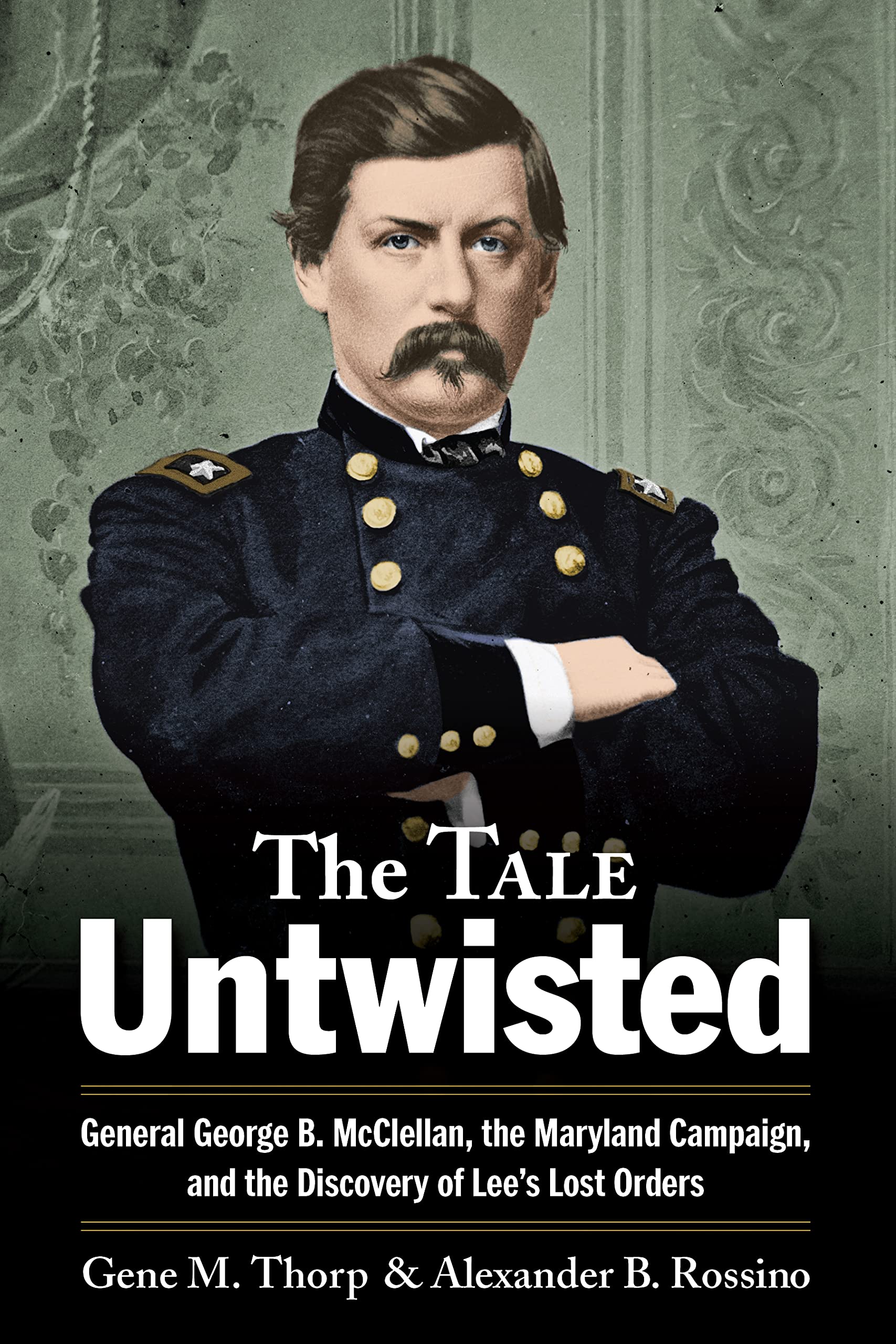
Review - " The Tale Untwisted: General George B. McClellan, the Maryland Campaign, and the Discovery of Lee’s Lost Orders " by Thorp & Rossino

[The Tale Untwisted: General George B. McClellan, the Maryland Campaign, and the Discovery of Lee’s Lost Orders by Gene M. Thorp & Alexander B. Rossino (Savas Beatie, 2023). Softcover, 17 maps, figures, appendix section, footnotes, bibliography, index. Pages main/total:xii,136/183. ISBN:978-1-61121-622-6. $18.95]

The case being much the same with the earlier Peninsula Campaign, controversies attached to every stage of the 1862 Maryland Campaign, both fair and unfair, have dogged General George B. McClellan's historical record for over a century and a half. To the chagrin of McClellan supporters, tradition has it that the general received a found copy of Robert E. Lee’s Special Orders No. 191 early on September 13 then proceeded to mull things over for as much as eighteen hours before compounding that initial indecision by responding not with alacrity but an overabundance of caution, ultimately throwing away the once in a lifetime opportunity provided by that amazing intelligence bonanza. The problem with this story line, too often passed down uncritically through the decades, is that none of it is true. In their book The Tale Untwisted: General George B. McClellan, the Maryland Campaign, and the Discovery of Lee’s Lost Orders, authors Gene Thorp and Alexander Rossino sharply and convincingly argue that McClellan responded to the Lost Orders both rapidly and with poised confidence, and his corps commanders, issued orders aggressive in tone and expectation, moved forward to engage the enemy as rapidly as one could expect given the bottlenecks and terrain obstacles ahead of them.

Even the general's harshest critics typically concede that McClellan, in hastily reconstituting a cohesive, mobile, and battle ready army from a jumbled and demoralized collection of existing formations and an infusion of fresh levies, achieved an organizational feat perhaps no other leader could have accomplished within the same time frame. Thorp and Rossino add to this the lesser appreciated fact that many of the divisions had to conduct long and exhausting approach marches from their camps in northern Virginia just to reach McClellan's new strike force assembling outside the capital in Maryland.

In a relatively brief study of less than 150 pages, Thorp and Rossino offer readers a masterful summary of the period September 7-15, exploring at each stage the when and where of what McClellan knew of the enemy's intentions, his series of orders to principal subordinates, and the positions of each major element of his army in relation to those of his opponent. Clarity abounds in the narrative, but the book's dynamic and highly detailed maps (many of which are two-page spreads) provide what amounts to a daily military chessboard. The combination considerably enhances reader understanding of decisions and events. Additionally, selective use of brigade symbols also helps readers judge weight of force at a glance. Taken together, maps and text completely demolish the allegation that McClellan's army marched only "six miles a day" in Maryland. The origins of that canard the authors trace first to General-in-Chief Henry Halleck and then more popularly to William Swinton's 1864 election propaganda.

Through a meticulous recounting of the events of September 13 by way of judicious examination of an array of sources offering key information about time and place, the best evidence clearly supports the conclusion that McClellan received the Lost Orders after noon (perhaps around 1pm) and, after due consideration of its contents, quickly responded. Ordering General Alfred Pleasonton to seek out confirmation of the information contained in the Lost Orders (which was four days old by the 13th), McClellan, without waiting to hear back from his cavalry eyes and ears, adjusted his existing marching orders and sent at midnight his controversial "trophies" telegram to Lincoln and the War Department. The commonly disseminated interpretation, most prominently advanced by Stephen Sears, that the "trophies" telegram was transmitted at noon is so convincingly refuted that the need for its permanent retirement is unquestionable. Hand in hand with that is the equally strong imperative to discard the accusation of excessive dawdling. Indeed, McClellan's army was constantly in motion during the week-long period examined in the book

Given that the Army of the Potomac was on the move and already in the midst of an early yet already self-assured response to Lee's incursion into Maryland, some have argued against the importance of the Lost Orders. Thorp and Rossino are sympathetic to that notion, but only to a small degree. Their explanation of the ways in which the Lost Orders reshaped McClellan's mindset and plans going forward from September 13 offers a persuasive argument, one admitted later by the general himself, that the intercepted intelligence had a significant impact on how the army conducted its affairs between then and the fall of Harpers Ferry.

The general's alleged case of the "slows" has also been used to shift a lion's share of blame for the ignominious Harpers Ferry surrender upon McClellan's shoulders. Thorp and Rossino more properly place the burden of responsibility upon Halleck and post commander Col. Dixon Miles, with a nod to Confederate general Stonewall Jackson's skillful and aggressive investment of the town. Halleck ignored McClellan's advice regarding the best disposition of the post's defenders, and he waited until it was too late before handing McClellan authority over the garrison. Miles, as every observer then and now justifiably believes, was in over his head and badly botched his arrangements for holding Harpers Ferry, essentially trapping himself inside an indefensible bowl. In addition, after informing those responsible for his relief that he would hold out for 48 hours, Miles surrendered after only a day. As this book's keen analysis of events demonstrates, the force assigned to rescue Harpers Ferry, General William Franklin's Sixth Corps, had little chance of doing so under that sharply cropped time frame.

Found in the appendix section is a rather detailed summary of telegraphic communications sent over September 6-13, its in-depth look at the "trophies" telegram supplemented by cautionary general discussion of Civil War telegraph transcription errors. Also included is an Army of the Potomac strength table and the Lost Order text (the last accompanied by an excellent map tracing the actual movements of those parts of Lee's army mentioned in the order).

Thorp and Rossino's study ends on September 15, with the main body of McClellan's army converging on Antietam Creek and Lee's army still widely divided between Sharpsburg and the Harpers Ferry environs. What followed during September 16, the September 17 Battle of Antietam, and the post-battle Union pursuit of Lee's army still fuel McClellan critics, but The Tale Untwisted makes it abundantly clear that, contrary to long-held belief, the preceding week was a rather superb one for Little Mac. Much in the way of insightful revisionism within the Civil War literature diminishes itself through contrarian overreach and attacking tone directed toward principal proponents of the established view; however, there's little cause for complaint on those grounds here (though one target might disagree!). In research, argumentation, and overall presentation, Thorp and Rossino's study shows how going about the process of changing minds influenced by generations of printed misinformation is properly done. Theirs is a refreshing and essential new addition to the 1862 Maryland Campaign literature.

Saturday, February 18, 2023

I Dread the Thought of the Place

Clear out a wide shelf space next to your copy of To Antietam Creek: The Maryland Campaign of September 1862. The decade-plus wait for the second installment of Scott Hartwig's mammoth two-volume 1862 Maryland Campaign study will soon be over.

Scheduled for an August release by Johns Hopkins University Press, I Dread the Thought of the Place: The Battle of Antietam and the End of the Maryland Campaign "provides an hour-by-hour tactical history of the battle, beginning before dawn on September 17 and concluding with the immediate aftermath, including General McClellan's fateful decision not to pursue Lee's retreating forces back across the Potomac to Virginia." Enhancing that highly detailed narrative will be "21 unique maps illustrating the state of the battle at intervals ranging from 20 to 120 minutes." The current listing indicates that it will come in at nearly 1,000 pages so don't drop it on your foot.

Friday, February 17, 2023

Booknotes: Grant at 200

New Arrival:
Grant at 200: Reconsidering the Life and Legacy of Ulysses S. Grant edited by Chris Mackowski & Frank J. Scaturro (Savas Beatie, 2023).

Any observer of trends in the Civil War-era literature cannot help but notice the scale of revision brought to our modern reevaluation of U.S. Grant's Civil War generalship and 1869-77 presidency. Though reminders of where counterbalancing forces might have gone too far in the other direction frequently pop up, Grant is clearly no longer the drunk butcher who parlayed victory bought by overwhelming resources into a multi-term presidency the principal legacy of which was extreme corruption. This upward swing did not occur all at once, with the military career revisionism largely preceding the new appreciation of Grant's presidency.

Exploring current lines of thinking regarding this transformation, among other things, is the essay anthology Grant at 200: Reconsidering the Life and Legacy of Ulysses S. Grant, edited by Chris Mackowski and Frank Scaturro. It "celebrates the bicentennial of the birth of a man whose towering impact on American history has often been overshadowed and, in many cases, ignored. This collection of essays by some of today’s leading Grant scholars offers fresh perspectives on Grant’s military career and presidency, as well as underexplored personal topics such as his faith and family life."

Including introductory and epilogue pieces, there are seventeen essays. Grant's cadet career, Methodist upbringing, and relationship with his in-laws are examined. Reflecting on his Civil War career are essays looking at his "art of war," the Appomattox surrender, and moments of contingency in his rise through the ranks of top Union generals. Grant's political skills, his civil rights record, and foreign policy are discussed. Legacy perspectives from a Grant descendant and a living history impersonator are included, as is coverage of the "odyssey" of Grant's tomb.

It should also be noted that "proceeds from this volume will go to support the Ulysses S. Grant Association and the Grant Monument Association."

Wednesday, February 15, 2023

Booknotes: July 22

New Arrival:
July 22: The Civil War Battle of Atlanta by Earl J. Hess (UP of Kansas, 2023).

From the description: "So remarkable was the fighting to the east of Atlanta on July 22, 1864, that it earned its place as the only engagement of the Civil War to be widely referred to by the date of its occurrence. Also known as the Battle of Atlanta, this was the largest engagement of the four-month-long Atlanta Campaign for control of the city and the region. Although Confederate commander John Bell Hood’s forces flanked William T. Sherman’s line and were able to crush the end of it, they could go no further. On July 22, 1864, the Confederates came closer to achieving a major tactical victory than on any other day of the Atlanta Campaign."

As remarkable as the July 22 Battle of Atlanta may have been, it would be the year 2010 before the first modern standalone study would be published, Gary Ecelbarger's The Day Dixie Died: The Battle of Atlanta. Before that, Albert Castel's 1992 classic Decision in the West contained the most detailed account of the battle. Ecelbarger's landmark work was later augmented by David Allison's Attacked On All Sides: The Civil War Battle of Decatur, Georgia, the Untold Story of the Battle of Atlanta (2018). Now, prolific-as-ever military historian Earl Hess has thrown his hat into the ring with July 22: The Civil War Battle of Atlanta, his fifth book covering some aspect of the campaign.

More from the description: Earl Hess’s July 22 "is a thorough study of all aspects of the most prominent battle of the Civil War’s Atlanta Campaign. Based on exhaustive research in primary sources, Hess has crafted a unique and compelling study of not only the tactics and strategy associated with the engagement but also of the personal experiences of Union and Confederate soldiers and the effects the battle had on them. This book offers fresh insights to the significance that the Battle of July 22 held for the larger Atlanta campaign and the entire Union war effort. Hess also provides a thorough discussion of the death of Maj. Gen. James B. McPherson, the most prominent casualty of the battle, and the effect this loss had on Union soldiers and civilians alike. He concludes with an assessment of the battle’s legacy in American history and culture." In a welcome break from recent practice, Hess's decision to commission a set of maps (27 in number) from an outside source is a noticeable improvement.

This has all the hallmarks of yet another Hess-authored must-own title. The preface contains a fairly lengthy sketch of what Hess sees as major differences in content, research, and interpretation between Ecelbarger's study and his own. Unfortunately, it doesn't look like any previews or 'search inside' tools containing the preface text are freely available for prospective buyers to peruse. Suffice it to say that Hess's book, in his words, offers a "wider and deeper research base," provides a "more holistic understanding of the battle," and doesn't share Ecelbarger's views on the battle's "decisive" significance "within the context of both the Atlanta Campaign and the Civil War" (pg. xii-xiii).

Tuesday, February 14, 2023

Booknotes: Freedom's Crescent

New Arrival:
Freedom's Crescent: The Civil War and the Destruction of Slavery in the Lower Mississippi Valley by John C. Rodrigue (Cambridge UP, 2023).

From SW Tennessee all the way down through southern Louisiana, counties (or parishes) lining both banks of the Mississippi River were among those possessing the valley's densest slave populations. With Union land and naval forces achieving deep and lasting penetrations into the region by the end of 1862, it's long been recognized in the Civil War literature that the Lower Mississippi Valley experienced the earliest widespread testing ground of emerging "hard war" policy and one of its principal features, military emancipation.

From the description: "Beginning with Lincoln's 1860 presidential election and concluding with the final ratification of the Thirteenth Amendment in 1865, Freedom's Crescent explores the four states of this region that seceded and joined the Confederacy: Tennessee, Mississippi, Arkansas, and Louisiana. By weaving into a coherent narrative the major military campaigns that enveloped the region, the daily disintegration of slavery in the countryside, and political developments across the four states and in Washington DC, John C. Rodrigue identifies the Lower Mississippi Valley as the epicenter of emancipation in the South."

According to Rodrigue, two major themes dominate his chronological narrative. The first "argues that the multidimensional nature of emancipation and abolition [and he is careful to distinguish between the two] in the lower Mississippi valley elucidates the various means by which slavery was brought to and end in the United States." Within that examination, the author identifies "five major dimensions of wartime emancipation and abolition" and explains their involvement in all four states. These are: (1) limited military emancipation (slaves directly freed by Union forces prior to the Emancipation Proclamation), (2) universal military emancipation via the EP, (3) the EP's exclusions thought necessary to maintain the support of Southern Unionists, (4) state-level abolition through wartime reconstruction governments, and (5) Federal civil authority (the definitive end of slavery through dictate and constitutional amendment). By the author's estimation, this region was the only one in the South to experience all five dimensions.

The second theme revolves around the concept of historical contingency and how its role in permanently ending slavery was much more significant than most of the previous literature has allowed. Rodrigue embarks on a deep exploration of the myriad of complications involved in "transforming military emancipation into constitutional abolition," coming to the conclusion that the latter was not inevitable. The author argues that scholarly fixation on the Emancipation Proclamation has led too many historians to "equate emancipation with abolition" in ways that accept inevitability without due reflection upon what difficulties were actually involved in going from the former to the latter. His book seeks to reorient our understanding of that transition as being not a "one-step process but rather a two-step process: war for Union to Emancipation Proclamation, and Emancipation Proclamation to constitutional abolition," that latter stage being more contingent than popularly believed.

In explaining that his book only selectively targets engagement with the recent borderlands literature, Rodrigue points out a key irony between antebellum antislavery thought and wartime/postwar reality. Before the Civil War, most thinkers believed that the Border States would lead the nation in abolishing slavery, that successful model then being employed southward, but the war itself upended that conventional assumption when the "states of the lower Mississippi valley eventually leap-frogged over them."

I'm not familiar with the author's other emancipation and Reconstruction scholarship, but Freedom's Crescent has the hallmarks of a possible career magnum opus. At nearly 500 smallish-font pages of narrative, reaping its rewards is a pretty substantial reading commitment. "A sweeping examination of one of the war's most important theaters, this book highlights the integral role this region played in transforming United States history."

Monday, February 13, 2023

Review - " The Antietam Paintings by James Hope " by Gottfried & Gottfried

[The Antietam Paintings by James Hope by Bradley M. Gottfried & Linda I. Gottfried (Author, 2022). Softcover, color art, source list. ISBN:979-8-218-01411-7. $17.95]

Every Antietam reader has encountered the Hope paintings depicting various scenes from the battle. The five panoramic oils on canvas (each five and a half feet in height by twelve feet in width) were completed by the time the 30th anniversary of the battle rolled around and were exhibited in the nation's capital. Preservation proved to be precarious after Hope's death, but the National Park Service was able to purchase the collection in 1979, carefully removing them from an old church building and restoring them. Of the five ["Artillery Hell," "A Fateful Turn," "A Crucial Delay," "Wasted Gallantry," and "The Aftermath at Bloody Lane"], the last was badly damaged during a Hope gallery flood, with only a portion of it surviving to today (but what a portion it is).

Offering a unique new look at the Hope art is Bradley and Linda Gottfried's The Antietam Paintings by James Hope. As noted in the introduction, Hope was Scottish born and made his way to the United States via Canada. A class at the Castleton academy in Vermont (yes Time Chasers fans, that Castleton) led to a blossoming art career, first in teaching then in portraiture. His true artistic passion soon turned to landscapes. This favored direction was interrupted by the Civil War, during which Hope served as a captain in the Second Vermont. Topographical engineering duties performed during the war furthered his skill set in rendering physical landscapes. Resigning from the army in late 1862 due to serious health reasons, Hope returned to his prewar career path, and his portfolio of Civil War artworks eventually covered a number of campaigns and battles in addition to Antietam.

Most of Hope's Antietam paintings are not meant to be snapshots in time but rather a composite of events. For example, "Artillery Hell" depicts three hours of action between 7am and 10am. In order to scrutinize details more closely in the book, each painting is examined in three parts (appropriate to the landscape format: left side, middle, and right side). Reproduced in full color, the sections are annotated, with the painting image on the right-hand page and notes facing it on the left. The lettered sequence of notes describe specific military actions and scenes that are depicted; identify units, individuals, roads, fields, buildings, etc.; and point out both near and distant natural features (ex. woods, mountains, and limestone ledges).

Interesting considerations emerge from this close-up examination. For example, at least two instances are revealed of Hope closely modeling a small area of canvas on a famous Alexander Gardner photographic image. Some oddities pop up, too. One being the inexplicable decision to paint the guns of a Confederate battery in "Artillery Hell" shooting in completely opposite directions, forward toward the enemy and seemingly back toward its own lines. According to the text, veterans lauded the authenticity of the battlescapes Hope painted, though a soldier-critic complained that there were too few bodies down in the fields. One wonders what that fellow thought of the perfectly dressed battle lines, too. There certainly was no holding back when it came to imagery of the slain in Hope's Bloody Lane painting, which is one of the most evocative depictions of a battle's grim aftermath in all of the contemporary Civil War brush art. Though the book does not go into it much, it is noted that Hope's landscape art was profoundly shaped by the Hudson River School (for prime examples, see the artist's Watkins Glen series of paintings), and one can identify elements of that influence in these Civil War paintings as well. For a more telling example, see his Civil War Soldier at Rest.

A welcome break from the norm, this volume is highly recommended for anyone interested in nineteenth-century Civil War art and the Battle of Antietam.

Friday, February 10, 2023

Booknotes: Of Age

New Arrival:
Of Age: Boy Soldiers and Military Power in the Civil War Era by Frances M. Clarke & Rebecca Jo Plant (Oxford UP, 2023).

From the description: Of Age: Boy Soldiers and Military Power in the Civil War Era "is the first comprehensive study of how Americans responded to the unauthorized enlistment of minors in this conflict and the implications that followed. Frances M. Clarke and Rebecca Jo Plant offer military, legal, medical, social, political, and cultural perspectives as well as demographic analysis of this important aspect of the war." After a quick thumb through, the level of comprehensiveness implied above certainly looks to be as advertised. Many parts of it catch my eye, including a long discussion of how well or unwell the undeveloped bodies of underage soldiers held up to the arduous nature of military service (an important finding being that the consequences could be lifelong for "a disproportionate number" of these boys whose time in the army "would spell an adulthood marred by chronic ill health and suffering").

A year or two ago, I tried to find a ballpark figure of how many underage soldiers were enlisted in both armies, and the estimates were truly all over the place. Clarke and Plant "find that underage enlistees comprised roughly ten percent of the Union army and likely a similar proportion of Confederate forces."

The authors reveal that underage enlistment raised numerous complicated issues, many of which are understudied in the current literature but expansively examined or reexamined in this volume. In Of Age, they "introduce common but largely unknown wartime scenarios. Boys who absconded without consent set off protracted struggles between households and the military, as parents used various arguments to recover their sons. State judges and the US federal government battled over whether to discharge boys discovered to be under age. African American youths discovered that both Union and Confederate officers ignored their evident age when using them as conscripts or military laborers. Meanwhile, nineteenth-century Americans expressed little concern over what exposure to violence might do to young minds, readily accepting their presence in battle. In fact, underage soldiers became prevalent symbols of the US war effort, shaping popular memory for decades to come."

Various quantitative methods, examples, and concerns are discussed in the appendix section. Appendix A looks at how underage soldiers have been (mis)counted in the past in a variety of documents and studies. As one example, the authors use their own demographic research into the 64th New York as a case study demonstrating the inaccuracies of official government records. Difficulties inherent in arriving at a statistically significant comparison between U.S. and Confederate armies are also explained. The second appendix extols the value of using the Early Indicators of Later Work Levels, Disease, and Death database (available online at uadata.org) as a means of "arriving at a clearer view of underage enlistment for the Union army as a whole." The book derives a number of useful data tables from that sample.

If it fulfills its promise, this is the type of groundbreaking reinterpretation that award committees love to add to their candidate lists. More from the description: "An original and sweeping work, Of Age convincingly demonstrates why underage enlistment is such an important lens for understanding the history of children and youth and the transformative effects of the US Civil War."

Thursday, February 9, 2023

Booknotes: I Thank the Lord I Am Not a Yankee

New Arrival:
I Thank the Lord I Am Not a Yankee: Selections from Fanny Andrews's Wartime and Postwar Journals edited with commentary by Stephen Davis (Mercer UP, 2023).

From the description: "In December 1864, twenty-four year-old Eliza Frances ("Fanny") Andrews began a journal that she would maintain through August 1865. Although overshadowed by Mary Boykin Chesnut's Diary From Dixie, Miss Andrews's War-Time Journal of a Georgia Girl surely ranks among the most observant and intelligent wartime memoirs by a Southern woman. Frances was born into a well-to-do Georgia family, received a strong education, and was raised to become a young woman able to support herself by writing for magazines and newspapers."

Credited as "edited with commentary," Stephen Davis's work on this title is a bit different from typical Civil War journal editing in that he essentially crafts an editorial narrative that incorporates select passages from Andrews's self-edited War-Time Journal of a Georgia Girl. In addition to footnoting the combined texts, Davis's introduction and epilogue relay information about Andrews's life before and after the war.

In editing War-Time Journal of a Georgia Girl over the years preceding its 1908 publication, Andrews sought to remove passages that might hurt the feelings of those still living or otherwise make her out to be "an ass" (her words). Though she admits that the bitter anti-Yankee words and tone found throughout her journal (which was written in the wake of Sherman's destructive path through her state) did not "represent the present feeling of the writer," she let them stand so as to not "falsify the record." Davis's intro recounts which scholarly volumes in the Civil War literature have used the journal, noting that its multiple reprintings over many decades also attest to its historical and historiographical value.

The Andrews writings in I Thank the Lord I Am Not a Yankee are presented in three parts. In addition to the December 1864 - August 1865 journal, the volume contains Andrews's Scott's Monthy Magazine articles (written under the pen name "Elzey Hay"), some of which are described by the editor as marking the emergence of a "mid-nineteenth-century protofeminist" voice. Published between 1866 and 1869, the magazine articles are eight in number. The third and final part of the book follows Andrews's 1870 travel journal that covered her seven-week visit of New York and New Jersey. That text is presented in the same editorial fashion as the wartime and early-Reconstruction journal.

Andrews was also a teacher, acclaimed novelist, and poet. According to Davis, royalties from the textbooks she wrote provided much of her income until her death in 1931. Of course, for CWBA readers, the main draw of this volume is the Andrews material found in Part I, which Davis describes as "a wartime journal that ranks among the best in Southern literature."

Tuesday, February 7, 2023

Review - " Gunboats, Muskets, and Torpedoes: Coastal South Carolina, 1861–1865 " by Michael Laramie

[Gunboats, Muskets, and Torpedoes: Coastal South Carolina, 1861–1865 by Michael G. Laramie (Westholme Publishing, 2022). Hardcover, maps, photos, tables, illustrations, notes, bibliography, index. Pages main/total:xii,329/395. ISBN:978-1-59416-395-1. $35]

By the time the smoke settled from Fort Sumter's bombardment and surrender, it became increasingly clear to everyone that the fate of Charleston, South Carolina was far from decided. Combined with its clear strategic value, the port city's enhanced symbolic presence as the "Cradle of Secession" ensured that it and its harbor would remain high on each side's list of military priorities. Unlike North Carolina's coast, which, outside of Wilmington, was quickly seized by Union forces in 1862 and its most important posts securely held for the duration of the war, the contest for control of South Carolina's coast, and of Charleston in particular, lasted four long years.

The two largest attacks on Charleston's outer defenses are fully explored in Patrick Brennan's Secessionville: Assault On Charleston (1996) and Stephen Wise's Gate of Hell: Campaign for Charleston, 1863 (1994), both works being gold standard treatments of their respective subjects. A lone book-length treatment of the siege artillery storm directed at Charleston itself exists in W. Chris Phelps's The Bombardment of Charleston, 1863–1865 (2000). Additionally, the contested space between Charleston and Savannah, a maze of swamps, sounds, sea islands, and inland waterways, has been studied in numerous books and articles, and H. David Stone's Vital Rails: The Charleston & Savannah Railroad and the Civil War in Coastal South Carolina (2008) provides us with an unmatched recounting of the wartime history of the rail link connecting those two port cities. Of lesser strategic significance, coastal targets between Charleston and the North Carolina border received much less attention from Union occupation and blockading forces during the war. It's a history worth examining, though, and Rick Simmons' Defending South Carolina's Coast: The Civil War from Georgetown to Little River (2009) very ably documents what happened there. No single volume weaves together all of these threads to satisfaction, though E. Milby Burton's The Siege of Charleston, 1861-1865 (1970) went some way toward doing it. Michael Laramie's highly engaging new book Gunboats, Muskets, and Torpedoes: Coastal South Carolina, 1861–1865 represents the most comprehensive attempt yet.

Though his study is ostensibly a chronological overview of military events that occurred along the full length of the South Carolina coast, Laramie understandably focuses on operations at and below Charleston. Following an obligatory geography lesson and brief discussion of the Port Royal expedition that secured the first vital Union foothold in the area, the narrative examines, from both perspectives, the series of combined army-navy operations launched against Charleston. The 1862 Battle of Secessionville fought on James Island, a resounding Confederate victory that turned away the first major Union thrust toward Charleston, is recounted to satisfaction (though the most recent work on that battle challenges the traditional interpretation, repeated in this book, of Union commander Henry Benham's conduct). Explored at greatest length are the 1863 Union operations that eventually captured Fort Wagner and secured Morris Island for the establishment of Union siege batteries that pummeled Fort Sumter and the lower districts of Charleston itself. That series of chapters comprises the heart of the book. Blockade and fleet actions, including the U.S. Navy's 1863 ironclad assault that failed to unhinge the harbor defenses, are also suitably detailed and assessed. The role and impact (both offensive and defensive) of technological innovation, especially in the areas of mine warfare, ironclad warships, submersibles, and torpedo boats, in the Charleston blockade and siege are seamlessly integrated into the narrative.

Though 1863's flurry of events was followed by what might be best described as stalemate, active operations continued along the periphery. Laramie appropriately highlights many actions that have often escaped notice in broader histories. Coverage of General John Foster's 1864 summer offensive against the Charleston defenses and C&S Railroad, a little-known four-pronged attack conducted over a wide area that failed to produce any significant results, is provided. Later in the year, new Union operations against the C&S that were timed to assist General William T. Sherman's advancing army. These included a bloody Union repulse at Honey Hill in late November and a redirected approach in December that also failed to cut rail communications between Savannah and Charleston. Both operations are described well in the text. Ultimately, Charleston would be evacuated, it's final fall precipitated not by Union forces lodged on the coast but by the inland approach of Sherman's overwhelming host.

While central focus on Charleston and the network of sea islands between that city and Savannah is inevitable within a work of this kind, the coastal ground stretching northward to the North Carolina border (which produced the nation's most lucrative rice growing economy) is arguably worthy of more extensive coverage than the glancing attention given to it in this volume. As revealed in Simmons's aforementioned book, Union raids and Confederate blockade running activities occurred there with some frequency. In recognition of its value as an alternative haven when Charleston was under greatest threat, Winyah Bay was rather extensively fortified, and Georgetown was a significant deep water port in its own right.

The analysis portions of this book blend reinforcement of consensus views with the author's own sound commentary. Similar to what transpired in North Carolina, Union interest in exploiting early-war gains along the South Carolina coast waxed and waned throughout the war. Like other modern observers who have criticized Union war planners for not utilizing captured North Carolina bases to their fullest, Laramie sees significant lost opportunity in South Carolina. There, Union forces never were able to leverage superior land and seaborne capabilities enough to seriously interdict the Charleston & Savannah Railroad, even though the line vulnerably hugged the coast along much of its length. The text's presentation of the possible reasons behind this chronic failure—among them issues of leadership, opposing strategy (the departmental defense arrangement initiated by Robert E. Lee and expanded upon by his successors proved remarkably successful), interservice rivalry, and more—are convincingly outlined. Laramie's attempt to explain what factors lay behind the powerful USN's inability to break the Charleston harbor stalemate (even after heavy investment in ironclad development) is largely in agreement with persuasive analyses expressed elsewhere the literature. In considering the limited but tantalizing evidence of their capabilities and potential when it came to harbor defense and challenging the blockade, the author is intrigued by the what-if possibility of the CSN employing squadrons of lightly-armored torpedo boats as a better 'bang for the buck' alternative to investment in expensive, resource-consuming ironclad capital ships.

Throughout the book, map coverage of varying scale amply supports text descriptions of geography and events. One thing that does detract from the narrative's otherwise appealing immersion is the great frequency of misspellings, an unfortunate holdover from the 2020 companion volume Gunboats, Muskets, and Torpedoes: Coastal North Carolina, 1861–1865. There are also niggling factual errors sprinkled about (ex. Henry Heth was a Virginian, not a South Carolinian as stated on pg. 34, and the USS Kearsarge did not, as claimed on pg. 275, capture the CSS Alabama but rather famously sank it in action). While no archival research was involved in the project, the army and navy O.R.s and other government source documents are supplemented with enough newspaper, book, and article resources of all kinds to craft a military narrative that creatively balances top-down operational history with more ground-level human experiences and perspectives. Though notable omissions remain, there does appear to be an increased willingness in this volume, in contrast to the earlier North Carolina study, to engage with the more recent literature, an important part of any modern synthesis. As one example, Laramie's discussion of the effectiveness of the Union naval blockade of Charleston is heavily influenced by the recently published findings of Michael Bonner and Peter McCord. Also, though biomedical engineer and blast injury expert Rachel Lance's In The Waves: My Quest to Solve The Mystery of A Civil War Submarine (2021) does not appear in the bibliography and is unmentioned in the text, the author appears fully convinced by her thesis regarding what caused the demise of the CSS Hunley's crew.

In the end, though, these justifiable concerns over the editing flaws and quirky research practices involved in its creation are outweighed by the many positive features of Michael Laramie's Gunboats, Muskets, and Torpedoes: Coastal South Carolina, 1861–1865. It's a fine popular overview of the complex series of military events that occurred in the region. For those seeking a suitable first entry into the Charleston Campaign literature, Laramie's embracive examination of that large topic makes this a recommendable new alternative to Burton's aging classic.

Saturday, February 4, 2023

Booknotes: John T. Wilder

New Arrival:
John T. Wilder: Union General, Southern Industrialist by Steven Cox (Mercer UP, 2023).

According to author Steven Cox, his book John T. Wilder: Union General, Southern Industrialist is the first Wilder biography to appear in print since 1936. That now much-outdated earlier work, General John T. Wilder by Samuel Cole Williams, was published by Indiana University Press, and its very slim narrative (the main text being only fifty pages in length) is dominated by the subject's famous Civil War exploits.

Seeking to offer a much fuller and more modern biographical treatment, Cox's study reintroduces Wilder as an important figure in western economic development. From the description: Before the Civil War, Wilder "was an influential nineteenth-century American industrialist, and a successful foundry owner at Greensburg, Indiana." Though history ties Wilder most closely to the state of Indiana, his role as New South industrialist dominated his postwar life and career. "After the war, Wilder answered the call Chattanooga, Tennessee, issued for northern investors to relocate. Wilder developed mines across eastern Tennessee and western North Carolina, and dabbled in the hotel and railroad business, as well as politics." Interestingly, though the description claims that Wilder "was heavily involved with getting the Chickamauga Battlefield established as the first National Military Park in the United States," the author's preface notes that Wilder's actual involvement "seems to have been limited, relying mostly on the use of his name as an endorsement" (pg. x).

Of course, Civil War readers are most familiar with Wilder's exploits during the Tullahoma and Chickamauga campaigns of 1863. Surviving the military career path embarrassment of surrendering the garrison of Munfordville, Kentucky to Bragg's forces in September 1862, Wilder redeemed himself the following year as the commander of a brigade of mounted infantry armed with repeating rifles, the celebrated "Lightning Brigade" of the Army of the Cumberland. Wilder's Civil War service occupies just over half of this book's 185-page main narrative.

With its wide margins, footnotes taking up page-bottom space, and large-ish print, this volume looks to be a brisk read. In yet another one of those inexplicable yet oddly frequent recurrences, after a nearly ninety-year gap there are actually two Wilder biographies slated for publication this year, this one and Maury Nicely's Forging a New South: The Life of General John T. Wilder (UT Press). Wilder's postwar business and political activities appear to be a major emphasis of both works.

Thursday, February 2, 2023

Booknotes: Lee Invades the North

New Arrival:
Lee Invades the North: A Comparison of the Antietam and Gettysburg Campaigns by Bradley M. Gottfried (Author, 2022).

I'm obviously not familiar with every title among the legions of 1862 Maryland Campaign and 1863 Gettysburg Campaign studies, but I don't recall any existing work offering an in-depth, point by point discussion of the differences and similarities between the two. Bradley Gottfried, a Licensed Town Guide for Gettysburg, Certified Battlefield Guide for Antietam, and author of numerous publications addressing both campaigns, has not encountered such a book either, and that proved to be the motivating force behind the creation of his 2022 book Lee Invades the North: A Comparison of the Antietam and Gettysburg Campaigns.

Gottfried envisions nearly every aspect of both campaigns, from beginning to end, as open to fruitful comparison. His description offers an overview of topical breadth as follows: "The military and political environment at the beginning of each campaign," "why Lee undertook the invasions," "the armies and their leaders," "the condition of the armies," "military intelligence," "getting to the battlefield," "battles along the way," "battlefield terrain," "initial encounters," "the three phases of battle in each campaign," "the armies and their commanders-in-chiefs," "post-campaign events," and "final thoughts."

The above and more comprise chapter-length subsections in the book, and those are subdivided even further into as many as a half dozen additional topics of discussion. Each chapter's text exploration is supplemented, in tabular format, by a useful recapitulation of that subject's most notable similarities and differences. Both primary and secondary research were involved in this volume's creation, with notes and bibliography revealing a wide range of manuscript, newspaper, government document, book, and article resources. Gottfried also includes 35 maps drawn from his published atlas studies of both campaigns.

It's obvious from all this that Gottfried has deeply pondered the subject from top to bottom. If you're the kind of reader who has already spent years devouring everything Antietam and Gettysburg and are wondering if this might be the book for you, the author notes in the foreword that the material is directed toward both newbies and nitpickers alike. "This book is written for all readers. Anyone who is not familiar with the campaigns might wish to read the entire volume; those with greater knowledge will benefit by concentrating on the comparison sections."

Tuesday, January 31, 2023

Booknotes: The Antietam Paintings by James Hope

New Arrival:
The Antietam Paintings by James Hope by Bradley M. Gottfried & Linda I. Gottfried (Author, 2022).

Except for the too-perfect alignment of battle lines in some of them, I've always liked the Hope series of paintings depicting scenes from the Battle of Antietam. According to the introduction to Bradley and Linda Gottfried's The Antietam Paintings by James Hope, Hope's work was directly informed by the artist's prewar painting background (during which he developed a passion for landscapes), his personal experience of the battle (he was a captain in the Second Vermont), and his topographical engineer duties during the war.

From the description: "The Battle of Antietam held a special place for Hope, and during the late 1880's into the 1890's, he created five large panoramic paintings of various aspects of the battle. Four of the five still exist today and are regularly displayed at the Antietam National Battlefield; the fifth was badly damaged in a flood, but a smaller version still exists."

In addition to learning more about Hope himself, I am looking forward to perusing the volume's breakdown of key features displayed in his painting series. More from the description: The 48-page booklet "describes Hope's life and then reviews each of the five panoramic paintings in detail, beginning with a representation of the entire painting and then by dividing the painting into three sections and illustrating the major features of each in subsequent pages. A full-color panel is on the right side of each page and a description of the events/scenes, is on the left."