Monday, August 13, 2018

Booknotes: The Webster-Hayne Debate

New Arrival:
• The Webster-Hayne Debate: Defining Nationhood in the Early American Republic
  by Christopher Childers (Johns Hopkins UP, 2018).

Part of JHUP's Witness to History series, The Webster-Hayne Debate examines one the great Senate debates over the preferred purpose and role of the federal government in the union of states. "Was it a confederation of sovereign states or a nation headed by a central government? To South Carolina Senator Robert Y. Hayne and others of his mindset, only the vigilant protection of states’ rights could hold off an attack on the southern way of life, which was undergirded by slavery. Massachusetts Senator Daniel Webster, on the other hand, believed that the political and economic ascendancy of New England―and the nation―required a strong, activist national government."

The emerging West figured prominently in the conversation, and author Christopher Childers "focuses on the sharp dispute that engaged Webster and Hayne in January 1830. During Senate discussion of western land policy, Childers explains, the senators’ exchanges grew first earnest and then heated, finally landing on the question of union―its nature and its value in a federal republic. Childers argues that both Webster and Hayne, and the factions they represented, saw the West as key to the success of their political plans and sought to cultivate western support for their ideas."

More from the description: "A short, accessible account of the conflict and the related issues it addressed, The Webster-Hayne Debate captures an important moment in the early republic. Ideal for use in college classrooms or for readers interested in American history, this book examines a pivotal moment and a critical problem in the history of US politics. It also shows how Americans grappled with the issues of nationalism, sectionalism, and the meaning of union itself―issues that still resonate today."

Friday, August 10, 2018

Booknotes: The Last Siege

New Arrival:
• The Last Siege: The Mobile Campaign, Alabama 1865 by Paul Brueske
  (Casemate, 2018).

The Last Siege is a study of the Union Army's month-long 1865 land campaign that captured Spanish Fort and Fort Blakely, actions which successfully forced the evacuation of Mobile itself. The closest comparable work, Sean O'Brien's Mobile, 1865: Last Stand of the Confederacy, was published back in 2001. I don't recall much about that one beyond being left wanting more detail.

At less than 200 pages of narrative, Brueske's book is not an exhaustive attempt at addressing the military aspects of a major Civil War campaign, but the research appears quite substantial. The bibliography suggests serious archival research and includes long lists of all source types related to the campaign.

Brueske is certainly correct that the 1865 land operation against Mobile is greatly understudied in comparison to other campaigns of similar size and significance. His attempt at rectifying the situation "explores the events surrounding th(e) siege and capture of Mobile, Alabama. The Union victory at the battle of Mobile Bay in 1864 ended blockade running from the port of Mobile. Uncaptured, the city remained a priority for the Confederates to defend and the Federals to attack. This book gives a new perspective on the strategic importance of Mobile as a logistical center which had access to vital rail lines and two major river systems, essential in moving forces and supplies. Included are the most detailed accounts ever written on Union and Confederate camp life in the weeks prior to the invasion, cavalry operations of both sides during the expedition, the Federal feint movement at Cedar Point, the crippling effect of torpedoes on U.S. naval operations in Mobile Bay, the tread-way escape from Spanish Fort, and the evacuation of Mobile. The entrance of Federals into the city and the reaction of the citizenry are featured. In doing so evidence is presented that contradicts the popular notion that Mobile wholeheartedly welcomed the Federals and was a predominately pro-Union town."

Thursday, August 9, 2018

Booknotes: "The Devil's To Pay" paperback ed.

New Arrival:
• “The Devil’s to Pay” - John Buford at Gettysburg: A History and Walking Tour
  by Eric J. Wittenberg (Savas Beatie, 2018).

“The Devil’s to Pay” is a book-length treatment of the important role played by General John Buford and his cavalry division during the Battle of Gettysburg. Though coverage extends from June 29 through July 2, there is special emphasis on Buford's celebrated July 1 delaying action. 

The book, just released in paperback, "also includes a detailed walking and driving tour of pertinent sites, complete with GPS coordinates. Three appendices address the nature of Buford’s defense at Gettysburg, whether his troopers were armed with repeating weapons, and whether a feint by his men late in the day caused the Confederate infantry to form “squares” (a Napoleonic defensive tactic). Finally, 17 maps by Gettysburg cartographer Phil Laino, together with more than 80 images, several published for the first time, round out this study."

Go here to read my positive review of the original 2014 edition, which won that year's Gettysburg Civil War Round Table Book Award. These paperback reprints are especially useful for those wanting to extensively utilize in the field the map and touring elements of the book without soiling the hardcover first edition.

Tuesday, August 7, 2018

Review - "Contested Loyalty: Debates over Patriotism in the Civil War North" by Robert Sandow, ed.

[Contested Loyalty: Debates over Patriotism in the Civil War North edited by Robert M. Sandow (Fordham University Press, 2018). Hardcover, notes, contributor list, index. 326 pp. ISBN:978-0-8232-7975-3. $65]

Past proposals by historians that internal divisions were the primary cause of Confederate wartime defeat spawned an extensive literature related to Civil War loyalty and dissent. Though the northern home front was never completely neglected in these areas, a significant sectional imbalance emerged in the scholarship. However, in recent years this North-South gap in the historiography has significantly narrowed, and many of the historians involved in this process are featured in the excellent new essay anthology Contested Loyalty: Debates over Patriotism in the Civil War North, edited by Robert Sandow. Generally speaking, the essays in Contested Loyalty presuppose the existence of "layers" of loyalty within individuals, a context that often serves as a useful starting point for deeper examination.

Melinda Lawson's opening essay looks that the relationship between sacred duty and patriotism, specifically the similarities and differences between the views of antislavery moderate Abraham Lincoln and the radicals Wendell Phillips and George Julian. All agreed that the Declaration of Independence was the U.S.'s defining document and that duty combined with action as the means to an end that upholds those ideals was the highest form of patriotism. Differences lay in Phillips's initial support for disunion and the more radical pair's belief that duty nearly always trumped regard for consequences, which are often unpredictable anyway. Unlike Phillips and Julian, however, Lincoln had much more measured concern for the short and long term outcomes of his actions, leading Lawson to label the president's sense of duty as much more "deliberative" by comparison and the one best able to achieve the ideological goals of all three men.

With the Peace Democrat literature, both older and more modern studies, largely concentrated on the Midwest opposition, the next chapter from Matthew Warshauer instead examines Connecticut "Copperheadism." Distinct from the three individuals mentioned above, these conservative Democrats insisted upon their strict interpretation of the sanctity of both Constitution and Union, believing their party to be the true loyal defenders of both and Republican radicalism the source of much of the country's woes. Nearly unseating the state's Republican governor in 1863 (which would have been a wartime first) and very nearly handing the state to McClellan in the 1864 election, with the soldier vote likely the decisive factor on both occasions, Connecticut's Peace Democrats were the strongest among the New England states. Why this was so seems to have been in large part related to the leadership's adroit coupling of consistent, principled ideological opposition to Republican war measures with compliance of the law. In this way, the state's Peace Democrats avoided violent backlash and were able to build an exceptionally robust political challenge to majority attempts at narrowly defining loyalty.

Jonathan White's essay looks at a seemingly innocuous Pennsylvania relief proposal that instead serves as yet another example of how contested loyalty became an embittering political football. After Confederate raids caused a great deal of property damage in southern Pennsylvania, a relief bill was introduced in the state legislature. Members from both parties opposed it on various grounds, but one of the largest sticking points was Republican insistence on a loyalty test, which Democrats were justifiably wary of given the wider tendency among Republicans to brand all political opposition as disloyal. Oddly enough, it was even proposed (without any justification) that Pennsylvania Democrats, who resided in the southern counties in large numbers, invited Confederate attacks in order to harm the Republican war effort and at the same time line their own pockets at taxpayer expense. The essay provides another defining example of the great lengths that many northern partisans would go to to wield loyalty as a political weapon.

Julie Mujic uses the correspondence between staunch Peace Democrat Gideon Winan Allen and his equally passionate abolitionist Republican fiance Annie Cox to discuss in fascinating fashion perhaps the most personal layer of contested loyalty, that between husband and wife (or in this case the betrothed). In what must be a remarkable set of letters, the Allen and Cox correspondence is filled with vigorous debates over all the great contentious issues of the war, including loyalty and treason. Throughout their letters, both writers used the war's conflicts in the areas of politics and loyalty to learn about each other. Nearly always disagreeing in the end, they were nevertheless able to forge a loving relationship of political opposites that stood in stark contrast with the country as a whole and found in their mutual bond an even higher fidelity that could not be shaken.

Kanisorn Wongsrichanalai's study of 25 college-educated New Englanders finds a variety of political ideologies but consistent support for a vigorous prosecution of the war. Distrusting the democratic masses and viewing themselves as a national elite sharing traditional New England values of "free labor, business, education, and abolitionism," these young men nevertheless demonstrated differing views on the country's political and military leadership as well as policies like wartime emancipation. However, loyalty to the Union, and the obligation of working toward its preservation, was their common cause and overarching concern.

The next essay enters the sphere of wartime conflict between religious conscience and public expressions of loyalty. Pennsylvania Presbyterian minister and seminary professor William S. Plumer was widely admired before the war, but his refusal to explicitly pray for Union battlefield victories and condemn the rebellion in the strongest possible terms (citing the dictates of his conscience that the pulpit should be apolitical and not a forum for secular partisanship) began a long period of persecution that ended with the minister leaving his position. As Sean Scott's interesting case study shows, Plumer fell victim to both a northern society that could reach no common ground on what constituted loyalty and a bitterly divisive wartime atmosphere that did not condone separation between the sacred and the secular worlds when it came to public professions of fealty to the Union and the war fought to preserve it.

Judith Giesberg's chapter amply demonstrates that pursuing work in key war industries was no guarantee against groundless suspicion of disloyalty. In her study of Philadelphia seamstresses, Giesberg finds that those women believed strongly that their war work was testament to their loyalty and they often had to fight with military contractors who equated worker efforts to organize with Copperhead opposition to the war. The more unscrupulous middlemen often used allegations of disloyalty, or just suspected disloyalty (ex. having no husband or male relatives in the army), as an instrument of control and grounds for discharge.

Timothy Orr offers another example of the intersection between war work and concepts of loyalty. His chapter examines the termination of Allegheny Arsenal workers in 1863 for disloyalty amid a domestic climate charged by the proximity of Confederate invasion and an invigorated peace movement on the home front. Simply on hearsay and vague accusations of dissent (all compiled by a hostile newspaper editor), the arsenal commander dismissed fifteen workers, though he was later forced to reinstate them. The chapter is perhaps most interesting for what is says about the work itself. According to Orr, officials at the time often viewed ordnance workers as recipients of government benevolence subject to suspicion rather than individuals demonstrating their loyalty to the nation through work essential to winning the war. That these skilled men remained vulnerable to conscription attests to this less than valuing attitude, which stood in marked contrast to how similar work was treated in the U.S. during the two world wars of the next century.

In the next chapter, Ryan Keating interestingly contrasts the mid-war disillusionment of the New York Irish population that culminated in the horrific draft riot of 1863 with the lack of similar sentiments and actions by Irish-Americans hailing from more integrated Wisconsin and Connecticut communities. Volunteers who enlisted in the 17th Wisconsin and 9th Connecticut regiments and fought in the western theater—where they won more victories while at the same time suffering fewer casualties than their eastern counterparts in the famous Irish Brigade—certainly had similar policy concerns in regard to conscription, emancipation, and black enlistment, but they largely rejected the motives and methods of the New York City uprising and viewed their loyalty to the Union and its preservation as an overriding factor in continued support for the war. The essay well reminds us of the great variety of local and regional differences within ethnic groups when it came to manifestations of loyal dissent.

Northern blacks comprised a tiny minority of USCT troops, but they are the subject of Thaddeus Romansky's final chapter, which examines military protest in the 55th Massachusetts and 14th Rhode Island Colored Heavy Artillery. These Northern black volunteers used resistance techniques informed by both home front civilian experiences and slave traditions to combat what they viewed as unequal treatment within the army. Believing that loyalty demonstrated by military service entitled them to equal rights and privileges, some soldiers responded to inequities in pay, punishment, and officer selection with protests that the army construed as mutiny. In citing several interesting case studies, Romansky links the often violent protests in a positive way to a fight for equality during the war and beyond but perhaps too easily dismisses the army's view that discipline cannot be maintained when private soldiers, regardless of the justness of their grievances, are allowed to take matters in their own hands and assault, curse, and disobey their officers.

As frustratingly shifting and amorphous as they proved to be, concepts of loyalty in the Civil War era North remain popular topics of study these days, and the essays comprising Contested Loyalty offer a fine survey of the range and current state of the scholarship. Hierarchies of loyalty, for which no societal consensus existed, resided in most individuals in the North, and these are identified and assessed by the volume's contributors in areas of personal and communal duty, partisan politics, gender, courtship, ethnicity, race, employment, and religious conscience. Together, these essays amply demonstrate how Civil War conflicts over loyalty and the limits of dissent permeated all elements of northern society, their wartime debates taking many forms with results ranging from productive to disappointingly repressive.

Monday, August 6, 2018

Booknotes: A Family and Nation under Fire

New Arrival:
• A Family and Nation under Fire: The Civil War Letters and Journals of William and Joseph Medill edited by Georgiann Baldino (Kent St Univ Press, 2018).

Edited by Georgiann Baldino, A Family and Nation under Fire is a "collection of previously unpublished diaries and correspondence between William Medill and older brother Joseph." Readers will probably be much more familiar with the higher profile of Joseph Medill, who was associated with the Chicago Tribune and is frequently mentioned in the Civil War literature. William Medill reached the rank of major in the 8th Illinois Cavalry and was mortally wounded during the Gettysburg Campaign. In their writings, "(t)he brothers correct newspaper coverage of the war, disagree with official military reports, and often condemn Lincoln administration policies."

Other correspondence is included as well. From the description: "Joseph’s letters to President Lincoln reveal their exceptional relationship. A founding member of the Republican Party, Joseph was a powerful force for moral journalism. With his partner Dr. Charles Ray, Joseph extended the Tribune’s reach until it achieved national influence. By 1860, Ray and Joseph claim to have elected Abraham Lincoln president, and Lincoln publicly agrees that their paper did more for him than any paper in the Midwest. When regional divisions escalate, Joseph issues early calls for war and lobbies fervently for emancipation. He continues to support Lincoln and the war effort but uses the Tribune to advise Washington about the conduct of the war, the draft, monetary policy, and slavery. In private letters, Joseph lectures the president about emancipation, urging him to take an aggressive stance toward slave owners and warning about the Conscription Act."

William's letters "rail against inept leaders, good men weakened by shortages, lives wasted, and destruction that defies understanding. His eyewitness accounts provide a fascinating perspective―part personal trauma and part social commentary."

In addition to compiling the material for publication, Baldino contributes volume and chapter introductions, abundant bridging narrative throughout the book, and endnotes.

Friday, August 3, 2018

Life in Jefferson Davis's Navy

I'm happy to find that naval historian Barbara Brooks Tomblin has another Civil War book on the horizon. Her Bluejackets and Contrabands: African Americans and the Union Navy (2009) offers, among other fine features, one of the most in-depth treatments of the mutually beneficial relationship forged between Union blockading vessels and escaped slaves that flocked to their incursions along the Confederacy's Atlantic seaboard. Likewise, my current recommendation for the best overview of Union naval operations on the Mississippi is her 2016 book The Civil War on the Mississippi: Union Sailors, Gunboat Captains, and the Campaign to Control the River.

Scheduled for release early next spring, her next book switches attention over to the other side and sounds pretty impressive in scope. Published by Naval Institute Press, Life In Jefferson Davis's Navy (March, 2019) "addresses every aspect of a Confederate sailor's life: shipboard routine, the Sabbath, liberty, entertainment, diet, health, medical care, discipline, imprisonment, desertion, and combat experience."

More from the description: "Drawing on diaries letters newspaper accounts and published works Tomblin offers a fresh look at the wartime experience of officers and men in the Confederate Navy who served on gunboats on western rivers ironclads and ships along the coast and at Mobile bay as well as on the high seas aboard the Confederate raiders Sumter Alabama Florida and Shenandoah. 

This narrative describes as well the work of Confederate Navy surgeons and surgeon's stewards who provided medical care for naval personnel who suffered from a variety of illnesses such malaria, dysentery, smallpox, and yellow fever as well as injuries caused by accidents or during combat. 

The author also explores the daily life deprivations and suffering of those who were captured and spent time in Union prisoner of war camps at Point Lookout, Elmira, Johnson's Island, and Fort Delaware. Confederate prisoners’ journals and letters give an intimate account of their struggle to survive the boredom poor rations and living conditions of imprisonment with little opportunity to escape or be granted prisoner exchange. 

Tomblin does not overlook the important contribution of the Torpedo Service and various experimental craft such as Squib and the Hunley all designed to destroy Union blockaders. Life in Jefferson Davis’ Navy concludes with the final months of the war afloat on the James River and with navy men manning gun batteries at Fort Fisher and Drewry's Bluff or fighting the Yankees as naval infantry with the "Aye Ayes" of the Semmes brigade."

Thursday, August 2, 2018

Review - "The American Military: A Concise History" by Joseph Glatthaar

[The American Military: A Concise History by Joseph T. Glatthaar (Oxford University Press, 2018). Hardcover, photos, notes, bibliography, index. Pages main/total:137/152. ISBN:978-0-19-069281-0. $18.95]

Even the most general history of the American military from Jamestown through today might easily fill several large volumes, but, remarkably, Joseph Glatthaar's The American Military: A Concise History manages to do so in only 125 pages of narrative. Much like fellow historian Allen Guelzo did recently for the same Oxford series with Reconstruction: A Concise History (2018), Glatthaar succeeds in applying the underappreciated talent of being able to produce a very brief but still meaningful synthesis and analysis of a seemingly boundless topic already supported by a vast literature.

Glatthaar organizes the descriptive elements of his history of America's military and its wars chronologically around four major, and often overlapping, themes. The first thematic element descends from the longstanding English tradition of universal military obligation for national defense. With that in view, the American distrust of standing armies meant that state and local citizen-militias would form the backbone of the early American military through colonial conflicts, the American Revolution, the War of 1812, and beyond.

The incremental, decades-long turn toward military professionalism would be the next stage in the evolution of American armed forces, and, like others have before him, Glatthaar appropriately sees the success of West Point-trained officers in the U.S.-Mexican War as the real beginning of a larger cultural shift toward wider acceptance of a professional officer corps. This trend would continue during the Civil War, the Spanish-American War, and World War I, but the author argues that it would take World War Two's national mobilization of men and resources along with its top to bottom modernization of the U.S. Army before military professionalism was firmly established. One might also add to this the beginning of public acceptance for large, permanent armed forces led by career professionals and maintained at vast expense.

Advances in technology and mechanization among all branches of the service during two World Wars comprises the third major theme in the development of the American military. In unmatched fashion, the U.S. used its newly "centralized organization and power" during WW2 to leverage materiel, resource, and technological superiority into irresistible military might without destabilizing either the economy or conditions on the home front. As mentioned before, the country also needed and got the professionalized officer corps and staff structure required to wield the technology efficiently and effectively.

The book's fourth and final theme explores the internal and external limits of American military power through the lens of the Cold War and various twentieth and twenty-first century hot war experiences in Korea, Vietnam, the Middle East, and Afghanistan. Throughout the chapter, Glatthaar notes a consistent inability of politicians, the military leadership, and general public to get on the same page when it came to realizing (or deciding) what the military could and could not do (or should and should not do).

In terms of quibbles, any book of this type will by necessity include some overgeneralizations made for the sake of brevity. Additionally, the author doesn't directly critique major interpretive traditions like Russell Weigley's highly influential The American Way of War thesis and book, but elements of such things are encountered here and there. Overall, The American Military: A Concise History is a solid introduction to a very complex subject that should serve well the purposes of college survey courses and general reading audiences alike.

Wednesday, August 1, 2018

Booknotes: Custer

New Arrival:
• Custer: The Making of a Young General by Edward G. Longacre (Skyhorse Pub, 2018).

Edward Longacre is the author of a great multitude of Civil War biographies, unit studies, and cavalry histories, and his work has on several occasions touched upon the life and career of George Armstrong Custer. His Custer And His Wolverines: The Michigan Cavalry Brigade, 1861-1865 was published back in 1997, and his latest, more biographical study of the famous and controversial "Boy General" is Custer: The Making of a Young General, the first of two planned volumes.

Focusing on Custer's Civil War career, Longacre's book offers "insight into this often-overlooked period in Custer's life. In 1863, under the patronage of General Alfred Pleasonton, commander of the Army of the Potomac's horsemen, a young but promising twenty-three-year-old Custer rose to the unprecedented rank of brigadier general and was placed in charge of the untried Michigan Calvary Brigade. Although over time Custer would bring out excellence in his charges, eventually leading the Wolverines to prominence, his first test came just days later at Hanover, then Hunterstown, and finally Gettysburg. In these campaigns and subsequent ones, Custer's reputation for surging ahead regardless of the odds (almost always with successful results that appeared to validate his calculating recklessness) was firmly established."

Longacre discusses "Custer's formative years, his character and personality; his attitudes toward leadership; his tactical preferences, especially for the mounted charge; his trademark brashness and fearlessness; his relations with his subordinates; and his attitudes toward the enemy with whom he clashed repeatedly in Pennsylvania and Virginia. Custer goes into greater depth and detail than any other study of Custer's Civil War career, while firmly refuting many of the myths and misconceptions regarding his personal life and military service." The book ends in the fall of 1863 with the general's star clearly on the rise, and the following volume will cover the remaining balance of the Civil War years along with Custer's service in Reconstruction Texas.

Tuesday, July 31, 2018

Booknotes: "An Arch Rebel Like Myself"

New Arrival:
• "An Arch Rebel Like Myself": Dan Showalter and the Civil War in California and Texas by Gene C. Armistead and Robert D. Arconti (McFarland, 2018).

Like many of his countrymen, Pennsylvania's Daniel Showalter moved to California for the opportunities it had to offer, eventually settling in Mariposa County.  A gold miner at one time, he also entered state politics. Despite his northern birth, Showalter aligned with Southern Democrats and became a vocal proponent of California leaving the Union. While the Broderick-Terry duel is one of the most famous fought west of the Mississippi, Showalter participated in California's last political duel, killing fellow Democrat Charles Piercy in a dispute over secession. A fugitive, he was caught and imprisoned. 

Upon release, Showalter traveled east to Texas, where he obtained a commission with the 4th Cavalry regiment of the Arizona Brigade. His Civil War service with the 4th Texas consisted mostly of fighting Indians on the frontier and repelling various Union incursions along the state's borders. This story is told for the first time in comprehensive fashion in Gene Armistead and Robert Arconti's "An Arch Rebel Like Myself": Dan Showalter and the Civil War in California and Texas.

Trans-Mississippi titles have been really scarce this year, and I am looking forward to this one. In addition to being the first substantial biographical treatment of Showalter, the book promises insights into the wider spheres of secession politics in California and the domestic military situation in Texas during the Civil War.

Monday, July 30, 2018

The Essential Guide to the Battle of Coffeeville, Mississippi

During his 1862-63 series of operations aimed at capturing Vicksburg, the December 5, 1862 Battle of Coffeeville marked the farthest southern reach of U.S. Grant's initial overland advance into the heart of the Magnolia State along the axis of the Mississippi Central Railroad. It was a small affair pitting the Union army's cavalry vanguard under Colonel Theophilus Dickey against a larger mixed force of Confederate infantry and cavalry from General Mansfield Lovell's command under the tactical direction of General Lloyd Tilghman. Their troops well placed in ambush positions just north of Coffeeville, the Confederates surprised the onrushing federal cavalry and drove them back over a mile and half before nightfall finally ended the fighting.

My only point of reference for Coffeeville is the section (Chapter V "Race for the Yalobusha") contained in the first volume of Ed Bearss's classic Vicksburg Campaign trilogy, and Don Sides's The Essential Guide to the Battle of Coffeeville, Mississippi: December 5, 1862 (Author, 2015) is the first book length treatment of the engagement. There seems to be broadstroke agreement between the two accounts, with the much more detailed and expansive narrative in Sides's book coming in at over 150 pages and incorporating more diverse source material (particularly letter, diary, and newspaper accounts). I don't recall seeing a map of the battle in any prior publication, and Sides does include some adapted satellite images that point out historical landmarks, unit positions, and battle movements over the modern topography.

Bearss more convincingly sees the battle as a bloody nose to the Union cavalry more incidental than consequential to Grant's post-battle operational pause, but Sides interprets Coffeeville as a "staggering" victory that decisively ended Grant's forward advance. According to the author, it was Coffeeville that transferred the initiative from the federals to the Confederates, the battle directly making possible the cavalry raids (particularly the famous Holly Springs Raid) that would disrupt Union supply lines enough to convince Grant to abandon the campaign in North Mississippi altogether. This chain of events triggered by Coffeeville ultimately delayed Vicksburg's fall for many months. Sides even goes further to argue that the Coffeeville victory was an integral component of the true "High Tide of the Confederacy" that took place in December 1862 when Grant was turned back in North Mississippi, Sherman was defeated at Chickasaw Bayou, and Burnside was badly beaten at Fredericksburg. While some of the connections referenced above seem dubious and conclusions overwrought, the battle narrative itself is worthwhile reading for Vicksburg aficionados.

I only skimmed lightly over the book's multitude of supplementary extras, which together comprise Parts II through V and fill around half the volume. Among them is a collection of short chapters describing the author's process of putting the book together over a period of many years. Sides also reproduces the Union and Confederate reports from the O.R., adding his own commentary in brackets. Union and Confederate officer biographies are included, as are lengthy weapons, FAQ, and local legend discussions. The land on which the fighting occurred remains private property, but most of the scenes of action can be viewed from public roads so Sides also put together a driving tour for the book. It appears that the author is very familiar with the ground.

In addition to its questionable analysis and conclusions, the volume exhibits many of the drawbacks common to self-publishing, from less than ideal page formatting to irregular source citation (particularly in the bibliography listings) and lack of an index. Sides is also too frequently overzealous in inserting unnecessary clarifying notes in the narrative's many quoted passages. The Coffeeville battle narrative contained in Part I will probably be the section having the greatest reader appeal. The aborted overland phase of Grant's Vicksburg Campaign has received the least comprehensive coverage by far, and if you're interested in the operations in North Mississippi during this period the book is worth picking up, flaws and all.

Friday, July 27, 2018

Booknotes: The Maps of Fredericksburg

New Arrival:
• The Maps of Fredericksburg: An Atlas of the Fredericksburg Campaign, Including all Cavalry Operations, September 18, 1862 - January 22, 1863 by Bradley M. Gottfried (Savas Beatie, 2018).

With the exception of David Powell's Chickamauga installment, all of the Civil War coverage from the Savas Beatie Military Atlas Series have been eastern theater titles from series creator Bradley Gottfried. His sixth and newest contribution is The Maps of Fredericksburg.

The volume begins on the day after Antietam and ends with the infamous "Mud March" that sealed the doom of Ambrose Burnside's short tenure at the helm of the Army of the Potomac. From the description: "After Robert E. Lee’s Army of Northern Virginia was forced out of Maryland in September 1862, President Abraham Lincoln grew frustrated by Maj. Gen. George McClellan’s failure to vigorously purse the Rebels and replaced him with Ambrose Burnside. The opening stages of what would come to be the Fredericksburg Campaign began in early October when the armies moved south. After several skirmishes, it became clear Burnside would force a crossing at Fredericksburg and drive south. Delays in doing so provided General Lee with time to get his troops into position behind the city.

The initial fighting occurred on December 11 when a single Mississippi Confederate brigade gallantly delayed the Union bridge-building efforts. Once across, Burnside’s army prepared for action. The main battle took place on December 13, a two-pronged attack against Marye’s Heights on the Union right and Prospect Hill at the opposite end of the line. Neither was successful. Burnside contemplated another attempt to flank Lee, but the January weather conspired against him and he was removed from command.
"

As expected, the combination atlas and narrative format remains the same as before. The Maps of Fredericksburg "plows new ground by breaking down the entire campaign into twenty-two map sets or “action sections,” enriched with 122 detailed full-page color maps. These cartographic originals bore down to the regimental and battery level, and include the march to and from the battlefield and virtually every significant event in between. At least two—and as many as ten—maps accompany each map set. Keyed to each piece of cartography is a full facing page of detailed text describing the units, personalities, movements, and combat (including quotes from eyewitnesses) depicted on the accompanying map, all of which make the Fredericksburg story come alive." At the rear of the book can be found explanatory endnotes, orders of battle, bibliography, and index.

Thursday, July 26, 2018

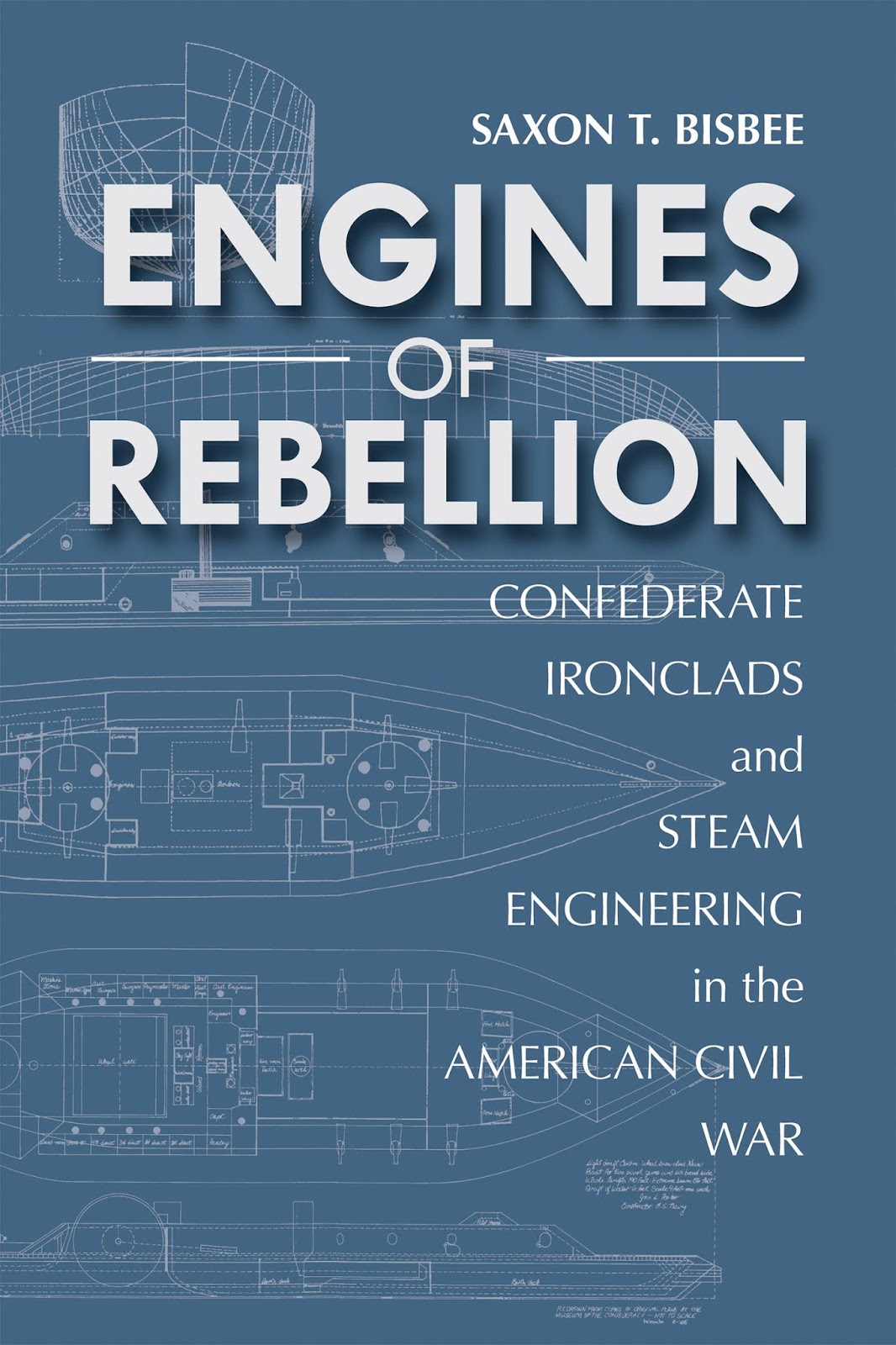
Booknotes: Engines of Rebellion

New Arrival:
• Engines of Rebellion: Confederate Ironclads and Steam Engineering in the American Civil War by Saxon T. Bisbee. (Univ of Ala Press, 2018).

It seems like a long time since an interesting technology-related Civil War book arrived on the doorstep, and this one appears to be something right up my alley. Civil War ironclad designs intended for operations along the country's rivers and sounds were frequently criticized, then and now, for being underpowered, with Confederate ones particularly tagged with having inadequate and/or poor quality engines. According to Engines of Rebellion: Confederate Ironclads and Steam Engineering in the American Civil War, "(h)istorians have given little attention to the engineering of Confederate ironclads, although the Confederacy was often quite creative in building and obtaining marine power plants."

More from the description: "Beginning with a contextual naval history of the Civil War, the creation of the ironclad program, and the advent of various technologies, Saxon T. Bisbee analyzes the armored warships built by the Confederate States of America that represented a style adapted to scarce industrial resources and facilities. This unique historical and archaeological investigation consolidates and expands on the scattered existing information about Confederate ironclad steam engines, boilers, and propulsion systems." Bisbee's book also offers readers "a detailed look at marine steam-engineering practices in both northern and southern industry prior to and during the Civil War."

Twenty-seven ships are examined in the study, with chapters organized around the various Confederate ironclad classes and conversions along with a final section looking at unfinished vessels. For each ship, Bisbee assesses the steam plant "by source, type, and performance, among other factors. The wartime role of each vessel is discussed, as well as the stories of the people and establishments that contributed to its completion and operation. Rare engineering diagrams never before published or gathered in one place are included here as a complement to the text." The book looks like something serious Civil War naval students will definitely want to check out. I will certainly review it on the site.

Wednesday, July 25, 2018

Review - "The Decision Was Always My Own: Ulysses S. Grant and the Vicksburg Campaign" by Timothy B. Smith

[The Decision Was Always My Own: Ulysses S. Grant and the Vicksburg Campaign by Timothy B. Smith (Southern Illinois University Press, 2018). Cloth, 7 maps, photos, notes, biblio essay, index. Pages main/total:225/266. ISBN:978-0-8093-3666-1. $34.50]

Though book-length coverage of many battles associated with the Union effort to capture Vicksburg between December 1862 and July 1863 remains spotty, the campaign as a whole has been well documented in Ed Bearss's classic trilogy and fine single-volume works from Warren Grabau and Michael Ballard. Other books have examined various aspects of land and naval operations during both the mobile and siege phases of the campaign. Timothy Smith's new study The Decision Was Always My Own: Ulysses S. Grant and the Vicksburg Campaign is most akin in scope and narrative style to Ballard's Vicksburg: The Campaign That Opened the Mississippi (2004), but his own full campaign treatment is constructed entirely from the Union perspective and, as the title suggests, focuses most closely on the operational and tactical decision-making of Army of the Tennessee commander U.S. Grant. It is the third volume in SIU Press's new World of Ulysses S. Grant series, for which Smith also serves as co-editor with John F. Marszalek.

In the most basic sense, Smith's book is a conventional retelling of Vicksburg Campaign events from Grant's initial drive down the Mississippi Central Railroad at the end of 1862 through the Second Battle of Jackson in July 1863. While the book overall maintains a popular-style narrative flow, its eight chapters revolve around what the author sees as key command decisions. These begin with department commander Grant's late-1862 resolution to launch a serious advance on Vicksburg in the first place and his subsequent determination to lead this campaign in person. The following two chapters discuss Grant's struggle to come to grips with Vicksburg's stubborn, well-placed defenders. After a series of "experiments" conducted both across the river from and above Vicksburg failed to achieve the desired result, the decision was ultimately made to risk all and cross the entire Union army to the east side of the Mississippi below the fortress. The next phase of the campaign, examining how Grant resolved to strike inland, root out the Confederate army, and capture the Hill City itself, is then discussed. The resulting string of victories at Port Gibson, Raymond, Jackson, Champion Hill, and Big Black Bridge would take the Union army all the way to the gates of Vicksburg. Decisions and controversies surrounding the two major attempts to take the city by storm on July 19 and 22, as well as Grant's ultimate determination that the fortifications could only be taken by siege approaches, are then assessed. The volume ends with the July surrender negotiations (including the Union commander's conflicted views on how best to handle the campaign's vast prisoner haul), and Grant's final removal of all other enemy threats in central Mississippi.

The above decision points are ones Vicksburg Campaign students will readily recognize, and experienced readers won't find any large surprises or contrarian viewpoints in the analysis. The book's format isn't conducive to the kind of expansive decision analysis that UT Press's new Command Decisions in America's Civil War series applies so well, but Smith's structuring of his evaluation of Grant's options and decision-making within the bounds of a free-flowing narrative framework is effectively done. The study is not one based on intensive archival research or the discovery of new sources. The notes indicate heavy reliance on the O.R., the Grant and Sherman memoirs, and a focused selection of other published works, so the value is in the execution of the synthesis. The narrative itself follows a comfortable and familiar path, but it is exceptionally well constructed and it's doubtful one can find elsewhere a better 200-page overview of the entire campaign from the Union perspective.

A common thread throughout most of the book is an examination of Grant's troubled relationship with his ranking subordinate, General John C. McClernand. With his own relentlessly negative portrayal of the politician-general's personal character and military performance, Smith seems to be channeling Grant's ghost throughout the study. While McClernand has always come across in the Civil War literature as an unlikable and insubordinate schemer who didn't always attend to his military duties with the requisite amount of attention, it's undeniable that bad faith handling of his command parameters by the administration and war department greatly contributed to his testy disposition. One could also make the argument that McClernand's war record was comparable to Sherman's own through the opening of the campaign, so the constant complaints from his critics within the army (primarily coming down from Grant and Sherman, and reaffirmed by the author) regarding his incompetence and danger to the safety of the operation seem largely overblown. McClernand was clearly his own worst enemy, but, even so, Smith's concessions to McClernand's positive contributions are only faintly distributed.

Smith integrates other themes into his military account. In addition to lauding Grant's administrative skills, the author also shows high appreciation for Grant's interpersonal skills and subtle political acumen in maintaining positive relationships (at least outside of his infamous order expelling Jews from the department and his early attempts to bar escaped slaves from entering his lines contrary to policy) with the U.S. Navy, military superiors, and the civilian leadership. The book also relates many anecdotes aimed at illustrating the general's more humane instincts. Grant dedication to wife and family is well known, and Smith also incorporates Julia Grant's visits into the book along with young son Jesse's many adventures with the army.

The Decision Was Always My Own is a finely constructed confirmatory reassessment of U.S. Grant's already widely-celebrated direction of the Vicksburg Campaign. Maintaining the initiative throughout the process, Grant's chain of decisions together comprise what some historians consider the finest operational performance of the war by any army commander on either side and informed evaluation of them is one of the book's major strengths. Recommended.

Tuesday, July 24, 2018

Booknotes: Penitentiaries, Punishment, and Military Prisons

New Arrival:
• Penitentiaries, Punishment, and Military Prisons: Familiar Responses to an Extraordinary Crisis during the American Civil War by Angela M. Zombek.
(Kent St Univ Press, 2018).

Penitentiaries, Punishment, and Military Prisons "confronts the enduring claim that Civil War military prisons represented an apocalyptic and a historical rupture in America’s otherwise linear and progressive carceral history." I don't think I've ever seen it put quite that way before, but then again I'm not exhaustively read when it comes to the Civil War prison literature. 

"Instead, it places the war years in the broader context of imprisonment in 19th-century America and contends that officers in charge of military prisons drew on administrative and punitive practices that existed in antebellum and wartime civilian penitentiaries to manage the war’s crisis of imprisonment. Union and Confederate officials outlined rules for military prisons, instituted punishments, implemented prison labor, and organized prisoners of war, both civilian and military, in much the same way as peacetime penitentiary officials had done, leading journalists to refer to many military prisons as “penitentiaries.”"

More from the description: "Since imprisonment became directly associated with criminality in the antebellum period, military prison inmates internalized this same criminal stigma." John Hunt Morgan and his officers, captured during their most overambitious raid, certainly objected to being locked up in the Ohio penitentiary instead of a POW camp. "The penitentiary program also influenced the mindset of military prison officials who hoped that the experience of imprisonment would reform enemies into loyal citizens, just as the penitentiary program was supposed to reform criminals into productive citizens."

Original in conception, Zombek's study encompasses both Union and Confederate prison facilities located east and west. The book "examines the military prisons at Camp Chase, Johnson’s Island, the Old Capitol Prison, Castle Thunder, Salisbury, and Andersonville whose prisoners and administrators were profoundly impacted by their respective penitentiaries in Ohio; Washington, D.C.; Virginia; North Carolina; and Georgia." The author also provides background history of the antebellum development of the country's prison systems, which leads to discussion regarding "how military and civil punishments continuously influenced each other throughout the Civil War era."