New Arrival:
• The Most Hated Man in Kentucky: The Lost Cause and the Legacy of Union General Stephen Burbridge by Brad Asher (UP of Ky, 2021).
From the description: "For the last third of the nineteenth century, Union General Stephen Gano Burbridge enjoyed the unenviable distinction of being the most hated man in Kentucky. From mid-1864, just months into his reign as the military commander of the state, until his death in December 1894, the mere mention of his name triggered a firestorm of curses from editorialists and politicians."
Burbridge was not the only Union general to be accused during and after the war of installing an arbitrary military rule over the home front that encompassed widespread abuse of the civilian population (including the loyal Kentucky majority under his charge). Readers might recall the recent publication of General E.A. Paine in Western Kentucky: Assessing the "Reign of Terror" of the Summer of 1864 (2018). In similar vein, Brad Asher's The Most Hated Man in Kentucky: The Lost Cause and the Legacy of Union General Stephen Burbridge reassesses the contentious historical reputation of its subject.
More from the description: "In this revealing biography, Brad Asher explores how Burbridge earned his infamous reputation and adds an important new layer to the ongoing reexamination of Kentucky during and after the Civil War. Asher illuminates how Burbridge―as both a Kentuckian and the local architect of the destruction of slavery―became the scapegoat for white Kentuckians, including many in the Unionist political elite, who were unshakably opposed to emancipation." In addition to "recalibrating history's understanding of Burbridge," The Most Hated Man in Kentucky "adds administrative and military context to the state's reaction to emancipation and sheds new light on its postwar pro-Confederacy shift."
Friday, July 16, 2021
Wednesday, July 14, 2021
Review - "Six Days of Awful Fighting: Cavalry Operations on the Road to Cold Harbor" by Eric Wittenberg
[Six Days of Awful Fighting: Cavalry Operations on the Road to Cold Harbor by Eric J. Wittenberg (Fox Run Publishing, 2021). Hardcover, 25 maps, photos, footnotes, OB appendix series, bibliography, index. Pages main/total:vi,270/331. ISBN:978-1-945602-16-0. $36.95]
After nearly a month of continuous fighting in Virginia that resulted in appalling casualties on both sides, the Confederate Army of Northern Virginia and Union Army of the Potomac found themselves by late May 1864 in yet another close embrace, this time along the North Anna River where another major battle was only narrowly avoided. Up to that time, the Cavalry Corps of the Army of the Potomac under its new commanding general Philip Sheridan had performed unevenly, with a rather inauspicious Wilderness debut and a long raid toward Richmond that was successful only in mortally wounding JEB Stuart at Yellow Tavern on May 11. After Sheridan resumed his place alongside the rest of the army, his job was to clear the way for yet another complicated passage of the Army of the Potomac around Lee's right. This new turning movement would involve a jump across the Pamunkey River, a potentially risky endeavor that would embroil the mounted forces of both sides in a week-long series of skirmishes and battles. That drawn-out episode of heated action fought during the 1864 Overland Campaign is the subject of prolific author and eastern theater cavalry expert Eric Wittenberg's latest study Six Days of Awful Fighting: Cavalry Operations on the Road to Cold Harbor. In the book Wittenberg discusses vividly and in great detail the series of cavalry actions fought amid the late-May repositioning of the main armies in Virginia, first to Totopotomoy Creek then to new opposing lines around Cold Harbor. The first action, a Union victory at Hanovertown on May 27, effectively cleared the way for the Army of the Potomac's Pamunkey River crossing. Seeking to block further progress of the enemy until his own infantry could get into an advantageous position, Lee sent his cavalry toward the front, and a large battle with Sheridan's men developed at Haw's Shop on May 28. Fought mostly dismounted and in rough terrain, it is the action recounted at greatest length in the book. At Haw's Shop, Wade Hampton (the heir apparent to Stuart) was soundly defeated but nevertheless succeeded in keeping Sheridan's otherwise victorious forces from locating the main body of Lee's army. As addressed in the book, Haw's Shop revealed several themes that developed over the week. The first revolves around Hampton's inexperience in meeting the demands of corps-level leadership. He would prove himself a superb addition to the ANV high command later on, but his decision-making during the battle directly led to unnecessary losses and the near rout of his forces. On the other side, Sheridan, though the victor, is criticized for unimaginative tactics and for not following up on his triumph. A more general Union misuse of cavalry during the Overland Campaign is another major theme explored in the book. According to Wittenberg's analysis, the eastern Union army's high command triumvirate of Grant, Meade, and Sheridan were all guilty of that offense, though for different reasons. Meade wanted to use his mounted forces to closely guard his army's rear, its trains, and its flanks, while Grant and Sheridan favored concentrating the corps for large-scale movements behind enemy lines. All neglected what Wittenberg persuasively maintains to have been of primary importance, the gathering of intelligence as to the exact whereabouts of the enemy and the screening of the main army's advance. Because of this signal failure, the author maintains that Union forces were very fortunate that disaster did not ensue at some point. Wittenberg is also critical of Confederate handling of their own mounted forces, specifically Lee's organizational decision to delay the appointment of a successor to Stuart. In the immediate wake of Stuart's demise, Lee relied on all three division commanders to cooperate with each other and report directly to him for instructions. Leaving the cavalry corps without the strong head needed should any dangerously fluid situation arise, this command structure could have had profoundly negative results, but the author credits Hampton and the two Lees (Fitzhugh and Rooney) for handling the awkward situation as well as could be expected. On the 29th, instead of using their cavalry to quickly probe ahead to locate Lee's army, Grant and Meade advanced three infantry divisions. That ponderous means of intelligence gathering is justly criticized by the author. The cavalry did remain active, though. With both sides recognizing the need to address their open eastern flank and seeing the value of holding the crossroads at Old Cold Harbor, a sharp fight developed on May 30 at Matadequin Creek that pitted Alfred Torbert's Union division against Matthew Butler's large but inexperienced brigade of South Carolinians. It was yet another Union victory, but, according to the author, it also proved to skeptical ANV veterans the fighting abilities of Butler and his untried men. Also covered in the book is Union cavalry division commander James Wilson's raid against the South Anna railroad bridges, an operation that started out well with Wilson beating Rooney Lee at Hanover Court House on May 31. To the east on that same day, Torbert drove two brigades of Confederate cavalry and Thomas Clingman's brigade of Robert Hoke's infantry division out of Cold Harbor and repurposed the enemy earthworks there for his own use. On the next day, Confederate reinforcements converged on Ashland to drive Wilson off and nearly destroy one of his brigades, but not before the twin South Anna bridges were successfully burned. With the bridges rapidly repaired, however, Wilson's operation did not have any long-term effect. Finally, the book ends with the return of Confederate forces to Cold Harbor, where a disorganized infantry attack was easily repulsed by the entrenched Union cavalry. This action set up the terrible events that would unfold over the next few days. One might have expected that by mid-1864 the cavalry corps of the Army of the Potomac would have been led by grizzled veteran commanders of long-standing mounted service, but that was not the case. Wittenberg interestingly points out the irony that Union success over the week-long period covered in his book was primarily accomplished by generals of little field experience leading cavalry (Wilson) or those with infantry backgrounds (Sheridan and Torbert). Only division commander David M. Gregg was a cavalryman through and through, and he was oddly marginalized by Sheridan. Further, Wittenberg astutely observes that this command arrangement had few negative effects overall, as the cavalry mostly fought dismounted in infantry-style engagements supported by their prodigious firepower advantages in breechloading arms and elite horse artillery. The Union army's Cavalry Corps also possessed an excellent assemblage of veteran brigade commanders. On the other side, the Confederate cavalry had to suffer a bit through Hampton's acclimation to his expanded responsibilities while also laboring under systemic disadvantages stemming from inferior cavalry arms technology and the campaign's sustained operations exposing the lack of a central remount system. Nevertheless, as the author explains, the series of Union victories achieved over the six days covered in the book did not augur a complete mastery over the foe, as Hampton dealt Sheridan a sharp defeat only weeks later at Trevilian Station. Tantalizingly, at least one Union participant quoted in the text claimed that the Confederate cavalry did not fight as hard as they did before Yellow Tavern. This perception from an enemy observer that widespread demoralization existed among the Confederate cavalry corps's rank and file after Stuart's death is not directly addressed by the author at any length, but judging from the content and tenor of the book's narrative as a whole it would not appear that Wittenberg holds much stock in that view. There is nothing to complain about when it comes to the technical side of the book as well as its overall presentation. Clear and insightful operational and tactical narrative, deep research, and abundant maps are characteristics of all of Wittenberg's military history studies, and we certainly encounter those qualities yet again here with Six Days of Awful Fighting's excellent battlefield accounts, primary source-filled bibliography, and 25 maps. Orders of battle for each major engagement [Hanovertown Ferry (May 27), Haw's Shop (May 28), Old Church/Matadequin Creek (May 30), Hanover Court House (May 31), Cold Harbor (May 31), Ashland (June 1), and Cold Harbor again (June 1)] are also helpfully included in the appendix section. In unprecedented fashion, the book reveals a number of cavalry (as well as army high command) leadership flaws and strengths that emerged on both sides during the 1864 Overland Campaign while also presenting mounted operations fought during a major phase of that campaign in fresh ways that greatly promote higher understanding of decisions and events leading up to the early June climax of the Battle of Cold Harbor. Highly recommended.
Monday, July 12, 2021
Booknotes: The Siege of Vicksburg
New Arrival:
• The Siege of Vicksburg: Climax of the Campaign to Open the Mississippi River, May 23-July 4, 1863 by Timothy B. Smith (UP of Kansas, 2021). After decades of neglect, book-length studies of various stages of the long 1862-63 Vicksburg Campaign are finally arriving to fill in the gaps and augment classic works such as the Bearss trilogy. Soon after the release of two books that covered in great depth the May 19 and May 22 assaults (one each from the prolific pair of military historians Timothy Smith and Earl Hess) is Smith's The Siege of Vicksburg: Climax of the Campaign to Open the Mississippi River, May 23-July 4, 1863. A direct follow up to his previous book, Smith's new volume represents the first comprehensive, standalone narrative history of the siege, and a big one it is at nearly 550 pages of main text. Siege tactics and operations along with other aspects of the static phase of campaign have been discussed in other books, but Smith brings it all together in a single, cohesive account supported by 19 original maps. The book "offers a new perspective and thus a fuller understanding of the larger Vicksburg Campaign. Smith takes full advantage of all the resources, both Union and Confederate—from official reports to soldiers’ diaries and letters to newspaper accounts—to offer in vivid detail a compelling narrative of the operations. The siege was unlike anything Grant’s Army of the Tennessee had attempted to this point and Smith helps the reader understand the complexity of the strategy and tactics, the brilliance of the engineers’ work, the grueling nature of the day-by-day participation, and the effect on all involved, from townspeople to the soldiers manning the fortifications." More from the description: Smith's "detailed command-level analysis extends from army to corps, brigades, and regiments and offers fresh insights on where each side held an advantage. One key advantage was that the Federals had vast confidence in their commander while the Confederates showed no such assurance, whether it was Pemberton inside Vicksburg or Johnston outside." The ground-level perspectives of both sides are also detailed, as Smith "offers an equally appealing and richly drawn look at the combat experiences of the soldiers in the trenches." Smith "also tackles the many controversies surrounding the siege, including detailed accounts and analyses of Johnston’s efforts to lift the siege, and answers the questions of why Vicksburg fell and what were the ultimate consequences of Grant’s victory." Among those topics, Smith's coverage of the activities of Joe Johnston's Army of Relief as well as his overall interpretation of the general's conduct during the campaign will be of particular interest to me.
Thursday, July 8, 2021
Booknotes: Military Prisons of the Civil War
New Arrival:
• Military Prisons of the Civil War: A Comparative Study by David L. Keller (Westholme, 2021). That the American Civil War military prisoner population was the largest in history up to its time is not something that I had previously considered. It might be true, though one can imagine that the Napoleonic Wars, the many participants of which also detained surrendered combatants in large numbers for extended periods of time, could have exceeded even the ACW's massive figure as that earlier continental conflict was fought over a much longer period of time and witnessed a great many mass capitulations. Anyway, getting back to the matter at hand, that is the claim made in David Keller's new book Military Prisons of the Civil War: A Comparative Study, which offers "a fresh analysis of the first large-scale imprisonment of soldiers in wartime and its failures." From the description: "Over the course of the American Civil War, more than four hundred thousand prisoners were taken by the North and South combined—the largest number in any conflict up to that time, and nearly fifty-eight thousand of these men died while incarcerated or soon after being released. Neither side expected to take so many prisoners in the wake of battles and neither had any experience on how to deal with such large numbers." Of course, dealing with such a burden had a learning curve that already overtaxed Union and Confederate governments and militaries had to very swiftly address, and accusations of abuse and incompetence abounded on both sides. "Prison camps were quickly established, and as the war progressed, reports of sickness, starvation, mistreatment by guards, and other horrors circulated in the press. After the war, recriminations were leveled on both sides, and much of the immediate ill-will between the North and South dealt with prisoners and their treatment." Using "official records, newspaper reports, first-person accounts from prisoners, and other primary source material," Keller seeks to "understand why imprisonment during the Civil War failed on both sides. His research identifies five factors shared among both Union and Confederate prisons that led to so many deaths, including the lack of a strategic plan on either side for handling prisoners, inadequate plans for holding prisoners for long periods of time, and poor selection and training of camp command and guards."
Tuesday, July 6, 2021
Review - "The Civil War Memoir of a Boy from Baltimore: The Remembrance of George C. Maguire, Written in 1893" by Holly Powers, ed.
[The Civil War Memoir of a Boy from Baltimore: The Remembrance of George C. Maguire, Written in 1893 edited by Holly I. Powers (University of Tennessee Press, 2021). Hardcover, photos, drawings, notes, bibliography, index. Pages:xxvi,133. ISBN:978-1-62190-335-2. $45]
A great multitude of underage soldiers served in the fighting ranks of Civil War armies of both sides (some estimates maintain that one-fifth of all Union soldiers were under the prescribed age of eighteen at enlistment). Impressed by the promise of grand adventure or any of a number of additional motivating factors, other boys too young to shoulder a rifle accompanied regiments as drummer boys or unit "mascots" looked after by the older officers and men. Mascots that demonstrated maturity beyond their years could even be assigned a certain degree of real responsibility in either official or unofficial roles. This was the case with Baltimore's George C. Maguire. Though his own deeds attained far less fame than those of some other Union child soldiers such as John Clem (a.k.a. "Johnny Shiloh"), Orion P. Howe, or Manny Root, young Maguire nevertheless contributed to the war in ways no less worthy of recognition. With the publication of The Civil War Memoir of a Boy from Baltimore: The Remembrance of George C. Maguire, Written in 1893, the newest volume in University of Tennessee Press's Voices of the Civil War series, a great many Civil War readers can now be fully exposed to Maguire's wartime activities through the efforts of editor Holly Powers.
In his memoir Maguire claimed to be "around 12" years of age when Fort Sumter was fired upon, but Powers's examination of census records indicates that he would have been closer to 14. The memoir's earliest wartime remembrances include observations of the violent 1861 rioting in Maguire's native Baltimore, made perhaps most interesting to today's readers for the writer's unconventional determination that the infamous assaults on passing Union soldiers were primarily motivated by false assumptions about the war and over two-thirds of the perpetrators would eventually see the error of their ways and enthusiastically join the Union Army. How Maguire arrived at such a number is unknown, but perhaps, as he came from a solidly pro-Union family, he wanted to present his fellow Baltimoreans in a more favorable (i.e. more loyal) light.
Maguire was allowed/invited to join his brother-in-law Lt. Salome Marsh (whom he lived with before the war) and two brothers in the Fifth Maryland, a volunteer infantry regiment that received its training at nearby Camp LaFayette and first field assignment at Fort Monroe in Virginia. The regiment did not participate in any of the Peninsula and Seven Days battles, and Maguire relates mostly boyish adventures on the Hampton Roads stretch of the Virginia Peninsula. However, during the 1862 Maryland Campaign Maguire would in more earnest begin his transformation from army tourist to active participant. He came under fire at Antietam (the Fifth was involved in the Second Corps attack on the Bloody Lane) and assisted the regimental surgeon in caring for the wounded. Traumatized by the experience, he returned home to Baltimore and reentered school. However, Maguire quickly became bored with the routine of home and school life, and rejoined the regiment at the end of 1862.
At the time of Maguire's return the Fifth was part of the Harpers Ferry garrison, and Lt. Marsh was provost marshal. Marsh employed the educated Maguire as an office clerk with document-issuing powers, and Maguire's memoir offers an eventful picture of Potomac River smuggling operations and the inner workings of the pass system for civilians traveling both directions through Harpers Ferry. This job would be his final one at the front. In June 1863, Maguire left the regiment altogether and returned home. There would be one final attempt to rejoin the war, though. Tempted by the considerable allure of the high fees being paid to late-war substitutes, Maguire tried to engage a broker in the city but was rejected.
In 1865, Maguire obtained employment at Maryland's new Thomas Hicks United States General Hospital. Impressed by his wartime experience (slim as it was) and his education, staff assigned Maguire a posting as Ward Master, and he was even given Medical Cadet status by the supervising physician as a way to allow Maguire to assume expanded duties related to direct patient care. Though this part of the memoir is relatively brief, it contains a number of empathetic patient stories as well as useful information regarding the layout and operation of the hospital. A number of Maguire's sketches are reproduced in the book, and the ones related to the hospital are the most revealing.
The memoir itself is a quick read, running sixty pages in the book. As part of her editorial duties, Powers contributes a scholarly introduction, a chapter-length conclusion, and extensive endnotes to the volume. Quite expansive discussions of persons, objects, places, and events are contained in her notes, and the editor frequently found in her research documented confirmation of Maguire's experiences and observations. Over the past few decades, the Civil War scholarship has examined in far more depth than ever before the many ways in which children engaged with the Civil War and were affected by it (most readers will be at least familiar with James Marten's work, but there are many others), and The Civil War Memoir of a Boy from Baltimore is another strong resource and contribution to that subfield.
Sunday, July 4, 2021
Happy 4th of July!
I hope everyone has an enjoyable Fourth, and, since everything comes down to books on this site, what better way is there to celebrate our nation's independence and also recognize one of the Civil War's pivotal events that occurred on that very month and day in 1863 than by cracking open Timothy Smith's The Siege of Vicksburg: Climax of the Campaign to Open the Mississippi River, May 23-July 4, 1863, which has just received a timely release by publisher University Press of Kansas. I have not received my copy of this colossal new history of the Vicksburg siege and surrender yet but am looking forward to reading it this month.
Friday, July 2, 2021
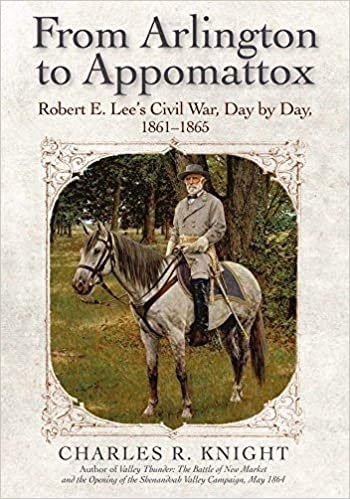
Booknotes: From Arlington to Appomattox
New Arrival:
• From Arlington to Appomattox: Robert E. Lee’s Civil War, Day by Day, 1861-1865 by Charles R. Knight (Savas Beatie, 2021). Though not part of their regular publishing lineup, Savas Beatie does occasionally produce reference books alongside their more typical output of campaign/battle histories, military biographies, and more. Their newest title in that category is From Arlington to Appomattox: Robert E. Lee’s Civil War, Day by Day, 1861-1865. In it "author Charles Knight does for Lee and students of the war what E.B. Long’s Civil War Day by Day did for our ability to understand the conflict as a whole." From the description: "Lost in all of the military histories of the war, and even in most of the Lee biographies, is what the general was doing when he was out of history’s “public” eye. We know Lee rode out to meet the survivors of Pickett’s Charge and accept blame for the defeat, that he tried to lead the Texas Brigade in a counterattack to save the day at the Wilderness, and took a tearful ride from Wilmer McLean’s house at Appomattox. But what of the other days? Where was Lee and what was he doing when the spotlight of history failed to illuminate him?" One can imagine that a resource such as this one will save authors and researchers studying the Army of Northern Virginia, eastern theater campaigns, and Lee himself a lot of time in pinning down activities, dates, and places. On a more general level, an information compilation like this one should also contribute to our knowledge and appreciation of the range of daily burdens and responsibilities assumed by anyone tasked with leading a major Civil War army. "Readers will come away with a fresh sense of his struggles, both personal and professional, and discover many things about Lee for the first time using his own correspondence and papers from his family, his staff, his lieutenants, and the men of his army." Source information and extensive editorial text are conveniently placed in the footnotes, and the author also took the effort to create an index of names, events, places, units, and more with expansive subheadings to go along with the page numbers.
Wednesday, June 30, 2021
Review - "The Complete Pickett's Mill Battlefield Trail Guide" by Brad Butkovich
[The Complete Pickett's Mill Battlefield Trail Guide by Brad Butkovich (Historic Imagination, 2021). 8.5"x11" softcover, color maps, color photos, orders of battle. 76 pp. ISBN:9781732597631. $21.95]
The stretch of large-scale 1864 Atlanta Campaign maneuvers conducted north of the Chattahoochee River consisted of a great deal of flanking and retreating, with General William T. Sherman's massive army group obliging the enemy's desire to be attacked behind its field fortifications on only a few occasions. One of those bloody noses delivered by General Joseph E. Johnston's Army of Tennessee occurred at Pickett's Mill on May 27. The Confederate defensive victory achieved by General Patrick Cleburne's reinforced division over elements of three Union corps, all placed under the overall command of General O.O. Howard, is perhaps best described in the pages of Brad Butkovich's 2013 volume The Battle of Pickett's Mill: Along the Dead Line. Unlike so many other Atlanta Campaign events overtaken by modern development, Pickett's Mill has been the beneficiary of strong preservation initiatives, the result of which is today's 765-acre Pickett's Mill Battlefield State Historic Site. Though a pristine green space crisscrossed with miles of walking trails, site interpretation is minimal. Bridging that gap between armchair historical reading and useful guided battlefield exploration is Butkovich's The Complete Pickett's Mill Battlefield Trail Guide. A brief but excellent introductory history of the battle is provided over the first twelve pages of the book, with the narrative overview of the fighting closely supported by seven highly detailed battle maps tied closely to events described in the text. The maps contain all of the information necessary to understand troop positions and movements along with the battlefield terrain (then and now). The historical map information provided is very easily correlated with features and stops indicated on today's park trail map. Generally speaking, Butkovich's guide follows the park's established network of connected trail loops, which are four in number and labeled blue, red, white, and orange. Butkovich incorporates the numbered official trail stations from those loops into the guide and generously supplements them with his own "Extra" stations that represent other "areas where historically significant or interesting events occurred" (pg. 14). For the most part, the loops cover different phases of the battle (and the red loop mostly "focuses on fighting that occurred in the park for the week after the May 27th battle") so there isn't an excessive amount of overlap present in the guide. For those with the most limited time available, the author recommends the blue loop. Each trail station is given its own page in the guide, with orientation summary (including GPS coordinates) at the top, a photograph in the middle, and text at the bottom. The attached text, in most cases filling around half of each 8.5 in. by 11 in. page, further establishes view orientation and incorporates firsthand accounts from the author's research into a vivid description of the action that occurred there. A modern color photograph of the viewshed is also included for every station. Unlike the author's previous photographic study of Antietam, where he carefully matched modern images with historical event timing estimates, for Pickett's Mill many off-season autumn photographs are included to provide views of the ground unobstructed by spring and summer's dense leaf growth. Even so, most photographs consist of forested views with relatively narrow framing, so they are primarily useful for in-person sight line orientation rather than providing armchair readers with panoramic images of the modern battlefield. An order of battle completes the volume. Anyone planning a serious visit to the park should have a copy of this highly functional guide in hand. Recommended.
Monday, June 28, 2021
Booknotes: The Boy Generals
New Arrival:
• The Boy Generals: George Custer, Wesley Merritt, and the Cavalry of the Army of the Potomac by Adolfo Ovies (Savas Beatie, 2021). Back in 2004, Adolfo Ovies self-published Crossed Sabers: General George Armstrong Custer and the Shenandoah Valley Campaign. Comparing a review of it (see the link above) to the blurbs attached to his new book The Boy Generals: George Custer, Wesley Merritt, and the Cavalry of the Army of the Potomac, it sounds like the author has been more than willing to address the shortcomings displayed in his first attempt at a serious foray into the topic of G.A.C.'s Civil War career. Part of an ambitious new project, The Boy Generals is "the first installment in a remarkable trilogy to examine the strategy, tactics, and relationships of the leading Union army’s mounted arm and their influence on the course of the Civil War in the Eastern Theater." Every year sees the release of multiple Custer books, but Ovies claims that this book adopts an uncommon approach. According to the author, "most Custer-related studies focus on his decision-making and actions to the exclusion of other important factors, including his relationships with his fellow officers. Custer developed his tactical philosophy within the politically ridden atmosphere of the Army of the Potomac’s Cavalry Corps. His relationship with his immediate superior, Wesley Merritt, was so acrimonious that even Custer’s wife Libbie described him as her husband’s “enemy.”" Eric Wittenberg's recent book Six Days of Awful Fighting (which I will review here sometime soon) contrasts Custer's more old school saber-charging fighting style with the firepower-focused dismounted tactics favored by the other cavalry generals in the Army of the Potomac in 1864. Apparently, that opposing philosophical stance was firmly embodied in the relationship/rivalry between Custer and division commander Wesley Merritt. More from the description: "With these diametrically opposed belief systems, it was inevitable that these officers would clash. What has often been described as a spirited rivalry was in fact something much darker, an association that moved from initial distaste to acrimony, and finally, outright insubordination on Custer’s part." In devoting an entire book to this topic, Ovies "exposes the depths of one of the most dysfunctional and influential relationships in the Army of the Potomac and how it affected cavalry operations in the Eastern Theater," and it is suggested that a reading of his study "will change the way Civil War readers think of the premier Union army’s mounted arm, as well as George Custer’s legacy."
Saturday, June 26, 2021
Coming Soon (July '21 Edition)
**NEW RELEASES1** Scheduled for JULY 2021:
• Strategies of North and South: A Comparative Analysis of the Union and Confederate Campaigns by Gerald Earley.
• The Union Blockade in the American Civil War: A Reassessment by Bonner & McCord.
• The Western Press in the Crucible of the American Civil War edited by Cronin & Tuyll.
• Marching for Union: A Civil War Soldier's Walk across the Reconstruction South by Randy Bishop.
• Buying and Selling Civil War Memory in Gilded Age America edited by Marten & Janney.
• Armistead and Hancock: Behind the Gettysburg Legend of Two Friends at the Turning Point of the Civil War by Tom McMillan.
• The Long Civil War: New Explorations of America's Enduring Conflict edited by Smith & Arsenault.
• Passing Through the Fire: Joshua Lawrence Chamberlain in the Civil War by Brian Swartz.
• The Most Hated Man in Kentucky: The Lost Cause and the Legacy of Union General Stephen Burbridge by Brad Asher.
• The Summer of ’63: Vicksburg and Tullahoma: Favorite Stories and Fresh Perspectives from the Historians at Emerging Civil War edited by Mackowski & Welch.
• Lincoln Comes to Gettysburg: The Creation of the Soldiers’ National Cemetery and Lincoln’s Gettysburg Address by Gottfried & Gottfried.
Comments: It looks like the Asher book is out already. As was the case in June, the release schedule is heavily weighted toward the second half of the month.
1 - These monthly release lists are not meant to be exhaustive compilations of non-fiction releases. They do not include non-revised/expanded reprints of previously published books and digital-only titles. Works that only tangentially address the war years are also generally excluded. Inevitably, one or more titles on this list will get a rescheduled release (and they do not get repeated later), so revisiting the past few "Coming Soon" posts is the best way to pick up stragglers.
Thursday, June 24, 2021
Review - "Meade and Lee at Rappahannock Station: The Army of the Potomac’s First Post-Gettysburg Offensive, From Kelly’s Ford to the Rapidan, October 21 to November 20, 1863" by Jeffrey Hunt
[Meade and Lee at Rappahannock Station: The Army of the Potomac’s First Post-Gettysburg Offensive, From Kelly’s Ford to the Rapidan, October 21 to November 20, 1863 by Jeffrey Wm. Hunt (Savas Beatie, 2021). Hardcover, 27 maps, photos, illustrations, appendices, footnotes, bibliography, index. Pages main/total:xiv,273/333. ISBN:978-1-61121-539-7. $32.95]
Regardless of their size, strategic significance, or worthiness of study as exemplars of the operational art, military campaigns that lack a major culminating battle often inspire little attention until coverage saturation naturally redirects research and writing toward a conflict's more obscure events. A good, perhaps even the best, example from the American Civil War is the 1863 Tullahoma Campaign, which did not receive a full-length published history of any kind until just last year1. Another example is the fighting in northern Virginia between the end of the Gettysburg Campaign and the onset of the 1864 Overland Campaign. Beginning in August 1863 and stretching into December, Robert E. Lee's Army of Northern Virginia and George Meade's Army of the Potomac traded offensive blows, none of which were decisive in result (though they produced a series of small-scale infantry and cavalry battles along with numerous skirmishes). While all had the potential for major results, their sputtering nature (albeit with rather significant casualties on the Confederate side) led to little modern interest beyond the release of a pair of book-length overviews published by H.E. Howard in the mid-1980s. Coverage has greatly improved and expanded over the past decade, though, with published output including a full-length Bristoe Campaign history from British author Adrian Tighe, a major atlas study, and a pair of Emerging Civil War series overviews2.
As good as much of that recent work is, the most significant development has been the emergence of historian Jeffrey Hunt's exhaustive treatment of the subject matter spread among multiple volumes. Originally conceived as a trilogy but since expanded to a planned four volumes, Hunt's "Meade and Lee" series offers by far the most complete military history of the period. Preceded by 2017's Meade and Lee After Gettysburg and 2019's Meade and Lee at Bristoe Station3, Hunt's Meade and Lee at Rappahannock Station: The Army of the Potomac’s First Post-Gettysburg Offensive, From Kelly’s Ford to the Rapidan, October 21 to November 20, 1863 examines General Meade's first opportunity to conduct his own major offensive operation (albeit with some constraints and interference from Washington) from start to finish as an army commander in Virginia. Though the sharp repulse of A.P. Hill's corps at Bristoe Station took some of the sting out of Meade being thoroughly outgeneraled and thrown on the defensive by Lee during that October operation, the Lincoln administration remained mostly disappointed with Meade's overall performance that summer into fall and anticipated further action before mud and winter set in. The dilemma lay in finding a way to catch Lee's army, which had fallen back behind the Rappahannock River after the Bristoe Campaign ended in early November and was thoroughly ensconced there, at a disadvantage.
Restricted by the administration to operations along the line of the Orange & Alexandria Railroad, Meade was confronted by significant challenges in planning and executing his next move. A casual glance at a period map of the area's road and rail network might suggest that Culpeper County possessed fine campaigning possibilities; however, a deeper look reveals significant, and at the time thoroughly recognized, problems for both attacker and defender. All of these are shrewdly noted and analyzed at length by Hunt in the book. A Union advance southward along the O&A would angle away from rather than toward the Confederate capital while also exposing the army's ever lengthening lines of supply and communications to interdiction by cavalry raiders and guerrillas, but the bigger problem was not wanting to be caught at a disadvantage within the narrow confines of the sideways-slanted "V" formed by the confluence of the Upper Rappahannock and Rapidan rivers. Because fighting within the dreaded V meant that both attacking and defending forces would have a significant river barrier to their immediate rear, neither Meade nor Lee looked forward to being involved in a major battle there. Nevertheless, at the conclusion of the Bristoe Campaign Lee's army settled into what increasingly seemed like winter quarters behind the Rappahannock while Meade, under pressure to resume operations before seasonal weather shut down the roads, pondered the best way get at his foe.
In the book Hunt presents readers with a clear description and insightful appraisal of the potentially dangerous "trap" laid by Lee and the ways by which Meade, who well recognized the inherent dangers imposed by Lee's crafty dispositions but was forbidden from altering his line of operations, might deal with it. By establishing both a fortified bridgehead north of the river at Rappahannock Station and light covering defenses along the south bank at Kelly's Ford (the two places that Meade needed possession of to support his leap across the Rappahannock), Lee hoped to force Meade to divide the Army of the Potomac in a way that might give the Confederate commander an opening to mass his own army against a portion of the enemy's. Meade, seeing that a Confederate force could use the Rappahannock Station bridgehead to launch a counterattack on his flank and rear if he used Kelly's Ford as his main crossing point, was indeed induced to divide his army, though if Meade could attack quickly and successfully enough at both places he could neutralize the threat and reunite enough of his army on the other side of the river to minimize the chances of being defeated in detail. If the bridgehead could not be taken quickly and a strong force pushed across, Meade's right wing commander (John Sedgwick) was to mask the position and reinforce the Kelly's Ford front. This back up plan would lessen the amount of time the Union army would be divided with equal halves on both sides of the river. What follows that perceptive introductory assessment of Meade's options and problems is the author's narrative detailing the Union advance (two wings of two corps each against Rappahannock Station and Kelly's Ford), the November 7 Union victories at both bridgehead and ford, the hurried Confederate retreat, the cautious federal follow-up movement toward Culpeper Court House, and, finally, the escape of Lee's army across the Rapidan without a major battle. All of the accounts of these events are amply supported by the volume's excellent set of over two dozen strategic, operational, and tactical-scale maps.
The author's thorough knowledge and nuanced appreciation of the military challenges imposed by the area's contested ground is readily apparent throughout the book, and detailed explanation of how terrain influenced operational and tactical decision-making during the campaign is one of the book's chief strengths. A good example can be seen in Lee's defense arrangements for the river line. An armchair general unfamiliar with the ground might expect that all crossings would be closely defended, but the physical features of the ground on both sides of the river dictated otherwise. Due to disadvantageous topography (ex. the higher ground was on the north side of this stretch of the Rappahannock), Lee did not intend to vigorously contest a full-scale assault on the crossings. The bulk of his army was deployed a few miles to the rear, hidden and out of range of the enemy's superior weight of long-range artillery, but ready to take advantage of any opportunities that might be offered.
Leadership performances on both sides during movement and battle come under similarly judicious consideration in the book. In his new role as wing commander, Union general William French efficiently marched his two corps to Kelly's Ford, captured it after a brief fight, and secured the south bank with a small force while the bulk of his troops remained on the north side of the river. Up to that time, French had had little opportunity to distinguish himself in command responsibilities commensurate with his high rank, and Hunt appropriately praises his performance before and during the battle as meeting all expectation. Sedgwick's right wing of the army approached its more strongly held fortified target far more cautiously. Hunt persuasively argues that Sedgwick, seemingly content with developing the enemy bridgehead and bringing it under bombardment, would not have ordered a storming of the enemy works at all on November 7 had one of his more enterprising subordinates, division commander David Russell, not pressed for permission to conduct a dusk assault. Using only a tiny part of Sedgwick's available force, Russell's attack was a splendid success, the victory a function of approaching darkness limiting cross-river artillery fire, enemy disorganization, and high-order tactical competence on the part of the assault units. The availability of only a single escape route also substantially increased the prisoner haul, with Russell's victory reducing two of the Army of Northern Virginia's best brigades to mere skeletons. The lack of defensive improvements such as deep ditches, abatis, and the like also contributed to the Confederate mini-disaster, but the author astutely reminds critics that the bridgehead's usefulness as a jumping off point for offensive movement would have been limited by such obstructions. On the other hand, Hunt might also have conceded that the very small capacity of the fortified bridgehead, its exceedingly shallow depth (the trenches were backed up close to the river along their entire length), and single bridge crossing would have made it suboptimal as a point from which to swiftly launch a major counterstroke. One might argue that the bridgehead, as constructed and manned, was improperly sized for both effective defense and offensive springboard roles. Lee, and to a lesser extent Jubal Early, whose division was tasked with defending that sector, were criticized for not withdrawing the troops in the face of Sedgwick's overwhelming force, but Hunt is more forgiving than some observers. By late in the day, Lee's overall plan was working as designed and Sedgwick's command had demonstrated for hours little inclination to do anything beyond bombarding the Rappahannock Station bridgehead from afar. Hindsight is always 20/20, and in Hunt's view Lee, who rode away from the front very late in the day in full expectation that the status quo would remain, assumed a reasonable risk by maintaining the bridgehead.
With the mini-disaster suffered at Rappahannock Station ending all hope of engaging Meade's army to advantage, Lee ordered a retreat. According to Hunt, Confederate teamsters and quartermasters were the heroes of the hour. With only moments of advance notice, they managed to save a mountain of supplies, ammunition, and personal baggage accumulated for winter. The transport of that amount of material, which could not be evacuated in a single trip, was covered by the withdrawal of the army to a new position near Culpeper Court House. Though the Army of Northern Virginia quickly dug a strong line of entrenchments there, both flanks were in the air and an impetuous Union advance could have caused Lee serious problems. However, Meade was not one for risky throws of the dice, and his methodical concentration and measured advance only covered half the distance to Lee's entrenchments by nightfall on November 8. While listing compelling reasons for Meade's exercising caution (or overcaution), Hunt notes that the Union commander's assignment of the bulk of his cavalry to flank protection rather than screening duties made his forward march even slower and left the general underinformed as to Lee's dispositions. Confederate cavalry also conducted an effective delaying action that contributed another element to Meade's painfully slow pace of advance.
Still out of close contact with the enemy and free to finally withdraw without risking disaster, Lee's army and its supply and baggage trains crossed the Rapidan without incident, leaving both armies roughly where they were back in August. In the early stages of his first major Virginia offensive Meade had acquitted himself well, but, as the author maintains, the general's "deliberate" command style almost immediately surrendered the initiative so effectively seized from the start. Lacking the audacity that might turn local tactical success into glorious victory, Meade in the end accomplished little beyond a chunk of Virginia front and another incremental increase in Army of the Potomac self-confidence. One might imagine that the final volume in the series will contain a full summation of the author's thoughts on Meade's strengths and weaknesses as an army commander. On the other side, none of Lee's hopes of striking a divided enemy army came to fruition and his own command suffered a heavy blow to its order of battle with the near destruction of two veteran infantry brigades. Both combatants in Virginia would not be going into winter quarters just yet, however, and the ensuing Mine Run Campaign will be covered in Hunt's fourth and final installment of this definitive-scale series. With the exceptional quality of its prose, research, depth of description, and informed analysis, Hunt's masterful multi-volume effort is well on its way to becoming a modern classic every bit deserving of rank and praise similar to that bestowed upon Gordon Rhea's Overland Campaign series.
Notes:
1 - See David Powell and Eric Wittenberg's Tullahoma: The Forgotten Campaign that Changed the Course of the Civil War, June 23 - July 4, 1863 (Savas Beatie, 2020).
2 - Both H.E. Howard titles were published in 1987. They are William Henderson's The Road to Bristoe Station: Campaigning with Lee and Meade, August 1 – October 20, 1863 and Mine Run: A Campaign of Lost Opportunities, October 21, 1863 – May 1, 1864 by Martin Graham and George Skoch. The self-published Adrian Tighe title referred to in the review is 2010's The Bristoe Campaign: General Lee's Last Strategic Offensive with the Army of Northern Virginia October 1863. The largest and most significant revival of interest in the Meade vs. Lee campaigning in Virginia during the latter half of 1863 has been led by publisher Savas Beatie. This ongoing effort has produced a number of worthy titles large and small, including Bradley Gottfried's The Maps of the Bristoe Station and Mine Run Campaigns: An Atlas of the Battles and Movements in the Eastern Theater after Gettysburg, Including Rappahannock Station, Kelly's Ford, and Morton's Ford, July 1863 - February 1864 (2013), 2015's A Want of Vigilance: The Bristoe Station Campaign, October 9–19, 1863 by Bill Backus and Robert Orrison [CWBA review], and Chris Mackowski's The Great Battle Never Fought: The Mine Run Campaign, November 26–December 2, 1863 (2018).
3 - Links: Meade and Lee After Gettysburg: The Forgotten Final Stage of the Gettysburg Campaign, from Falling Waters to Culpeper Court House, July 14-31, 1863 (2017) and Meade and Lee at Bristoe Station: The Problems of Command and Strategy after Gettysburg, from Brandy Station to the Buckland Races, August 1 to October 31, 1863 (2019). The established pattern suggests that volume four will be released sometime in 2023.
Tuesday, June 22, 2021
Booknotes: Matchless Organization
New Arrival:
• Matchless Organization: The Confederate Army Medical Department by Guy R. Hasegawa (SIU Press, 2021). "Matchless organization" is not a phrase that frequently comes to mind when considering the merits of any particular element of the Confederate military bureaucracy, but Guy Hasegawa, author of Matchless Organization: The Confederate Army Medical Department, nevertheless maintains that "(d)espite the many obstacles it had to overcome—including a naval blockade, lack of a strong industrial base, and personnel unaccustomed to military life—the Richmond-based Confederate Army Medical Department developed into a robust organization that nimbly adapted to changing circumstances." More from the description: "In the first book to address the topic, Guy R. Hasegawa describes the organization and management of the Confederate army’s medical department. At its head was Surgeon General Samuel Preston Moore, a talented multitasker with the organizational know-how to put in place qualified medical personnel to care for sick and wounded Confederate soldiers." Even amid the extreme exigencies of war, the department managed to fulfill its most immediately pressing tasks while also looking toward the future. In the book, Hasegawa "investigates how political considerations, personalities, and, as the war progressed, the diminishing availability of human and material resources influenced decision-making in the medical department. Amazingly, the surgeon general’s office managed not only to provide care but also to offer educational opportunities to its personnel and collect medical and surgical data for future use, regardless of constant and growing difficulties." Just going from the chapter headings, the book appears be a pretty broad survey of the topic. Among other things, the volume addresses medical department organization, personnel, and leadership matters; both domestic and foreign sources of medical supplies; battlefield, hospital, and prison care; examining boards; and contributions to medical science that outlasted the war.
Friday, June 18, 2021
Various Book News Items
This month's release schedule is pretty heavily backloaded, so hopefully the second half of June will make up for the paltry first half.
1. Larry Peterson's Decisions of the 1862 Kentucky Campaign avoided Perryville battlefield decisions with the intention of possibly addressing them in a future volume. It turns out that that will indeed be the case as Decisions at Perryville: The Twenty-Two Critical Decisions That Defined the Battle has been added to the series schedule as an October '21 release. As far as I know from my most recent contact with the publisher, the Seven Days installment is still on for the end of this month.
2. Publishers staying comfortable with digital-only review copies has had an unfortunate impact on the CWBA bookshelves during the pandemic. Though the numbers they put out overall were drastically reduced in 2020, I still rather missed getting my regular allotment of McFarland titles of all kinds over the past fifteen months. They do have a bunch of intriguing titles on the docket for this year, including Myron Smith's final volume of his inland west naval history series After Vicksburg: The Civil War on Western Waters, 1863-1865 , Andrew English's The Laird Rams: Britain's Ironclads Built for the Confederacy, 1862-1923, Todd Cathey and Ricky Robnett's The River Batteries at Fort Donelson: Construction, Armament and Battles, 1861-1862, and Gerald Earley's Strategies of North and South: A Comparative Analysis of the Union and Confederate Campaigns. I've already talked about Russell Blount's Port Hudson book and what will likely be the final volume of Roger Hunt's Colonels in Blue series. If you are interested in the Windy City's Civil War connections, they are also putting out unit histories of the 39th Illinois infantry regiment and the Chicago Board of Trade Battery. There's more, but those are the strongest blips on my radar.
3. Christopher Grasso is far from being done with John R. Kelso. I positively reviewed his 2017 book Bloody Engagements: John R. Kelso’s Civil War, which was selected as the A.M. Pate Award winner of 2018. As a bit of an aside, Kelso's writings were a prominent source in Piston and Rutherford's new account of the Second Battle of Springfield in their book "We Gave Them Thunder". Losing none of his enthusiasm for the subject, Grasso has now moved on to a full biographical treatment of Kelso's life of colorful and odd twists and turns. Teacher, Preacher, Soldier, Spy: The Civil Wars of John R. Kelso is set for a September '21 release from Oxford UP.
4. As every regular CWBA visitor knows, I'm not the most eager biography reader, but another one from 2021 that has my attention is Allen Ottens's General John A. Rawlins: No Ordinary Man (Indiana Univ Pr). I am not sure how much scholarly disagreement exists regarding the nature of the Grant-Rawlins relationship and the impact Rawlins had on his chief's career (I would guess that most differences lie in how much advisory credit Rawlins deserves), but those matters will surely figure prominently in the book. Look for it in around six weeks.
Wednesday, June 16, 2021
Review - "Life in the Mississippi Marine Brigade: The Civil War Diary of George Painter" by Beverly Kerr, ed.
[Life in the Mississippi Marine Brigade: The Civil War Diary of George Painter edited by Beverly Wencek Kerr (Author, 2020). Softcover, diary images, bibliography. Pages:xi,240. ISBN:979-8-559686-03-5. $14.95]
Consisting of an infantry battalion, a cavalry battalion, and an artillery battery (all transported by the Ellet ram fleet), the regiment-sized Mississippi Marine Brigade assumed a number of notable combat and support roles up and down its namesake river. Organized during the winter of 1862-63 and independent of both army and navy hierarchies over most of its existence, the MMB proved useful as an all-arms, amphibious strike force before its unfortunate penchant for looting and indiscriminate destruction led to it being disbanded in August 1864. Not much has been published about the Mississippi Marine Brigade in book-length format during or subsequent to the near century that passed between former MMB captains Isaac Newell and Warren Crandall's History of the Ram Fleet and the Mississippi Marine Brigade in the War for the Union on the Mississippi and Its Tributaries: The Story of the Ellets and Their Men (1907) and Chester Hearns's Ellet's Brigade: The Strangest Outfit of All (2000). Published letters and diaries are similarly scarce. Norman E. Clarke edited the correspondence of one of the formation's most prominent officers and published the book in 1961 under the title Warfare Along the Mississippi: The Letters of Lieutenant Colonel George E. Currie, but there is little else*. That dearth of available works makes Beverly Kerr's Life in the Mississippi Marine Brigade: The Civil War Diary of George Painter all the more valuable to the western theater literature.
At first glance it might seem that service in the Mississippi Marine Brigade would be attractive, but filling the ranks proved highly difficult. Eventually, recruiting officers had to resort to visiting hospital wards to sign up medical transfers and discharges, their pitch being that service in the unit would be less than arduous. One of those recruits was Private George Painter, who suffered multiple typhoid complications and remained sickly throughout his enlistment. He joined the MMB in January 1863 and immediately started a daily diary that ran unbroken, despite frequent health relapses, from January 4 through December 31. Though his weakened constitution often relegated him to guard duty while his comrades were experiencing more dangerous adventures, Painter did observe firsthand more than enough events to make his diary appeal to readers outside research specialists. At the very least, Painter's dedication as a diarist makes his writing an invaluable record of the unit's whereabouts and actions on a daily basis over an entire year.
Painter's diary exposes the full range of MMB activities, which included extensive foraging, destruction of rivercraft (to deny their use to the enemy), chasing guerrillas, breaking up river blockades, transporting army units, and occasional rear-area garrisoning. In March, two ships from the MMB fleet were tasked with passing the Vicksburg batteries, and one was sunk. The following month, the brigade escorted Abel Streight's raiders over the first leg of their journey before returning to the Vicksburg front. There, during May through July, the MMB garrisoned Snyder's Bluff for a time and did more scouting and foraging along both banks of the Mississippi. However, complaints about the sharp increase in their incendiary proclivities soon led General Grant to employ them as troop transports through much of August, as much to keep them out of trouble as to be useful. The men of the brigade could not have been completely unaware of their growing negative reputation within the military, but Painter does not comment upon the matter. Perhaps that speaks to the insularity within independently operating units such as this one.
The MMB was primarily tasked with counterguerrilla operations through the end of September, when their boats were taken away for detached service and the men relegated to shore duty. This was only temporary, though, and by November they were back afloat and operating against both irregular and conventional foes. Those events are documented in Painter's diary before his entries finally cease in late December. Unfortunately for us, Painter did not pick up his pen to describe the MMB's controversial role in the 1864 Red River Campaign or his unit's subsequent actions ashore in Arkansas against Confederate attempts to blockade the Mississippi. Painter's views on the brigade's sullied reputation and ultimate disbandment are also lost to history. Sadly, Painter himself did not live far beyond the MMB's demise, succumbing in September 1864 to his old typhoid nemesis while a patient in a Vicksburg military hospital.
Editor Beverly Kerr expresses some concern that the diary might not be exciting enough for many readers, but, though most entries are only a few sentences in length, there is enough meat on the bone to attract those interested in the wartime actions of the MMB as well as Mississippi Valley military operations more generally. Though the volume is not formally annotated and possesses only a slim bibliography, Kerr's connecting narrative does provide between diary entries some persons, places, and events background information of the kind normally found in footnotes. Diary presentation is a bit unusual in that each entry appears twice. Unedited diary text is shown in italics and immediately below that, in a box, is the same text edited for modern spelling, punctuation, and grammar. Painter writes more than well enough (especially in comparison to many other Civil War letter writers and diarists) to have not made this feature necessary, but it doesn't detract from anything. The book does not include any maps, illustrations, or historical photographs, the only images being photographs of original diary pages used as chapter separators. Though the absence of those supplements is felt, the diary itself stands on its own merits as a quite useful firsthand account of the activities of the controversial Mississippi Marine Brigade during much of its relatively brief existence. The book also serves as a compassionate memorial to Pvt. Painter's long-suffering but uncomplaining Civil War service, which likely would have remained, like so many others, completely unknown and unremembered by all but a few without this publication.
* - I am not familiar with 1994's Brown Paper Rams and Horse Marines: The History of the United States Ram Fleet and the Mississippi Marine Brigade in the American Civil War, self-published by Stephen R. Howard. The Diary of Josiah Henry Goodwin: Fife Major for the Fife and Drum Band of the Mississippi Marine Brigade, Covering the Period January 1, 1863 Through June 1, 1864 was apparently transcribed and bound in a single copy for library use.
Subscribe to:
Posts (Atom)