Wednesday, October 25, 2023

Coming Soon (November '23 Edition)

Scheduled for NOV 20231:

• The Abolitionist Civil War: Immediatists and the Struggle to Transform the Union by Frank Cirillo.
• War on Record: The Archive and the Afterlife of the Civil War by Yael Sternhell.
• Anatomy of a Duel: Secession, Civil War, and the Evolution of Kentucky Violence by Stuart Sanders.
• When Slavery and Rebellion Are Destroyed: A Michigan Woman’s Civil War Journal ed. by Jack Dempsey.
• The Folly and the Madness: The Civil War Letters of Captain Orlando S. Palmer, Fifteenth Arkansas Infantry ed. by Thomas Cutrer.
• Longstreet: The Confederate General Who Defied the South by Elizabeth Varon.
• The Iron Dice of Battle: Albert Sidney Johnston and the Civil War in the West by Timothy Smith.
• A Fine Opportunity Lost: Longstreet’s East Tennessee Campaign, November 1863 – April 1864 by Ed Lowe.

Comments: If you'd rather have the paperback version of Anatomy of a Duel, it is already available.

1 - These monthly release lists are not meant to be exhaustive compilations of non-fiction releases. They do not include reprints that are not significantly revised/expanded, special editions not distributed to reviewers, and digital-only titles. Works that only tangentially address the war years are also generally excluded. Inevitably, one or more titles on this list will get a rescheduled release (and they do not get repeated later), so revisiting the past few "Coming Soon" posts is the best way to pick up stragglers.

Tuesday, October 24, 2023

Booknotes: Confederates from Canada

New Arrival:

• Confederates from Canada: John Yates Beall and the Rebel Raids on the Great Lakes by Ralph Lindeman (McFarland, 2023).

From the description: "Unable to achieve sustained military success in the Civil War, the Confederacy tried a daring strategy in 1864--commando-style raids into northern states from Canada. Taking advantage of the undefended border, rebels hit targets along the Great Lakes, where growing antiwar sentiment was an election-year problem for the Lincoln administration."

While providing a larger perspective on Confederate raiding operations based in Canada as well as the northern peace movement that they hoped to exploit, Ralph Lindeman's Confederates from Canada focuses on the activities of privateer John Yates Beall. Beall, whose Confederate army service was cut short by a serious wound, first turned to privateering along Potomac and Chesapeake waters. Captured there, he was later exchanged, only to transfer his maritime guerrilla activities to the Great Lakes.

In 1864, Beall hatched a daring, if impractical, plan to free Confederate prisoners held at Johnson's Island. The expedition failed, but Beall persisted in his goal of freeing Confederate officers held in the North. Near the end of 1864, he was arrested in New York state, where he planned to attack a train. That was the final straw for U.S. authorities, and Beall's unusual career finally ended in his trial and execution.

According to the description, Beall's Johnson's Island operation is "covered in detail for the first time" in the pages of this book. Lindeman reveals that Johnson's Island was actually a backup undertaken after the original intention to strike the August 1864 Democratic Party convention in Chicago fell through. The book also explores how Confederate raids from Canada strained diplomatic relations between the U.S. and Great Britain. Possible connections between Beall and John Wilkes Booth are examined as well.

Coincidentally, for those who can't get enough of the topic, in just a few days we'll also see the publication of a full Beall biography by William C. Harris. The abrupt 'publishing in twos' phenomenon strikes again.

Monday, October 23, 2023

Booknotes: Civil War Q&A

New Arrival:

• Civil War Q&A: A Knowledge Challenge Handbook by Lloyd W. Klein & Eric J. Wittenberg (McFarland, 2023).

Well, I am finally back at CWBA HQ after an extended trip. I should be caught up with emails and comments submitted during my lengthy absence. Hopefully, I didn't miss any (I did catch a couple missives inappropriately mired in the email spam folder). It being October, by past experience a rather busy month for releases, it was a bit surprising to find only two packages awaiting my attention. The first new release, Civil War Q&A, is a Wittenberg collaboration (this time with cardiologist Lloyd Klein) quite different from the rest of his body of work.

From the description: "This Civil War sourcebook organizes the crucial details of the war in an inventive format designed to enhance the reader's knowledge base and big-picture understanding of key events and outcomes. The war's causes, political and economic issues, important (military and political) personalities, campaigns and battles are examined." Other topics address Lincoln speeches/quotations, secrets and spies, medicine, and the Lincoln assassination. The volume is also well illustrated, as "(p)hotographs and maps have been carefully selected to supplement the topic being explored."

The purpose of the book, as stated in the preface, is to challenge the reader "to recall facts and details and to organize them to better understand the larger picture" (pg. 1). More from the description: Situated within the range of topics referenced above, "(n)early 200 reader challenges stimulate reviews of critical moments, with suggested further reading." The answers to those challenges, as revealed in the text, "are intrinsically incomplete and intended only as an introduction and invitation to the reader to further in-depth exploration"(pg. 1).

Thursday, October 12, 2023

Review - " The Key to the Shenandoah Valley: Geography and the Civil War Struggle for Winchester " by Edward McCaul

[The Key to the Shenandoah Valley: Geography and the Civil War Struggle for Winchester by Edward B. McCaul, Jr. (McFarland, 2023). Softcover, maps, photos, appendix section, endnotes, bibliography, index. Pages main/total:vii,187/234. ISBN:978-1-4766-8398-0. $39.95]
When a town exchanges hands repeatedly during a conflict, it's usually a strong indication that the location itself possesses intrinsic military value or is a critical waypoint of some kind. During the Civil War, both possibilities held true for Winchester, Virginia, which, by historian Edward McCaul's estimate, was either occupied or evacuated an incredible 72 times between 1861 and 1864, the latter year witnessing the final end of major Confederate operations in the Lower Shenandoah Valley.

The author of excellent books covering Civil War artillery fuzes and the early-war naval contest for Memphis, Tennessee, McCaul describes his new study The Key to the Shenandoah Valley: Geography and the Civil War Struggle for Winchester as being a "philosophical history book," which seems like an apt description given the volume's atypically expansive and holistic approach to studying the role of geography in warfare. In it, McCaul moves beyond the most simplistic and limited definitions of geography that don't advance discussion beyond certain fundamentals such as location, distances, and topography. Indeed, the author approaches the topic of geography in the most expansive manner possible, exploring its impact on the grand strategic, strategic, operational, and tactical levels of warfare. So, in addition to taking into account the natural lay of the land and the purposeful military and civilian "improvements" applied to it, the book folds into its examination of military geography many other aspects such as key natural resources, technology, climate, weather, vegetation, and soil conditions.

In text and maps, McCaul paints a highly informative picture of the topography in and around Winchester. Situated within a bowl of sorts, Winchester was nearly encircled by higher ground that, in order to adequately defend the town, would have required far more troops than either side was willing or able to assign to its permanent occupation. One can readily see why that quality and others contributed to Winchester's extended cycle of occupation and abandonment, but there were clear reasons to occupy it for even a short time. While McCaul rejects the popular impression that the Shenandoah Valley was the true "breadbasket" of Lee's army, the Winchester environs and the rest of the Valley nevertheless were important sources of food and fodder. As most Civil War students know, the town was a Lower Valley road nexus and drew requisite attention from both sides as a key component of the sheltered raid/invasion corridor that the Shenandoah Valley as a whole represented. Any substantial Confederate force that occupied Winchester was in position to either conduct or threaten a raid into Maryland or Pennsylvania, while on the other side a strong Union force occupying the town effectively screened the flank and rear of primary offensive operations overland between Washington and Richmond. In several places (including in a standalone chapter citing numerous examples), the book constructs a strong case that possession of Winchester almost routinely dictated which side held the overall initiative on the Virginia front. That well-supported argument forms one of the volume's most prominent themes.

All six chapters covering the same number of engagements fought in the area surrounding Winchester [First Kernstown (March 22-23, 1862), First Winchester (May 25, 1862), Second Winchester (June 13-15, 1863), Second Kernstown (July 24, 1864), Third Winchester (September 19, 1864), and Cedar Creek (October 19, 1864)] offer perceptive observations of the critical impact of military geography on conducting battle. These focused accounts are additionally supported by numerous high-quality maps, drawings, and modern photographs. Given the overlap in vicinity, one might expect to encounter a lot of repetition in the text, but you mainly see that in each battle chapter's discussion of geography's grand strategic context. There are actually quite a number of considerations unique to each battle. In addition to being a function of differing strategic and operational conditions, contrasting sizes of armies, time of year, and frequently dissimilar directional approaches tended to make each battle rather distinctive in terms of where on the battlefield, and in what ways, topography most strongly shaped tactics. Also shown are the ways in which other aspects of McCaul's wider definition of geography, such as weather events, soil conditions, and technology (ex. macadamized roads and telegraph communications), also conferred tactical features particular to each battle. The clear common thread is that expansive geographical awareness and understanding were something that every successful commander had to take into account as a key element in the decision-making, conduct, and outcomes associated with all battles.

Succeeding chapters move beyond Winchester, and even the American Civil War itself, to more generally summarize the impact of geography on human history and warfare. An important lesson to be drawn from those discussions is that geography and the ways in which technology can be utilized to exploit or mitigate its impact on warfare are something that every high-ranking military and political figure must attempt to realistically comprehend. History teaches us that failure to do so has resulted in innumerable catastrophes.

Returning to the American Civil War, but staying in the realm of more general discussion, two more chapters look at geography's relationships with command decisions (as related to strategy, operations, resources, and army health) and technology (in the form of steam power, railroads, telegraphy, horsepower, and geographically dependent natural resources). In them, readers are usefully reminded of the fact that, while sagacious decision-making and military technology can be used to lessen geography's constraining influences, complete mastery over the many challenges involved can never be fully achieved.

Edward McCaul's The Key to the Shenandoah Valley is an insightful examination of the many geographical considerations both exerted by and imposed upon a single strategically located town during the American Civil War. More generally, the volume also serves as a useful admonition against neglecting geographical study at the top levels of national civilian and military leadership. It is, of course, superficially obvious that all wars are fundamentally impacted by geography, but, as McCaul reminds us, empires have crumbled and innumerable wars have been lost through lack of sufficient understanding of geographical limitations and through overconfidence in means (technological and otherwise) of overcoming them. Fortunately for its future as a reunited country, in terms of the leadership involved and the established and emerging technologies exploited by its armies and navies, the United States managed geography during the Civil War successfully enough to achieve complete victory.

Wednesday, October 4, 2023

Booknotes: Stay and Fight It Out

New Arrival:

• Stay and Fight it Out: The Second Day at Gettysburg, July 2, 1863 - Culp’s Hill and the North End of the Battlefield by Kristopher D. White & Chris Mackowski (Savas Beatie, 2023).

A number of Emerging Civil War volumes have been devoted to major bits and parts of the Gettysburg Campaign and battle, two of them being Kristopher White and Chris Mackowski's coverage of Gettysburg's Day 1 and the second day's fighting on the southern end of the battlefield. Their latest contribution (without co-author Daniel Davis this time), Stay and Fight it Out: The Second Day at Gettysburg, July 2, 1863 - Culp’s Hill and the North End of the Battlefield, continues the pair's Gettysburg series within a series.

From the description: After the events of July 1 and the establishment of the Union army's famous "fishook" defensive position along the high ground below Gettysburg, "July 2 saw a massive Confederate attack against the southernmost part of the line. As the Southern juggernaut rolled inexorably northward, Federal troops shifted away from Culp’s Hill and Cemetery Hill to meet the threat. Just then, part of the Army of Northern Virginia’s vaunted Second Corps launched itself at the weakened Federal right. The very men who had broken the Union army the day before resolved to break it once again."

The ensuing struggle—every bit as desperate and with stakes every bit as high as the more famous fight at Little Round Top on the far end of the line—imperiled the entire Union position. “Stay and fight it out,” one Union general counseled his peers. The Confederates were all too willing to oblige." Stay and Fight it Out "recounts the often-overlooked fight that secured the Union position and set the stage for the battle’s fateful final day."

Featured actions include artillery dueling between Union batteries atop the heights south of Gettysburg and Confederate guns on Benner's Hill, the fighting at Brinkerhoff's Ridge, and the evening to night assaults on Culp's Hill and East Cemetery Hill. All of that text is supported by maps and numerous period and modern photographs. The appendix section contains a downtown Gettysburg walking tour, a driving tour of Culp's Hill (both of these are accompanied by photographs and, for the space available, are quite extensive) and ends with two essays (one a brief preservation piece and the other a short discussion—with images—of early art and photography associated with the fighting on the hills). As per usual with ECW series installments of this type, the volume concludes with orders of battle and a suggested reading list.

Saturday, September 30, 2023

Coming Soon (October '23 Edition)

Scheduled for OCT 20231:

• The Civil War Memoirs of Captain William J. Seymour: Reminiscences of a Louisiana Tiger ed. by Terry Jones.
• The Medal of Honor at Gettysburg by James Gindlesperger.
• Abraham Lincoln: A Life by Burlingame, ed. by White.
• Miserable Little Conglomeration: A Social History of the Port Hudson Campaign by Christopher Thrasher.
• Abolitionist of the Most Dangerous Kind: James Montgomery and His War on Slavery by Mildfelt & Schafer.
• Fighting for a Free Missouri: German Immigrants, African Americans, and the Issue of Slavery ed. by Sydney Norton.
• The Political Transformation of David Tod: Governing Ohio during the Height of the Civil War by Joseph Lambert.
• Confederate Privateer: The Life of John Yates Beall by William Harris.
• Decisions of the 1862 Shenandoah Valley Campaign: The Sixteen Critical Decisions That Defined the Operation by Robert Tanner.
• Civil War Q&A: A Knowledge Challenge Handbook by Klein & Wittenberg.
• Stay and Fight it Out: The Second Day at Gettysburg, July 2, 1863, Culp’s Hill and the North End of the Battlefield by White & Mackowski.
• Battle of Gettysburg: The Impact of Alternative Technologies on Civil War History by Gentile, Johnson, et al.
• On Great Fields: The Life and Unlikely Heroism of Joshua Lawrence Chamberlain by Ronald White.


1 - These monthly release lists are not meant to be exhaustive compilations of non-fiction releases. They do not include reprints that are not significantly revised/expanded, special editions not distributed to reviewers, and digital-only titles. Works that only tangentially address the war years are also generally excluded. Inevitably, one or more titles on this list will get a rescheduled release (and they do not get repeated later), so revisiting the past few "Coming Soon" posts is the best way to pick up stragglers.

Thursday, September 28, 2023

Review - " I Dread the Thought of the Place: The Battle of Antietam and the End of the Maryland Campaign " by Scott Hartwig

[I Dread the Thought of the Place: The Battle of Antietam and the End of the Maryland Campaign by D. Scott Hartwig (Johns Hopkins University Press, 2023). Hardcover, 21 maps, 5 figures, appendix section, notes, source essay, index. Pages main/total:xv,781/975. ISBN:978-1-4214-4659-2. $54.95]

With the release of D. Scott Hartwig's I Dread the Thought of the Place: The Battle of Antietam and the End of the Maryland Campaign, one of the most highly anticipated Civil War titles of not only 2023 but recent memory is finally in the hands of eager readers. Just over a decade ago, Hartwig's To Antietam Creek: The Maryland Campaign from September 3 to September 16 (2012) took readers through the initial invasion, the investment and siege of Harpers Ferry, the Battle of South Mountain, and finally to the doorstep of the war's "Bloodiest Day." At nearly 1,800 pages of inspired writing, these two volumes form what is clearly the most thorough modern micro-history of the campaign and battle.

In breadth and depth, I Dread the Thought of the Place does not disappoint. Those who read and collect books of this type are very demanding, and this volume surely meets, even exceeds, most expectations. One might even imagine, if he were alive today, that this modern masterpiece would bring a tear of joy to distinguished predecessor Ezra Carman's eye. In authoritative fashion, the narrative's action phases seamlessly shift from Union right (the Miller Cornfield, Nicodemus Heights, East & West Woods, and Sunken Road) to center (Middle Bridge, Cemetery Hill, and Cemetery Ridge) and, finally, to the climactic left (Rohrback Bridge, the 9th Corps assault, and A.P. Hill's Confederate counterattack). The author's skill at writing immersive tactical narrative, both descriptive and analytical, ranks among the very best in the literature. Seemingly every regiment and battery that actively participated in the battle has its story told in detail appropriate to its contribution. The author manages to convey all of that micro-tactical information without causing the reader to lose grasp of the larger picture in each sector and across the battlefield. A strong measure of attention is paid to marching, maneuvering, and fighting formations employed at the regimental, brigade, and divisional levels, and Hartwig's assessments of how many of those deployment decisions, good and bad, fostered victory or defeat during key moments of the battle display uncommon insight. The battle is also deeply humanized in the text, as Hartwig writes with earnest pathos about the personal experiences of those on both ends of the muzzle. In addition to documenting the battlefield's horrors and heroics as revealed in firsthand letters, diaries, and reports from both sides, the narrative also evokes compassion for those forced to make difficult split-second decisions under the most trying of physical and psychological conditions.

Hartwig's expert knowledge of the mid-nineteenth century topography of the Antietam battlefield and the manner in which he conveys that essential information in his text descriptions of the fighting are something to behold. Even very experienced readers already deeply familiar with the natural and man-made features of the Antietam battlefield will likely find themselves, after finishing this book, with enhanced knowledge and appreciation of the landcape's nuances and how those affected the course and results of the fighting. The book's 21 maps, all fine creations from prolific modern military cartographer Hal Jesperson, heartily assist Hartwig's vivid writing in creating for the reader a comprehensive mental atlas of the battle. These maps, as the publisher's description notes, represent combat intervals ranging from twenty minutes to two hours. If any complaint can be lodged it would be that some maps among the latter variety, the longer intervals, are stretching it a bit in terms of how much back and forth action over the same ground can be suitably conveyed in a single static representation.

With approximately three-quarters of the volume's nearly 800-page main narrative devoted to the battle itself, the sheer number of trenchant leadership quality, unit action, and event observations and analyses (going both with and against convention) are far too large to list let alone discuss in full here, so a small selection will have to suffice.

In largely persuasive fashion, Hartwig agrees with those who maintain that Army of the Potomac First Corps commanding general Joseph Hooker's wounding was a major turning point in the course of the battle (more on that later), as his dynamic leadership up until that moment had succeeded in sweeping the Confederate left thoroughly enough to place it on the brink of collapse. As one example of the book highlighting underappreciated units or formations on that front, the author lauds the contributions of Second Division/Twelfth Corps, led by George Sears Greene, which played a key role in both seizing much of the West Woods and in repulsing several strong Confederate counterattacks with great slaughter. Greene and his men did much to ensure that the worst fears of Second Corps commander Edwin Sumner never came close to fruition.

According to Hartwig, the activities of Stonewall Jackson on September 17 are very poorly documented, and this is represented by how surprisingly little the wing commander appears in the text. The author goes much further down the order of battle to find those he deems chiefly responsible for saving the Confederate left. In Hartwig's informed opinion (persuasively expressed), it was the quick thinking, deft maneuvering, and hard hitting displayed by a strong group of Confederate brigade leaders, many of whom were let down by their respective division commanders, who did most to achieve stalemate in the north. Of course, Confederate division leadership on the left was not all bad, and Lafayette McLaws is singled out for his front-saving shattering of John Sedgwick's Second Corps division in the West Woods. Though the Confederates successfully managed to fight their opponents to a standstill, the author does insightfully question whether those results might have been achieved at far less human cost. While Lee's army was heavily outnumbered overall, relatively even numbers confronted each other in several places along the battlefield's northern front, and Hartwig maintains that those moments were not exploited by the Confederates using anything like an efficient expenditure of soldier lives. The frequent result of reflexive counterattacks and other costly offensive maneuvers employed there was unnecessarily catastrophic casualties that essentially annihilated entire layers of leadership and reduced units and entire formations to shadows of their former selves.

The book's detailed descriptions of fighting on left, right, and center all properly and quite strikingly call attention to the oft-quoted "Artillery Hell" nature of the battle. Hartwig's text repeatedly reveals moments in the battle when long-range frontal and enfilading fire coming from rifled Union batteries expertly positioned across Antietam Creek had a major hindering effect on Confederate maneuvers and deployments. Even so, the Union long arm, for all its contributions, inevitably had lapses of its own during the battle. As one example, Hartwig opines that Union forces failed to achieve a decisive breakthrough at the Sunken Road not from Second Corps division commander Israel Richardson's untimely mortal wounding but rather from insufficient tactical artillery support. On the other side, in response to Union assaults against Jackson's wing, the Confederates struggled to mass their own artillery; however, the book duly credits Robert E. Lee and his other wing commander, James Longstreet, with success in concentrating guns along the center. With exhausted infantry reserves, their patchwork artillery line was key to holding the Confederate center. More generally, Lee, who skillfully dispatched both arriving reinforcements and quiet sector defenders to the most dangerously threatened parts of the battlefield, is justifiably commended for his clearheaded responses to the mounting crises of the day.

Opposite Lee and Longstreet, Union cavalry and horse artillery crossed Middle Bridge, and the threat they posed was considerably enhanced that mid-afternoon through subsequent reinforcement by Fifth Corps Regulars. Hartwig is deeply impressed with the performance of the Regulars who, though relatively small in number, managed to dangerously threaten the Confederate center. Indeed, the author is enamored with the prospects of what they might have achieved had McClellan and Fifth Corps commander Fitz John Porter supported them with reinforcement instead of pulled them back (though Hartwig is careful to also point out that he doesn't believe that piercing the center at that moment would have led to the complete destruction of Lee's army, rather just a more clear-cut, morale-boosting tactical victory).

Hartwig, like most others today, does not put much faith in the truthfulness of Porter's alleged staying of McClellan's hand with the dire admonition "Remember, General, I command the last reserve of the last Army of the Republic," but he does powerfully assert that the army high command mishandled its reserves on the 17th. One potential source of support for the center was Sixth Corps, but those reserve troops were used to shore up the Union right. McClellan is not solely censured for this, as Hartwig attaches a large share of the blame to Sumner. High on Hooker's attitude, judgment, and performance, Hartwig laments that Hooker's wounding, and to a lesser extent Mansfield's mortal wound, rendered a panicky and unreasonably pessimistic Sumner the de facto voice of the Union right. Sumner's determination that the Union right was on the brink of collapse decisively swayed McClellan toward sending the Sixth Corps reinforcements to bolster that front, a decision that robbed the army of a powerful option for backing promising prospects in the center or strengthening Ninth Corps on the left.

McClellan was initially pleased by Ninth Corps's performance (at least before his 1863 battle report, which was heavily critical of Burnside, was written), and Hartwig also gives Burnside and Cox fairly high marks. The text praises the corps leadership for overcoming a tough, rugged defensive position and quickly concentrating the divisions on the west bank for the climactic assault. As for alleged lateness in getting to that point, the author blames McClellan and his staff for poor reconnaissance of the fords and for micromanaging inefficient placement of corps camp sites the night before the attack. Hartwig isn't quite as high on Cox's tactical performance (both during the attack and in responding to A.P. Hill's counterattack) as Carman was, but his criticisms of Cox (ex. not providing enough flank protection for the corps assault) are applied judiciously.

With Ninth Corps gearing up for its initially promising yet ultimately unsuccessful attack, most Antietam books are starting to wind down. However, Hartwig's still has 300 pages to go. Porter's adept exploitation of ANV artillery chief William Nelson Pendleton's mishandling of the Confederate rear guard at Boteler's Ford along with A.P. Hill's blunting of Porter's pursuit at Shepherdstown are both covered at some length, Hartwig also explores in great detail, on both personal and more general levels, the physical suffering and post-battle care of the battlefield's wounded, the psychological suffering of survivors (a topic much less commonly addressed in books like this), and the impact of the battle on the local civilian population (including their struggles when it came to getting financial compensation from the government for their property losses).

Formal federal emancipation and its close connections to the 1862 Maryland Campaign have already been exhaustively addressed in the modern literature, and in the book Hartwig dutifully provides a solid synthesis of current scholarly opinion on the topic. He does disagree with those who argue that the combination of Antietam and the Emancipation Proclamation marked the turning point of the war, maintaining instead that it was just one among many turning points on the road to ultimate military victory, restoration of the Union, and destruction of slavery. In terms of gross assessment of McClellan's actions during the battle, the subsequent pursuit, and his behind the scenes politicking (in likely partnership with General Porter), Hartwig's interpretations firmly align with the more traditional ones, leavened only in a few places with some concessions to elements of the budding revisionist trend that has gained at least some wider traction of late.

The volume's examination of the straggling issue is fascinating, both in addressing the sheer scale of the problem and in documenting the pace at which Lee's army regained its strength. Though some estimates are as high as ten thousand officers and men, Hartwig believes that it is reasonable to suggest that six to eight thousand stragglers returned to the Army of Northern Virginia's ranks by the 18th. However, the near annihilation at Antietam of entire units and the catastrophic losses incurred there in officer leadership largely mitigated the immediate positive impact of that manpower infusion, and Hartwig estimates that there was a full three-week period during which Lee's army was critically vulnerable after it recrossed into Virginia. While the author is somewhat sympathetic to the difficulties involved in quickly reorienting the Army of the Potomac's logistical apparatus to western Maryland, he nevertheless sees McClellan's adoption of a defensive stance covering the Potomac crossings to be an exercise in very poor military judgment on the army commander's part and a major missed opportunity.

The study's supplemental material is very strong. In addition to a brief primer on small-unit formations and tactics (that those without much of a background in those areas can readily use as a reading aid), the appendix section contains fully annotated orders of battle and September 17 strength & loss tables. There's also an add-on casualty table for the Shepherdstown battle. The source essay informs readers where the full bibliography can be found on the publisher's website.

Given how often major Civil War campaigns are revisited in the literature, one should hesitate to call anything truly definitive, but a project like this certainly evokes that kind of label. Tastes and trends in reading, writing, and publishing are always changing, and there's absolutely no guarantee that any future author of Hartwig's caliber and background might attempt to best this truly monumental history of the 1862 Maryland Campaign and Battle of Antietam. Taken together, To Antietam Creek and I Dread the Thought of the Place indisputably form the new gold standard treatment of a Civil War military history topic second only to Gettysburg in the amount of ink spilled over it. Some awards are almost certainly in the offing.


Monday, September 25, 2023

Booknotes: Lincoln and California

New Arrival:

• Lincoln and California: The President, the War, and the Golden State by Brian McGinty (Potomac Bks, 2023).

Even though Lincoln, like the majority of his fellow Americans of the period, never visited the Far West during his lifetime, its future (especially when it came to resolving the question of slavery) was very much in the minds of the future president and other leaders of his party. According to Brian McGinty, the author of Lincoln and California: The President, the War, and the Golden State, Lincoln even mentioned on numerous occasions a desire to settle his family in the state after the conclusion of his presidency.

McGinty's book "explains the relationship between the president and the Golden State, describing important events that took place in California and elsewhere during Lincoln’s lifetime. He includes the histories of Lincoln’s close friends and personal acquaintances who made history as they went to California, lived there, and helped to keep it part of the imperiled Union." In addition to subject matter mentioned above, the study also addresses the state's economic importance, Lincoln's Indian policy, and Lincoln remembrance in California.

Even though California voters rejected slavery, Confederate dreamers still envisioned that the state might somehow be transformed into a Pacific outpost of a continental Confederacy. Those unrealistic hopes were quashed relatively early in the war, and California, its volunteers spread all across the Pacific Coast, the Mountain West, and the Desert Southwest, ultimately assumed responsibility for many of the important tasks previously assigned to the Regular Army in those regions. That military history is recognized, but it is not a major focus of this particular study.

Lincoln and California "shines new light on an important state, a pivotal president, and a turning point in American history."

Friday, September 22, 2023

Booknotes: Conflict of Command

New Arrival:

• Conflict of Command: George McClellan, Abraham Lincoln, and the Politics of War by George C. Rable (LSU Press, 2023).

Obviously, any attempt at gaining a full understanding of the momentous period between the Union humiliation at First Manassas in July 1861 and the end of the following year's fall campaigning season has to critically examine the complex personal relationships and political dynamics involved in the many important interactions between President Abraham Lincoln, his administration, and Major General George B. McClellan. Knowing that, writers and scholars have scrutinized the 1861-62 Lincoln-McClellan association, in part of in full, inside the pages of innumerable books and articles, and a standard interpretation has emerged, one significantly deviated from only on rare occasion.

From the description: "The fraught relationship between Abraham Lincoln and George McClellan is well known, so much so that many scholars rarely question the standard narrative casting the two as foils, with the Great Emancipator inevitably coming out on top over his supposedly feckless commander." However, in his new book Conflict of Command: George McClellan, Abraham Lincoln, and the Politics of War, "acclaimed Civil War historian George C. Rable rethinks that stance, providing a new understanding of the interaction between the president and his leading wartime general by reinterpreting the political aspects of their partnership."

In this reinterpretation, the most expansive yet attempted, Rable "pays considerable attention to Lincoln’s cabinet, Congress, and newspaper editorials, revealing the role each played in shaping the dealings between the two men. While he surveys McClellan’s military campaigns as commander of the Army of the Potomac, Rable focuses on the political fallout of the fighting rather than the tactical details. This broadly conceived approach highlights the army officers and enlisted men who emerged as citizen-soldiers and political actors."

More: "Most accounts of the Lincoln-McClellan feud solely examine one of the two individuals, and the vast majority adopt a steadfast pro-Lincoln position. Taking a more neutral view, Rable deftly shows how the relationship between the two developed in a political context and ultimately failed spectacularly, profoundly altering the course of the Civil War itself." Sounds refreshing. The blurb writer agrees that Rable succeeded in being "fair to both men."

Wednesday, September 20, 2023

Booknotes: The Key to the Shenandoah

New Arrival:

• The Key to the Shenandoah Valley: Geography and the Civil War Struggle for Winchester by Edward B. McCaul, Jr. (McFarland, 2023).

Winchester, Virginia is one of those small, otherwise unexceptional American towns that the Civil War made very well-known to the rest of the country. It is perhaps most recognized by today's readers as one of the war's most fought over locations, exchanging hands a great many times during the conflict. From the description: "During the Civil War, the Shenandoah Valley was the scene of 326 engagements, many taking place around Winchester. The city was occupied and evacuated 72 times and five major battles were fought in the vicinity, including First and Second Kernstown and Cedar Creek."

Obviously, Winchester's location in the Shenandoah Valley was key to its wartime significance. More from the description: "Geography was a crucial factor in the struggle to control Winchester, which was key to controlling Virginia. Confederate occupation gave them psychological dominance of the central valley and enabled them to disrupt enemy operations. When Union forces prevailed, they dictated the tempo of operations in the region. The decisive Union capture of the city in 1864 foretold the end of the Confederacy." All of this is discussed in Edward McCaul's The Key to the Shenandoah Valley: Geography and the Civil War Struggle for Winchester.

Being a study of how geography influences history, the book is described in the author's introduction as a "philosophical history book," the goal of which is to "give the reader a better understanding of the overall impact geography has had on military actions and more specifically those around Winchester, Virginia" (pg. 1). The text is supported by numerous maps and photographs. I like all of McCaul's previous full-length works, which include books covering early-war Upper Mississippi naval operations and artillery fuzes, so I am looking forward to checking this one out.

Monday, September 18, 2023

Booknotes: Two Counties in Crisis

New Arrival:

• Two Counties in Crisis: Measuring Political Change in Reconstruction Texas by Robert J. Dillard (UNT Press, 2023).

From the description: "Commercially prosperous and built on slave labor in the mold of Deep South plantation culture, East Texas’s Harrison County" (its county seat being Marshall, a regional center very frequently mentioned in the Civil War literature) "strongly supported secession in 1861. West Texas’s Collin County, characterized by individual and family farms with a limited slave population, favored the Union. During Reconstruction, Collin County became increasingly conservative and eventually bore a great resemblance to Harrison County. By 1876 and the ratification of the regressive Texas Constitution, Collin County had become firmly resistant to all aspects of Reconstruction." By maps of the state's regions that I've seen online, Collin County is firmly in "North" or "North Central" Texas, so I'm not sure where the West Texas regional location comes from. Perhaps that's an older designation from the period in question.

Political scientist Robert Dillard's study "seeks to investigate social and political change by integrating elements of the political culture genre into a narrative of Reconstruction focused on a case study analysis" of these two "dramatically different" counties. In the author's view, his dual county study of cultural evolution "illustrates how political cultures consolidate themselves, and how the process of achieving unity hinges not upon cultural commonalities between citizens but upon fear, distrust, and hatred of the oppositional culture that seeks to do them harm" (pg. x). According to Dillard, in this case, consolidated resistance was expressed and maintained in ways that hindered the "common good."

More from the description: Two Counties in Crisis "offers a rare opportunity to observe how local political cultures are transformed by state and national events. Utilizing an interdisciplinary fusion of history and political science, Robert J. Dillard analyzes two disparate Texas counties—traditionalist Harrison County and individualist Collin County—and examines four Reconstruction governors (Hamilton, Throckmorton, Pease, Davis) to aid the narrative and provide additional cultural context."

Tuesday, September 12, 2023

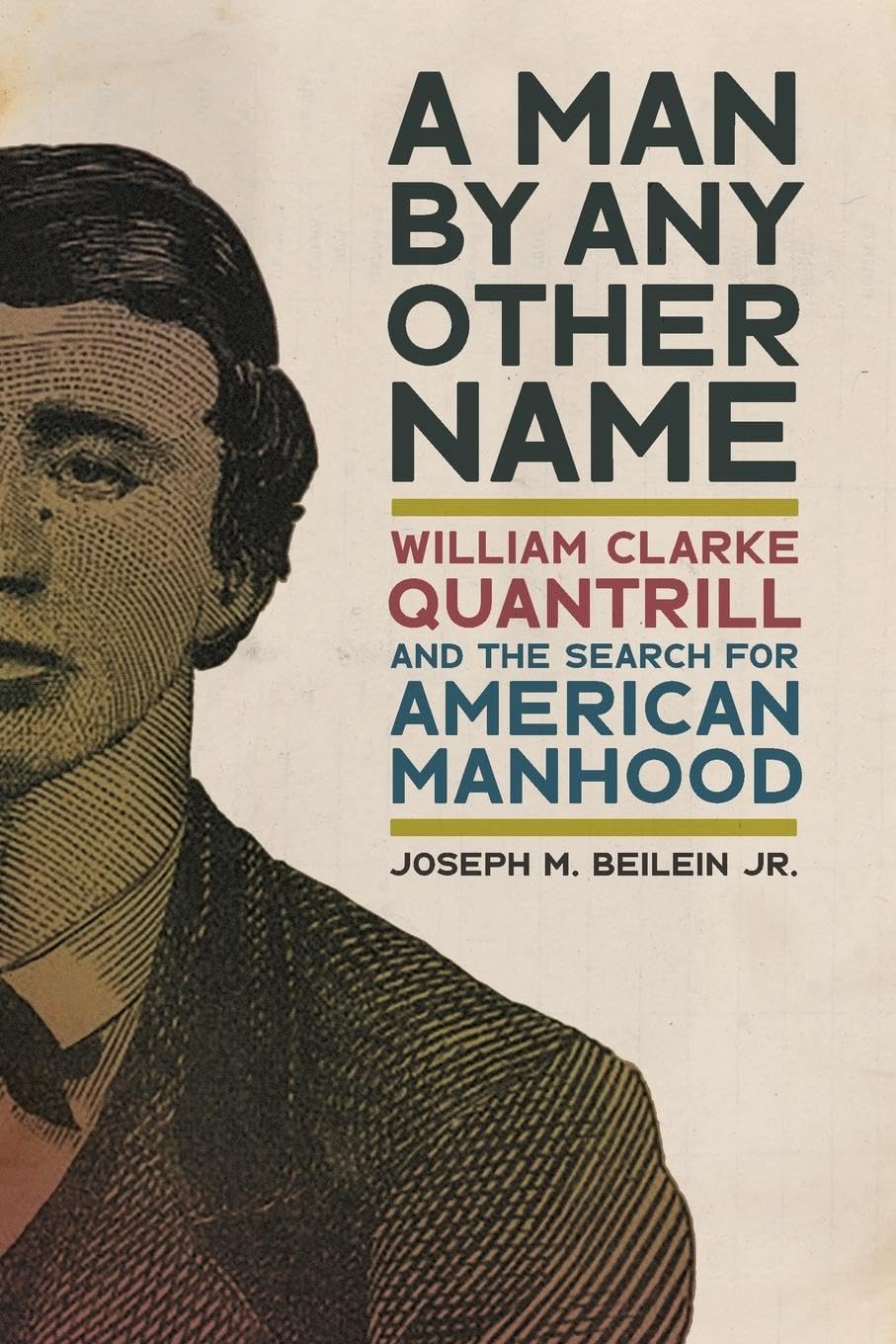
Booknotes: A Man by Any Other Name

New Arrival:

• A Man by Any Other Name: William Clarke Quantrill and the Search for American Manhood by Joseph M. Beilein, Jr. (UGA Press, 2023).

Finally something came in the mail this month. Infamous guerrilla chieftain William C. Quantrill has been the subject of a number of biographies, the most recent of the sound variety (in my opinion, anyway) being Edward Leslie's The Devil Knows How to Ride (1996). As one can readily recognize from its title, Joseph Beilein's A Man by Any Other Name: William Clarke Quantrill and the Search for American Manhood is a new biography with a new theme.

From the description: Before Quantrill became a terror to pro-Union soldiers and civilians in Missouri and Kansas, he "led a transient life, shifting from one masculine form to another. He played the role of fastidious schoolmaster, rough frontiersman, and even confidence man, developing certain notions and skills on his way to becoming a proslavery bushwhacker. Quantrill remains impossible to categorize, a man whose motivations have been difficult to pin down."

That's certainly true, but Beilein gives it a try. More from the description: "Using new documents and old documents examined in new ways," A Man by Any Other Name "paints the most authentic portrait of Quantrill yet rendered. The detailed study of this man not only explores a one-of-a-kind enigmatic figure but also allows us entry into many representative experiences of the Civil War generation. This picture brings to life a unique vision of antebellum life in the territories and a fresh view of guerrilla warfare on the border. Of even greater consequence, seeing Quantrill in this way allows us to examine the perceived essence of American manhood in the mid-nineteenth century."

Thursday, September 7, 2023

Review - " Outwitting Forrest: The Tupelo Campaign in Mississippi, June 22 - July 23, 1864 " by Edwin Bearss, ed. by David Powell

[Outwitting Forrest: The Tupelo Campaign in Mississippi, June 22 - July 23, 1864 by Edwin C. Bearss, ed. by David A. Powell (Savas Beatie, 2023). Hardcover, 6 maps, photos, footnotes, bibliography, index. Pages main/total:x,174/191. ISBN:978-1-61121-670-7. $29.95]

Before his stint as a featured commentator on Ken Burns's award-winning Civil War television series vaulted him into wider public recognition and before he became a well-known preservation advocate and legendary battlefield tour leader, the incomparable Edwin Cole Bearss researched and authored a slew of manuscripts and journal articles covering Civil War campaigns and battles fought across all three major theaters. During a time when modern maps, at least detailed ones, were generally neglected, Bearss made them a priority in his work. His magnum opus, a three-volume history of the Vicksburg campaign, has received multiple printings, but other significant book-length studies written during the Park Service historian's early and middle career periods unfortunately languish in unpublished form or were released only in obscure, small-run printings. An example of the latter is his groundbreaking 1969 survey The Tupelo Campaign, June 22-July 23. A Documented Narrative & Troop Movement Maps. However, courtesy of publisher Savas Beatie and editor David Powell, that is no longer the case, with Bearss's Tupelo manuscript, retitled Outwitting Forrest: The Tupelo Campaign in Mississippi, June 22 - July 23, 1864, the latest release from SB's Battles & Leaders series.

Confederate cavalry general Nathan Bedford Forrest's shocking rout of Union general Samuel Sturgis's large combined-arms column at Brice's Crossroads on June 10, 1864 almost immediately caused shaken, yet still determined, Union authorities to fit out another even stronger expedition for a renewed drive into northern Mississippi. Led by A.J. Smith, a well-regarded fighting general, and consisting of a corp-sized infantry element backed by powerful cavalry and artillery forces, this new campaign hit the road less than a month after Sturgis's defeat. That expedition, and its signature battle fought at Tupelo, Mississippi, is the central focus of this study.

Readers familiar with Bearss's style of presentation, spare in language but thorough in intelligibly written operational and tactical narrative accompanied by sound strategic commentary, will find the same in this government-sponsored manuscript. Supported by new maps created at the appropriate scale, the text follows the paths of opposing forces in northern Mississippi across roughly two weeks of marching, skirmishing, and fighting, those sequence of events culminating in a sharply fought battle at Harrisburg/Tupelo on July 14 and a lesser engagement at Old Town Creek the following day. The "Outwitting Forrest" aspect of the book title adopted by the publisher likely refers to Smith's 'stolen march' that resulted in Union forces successfully bypassing Forrest's roadblock established southeast of Pontotoc. Smith's skillful lateral redeployment from Pontotoc to Tupelo successfully fended off multiple Confederate attempts at interdicting the march. As a result, the bluecoats were able to reach the Mobile & Ohio Railroad in force, a goal of the campaign, and establish a strong defensive perimeter around Tupelo. On July 14, Smith's command delivered a bloody repulse to the attacking Confederate cavalry under the direction of department commander S.D. Lee and principal subordinate Forrest. However, after Smith, complaining about dwindling supplies and ammunition problems, abruptly abandoned his campaign and returned to Tennessee, both sides laid claim to overall victory.

Contemporary critics and modern observers alike generally agree that the best use of Forrest's cavalry during this period lay in raiding Sherman's supply lines. Agreeing with that line of thinking, Bearss determines that S.D. Lee's decision as Department of Alabama, Mississippi, and East Louisiana commander to concentrate his considerable mounted forces for the defense of Mississippi instead of using them to operate against the enemy lines of supply and communication supporting Sherman's army group in Georgia was a clear mistake. One can certainly use that (as Bearss does) as an example of Lee lacking strategic vision, but, to be fair, most Civil War department commanders were understandably hesitant to strip the defenses of their own geographic area of responsibility by sending their best troops well beyond departmental boundaries. Strongest criticism might perhaps be more appropriately levied against President Davis and his War Department for declining to intervene, and Bearss's text also condemns Davis's inaction on this matter.

In his usual fashion, Bearss does not inappropriately stretch the documentary evidence in support of taking sides in controversies associated with the battle. After Smith placed his superior command in favorable defensive positions west and south of Tupelo, it was incontestably Forrest-like for that general to want to wait Smith out and then hit the federals after circumstances forced the bluecoats to resume movement. However, Lee was in charge and felt keenly pressured by the situation in his department to attack immediately. As Bearss relates in the book, primary sources are in conflict regarding Forrest's level of enthusiasm for attacking Smith's strong position at Tupelo. Similarly, what motivation(s) lay behind Forrest declining Lee's offer to command all Confederate forces during the battle has been a subject of long debate. Here again, Bearss presents the evidence as he sees it and leaves it to his readers, if they so choose, to engage in speculation. Given the typical result of Civil War cavalry assaulting well-formed infantry, it becomes difficult to imagine any scenario in which Forrest and Lee's outnumbered cavalry could have overcome Smith's veterans compactly positioned behind temporary breastworks and backed by plentiful artillery and strong cavalry on the flanks. Brice's Crossroads provided some precedent in terms of force mix, but the two battlefield situations were very different. Regardless of how one characterizes the high command interaction of Lee and Forrest (who generally got along well together), as Bearss explains, the Confederate attack proceeded in piecemeal fashion and to neither general's credit. The result was a badly directed battle from the Confederate side and a terrible decimation of irreplaceable officers and manpower in four brigades. In the author's view, those brigades permanently lost their offensive capabilities, a significant impact.

Three additional chapters at the rear of the book cover a series of Union diversionary operations in Central Mississippi. Most significantly, General Henry Slocum pushed a division-strength raiding column well beyond the Big Black River (at one point reoccupying Jackson and destroying the rebuilt railroad bridge over Pearl River). In another, General Alfred Ellet conducted an inland expedition into Jefferson and Claiborne counties. All of these early to mid-July raiding operations are described by Bearss in some detail. As the author astutely observes, their significance is primarily attached to their fixing Confederate defenders in place and withholding possible reinforcements for Forrest. Through influencing Lee's determination to immediately attack at Tupelo, those events, especially Slocum's movements, greatly affected the course of events in northern Mississippi. Finally, in fulfillment of his government directive, Bearss concludes the study with his professional recommendations regarding interpretation of the Tupelo site.

David Powell edits the manuscript with a restrained hand, his supplemental footnotes largely confined to providing capsule biographies of a number of general and field grade officers mentioned in the text. Occasionally, additional historiographical context is added, an example of that being some comparisons between Bearss's text and corresponding views and conclusions found in the most thorough and up to date modern treatment of the campaign, Tom Parson's Work for Giants: The Campaign and Battle of Tupelo / Harrisburg, Mississippi, June-July 1864 (2014). Though it would be unfair to compare too closely works researched and written nearly a half-century apart, Bearss and Parson do share a number of opinions and interpretations in regard to the quality of opposing generalship, their decision-making during the campaign, and the overall significance of events that July. Obviously, if you can only read one book on the campaign you have to go with the very impressive Work For Giants, but Parson generously credits Bearss's trailblazing work as having a profound influence on his own. For those who already have Bearss's Forrest at Brice's Crossroads [Morningside (1979, R-1987)], the middle section of which covers the Tupelo Campaign, and are curious about similarities between it and the 1969 manuscript, there are numerous shared elements (i.e. very similarly written passages), but both text and overall coverage are not exactly the same. One notable difference is the absence in the 1979 book of the chapters addressing the Slocum and Ellet raids that, as mentioned before, so strongly influenced Lee's mindset at Tupelo.

A decade ago, Savas Beatie and editor Bryce Suderow made widely available for the first time two volumes of Bearss's previously unpublished Petersburg Campaign writings. Through the continued efforts of SB and now David Powell, in Outwitting Forrest we now have another seminal Bearss study finally achieving general access through wider publication. Hopefully, there's more to come.

Monday, September 4, 2023

Booknotes: Artillery of Antietam

New Arrival:

• Artillery of Antietam: The Union and Confederate Batteries at the Battle of Antietam by James A. Rosebrock (Press of the Antietam Inst, 2023).

The depth and scope of Jim Rosebrock's Artillery of Antietam clearly exceeds that of the battle's long-serving standard reference work Artillery Hell: The Employment of Artillery at Antietam, which is fast approaching its 30-year anniversary.

From the description: Rosebrock's study "provides for the first time ever, a comprehensive examination of every Federal and Confederate artillery battery (135 in all), and their commanders, that participated in the Maryland Campaign of 1862. Detailed accounts cover the artillery battles at South Mountain, Harpers Ferry, Antietam, Shepherdstown, Williamsport, and the skirmishes between the Union and Confederate horse artillery batteries during the advance into Maryland."

Saying the battery accounts are "detailed" is no overstatement. The divisional artillery (consisting of 2 or more batteries) unit background and Maryland Campaign service histories for both sides routinely fill a dozen or so 8.5" x 11" double-column pages. The text is researched from a diverse range of primary and secondary sources, including archival materials, newspapers, books, articles, and various online resources.

Supplemental material is also impressive. More from the description: "Twenty-eight original maps highlight the artillery actions in great detail. The book has an introductory chapter on light artillery operations in the Civil War and six tables providing detailed information on numbers of artillerymen, casualties, and armament."

Hartwig's mammoth battle history, of which I am currently approaching the halfway mark, will undoubtedly leave me Antietam'd out of a while, but I will eventually get to this.