


Paid Sponsor
Saturday, December 31, 2016


Wednesday, December 28, 2016
McClellan and the Union High Command, 1861-1863
Sometimes it is interesting to see what a Civil War 'outsider' can bring to the discussion of a well-worn topic. The author of the upcoming McClellan and the Union High Command, 1861-1863: Leadership Gaps That Cost A Timely Victory (McFarland, January 2017) is Jeffrey Green, a history professor who teaches in Australia and has previously published books on modern wars in the Far East and Pacific. Hopefully, in dipping his toes into unfamiliar waters, the author does not grasp at appallingly outdated cliches to the degree found in the recent A Savage War. Perhaps Hsieh & Murray's book immeasurably improves after the first 100 pages, which was all I could take before quitting on it. Neither author is a serially published Civil War specialist, but I mostly liked Hsieh's book about 19th Century West Point officers (a work that received mixed reviews from readers at large) and didn't recognize his stamp on any of the early parts of A Savage War that I read.
Anyway, getting back to Green ... the book description is very brief and shy about hinting at what directions it will take. I would reword the following passage from it — "McClellan's "On to Richmond" battle cry dominated strategic thinking in the high command." The last sentence is tantalizing and reads: "This re-examination of the high command and McClellan's war in the East provides a broader understanding of the Union's inability to achieve victory in the first two years, and takes the debate about the Union's leadership into new areas." I am curious as to what these "new areas" might be.
 (McFarland, January 2017) is Jeffrey Green, a history professor who teaches in Australia and has previously published books on modern wars in the Far East and Pacific. Hopefully, in dipping his toes into unfamiliar waters, the author does not grasp at appallingly outdated cliches to the degree found in the recent A Savage War. Perhaps Hsieh & Murray's book immeasurably improves after the first 100 pages, which was all I could take before quitting on it. Neither author is a serially published Civil War specialist, but I mostly liked Hsieh's book about 19th Century West Point officers (a work that received mixed reviews from readers at large) and didn't recognize his stamp on any of the early parts of A Savage War that I read.
Anyway, getting back to Green ... the book description is very brief and shy about hinting at what directions it will take. I would reword the following passage from it — "McClellan's "On to Richmond" battle cry dominated strategic thinking in the high command." The last sentence is tantalizing and reads: "This re-examination of the high command and McClellan's war in the East provides a broader understanding of the Union's inability to achieve victory in the first two years, and takes the debate about the Union's leadership into new areas." I am curious as to what these "new areas" might be.
Monday, December 26, 2016
Booknotes: John Quincy Adams and the Politics of Slavery
New Arrival:
• John Quincy Adams and the Politics of Slavery: Selections from the Diary by David Waldstreicher & Matthew Mason (Oxford UP, 2016).

• John Quincy Adams and the Politics of Slavery: Selections from the Diary
 by David Waldstreicher & Matthew Mason (Oxford UP, 2016).
This book uses John Quincy Adams's own words (in the form of a series of diary selections) to examine the life-long evolution of the sixth president's views on slavery and slavery politics. In addition to selecting the material, the editors contribute a general introduction, chapter introductions, bridging commentary covering gaps between diary texts, and footnotes.
From the description: "Expertly edited by David Waldstreicher and Matthew Mason, John Quincy Adams and the Politics of Slavery offers an unusual perspective on the dramatic and shifting politics of slavery in the early republic, as it moved from the margins to the center of public life and from the shadows to the substance of Adams's politics. The editors provide a lucid introduction to the collection as a whole and frame the individual documents with brief and engaging insights, rendering both Adams's life and the controversies over slavery into a mutually illuminating narrative. By juxtaposing Adams's personal reflections on slavery with what he said-and did not say-publicly on the issue, the editors offer a nuanced portrait of how he interacted with prevailing ideologies during his consequential career and life."
Friday, December 23, 2016
CWBA book "awards"
My annual list of favorite Civil War books across a slew of categories will be a bit delayed this time around. Though I've never been shy about including early winter titles on the following year's list, there are a number of candidates I want to finish up first. You can expect the 2016 group to appear sometime in the middle of January. For those new to the site and wondering what I'm talking about, go here to view the 2015 list.
Thursday, December 22, 2016
Booknotes: The First Republican Army
New Arrival:
• The First Republican Army: The Army of Virginia and the Radicalization of the Civil War by John H. Matsui (Univ of Va Pr, 2016).
 John Pope gained early-war notoriety for targeting Missouri civilians in retaliation for guerrilla attacks on infrastructure. But he's better known for the bombastic manner by which he brought this harsher brand of western frontier warfare east to Virginia, where he assumed command of the Army of Virginia and quickly drew the ire of Robert E. Lee. In his book The First Republican Army, author John Matsui argues that ideological differences between the Army of Virginia and the Army of the Potomac ran much deeper than the politics, mindset, and leadership style of the man at the top.
• The First Republican Army: The Army of Virginia and the Radicalization of the Civil War
 by John H. Matsui (Univ of Va Pr, 2016).
 John Pope gained early-war notoriety for targeting Missouri civilians in retaliation for guerrilla attacks on infrastructure. But he's better known for the bombastic manner by which he brought this harsher brand of western frontier warfare east to Virginia, where he assumed command of the Army of Virginia and quickly drew the ire of Robert E. Lee. In his book The First Republican Army, author John Matsui argues that ideological differences between the Army of Virginia and the Army of the Potomac ran much deeper than the politics, mindset, and leadership style of the man at the top.
From the description: "If the Army of the Potomac (the major Union force in Virginia) was dominated by generals who concurred with the ideology of the Democratic Party, the Army of Virginia (though likewise a Union force) was its political opposite, from its senior generals to the common soldiers. The majority of officers and soldiers in the Army of Virginia saw slavery and pro-Confederate civilians as crucial components of the rebel war effort and blamed them for prolonging the war. The frustrating occupation experiences of the Army of Virginia radicalized them further, making them a vanguard against Southern rebellion and slavery within the Union army as a whole and paving the way for Abraham Lincoln to issue the Emancipation Proclamation."
It looks like the author assembled a pretty good-sized study group. "Drawing on archival sources from twenty-five generals and 250 volunteer officers and enlisted men, John Matsui offers the first major study to examine the ways in which individual politics were as important as military considerations to battlefield outcomes and how the experience of war could alter soldiers’ political views." If I recall correctly, Joseph Glatthaar's cohort numbered 600 for his celebrated quantitative Army of Northern Virginia study.
Wednesday, December 21, 2016
Review of Baker - "THE SACRED CAUSE OF UNION: Iowa in the Civil War"
[The Sacred Cause of Union: Iowa in the Civil War by Thomas R. Baker (University of Iowa Press, 2016). Softcover, maps, photos, notes, index. Pages main/total:259/293. ISBN:978-1-60938-435-7. $27.50]
 Iowa was the first state in what author Thomas Baker calls the "New West" (i.e. the states and territories carved up by 1860 from the vast Louisiana Purchase) to prohibit slavery, and his book The Sacred Cause of Union argues that Iowa also forged a distinctive military and political Civil War legacy richly deserving of wider appreciation. Baker's case is difficult to dispute.
Though Iowa's Civil War volunteers were not much different than their comrades from other northern states in that their primary enlistment motivation was to punish the secessionists and preserve the Union, their state's shared border with Missouri and Nebraska meant that Iowans had a front row seat to the mid-1850s Kansas violence that radicalized the slavery politics of many U.S. citizens. While the broad overview nature of Baker's book also meant that the author could not explore Iowa's prewar role as a haven for escaped slaves and its connections with abolitionist militants in as much depth as, for example, Lowell Soike's recent study Busy in the Cause: Iowa, the Free-State Struggle in the West, and the Prelude to the Civil War (2014) did, The Sacred Cause of Union does touch upon those and other antebellum antislavery actions as early signs pointing toward a rapid Republican ascendancy in state politics during the war.
The book documents at some length the Hawkeye State's enthusiastic and full response to the federal government's constant and insistent calls for army volunteers. Even though non-urbanized frontier states like Iowa did not possess a superabundance of labor, young men needed on their family farms nevertheless flocked to the army in 1861 (during both the initial 90-day and later 3-year enlistment waves). The state quotas of nearly every War Department manpower levy from 1862 onward also tended to be quickly filled in Iowa. Conscription was unpopular throughout the North, and Iowa was fortunate that its sustained volunteering meant that, when federal demands finally exceeded supply in 1864, only a few men needed to be drafted. According to Baker, Iowa was remarkable for its peaceful bipartisan acceptance of federal draft policy, a pacific stance in marked contrast to the violent reactions to conscription that occurred in New York City or in the timber counties of western Pennsylvania. The author credits much of the lack of civil unrest to the state's Peace Democrats for not organizing opposition to conscription, though his case is weakened by a statement later in the book that two draft officials were killed in one county. How isolated that type of incident truly was is not examined further.
The lion's share of credit for successfully creating and sustaining the massive Union volunteer army that won the Civil War has generally gone to the Lincoln administration, but there is a growing literature that seeks to better appreciate the work of the states. It was the North's immense good fortune to possess a group of extremely talented state governors whose dedication to winning the war matched that of the nation's chief executive. While Iowa governor Samuel Kirkwood is not often placed in the same meritorious category occupied by fellow Republican state chief executives Oliver Morton, Richard Yates, John Andrew, Andrew Curtin, and others, Baker effectively argues in the book that Kirkwood should rank among the best of the North's war governors.
How "radical" Iowa became during the Civil War is one of the book's major themes. The study's survey of Iowa political trends seems to indicate that the war radicalized the Hawkeye electorate much more quickly and widely than it did the voters of other western states (though the author is careful not to overstate the matter). In contrast with other states across the West, the triumvirate of war weariness, conscription, and emancipation did not significantly revitalize the Democratic political opposition in Iowa. When Republican majorities suffered crushing losses across the nation during the fall midterm elections in 1862, all six Iowa congressional races went against the Democrats. However, as Baker takes great pains to show, that isn't to say that pro-emancipation Iowans suddenly became friendly to the presence of black refugees in their communities or warmed to the idea of granting ex-slaves voting rights and the full privileges of citizenship. Those changes would come later in the decade after a series of political advances and retreats.
Much of the book is comprised of a thorough and often fascinating (and even sometimes surprising) accounting of the specific contributions of Iowa regiments to the many campaigns fought in the western and Trans-Mississippi theaters. Baker appropriately grants Iowa regiments a great deal of credit for securing Missouri in 1861-62, a vital job which needed to be done before any Union advances into the Confederate heartland could be contemplated. The narrative can be a bit over congratulatory at times and rating the contributions of single states among massive combined efforts is surely almost hopelessly subjective, but Baker does very compellingly document the uncanny knack that so many Iowa officers and regiments had for being at the right place at the right time during many pivotal battles. His point that Crocker's Iowa Brigade deserves wider recognition as one of the best Union fighting brigades is similarly forceful.
As a way to represent the human range of the Iowa Civil War experience on a more intimate level, Baker selected six individuals [Cyrus Carpenter, Ferdinand Dunham, Charles Musser, Simeon Stevens, Alexander Clark, and Annie Wittenmyer] from different parts of the state to follow throughout the book. It is a mostly fruitful exercise, though the soldiers in the group rather blend together over time and their writings seem a bit underutilized in the military narrative. For the sake of greater diversity, it might also have been more interesting to have included a Peace Democrat in the group. Of the six, Wittenmyer and Clark stand out the most. Wittenmyer was a prominent aid society organizer who tirelessly worked to provide Iowa soldiers with food, clothing, supplies, and medicine, all the while fighting powerful internal and external forces that sought to abolish state organizations by merging them with the United State Sanitary Commission. Clark was a successful black businessman who became a leading advocate in the state for African American army enlistment and civil rights.
Thomas Baker's The Sacred Cause of Union admirably addresses the literature's longstanding need for a general study of Iowa's involvement in the Civil War. It is a fine survey history of the military and home front contributions of Iowa citizens to victory, exposing as well the many momentous political and social changes wrought by the conflict. Recommended.
 by Thomas R. Baker (University of Iowa Press, 2016). Softcover, maps, photos, notes, index. Pages main/total:259/293. ISBN:978-1-60938-435-7. $27.50]Iowa was the first state in what author Thomas Baker calls the "New West" (i.e. the states and territories carved up by 1860 from the vast Louisiana Purchase) to prohibit slavery, and his book The Sacred Cause of Union argues that Iowa also forged a distinctive military and political Civil War legacy richly deserving of wider appreciation. Baker's case is difficult to dispute.
Though Iowa's Civil War volunteers were not much different than their comrades from other northern states in that their primary enlistment motivation was to punish the secessionists and preserve the Union, their state's shared border with Missouri and Nebraska meant that Iowans had a front row seat to the mid-1850s Kansas violence that radicalized the slavery politics of many U.S. citizens. While the broad overview nature of Baker's book also meant that the author could not explore Iowa's prewar role as a haven for escaped slaves and its connections with abolitionist militants in as much depth as, for example, Lowell Soike's recent study Busy in the Cause: Iowa, the Free-State Struggle in the West, and the Prelude to the Civil War (2014) did, The Sacred Cause of Union does touch upon those and other antebellum antislavery actions as early signs pointing toward a rapid Republican ascendancy in state politics during the war.
The book documents at some length the Hawkeye State's enthusiastic and full response to the federal government's constant and insistent calls for army volunteers. Even though non-urbanized frontier states like Iowa did not possess a superabundance of labor, young men needed on their family farms nevertheless flocked to the army in 1861 (during both the initial 90-day and later 3-year enlistment waves). The state quotas of nearly every War Department manpower levy from 1862 onward also tended to be quickly filled in Iowa. Conscription was unpopular throughout the North, and Iowa was fortunate that its sustained volunteering meant that, when federal demands finally exceeded supply in 1864, only a few men needed to be drafted. According to Baker, Iowa was remarkable for its peaceful bipartisan acceptance of federal draft policy, a pacific stance in marked contrast to the violent reactions to conscription that occurred in New York City or in the timber counties of western Pennsylvania. The author credits much of the lack of civil unrest to the state's Peace Democrats for not organizing opposition to conscription, though his case is weakened by a statement later in the book that two draft officials were killed in one county. How isolated that type of incident truly was is not examined further.
The lion's share of credit for successfully creating and sustaining the massive Union volunteer army that won the Civil War has generally gone to the Lincoln administration, but there is a growing literature that seeks to better appreciate the work of the states. It was the North's immense good fortune to possess a group of extremely talented state governors whose dedication to winning the war matched that of the nation's chief executive. While Iowa governor Samuel Kirkwood is not often placed in the same meritorious category occupied by fellow Republican state chief executives Oliver Morton, Richard Yates, John Andrew, Andrew Curtin, and others, Baker effectively argues in the book that Kirkwood should rank among the best of the North's war governors.
How "radical" Iowa became during the Civil War is one of the book's major themes. The study's survey of Iowa political trends seems to indicate that the war radicalized the Hawkeye electorate much more quickly and widely than it did the voters of other western states (though the author is careful not to overstate the matter). In contrast with other states across the West, the triumvirate of war weariness, conscription, and emancipation did not significantly revitalize the Democratic political opposition in Iowa. When Republican majorities suffered crushing losses across the nation during the fall midterm elections in 1862, all six Iowa congressional races went against the Democrats. However, as Baker takes great pains to show, that isn't to say that pro-emancipation Iowans suddenly became friendly to the presence of black refugees in their communities or warmed to the idea of granting ex-slaves voting rights and the full privileges of citizenship. Those changes would come later in the decade after a series of political advances and retreats.
Much of the book is comprised of a thorough and often fascinating (and even sometimes surprising) accounting of the specific contributions of Iowa regiments to the many campaigns fought in the western and Trans-Mississippi theaters. Baker appropriately grants Iowa regiments a great deal of credit for securing Missouri in 1861-62, a vital job which needed to be done before any Union advances into the Confederate heartland could be contemplated. The narrative can be a bit over congratulatory at times and rating the contributions of single states among massive combined efforts is surely almost hopelessly subjective, but Baker does very compellingly document the uncanny knack that so many Iowa officers and regiments had for being at the right place at the right time during many pivotal battles. His point that Crocker's Iowa Brigade deserves wider recognition as one of the best Union fighting brigades is similarly forceful.
As a way to represent the human range of the Iowa Civil War experience on a more intimate level, Baker selected six individuals [Cyrus Carpenter, Ferdinand Dunham, Charles Musser, Simeon Stevens, Alexander Clark, and Annie Wittenmyer] from different parts of the state to follow throughout the book. It is a mostly fruitful exercise, though the soldiers in the group rather blend together over time and their writings seem a bit underutilized in the military narrative. For the sake of greater diversity, it might also have been more interesting to have included a Peace Democrat in the group. Of the six, Wittenmyer and Clark stand out the most. Wittenmyer was a prominent aid society organizer who tirelessly worked to provide Iowa soldiers with food, clothing, supplies, and medicine, all the while fighting powerful internal and external forces that sought to abolish state organizations by merging them with the United State Sanitary Commission. Clark was a successful black businessman who became a leading advocate in the state for African American army enlistment and civil rights.
Thomas Baker's The Sacred Cause of Union admirably addresses the literature's longstanding need for a general study of Iowa's involvement in the Civil War. It is a fine survey history of the military and home front contributions of Iowa citizens to victory, exposing as well the many momentous political and social changes wrought by the conflict. Recommended.
Monday, December 19, 2016
Ordered West
It seems like it's been a long while since an edited letter collection/diary/memoir written by a soldier that fought in the Desert Southwest during the Civil War has been published. An upcoming volume from University of North Texas Press, Ordered West: The Civil War Exploits of Charles A. Curtis (June, 2017), sounds very interesting. Curtis served in New Mexico and Arizona, and his wartime experiences between 1862 and 1865 were recounted at length in a memoir originally published as a newspaper serial.
From the description:
The book will apparently run over 700 pages so the description of Curtis's writing as "extensive" might be an understatement.
 (June, 2017), sounds very interesting. Curtis served in New Mexico and Arizona, and his wartime experiences between 1862 and 1865 were recounted at length in a memoir originally published as a newspaper serial.
 From the description:
"In addition to his keen observations of daily life as a soldier serving in the American Southwest, Curtis’s reminiscences include extensive descriptions of Arizona and New Mexico and detail his encounters with Indians, notable military figures, eccentrics, and other characters from the Old West. Among these many stories readers will find Curtis’s accounts of meeting Kit Carson, the construction of Fort Whipple, and expeditions against the Navajo and Apache."
"In Ordered West, editors Alan D. Gaff and Donald H. Gaff have pulled together the pieces of Curtis’s story and assembled them into a single narrative. Annotated with footnotes identifying people, places, and events, the text is lavishly illustrated throughout with pictures of key figures and maps. A detailed biographical overview of Curtis and how his story came to print is also included."
Sunday, December 18, 2016
Stahr on Stanton
Next summer, Simon & Schuster will publish Walter Stahr's Stanton: Lincoln's Staunch Secretary of War (August, '17). The author's Seward biography was well received (I think), and in Stanton he takes on a much more controversial figure from the Lincoln cabinet. The author certainly well recognizes the man's hotly disputed legacy — from the description: "Of the crucial men close to President Lincoln, Secretary of War Edwin Stanton (1814–1869) was the most powerful and controversial. Stanton raised, armed, and supervised the army of a million men who won the Civil War. He organized the war effort. He directed military movements from his telegraph office, where Lincoln literally hung out with him. He arrested and imprisoned thousands for “war crimes,” such as resisting the draft or calling for an armistice. Stanton was so controversial that some accused him at that time of complicity in Lincoln’s assassination. He was a stubborn genius who was both reviled and revered in his time." — but one can probably safely assume that Stahr's assessment of Stanton's actions will be much more sympathetic as a whole than William Marvel's in Lincoln's Autocrat: The Life of Edwin Stanton
 (2015).
Speaking of Marvel's book, the marketing copy writer assigned to Stanton who dreamed up the following arresting passage for the description — "Walter Stahr’s essential book is the first major biography of Stanton in fifty years" — apparently wants to wish away the very existence of the competition. A full scholarly biography written by a well-known author and published by one of the field's top university presses is clearly impossible to miss without deliberately doing so.
 (August, '17). The author's Seward biography was well received (I think), and in Stanton he takes on a much more controversial figure from the Lincoln cabinet. The author certainly well recognizes the man's hotly disputed legacy — from the description: "Of the crucial men close to President Lincoln, Secretary of War Edwin Stanton (1814–1869) was the most powerful and controversial. Stanton raised, armed, and supervised the army of a million men who won the Civil War. He organized the war effort. He directed military movements from his telegraph office, where Lincoln literally hung out with him. He arrested and imprisoned thousands for “war crimes,” such as resisting the draft or calling for an armistice. Stanton was so controversial that some accused him at that time of complicity in Lincoln’s assassination. He was a stubborn genius who was both reviled and revered in his time." — but one can probably safely assume that Stahr's assessment of Stanton's actions will be much more sympathetic as a whole than William Marvel's in Lincoln's Autocrat: The Life of Edwin Stanton
 (2015).
Speaking of Marvel's book, the marketing copy writer assigned to Stanton who dreamed up the following arresting passage for the description — "Walter Stahr’s essential book is the first major biography of Stanton in fifty years" — apparently wants to wish away the very existence of the competition. A full scholarly biography written by a well-known author and published by one of the field's top university presses is clearly impossible to miss without deliberately doing so.
Friday, December 16, 2016
Booknotes: Independence or Annihilation
New Arrival:
• Independence or Annihilation: Campaigns of the 60th Virginia Infantry Regiment
by William L. Caynor Sr. (Civil War Collectibles, 2016).
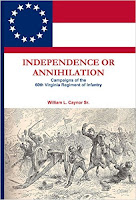 The title "Independence or Annihilation" refers to the motto of the 60th Virginia, which was formed in western Virginia in 1861 and became part of the Wise Legion. Before the publication of William Caynor's book, the only reasonably complete 60th Va unit study was John L. Scott's 1997 contribution to the H.E. Howard series of Virginia regimental roster histories.
The 60th fought in the Kanawha Valley in 1861 and in the Peninsula and 2nd Bull Run campaigns of 1862 before returning to the mountains of western (soon to be West) Virginia. The regiment participated in the Battle of Cloyd's Mountain in 1864 and subsequently joined Jubal Early's army in the Shenandoah, where it battled Union forces in a long string of engagements there. The 60th's last major fight was at Waynesboro in March 1865.
• Independence or Annihilation: Campaigns of the 60th Virginia Infantry Regiment

by William L. Caynor Sr. (Civil War Collectibles, 2016).
 The title "Independence or Annihilation" refers to the motto of the 60th Virginia, which was formed in western Virginia in 1861 and became part of the Wise Legion. Before the publication of William Caynor's book, the only reasonably complete 60th Va unit study was John L. Scott's 1997 contribution to the H.E. Howard series of Virginia regimental roster histories.
The 60th fought in the Kanawha Valley in 1861 and in the Peninsula and 2nd Bull Run campaigns of 1862 before returning to the mountains of western (soon to be West) Virginia. The regiment participated in the Battle of Cloyd's Mountain in 1864 and subsequently joined Jubal Early's army in the Shenandoah, where it battled Union forces in a long string of engagements there. The 60th's last major fight was at Waynesboro in March 1865.
In the book, the introductory chapters and the regimental organization and service history narrative together run around 250 pages, much of the last written in a format akin to a daily unit diary. Photos and illustrations are abundantly sprinkled throughout the volume. Presented after the unit history are numerous tables and appendix discussions on a great variety of related topics. The author visited a number of archives during his research, but what really stands out in the bibliography is the exceptional number of newspaper resources that Caynor examined.
Caynor's 2,011-man roster, which includes officers & staff and takes up roughly 300 of the book's 735 total pages, contains much in the way of service record details. The author also discovered 113 additional soldiers absent from Scott's 1997 roster. The roster is indexed, as well.
Thursday, December 15, 2016
Civil War Logistics
There are many monographs floating around that analyze Civil War logistics as applied to specific campaigns, but I can't recall (at least at the moment) an existing standard work that broadly addresses the topic in scholarly fashion. Now it appears that Earl Hess will give it a go next September with Civil War Logistics: A Study of Military Transportation (LSU). Beyond his rare ability to produce top-notch scholarship at a nearly unbelievable pace, Earl Hess's body of work also appeals as a great mix of the familiar and the unique. A logistics study certainly shades toward the latter group. I am looking forward to reading it. LSU Press is really on a roll lately.
 (LSU). Beyond his rare ability to produce top-notch scholarship at a nearly unbelievable pace, Earl Hess's body of work also appeals as a great mix of the familiar and the unique. A logistics study certainly shades toward the latter group. I am looking forward to reading it. LSU Press is really on a roll lately.
Wednesday, December 14, 2016
Review of Lowry - "THE BATTLE OF CHARLESTON AND THE 1862 KANAWHA VALLEY CAMPAIGN"
[The Battle of Charleston and the 1862 Kanawha Valley Campaign by Terry Lowry (35th Star Publishing, 2016). 8 1/2" x 11" hardcover, 11 maps, 332 photos & illustrations, appendices, notes, bibliography, index. Pages main/total:416/492. ISBN:9780966453485. $34.95]
 Occurring simultaneously with renowned 1862 Confederate grand offensives into Kentucky and Maryland (and dwarfed in size by both), it is no great surprise that the 1862 Kanawha Valley Campaign remains virtually unknown to the general interest Civil War reader. Until now, the operation has lacked a competent standalone campaign history of any length1 and has been only lightly addressed within wider studies. Stepping into this void, and filling it to the brim, is Terry Lowry's The Battle of Charleston and the 1862 Kanawha Valley Campaign, a sweeping and utterly exhaustive examination of the topic. Lowry is one of a very small group of authors specializing in Civil War West(ern) Virginia military history. Among his many works is an excellent study of the Union conquest of the Kanawha Valley in early 18612, making Lowry a natural candidate for examining the next major phase of the Civil War struggle for control of the strategic valley.
To briefly summarize, in early September 1862 the Confederate Army of Southwest Virginia, consisting of roughly 5,000 men (the figure is the subject of some debate3) under General W.W. Loring organized into three and sometimes four brigades, launched an offensive north from the Narrows of New River. The goal was to eject occupying Union forces entirely from the Kanawha River Valley and reestablish Confederate control over the resources and manpower of the area. Loring's Union Army opponent was Colonel Joseph A.J. Lightburn, whose District of the Kanawha troop numbers were similar in size to Loring's own. However, whereas Loring's force was concentrated, the federal troops of the district were scattered all over the valley performing garrison duty. Union attention was also diverted from Loring's impending advance by a summer mounted raid conducted far to the rear by Confederate cavalry general Albert Gallatin Jenkins.
The campaign's first major encounter occurred on September 10 at Fayetteville, where Loring attacked a series of detached Union fortifications surrounding the town. The Union defenders, ably led by Colonel Edward Siber, held their position and later escaped during the night. Gathering in forces from the surrounding countryside as they retreated, the Federals split into two groups after the September 11 skirmish at Montgomery's Ferry (near Gauley Bridge). With Union forces traveling down both banks of the Kanawha River, the pursuing Confederates likewise divided. They soon caught up with Lightburn's united command at Charleston. On the 13th, Loring's men drove the federals through the town and forced them to continue their retreat, which didn't end until the Ohio River itself was reached at Point Pleasant.
Upon conclusion of this dramatic week-long offensive, the Confederates occupied the valley for six weeks, securing an enormous quantity of precious salt but few recruits. Rapidly reinforced to perhaps 20,000 men (including the tattered division of General George W. Morgan that had just completed a truly epic escape from Cumberland Gap), the Union forces in the Kanawha, led by freshly returned General Jacob Cox (the valley's original conqueror), turned the tables on the Confederates and drove them from the valley for the final time. Loring actually began his retreat before the federal counter-offensive even started, an unauthorized action for which he was sacked in favor of General John Echols. Echols promptly reversed course and returned to Charleston only to evacuate the entire valley soon after. No significant battle was fought during Cox's successful and almost bloodless October-November operation.
All of the events described above are meticulously recounted in the book. The word exhaustive is a common descriptor attached to historical works that are merely detailed, but, if anything, the term is an understatement when applied to this book. Physically, the volume is fairly massive, with the manuscript comprised of nearly 500 text-heavy pages presented in oversized 8.5" x 11" format. Integrated into every page are innumerable firsthand accounts written by civilian observers and military participants of all ranks. The book is first and foremost a campaign history, but a great deal of attention is devoted to the affects of the fighting (both conventional and irregular) on civilian lives, property, and commerce. Though casualties were minimal, the initial phase of the campaign (Loring's advance and Lightburn's retreat) was quite destructive. Much of Charleston was burned during the federal withdrawal from the town, and the fine suspension bridge over the Elk River demolished. As mentioned before, the valley had coveted economic value, and the Confederate occupation put salt production and transportation of the commodity back to friendly lines in high gear.
The study begins with a very thorough examination of the officer corps and campaign order of battle for both sides. The background history of each regiment's Civil War service up to September 1862 is discussed at some length, and capsules biographies are offered for seemingly every field grade and general officer in either army. A full account of the August-September cavalry raid conducted by Jenkins that preceded Loring's advance is delivered, as well. Events large and small are duly described in the book on a daily basis between September 6 and November 20, with even the most minute peripheral actions diligently studied.
The tactical treatments of the main battles at Fayetteville and Charleston (as well as several smaller skirmishes at Cotton Hill, Montgomery's Ferry, and elsewhere) are well executed. Discussions of the campaign's military geography are informative, and the battlefield actions of each regiment and battery are generally made clear. It's a testament to the thoroughness of the narrative that visualizing the course of each skirmish and battle is not difficult. However, a set of tactical maps originally designed to accompany the text (especially for the chapters on Fayetteville and Charleston) would have been immensely helpful. The campaign and battle drawings actually included in the book are rough schematic affairs with very limited features. It is much regretted that so much fine work went into the making of the book only for a critical element like maps to fall short of the high standards displayed elsewhere. The lack of an index is another source of complaint.
Lowry's command evaluations seem well justified. Lightburn was much faulted at the time for what was considered an overly precipitate withdrawal, but his command suffered few casualties in the process and arrived at the Ohio River with both its combat effectiveness and its 700-wagon supply train almost entirely intact. These would be important factors in determining how quickly a Union counteroffensive could be launched. Loring's unspectacular performance was typical of his Civil War career as a whole, but he achieved his primary goal of reoccupying the Kanawaha Valley, all at a relatively small cost in men. If the enemy escaped largely unscathed and the occupation proved only short lived, the Confederate operation nevertheless did make a significant contribution to the war effort by acquiring vast quantities of invaluable salt. Expectations up the chain of command that Loring might advance north against Union railroads or act in support of Robert E. Lee's western flank were completely unrealistic given the Kanawha army's small numbers and logistical limitations.
One of the book's most impressive features is its collection of more than 300 photographs (which range from modern photos to rare archival images) and other illustrations related to the Kanawha Campaign. Lowry also usefully compiled a casualty appendix that significantly revises the official loss numbers, which have been deemed too low by the author.
Among Terry Lowry's many fine contributions to the historiography of the Civil War in West(ern) Virginia, The Battle of Charleston and the 1862 Kanawha Valley Campaign makes by far the fewest concessions to popular history. The casual reader might easily be overwhelmed by the depth involved, but others will revel in the historical micro-details present in the book's expansive combination of full-scale campaign narrative and encyclopedic officer and unit reference guide. The first of its kind and exceeding expectations in many ways, this study will very likely remain the standard treatment of the campaign long into the foreseeable future.
Notes:
1 - This may not be entirely true. In comparing views on a number of matters, Lowry cites an obscure self-published book, Kanawha Valley Campaign of 1862 or West Virginia History Lost and Found (2012), by Joseph A.J. Lightburn descendant Frances Lightburn Cressman. Not being aware of its existence prior to reading Lowry's book, the quality and extent of Cressman's work is unknown to me.
2 - The Battle of Scary Creek: Military Operations in the Kanawha Valley, April-July 1861 (1998, 2nd edition).
3 - That is the official figure, but some have suggested Loring might have actually commanded upwards of twice that number, though that seems unlikely given the established order of battle.
 Occurring simultaneously with renowned 1862 Confederate grand offensives into Kentucky and Maryland (and dwarfed in size by both), it is no great surprise that the 1862 Kanawha Valley Campaign remains virtually unknown to the general interest Civil War reader. Until now, the operation has lacked a competent standalone campaign history of any length1 and has been only lightly addressed within wider studies. Stepping into this void, and filling it to the brim, is Terry Lowry's The Battle of Charleston and the 1862 Kanawha Valley Campaign, a sweeping and utterly exhaustive examination of the topic. Lowry is one of a very small group of authors specializing in Civil War West(ern) Virginia military history. Among his many works is an excellent study of the Union conquest of the Kanawha Valley in early 18612, making Lowry a natural candidate for examining the next major phase of the Civil War struggle for control of the strategic valley.
To briefly summarize, in early September 1862 the Confederate Army of Southwest Virginia, consisting of roughly 5,000 men (the figure is the subject of some debate3) under General W.W. Loring organized into three and sometimes four brigades, launched an offensive north from the Narrows of New River. The goal was to eject occupying Union forces entirely from the Kanawha River Valley and reestablish Confederate control over the resources and manpower of the area. Loring's Union Army opponent was Colonel Joseph A.J. Lightburn, whose District of the Kanawha troop numbers were similar in size to Loring's own. However, whereas Loring's force was concentrated, the federal troops of the district were scattered all over the valley performing garrison duty. Union attention was also diverted from Loring's impending advance by a summer mounted raid conducted far to the rear by Confederate cavalry general Albert Gallatin Jenkins.
The campaign's first major encounter occurred on September 10 at Fayetteville, where Loring attacked a series of detached Union fortifications surrounding the town. The Union defenders, ably led by Colonel Edward Siber, held their position and later escaped during the night. Gathering in forces from the surrounding countryside as they retreated, the Federals split into two groups after the September 11 skirmish at Montgomery's Ferry (near Gauley Bridge). With Union forces traveling down both banks of the Kanawha River, the pursuing Confederates likewise divided. They soon caught up with Lightburn's united command at Charleston. On the 13th, Loring's men drove the federals through the town and forced them to continue their retreat, which didn't end until the Ohio River itself was reached at Point Pleasant.
Upon conclusion of this dramatic week-long offensive, the Confederates occupied the valley for six weeks, securing an enormous quantity of precious salt but few recruits. Rapidly reinforced to perhaps 20,000 men (including the tattered division of General George W. Morgan that had just completed a truly epic escape from Cumberland Gap), the Union forces in the Kanawha, led by freshly returned General Jacob Cox (the valley's original conqueror), turned the tables on the Confederates and drove them from the valley for the final time. Loring actually began his retreat before the federal counter-offensive even started, an unauthorized action for which he was sacked in favor of General John Echols. Echols promptly reversed course and returned to Charleston only to evacuate the entire valley soon after. No significant battle was fought during Cox's successful and almost bloodless October-November operation.
All of the events described above are meticulously recounted in the book. The word exhaustive is a common descriptor attached to historical works that are merely detailed, but, if anything, the term is an understatement when applied to this book. Physically, the volume is fairly massive, with the manuscript comprised of nearly 500 text-heavy pages presented in oversized 8.5" x 11" format. Integrated into every page are innumerable firsthand accounts written by civilian observers and military participants of all ranks. The book is first and foremost a campaign history, but a great deal of attention is devoted to the affects of the fighting (both conventional and irregular) on civilian lives, property, and commerce. Though casualties were minimal, the initial phase of the campaign (Loring's advance and Lightburn's retreat) was quite destructive. Much of Charleston was burned during the federal withdrawal from the town, and the fine suspension bridge over the Elk River demolished. As mentioned before, the valley had coveted economic value, and the Confederate occupation put salt production and transportation of the commodity back to friendly lines in high gear.
The study begins with a very thorough examination of the officer corps and campaign order of battle for both sides. The background history of each regiment's Civil War service up to September 1862 is discussed at some length, and capsules biographies are offered for seemingly every field grade and general officer in either army. A full account of the August-September cavalry raid conducted by Jenkins that preceded Loring's advance is delivered, as well. Events large and small are duly described in the book on a daily basis between September 6 and November 20, with even the most minute peripheral actions diligently studied.
The tactical treatments of the main battles at Fayetteville and Charleston (as well as several smaller skirmishes at Cotton Hill, Montgomery's Ferry, and elsewhere) are well executed. Discussions of the campaign's military geography are informative, and the battlefield actions of each regiment and battery are generally made clear. It's a testament to the thoroughness of the narrative that visualizing the course of each skirmish and battle is not difficult. However, a set of tactical maps originally designed to accompany the text (especially for the chapters on Fayetteville and Charleston) would have been immensely helpful. The campaign and battle drawings actually included in the book are rough schematic affairs with very limited features. It is much regretted that so much fine work went into the making of the book only for a critical element like maps to fall short of the high standards displayed elsewhere. The lack of an index is another source of complaint.
Lowry's command evaluations seem well justified. Lightburn was much faulted at the time for what was considered an overly precipitate withdrawal, but his command suffered few casualties in the process and arrived at the Ohio River with both its combat effectiveness and its 700-wagon supply train almost entirely intact. These would be important factors in determining how quickly a Union counteroffensive could be launched. Loring's unspectacular performance was typical of his Civil War career as a whole, but he achieved his primary goal of reoccupying the Kanawaha Valley, all at a relatively small cost in men. If the enemy escaped largely unscathed and the occupation proved only short lived, the Confederate operation nevertheless did make a significant contribution to the war effort by acquiring vast quantities of invaluable salt. Expectations up the chain of command that Loring might advance north against Union railroads or act in support of Robert E. Lee's western flank were completely unrealistic given the Kanawha army's small numbers and logistical limitations.
One of the book's most impressive features is its collection of more than 300 photographs (which range from modern photos to rare archival images) and other illustrations related to the Kanawha Campaign. Lowry also usefully compiled a casualty appendix that significantly revises the official loss numbers, which have been deemed too low by the author.
Among Terry Lowry's many fine contributions to the historiography of the Civil War in West(ern) Virginia, The Battle of Charleston and the 1862 Kanawha Valley Campaign makes by far the fewest concessions to popular history. The casual reader might easily be overwhelmed by the depth involved, but others will revel in the historical micro-details present in the book's expansive combination of full-scale campaign narrative and encyclopedic officer and unit reference guide. The first of its kind and exceeding expectations in many ways, this study will very likely remain the standard treatment of the campaign long into the foreseeable future.
Notes:
1 - This may not be entirely true. In comparing views on a number of matters, Lowry cites an obscure self-published book, Kanawha Valley Campaign of 1862 or West Virginia History Lost and Found (2012), by Joseph A.J. Lightburn descendant Frances Lightburn Cressman. Not being aware of its existence prior to reading Lowry's book, the quality and extent of Cressman's work is unknown to me.
2 - The Battle of Scary Creek: Military Operations in the Kanawha Valley, April-July 1861
 (1998, 2nd edition).
3 - That is the official figure, but some have suggested Loring might have actually commanded upwards of twice that number, though that seems unlikely given the established order of battle.
Tuesday, December 13, 2016
Booknotes: John McDonald and the Whiskey Ring
New Arrival:
• John McDonald and the Whiskey Ring: From Thug to Grant's Inner Circle by Edward S. Cooper (Rowman & Littlefield Univ Press Copublishing Division / Fairleigh Dickinson Univ Pr, 2016).
 I anticipated that December was going to be a slow month for new releases, but by the midpoint I was expecting to see more than a grand total of two arrivals in the mail. This one was the first.
I reviewed one of Cooper's books before on the site, it being a pretty good small unit history of Company A, 41st Ohio. His new work explores the black career of John McDonald, who, according to Cooper, was the ringleader of the infamous Whiskey Ring that scandalized the Grant Administration. Apparently, he had an early career as a shady riverfront tough. As major of the 8th Missouri, McDonald early in the war fought with distinction in SE Missouri and during the Fort Donelson Campaign. Court-martialed after a fit of insubordinate rage, McDonald resigned his commission and redirected his efforts to war profiteering in Memphis, where he also used his insider status to sell draft exemptions.
After the Civil War, from the Grant Administration he received a patronage post of Supervisor of Internal Revenue, through which he conspired with distillers to defraud the federal government out of millions of dollars of alcohol tax revenues. What a guy. From the description: "McDonald organized and ran the Whiskey Ring but he always credited Grant with the initiation of the Ring declaring that the president “actually stood god-father at its christening.” The demise of the Ring rivals anything that the real or fictional Elliot Ness and his “Untouchables” ever accomplished during the prohibition era in America."
• John McDonald and the Whiskey Ring: From Thug to Grant's Inner Circle
 by Edward S. Cooper (Rowman & Littlefield Univ Press Copublishing Division / Fairleigh Dickinson Univ Pr, 2016).
 I anticipated that December was going to be a slow month for new releases, but by the midpoint I was expecting to see more than a grand total of two arrivals in the mail. This one was the first.
I reviewed one of Cooper's books before on the site, it being a pretty good small unit history of Company A, 41st Ohio. His new work explores the black career of John McDonald, who, according to Cooper, was the ringleader of the infamous Whiskey Ring that scandalized the Grant Administration. Apparently, he had an early career as a shady riverfront tough. As major of the 8th Missouri, McDonald early in the war fought with distinction in SE Missouri and during the Fort Donelson Campaign. Court-martialed after a fit of insubordinate rage, McDonald resigned his commission and redirected his efforts to war profiteering in Memphis, where he also used his insider status to sell draft exemptions.
After the Civil War, from the Grant Administration he received a patronage post of Supervisor of Internal Revenue, through which he conspired with distillers to defraud the federal government out of millions of dollars of alcohol tax revenues. What a guy. From the description: "McDonald organized and ran the Whiskey Ring but he always credited Grant with the initiation of the Ring declaring that the president “actually stood god-father at its christening.” The demise of the Ring rivals anything that the real or fictional Elliot Ness and his “Untouchables” ever accomplished during the prohibition era in America."
Monday, December 12, 2016
Gordon Rhea's "On to Petersburg" (at last)
Finally, some solid information about Gordon Rhea's long-awaited fifth and final volume of his acclaimed Overland Campaign series. LSU Press is scheduled to release On to Petersburg: Grant and Lee, June 4-15, 1864 in August of 2017. From the description: "...Rhea concludes his series with a comprehensive account of the last twelve days of the campaign, which concluded with the beginning of the siege of Petersburg. Like the four volumes that preceded it, On to Petersburg represents decades of research and scholarship and will stand as the most authoritative history of the final battles in the campaign." I'm sure many people acquainted with the author already knew this was happening, but it's news to me. By a wide margin, this is the upcoming title that I get asked about more than any other.
 in August of 2017. From the description: "...Rhea concludes his series with a comprehensive account of the last twelve days of the campaign, which concluded with the beginning of the siege of Petersburg. Like the four volumes that preceded it, On to Petersburg represents decades of research and scholarship and will stand as the most authoritative history of the final battles in the campaign." I'm sure many people acquainted with the author already knew this was happening, but it's news to me. By a wide margin, this is the upcoming title that I get asked about more than any other.
Tejano Tiger
Back in 2011, The Texas Biography Series from TCU Press published the award-winning Fighting Stock: John S. "Rip" Ford of Texas by Richard McCaslin. It's a fine account of the life and Civil War military career of the well-known Confederate officer. The series will soon be revisiting the Civil War era with Jerry Thompson's Tejano Tiger: Jose de los Santos Benavides and the Texas-Mexico Borderlands, 1823-1891 (March 2017). Thompson spent much of his professional career researching and writing about the antebellum and Civil War years along the South Texas border with Mexico, and is arguably the preeminent scholar of the Hispanic Civil War military experience. Thus, he's more than well suited to provide us with a much needed Benavides biography. According to the book description, Benavides owed much of his future public prominence to his uncle, Basilio Benavides, who was a Texas mayor, judge, and state lawmaker. "It was under the Confederacy in the disputed Texas-Mexico borderlands that Santos Benavides reached the pinnacle of his military career as the highest-ranking Tejano in the entire Confederate army. In the decades that followed the Civil War, he became an esteemed political leader, highly respected on both sides of the border. This is the first scholarly study of this important historical figure."
 (March 2017). Thompson spent much of his professional career researching and writing about the antebellum and Civil War years along the South Texas border with Mexico, and is arguably the preeminent scholar of the Hispanic Civil War military experience. Thus, he's more than well suited to provide us with a much needed Benavides biography. According to the book description, Benavides owed much of his future public prominence to his uncle, Basilio Benavides, who was a Texas mayor, judge, and state lawmaker. "It was under the Confederacy in the disputed Texas-Mexico borderlands that Santos Benavides reached the pinnacle of his military career as the highest-ranking Tejano in the entire Confederate army. In the decades that followed the Civil War, he became an esteemed political leader, highly respected on both sides of the border. This is the first scholarly study of this important historical figure."
Subscribe to:
Posts (Atom)