The Fort Worth Civil War Round Table just announced the 2018 recipient of the A. M. Pate, Jr. Award and congratulations are in order to Christopher Grasso for his winning book Bloody Engagements: John R. Kelso's Civil War (Yale, 2017). The honor, the only purely Trans-Mississippi Civil War book award, is handed out on a yearly basis but candidates from the previous twenty-four months are considered (a probably wise state of affairs given that some years, like 2018, can be quite thin ones when it comes to T-M publications). The Kelso material is an exceptional Civil War Missouri memoir and Grasso demonstrated a good eye in seeing its value and did very fine work editing it for publication.
More options are always good and in that way things might be looking up for the award committee in 2019. Currently, there are a decent number of Trans-Mississippi titles scheduled for release over the first half of next year:
• Bluecoat and Pioneer: The Recollections of John Benton Hart, 1864–1868
• The Civil War on the Rio Grande, 1846–1876
• Confederate Generals in the Trans-Mississippi, Vol. 3: Essays on America's Civil War
• A Burned Land: The Trans-Mississippi in the Civil War
• Caught in the Maelstrom: The Indian Nations in the Civil War, 1861-1865
• Campaign for Wilson's Creek: The Fight for Missouri Begins, Updated Edition
• An East Texas Family’s Civil War: The Letters of Nancy and William Whatley, May–December 1862
Let's hope there will be even more to come during the rest of the year.

Sunday, December 30, 2018


Friday, December 28, 2018
2018 - The CIVIL WAR BOOKS and AUTHORS Year in Review
BOOK OF THE YEAR
• Lincoln's Mercenaries: Economic Motivation Among Union Soldiers During the Civil War by William Marvel (LSU).
MORE FAVORITES OF 2018 BY CATEGORY
Battle/Campaign Histories (West):
• The Real Horse Soldiers: Benjamin Grierson’s Epic 1863 Civil War Raid Through Mississippi by Timothy Smith (Savas Beatie).
Battle/Campaign Histories (East):
• A Campaign of Giants - The Battle for Petersburg, Volume 1: From the Crossing of the James to the Crater by A. Wilson Greene (UNC).
General Military:
• Fighting Means Killing: Civil War Soldiers and the Nature of Combat by Jonathan M. Steplyk (Kansas).
Naval History:
• "Our Little Monitor": The Greatest Invention of the Civil War by Anna Gibson Holloway and Jonathan W. White (Kent St).
Home Front:
• Contested Loyalty: Debates over Patriotism in the Civil War North edited by Robert M. Sandow (Fordham).
Society and Culture:
• War Matters: Material Culture in the Civil War Era edited by Joan E. Cashin (UNC).
Culture and War:
• At the Forefront of Lee's Invasion: Retribution, Plunder, and Clashing Cultures on Richard S. Ewell's Road to Gettysburg by Robert Wynstra (Kent St).
War and Society:
• In the Wake of War: Military Occupation, Emancipation, and Civil War America by Andrew F. Lang (LSU).
Politics and Society:
• Mountain Feds: Arkansas Unionists and the Peace Society by James J. Johnston (Butler Ctr).
Industry and Technology:
• Engines of Rebellion: Confederate Ironclads and Steam Engineering in the American Civil War by Saxon T. Bisbee (Alabama).
Unit History:
• On Duty in the Pacific Northwest during the Civil War: Correspondence and Reminiscences of the First Oregon Cavalry Regiment edited by James Robbins Jewell (Tennessee).
Essay Collection:
• Upon the Fields of Battle: Essays on the Military History of America's Civil War edited by Andrew S. Bledsoe and Andrew F. Lang (LSU).
Biography:
• "An Arch Rebel Like Myself": Dan Showalter and the Civil War in California and Texas by Gene C. Armistead and Robert D. Arconti (McFarland).
Edited Letters/Memoir/Diary:
• The Diaries of Reuben Smith, Kansas Settler and Civil War Soldier edited by Lana Wirt Myers (Kansas).
State/Regional History:
• A Forgotten Front: Florida during the Civil War Era edited by Seth A. Weitz and Jonathan C. Sheppard (Alabama).
Local History:
• Kirk's Civil War Raids Along the Blue Ridge by Michael C. Hardy (Arcadia & Hist Pr).
Reference Book:
• Rethinking the Civil War Era: Directions for Research by Paul D. Escott (Kentucky).
Reprint/Reissue:
• The Battle of Ball's Bluff: All the Drowned Soldiers by Bill Howard (Arcadia & Hist Pr).
Self-Published:
• Attacked On All Sides: The Civil War Battle of Decatur, Georgia, the Untold Story of the Battle of Atlanta by David Allison (Author).
Map and Guidebook:
• Decisions at Stones River: The Sixteen Critical Decisions That Defined the Battle by Matt Spruill & Lee Spruill (Tennessee).
Thursday, December 27, 2018
Booknotes: Holding the Line on the River of Death
New Arrival:
• Holding the Line on the River of Death: Union Mounted Forces at Chickamauga, September 18, 1863 by Eric J. Wittenberg (Savas Beatie, 2018).
 While obviously well executed, General John Buford's celebrated delaying action on July 1 at Gettysburg has always struck me as less exceptional than it's been commonly portrayed in the Civil War literature. Eric Wittenberg, the cavalry expert who wrote the book on Buford at Gettysburg, chronicles what he considers the western companion to Buford's stand in his latest study Holding the Line on the River of Death.
• Holding the Line on the River of Death: Union Mounted Forces at Chickamauga, September 18, 1863 by Eric J. Wittenberg (Savas Beatie, 2018).
 While obviously well executed, General John Buford's celebrated delaying action on July 1 at Gettysburg has always struck me as less exceptional than it's been commonly portrayed in the Civil War literature. Eric Wittenberg, the cavalry expert who wrote the book on Buford at Gettysburg, chronicles what he considers the western companion to Buford's stand in his latest study Holding the Line on the River of Death.
From the description: "This volume focuses on the two important delaying actions conducted by mounted Union soldiers at Reed’s and Alexander’s bridges on the first day of Chickamauga. A cavalry brigade under Col. Robert H. G. Minty and Col. John T. Wilder’s legendary “Lightning Brigade” of mounted infantry made stout stands at a pair of chokepoints crossing Chickamauga Creek. Minty’s small cavalry brigade held off nearly ten times its number on September 18 by designing and implementing a textbook example of a delaying action. Their dramatic and outstanding efforts threw Confederate Gen. Braxton Bragg’s entire battle plan off its timetable by delaying his army’s advance for an entire day. That delay cost Bragg’s army the initiative at Chickamauga. Wittenberg brings his expertise with Civil War cavalry operations to bear with vivid and insightful descriptions of the fighting and places the actions in their full and proper historic context."
It's interesting that until recently the actions on the 18th were considered to be outside the main Chickamauga battle, which has been traditionally regarded as a two-day fight (September 19-20, 1863). Though the current interpretation of Chickamauga as a three-day battle has not been universal in its propagation, through matured reflection of emerging major works from David Powell and others it surely will be eventually.
Wittenberg's book covers various movements made over the previous four weeks before delving extensively into the September 18 fighting at Reed's Bridge and Alexander's Bridge. The battle narrative is accompanied by 15 maps from Mark A. Moore, and there's also a driving tour of the sites. The appendix section includes orders of battle for both actions and a classic discussion of cavalry's vidette and outpost duties.
Wednesday, December 26, 2018
Booknotes: The Army of Tennessee in Retreat
New Arrival:
• The Army of Tennessee in Retreat: From Defeat at Nashville through "the Sternest Trials of the War" by O.C. Hood (McFarland, 2018).
 The 1864 Confederate retreat from Nashville doesn't get a whole lot of in-depth treatment in the secondary literature. The main text in O.C. Hood's The Army of Tennessee in Retreat: From Defeat at Nashville through "the Sternest Trials of the War" runs around two hundred pages, which makes it probably the lengthiest modern account in print. Leaning very heavily on the O.R. with limited help from a small array of supporting materials (the bibliography is two pages), the book's account of the retreat and pursuit is a combination of author narrative and extensive block quotes from the sources.
• The Army of Tennessee in Retreat: From Defeat at Nashville through "the Sternest Trials of the War" by O.C. Hood (McFarland, 2018).
 The 1864 Confederate retreat from Nashville doesn't get a whole lot of in-depth treatment in the secondary literature. The main text in O.C. Hood's The Army of Tennessee in Retreat: From Defeat at Nashville through "the Sternest Trials of the War" runs around two hundred pages, which makes it probably the lengthiest modern account in print. Leaning very heavily on the O.R. with limited help from a small array of supporting materials (the bibliography is two pages), the book's account of the retreat and pursuit is a combination of author narrative and extensive block quotes from the sources.
 From the description: "Following the Battle of Nashville, Confederate General John Bell Hood's Army of Tennessee was in full retreat, from the battle lines south of Nashville to the Tennessee River at the Alabama state line. Ferocious engagements broke out along the way as Hood's small rearguard, harried by Federal Cavalry brigades, fought a 10-day running battle over 100 miles of impoverished countryside during one of the worst winters on record."
Quickly flipping through it, I found only one map. The appendix section contains Union and Confederate casualty lists by date and regiment, Confederate rear guard and Union pursuit vanguard orders of battle, some biographical sketches, and commentary on battle flags captured during the retreat and a trio of Medal of Honor awards.
Monday, December 24, 2018
Book News: Thomas W. Knox
Back when most publishers expressed little interest in military and civilian letters, diaries, and memoirs exclusive to the Civil War west of the Mississippi, Camp Pope Publishing (formerly The Press of the Camp Pope Bookshop) was quietly building a reputation as the premier publisher and purveyor of such things. And the press (or rather talented jack of all trades owner-proprietor Clark Kenyon) is still going strong. The latest CPP release is the newly available Thomas W. Knox: Civil War Correspondent in Missouri, edited by Robert G. Schultz. See the link above for more information.
 From the description: "By the beginning of the Civil War, the New York Herald, founded in 1835, had become one of the largest and most influential newspapers in the country. The Herald sent correspondents throughout the North to report on the war. Among them, Thomas W. Knox was assigned to report on the war in Missouri, based in St. Louis. In the early days of the war, there was much action to report on in Missouri. Knox was an ideal choice for this assignment and had a particular talent and perception for his assignment. He was able to be close to the Union leaders as they struggled to build a war machine to cope with secessionists in their midst and, at the same time, he was able to tell human interest stories about ordinary people and the effect of the war on them. He accompanied many of the expeditions and filed first-hand reports on the scenery, movements, and actions. These are his reports as they appeared in the New York Herald. They offer a different, more extensive view than that usually seen in books on the early part of the war in Missouri."
Anyone with a deep interest in the early-war period in Missouri is familiar with Knox's valuable firsthand perspectives on people and events, but I'm sure many readers are also like me in not having read all of his articles and reports in full. At nearly 600 pages this is a huge collection of Knox war reportage, and I can't wait to jump right in when my copy of the book arrives. I'm curious to see what Schultz did with the material in terms of notes, editing, and commentary as well.
Saturday, December 22, 2018
Jim McGhee
I know this is a downer amidst the season of joy, but it's also a time to give thanks for the good people in our lives and I just wanted to say a few words about the recent passing of a person who meant a lot of me over the years. I'd known for quite some time that Jim McGhee, one of those individuals who was a lawyer by profession and Civil War historian by the grace of God, was in declining health. I feared the worst when my last email to him went unanswered and learned from his wife last week that he'd passed away back in November.
I don't recall our very first conversation, but Jim and I corresponded over our shared interests in all things Civil War Missouri on a semi-regular basis for what was probably fifteen years or more. John Waugh's biography of Ed Bearss is titled "History's Pied Piper," and I personally regard Jim in the same manner when it comes to promoting Missouri's Civil War. Jim authored numerous books and articles that made him a major figure in the modern chronicling of Missouri's Civil War history. His edited works put many obscure firsthand accounts and other primary source materials in the hands of readers for the first time. Many of his titles were put out in tiny print runs through now-defunct regional publishers, so you'll have to employ great effort in seeking them out yourself because they will never find you on their own.
An acknowledged expert on the Missouri State Guard and Missouri's Confederate soldiers, Jim's co-authorship (and it was more than that) of Sterling Price's Lieutenants (Two Trails Pub, rev. 2007) and his creation of the equally indispensable Guide to Missouri Confederate Units, 1861-1865 (Univ of Ark Press, 2008) are arguably his two greatest contributions. But he was also very generous when it came to sharing his knowledge and research with others. Jim helped me enormously on more occasions than I can count, and if you read any book that touches upon Civil War Missouri you'll more than likely find Jim's name prominently mentioned in the acknowledgments section.
Stubbornly unwarranted modesty about his writing ability probably kept Jim from publishing even more. For example, even though I thought it publishable with very few needed changes, I couldn't convince him to convert his excellent master's thesis on the MSG's First Division (M. Jeff Thompson's outfit that operated in the Bootheel of Missouri) into a book. Rereading our 2008 CWBA interview just now [you can find it here], I also realized that I had completely forgotten about (and he never mentioned it since) his unfinished "A Missouri State Guard Reader" project. We'll just treasure what we do have, and it's indeed a great deal.
Rest in Peace, Jim.
I don't recall our very first conversation, but Jim and I corresponded over our shared interests in all things Civil War Missouri on a semi-regular basis for what was probably fifteen years or more. John Waugh's biography of Ed Bearss is titled "History's Pied Piper," and I personally regard Jim in the same manner when it comes to promoting Missouri's Civil War. Jim authored numerous books and articles that made him a major figure in the modern chronicling of Missouri's Civil War history. His edited works put many obscure firsthand accounts and other primary source materials in the hands of readers for the first time. Many of his titles were put out in tiny print runs through now-defunct regional publishers, so you'll have to employ great effort in seeking them out yourself because they will never find you on their own.
An acknowledged expert on the Missouri State Guard and Missouri's Confederate soldiers, Jim's co-authorship (and it was more than that) of Sterling Price's Lieutenants (Two Trails Pub, rev. 2007) and his creation of the equally indispensable Guide to Missouri Confederate Units, 1861-1865 (Univ of Ark Press, 2008) are arguably his two greatest contributions. But he was also very generous when it came to sharing his knowledge and research with others. Jim helped me enormously on more occasions than I can count, and if you read any book that touches upon Civil War Missouri you'll more than likely find Jim's name prominently mentioned in the acknowledgments section.
Stubbornly unwarranted modesty about his writing ability probably kept Jim from publishing even more. For example, even though I thought it publishable with very few needed changes, I couldn't convince him to convert his excellent master's thesis on the MSG's First Division (M. Jeff Thompson's outfit that operated in the Bootheel of Missouri) into a book. Rereading our 2008 CWBA interview just now [you can find it here], I also realized that I had completely forgotten about (and he never mentioned it since) his unfinished "A Missouri State Guard Reader" project. We'll just treasure what we do have, and it's indeed a great deal.
Rest in Peace, Jim.
Friday, December 21, 2018
Booknotes: Maryland, My Maryland
New Arrival:
• Maryland, My Maryland: Music and Patriotism during the American Civil War by James A. Davis (Univ of Neb Press, 2019).
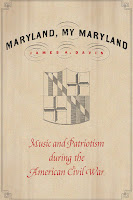 From the description: "Historians have long treated the patriotic anthems of the American Civil War as colorful, if largely insignificant, side notes. Beneath the surface of these songs, however, is a complex story. “Maryland, My Maryland” was one of the most popular Confederate songs during the American Civil War, yet its story is full of ironies that draw attention to the often painful and contradictory actions and beliefs that were both cause and effect of the war. Most telling of all, it was adopted as one of a handful of Southern anthems even though it celebrated a state that never joined the Confederacy."
• Maryland, My Maryland: Music and Patriotism during the American Civil War by James A. Davis (Univ of Neb Press, 2019).
 From the description: "Historians have long treated the patriotic anthems of the American Civil War as colorful, if largely insignificant, side notes. Beneath the surface of these songs, however, is a complex story. “Maryland, My Maryland” was one of the most popular Confederate songs during the American Civil War, yet its story is full of ironies that draw attention to the often painful and contradictory actions and beliefs that were both cause and effect of the war. Most telling of all, it was adopted as one of a handful of Southern anthems even though it celebrated a state that never joined the Confederacy."
In Maryland, My Maryland: Music and Patriotism during the American Civil War academic musicologist James A. Davis "illuminates the incongruities underlying this Civil War anthem and what they reveal about patriotism during the war. The geographic specificity of the song’s lyrics allowed the contest between regional and national loyalties to be fought on bandstands as well as battlefields and enabled “Maryland, My Maryland” to contribute to the shift in patriotic allegiance from a specific, localized, and material place to an ambiguous, inclusive, and imagined space. Musical patriotism, it turns out, was easy to perform but hard to define for Civil War–era Americans."
With many songs and anthems of this type freely borrowing their sheet music from popular existing tunes (for example, "O Tannenbaum" for "Maryland, My Maryland"), presumably the book examines that practice and tradition, as well. An epilogue discusses the postwar impact and history of "Maryland, My Maryland", which became the official state song, and touches very briefly on modern attempts to revise its lyrics or reduce its status altogether.
Thursday, December 20, 2018
Booknotes: Preparing for Disunion
New Arrival:
• Preparing for Disunion: West Point Commandants and the Training of Civil War Leaders by Allen H. Mesch (McFarland, 2018).
 Though I'm certainly not privy to the inner workings of West Point, it might be a reasonable guess to suggest that antebellum commandants had more opportunities to personally shape the education and training of the U.S. Army's professional elite than the institution heads of following eras. If that's indeed true, it would make Allen Mesch's Preparing for Disunion: West Point Commandants and the Training of Civil War Leaders even more illuminating to read and contemplate.
In case you're wondering, the sixteen officers that held the post over that time are George W. Gardiner, John Bliss, John R. Bell, William J. Worth, Ethan A. Hitchcock, John Fowle, Charles F. Smith, John A. Thomas, Bradford R. Alden, Robert S. Garnett, William H.T. Walker, William J. Hardee, John F. Reynolds, Christopher C. Augur, Kenner Garrard, and Henry B. Clitz.
• Preparing for Disunion: West Point Commandants and the Training of Civil War Leaders by Allen H. Mesch (McFarland, 2018).
 Though I'm certainly not privy to the inner workings of West Point, it might be a reasonable guess to suggest that antebellum commandants had more opportunities to personally shape the education and training of the U.S. Army's professional elite than the institution heads of following eras. If that's indeed true, it would make Allen Mesch's Preparing for Disunion: West Point Commandants and the Training of Civil War Leaders even more illuminating to read and contemplate.
From the description: "Between 1817 and 1864, sixteen officers were assigned as Commandants of Cadets at the U.S. Military Academy. They played an important role in training the officers who would serve on both sides of the Civil War. Historians criticize the program as antiquated for its time: A course in Napoleonic strategy and tactics that did not account for rifled weapons or the particularities of terrain. Yet these commandants made changes to the program, developed new textbooks and instructed cadets who became field generals. The biographies of the commandants are presented along with their contributions to the Academy, notable graduates and other military service."
In case you're wondering, the sixteen officers that held the post over that time are George W. Gardiner, John Bliss, John R. Bell, William J. Worth, Ethan A. Hitchcock, John Fowle, Charles F. Smith, John A. Thomas, Bradford R. Alden, Robert S. Garnett, William H.T. Walker, William J. Hardee, John F. Reynolds, Christopher C. Augur, Kenner Garrard, and Henry B. Clitz.
In addition to exploring the common duties of the West Point commandant during the early to mid 19th century period under consideration and presenting biographical sketches and a direct contributions discussion for each officer listed above, the book is packed with lists, charts, and tables. The appendix section goes into some depth on the antebellum graduating classes, with particular attention paid to those officers that would serve in the Civil War. Looks interesting.
Wednesday, December 19, 2018
Review - "High Private: The Trans-Mississippi Correspondence of Humorist R. R. Gilbert, 1862–1865" by Mary Cronin, ed.
[High Private: The Trans-Mississippi Correspondence of Humorist R. R. Gilbert, 1862–1865 edited by Mary M. Cronin (University of Tennessee Press, 2018). Hardcover, photos, notes, bibliography, index. Pages main/total:xii,271/335. ISBN:978-1-62190-445-8. $50]
 Rensselaer Reed Gilbert, a northern-born wartime humorist and reporter from Texas who wrote under the pen name High Private, was never as famous as Charles F. Brown's creation Artemus Ward, or Charles Henry Smith's Bill Arp, or David Locke's Petroleum V. Nasby, but he was a well-known "literary comedian" to citizens of the Confederate Trans-Mississippi. It's probably safe to say that the great majority of today's Civil War readers, including most serious students of the Civil War west of the Mississippi, have either never heard of him or have forgotten about him if they ever did. Details about Gilbert's personal life and his Vermont (some have said New York) upbringing remain sparse, but editor Mary Cronin makes good use of what information is available and builds significantly upon her earlier published work on Gilbert in her new book High Private: The Trans-Mississippi Correspondence of Humorist R. R. Gilbert, 1862–1865. The volume possesses significant biographical elements, but most of it consists of Cronin's edited compilation of a select but large body of Gilbert's newspaper writings (supplemented by a handful of revised war reminiscences originally published in the two early 1890s editions of Gilbert's Confederate Letters collection).
R.R. Gilbert had some apprentice medical training before the war but practiced little and instead attempted throughout his life to make a living in newspaper publication. Never a smashing pecuniary success at anything he tried, he lived a rather nomadic existence, starting a paper in one town only to soon either lose or sell the business before moving to another Texas community with his family to begin anew. A wag critic at the time suggested that Gilbert intended to fail at newspaper editorship in every town and city in the state.
Given that Gilbert was born and raised in a state that was as Yankee as one could find, an obvious question arises as to the source(s) of his seemingly wholesale adoption of southern culture, racial views, and radical pro-secession ideology. While Gilbert's conversion was far from an isolated case in antebellum America, it remains unfortunate that his innermost personal thoughts were not something he put to page (or if he did so privately such papers have either never been found or no longer exist). When his adopted state of Texas left the Union, Gilbert became an ardent Confederate nationalist and keen supporter of the war. Enlisting in Company B of the 6th Texas Volunteer Infantry Regiment, he frequently wrote to his home newspaper about his army experiences but never saw action before leaving the service to become a paid correspondent for the Houston Tri-Weekly Telegraph. Articles pertaining to his brief military service are generally limited in scope to remarks on camp life, drilling, training, and the government's inability to adequately arm and equip the men. When medically discharged in 1862 Gilbert was already past forty, much older than the typical Civil War private soldier.
Readers looking for detailed firsthand observations of Trans-Mississippi theater campaigns and battles won't find anything like that in his newspaper articles. Though Gilbert traveled some distances toward the front (ex. to Camden, Arkansas and Alexandria, Louisiana) to be near the most prominent generals in the department's military high command—particularly major generals John B. Magruder, Edmund Kirby Smith, and Richard Taylor—he was not a war correspondent in the traditional sense of accompanying the armies in the field. If he met and conversed with any of those high-ranking generals in person, he unfortunately did not record his impressions. Instead, Gilbert served his readers more in the capacity of news conduit between Texas and points east, an increasingly important job as the Trans-Mississippi became progressively isolated from the rest of the Confederacy beginning in 1863. Striving to convey news that was as accurate as possible, Gilbert actively canvassed Arkansas and Louisiana citizens for copies of cis-Mississippi newspapers of any origin, and he frequently chastised in print those owners reluctant to let him borrow them.
Not really a purveyor of detailed military news (though he did very frequently integrate hard news of various kinds into his writing), Gilbert's correspondence seems to have been primarily aimed at entertaining the home audience and boosting their morale after the war turned sour. He also certainly wasn't shy about creating shrill anti-Yankee propaganda for local consumption. He leveraged his northern background to both lend credibility to his propaganda and warn his fellow citizens that northerners would fight and fight very well. Alternately whimsical and bitingly critical, Gilbert's humor almost always employed creative wordplay and puns, and he used a number of recognizable rhetorical devices that Cronin discusses in the second chapter. Much of the time, Gilbert's articles combined humor and news (usually in that order) but also wrote many pieces that were entirely news, editorial, or comic sketch. His comedy was expressed in many different forms, too, among them songs, poetry, mock speeches, and the like.
As mentioned above, Gilbert could wield a sharp pen against friend and enemy alike. One rather expects to see exaggerated portraits of villainy when it comes to enemy soldiers and controversial northern generals like Ben Butler, but Gilbert also repeatedly criticized Confederate authorities for not paying the soldiers on time (or at all) and not supplying them properly. He also chastised civilians for war profiteering and shirking (the slow filling of ranks in the 6th being one factor behind why Gilbert saw no action during his brief army service). While humor proved to be a useful tool for relieving civilian stress amid the mounting pressures, worries, and privations of war, it also to some degree shielded critical yet loyal voices like Gilbert's from strong public and official reproach.
While Gilbert's wartime writing clearly demonstrates a deeply felt Confederate nationalism, his postwar correspondence indicates that he was also a highly pragmatic realist. Though undoubtedly rendered distraught by defeat and troubled by military occupation, he rather quickly accepted the new world he was confronted with and counseled other Texans to do the same. Rather than urging resistance, Gilbert lent his efforts fully toward promoting Texas's economic recovery and growth. What didn't change were his views on race. Feeling that freedpeople could never contribute to Texas's rebirth, Gilbert actively sought mass immigration from Europe to fulfill the state's labor and development needs.
Cronin, a journalism professor, does a fine job of adding historical and rhetorical context to Gilbert's life, writing content and style, and professional activities. She achieves this through two excellent introductory chapters, informative annotation, and careful selection of material. As mentioned before, not all of Gilbert's prodigious literary output is included in the book. Readers with a special interest in Civil War Houston might have benefited from the inclusion of Gilbert's "City Items" columns, but those are available online elsewhere. The work of R.R. Gilbert is richly deserving of the kind of reintroduction to modern readers that editor Mary Cronin provides so well, and the anthologized content and associated scholarship contained in High Private represents an important contribution to the study of war reporting in the Trans-Mississippi.

R.R. Gilbert had some apprentice medical training before the war but practiced little and instead attempted throughout his life to make a living in newspaper publication. Never a smashing pecuniary success at anything he tried, he lived a rather nomadic existence, starting a paper in one town only to soon either lose or sell the business before moving to another Texas community with his family to begin anew. A wag critic at the time suggested that Gilbert intended to fail at newspaper editorship in every town and city in the state.
Given that Gilbert was born and raised in a state that was as Yankee as one could find, an obvious question arises as to the source(s) of his seemingly wholesale adoption of southern culture, racial views, and radical pro-secession ideology. While Gilbert's conversion was far from an isolated case in antebellum America, it remains unfortunate that his innermost personal thoughts were not something he put to page (or if he did so privately such papers have either never been found or no longer exist). When his adopted state of Texas left the Union, Gilbert became an ardent Confederate nationalist and keen supporter of the war. Enlisting in Company B of the 6th Texas Volunteer Infantry Regiment, he frequently wrote to his home newspaper about his army experiences but never saw action before leaving the service to become a paid correspondent for the Houston Tri-Weekly Telegraph. Articles pertaining to his brief military service are generally limited in scope to remarks on camp life, drilling, training, and the government's inability to adequately arm and equip the men. When medically discharged in 1862 Gilbert was already past forty, much older than the typical Civil War private soldier.
Readers looking for detailed firsthand observations of Trans-Mississippi theater campaigns and battles won't find anything like that in his newspaper articles. Though Gilbert traveled some distances toward the front (ex. to Camden, Arkansas and Alexandria, Louisiana) to be near the most prominent generals in the department's military high command—particularly major generals John B. Magruder, Edmund Kirby Smith, and Richard Taylor—he was not a war correspondent in the traditional sense of accompanying the armies in the field. If he met and conversed with any of those high-ranking generals in person, he unfortunately did not record his impressions. Instead, Gilbert served his readers more in the capacity of news conduit between Texas and points east, an increasingly important job as the Trans-Mississippi became progressively isolated from the rest of the Confederacy beginning in 1863. Striving to convey news that was as accurate as possible, Gilbert actively canvassed Arkansas and Louisiana citizens for copies of cis-Mississippi newspapers of any origin, and he frequently chastised in print those owners reluctant to let him borrow them.
Not really a purveyor of detailed military news (though he did very frequently integrate hard news of various kinds into his writing), Gilbert's correspondence seems to have been primarily aimed at entertaining the home audience and boosting their morale after the war turned sour. He also certainly wasn't shy about creating shrill anti-Yankee propaganda for local consumption. He leveraged his northern background to both lend credibility to his propaganda and warn his fellow citizens that northerners would fight and fight very well. Alternately whimsical and bitingly critical, Gilbert's humor almost always employed creative wordplay and puns, and he used a number of recognizable rhetorical devices that Cronin discusses in the second chapter. Much of the time, Gilbert's articles combined humor and news (usually in that order) but also wrote many pieces that were entirely news, editorial, or comic sketch. His comedy was expressed in many different forms, too, among them songs, poetry, mock speeches, and the like.
As mentioned above, Gilbert could wield a sharp pen against friend and enemy alike. One rather expects to see exaggerated portraits of villainy when it comes to enemy soldiers and controversial northern generals like Ben Butler, but Gilbert also repeatedly criticized Confederate authorities for not paying the soldiers on time (or at all) and not supplying them properly. He also chastised civilians for war profiteering and shirking (the slow filling of ranks in the 6th being one factor behind why Gilbert saw no action during his brief army service). While humor proved to be a useful tool for relieving civilian stress amid the mounting pressures, worries, and privations of war, it also to some degree shielded critical yet loyal voices like Gilbert's from strong public and official reproach.
While Gilbert's wartime writing clearly demonstrates a deeply felt Confederate nationalism, his postwar correspondence indicates that he was also a highly pragmatic realist. Though undoubtedly rendered distraught by defeat and troubled by military occupation, he rather quickly accepted the new world he was confronted with and counseled other Texans to do the same. Rather than urging resistance, Gilbert lent his efforts fully toward promoting Texas's economic recovery and growth. What didn't change were his views on race. Feeling that freedpeople could never contribute to Texas's rebirth, Gilbert actively sought mass immigration from Europe to fulfill the state's labor and development needs.
Cronin, a journalism professor, does a fine job of adding historical and rhetorical context to Gilbert's life, writing content and style, and professional activities. She achieves this through two excellent introductory chapters, informative annotation, and careful selection of material. As mentioned before, not all of Gilbert's prodigious literary output is included in the book. Readers with a special interest in Civil War Houston might have benefited from the inclusion of Gilbert's "City Items" columns, but those are available online elsewhere. The work of R.R. Gilbert is richly deserving of the kind of reintroduction to modern readers that editor Mary Cronin provides so well, and the anthologized content and associated scholarship contained in High Private represents an important contribution to the study of war reporting in the Trans-Mississippi.
Tuesday, December 18, 2018
Booknotes: Civil War Barons
New Arrival:
• Civil War Barons: The Tycoons, Entrepreneurs, Inventors, and Visionaries Who Forged Victory and Shaped a Nation by Jeffry D. Wert (Da Capo, 2018).
 Jeffry Wert's Civil War Barons examines the lives and work of a number of northern creators and innovators who together made Union victory even more likely than it already was. "The Civil War woke a sleeping giant in America, creating unprecedented industrial growth that not only supported the struggle but reshaped the nation. Energized by the country's dormant potential and wealth of natural resources, individuals of vision, organizational talent, and capital took advantage of the opportunity that war provided. Their innovations sustained Union troops, affected military strategy and tactics, and made the killing fields even deadlier."
• Civil War Barons: The Tycoons, Entrepreneurs, Inventors, and Visionaries Who Forged Victory and Shaped a Nation by Jeffry D. Wert (Da Capo, 2018).
 Jeffry Wert's Civil War Barons examines the lives and work of a number of northern creators and innovators who together made Union victory even more likely than it already was. "The Civil War woke a sleeping giant in America, creating unprecedented industrial growth that not only supported the struggle but reshaped the nation. Energized by the country's dormant potential and wealth of natural resources, individuals of vision, organizational talent, and capital took advantage of the opportunity that war provided. Their innovations sustained Union troops, affected military strategy and tactics, and made the killing fields even deadlier."
Books like this are typically organized as a series of chapters, each devoted to a single individual. Wert's study instead adopts a more thematic approach with the stories of two of more "barons" examined in every chapter but one. With chapter headings of The Administrators, The Visionary, The Inventors, The Improvisers, The Patriots, The Investors, The Tinkerers, The Dreamers, The Opportunists, and The Builders, the variety of contributions addressed across society and industry is broad indeed. The author also does a fine job of mixing famous men with those that were well known in their own time but comparatively obscure historical figures to today's readers. So for every Jay Cooke, Cyrus McCormick, and Cornelius Vanderbilt, there's a Gordon McKay, Abram Hewitt, and Henry Burden.
As one might expect from Wert, his writing in Barons is stylistically easy going but backed by serious research. More from the description: "Individually, these men came to dominate industry and amass great wealth and power; collectively, they helped save the Union and refashion the economic fabric of a nation. Utilizing extensive research in manuscript collections, company records, and contemporary newspapers, historian Jeffry D. Wert casts a revealing light on the individuals most responsible for bringing the United States into the modern age."
Monday, December 17, 2018
Booknotes: Clara Barton's Civil War
New Arrival:
• Clara Barton's Civil War: Between Bullet and Hospital by Donald C. Pfanz (Westholme, 2018).
 Apart from those who mix her up with Britain's Florence Nightingale, Clara Barton has to be the most recognized name in the history of American military nursing. Interested in the Civil War or not, everyone has at least heard of her. Attempting to separate truth from legend, Donald Pfanz's Clara Barton's Civil War: Between Bullet and Hospital represents a fresh reappraisal of her wartime service. Barton "served in at least four Union armies, providing food and assistance to wounded soldiers on battlefields stretching from Maryland to South Carolina. Thousands of soldiers benefited from her actions, and she is unquestionably an American heroine." Like most individuals who survive and thrive in the national consciousness long after their passing, Barton had great PR, much of it created by herself.
• Clara Barton's Civil War: Between Bullet and Hospital by Donald C. Pfanz (Westholme, 2018).
 Apart from those who mix her up with Britain's Florence Nightingale, Clara Barton has to be the most recognized name in the history of American military nursing. Interested in the Civil War or not, everyone has at least heard of her. Attempting to separate truth from legend, Donald Pfanz's Clara Barton's Civil War: Between Bullet and Hospital represents a fresh reappraisal of her wartime service. Barton "served in at least four Union armies, providing food and assistance to wounded soldiers on battlefields stretching from Maryland to South Carolina. Thousands of soldiers benefited from her actions, and she is unquestionably an American heroine." Like most individuals who survive and thrive in the national consciousness long after their passing, Barton had great PR, much of it created by herself.
 From the description: "Most information about Barton’s activities comes from Barton herself. After the war, she toured the country recounting her wartime experiences to overflowing audiences. In vivid language, she described crossing the Rappahannock River under fire to succor wounded Union soldiers at Fredericksburg, transporting critical supplies to field hospitals at Antietam, and enduring searing heat and brackish water on the sun-scorched beaches of South Carolina. She willingly braved hardship and danger in order to help the young men under her care, receiving in return their love and respect. Most of Barton’s biographers have accepted her statements at face value, but in doing so, they stand on shaky ground, for Barton was a relentless self-promoter and often embellished her stories in an effort to enhance her accomplishments."
In the book, Pfanz "revisits Barton’s claims, comparing the information in her speeches with contemporary documents, including Barton’s own wartime diary and letters. In doing so, he provides the first balanced and accurate account of her wartime service—a service that in the end needed no exaggeration."
Sunday, December 16, 2018
More on Greene's "A Campaign of Giants" Vol. 1
Every once in a blue moon I get a note from the author of a reviewed title. Last week, A. Wilson Greene nicely emailed me about an issue he had with my highly positive review of his most recent book A Campaign of Giants - The Battle for Petersburg, Volume 1: From the Crossing of the James to the Crater (2018) and with how I encapsulated his views on Meade in a later interview with Meade biographer John Selby. It turns out that my summary characterization of Greene's views on Meade at Petersburg are not exactly in line with the author's true feelings or intentions. Indeed, they are much opposed. I always welcome comments from anyone about the reviews on the site, so I invited him to leave a comment on the review page or better yet put together a rebuttal of sorts that I could publish as a standalone post where more people would see it.
Not getting a response either way, I think my obligation ends there but I'm not really comfortable leaving it at that. Many readers tend to want to box authors and biographers into pro and anti camps, and I didn't want to have my review construed by anyone in the opposite way that the author intended. That said, I stand by everything that I wrote in the review (which was published eight months ago), as it represents my honest impression of the accumulated arguments presented in the book.
So, what can I say? I'm not going to block quote from a private email, but I think I can appropriately try to encapsulate Greene's objections. Apparently, my impression that Meade had outlived his usefulness as an effective army commander by the end of the period covered in the book is not at all the view that Greene wanted to convey. He doesn't see any of the failures and mistakes committed during the initial offensives as singularly attached to Meade but rather liberally shared among the rest of the theater's high command. Greene by no means self-describes himself as a Meade "detractor."
I think that's a good overview of what he shared with me, and I'll link to this on both the original book review and the Selby interview.
Not getting a response either way, I think my obligation ends there but I'm not really comfortable leaving it at that. Many readers tend to want to box authors and biographers into pro and anti camps, and I didn't want to have my review construed by anyone in the opposite way that the author intended. That said, I stand by everything that I wrote in the review (which was published eight months ago), as it represents my honest impression of the accumulated arguments presented in the book.
So, what can I say? I'm not going to block quote from a private email, but I think I can appropriately try to encapsulate Greene's objections. Apparently, my impression that Meade had outlived his usefulness as an effective army commander by the end of the period covered in the book is not at all the view that Greene wanted to convey. He doesn't see any of the failures and mistakes committed during the initial offensives as singularly attached to Meade but rather liberally shared among the rest of the theater's high command. Greene by no means self-describes himself as a Meade "detractor."
I think that's a good overview of what he shared with me, and I'll link to this on both the original book review and the Selby interview.
Saturday, December 15, 2018
Booknotes: On Duty in the Pacific Northwest during the Civil War
New Arrival:
• On Duty in the Pacific Northwest during the Civil War: Correspondence and Reminiscences of the First Oregon Cavalry Regiment edited by James Robbins Jewell
(UT Press, 2018).
 When regular army troops stationed in the Far West departed to points east at the outbreak of the Civil War, it was largely California volunteers that picked up the slack. Garrisoning key posts and keeping tabs on both internal dissent and potentially hostile tribes, they ranged all across the West's vast expanses, including the Pacific Northwest. Published primary source accounts of their service in the region are few, and by far the best-known is Royal Bensell's edited journal All Quiet on the Yamhill: The Civil War in Oregon (1959). But Oregon raised troops of their own, too, and James Robbins Jewell's new collection of wartime letters written by Oregon volunteers titled On Duty in the Pacific Northwest during the Civil War: Correspondence and Reminiscences of the First Oregon Cavalry Regiment is now available as part of UT Press's classic Voices of the Civil War series.
• On Duty in the Pacific Northwest during the Civil War: Correspondence and Reminiscences of the First Oregon Cavalry Regiment edited by James Robbins Jewell
(UT Press, 2018).
 When regular army troops stationed in the Far West departed to points east at the outbreak of the Civil War, it was largely California volunteers that picked up the slack. Garrisoning key posts and keeping tabs on both internal dissent and potentially hostile tribes, they ranged all across the West's vast expanses, including the Pacific Northwest. Published primary source accounts of their service in the region are few, and by far the best-known is Royal Bensell's edited journal All Quiet on the Yamhill: The Civil War in Oregon (1959). But Oregon raised troops of their own, too, and James Robbins Jewell's new collection of wartime letters written by Oregon volunteers titled On Duty in the Pacific Northwest during the Civil War: Correspondence and Reminiscences of the First Oregon Cavalry Regiment is now available as part of UT Press's classic Voices of the Civil War series.
From the description: "From 1862 to 1865, twenty-six hundred miles away from the seat of the federal government in Washington, DC, the First Oregon Volunteer Cavalry Regiment offered aid to the Union cause in the American Civil War. The First Oregon Cavalry confronted a host of complex challenges unseen by their counterparts serving in a more traditional role in the East. Their battles were more often with Native Americans—and often more concerned with their own status in the territory than with the Civil War rending the nation—while searching for pro Confederate spies and sympathizers. However unsung during the war, the regiment carried out their responsibilities successfully, managing to expedite the development of the Pacific Northwest in the process."
Jewell's edited collection also represents the closest thing we currently have to a 1st Oregon regimental study. "Complete with a series of reminiscences and excerpts from memoirs by First Oregon Cavalry officers and soldiers, On Duty in the Pacific Northwest during the Civil War is the first collection of primary source materials from soldiers serving in this Far Western territory. Jewell’s first-rate collection enables readers to step directly into the Pacific Northwest of the early 1860s and experience the Civil War from a different perspective." I've been waiting all year to get my hands on this title, and it looks great. Expect a review fairly soon.
Thursday, December 13, 2018
Review - "The Calculus of Violence: How Americans Fought the Civil War" by Aaron Sheehan-Dean
[The Calculus of Violence: How Americans Fought the Civil War by Aaron Sheehan-Dean (Harvard University Press, 2018). Hardcover, 15 photos/illustrations, notes, bibliography, index. Pages main/total:358/480. ISBN:978-0-674-98422-6. $35]
 The question of whether the American Civil War was a limited conflict still connected to Enlightenment ideals of military restraint and non-targeting of civilians or was an early version of modern total war remains much debated today. Less concerned with weighing in one way or another on that particular issue, Aaron Sheehan-Dean's The Calculus of Violence: How Americans Fought the Civil War is primarily interested in examining the modulating interaction that existed between the many social, military, and political factors that exacerbated Civil War violence and the range of enemy responses that deescalated those very same volatile situations that threatened to spiral out of control. According to the author, in this 'calculus of violence' moral and physical restraint ultimately won out, but not without considerable stretching and violations of the rules of war by both sides.
For some time now, cracks have regularly appeared in the traditional interpretation that Civil War violence and destruction increased along a linear path, with mid-1862 being the tipping point between abandonment of limited war (or conciliatory) objectives and the earnest application of hard war. Sheehan-Dean agrees with those that have more recently argued that hard war style human violence and property destruction existed from the very beginning of the conflict. His alternative characterization of escalating violence as unevenly distributed (in both human and geographical terms) and progressing in fits and starts with periodic pull back (even during the latter years of the war when most assume peak violence to have occurred) much better fits the collective impression gained from the widest reading of the current literature.
Clay Mountcastle and Daniel Sutherland, both astute and influential scholars of the irregular Civil War, would certainly approve of Sheehan-Dean's assigning guerrilla warfare a prominent role in the amplification of Civil War violence. In the author's view, the Confederate government's early acceptance and even encouragement (or at least lack of active discouragement) of guerrilla warfare doomed vast areas of the South and Border States to lawlessness and exposed civilians (guilty and innocent alike) to harsh and frequently disproportionate Union reprisal measures. But it could have been much worse, and the author persuasively credits federal retaliation policies, or just the threat of same, for providing a reasonably effective braking mechanism to the violence. Banishment, imprisonment, bond & oath taking requirements, and other non-lethal measures were also employed to effect, particularly in the breaking up of guerrilla support networks. The personalized nature of guerrilla violence created intense emotions and desires for revenge, and it is also perceptively noted in the book that institutional procedures and the non-instantaneous nature of nineteenth century communications created delays in response that usefully doubled as cooling off periods.
As the study shows, both sides attempted to use various moral and legal considerations to elevate the justness of their own cause and diminish the enemy's, while at the same time ignoring their own excesses and ethical failings (often for same or similar offenses). Guerrilla warfare can serve as a good example of this. It is somewhat unfortunate that the author characterizes the war's guerrilla conflict as distinctly Confederate when in truth pro-Union (or anti-Confederate) guerrillas operated in contested areas with similarly muted official opposition. During the war, many Union commanders sanctioned irregular forces whose actions closely mirrored those so vehemently condemned when committed by the enemy. Placing such a strong degree of blame for the guerrilla crisis on Confederate government officials also seems only partially valid, as many of the worst actors operated in areas outside of the Confederacy itself (ex. in Missouri and Kentucky) or committed depredations in enemy occupied or isolated places beyond practical reach. In a true people's contest, as the American Civil War arguably was, it would be hard to imagine guerrilla warfare not arising within occupied rear areas or isolated districts regardless of official government policy. One of the primary reasons individuals joined guerrilla outfits was to avoid being placed under any kind of regimented control, and it is unlikely that such men would have listened to any edicts from far off Richmond or feared suppression from a vastly overstretched Confederate Army. Rather than just critiquing the Partisan Ranger Act of 1862 on the grounds of how the law sanctioned and promoted a highly inadvisable, illegal, and unjust mode of warfare while also cynically providing legal cover for those same bad actors, one might reasonably also see it as a good faith (if tragically naive) attempt to exert governmental order and regulatory oversight over a problem already getting out of hand. The book also fails to mention that the Act was repealed by the Confederate Congress in February 1864.
Emancipation, the Union Army's employment of black troops (the vast majority of whom were freed slaves), and the Confederate response to those decisions all joined guerrilla warfare as factors that significantly exacerbated the scale and intensity of Civil War violence. Like the guerrilla war, large-scale black enlistment directly contributed to heated debates within and between the warring sections over who could decide the status of lawful vs. unlawful combatants. In retrospect, it seems inevitable that widespread abuses and unlawful killings would occur when Confederate troops inculcated with servile insurrection fears encountered black soldiers assumed to have been placed into Union ranks for the very purpose of sparking mass slave uprisings and race war. From the Confederate perspective, these men were illegitimate enemies not subject to treatment under the laws of war. However, Sheehan-Dean sees this argument of inevitability as a false assumption, and cites several international examples of colonial armies putting ex-slaves in their ranks to fight against their former masters, acts that apparently did not produce violent objections of the kind seen during the American Civil War. Unfortunately, not enough contextual details are presented to properly assess the appropriateness of the comparison. Regardless, Union retaliatory measures, both real and threatened, helped ensure that black flag warfare would not be the rule whenever Confederate troops encountered black Union regiments on the battlefield, though unlawful mistreatment of black POWs continued to be routine.
Violent slave rebellion easily had the greatest potential to comprehensibly devastate the South and result in civilian casualty levels similar to those produced by contemporary Civil Wars like the Taiping Rebellion in China. That nothing of the kind occurred during the American Civil War came as a true surprise to the strongest critics, north and south, of emancipation and black enlistment. Like other scholars, Sheehan-Dean sees slaves as having been more concerned with gaining freedom than revenge. He also concurs with the view that the tenets of Christianity instilled into slaves over generations very likely had a restraining effect.
Discussed here are just some of the most significant ingredients to Civil War violence's toxic brew. Of the remaining factors discussed at some length in the book, one of the most interesting is the author's positive assessment of the role of the nation-state. Rightly and wrongly, the reputation of the modern nation-state and the nationalism associated with it took a severe hit in the aftermath of the bloodbaths of the twentieth century. However, Sheehan-Dean convincingly argues that the construct of the nation-state and all the idealized aspirations that went with it (including a desire for acceptance in the international community of nations) had salutary restraining effects on both sides during the American Civil War. Though lacking formal recognition, it's undeniable that the Confederacy created a functioning democratic nation-state in the midst of war, which was an unusual achievement for the rebelling side in historical civil conflicts of similar scale. Attaining the status of an internationally recognized and respected nation-state was important to both sides, and democratic nationhood's institutional checks and balances, accountable law and order systems, open lines of communication, and desire to appear morally upright in the eyes of the rest of the world all combined to restrain the kinds of ultraviolent excesses typically seen during civil wars.
It should also be mentioned that the author is clearly not ingenuous when it comes to assessing the laws of war and their positive restraining effects. He certainly recognizes that the laws of war were often bent and manipulated by each side, both to justify their own questionable conduct and to attempt to restrict the enemy's employment of tools and tactics of proven use against them. Moral malleability also occurred hand in hand with self-serving legal and political machinations. One of the best examples provided in the book is the war's transformation of much of the North's pacifist abolitionist element into one of the conflict's most radical proponents of unrestrained violence against enemy combatants and civilians.
In presenting the material, Sheehan-Dean does a fine job of melding his own research with a well-selected synthesis of the best existing scholarship. With some notable exceptions (for example, his insistence that the bombing of the military depot at City Point by Confederate saboteurs represented one of the war's worst atrocities), the author generally avoids channeling readers toward starkly black and white conclusions, instead inviting them to pass their own judgment. One might argue that he applies the just vs. unjust label a bit too freely in the book, but it cannot be expected that authors to be equivocal on everything, nor should they be.
It is popular to say that in war violence tends to take on a life of its own with consequences unforeseen by anyone, but Sheehan-Dean's study effectively reminds us that deliberate decisions made by the human actors in the drama are at least as important in shaping that violence, and likely more so. As terrible as the reality of the American Civil War was to both civilians and combatants, The Calculus of Violence shows that the conflict held great potential to in many ways become far more devastating.

For some time now, cracks have regularly appeared in the traditional interpretation that Civil War violence and destruction increased along a linear path, with mid-1862 being the tipping point between abandonment of limited war (or conciliatory) objectives and the earnest application of hard war. Sheehan-Dean agrees with those that have more recently argued that hard war style human violence and property destruction existed from the very beginning of the conflict. His alternative characterization of escalating violence as unevenly distributed (in both human and geographical terms) and progressing in fits and starts with periodic pull back (even during the latter years of the war when most assume peak violence to have occurred) much better fits the collective impression gained from the widest reading of the current literature.
Clay Mountcastle and Daniel Sutherland, both astute and influential scholars of the irregular Civil War, would certainly approve of Sheehan-Dean's assigning guerrilla warfare a prominent role in the amplification of Civil War violence. In the author's view, the Confederate government's early acceptance and even encouragement (or at least lack of active discouragement) of guerrilla warfare doomed vast areas of the South and Border States to lawlessness and exposed civilians (guilty and innocent alike) to harsh and frequently disproportionate Union reprisal measures. But it could have been much worse, and the author persuasively credits federal retaliation policies, or just the threat of same, for providing a reasonably effective braking mechanism to the violence. Banishment, imprisonment, bond & oath taking requirements, and other non-lethal measures were also employed to effect, particularly in the breaking up of guerrilla support networks. The personalized nature of guerrilla violence created intense emotions and desires for revenge, and it is also perceptively noted in the book that institutional procedures and the non-instantaneous nature of nineteenth century communications created delays in response that usefully doubled as cooling off periods.
As the study shows, both sides attempted to use various moral and legal considerations to elevate the justness of their own cause and diminish the enemy's, while at the same time ignoring their own excesses and ethical failings (often for same or similar offenses). Guerrilla warfare can serve as a good example of this. It is somewhat unfortunate that the author characterizes the war's guerrilla conflict as distinctly Confederate when in truth pro-Union (or anti-Confederate) guerrillas operated in contested areas with similarly muted official opposition. During the war, many Union commanders sanctioned irregular forces whose actions closely mirrored those so vehemently condemned when committed by the enemy. Placing such a strong degree of blame for the guerrilla crisis on Confederate government officials also seems only partially valid, as many of the worst actors operated in areas outside of the Confederacy itself (ex. in Missouri and Kentucky) or committed depredations in enemy occupied or isolated places beyond practical reach. In a true people's contest, as the American Civil War arguably was, it would be hard to imagine guerrilla warfare not arising within occupied rear areas or isolated districts regardless of official government policy. One of the primary reasons individuals joined guerrilla outfits was to avoid being placed under any kind of regimented control, and it is unlikely that such men would have listened to any edicts from far off Richmond or feared suppression from a vastly overstretched Confederate Army. Rather than just critiquing the Partisan Ranger Act of 1862 on the grounds of how the law sanctioned and promoted a highly inadvisable, illegal, and unjust mode of warfare while also cynically providing legal cover for those same bad actors, one might reasonably also see it as a good faith (if tragically naive) attempt to exert governmental order and regulatory oversight over a problem already getting out of hand. The book also fails to mention that the Act was repealed by the Confederate Congress in February 1864.
Emancipation, the Union Army's employment of black troops (the vast majority of whom were freed slaves), and the Confederate response to those decisions all joined guerrilla warfare as factors that significantly exacerbated the scale and intensity of Civil War violence. Like the guerrilla war, large-scale black enlistment directly contributed to heated debates within and between the warring sections over who could decide the status of lawful vs. unlawful combatants. In retrospect, it seems inevitable that widespread abuses and unlawful killings would occur when Confederate troops inculcated with servile insurrection fears encountered black soldiers assumed to have been placed into Union ranks for the very purpose of sparking mass slave uprisings and race war. From the Confederate perspective, these men were illegitimate enemies not subject to treatment under the laws of war. However, Sheehan-Dean sees this argument of inevitability as a false assumption, and cites several international examples of colonial armies putting ex-slaves in their ranks to fight against their former masters, acts that apparently did not produce violent objections of the kind seen during the American Civil War. Unfortunately, not enough contextual details are presented to properly assess the appropriateness of the comparison. Regardless, Union retaliatory measures, both real and threatened, helped ensure that black flag warfare would not be the rule whenever Confederate troops encountered black Union regiments on the battlefield, though unlawful mistreatment of black POWs continued to be routine.
Violent slave rebellion easily had the greatest potential to comprehensibly devastate the South and result in civilian casualty levels similar to those produced by contemporary Civil Wars like the Taiping Rebellion in China. That nothing of the kind occurred during the American Civil War came as a true surprise to the strongest critics, north and south, of emancipation and black enlistment. Like other scholars, Sheehan-Dean sees slaves as having been more concerned with gaining freedom than revenge. He also concurs with the view that the tenets of Christianity instilled into slaves over generations very likely had a restraining effect.
Discussed here are just some of the most significant ingredients to Civil War violence's toxic brew. Of the remaining factors discussed at some length in the book, one of the most interesting is the author's positive assessment of the role of the nation-state. Rightly and wrongly, the reputation of the modern nation-state and the nationalism associated with it took a severe hit in the aftermath of the bloodbaths of the twentieth century. However, Sheehan-Dean convincingly argues that the construct of the nation-state and all the idealized aspirations that went with it (including a desire for acceptance in the international community of nations) had salutary restraining effects on both sides during the American Civil War. Though lacking formal recognition, it's undeniable that the Confederacy created a functioning democratic nation-state in the midst of war, which was an unusual achievement for the rebelling side in historical civil conflicts of similar scale. Attaining the status of an internationally recognized and respected nation-state was important to both sides, and democratic nationhood's institutional checks and balances, accountable law and order systems, open lines of communication, and desire to appear morally upright in the eyes of the rest of the world all combined to restrain the kinds of ultraviolent excesses typically seen during civil wars.
It should also be mentioned that the author is clearly not ingenuous when it comes to assessing the laws of war and their positive restraining effects. He certainly recognizes that the laws of war were often bent and manipulated by each side, both to justify their own questionable conduct and to attempt to restrict the enemy's employment of tools and tactics of proven use against them. Moral malleability also occurred hand in hand with self-serving legal and political machinations. One of the best examples provided in the book is the war's transformation of much of the North's pacifist abolitionist element into one of the conflict's most radical proponents of unrestrained violence against enemy combatants and civilians.
In presenting the material, Sheehan-Dean does a fine job of melding his own research with a well-selected synthesis of the best existing scholarship. With some notable exceptions (for example, his insistence that the bombing of the military depot at City Point by Confederate saboteurs represented one of the war's worst atrocities), the author generally avoids channeling readers toward starkly black and white conclusions, instead inviting them to pass their own judgment. One might argue that he applies the just vs. unjust label a bit too freely in the book, but it cannot be expected that authors to be equivocal on everything, nor should they be.
It is popular to say that in war violence tends to take on a life of its own with consequences unforeseen by anyone, but Sheehan-Dean's study effectively reminds us that deliberate decisions made by the human actors in the drama are at least as important in shaping that violence, and likely more so. As terrible as the reality of the American Civil War was to both civilians and combatants, The Calculus of Violence shows that the conflict held great potential to in many ways become far more devastating.
Subscribe to:
Posts (Atom)