The spring harvest has begun. As usual, there will surely be early releases and other unexpected arrivals to add to the list as the month progresses.
• Civil War Writing: New Perspectives on Iconic Texts ed. by Gallagher and Cushman.
• Civil War Places: Seeing the Conflict through the Eyes of Its Leading Historians ed. by Gallagher and Gallman.
• France and the American Civil War: A Diplomatic History by Stève Sainlaude.
• Longstreet at Gettysburg: A Critical Reassessment by Cory Pfarr.
• All Hell Can’t Stop Them: The Battles for Chattanooga―Missionary Ridge and Ringgold, November 24-27, 1863 by David Powell.
• Presidents, Battles, and Must-See Civil War Destinations: Exploring a Kentucky Divided by Ludwick and Hess.
• The Last Battleground: The Civil War Comes to North Carolina by Philip Gerard.
• Armies of Deliverance: A New History of the Civil War by Elizabeth Varon.
• Illusions of Emancipation: The Pursuit of Freedom and Equality in the Twilight of Slavery by Joseph Reidy.
• Lincoln, Seward, and US Foreign Relations in the Civil War Era by Joseph Fry.
• The Seventh West Virginia Infantry: An Embattled Union Regiment from the Civil War's Most Divided State by Mellott and Snell.
• Yank and Rebel Rangers: Special Operations in the American Civil War by Robert Black.
• Propaganda from the American Civil War by Paul Springer.
• Bicycling Gettysburg National Military Park: The Cyclist's Civil War Travel Guide by Sue Thibodeau.
• Private Confederacies: The Emotional Worlds of Southern Men as Citizens and Soldiers by James Broomall.
• Campaign for Wilson's Creek: The Fight for Missouri Begins, Updated Edition by Jeff Patrick.
• Healing Civil War Veterans in New York and Washington, D.C. by Heather Butts.
• Dear Delia: The Civil War Letters of Captain Henry F. Young, Seventh Wisconsin Infantry ed. by Larson and Smith.
• Lone Star Valor: Texans of the Blue & Gray at Gettysburg by Joe Owen.


Paid Sponsor
Saturday, March 2, 2019


Friday, March 1, 2019
Review - "Blue and Gray on the Border: The Rio Grande Valley Civil War Trail" by Miller, Skowronek, & Bacha-Garza
[BLUE AND GRAY ON THE BORDER: The Rio Grande Valley Civil War Trail by Christopher L. Miller, Russell K. Skowronek, and Roseann Bacha-Garza (Texas A&M University Press, 2018). Flexbound, maps, photos, drawings, tables, source lists, index. Pages main/total:xxv,191/200. ISBN:978-1-62349-682-1. $28]
 Taking their cue from the educational and economic success stories of similar trail projects created in other parts of the country possessing rich collections of Civil War era historical sites, a small group of individuals at University of Texas-Pan American in 2012 planted the seeds of what would eventually become the Rio Grande Valley Civil War Trail. Between that time and the present a number of educators, government agencies, historical societies, museums, and other groups joined the effort. Their collective work resulted in a jointly funded, bilingual Lower Rio Grande historical trail spanning five Texas border counties (Cameron, Hidalgo, Starr, Webb, and Zapata). An illustrated history and travel guide designed to directly engage readers and travelers with this ambitious project, which begins at the Gulf Coast's Point Isabel Lighthouse and ends approximately 200 miles upriver at Laredo, has just been published under the title Blue and Gray on the Border: The Rio Grande Valley Civil War Trail.
The long settled history of the valley of the Lower Rio Grande is a complicated one with prominent international elements, and co-authors Christopher Miller, Russell Skowronek, and Roseann Bacha-Garza appropriately begin their book with a brief but helpful contextual refresher course on the border region's history from the Spanish colonial period through Mexican Independence, the U.S.-Mexican War, the American Civil War, and Reconstruction. The guide's collection of Rio Grande Valley Civil War Trail historical sites are organized into five chapters, one for each county. With African-American connections to the border an additional topic of emphasis in the book, discussion includes settlers who took advantage of the border region's comparatively higher tolerance for biracial families. In addition, a standalone chapter is devoted to the black military experience during and after the Civil War. Especially during the Reconstruction period, black troops formed a large part of the U.S. army contingent tasked with border security, cross-border trade regulation, and protection of Texas Unionists and freedpeople from violence.
Among the great diversity of historical locations featured on the virtual trail are ranches, cities, towns, homes, hospitals, cemeteries, memorials, museums, battle sites, and forts. More site register than complete tour guide, the book does not provide detailed driving directions for following the entire length of the trail. However, street addresses, access information, GPS coordinates, and other applicable location information are included for each site on a standalone basis. Each trail stop also has its own extension number for visitors wishing to take advantage of the "mobile web" experience through their cell phones. Supplementing the guide's text is a profusion of photos (B&W and color), maps (period and original), and tables.
Several paragraphs of informative historical background narrative accompany each trail stop sub-section, as do full text transcriptions (where relevant) of Texas Historical Commission markers. It might seem out of place that the trail has so many places associated with the Mexican War, but these entries offer useful context for many Civil War events like the bloody cross-border rivalry that developed between Union ally Juan Cortina and Confederate officer Santos Benavides. Sites are suitably selected in support of common themes that convey the local, national, and international importance of the Texas borderland during the Civil War period and beyond. For example, a great many trail stops represent key geographical points and events related to the border trade economy (southern cotton in exchange for otherwise unobtainable supplies, medicines, consumer goods, and war materials) that were critical to the maintenance and survival of the Confederate Trans-Mississippi Department. Union authorities attempted to choke off this regional trade outlet that was immune to naval blockade at various times during the war and many trail locations are associated with their military interventions.
Readers are, of course, encouraged to visit the trail's official website (here) for more information. The guide should also be regarded as an introductory companion to Civil War on the Rio Grande, 1846-1876. Edited by Miller, Skowronek, and Bacha-Garza, that recently released volume from the same publisher contains a series of scholarly essays addressing at greater depth many of the same events and themes introduced in Blue and Gray on the Border. Hopefully, books, website, and trail will collectively inspire wider popular interest in the social, political, military, and economic history of the Lower Rio Grande River Valley during the Civil War era.

The long settled history of the valley of the Lower Rio Grande is a complicated one with prominent international elements, and co-authors Christopher Miller, Russell Skowronek, and Roseann Bacha-Garza appropriately begin their book with a brief but helpful contextual refresher course on the border region's history from the Spanish colonial period through Mexican Independence, the U.S.-Mexican War, the American Civil War, and Reconstruction. The guide's collection of Rio Grande Valley Civil War Trail historical sites are organized into five chapters, one for each county. With African-American connections to the border an additional topic of emphasis in the book, discussion includes settlers who took advantage of the border region's comparatively higher tolerance for biracial families. In addition, a standalone chapter is devoted to the black military experience during and after the Civil War. Especially during the Reconstruction period, black troops formed a large part of the U.S. army contingent tasked with border security, cross-border trade regulation, and protection of Texas Unionists and freedpeople from violence.
Among the great diversity of historical locations featured on the virtual trail are ranches, cities, towns, homes, hospitals, cemeteries, memorials, museums, battle sites, and forts. More site register than complete tour guide, the book does not provide detailed driving directions for following the entire length of the trail. However, street addresses, access information, GPS coordinates, and other applicable location information are included for each site on a standalone basis. Each trail stop also has its own extension number for visitors wishing to take advantage of the "mobile web" experience through their cell phones. Supplementing the guide's text is a profusion of photos (B&W and color), maps (period and original), and tables.
Several paragraphs of informative historical background narrative accompany each trail stop sub-section, as do full text transcriptions (where relevant) of Texas Historical Commission markers. It might seem out of place that the trail has so many places associated with the Mexican War, but these entries offer useful context for many Civil War events like the bloody cross-border rivalry that developed between Union ally Juan Cortina and Confederate officer Santos Benavides. Sites are suitably selected in support of common themes that convey the local, national, and international importance of the Texas borderland during the Civil War period and beyond. For example, a great many trail stops represent key geographical points and events related to the border trade economy (southern cotton in exchange for otherwise unobtainable supplies, medicines, consumer goods, and war materials) that were critical to the maintenance and survival of the Confederate Trans-Mississippi Department. Union authorities attempted to choke off this regional trade outlet that was immune to naval blockade at various times during the war and many trail locations are associated with their military interventions.
Readers are, of course, encouraged to visit the trail's official website (here) for more information. The guide should also be regarded as an introductory companion to Civil War on the Rio Grande, 1846-1876. Edited by Miller, Skowronek, and Bacha-Garza, that recently released volume from the same publisher contains a series of scholarly essays addressing at greater depth many of the same events and themes introduced in Blue and Gray on the Border. Hopefully, books, website, and trail will collectively inspire wider popular interest in the social, political, military, and economic history of the Lower Rio Grande River Valley during the Civil War era.
Thursday, February 28, 2019
Booknotes: Confederate Generals in the Trans-Mississippi, Volume 3
New Arrival:
• Confederate Generals in the Trans-Mississippi, Volume 3: Essays on America's Civil War edited by Lawrence Lee Hewitt and Thomas E. Schott (Univ of Tenn Press, 2019).
 I was happy to learn soon after UT Press's Confederate Generals in the Western Theater series ended its run that a third and final Trans-Mississippi volume was in the works. Released earlier this month, Confederate Generals in the Trans-Mississippi, Volume 3: Essays on America's Civil War "offers eight new essays on generals engaged in the effort to secure a region whose unique challenges would have daunted the best of commanders."
• Confederate Generals in the Trans-Mississippi, Volume 3: Essays on America's Civil War edited by Lawrence Lee Hewitt and Thomas E. Schott (Univ of Tenn Press, 2019).
 I was happy to learn soon after UT Press's Confederate Generals in the Western Theater series ended its run that a third and final Trans-Mississippi volume was in the works. Released earlier this month, Confederate Generals in the Trans-Mississippi, Volume 3: Essays on America's Civil War "offers eight new essays on generals engaged in the effort to secure a region whose unique challenges would have daunted the best of commanders."
 As before, the essays examine the Civil War careers of Confederate generals either in part (focusing on particular battles, campaigns, or other specific periods) or in full. Of the latter variety in Volume 3 are chapters on generals Hamilton Bee, James Fagan, and John Wharton. Of the former category we get "Joseph G. Dawson III on Earl Van Dorn’s efforts to bring order to the chaos of the Trans-Mississippi District and how his experiences affected his battlefield performance in 1862; Jeffery M. Prushankin on the administrative nightmares facing Edmund Kirby Smith when he assumed responsibility for the region in 1863; and Richard Holloway on the formidable army commander Richard Taylor and the all-but-forgotten effort to move Confederate troops east of the Mississippi in 1864." The remaining essays follow William Boggs's actions in Louisiana and cavalry general Tom Green's 1863 rise to a prominent leadership position in the same state.
Wednesday, February 27, 2019
Booknotes: Lions of the Dan
New Arrival:
• Lions of the Dan: The Untold Story of Armistead's Brigade by J.K. Brandau
(Morgan James Pub, 2019).
 "Lions of the Dan" sounds like a cool name for a band, but in this case it is the title of J.K. Brandau's upcoming study of Lewis Armistead's brigade of Virginians (the "Dan" part clearly in reference to the river that meanders along the border between Virginia and North Carolina, with adjoining counties being the source of most of the brigade's recruits). "Popular history lionizes Armistead's Brigade at the climax of Pickett's Charge. The moment transformed its prosaic brigadier into an icon of heroism in art and legend. Armistead perished, but his brigade endured, and its Southside Virginia soldiers exhibited indomitable courage throughout the Civil War. Lions of the Dan: The Untold Story of Armistead's Brigade chronicles those men of Pickett's Charge over the full course of the Civil War."
• Lions of the Dan: The Untold Story of Armistead's Brigade by J.K. Brandau
(Morgan James Pub, 2019).
 "Lions of the Dan" sounds like a cool name for a band, but in this case it is the title of J.K. Brandau's upcoming study of Lewis Armistead's brigade of Virginians (the "Dan" part clearly in reference to the river that meanders along the border between Virginia and North Carolina, with adjoining counties being the source of most of the brigade's recruits). "Popular history lionizes Armistead's Brigade at the climax of Pickett's Charge. The moment transformed its prosaic brigadier into an icon of heroism in art and legend. Armistead perished, but his brigade endured, and its Southside Virginia soldiers exhibited indomitable courage throughout the Civil War. Lions of the Dan: The Untold Story of Armistead's Brigade chronicles those men of Pickett's Charge over the full course of the Civil War."
Though Armistead's Brigade was composed of five infantry regiments (9th, 14th, 38th, 53rd, and 57th Virginia), the author adopts the convention of focusing his narrative upon a representative unit. The 38th Virginia (the "Pittsylvania Regiment") was understandably chosen because it hailed from the county (Pittsylvania) that supplied a quarter of the brigade's manpower.
Out of fifteen total chapters, only one covers Gettysburg and another the immediate aftermath, so the most iconic moment of the brigade's Civil War experience is not (over)emphasized to the exclusion of the rest of the formation's extensive service history. When I think of Armistead's Brigade I also think of Malvern Hill, and the book includes a standalone chapter on that battle as well as others covering Seven Pines, 2nd Manassas/Antietam, Fredericksburg, Siege of Suffolk, New Bern, and the Richmond-Petersburg Campaign. The bibliography is fairly modest in overall size, but the author did conduct his own archival research at a number of repositories located mostly in Virginia and North Carolina. One thing I immediately noticed while thumbing through the book was the lack of maps, which is an unfortunate omission in a unit study of any kind.
Though the review copy I received is the finished version, the official release date from the publisher is still September 3, so it will be a while yet before general release.
Tuesday, February 26, 2019
Review - "Let Us Die Like Men: The Battle of Franklin, November 30, 1864" by Lee White
[LET US DIE LIKE MEN: The Battle of Franklin, November 30, 1864 by William Lee White (Savas Beatie, 2019). Softcover, 12 maps, 198 images, tour, appendices, reading list. Pages main/total:xii,143/192. ISBN:978-1-61121-296-9. $14.95]
 The November 30, 1864 Battle of Franklin, a terrible Confederate defeat by every measure except simple possession of the field, is a topic that has been addressed quite well in the modern secondary literature. The first major study was James Lee McDonough's Five Tragic Hours: The Battle of Franklin (1983). This was followed in 1992 by the release of Wiley Sword's Embrace an Angry Wind: The Confederacy's Last Hurrah—Spring Hill, Franklin, and Nashville and Eric Jacobson's For Cause & for Country: A Study of the Affair At Spring Hill & the Battle of Franklin in 2007. Aside from some notoriously unsupported claims about Hood himself, Sword's book retains great value; however, most serious students consider Jacobson's work to be the finest of the three. Short works of note also exist. Both The Battle of Franklin: When the Devil had Full Possession of the Earth (2009) and Hood's Tennessee Campaign: The Desperate Venture of a Desperate Man (2014) highlight author James Knight's skill at compressing histories of major Civil War campaigns and battles into slim overviews of merit. Lee White shows himself similarly adept at that particular skill in Let Us Die Like Men: The Battle of Franklin, November 30, 1864, the most recent title from the Emerging Civil War series.
White provides readers with a long lead-in to his central account of Franklin itself. His narrative begins in Georgia during early fall when General Sherman finally abandoned further attempts to come to grips with General Hood's elusive Army of Tennessee. Leaving behind their foe of the past several months, Hood and his army struck out from North Georgia, crossed northern Alabama, and drove into the heart of Tennessee. In its coverage of those event-filled weeks, the volume offers brief but excellent summaries of the fierce rear area battle fought at Allatoona Pass and Hood's investment of Decatur (with the Confederates failing to take possession of either well-defended post). In discussing the Confederate treatment of black garrison troops captured during the march to Tennessee, the book does address a frequently overlooked aspect of the campaign. Though not killed, captured USCTs were frequently mistreated by being forced into work gangs or even reenslaved when a prior owner came forth to claim them.
Even after those delays and others, the Confederates still had a narrow window of opportunity in which to strike Union forces to their advantage. White's summary of the infamous Spring Hill Affair, Hood's best opportunity to inflict major damage to a large part of Union general George Thomas's scattered but growing army, is evenhanded in its assessment of shared blame for the failure. Of course, the centerpiece of the book is White's account of the Battle of Franklin. Incorporating numerous firsthand accounts written by participants from both sides, it is an excellent summary and an exceptionally fine example of how to both artfully and informatively craft a condensed Civil War battle narrative.
The author does not attempt any major reinterpretations of events related to Franklin or the campaign as a whole. Chief blame for the Spring Hill fiasco is not directed toward any particular individual, and White certainly has no patience for already discredited notions that Hood operated under the fog of narcotic painkillers and intended to punish his army at Franklin for the lost opportunity at Spring Hill.
The ECW series's trademark emphasis on visual aids is well realized in this title, with 12 maps and nearly 200 illustrations of all kinds included. The Franklin maps in particular offer excellent representations of opposing troop positions (often at regimental scale) and usefully feature the many terrain elements and man-made obstructions that played a major role in aiding the Union defense of the town. There's also a 14-stop battlefield tour complete with detailed directions, guiding text, and modern sight line images. The four-piece appendix section explores the limited use of Confederate artillery at Franklin, provides a list of regimental flags lost during the battle, discusses preservation history, and concludes with the author's brief personal "memories" essay. Orders of battle and a suggested reading list are also present.
Let Us Die Like Men is a fine summary representation and synthesis of current thinking on the Battle of Franklin and the events leading up to those few hours of desperate combat. For those less disposed toward taking on any of the available full-length studies of the Franklin battle or 1864 Tennessee Campaign as a whole, this compact yet fulfilling alternative reading option can be recommended without reservation.

White provides readers with a long lead-in to his central account of Franklin itself. His narrative begins in Georgia during early fall when General Sherman finally abandoned further attempts to come to grips with General Hood's elusive Army of Tennessee. Leaving behind their foe of the past several months, Hood and his army struck out from North Georgia, crossed northern Alabama, and drove into the heart of Tennessee. In its coverage of those event-filled weeks, the volume offers brief but excellent summaries of the fierce rear area battle fought at Allatoona Pass and Hood's investment of Decatur (with the Confederates failing to take possession of either well-defended post). In discussing the Confederate treatment of black garrison troops captured during the march to Tennessee, the book does address a frequently overlooked aspect of the campaign. Though not killed, captured USCTs were frequently mistreated by being forced into work gangs or even reenslaved when a prior owner came forth to claim them.
Even after those delays and others, the Confederates still had a narrow window of opportunity in which to strike Union forces to their advantage. White's summary of the infamous Spring Hill Affair, Hood's best opportunity to inflict major damage to a large part of Union general George Thomas's scattered but growing army, is evenhanded in its assessment of shared blame for the failure. Of course, the centerpiece of the book is White's account of the Battle of Franklin. Incorporating numerous firsthand accounts written by participants from both sides, it is an excellent summary and an exceptionally fine example of how to both artfully and informatively craft a condensed Civil War battle narrative.
The author does not attempt any major reinterpretations of events related to Franklin or the campaign as a whole. Chief blame for the Spring Hill fiasco is not directed toward any particular individual, and White certainly has no patience for already discredited notions that Hood operated under the fog of narcotic painkillers and intended to punish his army at Franklin for the lost opportunity at Spring Hill.
The ECW series's trademark emphasis on visual aids is well realized in this title, with 12 maps and nearly 200 illustrations of all kinds included. The Franklin maps in particular offer excellent representations of opposing troop positions (often at regimental scale) and usefully feature the many terrain elements and man-made obstructions that played a major role in aiding the Union defense of the town. There's also a 14-stop battlefield tour complete with detailed directions, guiding text, and modern sight line images. The four-piece appendix section explores the limited use of Confederate artillery at Franklin, provides a list of regimental flags lost during the battle, discusses preservation history, and concludes with the author's brief personal "memories" essay. Orders of battle and a suggested reading list are also present.
Let Us Die Like Men is a fine summary representation and synthesis of current thinking on the Battle of Franklin and the events leading up to those few hours of desperate combat. For those less disposed toward taking on any of the available full-length studies of the Franklin battle or 1864 Tennessee Campaign as a whole, this compact yet fulfilling alternative reading option can be recommended without reservation.
Monday, February 25, 2019
Booknotes: Comanche Jack Stilwell
New Arrival:
• Comanche Jack Stilwell: Army Scout and Plainsman by Clint E. Chambers and Paul H. Carlson (Univ of Okla Press, 2019).
 "In 1863, the thirteen-year-old boy who would come to be called Comanche Jack was sent to the well to fetch water. Instead, he joined a wagon train bound for Santa Fe. Thus began the exploits of Simpson E. “Jack” Stilwell (1850–1903), a man generally known for slipping through Indian lines to get help for some fifty frontiersmen besieged by the Cheyenne at Beecher Island in 1868. Daring as his part in the rescue might have been, it was only one noteworthy episode of many in Comanche Jack Stilwell’s life—a life whose rollicking story is finally told here in full."
• Comanche Jack Stilwell: Army Scout and Plainsman by Clint E. Chambers and Paul H. Carlson (Univ of Okla Press, 2019).
 "In 1863, the thirteen-year-old boy who would come to be called Comanche Jack was sent to the well to fetch water. Instead, he joined a wagon train bound for Santa Fe. Thus began the exploits of Simpson E. “Jack” Stilwell (1850–1903), a man generally known for slipping through Indian lines to get help for some fifty frontiersmen besieged by the Cheyenne at Beecher Island in 1868. Daring as his part in the rescue might have been, it was only one noteworthy episode of many in Comanche Jack Stilwell’s life—a life whose rollicking story is finally told here in full."
"In his later years, Stilwell crafted his own legend as a celebrated raconteur." In creating their book Comanche Jack Stilwell: Army Scout and Plainsman Clint Chambers (whose grandfather was Stilwell’s nephew) and Paul Carlson "scour(ed) the available primary and secondary sources to find the unvarnished truth and remarkable facts behind the legend. In a crisp, fast-paced style, the narrative follows Stilwell from his precocious start as a teenage runaway turned teamster on the Santa Fe Trail to his later turns as lawyer, judge, U.S. marshal, hangman, and associate of Buffalo Bill Cody. Along the way, he learned Spanish, Comanche, and sign language, scouted for the U.S. Army, and became a friend of George A. Custer and an avowed, if failed, avenger of his kid brother Frank, an outlaw killed by Wyatt Earp."
After his abrupt and possibly apocryphal departure from his troubled home in 1863, young Stilwell spent the balance of the Civil War years as a freight hand traveling back and forth between Santa Fe and Kansas City. Though the Confederate threat to the great overland trails had receded by the time he began his teamster career, the job was far from a safe occupation. Those experiences and the knowledge gained of the lands and peoples of the Southern Plains did prepare him well for another stage of his colorful life, that of an army scout.
More from the description: "Unfolding against the backdrop of the Civil War, cattle drives, the Indian Wars, the Oklahoma land rush, and the rough justice of the Wild West, Comanche Jack Stilwell takes a true American character out of the shadows of history and returns to the story of the West one of its defining figures."
Sunday, February 24, 2019
Book News: The Battle of the Wilderness in Myth and Memory
With its projected mid-August release date, it's a bit surprising that Adam Petty's The Battle of the Wilderness in Myth and Memory: Reconsidering Virginia's Most Notorious Civil War Battlefield didn't make it into LSU Press's SS '19 catalog, but that happens every once in a while. The wording of the title is a sign of the times, but its subtitle is certainly eye-catching on another level. You can see what the author might be getting at. By any measure, the collective imagery of hundreds of wounded men being consumed by flames ignited by the muzzle flashes of rifles and artillery during the battle is singularly horrific. Also common to all accounts of the Wilderness battle are vivid descriptions of the fighting terrain as being uniquely claustrophobic in its near impenetrability to sight and awareness if not movement.
The book description is a bit short on content details but tantalizing nonetheless. The assumption of distinctive fighting conditions appears to be the source of much of the discussion. "In this book, Adam Petty argues that veterans and historians of the American Civil War created and perpetuated myths about the Wilderness, a forest in Virginia which was notorious for being one of the most challenging battlefields of the war. According to Petty, mythology about the campaigns in the Wilderness began to take shape during the war, but truly blossomed in the postwar years and continue into the present."
More: "The intention of this study is to sift through the Wilderness myth to obtain an accurate understanding of how the geography of the battle affected combat and strategy. While the Wilderness was indeed a battlefield that created very difficult combat conditions, the author suggests that the claims that it was unique and that it favored the Confederates are unfounded." Count me intrigued about this one.
The book description is a bit short on content details but tantalizing nonetheless. The assumption of distinctive fighting conditions appears to be the source of much of the discussion. "In this book, Adam Petty argues that veterans and historians of the American Civil War created and perpetuated myths about the Wilderness, a forest in Virginia which was notorious for being one of the most challenging battlefields of the war. According to Petty, mythology about the campaigns in the Wilderness began to take shape during the war, but truly blossomed in the postwar years and continue into the present."
More: "The intention of this study is to sift through the Wilderness myth to obtain an accurate understanding of how the geography of the battle affected combat and strategy. While the Wilderness was indeed a battlefield that created very difficult combat conditions, the author suggests that the claims that it was unique and that it favored the Confederates are unfounded." Count me intrigued about this one.
Friday, February 22, 2019
Booknotes: The Confederate Yellow Fever Conspiracy
New Arrival:
• The Confederate Yellow Fever Conspiracy: The Germ Warfare Plot of Luke Pryor Blackburn, 1864-1865 by H. Leon Greene (McFarland, 2019).
 My introduction to the Blackburn yellow fever plot was the article (or articles) published way back when during the good period of North & South magazine. If memory serves, that periodical published a number of interesting pieces on various Confederate covert operations, including the boat burnings on the Mississippi, the plot to torch New York, and the infamous coal bomb that blew up a large part of the City Point waterfront. One author even suggested (she would say proved!) that the Sultana boiler explosion was an act of sabotage. As far as I know, H. Leon Greene's The Confederate Yellow Fever Conspiracy: The Germ Warfare Plot of Luke Pryor Blackburn, 1864-1865 is the first book-length study of that particular operation.
• The Confederate Yellow Fever Conspiracy: The Germ Warfare Plot of Luke Pryor Blackburn, 1864-1865 by H. Leon Greene (McFarland, 2019).
 My introduction to the Blackburn yellow fever plot was the article (or articles) published way back when during the good period of North & South magazine. If memory serves, that periodical published a number of interesting pieces on various Confederate covert operations, including the boat burnings on the Mississippi, the plot to torch New York, and the infamous coal bomb that blew up a large part of the City Point waterfront. One author even suggested (she would say proved!) that the Sultana boiler explosion was an act of sabotage. As far as I know, H. Leon Greene's The Confederate Yellow Fever Conspiracy: The Germ Warfare Plot of Luke Pryor Blackburn, 1864-1865 is the first book-length study of that particular operation.
From the description: "Defeat was looming for the South—as the Civil War continued, paths to possible victory were fast disappearing. Dr. Luke Pryor Blackburn, a Confederate physician and expert in infectious diseases, had an idea that might turn the tide: he would risk his own life and career to bring a yellow fever epidemic to the North. To carry out his mission, he would need some accomplices. Tracing the plans and movements of the conspirators, this thoroughly researched history describes in detail the yellow fever plot of 1864-1865."
Though not an epidemiologist or specialist in tropical diseases, Greene is a cardiologist and emeritus professor of medicine so it's probably safe to say that the medical aspects of the book are in safe hands. Some Blackburn supporters have asserted that many of the accusations lodged against the good doctor were grounded more in partisan political wrangling (particularly during Blackburn's 1879 gubernatorial campaign in Kentucky) than established fact, but Greene claims to have found more than sufficient evidence that the plot was very real. His book also delves deeply into the life of co-conspirator Godfrey Joseph Hyams and looks at the activities of other Canada-based Confederate agents as well.
Thursday, February 21, 2019
Booknotes: Approaching Civil War and Southern History
New Arrival:
• Approaching Civil War and Southern History by William J. Cooper (LSU Press, 2019).
 "Initially published between 1970 and 2012," the ten essays in Approaching Civil War and Southern History "span almost the entirety of William J. Cooper’s illustrious scholarly career and range widely across a broad spectrum of subjects in Civil War and southern history." In addition to the value of the work itself, the collection serves as a survey of Cooper's historical interests. He wrote what is most often considered the best Jefferson Davis biography to date and two essays address topics related to the Confederate president, the first reassessing his qualities as war leader and the second his postwar life through 1870. Two more individuals examined through Cooper essays are artist Edwin Forbes and author Daniel Hundley. I can't say that I've ever heard of Hundley before. His Social Relations in Our Southern States was published in 1860. In it the writer attempted to paint an honest portrait of the South as he saw it and hoped in vain that his book would help tame the passions of the time. Several more chapters examine various aspects of the secession crisis and what led up to it. Another looks at the 1890 election for governor of South Carolina.
• Approaching Civil War and Southern History by William J. Cooper (LSU Press, 2019).
 "Initially published between 1970 and 2012," the ten essays in Approaching Civil War and Southern History "span almost the entirety of William J. Cooper’s illustrious scholarly career and range widely across a broad spectrum of subjects in Civil War and southern history." In addition to the value of the work itself, the collection serves as a survey of Cooper's historical interests. He wrote what is most often considered the best Jefferson Davis biography to date and two essays address topics related to the Confederate president, the first reassessing his qualities as war leader and the second his postwar life through 1870. Two more individuals examined through Cooper essays are artist Edwin Forbes and author Daniel Hundley. I can't say that I've ever heard of Hundley before. His Social Relations in Our Southern States was published in 1860. In it the writer attempted to paint an honest portrait of the South as he saw it and hoped in vain that his book would help tame the passions of the time. Several more chapters examine various aspects of the secession crisis and what led up to it. Another looks at the 1890 election for governor of South Carolina.
Cooper contributes a preface for the book and adds some retrospective commentary for each chapter. "In the new introduction to each chapter, Cooper notes the essay’s origins and purpose, explaining how it fits into his overarching interest in the nineteenth-century political history of the South."
More from the description: "Combined and reprinted here for the first time, the ten essays in Approaching Civil War and Southern History reveal why Cooper is recognized today as one of the most influential historians of our time."
Wednesday, February 20, 2019
Review - "The Vermont Brigade in the Seven Days: The Battles and Their Personal Aftermath" by Paul Zeller
[THE VERMONT BRIGADE IN THE SEVEN DAYS: The Battles and Their Personal Aftermath by Paul G. Zeller (McFarland, 2019). Softcover, 8 maps, photos, illustrations, notes, bibliography, index. Pages main/total:viii,165/201. ISBN:978-1-4766-7661-6. $39.95]
 Through their respective bodies of work, a number of prolific Civil War authors have become nearly synonymous with their native states. Just to name two examples among writers working today, we have Michael Hardy's prodigious Civil War North Carolina output and Rhode Island certainly has Robert Grandchamp to thank for many excellent monographs related to that state's military history. With now four Vermont titles under his belt (three Civil War unit studies and a town history), Paul Zeller is well on his way to achieving similar status through his Green Mountain State scholarship. His latest work is The Vermont Brigade in the Seven Days: The Battles and Their Personal Aftermath.
One of many distinguished infantry brigades that served in the Army of the Potomac, the First Vermont Brigade (most commonly called simply the "Vermont Brigade") was organized in the fall of 1861, saw its first heavy action during the 1862 campaign on the Virginia Peninsula, and remained in the field throughout the remainder of the conflict. Initially composed of the 2nd, 3rd, 4th, 5th, and 6th Vermont infantry regiments, all under the command of Brig. Gen. W.H.T. Brooks, the brigade was attached to William F. Smith's division of Erasmus Keyes's Fourth Corps. Smith's division later transferred mid-campaign to William B. Franklin's new Sixth Corps. During the early stages of the Seven Days, Smith's troops occupied the stretch of Union front directly abutting the south bank of the Chickahominy River.
The Seven Days focus of the study is framed by officer introductions, a brigade organizational history, and fine contextual summaries of 1862 Peninsula Campaign events before and after the week-long series of battles. In fact, one of the highlights of the book is its detailed recounting of the Vermonters's baptism of fire at Dam No. 1 on the Warwick River. Throughout the book, Zeller effectively weaves numerous, and often extensive, firsthand accounts into the narrative. Many of these were uncovered through the author's research efforts in Vermont archives.
Of course, the Seven Days battles are the heart of the book, and lengthy chapters cover the Vermont Brigade's involvement in the fighting at Garnett's Hill (June 27) and Gouldin's Farm (June 28), the Battle of Savage's Station (June 29), and White Oak Swamp (June 30). Though the "battle" at Garnett's Hill was fairly small in terms of total numbers engaged, casualties were nevertheless significant and the position occupied by the Vermont Brigade a vital one to hold. The brigade and other units in the area shielded the Chickahominy bridges that served as the only direct connection between the two wings of the Union army. On the 27th, when Confederate forces south of the Chickahominy pushed forward within range of these essential links to Porter's isolated command (which was then fighting for its life at the Battle of Gaines's Mill), the Vermont Brigade provided skirmishers and two regiments to bolster the Garnett's Hill line at important stages of the fighting. With their assistance, the Confederate attackers were repulsed.
With the battered Army of the Potomac's change of base underway, the Gouldin's Farm skirmish on June 28 was essentially a rear guard/holding action. Of historiographical note is the book's "Gouldin" alternate spelling. It's safe to say that even the most dedicated students of the campaign will be far more familiar with the apparently incorrect "Golding" spelling, which appeared on Union maps created after the battle and was then perpetuated over time. According to the author, the park service has since 2011 updated the spelling on its own maps and materials.
At Savage's Station, all of the Vermont Brigade regiments were on the battle line together for the first time in the war. There was much high command confusion during the battle, but the brigade stalwartly held the Union left and the resulting casualties (358 in number) were commensurate to the effort. This section is noteworthy for the author's decision to discuss the actions of each regiment in turn, densely populating each isolated account with lengthy individual stories of heroism and horrific battle injury. While documenting for posterity the harrowing experiences of those fighting men at such detail is commendable, the clarity of the chapter's narrative of the overall course of the battle (and the brigade's place in it) gets disrupted in the process.
On the 30th, Brooks's brigade assumed an elevated defensive position above the south boundary of White Oak Swamp facing the advance elements of Stonewall Jackson's enemy command. Though a minor Confederate probe near the burned bridge was easily turned away, most action on this front consisted of the Vermonters dodging projectiles fired from Jackson's large collection of artillery positioned across the swamp. On the following day, the Vermont Brigade was held in reserve at Malvern Hill and joined the rest of the army in the general retreat to Harrison's Landing.
As the reader can see, the Vermont Brigade wasn't exactly in the thick of the fighting during the Seven Days. However, they played a significant role in some of the period's lesser known and documented actions, particularly the fighting on the 27th and 28th. Though Garnett's Hill and Gouldin's Farm (particularly the former) are covered sufficiently well in Brian Burton's standard history of the Seven Days1, Zeller's study adds significantly to our knowledge of those events, both overall and in the particular attention paid to Vermont's participation in them.
Chapter Six ("The Aftermath") adds even more personal material. The section is comprised of a collection of well-researched mini-biographies of over two dozen Vermont Brigade soldiers, each placing special emphasis on the physical and psychological cost of war. The pieces highlight the many ways veterans and their families suffered the war's consequences for the rest of their lives.
In addition to assembling an impressive photo gallery of Vermont officers and men along with evocative images of them in camp and in the field, Zeller also commissioned a fine set of maps from well-known cartographer George Skoch. Skoch's full-page creations offer rich topographical detail and show the opposing forces at appropriate small-unit scales. However, while some license is always necessary when depicting in a single map the ebb and flow of extensive battlefield maneuvering, there's some rather glaring disagreement between maps and text in the Garnett's Hill and Gouldin's Farm chapter.2 These oversights to some degree mar accounts that otherwise rank among the best (perhaps even the best) available for those two actions. Other readily noticeable mistakes were missed during final editing as well. Thankfully, factual errors like the author's compound gaffe on page 5 referring to "President Buchannan's (sic) decision to invade Mexico" in 1846 do not appear to be routine, but typos of various kinds remain too numerous to escape criticism.
Those interjections aside, Zeller's book constitutes a valuable record of a prominent Union infantry brigade's trial by fire on the Virginia Peninsula in 1862. Certainly anyone with a deep interest in Vermont's role in the war will greatly benefit from reading this study, but long-suffering Peninsula Campaign students in general will also find much to learn from and appreciate. Zeller's full accounts of the Vermont Brigade's participation in Peninsula skirmishes and battles from Dam No. 1 through White Oak Swamp are well contextualized within the wider campaign narrative, and his detailed coverage of those events offers readers some fresh insights into several of the most understudied military aspects of the campaign. Recommended.
Notes:
1 - Extraordinary Circumstances: The Seven Days Battles by Brian K. Burton (Indiana Univ. Press, 2001) is by far the best military treatment of the Seven Days, with excellent narrative accounts of each battle, sound analysis throughout, and a fine set of maps.
2 - For those interested in the details, on page 70 the Garnett's Hill text states that the 15th Georgia formed on the left of the 2nd Georgia, but the map places the 15th to the right of the 2nd. The map in Burton's book agrees with Skoch's, so perhaps it was a simple left vs. right mistake of the type so commonly found in battle studies. For Gouldin's Farm, the error is more clearly cartographic in nature. The arrangement of the Confederate battle line is delineated in the text on page 76, with the 8th and 7th Georgia (in that order) anchoring the right, but Skoch's corresponding labels are of the 7th and 6th Georgia (the last is an impossibility, as the 6th was across the river with D.H. Hill's division at the time of this fight).
 Through their respective bodies of work, a number of prolific Civil War authors have become nearly synonymous with their native states. Just to name two examples among writers working today, we have Michael Hardy's prodigious Civil War North Carolina output and Rhode Island certainly has Robert Grandchamp to thank for many excellent monographs related to that state's military history. With now four Vermont titles under his belt (three Civil War unit studies and a town history), Paul Zeller is well on his way to achieving similar status through his Green Mountain State scholarship. His latest work is The Vermont Brigade in the Seven Days: The Battles and Their Personal Aftermath.
 One of many distinguished infantry brigades that served in the Army of the Potomac, the First Vermont Brigade (most commonly called simply the "Vermont Brigade") was organized in the fall of 1861, saw its first heavy action during the 1862 campaign on the Virginia Peninsula, and remained in the field throughout the remainder of the conflict. Initially composed of the 2nd, 3rd, 4th, 5th, and 6th Vermont infantry regiments, all under the command of Brig. Gen. W.H.T. Brooks, the brigade was attached to William F. Smith's division of Erasmus Keyes's Fourth Corps. Smith's division later transferred mid-campaign to William B. Franklin's new Sixth Corps. During the early stages of the Seven Days, Smith's troops occupied the stretch of Union front directly abutting the south bank of the Chickahominy River.
The Seven Days focus of the study is framed by officer introductions, a brigade organizational history, and fine contextual summaries of 1862 Peninsula Campaign events before and after the week-long series of battles. In fact, one of the highlights of the book is its detailed recounting of the Vermonters's baptism of fire at Dam No. 1 on the Warwick River. Throughout the book, Zeller effectively weaves numerous, and often extensive, firsthand accounts into the narrative. Many of these were uncovered through the author's research efforts in Vermont archives.
Of course, the Seven Days battles are the heart of the book, and lengthy chapters cover the Vermont Brigade's involvement in the fighting at Garnett's Hill (June 27) and Gouldin's Farm (June 28), the Battle of Savage's Station (June 29), and White Oak Swamp (June 30). Though the "battle" at Garnett's Hill was fairly small in terms of total numbers engaged, casualties were nevertheless significant and the position occupied by the Vermont Brigade a vital one to hold. The brigade and other units in the area shielded the Chickahominy bridges that served as the only direct connection between the two wings of the Union army. On the 27th, when Confederate forces south of the Chickahominy pushed forward within range of these essential links to Porter's isolated command (which was then fighting for its life at the Battle of Gaines's Mill), the Vermont Brigade provided skirmishers and two regiments to bolster the Garnett's Hill line at important stages of the fighting. With their assistance, the Confederate attackers were repulsed.
With the battered Army of the Potomac's change of base underway, the Gouldin's Farm skirmish on June 28 was essentially a rear guard/holding action. Of historiographical note is the book's "Gouldin" alternate spelling. It's safe to say that even the most dedicated students of the campaign will be far more familiar with the apparently incorrect "Golding" spelling, which appeared on Union maps created after the battle and was then perpetuated over time. According to the author, the park service has since 2011 updated the spelling on its own maps and materials.
At Savage's Station, all of the Vermont Brigade regiments were on the battle line together for the first time in the war. There was much high command confusion during the battle, but the brigade stalwartly held the Union left and the resulting casualties (358 in number) were commensurate to the effort. This section is noteworthy for the author's decision to discuss the actions of each regiment in turn, densely populating each isolated account with lengthy individual stories of heroism and horrific battle injury. While documenting for posterity the harrowing experiences of those fighting men at such detail is commendable, the clarity of the chapter's narrative of the overall course of the battle (and the brigade's place in it) gets disrupted in the process.
On the 30th, Brooks's brigade assumed an elevated defensive position above the south boundary of White Oak Swamp facing the advance elements of Stonewall Jackson's enemy command. Though a minor Confederate probe near the burned bridge was easily turned away, most action on this front consisted of the Vermonters dodging projectiles fired from Jackson's large collection of artillery positioned across the swamp. On the following day, the Vermont Brigade was held in reserve at Malvern Hill and joined the rest of the army in the general retreat to Harrison's Landing.
As the reader can see, the Vermont Brigade wasn't exactly in the thick of the fighting during the Seven Days. However, they played a significant role in some of the period's lesser known and documented actions, particularly the fighting on the 27th and 28th. Though Garnett's Hill and Gouldin's Farm (particularly the former) are covered sufficiently well in Brian Burton's standard history of the Seven Days1, Zeller's study adds significantly to our knowledge of those events, both overall and in the particular attention paid to Vermont's participation in them.
Chapter Six ("The Aftermath") adds even more personal material. The section is comprised of a collection of well-researched mini-biographies of over two dozen Vermont Brigade soldiers, each placing special emphasis on the physical and psychological cost of war. The pieces highlight the many ways veterans and their families suffered the war's consequences for the rest of their lives.
In addition to assembling an impressive photo gallery of Vermont officers and men along with evocative images of them in camp and in the field, Zeller also commissioned a fine set of maps from well-known cartographer George Skoch. Skoch's full-page creations offer rich topographical detail and show the opposing forces at appropriate small-unit scales. However, while some license is always necessary when depicting in a single map the ebb and flow of extensive battlefield maneuvering, there's some rather glaring disagreement between maps and text in the Garnett's Hill and Gouldin's Farm chapter.2 These oversights to some degree mar accounts that otherwise rank among the best (perhaps even the best) available for those two actions. Other readily noticeable mistakes were missed during final editing as well. Thankfully, factual errors like the author's compound gaffe on page 5 referring to "President Buchannan's (sic) decision to invade Mexico" in 1846 do not appear to be routine, but typos of various kinds remain too numerous to escape criticism.
Those interjections aside, Zeller's book constitutes a valuable record of a prominent Union infantry brigade's trial by fire on the Virginia Peninsula in 1862. Certainly anyone with a deep interest in Vermont's role in the war will greatly benefit from reading this study, but long-suffering Peninsula Campaign students in general will also find much to learn from and appreciate. Zeller's full accounts of the Vermont Brigade's participation in Peninsula skirmishes and battles from Dam No. 1 through White Oak Swamp are well contextualized within the wider campaign narrative, and his detailed coverage of those events offers readers some fresh insights into several of the most understudied military aspects of the campaign. Recommended.
Notes:
1 - Extraordinary Circumstances: The Seven Days Battles by Brian K. Burton (Indiana Univ. Press, 2001) is by far the best military treatment of the Seven Days, with excellent narrative accounts of each battle, sound analysis throughout, and a fine set of maps.
2 - For those interested in the details, on page 70 the Garnett's Hill text states that the 15th Georgia formed on the left of the 2nd Georgia, but the map places the 15th to the right of the 2nd. The map in Burton's book agrees with Skoch's, so perhaps it was a simple left vs. right mistake of the type so commonly found in battle studies. For Gouldin's Farm, the error is more clearly cartographic in nature. The arrangement of the Confederate battle line is delineated in the text on page 76, with the 8th and 7th Georgia (in that order) anchoring the right, but Skoch's corresponding labels are of the 7th and 6th Georgia (the last is an impossibility, as the 6th was across the river with D.H. Hill's division at the time of this fight).
Tuesday, February 19, 2019
Booknotes: Kentucky Barracuda
New Arrival:
• Kentucky Barracuda: Parker Hardin French (1826-1878) by Joe Goodbody (Mascot Books, 2018).
 American history is replete with the antics of con men, from small-time grifters to orchestrators of elaborate confidence games. Lesser known today, Parker Hardin French engaged in both extremes and was one of the nineteenth-century's most notorious practitioners of the art of the con. The discovery that one of his ancestors was victimized by French prompted author Joe Goodbody to research the swindler's life of crime. Along the way, the author "pieced together information from primary sources gathered from historical archives, personal journals and diaries, period newspapers, public records, government reports, court documents and cooked accounting books to recreate Parker Hardin French as he lived." The result is the biography Kentucky Barracuda: Parker Hardin French (1826-1878), a "barracuda" being, in the parlance of the time, someone who was a "con man, crook, hustler, swindler, clip artist, fraud, scam artist". Goodbody's book brings French "out of the shadows and into the spotlight," finding that the "crafty Machiavellian contributed more to mid-nineteenth century history than has been previously documented."
• Kentucky Barracuda: Parker Hardin French (1826-1878) by Joe Goodbody (Mascot Books, 2018).
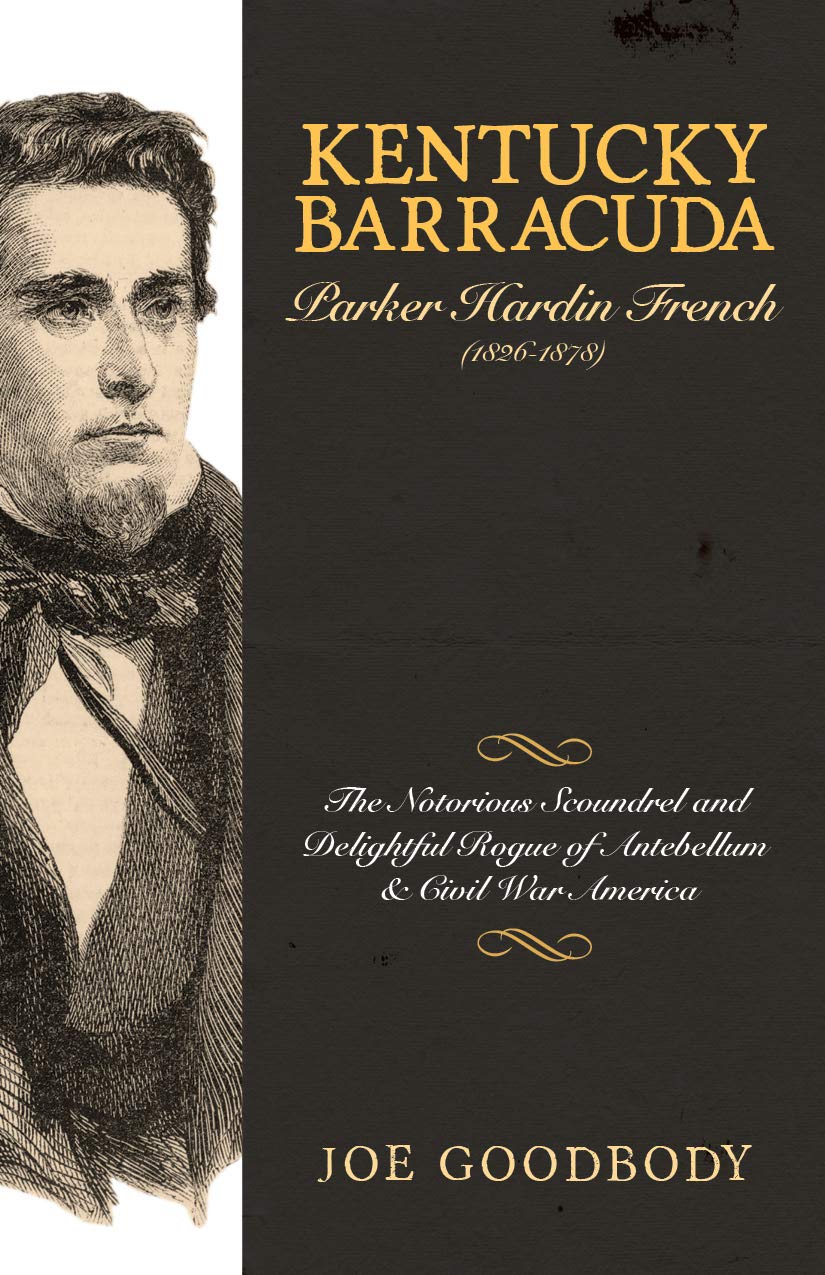 American history is replete with the antics of con men, from small-time grifters to orchestrators of elaborate confidence games. Lesser known today, Parker Hardin French engaged in both extremes and was one of the nineteenth-century's most notorious practitioners of the art of the con. The discovery that one of his ancestors was victimized by French prompted author Joe Goodbody to research the swindler's life of crime. Along the way, the author "pieced together information from primary sources gathered from historical archives, personal journals and diaries, period newspapers, public records, government reports, court documents and cooked accounting books to recreate Parker Hardin French as he lived." The result is the biography Kentucky Barracuda: Parker Hardin French (1826-1878), a "barracuda" being, in the parlance of the time, someone who was a "con man, crook, hustler, swindler, clip artist, fraud, scam artist". Goodbody's book brings French "out of the shadows and into the spotlight," finding that the "crafty Machiavellian contributed more to mid-nineteenth century history than has been previously documented."
More from the synopsis: "In the era of steam, sail and horse, the rapidity of French's movement and breadth of his adventures is almost mind-numbing. As a runaway kid he fought in the British Navy in the first Opium War. When he was just 22 years old, he was a commission merchant and, a year later, built the first ocean going ship on the upper Mississippi. Before he was 30, he was the leader of an infamous gold rush expedition; implicated in an irregular invasion of Cuba; jailed bandit and then military hero in Mexico; lawyer, district attorney, legislator, journalist, and political enforcer in California; part of an American cabal which governed Nicaragua; and, appointed but rejected Nicaraguan ambassador to the United States. He didn’t slow down in his 30s: he was a real estate developer; lawyer; journalist; part of a conspiracy to invade Mexico; suspected seditionist agitator and Confederate agent; jailed as a political prisoner; and, lawyer and purveyor for Union troops. His final days were spent in obscurity but the period was still peppered with the occasional swindle that garnered both regional and national attention. First and foremost, he was a barracuda."
French did indeed have significant Civil War connections. One chapter in the book discusses the possibility of French's involvement with the Knights of the Golden Circle, and the four that follow it recount his activities during the Civil War. After victimizing the citizens of Massachusetts and Connecticut, French was arrested and jailed in Fort Warren under suspicion of being a Confederate agent. After release, he was, amazingly enough, allowed to be an army sutler and defense counsel or legal consultant in two court-martial cases.
You can find more information about French and the book on the author's website. Go here to check it out.
Monday, February 18, 2019
Booknotes: Confederate Ironclads at War
New Arrival:
• Confederate Ironclads at War by R. Thomas Campbell (McFarland, 2019).
 Back during the 1990s peak in popular interest in the Civil War, bookstore shelves across the country overflowed with new and used titles of all kinds (even in places where I lived far removed from any Civil War hotbed). At least from my experience, one thing you could count on seeing in stores was an array of Civil War books from White Mane/Burd Street, up to that time one of the most prolific publishers of Civil War books. Filling a large proportion of their naval catalog were works from R. Thomas Campbell, and it's probably safe to say that many new readers were introduced to Confederate ships and sailors through Campbell's many popular books. And he's still active. His latest title is Confederate Ironclads at War.
• Confederate Ironclads at War by R. Thomas Campbell (McFarland, 2019).
 Back during the 1990s peak in popular interest in the Civil War, bookstore shelves across the country overflowed with new and used titles of all kinds (even in places where I lived far removed from any Civil War hotbed). At least from my experience, one thing you could count on seeing in stores was an array of Civil War books from White Mane/Burd Street, up to that time one of the most prolific publishers of Civil War books. Filling a large proportion of their naval catalog were works from R. Thomas Campbell, and it's probably safe to say that many new readers were introduced to Confederate ships and sailors through Campbell's many popular books. And he's still active. His latest title is Confederate Ironclads at War.
From the description: "Hampered by lack of materials, shipyards and experienced shipbuilders, even so the South managed to construct 34 iron-armored warships during the Civil War, of which the Confederate Navy put 25 into service. The stories of these vessels illustrate the hardships under which the Navy operated--and also its resourcefulness. Except for the Albemarle, no Confederate ironclad was sunk or destroyed by enemy action. Overtaken by events on the ground, most were destroyed by their own crews to prevent them from falling into Union hands. This account covers the design and construction and the engagements of the Confederate ironclads and describes the ingenuity and courage, as well as the challenges and frustrations of their "too little, too late" service."
While Campbell does not appear to address the Civil War careers of every Confederate ironclad that went into service, his overall treatment of the subject matter is still fairly comprehensive. The book's fourteen chapters (two of which were first published in Campbell's 1997 book Southern Fire) are a mixed collection of single vessel and squadron histories. Visual aids are abundant, with photographs, previously published maps, newspaper illustrations, and line drawings of the ships spread liberally throughout. The appendix section contains crew rosters for six of the vessels covered in the book (the Virginia, Arkansas, Albemarle, Neuse, North Carolina, and Raleigh).
Saturday, February 16, 2019
Pair of upcoming Longstreet studies

Just going from a prospective page length nearly double that of the second edition, I would imagine that Harold Knudson's The Confederacy’s Most Modern General: James Longstreet and the American Civil War, which was announced earlier this month in publisher Savas Beatie's February newsletter, will be a substantially expanded version of the author's earlier study of the same title, which first appeared in 2007 and was revised and expanded in 2010. I have not read either of the existing iterations, which argue that Longstreet was an important and underappreciated tactical innovator whose influences could be traced all the way up to modern twentieth-century military practices. According to the description of Knudson's upcoming book, Longstreet's generalship also demonstrated "progressive applications with artillery, staff work, force projection, and operational-level thinking." The new book "draws heavily on 20th Century Army doctrine, field training, staff planning, command, and combat experience, and is the first serious treatment of Longstreet’s generalship vis a vis modern warfare."

Colonel Knudson contributes the foreword to the other upcoming book, Cory Pfarr's Longstreet at Gettysburg: A Critical Reassessment (McFarland, Spring 2019), which is promoted as "the first book-length, critical analysis of Lieutenant General James Longstreet's actions at the Battle of Gettysburg." Out of all the thousands of Gettysburg-related books that have been published, how can it be that no one has produced a standalone study of this highly controversial topic before? From the description: By closely studying the three-day battle, and conducting an incisive historiographical inquiry into Longstreet's treatment by scholars, this book presents an alternative view of Longstreet as an effective military leader, and refutes over a century of negative evaluations of his performance."
Friday, February 15, 2019
Booknotes: Bluecoat and Pioneer
New Arrival:
• Bluecoat and Pioneer: The Recollections of John Benton Hart, 1864–1868
edited by John Hart (Univ of Okla Press, 2019).
 "In 1918, urged on by his son Harry, John Benton Hart began to tell stories of a three-year period in his youth. He recalled his days as a trooper in the Eleventh Kansas Cavalry, fighting in Missouri and on the frontier, and his time as a civilian jack-of-all-trades doing risky work for the U.S. Army on the Wyoming-Montana Bozeman Trail in the middle of the Indian resistance campaign known as Red Cloud’s War. Once started, John Benton Hart became an enthusiastic raconteur, describing events with an almost cinematic vividness, while his son, an aspiring writer, documented his father’s testimony in what became several manuscripts." Compiled and edited by historian John Hart (John Benton Hart’s great-grandson) and published under the title Bluecoat and Pioneer: The Recollections of John Benton Hart, 1864–1868 "this memoir is a singular document of living history."
• Bluecoat and Pioneer: The Recollections of John Benton Hart, 1864–1868
edited by John Hart (Univ of Okla Press, 2019).
 "In 1918, urged on by his son Harry, John Benton Hart began to tell stories of a three-year period in his youth. He recalled his days as a trooper in the Eleventh Kansas Cavalry, fighting in Missouri and on the frontier, and his time as a civilian jack-of-all-trades doing risky work for the U.S. Army on the Wyoming-Montana Bozeman Trail in the middle of the Indian resistance campaign known as Red Cloud’s War. Once started, John Benton Hart became an enthusiastic raconteur, describing events with an almost cinematic vividness, while his son, an aspiring writer, documented his father’s testimony in what became several manuscripts." Compiled and edited by historian John Hart (John Benton Hart’s great-grandson) and published under the title Bluecoat and Pioneer: The Recollections of John Benton Hart, 1864–1868 "this memoir is a singular document of living history."
Hart enlisted in Col. Thomas Moonlight's 11th Kansas Volunteer Infantry in the fall of 1862 and fought with the regiment at the Battle of Prairie Grove that December, but the Civil War portion of his memoir does not start until late 1864, when he and his unit (which was converted into cavalry the prior year) opposed Confederate general Sterling Price's Missouri expedition. Hart's recollections of the fall 1864 campaign in Missouri are fairly extensive.
From there, the memoir goes on to address the writer's participation in "such engagements in the Plains Indian Wars as the Battle of Platte Bridge in July 1865 and the Hayfield Fight near Fort C. F. Smith in 1867. In the engaging style of a natural storyteller, Hart re-creates these events as he experienced them, giving readers a rare glimpse at moments of historical import from the point of view of the “ordinary” soldier. In arresting detail, he also tells of crossing the Plains as a bullwhacker, carrying the mail between the beleaguered forts on the Bozeman Trail, and befriending scout Jim Bridger and Mountain Crow Chief Blackfoot."
Editor John Hart contributes an abundance of introductory sections and inserts connecting narrative throughout the volume. The text is supplemented by numerous maps and photographs as well as his "biographical, historical, and explanatory notes." In the general introduction, the editor mentions that he selected for inclusion in the book approximately one-third of the available material, a relatively common practice when editing large, sprawling manuscripts for publication. The only chapter reproduced in its entirety is the one covering the Platte Bridge battle (Chapter 2), and the book makes use of around half of Hart's Civil War Missouri text.
Subscribe to:
Posts (Atom)