I've mentioned the upcoming Vicksburg Besieged (Volume Seven in SIU Press's rebranded Civil War Campaigns in the West series) more than once in passing, but the official description has now been fleshed out enough to give us a good idea about its content. The third of five planned Vicksburg Campaign installments, it follows The Vicksburg Campaign, March 29-May 18, 1863 (2013) and The Vicksburg Assaults, May 19-22, 1863 (2019). The contributor list to Vicksburg Besieged includes series editors Steven Woodworth and Charles Grear along with Andrew Bledsoe, John Gaines, Martin Hershock, Richard Holloway, Justin Solonick, Scott Stabler, and Jonathan Steplyk. Together their essays examine:
• "the role of Grant’s staff"
• "the critical contributions of African American troops to the Union Army of the Tennessee"
• "both sides’ use of sharpshooters and soldiers’ opinions about them"
• "unusual nighttime activities between the Union siege lines and Confederate defensive positions"
• "the use of West Point siege theory and the ingenuity of Midwestern soldiers in mining tunnels under the city’s defenses"
• "the horrific experiences of civilians trapped in Vicksburg"
• "the failure of Louisiana soldiers’ defense at the subsequent siege of Jackson"
• "the effect of the campaign on Confederate soldiers from the Trans-Mississippi region"
• "how the Confederate Army of Mississippi and residents of Vicksburg faced food and supply shortages as well as constant danger from Union cannons and sharpshooters"
Also, let's take a moment to briefly revisit the original list of planned series titles and see how things are going so far (the links are all to my reviews):
1. The Shiloh Campaign (2009)
2. The Chickamauga Campaign (2010)
3. The Chattanooga Campaign (2012)
4. Vicksburg: Mississippi Blitzkrieg, May 1863 [Presumably, this is the retitled The Vicksburg Campaign, March 29–May 18, 1863 (2013)]
5. The Tennessee Campaign of 1864 (2016)
6. The Vicksburg Assaults, May 19-22, 1863 (2019)
7. Forts Henry and Donelson
8. Vicksburg Besieged (June 2020)
9. The Kentucky Campaign of 1862
10. Vicksburg: To Chickasaw Bayou
11. The Atlanta Campaign from Rocky Face Ridge to Oostenaula: The Battle of Resaca
12. Vicksburg: Grant's Winter Endeavors
13. The Atlanta Campaign from the Oostenaula to the Etowa: Dallas, New Hope Church, 14. and Pickett's Mill
14. The Atlanta Campaign from the Etowa to the Chattahoochee: The Battle of Kennesaw Mountain
15. Iuka and Corinth
16. Peachtree Creek
17. The Battle of Atlanta, July 22, 1864
With seven titles published and three years at most between releases, that's pretty steady progress. Hopefully, the skipping over of Henry & Donelson is only temporary.

Tuesday, February 11, 2020


Monday, February 10, 2020
Booknotes: German Americans on the Middle Border
New Arrival:
• German Americans on the Middle Border: From Antislavery to Reconciliation, 1830–1877 by Zachary Stuart Garrison (SIU Press, 2019).
 From the description: "Before the Civil War, Northern, Southern, and Western political cultures crashed together on the middle border, where the Ohio, Mississippi, and Missouri Rivers meet. German Americans who settled in the region took an antislavery stance, asserting a liberal nationalist philosophy rooted in their revolutionary experience in Europe that emphasized individual rights and freedoms. By contextualizing German Americans in their European past and exploring their ideological formation in failed nationalist revolutions, Zachary Stuart Garrison adds nuance and complexity to their story."
Though wary of the contributions of former Know Nothings to the newly formed Republican Party of the mid to late 1850s, the more central ideology nevertheless appealed to many Germans. "Liberal German immigrants, having escaped the European aristocracy who undermined their revolution and the formation of a free nation, viewed slaveholders as a specter of European feudalism. During the antebellum years, many liberal German Americans feared slavery would inhibit westward progress, and so they embraced the Free Soil and Free Labor movements and the new Republican Party. Most joined the Union ranks during the Civil War."
Recent published scholarship of the German-American experience during the Civil War era has largely rejected the old assumption that the Civil War was a defining moment in German assimilation into mainstream American culture, arguing instead that many (most?) actively resisting being stirred into the melting pot. However, at least on a regional basis, Garrison maintains that some prewar attitudes were moderated during Reconstruction to fit in better within the more conservative Midwest body politic. "After the war, in a region largely opposed to black citizenship and Radical Republican rule, German Americans were seen as dangerous outsiders. Facing a conservative resurgence, liberal German Republicans employed the same line of reasoning they had once used to justify emancipation: A united nation required the end of both federal occupation in the South and special protections for African Americans. Having played a role in securing the Union, Germans largely abandoned the freedmen and freedwomen. They adopted reconciliation in order to secure their place in the reunified nation."
For such a short work, this is a pretty ambitious survey. Addressing the social, political, and military impact of German-Americans from early antebellum mass immigration through the end of Reconstruction, and doing it in only 150 pages of narrative, is no mean feat! The book also joins a fast-growing facet of the Civil War scholarship interested in the conflict's global context. "Garrison’s unique transnational perspective to the sectional crisis, the Civil War, and the postwar era complicates our understanding of German Americans on the middle border."
Friday, February 7, 2020
Booknotes: Confederate General Stephen Elliott
New Arrival:
• Confederate General Stephen Elliott: Beaufort Legend, Charleston Hero by D. Michael Thomas (Arcadia Pub & The Hist Press, 2020).
 From the description: "General Stephen Elliott rose from captain of a militia artillery battery to command of an infantry brigade. His early war reputation as a daring raider and superb artilleryman grew to true hero status through his exemplary service at Fort Sumter. Handpicked to defend Sumter to the last extremity, Elliott performed so well that his Yankee foes saluted him by dipping the Union flag in recognition of his courage and steadfastness. Wounded on five separate occasions, Elliott exemplified courage and inspirational leadership that justified promotions advocated by Generals Robert E. Lee and P.G.T. Beauregard and President Jefferson Davis. In the first in-depth study of Elliott, D. Michael Thomas presents the life of a renowned soldier with fresh, previously unpublished material."
This is the author's second Civil War book, the first being 2018's Wade Hampton's Iron Scouts (review), a brief study that I found well worthwhile. Coincidentally, Stephen Elliott also figures prominently in one of the books that I'm currently reading, Ron Roth's The Civil War in the South Carolina Lowcountry, with one half of the dual unit history covering the artillery company (Beaufort Artillery) first led by Elliott. Getting back to this book, the previously unpublished material referred to above appears to be a collection of wartime letters written by Elliott to his wife (at least that's what I gather from the author's preface).
Wednesday, February 5, 2020
Review - "Johnsonville: Union Supply Operations on the Tennessee River and the Battle of Johnsonville, November 4-5, 1864" by Jerry Wooten
[Johnsonville: Union Supply Operations on the Tennessee River and the Battle of Johnsonville, November 4-5, 1864 by Jerry T. Wooten (Savas Beatie, 2019). Hardcover, 9 maps, photos, drawings, notes, appendix, bibliography, index. Pages main/total:xvii,179/222. ISBN:978-1-61121-477-2. $29.95]
 The Union capture of the Tennessee state capital without a fight in February 1862 gifted federal forces with an excellent forward supply base for supporting the next phase of Union advances into the Confederate heartland. Though Nashville warehouses could be stocked by both rail and water transport, supply lines into the city were vulnerable to interdiction by man and nature. The West's railroad networks were frequent targets of Confederate cavalry raiders and guerrillas, and the Cumberland River was subject to seasonal low water that frequently cut off that route. In order to maintain a more consistent flow of supplies, an east-west connection with the Tennessee River was contemplated and eventually completed in 1864. Connecting the city of Nashville with the massive new supply depot at Johnsonville, located on the east bank of the river in Humphreys County and named after the Tennessee war governor, was the Nashville & Northwestern Railroad (an antebellum dream project that was finished during the war by Union authorities). Fully operational in May 1864, Johnsonville quickly became a supply hub second only to Fortress Rosecrans in the Tennessee logistical network that would be instrumental in sustaining General Sherman's massive army group in North Georgia. With much of the existing published literature more narrowly focused on the Confederate cavalry raid that contributed to the post's near destruction, the full nature of Johnsonville's role in the Civil War has now been revealed at unprecedented depth and range in Jerry Wooten's Johnsonville: Union Supply Operations on the Tennessee River and the Battle of Johnsonville, November 4-5, 1864.
After a brief opening discussion of the geography, early settlement history, and antebellum economic development of the site that would eventually become Johnsonville, Wooten's narrative launches into a fairly expansive discussion of the Union Army's mid-war recognition of the need for a new major supply depot on the Tennessee River (as summarized above) and the massive 1863-64 construction project that would bring it to fruition. Apparently, the quartermaster department employees and civilian contractors who lived and worked at the military depot left behind few accounts of their activities, but Wooten, a former Park Manager at Johnsonville State Historic Park, was able to uncover enough firsthand source material to provide readers with some useful insights into life there. The text also provides a fine descriptive overview of the physical layout of Johnsonville along with more specific details of the buildings and support structures (of which a few photographs survive) located there.
As one would expect, obtaining enough labor in wartime Tennessee to finish both the military town of Johnsonville and the railroad that connected it to Nashville was no easy task. In the book, Wooten discusses the efforts of soldiers and civilians in constructing, maintaining, and defending this new supply link in the Union Army's western logistical network. Black labor in particular, both volunteers and individuals impressed from Tennessee contraband camps, was essential to completing the railroad within the time frame required. By the author's estimate, 7,300 impressed laborers (mostly from Middle Tennessee) worked on the Nashville & Northwestern Railroad during the twelve months leading up to September 1864. As was the case in many other rear area western posts at this stage of the war, a combination of white and USCT troops were assigned to garrison Johnsonville, and black soldiers guarded the railroad all along its length. The navy was also ever present, with four tinclads based at Johnsonville. Despite its importance, Johnsonville was not really heavily defended. According to Wooten's research, though redoubts housing several batteries were built on the high ground and the depot facilities were surrounded by five miles of earthworks, the military garrison rarely exceeded 500 men at any given time (though the civilian workers could be armed in an emergency).
Given West Tennessee's history of destructive Confederate raids on isolated Union posts and transportation infrastructure, the relative weakness of Johnsonville's defenses (even in late 1864) made it an inviting target. Indeed, the most frequently documented aspect of Johnsonville's wartime history is the devastating attack on the post conducted by Nathan Bedford Forrest's Confederate cavalry in early November 1864. While an entire book [Col. Donald Steenburn's Silent Echoes of Johnsonville: Nathan B. Forrest, Rebel Cavalry & Yankee Gunboats (1994, 2001 2nd. ed.)] along with a few smaller treatments have already addressed Forrest's October-November raid that ended with the bombardment and burning of Johnsonville, Wooten account of the entire operation from beginning to end takes this coverage to a new level. Based on primary sources and unfolding over several chapters covering Confederate interdiction of river traffic, their capture of three Union vessels, the concurrent ship versus shore engagement at Reynoldsburg Island that also involved Confederate use of the captured gunboat U.S.S. Undine, and the direct bombardment of Johnsonville itself, the book's collective treatment (well supported with maps) of the raid's events, with Johnsonville at its center, is the best now available. With prior accounts presented mostly from the Confederate viewpoint, Wooten's work also adds much-needed Union perspective.
While the Confederate cross-river bombardment of Johnsonville was highly destructive, Wooten's research reinforces the modern consensus that the primary instigators of the conflagration that consumed ships, wharves, and buildings were the defenders themselves. Though the army and navy officers who ordered the destruction to keep the post's valuable ships and supplies out of the hands of the enemy (it was widely assumed by those in charge that the Confederates threatened Johnsonville on both sides of the river) were later acquitted of negligence, many still consider their actions premature and unnecessary. By any measure (Union authorities estimated government property losses at $1.5 million and Forrest claimed he inflicted $6.7 million worth of damage), the level of destruction at Johnsonville was extraordinary. However, as Wooten appropriately maintains, the strategic significance was minimal. Timing is everything in war, and striking Johnsonville in November 1864 was far too late to hinder Sherman's campaign in Georgia, and the effects on Union forces during the late stages of General Hood's operation in Middle Tennessee that winter were only slight.
An appendix very briefly explores the origins of the U.S. Army's quartermaster department and its Tennessee branch in the Civil War. This is appropriate enough, but, given the book's argument that Johnsonville's logistical importance has been underappreciated, the space might have been more usefully devoted to a quantitative rundown and analysis of the nature and volume of supplies that passed through Johnsonville during its months of peak operation (March-November 1864). But that's more of a wish list item than a serious criticism.
Though relatively short in length, Wooten's study offers a rather comprehensive examination of the historical legacies of persons and events related to Civil War Johnsonville. In addition to being a fine battle history, the book should be regarded as a major contribution to the ongoing study of what it took to keep Civil War armies supplied in the field. With several recent studies paying closer attention to logistical superiority as a key component of Union victory, Johnsonville's content and analysis should form a very useful part of that growing discussion, now and into the future.
Tuesday, February 4, 2020
Booknotes: The Spirits of Bad Men Made Perfect
New Arrival:
• The Spirits of Bad Men Made Perfect: The Life and Diary of Confederate Artillerist William Ellis Jones ed. by Constance Hall Jones (SIU Press, 2020).
 A combination of biography and edited diary, The Spirits of Bad Men Made Perfect tells "the story of William Ellis Jones (1838–1910), an artillerist in Crenshaw’s Battery, Pegram’s Battalion, the Army of Northern Virginia. One of the few extant diaries by a Confederate artillerist, Jones’s articulate writings cover camp life as well as many of the key military events of 1862, including the Peninsula Campaign, the Second Battle of Manassas, the Maryland Campaign, and the Battle of Fredericksburg."
The book also delves into Jones's civilian occupation and his postwar contributions to the Civil War in print. "In 1865 Jones returned to his prewar printing trade in Richmond, and his lasting reputation stems from his namesake publishing company’s role in the creation and dissemination of much of the Lost Cause ideology." Editor Constance Hall Jones also notes an interesting dichotomy in her ancestor's attitude toward the Civil War. In contrast to the ideological mindset displayed through his many pro-Confederate publications, Jones's own wartime diary showed him to be "an unenthusiastic soldier" (though it appears that frequent clashes with officers were a major source of his dissatisfaction with military service).
In addition to the editing the diary, "Jones brackets the soldier’s diary with rich, biographical detail, profiling his friends and relatives and providing insight into his childhood and post-war years. In doing so, she offers one of the first serious investigations into the experience of a Welsh immigrant family loyal to the Confederacy and makes a significant contribution to our understanding of Civil War–era Richmond and the nineteenth-century publishing industry."
The book is roughly evenly divided between the biographical chapters and edited diary. Nine helpful maps follow the course of Crenshaw's Battery through the end of 1862. Though the diary ends in 1862, Jones served with the battery for much of the balance of the conflict before being invalided out in February 1865 and ending the war as a clerk in the Quartermaster's Department. It looks like an interesting book on a number of levels.
Monday, February 3, 2020
Booknotes: The Women of City Point, Virginia, 1864-1865
New Arrival:
• The Women of City Point, Virginia, 1864-1865: Stories of Life and Work in the Union Occupation Headquarters by Jeanne Marie Christie (McFarland, 2020).
 From the description: "After more than three years of grim fighting, General Ulysses Grant had a plan to end the Civil War--laying siege to Petersburg, Virginia, thus cutting off supplies to the Confederate capital at Richmond. He established his headquarters at City Point on the James River, requiring thousands of troops, tons of supplies, as well as extensive medical facilities and staff."
More: "Nurses flooded the area, yet many did not work in medical capacities--they served as organizers, advocates and intelligence gatherers. Nursing emerged as a noble profession with multiple specialties. Drawing on a range of primary and secondary sources," Jeanne Marie Christie's The Women of City Point, Virginia, 1864-1865 "covers the resilient women who opened the way for others into postwar medical, professional and political arenas."
The book discusses a pretty expansive cross-section of women who lived and worked at City Point. Chapters address contraband women, independent nurses, government nurses, female representatives of the U.S. Christian and U.S. Sanitary commissions (the USCC and USSC), official state agents, and officer wives. The final chapter comprises a lengthy alphabetized register of City Point women referenced in the author's sources, the amount of biographical and work details attached to each varying widely. In recognition of how the environment of City Point affected working conditions and morale, an appendix summarizes weather conditions on a nearly daily basis between June 1864 and April 1865.
Friday, January 31, 2020
Booknotes: Mississippi Civil War Monuments
New Arrival:
• Mississippi Civil War Monuments: An Illustrated Field Guide by Timothy S. Sedore (Quarry Books - Indiana UP, 2020).
 According to the description to Timothy Sedore's Mississippi Civil War Monuments: An Illustrated Field Guide, Mississippi is "a former Confederate state that boasts more Civil War monuments than any other." Though that doesn't surprise me too much, I would have guessed that economic (those things don't come cheap) and population factors would have dictated that Virginia top the list.
Anyway, Sedore's guide "combs through the Mississippi landscape, exploring monuments commemorating important military figures and battles and remembering common soldiers, from rugged veterans to mournful youths. Sedore's insightful commentary captures a character portrait of Mississippi, a state that was ensnared between Northern and Southern ideologies and that paid a high price for seceding from the Union. Sedore's close examinations of these monuments broadens the narrative of Mississippi's heritage and helps to illuminate the impacts of the Civil War."
The format is similar to that found in the author's An Illustrated Guide to Virginia's Confederate Monuments , which was released back in 2011 through a different publisher. Organized by region and county, the Mississippi register includes a photograph of the monument, copy of its inscription, various physical details, and a few paragraphs of commentary. Unlike the Virginia volume, this one does include GPS coordinates. Fans of the author's work will also be happy to know that a Tennessee edition is scheduled for release in early March.
Thursday, January 30, 2020
Coming Soon (Feb '20 Edition)
*NEW RELEASES* Scheduled for February 2020:
• The Damnedest Set of Fellows: A History of Georgia's Cherokee Artillery by Garry Fisher & Zack Waters.
• Entertaining History: The Civil War in Literature, Film, and Song ed. by Chris Mackowski.
• The Three-Cornered War: The Union, the Confederacy, and Native Peoples in the Fight for the West by Megan Kate Nelson.
• The Second Colorado Cavalry: A Civil War Regiment on the Great Plains by Christopher Rein.
• The Life and Times of Missouri's Charles Parsons: Between Art and War by John Launius.
• Confederate General Stephen Elliott: Beaufort Legend, Charleston Hero by D. Michael Thomas.
• Congress at War: How Republican Reformers Fought the Civil War, Defied Lincoln, Ended Slavery, and Remade America by Fergus Bordewich.
Comments: Savas Beatie has something CW-related coming out nearly every month, but I don't know what they might have in store for February. I've mentioned the Cherokee Artillery book before as a most welcome rarity in the unit history category. I'm also curious about the Elliott book, not so much about special interest in the man himself but more about the Charleston coverage it will offer. Of all the February titles, the clear number one on my list is the Rein regimental history. A Second Colorado Cavalry study has been on the wishlist of many a Trans-Miss. reader.
Tuesday, January 28, 2020
Review - "Lincoln's Informer: Charles A. Dana and the Inside Story of the Union War" by Carl Guarneri
[Lincoln's Informer: Charles A. Dana and the Inside Story of the Union War by Carl J. Guarneri (University Press of Kansas, 2019). Hardcover, 10 maps, photos, illustrations, notes, bibliography, index. Pages main/total:xii,415/527. ISBN:978-0-7006-2846-9. $39.95]
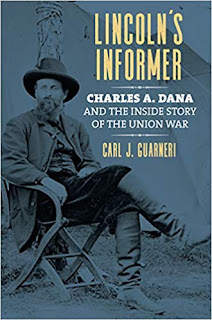 By most estimates, journalist and War Department official Charles Anderson Dana had a significant personal impact on the course of the American Civil War and on the careers of key generals and politicians. But just how influential was he? In assessing the effects of the background influencers of history, the potential for encountering frustrating pitfalls can be high. The nature of advice offered to those in power often goes undocumented (though that can't really be said for Dana) or is disputed, and decision-makers tend to jealously hoard credit when success is involved. Close access to power also breeds friends and enemies alike, and the earnestness of both groups can cloud the historical picture in equal measure. Taking all that into account, Carl Guarneri's deeply researched, insightful, and powerfully argued Lincoln's Informer: Charles A. Dana and the Inside Story of the Union War clearly offers Civil War students the most complete picture yet available of the depth and range of Dana's personal involvement in numerous aspects of the Union war effort.
As its title suggests, Guarneri's biographical study of Dana is centered on the Civil War years. However, the author well recognizes how essential Dana's prewar personal and professional experiences were in shaping how the military novice would carry out his new War Department responsibilities during the upcoming conflict. In highly informative fashion, the book's early chapters fulfill the important background role of establishing the character development, uncompromising Radical Republican credentials, and managerial capabilities that would all serve Dana so well later on. After an abbreviated Harvard education, Dana lived in and helped administer a utopian collective community, and his business instincts and personnel management skills were major factors behind the commercial success of Horace Greeley's New York Tribune (of which Dana served as managing editor). Guarneri perceptively traces much of Dana's adroitness in getting along with the notoriously irascible War Secretary Edwin Stanton to his successful professional partnership with the mercurial Greeley. At the Tribune, Dana was able to express his own editorial voice (one that often clashed with Greeley's notorious flip-flopping on big issues) without alienated his boss or grossly exceeding the boundaries of subordinate behavior. This tactful professionalism helped him be his own man at the War Department without drawing the ire of Stanton, with whom he maintained cordial relations. Maturity in successfully navigating delicate subordinate relationships also allowed Dana, whose War Department investigations in the West uncovered trade violations and army contract frauds committed by Lincoln friends and political allies, to force the president's hand without making the chief executive his enemy.
Dana would ultimately be fired by Greeley in 1862, an act Guarneri attributes more to investor/board pressure than Greeley's own personal animus. Though Dana was frequently critical of how the war was managed up to that point, the administration nevertheless saw the newly unemployed journalist as a useful friend, and Stanton quickly secured Dana's employment as a special agent for investigating fraud in the West. There he would meet the Civil War military figure with whom he would become most closely associated, U.S. Grant. Later, as a "special commissioner" nominally assigned to see to army paymasters but really the administration's representative (or "spy" as some would maintain) in Grant's headquarters during the Vicksburg Campaign, Dana would become a key player in Grant's rise. Of course, the story of Dana's arrival, the warm rapport that developed quickly between he and Grant, and the highly positive impression of Grant's character and generalship that Dana's War Department reports created in Washington have already been explored in countless publications, but one can make a very strong argument that Guarneri's detailed and judicious assessment of the Grant-Dana relationship is the most comprehensive now available in the literature.
Far more than Grant's cheerleader, the Dana of Guarneri's study was a close adviser to Grant and a very useful go-between that could get Grant what he needed while shielding the general himself from being seen as the source of incessant manpower and resource demands. Dana's long, detailed reports to Stanton regarding the campaign's progress relieved Grant of a significant burden as well. Grant and Dana's shared views regarding the big issues of the war and how the conflict should be fought made the general easy to champion, but Guarneri also astutely notes that this growing personal loyalty seldom meant that the War Department was ill-served in the bargain. That's not to say Washington was never deceived, as Dana participated in the cover-up of Grant's infamous "Yazoo bender." While the author does not dwell upon the point, it also seems highly likely that Dana's powers of persuasion, sharply honed through his partisan Tribune editorials, gave his pro-Grant correspondence a hearty measure of added impact.
A lesser appreciated aspect of Dana's official correspondence can be found in his detailed 'report cards' of Grant's staff and subordinates. Though personal grudges interfered in some of these assessments, and he wrote negative recommendations of several generals that modern historians consider quite capable (ex. Francis Herron and A.J. Smith), the author credits these reports with heavily influencing subsequent War Department personnel promotions and assignments.
Of course, the other major Civil War general closely associated with Dana is William S. Rosecrans. Dana has often been assigned a lion's share of the blame for Rosecrans's dismissal, his reports comprising a constant stream of negative distortions regarding Rosecrans's mindset and actions in the wake of the Chickamauga disaster. Guarneri counters complaints of Dana's bias against Rosecrans by pointing out that there were some positive reports interspersed with the negative ones, but the author clearly feels that the end result justified the means in Rosecrans's case. If providing a less than evenhanded picture was necessary to get the point across to the remaining Rosecrans supporters in the administration that the general's fighting spirit was insufficient and the army needed to be saved by his replacement, then Guarneri sees that as no major miscarriage of justice (with ensuing events proving Dana correct in his views). While that will not please Rosecrans's supporters, and more recent scholarship has suggested that Rosecrans was not quite the shattered individual of the older historical record, it remains the case that the way the army was handled after the change in command succeeded beyond all expectation.
After spending time in Washington after the victory at Chattanooga, Dana rejoined Grant in the field for the Overland Campaign. While he resumed his old course of sustaining Grant, some doubts began to creep into his mind. Even so, though critical thoughts regarding Grant's strategic and tactical approaches to the Virginia campaign and what he saw as excessive reluctance to relieve underperforming generals (Dana wanted both Meade and Butler to go) emerged, their substance was either covered up in reports or heavily moderated. In pointing out that there was no one in the army above Grant to appeal to and undermining the general in the minds of those at the top (i.e. Lincoln and Stanton) might lead to his dismissal, Guarneri argues with some merit that the public good (namely, the catastrophic effect that Grant's firing could have had on the overall war effort) was best advanced by Dana's judicious self-censorship.
The book's main title is apt in many ways, but it might even be more appropriately phrased "Stanton's Fireman." When Dana, who started out as Stanton's special agent before being appointed Asst. Secretary of War, wasn't in the field he was in a War Department office working as hard as his boss. The book documents many special tasks that were assigned by Stanton specifically to Dana. In addition to already mentioned contraband trade and contract investigations, other jobs include post-riot oversight of the draft in New York, a spymaster post, and being the go-to man at the War Department for overseeing complex logistical operations. Dana also served as a partisan political operative during the 1864 election cycles, providing an official stamp to propaganda that inflated the strength and influence of the Midwest Copperhead movement. In an even more troubling blow to honest government, Dana earnestly participated in War Department directives aimed at promoting the Republican vote and suppressing the Democratic vote in both the army and on the home front. The author also identifies Dana as a key figure in the behind-the-scenes lobbying (a.k.a. bribing through patronage promises) of Democratic votes for the passage of the 13th Amendment. Overall, the author builds a persuasive case that Dana deserves much higher recognition as an important contributor to Union victory and emancipation.
After the war, Dana set himself to returning to New York newspaper journalism. Denied the opportunity to purchase Republican papers, he turned to New York's Sun, which had a substantial Democratic reader base. Though he editorially supported Grant's presidential election, Dana altered his focus from promoting Radical Reconstruction and the political rights and welfare of former slaves to exposing public corruption. Though he appears to have had a longstanding ideological disposition that judged freedpeople better left to their own devices without excessive government intervention into their affairs, his break with Grant was most shocking. Guarneri traces it to Grant's refusal to appoint Dana to the lucrative post of customs collector of the port of New York, one of the richest patronage plums. It seems that Grant had heard about Dana's mild criticisms of his Overland & Petersburg campaigns and never forgave him for it. While this cannot be definitively proven as the root cause, the author argues that both the timing and the established pattern in Grant's character of punishing criticism (no matter how muted) as unforgivable disloyalty fit the situation. The author also appropriately notes the human irony inherent in Dana's public campaigning against nepotism and cronyism in government while at the same time constantly seeking those kinds of rewards for himself. However, none of these political transformations and personal disappointments greatly hindered a second career in journalism that was a huge success. The book also discusses the writing and publication of Dana's Recollections of the Civil War, which was ghostwritten in first person by Ida Tarbell and remains a cautiously oft-used historical source.
Charles A. Dana is far from a shadowy and forgotten Civil War figure, even general Civil War readers probably have at least a passing familiarity with his War Department role (particularly his association with Grant) and antislavery journalism, but Carl Guarneri's Lincoln's Informer is unprecedented in how expansively it defines and details the depth of Dana's myriad of important influences and actions. Often hailed on one side as a just promoter of talented men that would see the Union cause to victory and a vicious libeler on the other, Dana, through the determined efforts of Guarneri's fine scholarship, can now be more widely appreciated not just as an influential go-between but as an important historical actor in his own right. Highly recommended.
 By most estimates, journalist and War Department official Charles Anderson Dana had a significant personal impact on the course of the American Civil War and on the careers of key generals and politicians. But just how influential was he? In assessing the effects of the background influencers of history, the potential for encountering frustrating pitfalls can be high. The nature of advice offered to those in power often goes undocumented (though that can't really be said for Dana) or is disputed, and decision-makers tend to jealously hoard credit when success is involved. Close access to power also breeds friends and enemies alike, and the earnestness of both groups can cloud the historical picture in equal measure. Taking all that into account, Carl Guarneri's deeply researched, insightful, and powerfully argued Lincoln's Informer: Charles A. Dana and the Inside Story of the Union War clearly offers Civil War students the most complete picture yet available of the depth and range of Dana's personal involvement in numerous aspects of the Union war effort.
As its title suggests, Guarneri's biographical study of Dana is centered on the Civil War years. However, the author well recognizes how essential Dana's prewar personal and professional experiences were in shaping how the military novice would carry out his new War Department responsibilities during the upcoming conflict. In highly informative fashion, the book's early chapters fulfill the important background role of establishing the character development, uncompromising Radical Republican credentials, and managerial capabilities that would all serve Dana so well later on. After an abbreviated Harvard education, Dana lived in and helped administer a utopian collective community, and his business instincts and personnel management skills were major factors behind the commercial success of Horace Greeley's New York Tribune (of which Dana served as managing editor). Guarneri perceptively traces much of Dana's adroitness in getting along with the notoriously irascible War Secretary Edwin Stanton to his successful professional partnership with the mercurial Greeley. At the Tribune, Dana was able to express his own editorial voice (one that often clashed with Greeley's notorious flip-flopping on big issues) without alienated his boss or grossly exceeding the boundaries of subordinate behavior. This tactful professionalism helped him be his own man at the War Department without drawing the ire of Stanton, with whom he maintained cordial relations. Maturity in successfully navigating delicate subordinate relationships also allowed Dana, whose War Department investigations in the West uncovered trade violations and army contract frauds committed by Lincoln friends and political allies, to force the president's hand without making the chief executive his enemy.
Dana would ultimately be fired by Greeley in 1862, an act Guarneri attributes more to investor/board pressure than Greeley's own personal animus. Though Dana was frequently critical of how the war was managed up to that point, the administration nevertheless saw the newly unemployed journalist as a useful friend, and Stanton quickly secured Dana's employment as a special agent for investigating fraud in the West. There he would meet the Civil War military figure with whom he would become most closely associated, U.S. Grant. Later, as a "special commissioner" nominally assigned to see to army paymasters but really the administration's representative (or "spy" as some would maintain) in Grant's headquarters during the Vicksburg Campaign, Dana would become a key player in Grant's rise. Of course, the story of Dana's arrival, the warm rapport that developed quickly between he and Grant, and the highly positive impression of Grant's character and generalship that Dana's War Department reports created in Washington have already been explored in countless publications, but one can make a very strong argument that Guarneri's detailed and judicious assessment of the Grant-Dana relationship is the most comprehensive now available in the literature.
Far more than Grant's cheerleader, the Dana of Guarneri's study was a close adviser to Grant and a very useful go-between that could get Grant what he needed while shielding the general himself from being seen as the source of incessant manpower and resource demands. Dana's long, detailed reports to Stanton regarding the campaign's progress relieved Grant of a significant burden as well. Grant and Dana's shared views regarding the big issues of the war and how the conflict should be fought made the general easy to champion, but Guarneri also astutely notes that this growing personal loyalty seldom meant that the War Department was ill-served in the bargain. That's not to say Washington was never deceived, as Dana participated in the cover-up of Grant's infamous "Yazoo bender." While the author does not dwell upon the point, it also seems highly likely that Dana's powers of persuasion, sharply honed through his partisan Tribune editorials, gave his pro-Grant correspondence a hearty measure of added impact.
A lesser appreciated aspect of Dana's official correspondence can be found in his detailed 'report cards' of Grant's staff and subordinates. Though personal grudges interfered in some of these assessments, and he wrote negative recommendations of several generals that modern historians consider quite capable (ex. Francis Herron and A.J. Smith), the author credits these reports with heavily influencing subsequent War Department personnel promotions and assignments.
Of course, the other major Civil War general closely associated with Dana is William S. Rosecrans. Dana has often been assigned a lion's share of the blame for Rosecrans's dismissal, his reports comprising a constant stream of negative distortions regarding Rosecrans's mindset and actions in the wake of the Chickamauga disaster. Guarneri counters complaints of Dana's bias against Rosecrans by pointing out that there were some positive reports interspersed with the negative ones, but the author clearly feels that the end result justified the means in Rosecrans's case. If providing a less than evenhanded picture was necessary to get the point across to the remaining Rosecrans supporters in the administration that the general's fighting spirit was insufficient and the army needed to be saved by his replacement, then Guarneri sees that as no major miscarriage of justice (with ensuing events proving Dana correct in his views). While that will not please Rosecrans's supporters, and more recent scholarship has suggested that Rosecrans was not quite the shattered individual of the older historical record, it remains the case that the way the army was handled after the change in command succeeded beyond all expectation.
After spending time in Washington after the victory at Chattanooga, Dana rejoined Grant in the field for the Overland Campaign. While he resumed his old course of sustaining Grant, some doubts began to creep into his mind. Even so, though critical thoughts regarding Grant's strategic and tactical approaches to the Virginia campaign and what he saw as excessive reluctance to relieve underperforming generals (Dana wanted both Meade and Butler to go) emerged, their substance was either covered up in reports or heavily moderated. In pointing out that there was no one in the army above Grant to appeal to and undermining the general in the minds of those at the top (i.e. Lincoln and Stanton) might lead to his dismissal, Guarneri argues with some merit that the public good (namely, the catastrophic effect that Grant's firing could have had on the overall war effort) was best advanced by Dana's judicious self-censorship.
The book's main title is apt in many ways, but it might even be more appropriately phrased "Stanton's Fireman." When Dana, who started out as Stanton's special agent before being appointed Asst. Secretary of War, wasn't in the field he was in a War Department office working as hard as his boss. The book documents many special tasks that were assigned by Stanton specifically to Dana. In addition to already mentioned contraband trade and contract investigations, other jobs include post-riot oversight of the draft in New York, a spymaster post, and being the go-to man at the War Department for overseeing complex logistical operations. Dana also served as a partisan political operative during the 1864 election cycles, providing an official stamp to propaganda that inflated the strength and influence of the Midwest Copperhead movement. In an even more troubling blow to honest government, Dana earnestly participated in War Department directives aimed at promoting the Republican vote and suppressing the Democratic vote in both the army and on the home front. The author also identifies Dana as a key figure in the behind-the-scenes lobbying (a.k.a. bribing through patronage promises) of Democratic votes for the passage of the 13th Amendment. Overall, the author builds a persuasive case that Dana deserves much higher recognition as an important contributor to Union victory and emancipation.
After the war, Dana set himself to returning to New York newspaper journalism. Denied the opportunity to purchase Republican papers, he turned to New York's Sun, which had a substantial Democratic reader base. Though he editorially supported Grant's presidential election, Dana altered his focus from promoting Radical Reconstruction and the political rights and welfare of former slaves to exposing public corruption. Though he appears to have had a longstanding ideological disposition that judged freedpeople better left to their own devices without excessive government intervention into their affairs, his break with Grant was most shocking. Guarneri traces it to Grant's refusal to appoint Dana to the lucrative post of customs collector of the port of New York, one of the richest patronage plums. It seems that Grant had heard about Dana's mild criticisms of his Overland & Petersburg campaigns and never forgave him for it. While this cannot be definitively proven as the root cause, the author argues that both the timing and the established pattern in Grant's character of punishing criticism (no matter how muted) as unforgivable disloyalty fit the situation. The author also appropriately notes the human irony inherent in Dana's public campaigning against nepotism and cronyism in government while at the same time constantly seeking those kinds of rewards for himself. However, none of these political transformations and personal disappointments greatly hindered a second career in journalism that was a huge success. The book also discusses the writing and publication of Dana's Recollections of the Civil War, which was ghostwritten in first person by Ida Tarbell and remains a cautiously oft-used historical source.
Charles A. Dana is far from a shadowy and forgotten Civil War figure, even general Civil War readers probably have at least a passing familiarity with his War Department role (particularly his association with Grant) and antislavery journalism, but Carl Guarneri's Lincoln's Informer is unprecedented in how expansively it defines and details the depth of Dana's myriad of important influences and actions. Often hailed on one side as a just promoter of talented men that would see the Union cause to victory and a vicious libeler on the other, Dana, through the determined efforts of Guarneri's fine scholarship, can now be more widely appreciated not just as an influential go-between but as an important historical actor in his own right. Highly recommended.
Monday, January 27, 2020
Booknotes: The Union Assaults at Vicksburg
New Arrival:
• The Union Assaults at Vicksburg: Grant Attacks Pemberton, May 17–22, 1863 by Timothy B. Smith (UP of Kansas, 2020).
 The failed Union attacks on the Vicksburg fortifications on May 19 and 22 are of a scale and significance worthy of standalone study. The twin battles marked a dramatic inflection point in Grant's operation against Vicksburg, transforming it from an almost breathtaking campaign of movement to a static siege while also resulting in the removal of a major figure in the Army of the Tennessee's high command. The most in-depth tactical treatment of these events has long resided in the relevant chapters of Ed Bearss's campaign trilogy, and the essay anthology The Vicksburg Assaults, May 19-22, 1863 from editors Steven Woodworth and Charles Grear represents the most recent scholarly study. Now we have in Timothy Smith's The Union Assaults at Vicksburg: Grant Attacks Pemberton, May 17–22, 1863 what promises to be the new standard history of this phase of the campaign.
From the description: "Establishing a day-to-day—;and occasionally minute-to-minute—;timeline for this crucial week, military historian Timothy B. Smith invites readers to follow the Vicksburg assaults as they unfold. His finely detailed account reaches from the offices of statesmen and politicians to the field of battle, with exacting analysis and insight that ranges from the highest level of planning and command to the combat experience of the common soldier. As closely observed and vividly described as each assault is, Smith’s book also puts the sum of these battles into the larger context of the Vicksburg campaign, as well as the entire war."
The six-day period covered by the book is addressed over nearly 400 pages of narrative and supported by 15 original maps. Content emphasis is overwhelmingly placed on the latter part of the week, so readers should expect only a cursory look at the May 17 Battle of Big Black River Bridge, the Confederate mini-catastrophe that left the direct road to Vicksburg wide open. The subject matter covered combined with the fact that Smith never disappoints make this one a must-read (for me, anyway).
Saturday, January 25, 2020
Booknotes: Death at the Edges of Empire
New Arrival:
• Death at the Edges of Empire: Fallen Soldiers, Cultural Memory, and the Making of an American Nation, 1863-1921 by Shannon Bontrager (Univ of Neb Press, 2020).
 From the description: "Hundreds of thousands of individuals perished in the epic conflict of the American Civil War. As battles raged and the specter of death and dying hung over the divided nation, the living worked not only to bury their dead but also to commemorate them. President Abraham Lincoln’s Gettysburg Address perhaps best voiced the public yearning to memorialize the war dead. His address marked the beginning of a new tradition of commemorating American soldiers and also signaled a transformation in the relationship between the government and the citizenry through an embedded promise and obligation for the living to remember the dead."
My reading on this topic is negligible, but books like this one and the equally recent Thomas Brown book Civil War Monuments and the Militarization of America seem to agree that the post-Civil War period was the watershed moment in America's permanent public memorialization and commemoration of military leaders and ordinary soldiers, a time when statuary and architectural war memorials located in prominent common spaces began to transform in number from rare to ubiquitous.
In Death at the Edges of Empire author Shannon Bontrager "examines the culture of death, burial, and commemoration of American war dead. By focusing on the Civil War, the Spanish-Cuban-American War, the Philippine-American War, and World War I, Bontrager produces a history of collective memories of war expressed through American cultural traditions emerging within broader transatlantic and transpacific networks. Examining the pragmatic collaborations between middle-class Americans and government officials negotiating the contradictory terrain of empire and nation, Death at the Edges of Empire shows how Americans imposed modern order on the inevitability of death as well as how they used the war dead to reimagine political identities and opportunities into imperial ambitions."
Thursday, January 23, 2020
Author Q&A: Laurence Freiheit on "Major General Joseph King Fenno Mansfield"
Today we are joined by Larry Freiheit to talk about his 2019 book Major General Joseph King Fenno Mansfield: A Soldier From Beginning to End. It is his second major Civil War study (both with Camp Pope Publishing), the first being Boots and Saddles: Cavalry During the Maryland Campaign of September 1862, which is now in its second edition. Freiheit's Mansfield biography is a massive and beautifully illustrated tome that exhaustively examines the general's life and military career, both of which tragically ended on September 17, 1862 at the Battle of Antietam.

• CWBA: Hi, Larry. Clearly a great deal of lifeblood went into your 800-page biography of J.K.F. Mansfield. In addition to being a keen student of the Maryland Campaign and your shared Connecticut origins, what else inspired you to involve yourself so deeply in Mansfield’s life story?
LF: First, thank you for your “keen student” comment, I don’t deserve that. This sounds silly but when I first started looking at Mansfield in the late 1990’s I identified with him not only because I was about his age when he was mortally wounded and I had a full beard at the time but with his somewhat acerbic wit and Puritanical bent. After I wrote my Maryland Campaign cavalry book my research and contacts with the primary Mansfield expert in the U.S., Dr. Tom Clemens, provided an easy gateway to a book about one of my home state’s most famous generals. Tom provided extensive help with my draft due to his expertise concerning Mansfield and the Battle of Antietam as well as 19th century U.S. military history.
• CWBA: After graduation from West Point and appointment to the prestigious U.S. Army Corps of Engineers, Mansfield spent nearly three decades all told as a military engineer. What major construction projects did he oversee during that part of his army career?
LF: His most famous project was his decades-long involvement with the construction of Ft. Pulaski east of Savannah, Georgia. I visited the fort four times over the space of 20 years and talked with and received critical help from a ranger there, Michael Weinstein. He gave me access to hundreds of pages of documents about Mansfield’s involvement at the fort most importantly from Rogers W. Young, a Park Service employee. Young wrote extensively about the construction of Fort Pulaski and his research and writing are the most comprehensive available documents about Ft. Pulaski. His unpublished manuscripts, which include details from U.S. Army Engineering Department records, were the sources for his book A Connecticut Yankee on the Georgia Coast: The Engineering Epic of Fort Pulaski, 1821-1861 (subtitled “Being The Story of the Trials and Triumphs of Lieutenant, later Captain, Joseph K.F. Mansfield, United States Corps of Engineers, in the building of Fort Pulaski, on Cockspur Island, Savannah River, Georgia”) dated 1938. Ranger Weinstein copied the book for my use, which saved me countless hours at the National Archives.
While he was chief engineer for the fort Mansfield was also involved in many other projects since the Engineering Department allowed him to be absent during the summer “sickly months”. Most recognizable to readers would be his involvement with the National Road and help with projects such as assisting in the construction of Fort Hamilton, New York, and in the construction of the defenses of Hampton Roads, Virginia. He was in charge of Savannah River Improvement, Sullivan's Island Breakwater, South Carolina, and repairs to St. Augustine Seawall, Florida as well as improvement of Brunswick Harbor, Georgia. He was for about one year principal assistant at Fort Monroe and one year principal assistant at Fort Calhoun at the Rip Raps. While at Old Point Comfort Mansfield was detached and made a reconnaissance of the Pasquotank River from the Canal in the Dismal Swamp to Elizabeth City in North Carolina, and surveyed the bars.
• CWBA: The Mexican-American War briefly interrupted his engineer work. What were the highlights of his service in that conflict?
LF: Mansfield served as Gen. Zachary Taylor’s chief engineer. His first important contribution to Taylor’s successes was the design and construction of what became Ft. Brown, Texas, across the Rio Grande from Matamoros, Mexico. After it was completed, he helped defend it when the Mexican Army attacked. Mansfield, while not in command of the fort, actively participated in its defense by leaving the fort one night to level a trench previously dug by U.S. Troops and by cutting down brush from which enemy snipers had been firing. An infantry officer in the fort wrote that “He is without doubt the soul of this little place and he is almost ubiquitous. He is without doubt of more service here than all the other officers put together.” Mansfield received a brevet to major for his actions.
But Mansfield’s most famous exploit was at the Battle of Monterrey, during which he was seriously wounded. Under Taylor’s orders, he was to show infantry units a way into the city. Taylor’s attack on Monterrey, a well-fortified city, was later viewed by some critics as ill-advised and unnecessary. Mansfield was praised by Lieutenant Napoleon Jackson Tecumseh Dana: “That Mansfield is one of the most noble specimens of gallantry and heroism and chivalry I have ever met with. He is unacquainted with a feeling of fear and is persevering to death. After he was wounded, he tied a handkerchief round his leg and led the murderous charge on the enemy's works where the First and Third Divisions suffered so severely.” Mansfield received another brevet to lieutenant colonel for his bravery here. His flesh wound confined him to his bed for almost a month.
At the Battle of Buena Vista Mansfield again performed well, helping Taylor win his final major battle against the Mexican Army, this time commanded by Gen. Santa Anna. Here, Taylor was even more greatly outnumbered than he was in his previous battles, but, unlike before, most of his troops here were volunteers not regulars. Mansfield’s help was noted by Lt. John Pope in a tribute to all of Mansfield’s Mexican-American War exploits:
“I first saw him in action at the storming of Monterrey….I was one of the junior officers under him. We led the advance of the column which attacked and carried some of the fortifications on the lower part of the city. Of course Mansfield was wounded, shot through the calf of the leg; but he had it bound up, and the next I saw of him he was stretched out in a partly-reclining position behind a piece of artillery of Webster's battery, within open sight of the enemy's entrenchments, not 200 yards distant, and from which A TERRIFIC FIRE FROM ARTILLERY and small-arms was being poured upon the spot until the dust and dirt were flying in every direction. The place was too hot even for the gunners, and this one gun was served in person by Lieut. J.L. Donaldson, the First Lieutenant of the battery, who seemed as careless of his life as Mansfield. The latter was unable to walk on his wounded leg but was lying in the midst of this tremendous fire, in which it seemed impossible to live, with his field-glass to his eye, directing Donaldson where to aim his gun. Absolutely he seemed as unconscious of danger or as indifferent to it as if he had been walking the streets of Washington. I saw him again in battle under somewhat different circumstances at Buena Vista. Although still on General Taylor's staff, he did not go back with the General that night to Saltillo, but remained on the field with General Wool to help him select positions and post the troops for the next day's work. When we rode up on the plateau in the midst of a lost battle, as I have described, one of the first men I saw was General Mansfield. He rode a gray horse, which made him very conspicuous, and was charging furiously back and forth across the field, trying to rally the broken columns, but without success. He was beside himself with shame and humiliation, and the tears poured down his face. He was not tranquilized until the effects from Bragg's and Sherman's batteries became apparent. Mansfield had a keen military eye and most excellent military judgment, but he never afterward had the opportunity to exhibit them until the civil war, and he was killed, as it was almost certain he would be, in the first battle in which he was engaged.”Pope’s 1891 encomium is a fitting tribute to Mansfield’s combat experiences during both the Mexican-American War and the U.S. Civil War.
• CWBA: The nearly eight years Inspector General Mansfield spent conducting extensive inspection tours throughout the West are meticulously documented in your book. As a senior staff officer acting in this capacity, what impact did he have on the antebellum army?
LF: As one of the Army’s two inspector generals, his meticulous reviews of troops and posts mainly west of the Mississippi River focused on his main obsession that soldiers and the posts they manned were combat ready. He had no patience for Army regulations or policies which did not contribute to ensuring that men, equipment, animals, and facilities were prepared to perform the Army’s missions. His somewhat Puritanical bent also resulted in his repeated condemnations of alcohol abuse in many western posts. As a senior Army officer of over 30 years and a combat veteran, Col. Mansfield was keenly aware of what the Army had to do to prepare for the next war. Mansfield also paid attention to the care of enlisted men knowing that it was they who won or lost battles, so their quarters, food, medical care, and pay were among his priorities. His engineering background also allowed him to propose better locations for forts and champion better roads and even transcontinental railroads. In addition to the persistent alcohol problem at existed at almost every post he decried the lack of sufficient numbers of officers, especially at the company level, which affected soldier’s training and discipline. This lack of leadership at small western posts meant that troops were often not able to perform basic functions required of soldiers because officers were assigned to duties away from their companies. Those officers who remained had to perform extra duties to cover for missing comrades, so they could spend little time with their men. He also decried the general lack of marksmanship training, which the Army began to address some years later. In short, Mansfield simply wanted the Army to be ready to perform its duties ,and he was ready to criticize anyone or anything which prevented it from so doing.
• CWBA: Mansfield commanded the Department of Washington during the first three months of the war and was in charge of the Washington city defenses for much of the second half of 1861. Was he a serious candidate for a major field command? What was his reaction to McDowell’s appointment to lead the army that would clash with the Confederates at First Bull Run?
LF: General Winfield Scott wanted Mansfield to lead the army in northern Virginia that confronted the Confederates at First Bull Run. Against Scott’s wishes, Pres. Lincoln appointed Brig. Gen. Irvin McDowell, who suffered from lack of cooperation from Mansfield and Scott in his efforts to form his army and move west to challenge the Confederates. Mansfield was angry that Lincoln chose his junior, McDowell, to command the Union Army of Northeastern Virginia instead of him. It is unfortunate that the old general’s disappointment may have led to his not being enthusiastic or punctilious about helping McDowell’s efforts in the summer of 1861 prior to the battle: “Regiments were slow in coming across the river to take their assigned places with the Army of Northeastern Virginia. Scott or Mansfield had to approve each such assignment, and they took their time about it. When McDowell went personally to Mansfield to ask for more men, and more speedily, Mansfield just shook his head and replied, ‘I have no transportation.’” Scott was not opposed to McDowell’s advancement as he was adjutant general on Scott’s staff during the Mexican-American War, but Scott wanted Mansfield to command the army in northern Virginia.
• CWBA: Did Mansfield have any powerful political patrons or military high command supporters to back his ambitions?
LF: Mansfield had only Sec. of the Navy Gideon Welles in Lincoln’s cabinet more or less on his side, likely along with the State of Connecticut’s Congressional representatives. Scott favored Mansfield also but Mansfield had apparently only had lukewarm support from Welles. Welles did not find Mansfield to be more aggressive or creative than fellow West Pointers, as he expressed in his diary on 17 August 1862:
“A difficulty has existed from the beginning in the military, and I may say general management of the War…. General Scott was for a defensive policy, and the same causes which influenced him in that matter, [reinforcement of Norfolk, Virginia, which Welles championed and Scott denied] and the line of policy which he marked out, have governed the educated officers of the Army and to a great extend shaped the war measures of the Government. ‘We must erect our batteries on the eminences in the vicinity of Washington,' said General Mansfield to me, ‘and establish our military lines; frontiers between the belligerents, as between the countries of Continental Europe, are requisite.’ They were necessary in order to adapt and reconcile the theory and instruction of West Point to the war that was being prosecuted. We should, however, by this process become rapidly two hostile nations…. Instead of halting on the borders, building entrenchments, and repelling indiscriminately and treating as Rebels—enemies—all, Union as well as disunion, men in the insurrectionary region, we should, I thought, penetrate their territory, nourish and protect the Union sentiment, and create and strengthen a national feeling counter to Secession.”Welles and many others including Lincoln believed, unlike Scott, Mansfield, and other experienced Army officers, that the war would be short and could be won quickly by aggressive action rather than a more planned, considered method. Welles would quickly be proved wrong but his early lack of strong support for Mansfield allowed McDowell to command the Union army which lost at First Bull Run.
McDowell found very active support from Sec. of the Treasury Chase, who clearly favored fellow Ohioans for positions as generals in the Army. McDowell, as assistant Adjutant General of the Army, was an early favorite of his, perhaps helped by a plan he submitted to Chase describing a Union deployment toward Manassas Junction. With Chase’s support, McDowell was put in command of the new Department of Northeastern Virginia. McDowell also had the support of Gov. William Dennison of Ohio. At a cabinet meeting in May 1861, Chase ensured that McDowell received a brigadier general's star although Chase wanted him to be a major general. Outside of the cabinet meeting, Chase spoke to McDowell who was surprised and chagrined that he might be made a major general ahead of senior officers, but he acquiesced in accepting a single star. Scott had plans for Mansfield and McDowell, but McDowell did not cooperate. Scott wanted Mansfield to remain in charge at Washington but did not want McDowell to command in northern Virginia. Scott tried unsuccessfully to get McDowell to refuse the command of the new Department of Northeastern Virginia, but the War Department placed McDowell in command at Lincoln’s urging. Mansfield expressed his disappointment in a letter to his wife: “I don’t feel exactly right about the manner I have been used. I should have been given a separate command in the place others assigned. I shall not forget this soon. They have allowed politics to interfere with my matters, and deprive me of my just position.”
• CWBA: What was Mansfield doing between the end of his run commanding the Washington defenses and his assignment to lead the army’s Twelfth Corps in mid-September?
LF: Mansfield reported to Fort Monroe on 1 October 1861 and met with Maj. Gen. John E. Wool, who sent him to Hatteras Inlet to bring order out of chaos at Union outposts on the North Carolina coast. There, Mansfield took command at Hatteras Inlet as Col. Rush C. Hawkins, commanding the 9th N.Y. Infantry, was relieved. General Wool held Hawkins responsible for the debacle in which the Union steam tug Fanny was surrendered, and for the “Chicamacomico Races” a few days later. Mansfield returned to Fort Monroe on 14 October and was in command of Camp Hamilton near Fort Monroe from 13 October to 24 November 1861, when he turned over command to Col. Max Weber and was ordered to relieve Brigadier General John W. Phelps at Newport News 24 November 1861. On 3 March 1862, Mansfield’s command was designated the First Brigade, First Division, Department of Virginia. Dix sent Mansfield to Suffolk with three regiments on 13 June 1862. But the most noteworthy adventure Mansfield had while in command at Newport News was related to the remarkable naval battle of the Civil War, the U.S.S. Monitor versus the C.S.S. Virginia (U.S.S. Merrimack). While the battle between the two ironclads took place on 9 March, Mansfield’s involvement was primarily the day before when the Virginia attacked Union blockaders in Hampton Roads. Mansfield ordered Union shore batteries and infantry to fire at Rebel ships and sailors as they approached the helpless U.S.S. Congress which had run aground and surrendered. He was heavily criticized by Confederates for continuing to fire after the Union ships had run up the white flag. He reportedly replied that: "I know the damned ship has surrendered…but we haven't." The Merrimack responded by firing at Mansfield’s camp: “The large shot passed entirely through the post hospital and the headquarters' building of General Mansfield, tearing down the chimney of the latter, and nearly burying that venerable officer in the ruins. He was, fortunately, but little hurt, and soon emerged from the house white with plaster.” Mansfield continued to bombard his superiors with requests to be assigned to command a unit in an active theater but to no avail. Maj. Gen. McClellan recognized Mansfield’s abilities and asked Sec. of War Stanton to place Mansfield in command of a division to be stationed at Ft. Monroe, but that did not happen. Mansfield had little use for either Wool or McClellan. Mansfield participated along with Lincoln and some of his cabinet in the capture of Norfolk in early May 1862. Perhaps reminding Lincoln of his abilities, on 8 September 1862 Mansfield was ordered north to join McClellan’s army near Washington, DC.
• CWBA: Was Mansfield the administration’s first choice to command the newly-formed Twelfth Corps?
LF: I found nothing to show when or why Lincoln or Stanton decided to give Mansfield a command with McClellan. Perhaps the administration was running out of experienced generals who had not failed in command and were not McClellan sycophants. Lincoln was likely casting about for generals in the east who were not part of McClellan’s coterie, who had faithful and unblemished military service and were available. It was also very likely that Mansfield had come to Lincoln’s attention again when Lincoln was at Fort Monroe and Norfolk, and, of course, Lincoln knew Mansfield well when he was in command of Washington in 1861. Mansfield’s recent letters to generals and politicians ardently requesting combat service likely reminded Lincoln that Mansfield should be a general pushed forward as others fell away due to poor performance or for political reasons. And it may be that finally his entreaties to friends and acquaintances such as Welles, Chase, Thayer, Totten, etc., bore fruit. McClellan did not choose Mansfield to command the XII Corps but rather Maj. Gen. John Sedgwick. Sedgwick did not want the command and refused thereby allowing McClellan to place Mansfield in command of his smallest corps. There is no record why McClellan replaced his first selection with Mansfield. Possibly he learned from Washington that Mansfield was soon to arrive and receive a command so if Mansfield’s fellow Nutmegger, Sedgwick, did not wish to leave his division, McClellan was not going to force the issue--Mansfield would command his smallest corps. These Old Army men, all Mexican-American War veterans--McClellan, Mansfield and Sedgwick--were not going to squabble at this time when combat was imminent. McClellan was obviously too busy to spend much time on what he probably wound up seeing as a relatively minor matter.
• CWBA: Unfortunately, Mansfield’s tenure as corps commander was measured in mere days. Can we glean anything from that very brief period that might tell us anything about Mansfield’s leadership style and high command fitness?
LF: As noted by John Pope, “Mansfield had a keen military eye and most excellent military judgment, but he never afterward had the opportunity to exhibit them until the civil war, and he was killed, as it was almost certain he would be, in the first battle in which he was engaged.” Although Mansfield had always been a staff officer, in the Mexican-American War he was in close combat and able to observe field commanders in action. Additionally, being on Gen. Taylor’s staff and interacting with him and other top commanders, he knew what had to be done at all levels in Taylor’s army. His tours of installations in the West showed him what good commanders could do in difficult situations. In the Mexican-American War, he and other Regular Army officers saw firsthand the good and bad qualities of volunteers so Mansfield’s efforts at Antietam concentrated on ensuring that his mostly volunteer troops were under close command. However, leading from the front often led to the death and wounding of general and field grade officers, but that obviously did not deter them from so doing. Mansfield, as Pope wrote, was perhaps too willing to expose himself and maybe should have been more cautious since he commanded a corps (and it was important to lead it for more than a few hours in the most important battle of the Civil War). Also Mansfield was in command of his corps for only a few days so did not know the abilities of his commanders and the capabilities of his regiments, so in leading them into battle he was perhaps overly cautious. Had he lived I believe that he would have been one of Lincoln’s better generals—aggressive but not overly so and willing to obey orders. His other potential weakness was his fondness for his enlisted men, but there is nothing in his record to show that he would not send them into battle because many would be killed or wounded. As an Old Army soldier his foremost desire was to accomplish his assigned mission.
• CWBA: In your opinion, has the battle’s traditional historical narrative gotten anything significantly wrong about how the general conducted himself at Antietam?
LF: Most historians spend little time on Mansfield at Antietam, justifiably so as he was wounded early in the battle and his influence was minimal. Since he was only in command of his corps for a few days he had little impact on its battle worthiness. Historians focus on Brig. Gen. Alpheus Williams’s comments about that morning; he described Mansfield as “an excellent gentleman, but a most fussy, obstinate officer.” Mansfield rode ahead to assess the situation and while he was gone, Williams saw that his division’s regiments were not deployed into line to meet the close-by enemy. Williams ordered his leading brigade, Crawford’s, to deploy, but Mansfield, upon returning, disagreed. The new corps commander was adamant about marching his troops to Hooker’s aid in formation of columns to maintain better control of his inexperienced troops, however, Williams did not agree: “I had five new regiments without drill or discipline. General Mansfield was greatly excited. Though an officer of acknowledged gallantry, he had a very nervous temperament and a very impatient manner. Feeling that our heavy masses of raw troops were sadly exposed, I begged him to let me deploy them in line of battle, in which the men present but two ranks or rows instead of twenty, as we were marching, but I could not move him. He was positive that all the new regiments would run away.” Mansfield’s experience with green volunteers clearly affected his view of how he should employ his regiments. Williams knew more about these regiments as he was in temporary command until Mansfield was assigned, so perhaps he might have trusted Williams’s judgement more. It is clear, however, based upon his combat experience and best judgement, that he proceeded as he thought best and his lack of fear of being in the line of fire sealed his fate. Historian Bruce Catton wrote a fitting summary for the old general’s efforts that day: “He had had the corps only two days, but he had already made the soldiers like and respect him; it seems likely that he might have made quite a name if he had been spared.”
• CWBA: Are there any lingering questions about his mortal wounding that your book attempts to answer?
LF: The controversies after the battle and after the end of the war revolved around who shot Mansfield and where Mansfield was when he was shot. John Mead Gould was the 10th Maine’s regiment’s historian and a participant at Antietam as a first lieutenant in Co. E, and the Adjutant of 10th Maine. He became an authority for the 10th Maine’s activities and collaborated with Antietam expert Ezra Carman for details of actions on that part of the field especially concerning Mansfield. Gould first recorded in his diary the circumstances of Mansfield’s wounding and later spent much time and effort to ensure that his recollection prevailed over all the others, especially the 125th Pennsylvania. Gould, having convinced Carman and most other veterans that Mansfield was wounded in front of the 10th Maine, determined after corresponding with Confederate veterans that the 21st Georgia were the ones most likely to have shot Mansfield although he admitted that units of the 5th Texas and 4th Alabama were mixed in. Today most historians agree with Gould and Carmen that Mansfield was near the 10th Maine when he was shot despite the believable claims of the 125th Pennsylvania location advocates. I have to agree with Gould and Carmen as they have the weight of the evidence. Dr. Tom Clemens believes that the Pennsylvanians witnessed another officer shot who resembled Mansfield thereby engendering the controversy.
• CWBA: Finally, how would you summarize Mansfield’s Civil War legacy?
LF: Mansfield spent his entire life from age 13 in the U.S. Army, entering West Point at that age. He was a true soldier of the Old Army. His contribution to the Union Civil War effort was small but in every action or activity he did well, except arguably his last day on 17 September 1862 at Antietam. Perhaps his inspection of military posts as an Inspector General influenced the pre-war Army to have more company level officers available with their troops and ensure that enlisted men were adequately cared for and trained by their officers. So his Civil War influence started years before the war began. During the war his troops universally admired him, often commenting on his willingness to look after their well-being. He did well in command of Washington helping take parts of northern Virginia from the Confederates. His efforts during the Monitor-Merrimack battle showed that he was willing to bend rules to help his comrades in the Navy. He was a driven officer who did not suffer fools gladly. As he did not survive Antietam, his future as a Civil War commander is only speculative, but I believe that he would have been one of Lincoln’s best generals.
Tuesday, January 21, 2020
Book News: First for the Union
I recently noticed that there is another Army of the Potomac corps history in the works. Scheduled for release this fall, Darin Wipperman's First for the Union: Life and Death in a Civil War Army Corps from Antietam to Gettysburg (Stackpole, Oct 2020) follows on the heels of Lawrence Kreiser's Defeating Lee: A History of the Second Corps, Army of the Potomac (2011) and James Pula's two-volume Eleventh Corps project that was completed in 2018. I can't believe it's been nearly a decade already since Kreiser's Second Corps book was published (seems like it was only a few years ago!).
I was going to go into the rarity of Civil War corps histories (or divisions for that matter) in comparison to the far more popular regimental, brigade, and even army studies, but Wipperman's book description took the words right out of my mouth. According to the writer, "corps remain relatively overlooked—not because they are an unimportant or unappealing subject, but because mastering the subject is so difficult, requiring knowledge of many commanders’ careers, dozens of constituent units, and many battles. Few are willing to tackle the subject." I would agree that those reasons have something to do with it. On a related topic, using the AoP Fourth Corps (which was dissolved in 1863) as an example, a reader recently suggested to me that there is also good cause to study corps that were dysfunctional or otherwise did not live up to expectations. I would agree with that notion as well.
But getting back to the matter at hand, First Corps (unlike Fourth Corps) essentially fought itself to extinction. From the description: "The Army of the Potomac’s First Corps was one of the best corps in the entire Union army. In September 1862, it was chosen to spearhead the Union attack at Antietam, fighting Stonewall Jackson’s men in the Cornfield and at the Dunker Church. In July 1863 at Gettysburg, its men were the first Union infantry to reach the battle, where they relieved the cavalry and fought off the Confederate onslaught all day before retreating to Cemetery Hill. Their valiant stand west of Gettysburg saved the Union from disaster that day but came at great cost (60 percent casualties). The corps was disbanded the following spring, having bled itself out of existence."
I would be interested in reading this. I suppose it's no surprise that all the current Union corps-level scholarship is concentrated in the Army of the Potomac (though, of course, Eleventh Corps was transferred out west in '63). I have Pula's books, but not Kreiser's volume. My review copy request went unfulfilled at the time of release, and I never did get a chance to see it or read it. If you'd like to offer your own thoughts about the book, please feel free to share them in the comments section.
Saturday, January 18, 2020
Booknotes: Owen Lovejoy and the Coalition for Equality
New Arrival:
• Owen Lovejoy and the Coalition for Equality: Clergy, African Americans, and Women United for Abolition by Jane Ann Moore and William F. Moore (Univ of Ill Press, 2019).
 The three antislavery groups explored in Jane and William Moore's Owen Lovejoy and the Coalition for Equality: Clergy, African Americans, and Women United for Abolition "attributed their common vision of a nation free from slavery to strong political and religious values. Owen Lovejoy’s gregarious personality, formidable oratorical talent, probing political analysis, and profound religious convictions made him the powerful leader the coalition needed." Beginning in 1846, these socially disparate groups "merged their agendas into a single antislavery, religious, political campaign for equality with Lovejoy at the helm."
A younger brother of the murdered abolitionist minister and newspaper editor Elijah Lovejoy, Owen Lovejoy was also a church leader who shared the same views on slavery, the destruction of which he devoted his religious as well as political activities (a Republican, he served Illinois's Third District in the U.S. House of Representatives).
"Combining scholarly biography, historiography, and primary source material, Jane Ann and William F. Moore" (who are the authors, also through University of Illinois Press, of Collaborators for Emancipation: Abraham Lincoln and Owen Lovejoy, released earlier this year, and the editors of a 2004 collection of Owen's Lovejoy's speeches and writings titled His Brother's Blood) "demonstrate Lovejoy's crucial role in nineteenth-century politics, the rise of antislavery sentiment in religious spaces, and the emerging commitment to end slavery in Congress."
Subscribe to:
Posts (Atom)