Paid Sponsor

Wednesday, December 5, 2007

Geier and Potter (eds): "Archaeological Perspectives on the American Civil War"

[Archaeological Perspectives on the American Civil War edited by Clarence R. Geier and Stephen R. Potter (University Press of Florida, 2003). Softcover, maps, drawings, photos, notes, glossary, bibliography, index. Pages: 448. ISBN 13: 978-0-8130-2651-0 $27.95]

A fascinating 1980s National Geographic article on the projectile mapping of the Little Bighorn battlefield was my introduction to modern battlefield archaeology. The technology and methodology introduced was truly novel and supplied a professional model for others to follow. Much of this legacy is wonderfully displayed in Archaeological Perspectives on the American Civil War.

Considering the mainstream popularity of both the ACW and archaeology, it is a bit surprising to see so few books utilize the intersection at depth [Earl Hess's scholarly field fortification studies published by UNC Press immediately comes to mind]. This volume, edited by anthropologist Clarence Geier and archaeologist Stephen Potter, makes a very strong case for promoting the role of inter-disciplinary archaeological study in the examination of Civil War history. Archaeological Perspectives contains a great number of articles that should enlighten interested readers as to method & technique, and how they can be used to draw conclusions about not only battles and battlefields, but also everyday life in camps, hospitals, farms, towns, and forts -- the material culture and lifestyle of both soldiers and civilians.

At the heart of this collection of essays is the view of the Civil War battlefield as a "cultural landscape" that cannot be fully understood without input from a variety of academic disciplines. Historians, archaeologists, and anthropologists take the lead in this cooperative effort. While the focus is on the work of professionals in these fields, it is refreshing to see an acknowledgment of the pioneering work done by amateurs in the use of metal detection technology.

The book's eighteen chapters [see this link for a complete table of contents] are too densely detailed and variable in content to independently cover in a review of this length, but some general comments are in order. The volume is divided into three main parts [I - Tactics and the Conduct of Battle, II - The Home Front and Military Life, III - New Methods and Techniques]. Articles in Part I discuss the use of archaeological data in determining battle lines and tactical movements [at Brawner's Farm and Cool Spring]. Other chapters deal with archaeological issues surrounding the submarine C.S.S. Hunley, field fortifications at Atlanta, and the interdisciplinary approach used to identify individual remains on the battlefield. In Part II, readers learn about artifact analysis and its role in the study of the material culture of military camps, along with farms, towns, and other aspects of domestic life affected by the conflict. Part III details the field's use of modern technology and methodology. Survey techniques (including metal detecting) are discussed, as well as projectile analysis and artifact distribution mapping and analysis. Rarely does an edited compilation cover so much ground, and in such depth of detail and analysis. Additionally, the reader is struck throughout by the practical (and broad) usefulness of the research data obtained by these studies. Rather than providing incremental advancements to narrow specialties, the knowledge gained from these studies overlaps expansively into other fields.

In addition to the quality of the text, Archaeological Perspectives is wonderful to look at. It is profusely illustrated with photographs, drawings, battle maps, tables, artifact maps, and distribution plots. These figures and illustrations are intimately tied to the text, an essential aid to reader understanding.

I wouldn't hesitate to recommend this fascinating survey of Civil War archaeology to a broad range of readers. It's detailed enough for a specialist to appreciate, yet will not overwhelm the interested generalist with technical minutiae. Highly recommended.

--------------------------------------------------

See also, a companion volume Huts and History: The Historical Archaeology of Military Encampment During the American Civil War (Univ Press of Florida, 2006).

Tuesday, December 4, 2007

2007 Book Prizes

The A.M. Pate, Jr. Award winner is Steven Mayeux for his book Earthen Walls, Iron Men: Fort DeRussy, Louisiana, and the Defense of Red River (University of Tennessee Press, 2007). The honor conferred upon Mr. Mayeux is well deserved. I reviewed this book earlier in the year (link).

And, from a comment to a previous post:
Speaking of Civil War book awards, as the Chairman of the Robert E. Lee Civil War Library & Research Center, I would like to announce that this year's winner of the Dr. James I. Robertson Jr. Literary Prize for Confederate History is Brian D. McKnight for his book Contested Borderland: The Civil War in Appalachian Kentucky And Virginia. The Robertson Prize, which honors Dr. James I. Robertson, was established in 2000 and confers the award to the author of the best orignial work of published scholarship in the field of Confederate History for a calendar year. Past winners of the Robertson Prize have included Rod Gragg, Frank O'Reilly, G. Ward Hubbs, John Fox, Earl Hess, and Kent Masterson Brown.

Lawrence Korczyk
Chairman-Robertson Prize
If you'd like to read my review of McKnight's book, or refresh your memory if you already have, click on this (link).

Others:
The 2007 Laney Prize (sponsored by the The Austin Civil War Round Table of Austin) went to A. Wilson Greene for his book Civil War Petersburg: Confederate City in the Crucible of War . I'd never heard of this award before, which is devoted to ACW political and military history scholarship.

I may have mentioned this one previously, but Russell Bonds' Stealing the General: The Great Locomotive Chase and the First Medal of Honor won the 2007 Richard Barksdale Harwell Book Award. Certainly one of my 2007 favorites.

The Barondess/Lincoln Award (CWRT of NY): Gabor Boritt for The Gettysburg Gospel: The Lincoln Speech That Nobody Knows.

The Lincoln Book Prize: Douglas L. Wilson for Lincoln’s Sword: The Presidency and the Power of Words.

Monday, December 3, 2007

Briefly - "Images of Civil War Medicine"

Images of Civil War Medicine: A Photographic History [by Gordon Dammann DDS and Alfred Bollett MD, Demos Medical Publishing, 2007] is a profusely illustrated (photos, maps, drawings) general introduction to the people and practices of Civil War medicine. As indicated by the title, photography is the book's main focus, and according to the authors, many of the selections are published for the first time. The image subjects range from individual CDVs (of surgeons, nurses, wounded men, etc.) to photos of field stations and hospital buildings.

The text is a brief but comprehensive overview of a variety of topics (e.g. photographic technique, medical education, nursing, dentistry, ambulances, hospitals, wounds, and disease). While the ARC has some issues of image quality and presentation, these would presumably be addressed in the final publication. Also, while notes were included, it is hoped that a full bibliography will be added. With its large collection of previously unpublished surgeon CDVs from both sides, this volume should be of interest to students of Civil War medicine and photography.

Saturday, December 1, 2007

New Camp Pope release: "Skim Milk Yankees Fighting"

Skim Milk Yankees FightingAs announced today in the newsletter, and just in time for Christmas, the Camp Pope Bookshop has just released Skim Milk Yankees Fighting: The Battle of Athens, Missouri, August 5, 1861 by Jonathan K. Cooper-Wiele [(The Camp Pope Bookshop, 2007) Softcover, 168 pages, 55 photographs, 3 maps, roster, notes, bibliography, index, paperback 6 x 9. ISBN 978-1-929919-12-3. $14.95]. As regular readers know, I've been following the progress of this project from afar for quite some time, and I am excited to see the final results. I should have a copy fairly soon.

Like all Camp Pope publications (see this link for a complete list of titles), I am anticipating a high quality effort. From the book description on the publisher website:
Using dozens of contemporary and historical sources never before brought together in one book, author Jonathan Cooper-Wiele places a detailed narration of the battle against the backdrop of the historical events in Missouri and the rest of the nation that led to the Civil War. The maps are new, drawn by Athens Park Ranger Matt Kantola, making use of archaeological discoveries of the last 20 years. And most of the 55 photographs have never before been published. Skim Milk Yankees Fighting is a 168 page quality paperback, with 55 illustrations, three maps, notes, bibliography, index, and, published here for the first time ever, the reconstructed rosters of men sworn to the service of the United States in the 1st and 2nd Northeast Missouri Home Guard, as gathered in 1863 by the Hawkins Taylor Commission.

Until now, the fine but short Missouri Historical Review article by Leslie Anders was pretty much the only thing going in terms of published information about this battle. Can't wait.

Friday, November 30, 2007

Booknotes II (Nov 07)

Regular rundown of recent book purchases and review copies received:

Walker’s Texas Division, C.S.A.: Greyhounds of the Trans-Mississippi by Richard Lowe (Louisiana State University Press, 2006). Paperback reprint of the 2004 hardcover release that won the 2004 Jefferson Davis Award (sponsored by the Museum of the Confederacy). I'm a fan of Lowe's work, and this is a long overdue acquisition. His contribution to the Civil War Campaigns and Commanders series, The Texas Overland Expedition of 1863, is among the best of the bunch.

Cry Havoc!: The Crooked Road to Civil War, 1861 by Nelson Lankford (Viking, HC Jan 2007, SC Dec 2007). I reviewed the hardcover edition (see above link) for North & South soon after release but it hasn't appeared yet. This is the December 2007 paperback. The current Amazon reviews as of this writing are rubbish; it's a fine book.

The Civil War on Pensacola Bay, 1861–1862 by John K. Driscoll (McFarland, 2007). This one just arrived and I've only glanced quickly through the bibliography and text, but it looks promising. Up to this point, the best study of Pensacola and the Civil War is George Pearce's excellent Pensacola During the Civil War: A Thorn in the Side of the Confederacy (Univ Press of Florida, 2000).

Wednesday, November 28, 2007

New revised edition of "Sterling Price's Lieutenants"

Currently on schedule for a mid-December 2007 release, the long awaited new edition of Sterling Price's Lieutenants*(ed. and compiled by R. Peterson, J.E. McGhee, K. Daleen, K. Lindberg) will soon be available. It's an essential research and reference resource for the study of the Civil War in Missouri. Older edition(s) [Two Trails, 1995?] are quite scarce and expensive. The new ed. sports many improvements and revisions.

Quoted from the Two Trails website:
New Edition: It has taken some ten years of work, but Sterling Price's Lts is now being released. This edition contains over 4000 officers, 5,000 plus foot-notes, and much more valuable information concerning Missouri's first provisional army, within its 500+ pgs of text; fully indexed. Contains a huge listing of sources. Reserve your copy now by e-mailing us. Release date is set for mid-December. The book will be available in both soft-cover and hard-cover. It is unpriced as yet, but please reserve your copy of this first run. [ed. see website link above for email contact info]
* - To find the book listing, scroll down either the 'R thru S' or the 'New on the Shelf' links from the sidebar at left.

Tuesday, November 27, 2007

Masich: "THE CIVIL WAR IN ARIZONA: The Story of the California Volunteers, 1861-1865"

[The Civil War in Arizona: The Story of the California Volunteers, 1861-1865 by Andrew E. Masich. (Norman, OK: University of Oklahoma Press, 2006). Pp. 335, $32.95, Hardback, 2 maps, illustrations, photos, footnotes, bibliography. ISBN: 0-8061-3747-9]

Arizona’s place in the Civil War limelight was relatively brief, with most attention paid to the successful trek of General James H. Carleton’s “California Column” across the desert southwest in response to the 1861-1862 Confederate invasion of New Mexico. While dealing with this important event in some depth, Andrew Masich’s new book The Civil War in Arizona goes much further. Along with recounting the logistical preparations for a desert march of several hundred miles, the author details the process of organizing, arming, and equipping Carleton’s combined arms force. The soldiers saw little actual fighting against Confederate foes during the advance into Arizona, with the skirmish at Picacho Peak providing the most excitement, but occupation of the territory from 1862-1865 brought innumerable conflicts with the nearby Apaches. Importantly, Masich recognizes the role of Spanish-speaking native volunteers and friendly Indians in aiding these U.S. army operations.

Although military events certainly comprise a large segment of the book’s narrative history [note: for the Confederate viewpoint, L. Boyd Finch’s Confederate Pathway to the Pacific is recommended], the author is also interested in the territorial conflict’s social, political, and economic ramifications. Military rule replaced what civilian government existed, and Masich attributes much of the genesis of the region’s economic development to Gen. Carleton’s military and civilian policies. Soldiers built bridges and improved hundreds of miles of trails into serviceable wagon roads. Additionally, military couriers provided mail service throughout the settled areas. Carleton also had a creative solution to the problem of soldiers deserting for the gold fields—he had his commanders frequently detach entire companies to work their own claims. Hundreds of ex-soldiers remained in Arizona after the war, and the lasting effects went beyond simple economic development with educated men taking numerous community leadership roles.

The Civil War in Arizona is actually two books in one. In addition to his narrative history, Mr. Masich has compiled and edited a large number of newspaper articles written by soldier-correspondents during their wartime duty in Arizona. Filling almost two hundred pages of text, these letters, originally published in the San Francisco Daily Alta California, will be a great resource for other researchers. In addition to contributing voluminous footnotes for the letters, the author also helpfully places the writings within the context of the journalistic/literary standards of the time.

With this book, Andrew Masich has made a significant and original contribution to the literature of the Civil War in the Far West. Beyond filling in yet another historiographical gap, The Civil War in Arizona also serves as a nice companion volume to another recent monograph written from the Union point of view, Flint Whitlock’s Distant Bugles, Distant Drums: The Union Response to the Confederate Invasion of New Mexico. This is scholarly convergence at its best.

(Review reprinted with the permission of North and South Magazine, originally appearing in vol.10 #3, pp. 88, reviewed by Andrew Wagenhoffer)

Saturday, November 24, 2007

Buker: "Blockaders, Refugees, and Contrabands: Civil War on Florida's Gulf Coast, 1861-1865"

[Blockaders, Refugees, and Contrabands: Civil War on Florida'S Gulf Coast, 1861-1865 by George E. Buker (Fire Ant - University of Alabama Press, 2004). Paperback, maps, photos, notes, appendices1, bibliography. Page Total/Main: 248/182. ISBN 0-8173-1296-X $24.95]

Unlike perhaps any other study of the Union blockade of the southern coastline, George Buker's history of the East Gulf Blockading Squadron focuses on internal political and economic developments. According to the author, these blockaders of Florida's western coastline were uniquely successful in their ability to facilitate a civil war within a Confederate state2. Buker makes a strong case overall. In addition to providing arms and supplies to dissident Floridians, the fleet cooperated directly with organized pro-Union irregulars in the disruption of vital Confederate salt production and cattle procurement. Operating under the umbrella of the U.S. Navy, refugee camps protected the families of pro-Union/anti-Confederate Floridians. The establishment of contraband camps served the dual purpose of breaking down the institution of slavery in the state and providing recruits for USCT units.

Buker credits the East Gulf Blockading Squadron with the novel creation of an army regiment [the 2nd Florida Cavalry (U.S.)]3 by the navy. The 2nd Florida cooperated with the 2nd USCT in operations along large stretches of the Gulf coast. As blockade running in this region was characterized by the use of small sailing schooners, close cooperation with locals was critical to success. Unfortunately, when the U.S. army took over oversight of these units, they alienated segments of the sympathetic populace by requiring regular enrollment in exchange for help, and ending the arming and supplying of independent irregulars. Changes in naval leadership also led to increased friction.

By taking Civil War naval studies in a fresh direction, George Buker has produced a significant contribution to the literature. Blockaders, Refugees, and Contrabands should be considered essential reading for those interested in examining the Union blockade, the South's inner civil war, and the degree of interaction between the two.

Notes:
1 - 4 Tables. They list known members of local pro-Union guerrilla bands and those enlisted in Federal units.
2 - According to Buker, the same opportunity for fomenting civil conflict in the state existed for the South Atlantic Blockading Squadron off Florida's east coast, but the navy and army [Dept. of the South] displayed little interest.
3 - The 1st Florida Cavalry (U.S.) was organized by the army in East Florida [Dept. of the South], but the effort was largely an organizational failure.

Wednesday, November 21, 2007

William Glenn Robertson's Chickamauga

Blue and Gray Magazine is in the middle of a stunningly good five-part series by Chickamauga expert William Glenn Robertson. Through Part III (.pdf link), Robertson is just opening the battle itself. His operational history of the campaign up to that point is the clearest, best written account I've come across. Thanks to Dave Roth and the rest of B&G, each volume contains more maps than one can expect to find inside even the best of battle histories. The attached driving tour guides make the series even more valuable. I look forward to the final two installments, and get the feeling the series will be a valuable collector's item as well.

There is something to be said for a family run publication, one that starts with deep commitment and maintains consistent editorial oversight. It's gratifying to see a popular Civil War magazine that demonstrates such conspicuous improvement in content and presentation with each passing year.

Sunday, November 18, 2007

Joiner, ed.: "Little to Eat and Thin Mud to Drink: Letters, Diaries, and Memoirs from the Red River Campaigns, 1863-1864"

[Little to Eat and Thin Mud to Drink: Letters, Diaries, and Memoirs from the Red River Campaigns, 1863-1864 edited by Gary D. Joiner (University of Tennessee Press, 2007). Cloth, 10 maps, photos, notes, appendices, bibliography. Pages total/main: 372/264 ISBN: 1-57233-571-8 $45]

As Voices of the Civil War series editor Peter Carmichael writes in the foreword, Little to Eat and Thin Mud to Drink is a fresh attempt at a new kind of campaign history, one constructed from the ground up. Rather than a narrative dominated by generals and politicians, this superbly edited compilation stresses the individual experience, the necessarily limited perspective of a single person caught up in the swirling chaos of battle, the passage of armies, or the remembrance of defining moments of the past.

General Editor Gary D. Joiner begins the study with a brief discussion of the historiography of the Red River Campaign. The writers of the first person accounts he and his team edited are then introduced. Each account [letters, diaries, memoirs, even a song] is prefaced with a nice contextual introduction by one of the editors. Of course, the value of works of this type are limited without explanatory notes and the ones provided in this volume are uniformly excellent. The notes are lengthy, numerous, and exquisitely detailed. Exhibiting the depth of the editor(s)' knowledge, they are enormously helpful to general readers and specialist researchers alike.

While readers with no prior familiarity with the Red River Campaign may run into some difficulties in understanding the larger picture1, Joiner and his team do a fine job of tying the individual experiences to the wider events of the campaign, and also to each other where possible. For instance, Consolidated Crescent Regiment soldier James Jarratt's Mansfield memoir2 is nicely dovetailed with that of a Vermont member of Nims' Battery. These two units faced each other almost head-on at Mansfield.

In an attempt to broaden our understanding of the conduct and consequences of the Red River Campaign, both military and civilian accounts were selected. Writings of participants below officer level are rare for this campaign, and their inclusion here adds greatly to the value of the study. Some selections serve as a counterpoint to prevailing wisdom. For example, while Edmund Kirby Smith is roundly criticized in the literature, the editors chose to include a private letter sympathetic to the commanding general, written by one of his staff officers to a family member3. On the civilian front, the diary of a young woman (Miss Sidney Harding) forced to flee her home is included, along with a commemorative song written by two local ladies. The memorial theme is most prominently examined in J.E. Hewitt's monument dedication pamphlet.

Unusual for a book of this type, Thin Mud is well stocked with cartography, photos, and other illustrations. Maps range from large area views to detailed tactical expositions. The Mansfield maps are particularly well done, both for their level of detail and for their close relationship with the text (e.g. Joiner placed numbers on the Mansfield maps, that, as indicated in his explanatory notes, correspond to places and events described in Jarratt's detailed memoir).

Five appendices provide both standalone information and supplementary materials. Orders of battle are included, along with a listing of Mississippi Squadron vessels and a helpful campaign timeline. Additional annotated Harding and Knapp diary entries are placed here.

A multifaceted work that delightfully exceeded my expectations, Little to Eat and Thin Mud to Drink is a uniquely valuable addition to the historiography of the Red River campaign. I heartily concur with Carmichael's stated hope that prospective Voices editors will seek to emulate for other campaigns the interpretive approach4 that Joiner and his team have so successfully employed with this one. Highly recommended.

Notes:
1 - For these readers, the campaign timeline included as an appendix should be quite helpful in this regard. For a quick but thorough introduction, I would recommend Ludwell Johnson's classic Red River Campaign: Politics and Cotton in the Civil War or Gary Joiner's One Damn Blunder from Beginning to End.
2 - Jarratt's remembrance is one of the finest personal accounts covering the Red River Campaign; it's only enhanced by the fact that the author grew up near the battlefield and is intimately acquainted with the landscape. Although written decades after the battle, his articulate account is richly detailed and challenges many of the established interpretations of events from the Battle of Mansfield.
3 - Lt. Cunningham's case is not persuasive, but it is illustrative of the fact that no officer is universally condemned.
4 - That's not to say this newer approach is better than more traditional ones. It's an added piece of the puzzle. When considered in isolation, it has relative deficits of its own, regardless of what one feels about the artificiality of narrative history.

Friday, November 16, 2007

Upcoming (well, it'll be awhile) big press titles of interest

Southern Storm: Sherman's March to the Sea by Noah Andre Trudeau (HarperCollins, Aug 2008). Eric mentioned a while back that Trudeau was working on a Sherman's March project, but this is the first public notice I've come across. There is certainly plenty of room for a full study.

Lincoln's Darkest Year: The War in 1862 by William Marvel (Houghton Mifflin, July 2008). I think I heard or read somewhere that Marvel was planning a three volume series, so I wonder if this is Part 2. This one is from the same publisher, anyway. Marvel's earlier study [reviewed here] received a generally mixed reception, but I find his often provocative views to be always worth a listen.

Wednesday, November 14, 2007

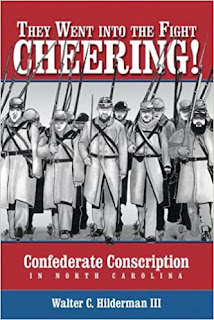
Hilderman: "They Went into the Fight Cheering!: Confederate Conscription in North Carolina"

[They Went into the Fight Cheering!: Confederate Conscription in North Carolina by Walter Hilderman III (Parkway Publishers, 2005) Softcover, 3 maps, illustrations, notes, appendices, bibliography. Pages total/main: 290/224. ISBN:1-933251-25-5 $24.95]

Book length studies of Confederate conscription at any level are rare, and this well-documented manuscript by Walter Hilderman is a welcome contribution to the literature. Readers will likely find that North Carolina's often sharp geographic, economic, and political divisions contribute to a particularly interesting examination of the subject.

Hilderman writes well and makes use of a mix of primary and secondary sources. Three correspondence collections in particular showcase well the experiences of soldiers responsible for enforcing the conscript laws in the state. However, while the text's reproduction in full of so many of these reports and letters can be helpful, there were many instances in which pertinent excerpts would have served just as well, if not better. Footnotes and endnotes are present, with the sources and explanatory notes the author feels most interesting to readers chosen for placement at the bottom of the page.

They Went into the Fight Cheering! gives readers a good sense of the realities of enforcing conscription laws amongst a populace with a highly varying degree of support of the Confederacy. A satisfactory amount of organizational and bureaucratic detail is provided in the text without becoming cumbersome. Difficulties are highlighted, both internal and external. Some regions in the state (particularly the western counties) harbored large, increasingly organized bands of deserters and conscription resisters. The Confederate military also exacerbated Conscription Bureau problems by allowing the army to directly recruit replacements, bypassing conscript camps of instruction and creating a bureaucratic mess. In fact, the battle over military vs. civilian control of conscription (and their contrasting degree of regard for individual civil rights) lasted until the end of the war and iss a common theme of Hilderman's study. While the author notes that the North Carolina conscription apparatus run by Peter Mallett was exceptionally effective, he does not provide the comparative data from other states that would backup his claim. Detailed data for counties or congressional districts [the typical bureaucratic boundary] are similarly beyond the study's scope.

They Went into the Fight Cheering!
also serves as a reasonably detailed unit history of the military organizations* (primarily Mallet's Battalion) responsible for Conscription Bureau duties such as enrollment and camp administration and security. As the war dragged on, these companies were frequently drawn into combat duty, notably during the 1863 Kinston/Goldsboro raid.

Hilderman's study is probably not the last word on conscription in North Carolina, but it is a fine comprehensive introduction to the program at the state level. Beyond providing insight into the men involved in enforcement, it also yields a useful leadership and organizational assessment.

* - For interested readers, two appendices are included. The first lists officers attached to the Conscription Bureau of the various congressional districts in NC. The second is a unit roster of Hahn's Battalion.

Monday, November 12, 2007

Booknotes (Nov 07)

Regular rundown of book purchases and review copies received:

To Take Charleston: The Civil War on Folly Island by James W. Hagy (Pictorial Histories, 1993). I read this one earlier in the year and just got around to purchasing a copy. It's an interesting illustration-heavy book that's out of print, but a few reasonably priced copies remain on the market.

Lone Star Blue and Gray: Essays on Texas in the Civil War ed. by Ralph A. Wooster (Texas State Historical Association, 1995). This volume collects sixteen previously published journal articles dealing with political, economic, and military aspects of Texas' Civil War.

Blockaders, Refugees, and Contrabands: Civil War on Florida's Gulf Coast, 1861-1865 by George E. Buker (Fire Ant Books / Univ. of Alabama Press, 2004).
A fine study of the Union coastal blockade and disruptive inland operations, in cooperation with the significant Unionist element of Florida's population.

Blood, Tears & Glory by James Bissland (Orange Frazer Press, 2007). This is a textbook style, narrative history of the entire war that focuses on the contributions of Ohio politicians, soldiers, and civilians. However, the role of (mid)westerners in the achievement of ultimate Union victory is so well documented in the literature at this point that there is little reason to maintain that their efforts continue to be overlooked. Issues raised by the needlessly off-putting How Ohioans Won the Civil War subtitle aside, B,T&G appears to follow a familiar path for the seasoned Civil War reader.

Guerrillas, Unionists, and Violence on the Confederate Home Front ed. by Daniel Sutherland (University of Arkansas Press, 1999). This is another great essay compilation from U. of Ark. Press. Well known experts contribute eleven chapters covering an aspect of home front violence in a particular state. Excellent.

Camp Chase and the Evolution of Union Prison Policy by Roger Peckinpaugh (University of Alabama Press, 2007).

Thursday, November 8, 2007

Hess: "Trench Warfare under Grant & Lee: Field Fortifications in the Overland Campaign"

[ Trench Warfare under Grant and Lee: Field Fortifications in the Overland Campaign by Earl J. Hess. (University of North Carolina Press, 2007) Hardcover, 25 maps, photos, drawings, notes, appendix, bibliography. Page total/main: 331/253 ISBN:978-0-8078-3154-0 $39.95]
--------------------
Trench Warfare Under Grant & Lee is the middle volume of Earl Hess' planned trilogy examining the evolution and role of field fortifications in the Civil War's eastern theater. The first book [UNC Press(2005) reviewed here] covered the period 1861-1864, and introduced the interpretive themes1 at the heart of the author's analysis. This second volume, a structurally and thematically seamless continuation of Hess' research, studies the critical 1864 Overland Campaign (to include the battles of the Wilderness, Spotsylvania, Bermuda Hundred, North Anna, and Cold Harbor).

Hess begins with an overview of the engineer officers and units employed by either side during the Overland Campaign. Lee placed Maj. Gen. Martin L. Smith2 in the position of chief engineer, and the Confederates assigned a single battalion, the 1st Confederate Engineers, to the Army of Northern Virginia. On the Union side, Brig. Gen. James C. Duane served as chief engineer of the Army of the Potomac during the campaign. The author's brief service biographies of engineer officers serving under Duane, men like James Morton, Francis Fahrquar, Nathaniel Michler, and Ira Spaulding, introduce readers to these important, yet little celebrated, figures. Those familiar with the Official Military Atlas will undoubtedly recognize Michler, whose artistic cartography graces many of its plates. Hess makes an excellent sidepoint of the danger of relying on these engineer maps in isolation. The placement of even major topographical features often varied widely between maps covering the same area3.

While helpful, prior familiarity with the literature of the Overland Campaign is not required for the reader to grasp the essential point of this study, which basically provides an operational and grand tactical examination of the campaign in the specific context of the expanding role of field fortifications. Pursuant to this aim, the planning and deployment of engineering assets are given special attention in the narrative. Although Hess relies heavily, both descriptively and analytically, upon Gordon Rhea's multi-volume military history of the campaign for background information, the central ideas of Trench Warfare are drawn from the author's mass of original research and personal surveys of the earthwork remains on the various battlefields.

Detailed cartography is an essential element of a study of this type, and the effort put forth by author and publisher in this regard is first rate. Maps trace existing earthworks, and note salient features such as gun emplacements, traverses, ditches, rifle pits, communicating trenches, and bombproofs. Relevant battlefield topography, such as ravines, are also duly noted. Many of these drawings are placed within a lengthy appendix that also discusses field fortification design and construction. My only quibble is with the lack of a distance scale and more thorough orientation aids for those readers that would like to visit the sites.

While detailed tactical discussions are beyond the scope of the series, Hess makes note of the unique problems associated with attacking fortified positions. Simply passing over friendly trenches would often disrupt formations. Linear formations fractured while passing through obstructions and lacked the ability to exploit breakthroughs, while the alternative use of columns of regiments, brigades, or divisions led to the dilemma of where to place the supports. Units in close support often only added to the confusion (and casualty lists) as these formations quickly intermixed with the lead regiments. Supports placed far to the rear also experienced difficulty in exploiting gains as enemy reserves would reach the front before these friendly supports could be brought forward. Grant is faulted for the constant operational maneuvering of exhausted units in order to find a weak spot in Confederate defenses, and also for the lack of proper reconnaissance before launching assaults. Entire corps (especially II Corps) were ground down, their offensive effectiveness severely crippled by frightening levels of attrition in experienced officers and men. Of course, time spent by Union forces on rest, reorganization, and intelligence gathering only allowed Lee a window he would use to fortify his lines into a state of near impregnability. These problems would never be adequately solved.

Trench Warfare Under Grant & Lee is another well researched, astutely analyzed, and richly illustrated study by Earl Hess. It concludes with the siege-like quality of the overall situation at the front in the aftermath of the failed June 3 assault at Cold Harbor. The extensive network of fortifications constructed during this short period and the first tentative attempts at regular siege approaches were a harbinger of the type of warfare that would be conducted at Petersburg. Unfortunately, for that discussion, we must patiently await the third and final installment of this landmark, scholarly series.
--------------------
Notes:
1 -
As outlined in volume 1, and excerpted from my earlier review: Hess rightly contends that the inclination to construct field fortifications existed in one form or another throughout the entire war. It was a question of degree. He also argues that the progression of trench warfare was intimately tied to commanders’s evolving conceptions of offensive and defensive action. An early war commander planning a tactical offensive generally would not consider entrenching his force as that would indicate a static posture. Similarly, an undecided leader often viewed entrenchments as limiting his tactical options. It is also asserted that the increased killing range of the rifle had far less to do with the average infantryman’s desire to dig in than did the increasingly constant nature of close contact between opposing armies in the second half of the conflict. The author also demonstrates that the nature of the war’s increasing reliance on earthworks was not linear but rather was characterized by fits and starts interspersed with periods of actual regression, where the preceding campaign’s lessons seem to have been forgotten. Perhaps uniquely among historians, Hess places the watershed moment of this evolution of trench warfare in the east at Chancellorsville.

2 - Smith, a division commander at Vicksburg, was a highly experienced officer in the construction of defensive earthworks. While not particularly well-known today, he served Lee exceptionally well during the Overland Campaign.

3 - For example, there is the tendency for no two depictions of a particular road network to agree; even major thoroughfares can be missing or drawn miles apart. Engineers often had to reconnoiter under fire, impairing their ability to construct accurate topographic maps. This reviewer suggests that interested readers examine the maps in the
O.R. Atlas depicting Richmond and Corinth to get a clear idea of the enormity of the contrast between various efforts.